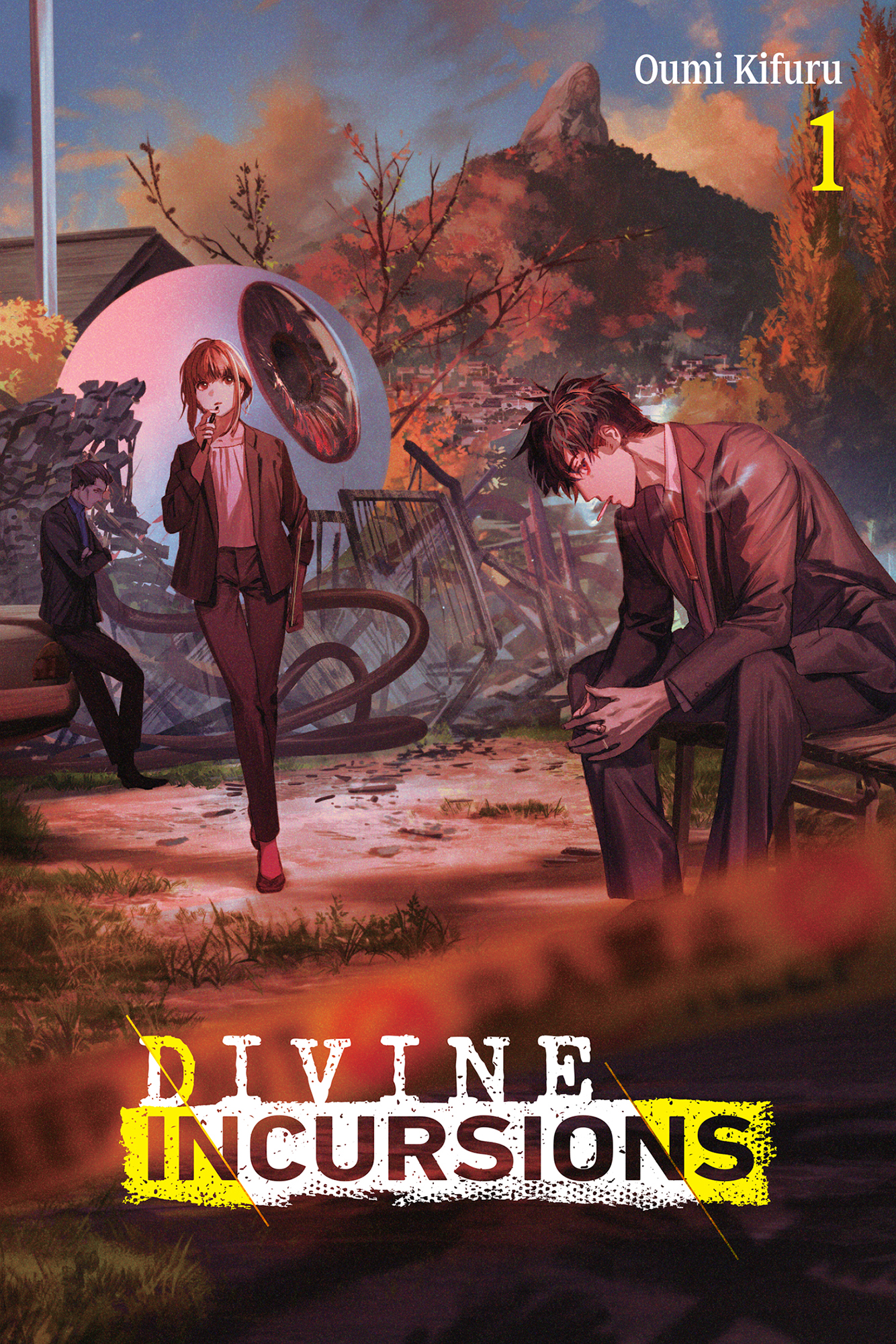
There are strange phenomena in this world that cannot be called good or evil. Enigmas that surpass human knowledge and control. We call these phenomena, and the entities that give rise to them, divine incursions.
The God That Descends in Pieces
Prologue
Oh yes, the shed! That was quite something, wasn’t it?
No, not a typhoon. If a typhoon had done that, this house or the road out there would have been smashed up, too, don’t you think?
There was no construction going on at the time, either. But no need to worry. It wasn’t an accident or vandalism. It’s not like a truck could have rammed into the shed without tearing through the hedges first, and who around here is strong enough to smash wood to smithereens like that? But you’re getting close. In a way, you could say that someone flattened the shed. Well, no, not someone so much as something. It was just that time of year again.
Yes, that’s right. Once per year. No, not some yearly disaster. It’s the date we used to hold our festival on back in the day. Now, don’t get me wrong; no one got worked up by the festivities and deliberately smashed my shed or anything like that. No one around these parts has the energy for that sort of thing nowadays. We don’t hold the festival anymore. But maybe we should. The festival was to thank our village’s god, after all.
A harvest festival? Yes, I guess you could say it’s something like that. It just goes to show, though, what happens when you don’t keep up the tradition. Though I’m not sure how we’re supposed to celebrate a god that does a thing like this…
Oh, the god isn’t around anymore. Well, they say back around the time the first big road was made, the god picked up and hauled itself back to the mountain, claiming there was no need to look out for us anymore.
When it came time to widen the road, there was a lot of stuff in the way—you know, the paddies and the fields and what have you. The shrine, yes, sure. I suppose it was in the way. Not that we were insensitive about it. A priest came and purified everything, good and proper, before the shrine was moved. So I don’t think the god is angry at us, nothing like that.
There used to be a festival once per year when the god would come down from the mountain. Let’s see, it was around when my second child had just started elementary school. We had put up a few little stalls and strung up some lanterns, and the children did Bon dances and carried the palanquin on a procession to the shrine.
There were still lots of children in the village back then, and they wore animal masks of a character from some anime that aired on Fridays and danced along to the theme song—that sort of thing. We were all wearing the traditional happi festival coats, and everyone was whooping it up. Even the teachers from the school, the quietest sticks-in-the-mud, were having fun, like they were completely different people. Things were fun back then. Back when this place was lively.
That night, just as everything was winding down and people were starting to head home, we heard a loud crash from over by the elementary school. It was dark, though, so we figured maybe a truck had hit the school building. Someone could have been hurt, and we had all that leftover adrenaline from the festival in us, so everyone rushed to find the source of the sound.
The mosquitoes were flitting about, and the frogs were singing in the paddies as we held our children by the hand and hurried down the road through the fields. “There, over there,” we shouted as we made our way toward the darkened school building. When we arrived, though, the gate looked just fine. While we were still milling about, trying to figure out what all the noise had been about—like maybe there had been a gas explosion—a shout suddenly came from near the pool. My own kid’s teacher was actually the one who had gone and grabbed the keys from the janitor’s office, but whatever they had seen, it made their knees buckle right out from under them. Of course, we had to go see for ourselves. And when we flipped on the pool lights, bright as day, and went to take a look, there it was.
The water was already drained, and the pool was dry as a bone. Inside it was something that looked like one long pipe, stretching from one end of the twenty-five-meter pool to the other. On the five starting blocks down at the end rested five fat fingers, tipped with curved fingernails, each finger on a separate block. An arm. It was a huge, giant arm. We figured it was some kind of prank and called the police, but after taking a good look, the man who did the autopsies announced that the skin, the muscles, all of it was real. Obviously, there’s no living creature out there so big, but it really was a humongous human arm. Not that the police department was about to file a report. Who were they going to put down as the victim? A man with a twenty-five-meter arm?
Police, hospital, we’re all more or less intertwined in this village. So what else were we gonna do? Everyone got together and carried the arm to the shrine, just like it was another palanquin.
The looks on our faces! Imagine if a truck had passed by just then as we dragged the long pale arm along through the dead of night, grunting and groaning and dripping with sweat. But that was when it all began. Ever since, around this time of year, another huge body part falls somewhere on the village.
Yes, my shed got hit, too. Wham, straight out of the sky. I knew right away. I said to myself, I guess it’s my turn now. It happened to my neighbor, too, you see, about four years ago.
We got an eye. Big, round, and glistening, smack-dab on the shed’s roof, flat as a pea on a plate.
Of course, it only happens the one time per year, and no one’s ever been hurt. What’s that? Why don’t we do something about it? I suppose we would if we could, but what can anyone do really? It’s a god, after all; it’s not like it’s going to hurt anyone. Sure, maybe we could move someplace else, but the only folks left round here these days are the ones who never had any other options in the first place.
I don’t know if it’s up there in the sky or whatever, but you’ve got to wonder. How much of it could even be left at this point?
I
It was a typical sleepy rural scene.
A garden this big would have been unthinkable in the city. Once winter came, the verdant green hedge surrounding the house would probably blossom with camellias. The neighbors didn’t seem to mind if the branches stuck out a little into the road. A brand-new shed, painted sky blue, glittered beneath the sunlight in a corner of the yard.
“My grandson painted it when he came to visit. I even told him it was too flashy for this old house.”
The old woman who owned the house smiled at me softly as she massaged her liver-spotted hands. I responded with what I hoped was a polite smile in turn, though I’m not sure how convincing I was.
“And this is the shed in question?”
The old woman nodded. I pulled out a photo, taken with an instant camera, from my suit pocket. The date was written on the back with a splotchy ballpoint pen; it was exactly one year ago. I turned the photograph around and held it up in front of the sky-blue shed.
It was far from a typical rural scene.
The shed in the photograph had been thoroughly crushed. It looked as if a typhoon had just swept through, except that the wooden garden gate in the background stood untouched. The shed, meanwhile, had been reduced to a splintered heap of plywood, with garden tools, a dented children’s bike, wooden bats, baseball gloves, and other scattered contents tumbling out from within.
The real issue, however, was the single massive eyeball enshrined almost reverently atop the ruined shed. It looked to be around one and a half meters in diameter. The white orb glimmered wetly with a texture like milk jelly, reflecting the morning light at the time the photograph was taken. A slighter, smaller, pale-gray circle sat ensconced within the larger orb, with yet another concentric black circle within that. Looking closer, I could see red veins, like coral, scattered throughout the jelly-white sphere.
“So…an eye?” I asked stupidly.
“It would appear so,” the old woman said with a perfunctory grin.
“And this fell on your shed last year?”
“Yes…”
As I lowered the photograph, the new blue shed slid into view like a projector slide.
“I couldn’t tell you if it was the left eye or the right, I’m afraid…”
“Does it matter?”
I must have sounded irritated, because the old woman reacted by shrinking backward slightly. I’ve never been good at these sorts of interviews. With a sigh, I glanced past the hedge, where I spotted a petite woman dressed in an inoffensive plain black suit just like I was. There was a grin on her face.
“Miyaki, next time, you come along, too.”
I exited the old woman’s yard, leaning my weight against a guardrail that stood along the unpaved road. I lit a cigarette.
“I take that to mean you frightened one of the locals again. I was busy, you know, tracking down information at the village hall. You’re gonna have to get used to interviewing people, Katagishi.”
“Remind me, which one of us is the senior agent?”
Despite having only just transferred into our department, Miyaki had her shit together. Her large round eyes and neatly trimmed bangs may have made her look like a kid, but the section she’d been in before coming to mine was apparently sort of a big deal. As for why she had been transferred into a peculiar department like ours, I wouldn’t have a clue.
“Well? What did you manage to learn that was so important, you had to leave your poor partner all by himself?”
“Yeah, yeah,” Miyaki said with a grimace, as she pulled out an acrylic file folder from her briefcase. “Apparently, the incidents started in ’97. The first occurrence happened in the pool at Daisan Elementary School, which is located just down the hill from here. The school is abandoned now.”
“Declining birth rates strike again.”
But what could you expect? With a population of less than four thousand, the majority of whom were already senior citizens, this place was the definition of rural depopulation. It seems the main industry here was agriculture, and most of the land was taken up by rice paddies. There wasn’t so much as a convenience store in sight. On top of that, with these unfortunate incidents happening every year, who wouldn’t want to get out of here?
I took the document that Miyaki held out. The image resolution of the newspaper article, which had been copied onto a sheet of paper, was hideously grainy. After squinting, I could just barely make out the edge of a twenty-five-meter pool in the black-and-white photo included in the article. Something that looked like a large pipe crossed through the center of the picture, stretching from one end to the other. It formed a slight crook about halfway along the pool.
“It’s hard to make out. Couldn’t you have at least made a color copy?”
“Not on the taxpayer’s dime. Hey, hey, don’t get your cigarette ash on the documents.”
Still clutching the cigarette between my lips, I held the page up to my face, moving it back and forth, up close and then far away again several times before I finally managed to piece together what I was supposed to be seeing. The pipe split apart into five hose-like appendages, the ends of which were resting on the starting blocks at one end of the pool. Each of those hoses were tapered at the end, capped with something stiff and curved, like dingy oblong kickboards. I frowned. The whole thing looked like some sort of B-tier composite photograph.
“This must be the arm the old lady mentioned earlier.”
“So it would seem,” Miyaki said, rifling through the documents in her file folder. “Apparently, once per year without fail since ’97, a giant body part has fallen somewhere in this village. So far, I’ve been able to confirm a nose, two arms, what looks like a canine tooth, a knee, a forty-meter-long strand of hair that weighed around twenty kilograms, and, oh, the organs. A spleen and a left kidney, supposedly. Hmm…let’s see. Then the eyeball from the house you just visited, of course. The other eye already fell in ’98.”
“Now they’ve got a set.”
“They’re not playing Go Fish.”
Just then, a little car horn beeped twice jauntily, making Miyaki and I lift our heads. A suntanned old man leaned out of the driver’s side of a pickup that was piled high with lumber, smiling and waving his hand. I stiffly spread the corners of my mouth, doing my best to return his smile.
“You two folks down from the city?”
“Yes, we came from Tokyo for a municipal survey,” Miyaki answered in a cheerful voice before I could even open my mouth.
“Is that so? Well, tell your higher-ups to do something to bring some younger tourists out this way!” the old man said, then drove off in his truck, leaving a friendly smile and the putter of his engine behind. There was no indication he had doubted Miyaki’s words.
“You lie like a rug, you know?” I said, half exasperated and half impressed. Miyaki just shrugged.
The only true part of what she had said was that we had come from Tokyo. But it didn’t matter. It wasn’t as if we could go around telling people we were a couple of government agents dispatched all across the country to investigate paranormal incidents that were deemed too serious to ignore. In other words, the kind of stuff that fell outside typical human jurisdiction. Our job wasn’t to solve these issues, though, only to investigate in hopes of finding détente. Not exactly exciting or rewarding work but such is the job of a public servant. To do what the private sector will not.
I took out my portable pocket ashtray, stubbed out my cigarette butt, and started heading back down the hill for the time being in search of more locals to interview.
Winter was approaching. The brittle trees had begun to drop their leaves. Through the gaps, I could see more houses surrounded by more hedge walls; everywhere everything was the same. Beyond the houses, a cracked asphalt road passed through the paddies and fields, unfolding like a burn scar.
“What should we do next? We could try the local museum or the shrine. We’ve barely scratched the surface regarding information about the gods in this area, after all,” Miyaki said.
Her eyes were focused on the mud oozing into her pumps as she walked.
“I already looked into that.”
“Well, you could have mentioned that,” Miyaki said, glancing up at me reproachfully. She had a baby face to begin with, but at times like these, she really could have passed for just a college student.
“We don’t have each other’s personal contact information.”
“This kind of seems like a work matter to me…”
“I know, but we’ve been so busy with other cases that I never had a chance to mention it.”
Before Miyaki could say anything else, I retrieved a folded piece of paper from my suit pocket and unfurled it. It was a copy of a brushstroke illustration I had found in a book of local folk legends that had been sitting in a corner of the village folk museum. It was the kind of niche tome that would probably never leave the shelf unless some very particular college students happened to come sniffing around.
“This was apparently drawn by an artist who lived here, in the tenth year of the Tenpo era.”
Miyaki peered down at the paper in my hands. The image showed yellowing calligraphy paper with rows of overlapping straight lines meant to represent a mountain ridge, as well as a series of dots meant to represent rice paddies. It looked like something even I could scribble. However, a gaunt giant with a bald pate peered out from the shadow of the mountains, a vacant look upon its face.
“The drawing has character. I’ll give it that.”
It was impossible to read any emotion in the giant’s eyes. They were almost caves. The image had been rendered with a flat-slanted brush, showing the perspective of villagers staring up at the giant.
“There were almost no concrete myths remaining. I couldn’t even find a name for the kami—the god. Just that the shintai, the immanent object of worship embodying the god, included both the mountain and the village land as a whole and that the god supposedly watched over the villagers and protected them. Pretty standard stuff.”
“Nothing else?”
“I also found a poem or something written toward the beginning of the Meiji era. I didn’t understand much of it, but it mentioned something about the god leaving during a festival one year because the village was prosperous enough on its own, I think…”
“Hold on, I heard something like that, too. It was a song. Apparently, they used to dance to it during the village festival.”
Suddenly, I stubbed my toe on something that felt a little bigger than a rock. I came to a stop. Looking down, I saw an object made of stone poking out from the dirt, half buried, smooth, and worn like melting ice.
“Who put this here? I nearly broke my neck.”
As soon as I crouched down, I got a terrible feeling. In my experience, touching these sorts of things was bad luck. Either that or they were bad luck whether you touched them or not. All I could make out, etched into the surface of the mud-strewed stone, were the characters for “harvest” and “road.” At first, I thought it must have been some monument or marker of some sort, but it was oddly smooth for a marker, and there was even the suggestion of arms and legs around the edges.
“What’s wrong?” Miyaki asked.
I shook my head. “Nothing.”
We had reached the bottom of the hill at some point, I realized, where silvery-white plumes of pampas grass billowed around us. Out of the corner of my eye, I could see a little gasoline stand tucked away beneath the shadows of the trees, as if buried. Not a single car currently sat underneath the gasoline stand’s red- and orange-striped roof. Even the electronic signboard, where the current price of gas should have been displayed, had been switched off.
“We really are in the middle of nowhere.”
“Believe it or not, this place was being developed not so long ago. A bunch of roads came through, and they even opened up the mountain and excavated a tunnel.”
“Exactly…how long ago?”
“Until around…’97.”
Miyaki and I made eye contact.
“The same time the first arm or whatever it was fell.”
“That sounds like something we should dig into.”
Miyaki tucked her chin in, a serious expression upon her face. It was starting to look like this case was going to be a hassle.
Glancing up, I could see the mountain, black as ink, through the dense, leafless trees. Scanning its surface, I spotted an area, like a thin scratched line, where no trees grew. That must have been the road they had built that went through the mountain. The dreariness of the landscape reminded me of the photo I had seen earlier. It must have been taken at around the same time of year.
“Hey, Miyaki, what day did they hold the festival on?” The pitch of my voice rose slightly.
Miyaki flipped through her notepad, apparently not noticing.
“Well, they’ve stopped celebrating it lately, but…it would have been today.”
Just then, there was a loud boom like a crash of thunder, almost drowning out Miyaki’s voice. I was standing a little ahead of her. Instantly, I was buffeted by a drab gray squall of wind, which pelted my skin with fine gravel. Miyaki and I tried to peer through the cloud of dust as we choked and hacked.
The red and orange roof of the gasoline stand had buckled into a V, like origami paper, a hole now poking through the middle. The gas pump below tilted dangerously to the side, as if ready to snap at any moment. For a moment, I pictured the gasoline inside catching fire and exploding, but we had other things to focus on right now. The bizarre thing that had just crashed through the roof was sitting neatly atop the pile of rubble below.
“What…is that…?”
Pale peach in color and shaped like a plump, semi-ovoid bed sham, it lay draped across the other pump. I could see a round hole inside the complicated wrinkles of its folds. Even the shadows of the downy hairs that poked out from within were visible in stark detail.
It was, in fact, a massive ear.
There are strange phenomena in this world that cannot be classified as good or evil. Enigmas that surpass human knowledge and control. We call these phenomena, and the entities that give rise to them, divine incursions.
II
A small truck-mounted crane was jolting up and down like a bird sipping at water as it snagged the end of the net encasing the giant ear, plucking it up into the air. The flatbed waiting underneath backed into position as the springy ear flopped down onto the cushioning material that’d been laid out in advance.
“Seems like they know what they’re doing.”
As Miyaki and I stood to the side, smiling uncomfortably and covered in dust, I caught sight of a man in his late middle age stepping over some of the yellow and black barricade tape surrounding the scene as he hurried our way.
“That must have been a shock for you… This sort of thing happens sometimes. I mean, not that it’s normal or anything, but well, it’s hard to explain to folks who aren’t from around here…”
The way he wiped the sweat from his forehead and the vinyl jacket he wore over his suit made him look like a site crew worker, but he was probably just an area official. I detected a hint of panic behind his smile as he stared into our faces warily. But something in his expression was also cold and pushy, as if he was trying to figure out how best to get us to keep our mouths shut.
“You don’t need to worry. We’ve dealt with stuff like this before,” I reassured him.
I must have taken the man by surprise, because the forced smile slipped from his face.
“Dealt with stuff like…ears and eyes falling from the sky?”
“No, not exactly. But we’re used to the kind of situations that are—what did you say?—difficult to explain to outsiders. That’s why we’re here to investigate.”
The man was clearly relieved. A feeling of complicity passed between us. Miyaki whispered into my ear.
“Katagishi, phrasing.”
“What should I have told him? That we just came from another village where every year, at the end of Obon, the well water transforms into amniotic fluid?” I responded to her in a low voice.
Miyaki jabbed me lightly in the side with her pointy elbow.
I got into the passenger seat of the man’s compact car, while Miyaki slid into the back seat. We were apparently on our way to stow the strange fallen object somewhere. As I watched silver plumes of pampas grass whip past the car window, I could see the face of the truck driver behind us in the sideview mirror. The giant ear had been loaded into the bed of his truck. I tore my gaze free, trying to find something to talk about.
“From what the villagers told me, all the parts that fall are brought to the shrine as dedications. Is that still true?” I asked.
“The shrine ran out of room a while ago, so now we just store them in the abandoned elementary school. It’s like a warehouse. Each piece is pretty big, after all. Plus, we can lock the classrooms afterward, and the curtains keep anyone from peeking inside. It does the job for now, I suppose.”
The man took one hand off the wheel and rubbed his greasy cheek.
In the rearview mirror, I could see Miyaki in the back seat furiously scribbling down notes in her notepad. The dry air from the car’s heater was robbing me of moisture, so I cracked the window slightly without asking for permission. A cool stream of fresh air blew in, along with the charred smell of rice straw being burned out in the fields.
As the tires bobbed along the uneven road, causing the vehicle to jostle up and down, I spotted several pieces of stone—just like the one I had discovered by the side of the road in front of the gasoline stand—gathered together in one spot. The stones were caked in mud, making it impossible to discern any of the characters inscribed on their surface, though these stones were a little larger than the one I had encountered earlier. In addition to the carved arms and legs, I could also make out lines suggesting the shape of a face on what looked like their rounded heads.
“What are those stone pieces? I saw one a little earlier as well.”
“Oh, those.”
The man pressed hard on the gas, and the car’s tires threw mud from deep ruts in the road as the vehicle picked up speed again.
“They’re like our village’s guardian kami, I guess you could say, or dousoji, gods of roads and travelers. They were erected all around the village a long time ago along the sides of the road as a way to show that whatever happens, good or bad, the gods are always watching.”
“But they’ve all been broken now, right?” Miyaki asked, poking her nose in from the back seat.
“Yes, they are… This area was being developed a long time ago, and the town had to build a bunch of roads for the trucks or whatever that were supposed to come through the tunnel up through the mountain. Awful as it sounds, the more roads that were built, the more grant money there was to be had, so the village decided to move the statues out of the way for a little while. No one was heartless about it, mind you. A priest came and purified everything, good and proper, before the statues were moved.”
“We’re here.”
The man turned on his blinker and brought the car to a stop beside the school gates. The abandoned school building towered against the blue sky. We followed the man out of the car. Shivering in the chilly air, I glanced up at the sky. The school was visible through the links of the rusty exterior fence, its stopped clock and forlorn basketball hoops remaining just as they had once been.
The man removed the double-looped chain and padlock, then opened the gate. The long bed truck that had followed behind us pulled into the school grounds, kicking up dust as it passed us.
In the early afternoon light, the abandoned school building was streaked with rain marks and covered in ivy. The air-conditioning condenser units and the flowerpots sitting atop them were so decayed, they looked as if they might crumble with the poke of a finger.
“What do you think?” I asked Miyaki, keeping my voice low so that the man walking ahead of us wouldn’t hear.
“I think it’s probably not great that those stone statues around the village have all been destroyed.”
“You can say that again.”
The man stopped in front of a sepia-tinged sliding glass door that was coated with dust. As he opened the door leading into the school, the musky air inside wafted out and hit us like a punch to the face.
“We’ll take it from here, if you don’t mind. You two Tokyo folks can look around inside while you wait…,” the man said after showing us in. He bowed several times at the waist before departing. We heard him flick a switch somewhere. The entrance hall of the otherwise-gloomy school was suddenly bathed in light.
“Might as well check it out,” I said, removing my penlight from my breast pocket as we proceeded down the hallway.
The hallway was long, murky, and thick with the choking stench of dust and mold. The only sound as we ascended the stairs at the end of the hallway was the squeaking of our shoe soles.
As we reached the second floor, the glow from my penlight bounced off a silver emergency door to our immediate left, throwing back a distorted reflection of our own faces. Panning the light the other way, I saw motes of dust dancing in the darkness and then a placard reading CLASS 2-1. I directed the light farther down, but all that could be seen through the glass window of the closed classroom door was fathomless black darkness.
“Miyaki, do you see a light switch anywhere?”
“Hold on a second. Maybe it’s around here.”
I could tell Miyaki was groping along the wall behind me. There was a click, and then light suddenly filled the space. I began to lower my penlight, then nearly shouted out loud.
It wasn’t darkness that I had seen through the small glass window in the door. An incredible mass of hair filled the room. The long, black, coiled fibers were pressed up against the window, leaving white streaks of sebaceous grease on the glass. I heard Miyaki gasp softly.
“A job is a job. Let’s keep going,” I said.
I adjusted my grip on the light, which was now damp with sweat from my hand, and proceeded farther down the hall.
The next room was Class 2-2. The wall opposite the classroom was puffy and warped from water damage, causing the rusted thumbtacks and printed notices stuck to the wall to jut outward. Peering through the small window, I could see a pale, protruding expanse that resembled a gently rolling mountain ridge. The surface of the bumps and valleys was finely textured with a pattern like woven hemp. It was an enlarged patch of skin, I realized.
“I think I’m starting to lose my mind in here,” I remarked.
“I don’t know, you look fine to me.”
“With all this weird stuff, maybe I’m just not sure how to respond anymore.”
“I suggest sticking with shocked and amazed,” Miyaki said, coming to stand by my side. Her voice sounded grim. “We don’t have to look in all the rooms, do we?”
“We are here to investigate. Not that looking will tell us much.”
We approached Class 2-3 next. As I flashed my light into the small window, I saw some sort of orb gleaming in the center of the room, chairs and desks lined up in front of it like a barricade. It was an eyeball. The creaking of the school building made it seem as if someone was sneaking up on us, and I couldn’t shake the feeling that we were being watched. This was not the kind of place a person ought to loiter in for too long.
“You know, I bet the guardian deity for this area was split up into pieces when the stone idols were broken and scattered back when they were developing the land. That must be the cause of all this.”
“Maybe. Or it might be because the land itself was split up by the roads. It’s hard to say.”
Miyaki and I quickened our pace once again.
“The thing I don’t get is this god is supposed to reside up in the mountain, right? So why do the body parts fall out of the sky? Why don’t they come down from the mountain instead?”
“Well…hmm…,” I said, trying to figure out how to answer.
Before I got the chance, however, everything suddenly began to shake up and down violently. The school building screeched like it was in pain, and dust and flecks of paint rained from the ceiling.
“An earthquake?!”
“Let’s get the heck out of here!”
Miyaki and I ran back the way we came. The floor shuddered beneath our feet, threatening to send us sprawling.
As we raced past Class 2-3, something thudded against the wall. The glass shattered, and I heard a squelching sound, like some sort of living creature trying to force its way through a space that was far too small for it. I glanced toward the window and immediately regretted it. The eyeball, which had been in the middle of the classroom earlier, was now pressed up against the small window. Bleeding from where it was forcing itself through the glass, it rotated, fixing me with its pale gray and murky black pupil.
There was another crash, this time from behind us. The glass in the classroom door at the end of the hallway rattled in its frame, and an even larger eyeball than the first began desperately attempting to break through the window. The two eyes, shut away in their separate rooms, spun about, trying to make contact with each other.
“Katagishi, what’s happening…?!”
“Who cares? Just run!”
I grabbed Miyaki by the arm and raced down the hallway without looking back, hurrying down the stairway as quickly as I could.
The moment we reached the first floor, all the violent heaving and shaking stopped as abruptly as if a switch had been flipped. Ignoring the trembling in our knees, which felt like cooked spaghetti after all that shaking, we bolted free from the school building, sweating and out of breath. The older man from earlier glanced up at us as if we were acting strange.
“What’s wrong? No need to rush like that. I was about to give a shout, though… You two were in there for quite a while.”
The man’s polite smile and the chilliness of the air robbed the warmth from the trails of sweat that trickled along my back. The patches of sky brimming through the rusty links of the fence had now changed to an evening red.
“Were we really in there that long?” Miyaki asked, wiping sweat from her jaw.
“Being in that place probably messes with your senses…,” I said eventually, trying to sound tough. I glared at the school building. “Whatever is going on here, though…those parts in there are moving.”
But my voice had come out thin and raspy instead.
“What do you think happened back there? Do you think the god is trying to put all its body parts together?” Miyaki asked.
I recalled the drawing I had seen earlier.
“That could be a part of it, but I don’t think that’s its main objective. Remember what we were talking about earlier? About the shintai.” I scuffed the tip of my shoe against the schoolyard’s ground, which was still painted with old white lines. “According to the documents we found, the object of worship was the mountain and land itself. Meaning that the god’s true body is the land. If this all started when the stones were scattered, then returning them to their original places to at least prevent any more parts from falling would probably be a good idea… I’m not sure we’d want to see what would happen once all the body parts piece themselves together.
“What would happen?”
“This is just my conjecture, but I think those massive parts will start moving as one, trying to make their way back to the earth. And if that happens, there probably won’t be much of the village left once they’re through.”
The mountain towered like a shadow puppet overhead, seeming to reach for the deep-crimson foot of the sky.
III
Miyaki and I were asked to come to the village community center, which was located on a slightly elevated plot along the mountain road. The cotton stuffing in the floor cushions was so thin, we could feel the texture of the tatami mats underneath. Across from us sat an elderly man, the mayor of this village, as well as a middle-aged woman, his secretary.
“In a nutshell…”
Miyaki glanced up at me worriedly as I kicked off the conversation. I knew I had a habit of putting my foot in it during these discussions, but there wasn’t very much I could do about that.
“There may be more in store than just eyes and ears falling from the sky. I believe these incidents are a sign that the mountain is attempting to return itself to the earth.”
The secretary was the first to speak.
“And that would mean…?” she said.
“This is all just my conjecture, but considering the size of the parts, if everything was to move at the same time, the damage would probably be a lot more severe than a few sheds or gas stands.”
“No one is saying this will happen immediately, of course. This is just what might happen if enough of the shintai are allowed to gather and mobilize…,” Miyaki said with a mollifying wave of her hands.
The community center must have doubled as an after-school study space as well, because one of the walls was plastered with sheets of calligraphy paper bearing delusional practice phrases such as our taxes, our community or a bright future awaits.
“What is it you think we should do, then?” the mayor asked, rubbing his chin in consternation. The phrase our taxes bracketed his shoulders.
“Well, for starters, you should probably consign the parts that have fallen back to the earth. Also, address the stone statues lying broken by the sides of the roads. You should remake them and return them to their original positions. Scattering them like that is likely what caused the kami’s body to split as well. You may not be able to get rid of the roads that are already here, but this should work as a stopgap measure. The only thing we as humans can do, after all, is to act with intention and demonstrate our sincerity.”
After a moment’s silence, the secretary spoke up timidly, an apologetic smile on her face.
“As for the statues, that shouldn’t be a problem anymore…”
“Excuse me?” I said, my voice unintentionally low.
Miyaki nudged me in the side.
“It occurred to us, too, that scattering those statues might have been a bad idea. First, the arm fell, and then the year after that, an eye, so people naturally started saying we must have made the god angry…”
The mayor continued, picking up where the secretary left off.
“We held a memorial service at the shrine for the broken statues, and we created new ones where the original statues used to stand. The majority of the broken ones were removed and are in an area that’s a little more bustling these days, over on the other side of the mountain. Some were so old that we couldn’t pull them out of the dirt, though, so we left those where they were.”
Miyaki and I were at a loss for words.
We made our way outside. Light was seeping from the community center behind us. The wind, which carried with it the scent of dead leaves and the smells of life from the village down the mountain road, was extremely chilly.
“See, there’s one now.”
The secretary rubbed her arms over her thin suit as if she was cold, then pointed toward an out-of-the-way spot toward the back of the community-center parking lot. A stone statue was sitting there, lost among the camellia trees. Its smooth outline was not that different from the older statues we had already seen, but its limbs and facial features were clearly defined. I crouched down and brushed my fingers along the surface. Feeling some ridges, I looked closer. The words NOVEMBER 3, ’99 had been chiseled into the stone.
“Isn’t this good enough?” the woman asked.
Miyaki seemed unconvinced. I could feel her eyes boring a hole into my back. I stood up, brushing the dirt from my knees.
“We’ll have to get back to you on this matter,” I answered uncomfortably. A fitting response for a civil servant, if you ask me.
“Now what do we do, Katagishi?” Miyaki muttered from behind me as we made our way down the sloping road that led toward our lodgings, having refused the mayor’s offer to give us a ride. The road was devoid of streetlights.
“Do? What else is left to do now other than to bury each of the body parts? We were only sent here in the first place because one of the young people who left the village mentioned something strange was going on. It’s a low-urgency case.”
The road was empty except for scattered pebbles. I felt like I was staring at the surface of the moon.
“Maybe the real problem was splintering up the area with roads. Like you said, though, it’s probably too late to remove them now.”
“Probably.”
“Do you think it’s still upset even though they built new statues? The god?”
“Who’s to say?”
“Could you take this a little more seriously, please? Have you even heard a word out of my mouth?”
I felt like we were missing something. One of the pebbles that Miyaki kicked down the road ricocheted past me, hitting a stone idol by the side of the road.
“That’s bad luck, you know,” I warned. Miyaki chuckled. “By the way, how much of the shintai do they have so far? There’s both eyes, the arms…”
I suddenly remembered what the old woman, the one whose shed had been destroyed, had said to me. She was right. We didn’t know if they were right or left eyes, did we?
I pictured the two eyes that had nearly burst through the classroom doors. The pupil on one of the eyes was a good size or two larger than the other. Could two eyes from one body really be that different? I came to a stop, glancing back over my shoulder.
“Miyaki, the arms. Have the right and left arm both fallen?”
“Hold on, give me a second.”
Miyaki began rifling through her briefcase in the dark. I stepped closer and shone my light inside. Miyaki flipped through the pages of the file folder she pulled out, one by one, before finally muttering with a sigh.
“Of course…”
“Let me see.”
I snatched the folder from Miyaki’s hands and searched for the pages in question. One was the arm that had fallen into the pool, while the other looked as if it had been tossed willy-nilly into the middle of a road, completely bisecting an intersection. Gripping my light between my teeth, I held both pages up to get a better look, but the photo of the arm in the intersection only showed from the crook of the elbow to the wrist. The fingers were hidden by a broken stoplight.
“That’s just great…,” I grumbled, then yanked the light from my mouth. “Miyaki, we’re going to have to go back to the school.”
“Tell me you’re joking.”
Miyaki looked deeply and profoundly displeased. I clapped her on the shoulder and then began rushing down the hill.
I had managed to sneak a peek at the combination to the padlock earlier. The iron gate creaked open loudly. Miyaki sounded distressed as I slipped inside.
“We shouldn’t be doing this. Public servants aren’t supposed to trespass.”
“Relax. No one is supposed to trespass!” I reassured her.
“How is that supposed to make me feel better?”
I held the light in one hand as we tiptoed through the schoolyard, past the old painted white lines still visible on the ground. Glancing up, we saw the unlit school building towering overhead, and it seemed to melt into the surrounding darkness. I quickened my pace as I pointed the light toward the abandoned school building—now either a mass gravesite or the coffin of a dismembered god.
“Now, if I were two giant arms, where would I be…?” I muttered to myself. Miyaki responded from behind me.
“I’m not sure. But the arms are each twenty-five meters long. I doubt they’d be able to store them in a classroom unless they knocked down some walls.”
A night breeze suddenly wafted past, causing something shaped like a distorted dome just beyond the school courtyard to sway in the dark. I moved the beam of light in that direction. A long covering that I had mistaken for a wall at first fluttered in the wind. Bumps and protrusions were visible on the surface, as if something was pressing against it from within. It was a pool cover. There was also a stand-alone wall fitted with rows of showerheads standing nearby.
“That’s the pool. Let’s go.”
The air grew more unforgiving, chilly like cold metal. The fence around the pool was already teetering to the side. I pushed on a section, and it gave way easily, opening into a path that led to a basin where children rinsed off before getting into the pool.
“Don’t come complaining if a guard finds you, Katagishi.”
“Me? You’re an accomplice now, too, you know. You don’t have to come any farther, though. Just hold this for me.”
I pressed the penlight into Miyaki’s hand and made my way toward the pool.
The showers, white with limescale, glowed faintly beneath the light of the moon. The kickboards that had been left scattered about were rife with mold. Out of the corner of my eye, I spotted a loose end of the pool cover sheet, which was fluttering madly like a living creature. I hurriedly approached the edge.
The sheet, which covered the twenty-five-meter pool from one end to the other, rose up in the middle to form two humps, giving the neat impression of a pair of elbows lined up side by side.
I quickly made my way toward the starting blocks, while Miyaki pointed the light at the ground beneath my feet. I began undoing the yellow and black rope that bound the sheet to the base of one of the blocks. It was no easy task. My hands were numb from the cold, and the rope had grown stiff from long years of rain and wind exposure. I lost my grip as I pulled, my hand colliding with something hard underneath the sheet. It felt like a thin metal plate. I assumed it was a fingernail.
I managed to pry apart the knot at last, then held tight to the loose end of the sheet. Before I could peel the sheet back, however, a strong gust of wind did the job for me. The dry base of the pool was visible beneath the dim light. There it was, right down the middle. I reflexively tried to look away, but ten column-like fingers, lined up just beneath the starting blocks, caught my eye.
“Miyaki, can you see it from where you are?”
There was no answer at first. Instead, the light shook erratically, as if Miyaki was trembling.
“They’re both right arms.”
Two giant arms were stretched along the length of the pool. The palms were facing the sides of the pool, both thumbs sticking up. The positions of the overlapping fingers matched.
“There wasn’t any mention of this guardian deity having three arms, was there…?” Miyaki said, her voice quivering.
“The two eyeballs we saw in the school building were different sizes as well. And that drawing of the god we found didn’t depict any hair…”
The head of the giant we had seen on the yellowing piece of paper had been drawn with a single clean stroke, completely bald. I recalled the great mass of tangled black hair stored away in one of the classrooms.
“Then whose hair did we see? And more importantly, if it’s not the god falling on this village every year…”
“I don’t know…”
The villagers had erected new stone statues around the village to honor the god again, worrying that they had angered it by clearing the mountain and the land. But was it really the original god that looked down upon the village and their new idols?
“It’s possible that the deity has changed in some way…but there could also be something else entirely that is just pretending to be the original deity of this land…”
One of the fingers on one of the arms in the pool, the one closest to me, twitched slightly. Moved by the wind? However, no sooner had I formed the thought than the wrist, with its protruding bluish-purple vein, began to stretch and rotate slowly. I heard Miyaki’s shoes scuff the ground as she scrambled back. With a slithering, crawling sound, the arm turned so that its palm was now facing my direction. Three of the fingers, along with the thumb, curled inward, while the remaining index finger pointed stiffly toward the sky. The universal sign for shh.
The next morning, the rice paddies and the tree leaves sparkled brilliantly, not a speck of the world out of place. After the events of the previous night, we had placed the pool cover back in its original position and left the school with our tails tucked between our legs. We returned to the lodgings the village had provided for us, acting as if we hadn’t seen a thing. Currently, we were staring at the peaceful village scenery from within the safe confines of our car. Heavy machinery, such as bulldozers and cranes, cut across the fat road carved into the land. I hadn’t gotten a wink of sleep. The glare coming off the paint of the vehicles stung my eyes.
“What did you tell them in the end? That they should just bury the things?” Miyaki asked from the passenger seat, rubbing her eyes. I nodded, my upper body slumped over the steering wheel.
“Yep. I didn’t mention anything about another god or anything like that. Just that they should go ahead and consign the body parts back to the earth, maybe in an area of the mountain that hasn’t been developed yet. It doesn’t matter—wherever possible.”
“I guess there isn’t much else they can try.”
“That’s how things go in our department. We may deal with unusual situations, but at the end of the day, it’s pretty standard bureaucratic stuff. When it comes to divine incursions, you should genuinely assume we won’t be able to fix anything. Just consider it a win if we manage to avoid the worst.”
Miyaki seemed dejected. I tossed her a can of coffee that I had bought from a vending machine. She smiled slightly and lowered her head.
“What do you think will happen after they bury the parts…?”
“Who’s to say? But if the real guardian deity is still alive, it will hopefully defeat whatever bizarre, terrible creature has invaded its soil. For the village’s sake.”
The old man who had passed us the other day leaned out of the driver’s seat of his truck and waved. I replied with a quick beep of my horn. Exhaust fumes diffused the glaring sunlight, meandering upward toward the mountain ridge, which towered beyond.
“We can only pray.”
After all, what else can humans do against gods?
The God That Ate Men
Prologue
My grandmother was an awful, awful person.
At the funeral, everybody went on and on about what a wonderful lady she was. How there wasn’t a soul like her. But I knew the truth.
Not a single honest word had come from that old woman’s mouth. My dad left just before I was born, and my mom had to work around the clock, so my grandma had looked after me. Everyone around me always said what a kind person she was, so when I was little, I believed it. The truth was she had always wanted a son of her own but had only ever given birth to girls. Really, she just wanted me as her own. And the way she spoiled me was abnormal. She was seriously terrible.
Of course, even she scolded me a few times as a kid. When I was young, people in the village, not just my family, liked to scare little boys and girls by telling them, “If you’re naughty, the god who ate men will come and take you away.” Which was fine. People say stuff like that everywhere.
But whenever I heard that, I couldn’t help wondering, why is it the god that ate men and not the god that eats men? Around the time I turned ten or so, I decided to ask my grandmother.
Here is what my grandmother told me. She said, “Once long ago, the god that ate men was a terrifying and wicked god that would grant wishes, but when the wish came true, the god would eat a person in exchange. Then one day, a miko—a shrine maiden—from the village offered herself up as the sacrifice, but as her wish, she asked that the godnever eat another villager again. After that day, the god became a good god, one that protects and watches over the village.” That old woman lied through her teeth.
I nearly died one day. After starting middle school. I was walking in front of a gasoline stand on my way home from school, when a truck that just filled up turned as it hit the road and sent me flying. I don’t remember it hurting at the time or even being scared. All I remember is the truck’s cargo skidding toward me like a landslide.
From what I was told afterward, the accident was pretty bad. The doctors had to frantically shove my insides back into my stomach. Supposedly, when the doctor emerged from the intensive care unit with his face pale, he told my mom to begin preparing for the worst. But when he said that, my grandma stood up from her chair and declared that she would “figure something out.” Looking back now, it probably would have been better if I had just died.
I must have been in a coma, I think, and dreaming. I didn’t see the Sanzu River—the river of the dead—like they say you’re supposed to, or any field of lilies. Instead, I saw a gloomy mountain road and a pair of emaciated, wrinkled, and bruised legs that were not mine. And each time those legs took another step, the scene advanced, and the darkness grew deeper. At one point, I remember seeing the sky as if through a high-exposure filter, with withered branches spreading like capillary vessels across the night.
When my gaze returned to the ground, a strange creature was standing there. It had horns like a deer, but it looked more like a dried-up cluster of straw than a living creature. It resembled the rush mats or old-fashioned straw winter clothing that hung as decorations in the village community center.
It had no eyes, nose, or ears. Its straw-like fur puffed up in the middle, fluttering insistently. Where the fur parted, I saw what looked like a faintly see-through red tube—a plastic bag, maybe. I think they were internal organs. Though it had no mouth.
My perspective dipped at that point, and all I could see was gravel, dead leaves, and the wet ground. I think I must have been kneeling or prostrating myself before the thing. That was when the dream ended.
When I woke up, my grandmother was at my bedside, and she was assuring me I would be fine. The anesthesia was still working, and I didn’t feel any pain, but I remember feeling empty inside. At the time, I thought it was because I had been on IV fluids for so long and because my organs were shredded up.
For a while, nothing else happened. I made it into college and left the village.
I returned to visit the village every now and again, but at some point, a thin animal trail that hadn’t been there before had formed, leading through the woods and up into the mountain. When night fell, I would often spot human figures making their way toward the trail, trying not to be seen.
I went back to the village again just recently for my grandmother’s funeral. Well, no, not really for her funeral. I’d rushed home in a panic because I’d been told something terrible had happened. When I arrived at the hospital, a police officer was there. “We don’t think a crime has taken place, not exactly…” That was the first thing they said when they saw me. I wondered what was going on as they led me to my mother and the doctor who had just performed the autopsy, who had bewildered looks upon their faces.
As it turned out, my dead grandmother’s abdomen had been as bare as a cupboard inside. The doctor said it looked like some sort of animal had rooted out the organs and devoured them. Nothing had shown up in any of her tests while she was still alive, and during her operation for colon cancer back when she was eighty, her insides had been right where they should have been. The only possible explanation seemed to be that some animal had been allowed to gorge on her guts after she passed, only for someone to sew her back up afterward, good as new, without even a scar. But obviously, there was no way that my mother, who had been looking after her, would have been capable of such a thing. Nor would there have been any reason for her to do that in the first place.
We carried on with the funeral and cremation, my grandmother’s missing organs still a mystery.
After returning home and divvying up her keepsakes, I was left with a notebook. Not that I wanted it. Apparently, my grandmother had kept a diary. My mom had no idea what was written inside, but it had my name on it, so now it was mine.
“Your grandmother went a little funny in her later years,” my mom said, by way of apology, when she handed it to me. Opening the cover, I saw my name on the very first page, written in brush-tip calligraphy. When I turned to the next page, it was covered with a maze of undulating loops and curved lines written in red pencil, like a child might doodle.
“You must have drawn stuff like that when you were a kid,” my mom said, laughing, but that wasn’t it. I knew. It was that monster’s innards.
That was when it started. Now, when people die in the village, though they were hale and whole while still alive, dissection reveals that they are bare inside, their guts and organs completely missing.
I
The cramped interior of the vehicle was filled with the aroma of coffee.
Sitting in the passenger seat, Miyaki stared down at the sweet bean paste spilling out from the stomach of the taiyaki, a fish-shaped griddle cake, that she had just split in half. She cried out in disappointment.
“This is smooth bean paste,” she complained.
“So? It’s the same, isn’t it?”
“Not at all. I wanted chunky.”
She sounded annoyed. She wiped the bean paste off her fingers with a wet tissue and then bit into her taiyaki with resignation. Through the car windshield, which had grown foggy from the car’s heater, I could see a train station. It was wooden—a rarity these days. There was also a small stall next to it. I glanced at the stall keeper, who was flipping hot metal taiyaki molds amid the steam. Our eyes met, and she bowed. There was a tear-shaped mole beneath her eye, which made her look tragic even when she smiled. For a moment, I was reminded of something from my past. I turned away.
When dealing with divine incursions, the most important thing was to never leave one’s flanks exposed. If someone held on to weakness, agitation, and past scars while doing this kind of work, there were things that had a way of slipping into those gaps. I shook my head and took another sip of coffee.
“Instead of a food stall with no customers, they could have assigned at least one attendant to the station,” I complained.
“What’s wrong with a food stall? I like when there’s little distractions like this.”
“We’re not here to have fun. The request came via a tip from the village doctor. People usually try to keep this kind of stuff under wraps. The fact that he came to us suggests this case is going to be even more trouble than the last one.”
There was no way to tell from the outside whether a taiyaki had smooth or chunky bean paste inside. But what if its puffy dough stomach was empty instead? Because that was what we were dealing with this time.
The two-story clinic sat with its back up against the thick and gloomy woods, surrounded by a smoky green haze. Glancing up at the walls of the building, which were streaked with dirty rain marks, I could see a white sheet on a laundry pole up on the roof that was encircled by a rusty fence. The fluttering sheet would probably look like a ghost once night fell.
The spaces in the parking lot were barely marked. I brought our van to a stop, and Miyaki and I disembarked.
“Based on what we’ve been told, there’s something in these woods known as the god that ate men,” Miyaki muttered, staring toward the foot of the gloomy mountain, which was swathed in a mantle of dark-green leaves.
“I wonder why it’s not called the god that eats men.”
“According to legend, it was once an evil god that could grant wishes but would snatch people away and eat them once the wishes came true. However, one day, a shrine maiden offered herself up as a sacrifice, and the god had a change of heart and became good instead. Or so the story goes.”
“If the god was so good, I doubt we would have been called in.”
Even as I said it, though, I knew that wasn’t necessarily true. Our job would have been a lot simpler if these things could have been sorted into neat categories like good or evil. If divine incursions were just malevolent creatures, maybe we could have stamped them out and washed our hands of the matter. But there was no telling what the consequences might be if one went around heedlessly destroying what no human meterstick could measure. A fact that I had experienced for myself more than once.
The glass door of the clinic was yellow like iodine, and it bore the establishment’s name etched in white. The door swung open, and a middle-aged man with a white doctor’s coat hanging from his shoulders ushered us inside. The place was quiet, as it was closed for lunch. The fluorescent lights reflecting off the lobby’s linoleum floor left the hallway as dark as a cave. A nurse was arranging charts and prescriptions at the reception counter in clear view, causing Miyaki to grimace. Before long, this lobby, which had a green pay phone and a vending machine that sold juice in paper cartons, would likely transform into a corral for the elderly.
We made our way deeper into the clinic, where the characteristic carefree magnanimity and sloppiness of the countryside was on full display. At the doctor’s urging, we entered one of the examination rooms toward the back.
The doctor closed the sliding door behind us and offered steel stools for us to sit upon. The stool had no backrest and almost no cushion. I felt like a patient as I took a seat, facing the doctor.
“Honestly, I shouldn’t be showing you this. It’s private patient information. But under the circumstances…”
The doctor pulled out a thick file from the cabinet, a bundle of papers bulging out from within, and placed it on the desk.
“These are the medical records of someone who passed away here.”
“Allow me to take a look.”
I opened the file. Several pages of yellow ruled notepaper were stapled together inside. I wasn’t even sure what language the words, scrawled in ballpoint pen, were supposed to be in. They must have been medical terminology. I tilted the file at an angle so that Miyaki could see as well, but she looked as bewildered as I was. There was a note in a corner of one of the pages that I thought might be in German.
“I’m sorry, what are we…?”
Just as I was about to glance up and ask the doctor for an explanation, a single photograph nestled among the notes seemed to leap off the page and catch my eye. I gasped.
The photo showed a series of white arches. Farther back, above these arches, I could see a human jaw and nose. It was a photograph of the upper half of a cadaver that had been laid out on a table, the abdominal cavity opened. I glanced back at Miyaki, who was sitting behind me, but she simply peered over my shoulder at the photograph, seeming unfazed.
The ribs had looked like archways to me at first. Looking back at the page once again, I noticed there was something disconcertingly mechanical and inhuman about their structure. A moment later, I realized what it was.
The internal organs, which ought to have been tucked inside the ribs, were gone. Even the muscle tissue, which should have stretched between the individual bones, was gone. Stripped clean, like fried drumstick bones.
“The organs…”
“Exactly.”
The doctor nodded with a sigh.
“The phenomenon began around two years ago. There doesn’t seem to be any issues while the patients are alive. But once their bodies are dissected, the organs that ought to be there are missing. It even happens in autopsies carried out immediately after death, which means that it can’t be explained by decay or by some sort of microorganism.”
“Could it be a parasite that only dissolves the organs…?” Miyaki asked, interrupting. The doctor shook his head.
“The idea that a patient could lose most of their internal organs without any noticeable symptoms is unthinkable. We last x-rayed Mrs. Karahara—excuse me, patient zero—just a week before she passed, and absolutely nothing was out of place.”
“So organs that must have been there while they were still alive are suddenly disappearing at the moment of death…”
I closed the file.
“The police suspected organ trafficking at first. I don’t know what I would have done if the relatives hadn’t spoken up on my behalf,” the doctor said with a wry smile.
I glanced at Miyaki. She seemed fascinated by all this.
“I don’t understand how you can stare at a photo of a dead body like that so soon after eating.”
“And I don’t see how those two things are at all related.”
“You’ve got more fortitude than I do, then.”
Although Miyaki occasionally seemed surprised or unsettled by the inexplicable phenomena we encountered, she never got spooked or lost control of herself. I wondered sometimes how she had managed to develop such composure at her young age.
We took some photos of the patient chart and autopsy report, and the doctor escorted us back to the lobby. We were about to leave when the nurse called out to him.
“Mrs. Karahara’s grandson is here again,” she said, her brow furrowed.
The doctor cast a reproachful glance in the nurse’s direction. Karahara. That was the name the doctor had accidentally let slip. The name of the first victim. Glancing through the sepia-toned glass, I saw a man standing between two vehicles out in the parking lot. Although he was young, he had a morbid, dreary sort of aura.
Even after we exited the building and approached, the young man did not acknowledge us.
“What? Is there something wrong with our car?” Miyaki asked and smiled politely.
The man responded with a flick of his eyes. His hunched shoulders and spindly body reminded me of a withered tree. Dark bags sagged underneath his lifeless orbs.
“The plate. It’s from Tokyo…”
The man’s voice was raspy. He glanced away slightly after speaking. I got the impression that he didn’t want to be taken for a nosy bumpkin. I did what I could to hide my smile.
“What brought you out here to the middle of nowhere?” he asked.
Miyaki stepped forward before I could stop her.
“We’re here to investigate an incident that occurred in this village. Your name is Karahara, correct? Would you mind speaking with us about whatever you know?”
The young man flinched. Miyaki’s well-placed smile had left no room for discussion.
As we walked along the mountain road, which was as gloomy as the dead of night even during midday, Karahara explained that he was twenty-four years old and had lived in Tokyo for a time, but he had fallen ill and been forced to leave his job. He was currently employed at the inn here in the village, which was his hometown. It was hard to believe this man worked in customer service. I couldn’t imagine him ever smiling.
“I say the inn, but no one comes to a place like this for sightseeing, so it’s mostly just oddball salesmen and students looking for somewhere cheap to stay… As long as I can interact with people from outside the village, that’s enough.”
Karahara pressed a cigarette to his lips and lit up.
“And when did you return to the village?” Miyaki asked as she walked next to him. She leaned away slightly to avoid the smoke.
“I came back once for my grandmother’s funeral, and then I returned for good about six months after that, so it must have been about a year and a half ago now. Honestly, I never thought I’d set foot here again unless it was for my mother’s funeral…” Karahara exhaled smoke and coughed. “You wanted to ask about my grandmother?”
“Or anything else you might be able to share,” I said.
The man laughed, his shoulders trembling as if he was choking.
“Nothing that would do outsiders any good to know. The people here brought this on themselves, after all.”
I was about to ask him what he meant by that when I heard a tiny bell. Karahara came to a halt. A woman, who looked to be in her thirties or so with her hair pulled back in a ponytail, stumbled out from in between the trees that lined the mountain road.
Karahara stared at her sharply. The woman frantically stooped over and snatched up the little bell key chain she had just dropped.
“Morning…”
She shoved the key into the pocket of her sweatshirt, which was covered with pill balls, and then she hurried down the road as if running away. I could see a slight gap between the dense trees where the woman had emerged. An animal trail led up into the mountain, bare like skin after a scab had been picked. Beyond the path, I could just barely see torii shrine gates buried amid a mass of murky, off-green leaves.
“Backwoods trash…”
Karahara dropped his half-smoked butt at his feet and stubbed it out with the tip of his toe, before turning his back to Miyaki and me.
“Come to the house, and I’ll show you my grandmother’s bequest.”
The cigarette paper had split open beneath Karahara’s shoe and lay crooked and bent like the dead body of some sort of beast, tobacco leaves spilling from its flanks.
“My grandmother was actually an awful person.”
Karahara’s voice was nearly lost in the sound of the heavy, frosted-glass door sliding open. It almost sounded like he was talking to himself. Miyaki and I pretended not to hear.
We brushed our way past the chipped hanging screen in the doorway as we entered the home. The chilly hallway was densely littered with rolled-up calendars, stacks of cardboard, broken folding chairs, and trolley frames.
“After my grandmother died, it was too much trouble to clean up and try to sell the property, so on my days off, I swing by to make sure bugs haven’t moved in. I’ve barely touched the place, though, so everything is still scattered all over…”
It wasn’t even evening yet, but the inside of the house was terribly dark. We avoided the clutter as we made our way in. Stacks of piled-up trash seemed to bleed into the surrounding shadows, losing any distinct outline. I felt like we were treading down the gully of some giant monster that had swallowed up a person’s home.
“You heard, I assume, that my grandmother was the first victim.”
Karahara had us sit down in the kitchen and poured us glasses of barley tea. The white stovetop kettle with its red flower pattern had probably been his grandmother’s. The smell of the dead woman’s house had permeated fully into him, making him seem worn-out and old, despite his youth. I could see a home-care bed in the living room behind him.
“That’s rich, though, calling her a victim. When half of this, she brought on herself.”
“I see. And the other half?” Miyaki asked bluntly as she sipped her tea. Karahara turned away from us, heading toward the living room without saying a word. “Do you think I made him angry?”
“A little late to worry about that now.”
“Guys like him don’t talk unless you piss them off a bit first.”
Karahara returned, carrying an old box in his hands. It looked like the kind of gift box that would have once held Japanese sweets or something like that.
“This is the diary my grandmother left behind.”
Karahara pulled out a notebook from the box and flipped past the first page. He turned it toward us, starting from the second. A large, oval circle had been drawn in the middle of the yellowing page, filled with multiple overlapping lines like intestines or brains. I flipped through more pages. They were all the same. The only difference was that every now and then, a few of the pages also had lines sticking out from the top of the oval.
“What is this…?” Miyaki muttered, then handed back the diary, her smile wavering.
“You think she was crazy, right?”
“Well, your grandmother was battling a serious illness. The kind of medicines she was on can sometimes cause delirium…”
It was an unsettling drawing scribbled entirely in red pencil. It reminded me of a frog’s belly I had once seen as a kid, the guts and arteries visible through the thin skin.
“Guts, maybe…?” I muttered to myself. Karahara’s eyes went wide, so I quickly said, “Sorry, I was just talking to myself.”
Karahara pursed his lips and looked down. After a long silence, he gazed intently at me.
“You’ll probably think I’m crazy, too…” Karahara intertwined his fingers atop the table. “When I was a kid, I got hit by a truck once. It was pretty bad. I was in a coma for a long time. While I was dreaming, I—I saw it.”
The shadows on Karahara’s gloomy countenance grew even deeper.
“I dreamed I was climbing a steep mountain road, surrounded by an overgrown canopy of trees, like a forest. When I reached the top, there was a strange creature there. Like a cluster of dry straw with horns. It had no eyes, nose, or ears. Its straw-like fur puffed up in the middle, fluttering insistently. Where the fur parted, I saw what looked like a faintly see-through red tube—a plastic bag, maybe. I think they were internal organs. Though it had no mouth. The organs were moving, as if it had eaten something and was now digesting it.”
Karahara had already broken eye contact before finishing. He was probably aware that what he was saying made no sense. He stared downward, his expression flat, expecting nothing.
“Has anyone else in the village dreamed of a creature like this?”
Karahara shook his head.
“Who knows? I never considered asking. If rumors started to spread that I was some kind of weirdo, I wouldn’t be able to find work anymore. Not in a place like this. You understand?”
“Well then, do you have any idea what this creature from your dreams might have been?”
Karahara dragged over a glass ashtray sitting atop the table toward himself, pulled out a cigarette, and lit the end. Trails of lingering smoke crept beneath the silence.
“The god that ate men.”
“Is that…a local belief?”
“I bet you think it’s just superstition. But I’m pretty sure that’s what I saw.”
“And why do you think the god that ate men would appear in your dream?” Miyaki asked. Karahara snorted in self-deprecation.
“Probably because my grandmother prayed to it.” Ash fell on the table, a few residual sparks melting the varnish. “The idea that it used to eat people for wishes but had turned over a new leaf was a bunch of bull. Nothing that old lady ever said was the truth. It’s still a man-eating monster, just like before. And my grandmother prayed to the thing. Asked it to save her grandson.”
I could feel the smoldering anger behind Karahara’s guttural tone.
“So you’re saying that your grandmother prayed to the god that ate men, and in exchange for it saving your life, she was eaten?”
“But that doesn’t make any sense,” Miyaki said, cutting me off. “Your grandmother died because she was sick, didn’t she? And long after you had already grown up. If she wasn’t killed and eaten on the spot, then how…?”
Miyaki suddenly trailed off. I assumed she had just reached the same conjecture as I had.
“It doesn’t snatch people and devour them. It just leaves behind the results. That’s the real reason it’s called the god that ate men and not the god that eats men…”
Karahara nodded.
“My grandmother awoke something truly terrible. And for what? It would have been better if I had been left to die…”
“You shouldn’t say that. It’s not as if anything has been done to you.”
In response, Karahara stood up and slowly reached for the buttons on his shirt. As we watched, speechless, he began undoing the buttons one by one from top to bottom.
“Wait, what are you doing?”
Before Miyaki could stop him, however, he had already unfastened the buttons and rolled up the hem of his black undershirt. We were speechless once again, although for very different reasons this time.
“I used to have a scar on my stomach from the accident. From where they had stitched my shredded abdomen back together. At first, it had just looked like stitch marks. But after a while, it slowly began to change.”
His stomach was thin. We could see the ribs poking out from underneath. This wasn’t an old, discolored scar, like the kind that grew taut and shiny with age. The scar had formed a meshwork pattern instead, with numerous overlapping dark-red lines. Like slash marks from a set of bestial claws, attempting to tear into the flesh and eat away the innards.
“If it was just a monster, something that attacks like normal, I could probably do something about it. But how am I supposed to deal with an invisible god, one that only leaves behind the scars from where it has fed?”
Karahara smiled wryly, causing his drab eyes to curve and distort.
“Miyaki…let’s head up the mountain. We need to gather more facts.”
Miyaki inhaled softly, as if thrown for a loop, but she recovered enough to nod.
“If you’re heading to the mountain, you should wait until nighttime,” Karahara advised as he tugged his undershirt back down and rebuttoned his shirt. “It will give you a chance to see for yourselves just how far gone this village is.”
Evening light streamed in through the kitchen window, ebbing into shadows as it crossed the room and silhouetting the keepsakes of the old woman, which filled every corner, in dark hues.
The nighttime forest sprawled, dark and indistinct, between the earth and the sky.
“Katagishi, this occurred to me back at the abandoned school building, too. But don’t you think we stick our necks out a little more than we need to sometimes? Inviting dangers that aren’t ours to deal with?” Miyaki asked in a plaintive voice as she picked her way through the woods, careful not to trip on protruding roots.
“Above and beyond, Miyaki. Don’t forget: It’s the taxpayers who pay our salaries!”
“Yeah, yeah. It’s the civil servant’s prerogative to do the jobs the private sector doesn’t want to, right?” Miyaki kicked a stone, which struck me in the heel, as if delivering her complaint. “Stuff like this pops up in horror stories all the time, you know, where some village has a dark secret. The unwitting outsiders who bumble into their midst are always the ones who wind up getting sacrificed in the end.”
“Who said anything about a sacrifice…? Other than Karahara, no one in this village appears bothered by the situation. At most, they seem annoyed at having to answer the questions of the police from the neighboring city.”
“That’s exactly my point. I find it very hard to believe.” The drooping canopy of trees overhead rustled in the nighttime wind. “That a person could be living their life, just like normal, and all the while, something is gnawing away at their insides, leaving them none the wiser. And with no rhyme or reason as to who it happens to. Shouldn’t that bother them more?”
“I’m sure there’re plenty of people who wouldn’t care so long as it doesn’t affect them while they’re still alive.”
“Assuming it really doesn’t affect them while they’re alive, that is.”
I didn’t have anything to say to that. I remembered the clawlike scars on Karahara’s stomach. I decided to change the subject.
“Speaking of sacrifices…”
“I don’t like where this is going.”
The wind ruffled the trees, and the canopy of leaves parted. Moonlight filtered down to us from far overhead.
“Do you think there really was a shrine maiden who offered herself up to the god that ate men?”
“I wonder. I looked up what I could before we came, but I didn’t find records of anything like that. Maybe it was just a convenient story made up after the fact to explain away the god’s name…”
I could see a spot up the slope where the path opened up slightly. We must have been getting close to the top.
I was about to take a step forward when Miyaki grabbed my shoulder to stop me. Moonlight reflected listlessly off the wet gravel and dead leaves on the ground. I could see some sort of clumped shape ahead, like a large boulder. It trembled ever so faintly. Soon, I heard a hushed voice.
“Please, please. I’m begging you…”
I immediately switched off my light and covered my mouth with my hand. Miyaki nodded ever so slightly in the dark.
The clumped shape was a person. A person hunched over in prostration, hands in the dirt, making some sort of proclamation.
I could tell from the frazzled white hair swaying in the darkness that the person was old. As my eyes adjusted to the darkness, I could even make out a dark-brown down jacket and a skirt with a pattern like an old floral curtain. The old woman pressed her face against the ground, not caring if she got dirty. Her forlorn voice bled into the night wind.
“Please, kill that woman for me…”
I breathed in sharply and glanced at Miyaki. Her pale face was stiff as a board, her gaze fixed upon the old woman.
“She’s a bad woman. She tricked my son. It’s her fault his father passed away, too, I know it. She wants the house. Our house. The one he worked so hard for, the one he finally built for just the two of us. When I can’t walk anymore, she’s going to do me in; she’s going to kill me. I got married at nineteen, and I’d devoted myself to my in-laws ever since. I put up with so much and for so long, and now all I have left are my house and my son. I won’t let that woman take that away from me. I’ve never done a single bad thing in my life, but I don’t care if I go to hell for this. Just please, please, kill that vile woman for me…”
The hatred in the old woman’s hushed words seeped into the night, causing the shadows to grow even deeper. Moonlight traced the crooked line of her stooped back.
Right then, I noticed something in front of the old woman. It looked like a clump of straw and was about the size of a child. Two horns, like withered branches, protruded from either side.
I was about to call Miyaki’s name, when suddenly, the thing was right in front of me. A beast with no eyes, nose, or ears. No mouth. Its fleecy, camel-colored fur swelled up in the middle and parted. Its belly bulged like a frog’s—transparent. Its intestines were like a red rubber hose, its organs plump like full balloons. They pulsated. I couldn’t take my eyes off the thing; I couldn’t move a finger. My thoughts alone raced through my head.
The victims were supposedly chosen without rhyme or reason. But some of the villagers must have had an inkling by now. That the victims’ organs had been devoured by the god that ate men after having their own wishes granted. The people of this village, however, continued to make supplications to their ghastly god. They no longer cared if their organs were gone once they died.
I was still holding the penlight. I felt something brush against my right hand. It felt too soft to be a branch or a leaf.
My gaze drifted ever so slowly to the right. Something dark was dangling there. No, not a branch. A bundle of black hair, like dried seaweed, moist and stiff. A woman was standing there.
I couldn’t see her face or upper body; they were hidden by her hair. But I could see she was wearing a pleated red hakama on her lower half, the same skirt worn by shrine maidens. The color grew deeper near her waist, like a rusty burgundy or maroon rather than scarlet. The woman’s hands trembled, reaching for the hair that hung down around her stomach.
I wanted to shout for her to stop, but I couldn’t speak anymore. The curtains of black hair began to spread, as if being forcibly stretched open. The center of her clothed stomach, as it finally came into view, was traced with the remnants of multiple curved lines etched in blood. The same pattern we had seen in the notes that Karahara’s grandmother had left.
She undid the sash around her waist and loosened her kimono. Inside, she was hollow. A yawning black hole, like the burrow of a grand old tree.
The beast had no mouth. But somehow, I knew it was smiling.
The woman was staring at me, too. I could feel the force of her gaze from within her tangled mass of hair. “You’ve come so close,” she seemed to say. “Why not make your own offering?” Karahara had never made his own wish. But I realized he was being affected, too. He was proof that the god was growing out of control. And there was only one way to stop this god. Someone would have to offer themselves up, just like the shrine maiden once had, to bring an end to the human feast.
“But I still haven’t…”
I heard a scuffing sound then, like something tumbling down the mountain. Suddenly, I could move again, as if a spell had been lifted. Miyaki was standing next to me, a weak smile on her face.
“S-sorry, my foot slipped…,” Miyaki said.
Turning back, I realized the beast and the shrine maiden were gone. In their place, the old woman, having noticed the noise, was staring our way.
“Let’s get the hell out of here.”
I grabbed Miyaki’s hand and began racing back down the craggy, uneven mountainside, nearly tumbling head over heels.
I could feel a set of eyes on us, though whether it was the beast’s, the shrine maiden’s, or the old woman’s, I didn’t know.
We stumbled out into the road at the foot of the mountain, out of breath. The clinic was waiting for us, grimy in appearance as if abandoned. Glancing up, I could see the sheet still fluttering on the laundry pole atop the roof. The full moon shone overhead, its stomach full, round, swollen, and gorged.
I rubbed my stomach with a clammy hand. I could feel my ribs and flesh pushing back against my hand. I wasn’t hollow inside.
As noon approached, the village was peaceful and bright. There was no sign that anything dark lurked within it. Miyaki sighed where she sat in the passenger seat of the van as she looked over the report I had drafted.
“No immediate issues?”
“I’ll convey the details directly, by mouth, so that no record is left behind. Only to those who can be trusted, of course. The higher-ups will figure something out, just like always.”
My supervisor apparently had connections I wasn’t privy to. For instance, connections that could fabricate local records, rewriting an object of worship little by little to gradually create new beliefs among the villagers.
That sounded like the literal definition of tempting the gods to me, but the boss man insisted otherwise. According to him, it took years for the effects of such minor changes to be felt. As for myself—as someone incapable of anything so noble and selfless as sacrificing my own life or as wicked as turning to monsters regardless of the consequences—that solution seemed as good as any other. I lit my cigarette with my lighter and exhaled the smoke. That old woman had seen our faces, so it would be better if we didn’t stay in this village much longer.
“We should get going soon. You sure you don’t want to get another taiyaki first?”
“I don’t feel so hungry anymore…”
“Why? Because it’s not chunky?”
Miyaki chuckled and rolled her eyes at me.
Down past the train station, I could see a small hotel that was maybe three or four stories tall at most. From behind its brown, prisonlike walls emerged a single taxi, which sped off into the distance, while a concierge in a white button-up shirt and vest bid the vehicle farewell. The man seemed familiar to me as he stood there, watching the exhaust fumes trail in the car’s wake. His hair was parted, and the smile on his face looked entirely natural, but that thin back and the bags under his eyes could only belong to one person. Karahara.
For a moment, Karahara glanced my way. The corners of his lips, which had been lifted into a professional customer service smile, dipped suddenly. His expression became blank, like that of a man who had already given up on everything. He glared at the taxi with dead eyes as it grew smaller in the distance, before turning on his heel and disappearing back inside the hotel.
“‘So long as it doesn’t affect them while they’re still alive’…”
I rolled down the window and let the tobacco smoke stream out. The guest Karahara had just seen off would probably never know the depths of resignation and darkness that lay in Karahara’s gut. Not for as long as they lived.
“We all get by on deception in the end, though, don’t we? If it works in the moment, why worry about the rest? At least, that’s how most people feel, I assume. Take me, for example. I don’t know anything about whatever department you were with before you transferred here,” I mused aloud.
“Did you want to ask?” I shook my head, so she continued. “You know, I heard a rumor that you’re already divorced, despite your age. But I promise, it never even crossed my mind to ask.”
The smirk I could hear in Miyaki’s voice almost made me wince. I stared out the windshield of the van, at the woman tending the taiyaki stall next to the station. And then I stubbed out my cigarette in my portable ashtray.
The tear-shaped mole still made the woman look tragic, even when she smiled.
“Yeah, something like that,” I said.
I closed the window and fastened my seat belt, before stepping on the gas.
The God of Immortal Dreams

Prologue
A beautiful ocean, isn’t it?!
You can see it from anywhere in this village, but just between you and me, the view is the best from right here.
Surfing and swimming in the summer, fishing in the winter. We get a lot of visitors for a sleepy place like this.
That’s why we’ve got all these tourist shops now.
Bit by bit, little by little, we keep growing, and every time we build something new, we space the houses out a little bit more.
People from the nearby villages say it’s a waste of land, but with all this space, what else is there to do but waste it?!
The petty ones say it looks unsightly, like an old person’s mouth missing half its teeth, but we get all the customers, so you can hardly blame them for being jealous.
Yes, exactly, you get it. You’ve got to space out the buildings to see the ocean in between.
In the morning and evening, when the light is the brightest, the waves all sparkle like scales on a fish.
You’ve noticed, I bet. How many of the shops and inns along our bit of coast display pictures of a mermaid?
That’s right. Long ago, before this area was bustling, before the breakwaters and tidal walls, you could see this wide, beautiful stretch where the ocean met the shore. And people said it looked like a mermaid’s tail, like pale skin adorned with scales.
The sandy beach was the skin of the belly, and the ocean was the sparkling scales. And where that hill pokes out right over there was where the waist constricts. The trees hanging down from that cliff were the hair, of course, and farther along… Ah, it’s foggy now, so you probably can’t see it. What a shame. There should be a mountain there with two nice lumps, not too big. You know what those are; they’re her… Oh, listen to me go on! No shame! You know what they say about us old fishwives.
Here, see, our shop has something referencing the tale, too. Our fish platter. We call it the Mermaid Broil! Don’t worry, it’s not real mermaid. Just your standard dried mackerel, butterfish, whatever’s around. But the legend goes that a mermaid lives in this village, so anything caught in that sea must come from the mermaid’s blessing.
Have you heard such stories before? About how eating the flesh of a mermaid grants immortality? It’s a common tale. There’s different versions of it all over the place, but our version is the real one.
You see, long ago, there was a fisherman who lived in the area, and his wife passed away before him. One day, he was walking along the beach, alone and sad, when he came across a woman who had washed ashore. When he went to wake her up and help her, though, he saw that she had a huge tail, like a silver carp, instead of legs.
Well, I guess he was lonely, because the fisherman decided to save the mermaid, bringing her home with him and nursing her back to health. Who knows? Maybe she resembled his wife.
Listen, not to be too graphic, but when people get lost in that sea, they usually come out in bad shape when they finally wash ashore. From bashing up against the rocks, I suppose. The mermaid was all banged up, too, so it took a long, long time for her to get better.
All that time, the fisherman went fishing in the morning and returned to nurse the mermaid at night. It wasn’t long, however, before the people of the village caught on. But they were such good people that they decided to look after the mermaid together and started bringing medicine and food. This place has always been full of good people. I guess it’s something in the water.
However, one night, the mermaid suddenly told the people that she wouldn’t last much longer. She thanked everyone and told them to consume her flesh after she had died. Because then they would become immortal.
And so the mermaid died, and everyone ate her.
Everyone, that is, except for the fisherman who had discovered the mermaid in the first place. He set sail the next dawn, never to return.
That’s right; it’s a fairy tale. But if you lived in this village, I think you’d know. That the mermaid’s blessing is real.
Lots of cars pass through here. Back when I was a girl, I once saw a child almost get hit by a speeding car. It was going so fast. But something must have warned the boy, because he dived out of the way lickety-split, like he knew somehow. Not even a scratch on him.
Maybe when you get older, you start wanting to believe in this sort of thing, I don’t know. But once they reach a certain age, all the old-timers around here insist they dream of the mermaid. None of them have turned immortal, of course, but they still seem to believe. The dream gives them peace. They tell us that the end won’t come. That the mermaid will stave it off.
And they keep saying that right up until their final moments, when they pass with smiles of happiness on their faces. It’s not just old people, either. It’s the young ones as well. Everyone who passes away in this village. I wonder if I’ll start dreaming soon, too.
It’s true. In this village, we all pass away with a smile on our faces, even those who die in the most terrible ways.
I
The ocean was so beautiful, it almost seemed fake.
Each individual wave shimmered like twists of aluminum foil beneath the sunlight, which streamed down ceaselessly from overhead.
The road that ran perpendicular to the shore was crowded on both sides with little wooden souvenir shacks and grills. Though it was the middle of winter, it was as bustling as anyone would expect to see in the swimming season.
The slow way the surfers walked in their thick wet suits, the wet fabric glistening, made me think of dolphins on legs.
I was puffing away at a cigarette in front of a convenience store with a name I had never heard before. Miyaki pointed to a flag that was fluttering atop a sign telling visitors to TURN OFF ENGINES.
“Hey, look at that. Apparently, this place was ‘number four in last year’s ranking of the best villages you’ve never heard of.’ And ‘top ten every year since ’97: a new record!!’”
The flag, which looked like a printout of something that a local store worker must have painfully hand sketched in colored pencil, fluttered in the sea breeze.
“Well, isn’t that swell? Honestly, most of the villages we go to have something so gloomy about them that you can tell something’s wrong right off the bat. That is, if they even have that much going for them. I can’t remember the last time we were sent to an actual tourist spot.”
“Vacationing on the taxpayers’ dime?”
I tossed my butt into a nearby red tin ashtray.
“Yeah, it’s a veritable paradise…at least, if you ask locals. But if it was so great, I doubt they’d have to keep hitting us over the head about it. If it was that great, I doubt we would have been called here in the first place.”
“You’ve been in a bad mood the whole way here, Katagishi,” Miyaki said, shrugging. “A job is a job, right? Even if this one did come from your brother-in-law. At least it seems like a decent case for once.”
“I don’t see what’s so decent about it…”
In campfire stories, it’s always living creatures, not the things that go bump in the night, that were the real horror. And I couldn’t agree more. I’d rather face a hundred paranormal oddities than deal with my older brother-in-law, Mitsuji Rokuhara.
Ever since I first met him, I’d been creeped out by his extremely pale face, his habit of looking off into the distance, and the way his eyes seemed to pick up on my every move.
I remember a time I visited his place. When he’d opened the fridge, I had almost expected it to be full of human limbs and organs, all sealed up in vacuum packs.
To make matters worse, though Rokuhara was not my immediate supervisor, he was still my boss.
And since we worked in the same place, even when the office was swamped, he always knew when I was too free to refuse a case. Which was how we had wound up with an open-ended dilemma like this dropped into our laps. The kind of case where there wasn’t enough evidence for a proper, official investigation. They say that humans are the real monsters. Usually, I hated that phrase, but at the moment, I was starting to get it. No amount of exorcism was ever going to banish Rokuhara from my life, and witchcraft wasn’t likely to have much of an effect on HR departments and family registers.
“So far, we’ve only dealt with relatively straightforward cases that involved hunting down the source or identity of an ongoing divine incursion. This time, we’re being asked to confirm that nothing is happening here. Probatio diabolica. There’s nothing harder to prove than a negative.”
While I was still grumbling, a young couple strolled past, causing the corners of Miyaki’s mouth to twist into a grin.
“There’s a lot of couples wandering about. That’s not the real reason you’re upset, is it?”
“What would that have to do with anything?”
“I don’t know. Maybe it reminds you of places you visited before with your ex-wife.”
Something seemed to get stuck in the back of my throat. I knew Miyaki wasn’t trying to be mean-spirited. In fact, she was probably just trying to lighten my mood with some well-meaning banter. I adjusted my tone of voice, reminding myself that she wouldn’t know the details of my situation.
“If you’re going to talk trash, maybe I’ll just leave you here.”
“Hey, wait!” Miyaki shouted, hurrying after me.
Ignoring her pleas, I began walking down the road of tourist shops, which led toward the sea.
A man was searing dried fish on a briquette grill in front of his shop, wafting smoke our way with a handheld fan. Meanwhile, a woman selling bath salts, face masks, and other random knickknacks packaged as local souvenirs tried to hawk small samples of her goods.
An old person was napping on a faded bench in front of a drugstore, arms and legs spread-eagle. The drool dripping from a corner of their lips captured the light, accentuating their satisfied smile.
“Maybe this place is just a peaceful, bustling tourist town after all,” Miyaki said.
As I turned to look at Miyaki, I caught sight of a store sign swaying in the wind over her head. It featured an orange mermaid.
“Let’s hope so.”
Everywhere we looked, this place was filthy with mermaids. Everything from the felt stuffed mascots in the stores to the American-style neon signs in front of the motels—so out of place for a Japanese fishing village—were modeled after a mermaid.
Miyaki came to a halt, staring into the display freezer at the front of one of the shops.
“Look, even the ice cream is shaped like a mermaid.”
I could make out the shape of a tail fin and a woman’s long head of hair among the frosty popsicles stuffed inside the frosted case.
“Ice cream in winter? No, no, no. A young lady like you needs to keep herself warm. Not that I’m one to talk. I am the person selling them, after all!” said a brash, pushy voice.
I raised my head in surprise as a middle-aged woman, tying the strings of her apron, appeared from out of nowhere.
Miyaki responded with a polite smile. The woman glanced at my suit, which made it immediately clear that we weren’t tourists. For a moment, a shadow passed across her smiling face.
“You’re here on business?”
“That’s right. Tourism research. We were just going to pop into the village hall today to say hello, but we decided to take a little walk around since we’re here,” Miyaki said.
The woman’s face changed to an obvious expression of relief, and she began arranging the goods at the front of her store. I didn’t have Miyaki’s talent for fabrications. I just nodded.
“There sure are a lot of places with mermaid motifs around here, though, aren’t there?” Miyaki said, as if she was just noticing this for the first time.
“You bet your sweet patootie there are. Have you heard the legend? About our local mermaid?”
“How did it go again? A mermaid washed up on the beach, right? And to thank the fisherman who saved her and the villagers who helped nurse her back to health, she shared her flesh with them to make them immortal?”
Of course, we hadn’t actually gone to the village hall. This was all information cribbed from the case file that Rokuhara had shoved at us. Although he had supposedly handwritten the file, the words were as trim and orderly as an open-source font. Which was also disconcerting.
“It’s true—the people around here have always believed in helping one another. Whenever someone is in trouble, whenever any ugly business rears its head, we’re right there to lend a hand. It’s rare for such a sleepy place as this, but a lot of the young people who come on vacation actually wind up staying, you know? Not that I’m surprised, considering how warm and inviting we are,” the woman said as she arranged three mermaid-shaped nesting dolls along the register counter in order of size.
We had been here for less than two minutes, and I could already tell that the word humility was not in these villagers’ vocabulary. The praise this woman was heaping on her village was the kind of stuff most people would usually be too embarrassed to say even about another person—not even one they were trying to butter up. This degree of loyalty to the group was starting to make the mermaid feel like the emblem of some sort of secret society or confederacy of spies.
“Not so much local pride as it is proud locals, I guess you could say,” I said, interrupting. Miyaki jabbed me in the side. Though I thought I had chosen my words rather judiciously.
“Proud as a peacock!”
Instead of being upset, a beaming smile filled the woman’s face.
“We are in the top ten villages you’ve never heard of, after all. And that’s top ten in the country. We’re the only ones on the list in this prefecture!”
The woman spoke with her diaphragm, so her voice was loud and booming. I could also hear horse races being broadcast on a radio in the store across the street. Miyaki jabbed me with her elbow again as my attention began to drift.
Sunlight pierced the store window, extending like a blade of light.
The woman squinted.
“Have you heard what they call the ocean yet? When it glitters in the sun like this? They say it’s the mermaid turning over in her sleep.”
I glanced to the side just in time to watch as the sun, glimmering brilliantly between the gaps between the shops, illuminated the paved slope of the road and the blue horizon of the sea waiting beyond.
“Sunny skies make for sunny people; that must be why everyone here is so bright. Not like the next village over. That place is like another country. Dark, by a cliff and next to a mountain, so all the people there—”
In a ham-fisted gesture, the woman suddenly clamped a hand over her mouth. Following her gaze, I saw a thin, shadowy figure walking along the faded white lines of the pedestrian crossing. It was a woman. She clearly looked out of place among all the absurdly bright and cheerful people of this village. Her hair hung down like tangled yarn, and her bare legs poked out from the long, trailing hem of her down jacket.
With a mixture of curiosity and disgust in her eyes, the proprietress of the tourist shop silently watched the woman until she finished crossing. Miyaki glanced at me as if questioning whether we should follow the strange woman, but I shook my head no. Once the storekeeper saw that the stranger was gone, the smile returned to her face.
“In any case, enjoy the village. Take your time. What were you working on again? A travel magazine, was it? You just promise to make us look good, you hear!”
The woman ladled out two cups of amazake from a pot in the back and pressed the paper cups into my and Miyaki’s hands.
“The woman who crossed the street—do you suppose she’s from the neighboring village?” Miyaki asked.
She traced the tourist shops with her eyes as she walked, the steaming paper cup of amazake, a sweet drink made from fermented rice, still in her hand.
“Maybe.”
At first glance, this fishing village seemed almost too carefree, but there was one dark shadow blotting out the sun after all. We already knew that they had issues with the neighboring village.
There had been complaints. About one village hoarding the tourists, enjoying prosperity, and getting preferential treatment when it came to public works, while the other continued to slide into obscurity. A common enough story.
“It’s true—this place is certainly jumping, whereas the other village we passed through on the way here looked like it was in a slump. But couldn’t any complaints just be ascribed to jealousy?” she speculated.
There was something I had intentionally not shared with Miyaki. There was a reason my brother-in-law had brought this case to me. It had stemmed from a letter.
While the sender had been anonymous, the postmark was from the neighboring village. Though incoherent in parts, one sentence stood out. About the village with the mermaid signs being in some sort of trouble. If the only thing the sender wanted was to defame the more successful village, there were a million better ways to do so. They could have gone to some tabloid or rag. If one person was so insanely jealous of their neighbor that they just couldn’t stand it anymore, would they really go out of their way to call a doctor after discovering that the neighbor was sick and didn’t know it yet?
“By the way, this was supposed to be amazake, right? Doesn’t it smell kind of fishy to you?” Miyaki said and brought the steam up to her face to sniff.
“That’s probably because she was selling dried fish in there, too.”
Just as I was about to lift my cup to my lips, someone bumped into my arm.
“Sorry…”
It was the woman in the down jacket who we’d seen before. She was much younger than I had thought when I had seen her from behind. In fact, although bedraggled, she couldn’t be older than a student. She was practically a kid. There were several moles scattered across her wan face, and the bones of her chest—which stuck out like a washboard and were visible through the open flaps of her down jacket—were painful to look at. Her sandaled feet and legs poked out of a short slip dress and were covered in fresh scratches. I could hear the old biddies in front of the diner across the street whispering to each other conspiratorially.
“What is she doing here again?”
“I know there aren’t any motels in their village, but can’t she find somewhere else to go…?”
The woman stared at me with a face so devoid of expression, she could have passed for a corpse, before swinging a hand mechanically into the air. Her fingers collided with my paper cup. It fell from my hand, the lukewarm liquid splashing all over the asphalt.
“Hey…!”
Miyaki stepped in front of me, but before Miyaki could speak, the woman suddenly pushed her back by the shoulder. Miyaki never even had a chance to complain before a truck barreled past at high speed mere centimeters away. The wind pressure rushed past, leaving only exhaust gas in its wake, and the remains of what had once been my paper cup were flattened against the road. If we had been even one step closer, it wouldn’t have been the cup now covered with tire tracks. It would have been Miyaki and me.
A moment later, the voices of the locals chimed in, asking if we were okay. The woman in the jacket shook her head wordlessly, shoved her hands into her pockets, and walked away.
“What just happened…?” I mumbled.
Miyaki, who was standing next to me, was still staring at the ground.
“I think she had the right idea about not drinking that stuff, Katagishi.”
My gaze shifted from Miyaki’s face, frozen in a nervous half smile, to her feet.
For some reason, the amazake seemed to sparkle as it crept across the surface of the asphalt. But I had a feeling it wasn’t just the light reflecting off it.
There were rainbow flecks mixed in among lumps of rice. Flecks that didn’t belong there. They were fish scales.
II
The ocean glittered even brighter when we got down to the beach, blindingly so.
“You should see your face right now, Katagishi.”
Miyaki had taken off her pumps, turning them upside down and shaking out the sand.
“I’m not good in strong sunlight.”
“It is pretty bright out, isn’t it? My eyes are starting to turn over easy. I can hear them sizzling.”
“You’d better flip them, then. Getting workers’ comp as a civil servant is a pain.”
I turned my gaze back to the sea.
“Miyaki, what did you do with your amazake?”
“I tossed it, obviously.”
“Those were fish scales, weren’t they?”
“The store sold dried fish as well. Maybe the scales just made their way inside while she was preparing the stuff…”
Here in the village, they apparently referred to the view from this spot as the mermaid’s stomach, because of how the white sand supposedly looked like pale skin and the waves like fish scales. I recalled the sparkling fish scales mixed in among the amazake as it trickled across the bumpy surface of the asphalt, the half-dissolved, pale, contorted lumps of rice looking like maggots. I shook my head reflexively.
“Dad, don’t get so close to the water,” I heard a woman say, her voice superimposed over the crash of approaching waves.
The woman was a bit past middle-aged and holding a black parasol. For a moment, as I watched her leisurely stroll along the beach, tracing the line where the water lapped the shore, I was filled with the delusion that it was the middle of summer. The woman smiled and nodded at us, her eyes scrunching up against the brightness. Another one of the interminably cheerful and unabashedly friendly villagers, it seemed.
Following her gaze, I spotted an elderly man on the beach. His white hair and beard had been allowed to grow free, and he was standing so close to the water’s edge that it looked as if the spray might hit him. Water seeped into his cloth shoes, causing the brown material to turn almost black. The old man stared down at his shoes, and he bent his knee slightly as if preparing to step forward. The movement was timid and unpleasant. He didn’t step so much as shift his entire body like a pawn moving ahead a square in chess.
The old man repeated that motion as the water soaked his feet. It was as if someone had taken a remote control and rewound the video a single second. As I watched, transfixed, the wrinkled and sunburned liver spots on the old man’s face contorted into a smile of radiance. Drool spilled from his cracked lips, dripping onto the front of his sweater.
“Dad, you’re going to catch a cold. Let’s head back.”
The woman with the parasol caught the old man by the elbow. He turned to face her, the smile still on his face, and nodded. She took his hand and began walking our way. Miyaki and I remained where we were, watching the two as they steadily approached. As they moved past us, I heard the woman whisper to the old man.
“Were you dreaming of the mermaid again?” she said.
I glanced toward Miyaki to see if she had heard. Miyaki nodded warily. Seagulls flew through the sky overhead. I lifted my head at the sound of their scream-like cries. A woman in a down jacket was standing at the top of the stairs leading down to the beach. Her hair, like tangled yarn, fluttered in the wind as she stared at me.
The eyes of the locals seemed to bore holes into our backs as the woman led us farther along the coast. They watched us from behind the counters of the convenience stores, from the benches and standing ashtrays, their gazes following us from beneath the hood of their brows, tight smiles plastered on their faces.
“About earlier…”
I wasn’t sure what to say.
“If you’re going to thank me, don’t. They’ll hear.”
The woman’s voice sounded hoarse, as if from too much drinking.
“Umm, was there something you wanted to talk to us about?” Miyaki asked with a polite smile on her face. The woman glanced at her out of the corners of her eyes and thrust her hands into her pockets.
“Not here.”
“Maybe a café, then? Or your home, if that would be all right with you?”
The woman came to a stop. The fake fur of her hood quivered around her shoulders. I could see an aging motel behind her. The building was flat. It looked more like an apartment building than a proper hotel, only with everything but the first floor shaved off.
“Pretend you’re a customer. It’ll be less trouble that way,” the young woman said.
I glanced at Miyaki.
“All in the line of duty, Katagishi. Go on, hear what she has to say.” Miyaki flashed me a reckless thumbs-up. Then she added, “Oops, but don’t forget. You’re just there to listen!”
I couldn’t bring myself to respond. I followed behind the woman in the down jacket like a dog, entering the motel.
I made my way down the dark hallway under the watchful glare of the bespectacled old man at the reception desk before opening the room that bore the same number as the key the woman had handed me.
The room was dark and dim, decorated in a cheap-looking blue and white wallpaper covered with images of seashells and starfish. There was a painting hanging in the room. Another mermaid, lying on her side on a muddy beach. There was something lascivious about the way the strokes of oil paint had scooped out the hollow of her belly, the dip of her clavicle. The woman sat down on the bed and introduced herself as Susaki. She claimed she was a transient worker from the neighboring village.
I pulled out the chair that was tucked underneath the desk and sat down, leaving a fair amount of space between us.
“You’re from Tokyo, right? I can tell. I can also tell that you don’t actually work in the travel industry,” she said. Susaki took the ashtray from the table, set it on the mattress, and lit a cigarette. “Did you get my letter?”
I thought for a moment. Yes, this village was strange, but how did I know this woman wasn’t one of them? She dangled her legs, which were covered with fresh cuts and scratches, off the bed as I remained silent. Unsure of what to think, I eventually just nodded.
“The letter? You sent it?”
“Yes, I sent it. That means you came to this village because you heard that there was something wrong, right?”
“Yes, but…”
“Don’t tell me you haven’t noticed it.”
I scratched my head. Susaki smiled a little mockingly.
“Is there some sort of connection, ma’am, between what’s going on here and the legend of the mermaid?”
Susaki pressed the cigarette filter to her lips and breathed out a puff of smoke.
“‘Ma’am’? Anyway, yeah. I don’t know how to explain it; this place has always been a shit show. But it got really bad after the mermaid stuff.”
“What do you mean by ‘shit show’?”
“You don’t see it? Don’t you think it’s weird how everyone here goes on and on about what a great place it is and how no one’s got problems?”
I didn’t say anything, but Susaki must have taken my lack of disagreement as an answer in and of itself.
“You already know the legend of the mermaid, right? Did any of it strike you as strange?”
The young woman tapped the end of her cigarette on the ashtray, not caring if she dirtied the bedcovers.
“The details…”
“Yes.”
“The whole setup was strange. Supposedly, the people of the village always helped one another out and were known to lend a helping hand when people were in trouble. So then why did the fisherman try to care for the mermaid all by himself at first instead of relying on his neighbors or getting a doctor? Maybe if the fisherman was some sort of oddball loner, that might explain things, but…”
“That’s just it.” Susaki crossed her legs. “The fisherman was odd. Odd because he knew that the villagers were dirtbags. The reason he tried to look after the mermaid all by himself was because he knew that something awful would happen if he told them. Of course, they figured it out in the end.”
The smell of the tobacco was making me want to smoke. I rubbed my lips with my fingers, waiting for her to continue.
“Did you know that eating mermaid flesh is supposed to grant immortality?” she asked.
“Like in the legend of the eight-hundred-year-old Buddhist nun?”
“I wouldn’t know about that. But yeah, supposedly, there are legends. That’s why after the people of this village discovered the mermaid, they decided to kill her and eat her.”
I glanced at the mermaid in the oil painting. Her hollow smile reminded me of the old man I had seen on the beach.
“Can you believe the story they’re telling now? The people of this village are such lying sacks of shit. You know, our village was actually the first to have a legend about the mermaid.”
“So then I take it the part at the end where the fisherman chooses to row off into the sea by himself was made-up, too?” The woman’s only response was a mad grin. This was unlike the smile of radiance I had seen on the old man’s face earlier. It was a morbid, possessed grin. “Let me guess. The villagers killed the fisherman before they killed the mermaid. Because he tried to resist when they demanded he hand over the mermaid. Then they murdered and ate the mermaid, and once dawn came, they disposed of the fisherman’s body. Is that right?”
“Not quite,” the woman said bluntly. I shrugged. “They nearly killed him, that’s true, but somehow, he managed to survive. He was tossed out to sea in a broken boat, but he was able to use one of the wood fragments like a kickboard to swim to the neighboring village.”
“And how can you be so sure of this?”
Susaki cocked her head in a childlike fashion.
“Because that fisherman was my grandfather,” she said, simple as you please.
My jaw dropped. I must have looked like a fish washed ashore. I started to stand up from my seat, but then I sat back down on second thought. Susaki chuckled at my reaction.
“After washing up at our village, my grandfather wound up getting remarried to the woman who nursed him back to health, my grandmother. Apparently, they had a rough time of it, since our two villages never got along. My family’s been pretty poor ever since then. I didn’t get to go to school very much, either. And now look where I am.”
If this troubled young woman’s grandfather had really been the fisherman of the story, that would make this village’s whole tale a lie. But then why would the mermaid bless the villagers if they had butchered and eaten her?
“Everyone in my family said to never have anything to do with this village, but my grandfather told me the story right before he died, and I couldn’t get it out of my head. It’s hard to explain, but ever since I was young, strange things have had a way of flocking to me. I thought, maybe if I visited this place, I would figure something out.”
Susaki used her legs, which were covered in scratches, to fiddle with her slippers. A few of the psychics and mediums I had met in the course of my work had sported similar cuts. They had claimed it was some form of communication from things invisible to the eye.
“And did you? Figure something out?”
“Yeah. I discovered how messed up the people of this village are. But I also learned something far worse—”
I suddenly heard the howl of a loose fan belt outside the window, and the screeching of skidding tires, followed by an explosive crash. I pushed aside the sooty curtain and looked outside. A compact car had plowed into a telephone pole, which was now tilting to the side. The nose of the car was crushed up like a bulldog’s. A short distance away, I could see a motorbike as well, lying on its side and belching out smoke. I glanced around for Miyaki, who I had left waiting outside, but I didn’t see her anywhere.
“If you’re gonna go, you should go,” Susaki said, her cigarette now short. She made no attempt to look. “I’ll stay here a little longer. It would be better if we didn’t leave at the same time.”
“Thanks for your help.”
I pulled the money for the room from my wallet and left it on the desk, before racing outside.
A crowd of onlookers had already gathered, and I could hear an ambulance siren in the distance.
Miyaki, who was watching from the edge of the crowd with her arms crossed, noticed me.
“Are you done?”
“I guess. What happened here? Was it an accident?”
“Yes. Two people from the village, apparently. The person in the car only has mild injuries. As for the kid on the bike, though…”
A man who appeared to be the driver was standing in front of the smashed car, pressing a bloody towel to his forehead. A black skid mark had left an arc across the asphalt at his feet, stretching all the way to the motorbike, which looked as if it had been launched against a wall.
“Clear the road—the ambulance is here!” an onlooker shouted.
The villagers parted to either side. Without thinking, I slipped into the gap left behind, making my way closer to the scene of the accident. Pushing my way through the wave of people, I caught sight of the rear tire of the bike, which was still spinning. The murmuring of the villagers began to reach my ear.
“Thank goodness, though!”
“What do you mean?”
“Take a look.”
“Oh, you’re right.”
A young man in a rider’s jacket who seemed to be a college student was currently lying on the ground. Dark-red blood clawed its way across the surface of the asphalt. The boy was far more injured than the cheerful voices of the villagers seemed to suggest. A steady gush oozed from his head, and one half of his face was already completely red. As I got close enough to see the young man’s expression, I heard one of the villagers speak. It was already too late to regret what I saw.
“Thank goodness, he was able to receive the mermaid’s dream.”
Copious volumes of blood streamed from the young man’s cracked head as a glorious smile, exactly like the old man’s at the beach, spread on his crimson face.
III
The ambulance siren faded into the distance.
The onlookers watched as the ambulance took the young college student away, their eyes following the red light as it lapped at the surface of the road. There was no real curiosity in the villagers’ eyes, let alone any hint of commiseration with the victim or even anger at the perpetrator. Their relieved expressions seemed so inappropriate for the scene of an accident. The villagers remained where they were, pleasant smiles upon their faces. I pushed my way past, searching for a gap in the crowd. It felt like swimming in a dark sea, the opposite shore nowhere in sight. After working my way through the gap between two shoulders, I bumped into the back of a woman who was standing still.
“Oh, excuse me…”
The woman, in her late fifties, turned around and nodded softly. The smile lines around her eyes and mouth deepened.
“It was touch and go there for a moment. But he was able to smile at the end! What a relief…”
I stared down at the woman’s hollow smile, completely forgetting to apologize for having bumped into her. The inside of my mouth went dry. I was having trouble forming words.
“He’s a good boy; that must be why the mermaid showed him the dream. Now we can rest easy if he doesn’t pull through.”
“So you know the young man who was on the motorbike?”
The woman looked at me in shock for a moment, before suddenly pressing the back of her hand against her chin in a strangely coy gesture. She smiled again.
“Know him? Why, he’s my son. I’m the boy’s mother.”
The blood creeping along the asphalt pooled against the woman’s shoes, staining the white cloth of her sneakers a brownish red. The smile remained on her face, even as her feet were covered in an eddy of her own son’s blood.
Turning around, I saw a tense look on Miyaki’s face.
“This place. Do you think…?” She didn’t finish her question.
I lowered my voice as I nodded and whispered back.
“I do. Of all the strange villages I’ve been to, this place takes the cake.”
As the sun began to sink over the coastal road, the tourist shops on either side began to cast shadows onto the pavement. The world turned indigo blue, as if at the bottom of the ocean.
I filled Miyaki in on what Susaki had told me, careful to avoid the villagers’ prying eyes.
“I figured it was something like that,” Miyaki whispered, nodding several times. “But if the mermaid was killed and eaten by the people of this village, I doubt she’s rewarding them with anything so great as eternal life.”
“No. If I were the mermaid, I’d want to find a way to curse them, even in death.”
“But if the mermaid’s flesh brought a curse instead of a blessing, why do the villagers here die with smiles of happiness on their faces?”
I pursed my lips and tried to think. It all seemed connected, but we were still missing something crucial. It was impossible to reach a conclusion.
“Also, if the people who ate the mermaid flesh were the same generation as that girl’s grandfather, there can’t be that many of them left at this point, can there? But even that college kid on the bike was smiling earlier. Does that mean the curse extends to future generations as well?”
“Who knows? But just because they’re smiling doesn’t necessarily mean they’re happy. Who knows what’s really going on inside their heads? Regardless, whether it’s a blessing or a curse, it’s clearly not real immortality.”
Miyaki placed her chin in the palm of her hand for a moment, lost in thought.
“Speaking of which,” she said suddenly, snapping her fingers. “I don’t know if this is related or not, but apparently, they still bury their dead in this village. That’s rare in Japan these days.”
“They…bury their dead?”
“Yes. I had some free time while you were in that motel, so I struck up a conversation with a family who were on their way to visit a loved one’s grave. According to what they told me, they used to cremate the deceased, just like elsewhere, but they switched to burials so that people would be able to sleep for a little while longer, peacefully dreaming of the mermaid.”
“It sounds like you’ve been busy.”
“I can’t let you work this whole case all by yourself… Speaking of which, you didn’t do anything else while you were in that motel, did you? Other than talk?”
“What else would there be to do?”
Miyaki pursed her lips, smiling suggestively. This was still better than the smiles of the villagers, though, whose eyes were fixed on less corporeal sights.
Glancing down the beach past the line of roofs, I saw a sunken dip in the earth where the ground seemed to have recessed. Peering closer, I was able to make out a dense cluster of small stone rectangles. Gravestones.
“Let’s go.”
Miyaki nodded. The sea breeze was growing cooler.
“By the way…,” Miyaki said, lifting her face as if she had just remembered something. “You know they say that some people smile instinctively when they’re scared.”
“Gee, thanks for sharing.”
The breeze that crawled up from the sea and swept over the road was fetid with the stench of rotting fish. Our backs, damp with sweat from climbing the hill, were just beginning to cool in the winter air as Miyaki and I arrived at a small cemetery surrounded by a concrete block wall. Without light from the harbor, the cemetery was not much different than that of any other backwater. Above us, crisscrossing, mummified branches formed a dome in the sky.
The tombstones were filthy, littered with limescale and brown pine needles. Beyond the old and weathered block wall, I could see a bulldozer parked halfway up along the roughly gouged surface of the mountain. My guess was that they were building another hotel for tourists. The sky was layered in indigo and orange.
We began walking, weaving our way between the gravestones.
“I don’t know what I expected us to find. It’s not like an arm is going to suddenly shoot out of the ground like in some zombie flick,” Miyaki said, shrugging.
Among the half-withered bouquets entwined around the ladles for sprinkling water on the graves, I saw there was at least one new, though faded, flower. Or so I thought, until I noticed the flower was fake. I spotted a curved shadow past the rows of stiff stone rectangles.
Directing my eyes that way, I saw a gravestone that was shaped like a mermaid sitting on a rock. Her spine was arched backward as if she were howling at the sky, and her tail fin peeked out from a cascade of long wavy hair around her ears. Naturally, I began to walk in that direction.
Just then, I heard a loud crash. The thick scent of dust and grit invaded my nostrils. No sooner had I turned around than a shower of concrete fragments from the collapsing wall rained down all around me in a plume of ashen smoke, just like a breaking wave. My brain went haywire as I processed my impending death—
—“I don’t know what I expected us to find. It’s not like an arm is going to suddenly shoot out of the ground like in some zombie flick,” Miyaki said, shrugging. Among the half-withered bouquets entwined around the ladles for sprinkling water on the graves, I saw there was at least one new, though faded, flower. Or so I thought, until I noticed the flower was fake. I spotted a curved shadow past the rows of stiff stone rectangles.
Directing my eyes that way, I saw a gravestone that was shaped like a mermaid sitting on a rock. Her spine was arched backward as if she were howling at the sky, and her tail fin peeked out from a cascade of long wavy hair around her ears. I felt like I had seen this somewhere before.
Naturally, I began to walk in that direction. Just then, I heard a loud crash—
“—I don’t know what I expected us to find,” Miyaki said, shrugging.
I felt like I had heard her say those same words and had seen her shrug just like that somewhere else before.
“What’s wrong?”
I came to a halt. Among the decaying flowers that had been left before the graves, there was one, that synthetic flower, covered in a layer of dust.
“This is our first time here, right?”
Miyaki looked puzzled.
Glancing around, I saw one gravestone past the other rectangular stone markers that was shaped like a mermaid.
I could see the wavy hair and the triangular fin, carved from stone, behind Miyaki. For some reason, it looked familiar. Miyaki glanced at me strangely, and then she began walking toward the mermaid stone. The gritty scent of dust filled the air.
“Miyaki, don’t go!”
I reached out instinctively just as a loud crash reverberated in my ears.
Small fingers clutched my wrist, which was thrust into the air.
“Are you all right?”
The sight of a dreary cemetery buffeted by winter wind awaited me. The sort of thing you might see in any small country village.
My whole body had gone stiff. At first, I thought it was Miyaki’s hand that was shaking, but I soon realized it was my own wrist.
“What just happened…?”
I rotated my neck stiffly to stare at Miyaki. I could see my own heavily backlit reflection in her dark eyes.
“You were smiling, Katagishi,” she said.
But I heard another voice, high and sharp like a thin plate of steel being struck, behind us.
“Well, I guess you’re not like them after all.”
No sooner had I turned than the concrete block well at the back of the cemetery toppled over like a breaking wave. A plume of ashen smoke billowed our way. One of the large concrete fragments struck the mermaid-shaped gravestone, lopping off the head from the neck up. The stone mermaid’s head rolled across the ground, landing face up on the blanket of pine needles underfoot. A smile was on her face.
Miyaki stared at it, frozen.
“This place isn’t safe… We should get out of here,” I said.
Miyaki nodded weakly in response.
Miyaki and I hurried back down the hill, keeping our eyes fixed on the ground.
The shadow of the mountain stretched behind us, as if chasing us away, repaving the asphalt from sunset to the deepest black.
“The mermaid granted immortality after all. Not as a blessing, though, but as a curse,” I said, staring at my own toes. “Not the nice kind of immortality we humans picture of eternal youth and endless life. But more like a nightmare, I think, where they endlessly repeat their last moment before death.”
“What do you mean…?”
“The villagers mentioned having premonitions, like some sort of danger detector. I think what’s happening is that when someone here has a brush with death, it’s as if the tape gets rewound for them by a second or two, sending them back to the moment just before they die. They don’t age or perish while in that moment. If they can spot a way out, they might still escape. But if they don’t or if it’s something that can’t be escaped from, like illness or age, then it’s quite possible the moment repeats forever…”
I felt a shiver of horror crawl up my back as I spoke. Immortality, but as a curse. Locked forever in the moment of death. Perhaps unaware of what was happening. Or perhaps aware but unable to escape, on a slow and steady descent into madness. Either way, the nightmare likely continued until the flesh eventually rotted away.
Miyaki glanced up at me in concern and then lowered her eyes. She must have guessed what I had seen and had decided not to ask.
“So from the outside, it looks like the people in those dreams are smiling?” she said instead.
“I think so.”
“If that continues until they rot away entirely, though”—Miyaki lifted her face again, staring up at the cemetery atop the hill—“getting buried instead of cremated must be true hell for them.”
The shadow of the mountain slowly crept along the slopes, like the wet strands of a mermaid’s hair clinging to her skin.
Susaki was waiting in the parking lot when we arrived at the convenience store by the station.
“Are you heading back to Tokyo?” Susaki asked, cocking her head in a childlike fashion, just like before.
“Yes. Thank you again for your assistance…”
Miyaki made a feeble attempt at a polite smile. Susaki did not smile back. I don’t think I had ever been so grateful for a frown as I was at that moment.
“Susaki, your grandfather…?”
I had to ask. The flag, which proclaimed the village’s ranking in the best villages you’d never heard of, fluttered in the wind.
“Was he smiling when he died?”
Miyaki turned toward me with a glare. Susaki used her bare, scuffed feet to toy with her sandals as she shook her head.
“No. He didn’t smile much while he was alive, either. But he didn’t suffer. When my grandmother went to wake him up for breakfast, she found him dead in his sleep. His face looked a little tired.”
“I see.”
I remembered the strange voice I had heard at the cemetery. “Well, I guess you’re not like them after all.” It had been a woman’s voice.
Susaki’s grandfather had also been an exception. The mermaid had cursed this village, but the curse didn’t seem to apply to everyone who had anything to do with this place. If I had to guess, I would say that so long as a person wasn’t like the villagers, who had earned the mermaid’s grudge by selfishly gobbling up anything and everything in their wake, then the curse would pass them by. My own nightmare had ended the moment I tried to save Miyaki.
We said good-bye to Susaki and boarded the train that arrived as soon as we set foot on the platform. Once I collapsed into the blue seat, a wave of exhaustion washed over me.
“Dammit, Rokuhara. Remind me to never take another request from him…”
Outside the window, the sea reflected the colors of the night sky. Once the train began moving, we would probably pass through the neighboring town where Susaki lived.
I suddenly remembered Susaki telling me that the mermaid legend had originally come from their village. If that was true, why had the mermaid washed up all the way over here?
The enmity between these two villages was deep-seated. What if the neighboring village, knowing what the villagers here were like, had intentionally delivered this curse into their laps? I turned away from the window, trying to banish those thoughts.
As I glanced to the side, I saw Miyaki retrieve a small, box-shaped device from her briefcase.
“What is that?”
“It’s a handheld game. You make your own village.”
She showed me the screen, which displayed red-roofed houses and gardens blooming with mismatched flowers from all four seasons.
“It’s cute, right? You have to protect the gardens by chasing away wild dogs and insects that show up every now and again, but if you mess up, you can always reset.”
“Aren’t you sick of villages at this point?”
“That’s just it. After the work we do, I need this escape into fiction,” Miyaki muttered, taking back the console. “Speaking of which, your theory about the mermaid’s curse kind of sounds like a similar method as the game, doesn’t it? Whenever you’re not happy with how things are going, you can simply reset back to an earlier stage.”
“I guess.”
“If you do that too many times with a game, though, the system gets overloaded and causes the game to bug out. Trees start poking through walls, and dogs clip straight through houses. Kind of like what we see with divine incursions.”
“What an unpleasant analogy.” I stared out the window at the night sky once again. “That might be fine for the player, but what about all the people in the game?”
Unlike the people in Miyaki’s game, however, there was a way out of the mermaid’s loop. Moral rectitude. The vengeful mermaid demanded only one thing. Total and utter decency. Like a strict guardian spirit, watching over the villagers.
I remembered the strange voice I had heard in the cemetery, possibly belonging to the mermaid. And I remembered my own words as well. “Miyaki, don’t go!” I had shouted, reaching out for her. Maybe if I had said the same thing to my wife before she disappeared, things would have turned out different. I was getting used to calling Miyaki’s name, though I hadn’t said my wife’s name out loud in a long time. Come to think of it, the two names were only a syllable apart. Maybe that was what had put these thoughts in my head.
I cut my trail of thought there. No point wondering about such things. I hadn’t said anything to my wife back then, which was how I wound up where I was now, constantly chasing the shadows of incomprehensible gods.
The train began moving. I turned my eyes the other way, not wanting to see the fishing village as it rushed past, instead catching sight of the parking lot we had just left. Susaki stood there in the faint gloom, her shadow stretching like one of the Sanskrit grave tablets that were left for the dead.
The God in the Sunken Box
Prologue
Careful, it’s dangerous over there.
You wouldn’t believe how much rain fell yesterday; the dam is going to be in a state. That’s right—I’m on my way to inspect it now.
It’s always a pain, the day after so much rain falls. I’ll be heading down to the bottom of the dam. There’s actually an elevator, but you can’t use it after the kind of weather we got. You’ve just got to take the stairs, one step at a time. Not because of the rain itself, of course. Obviously, the dam was built a lot sturdier than that. I mean, it had better be, since they submerged a whole village to build it. So don’t get me wrong… When I say the dam is in a state, I really just mean the elevator!
It almost sounds like some sort of punishment for destroying the village like that. Maybe things would be easier if it really were that simple.
The submerged had always been dark and bleak, studded with these dense thickets of camphor trees. I’m from the next village over, but I did my best not to get too close to that place. After all, they were in the business of building caskets out of those camphor trees. Can you imagine making boxes for dead people, day in and day out? It doesn’t get much more depressing than that. Although the people who lived there seemed to have had a different take on things. Apparently, those camphor trees were sacred, like the guardian god of their village or something.
Not one big old sacred tree in a shrine like what you usually see. It was all the camphor trees throughout the whole village. Long ago, they used to bury the village dead underneath those trees, so the idea was that by building coffins from wood that contained the spirits of their ancestors, the dead would be able to return to their god.
Sit tight for a second. I’m getting a call.
Yeah, what is it? What? That lazy jackass. I told him to take the stairs. Well, how is that my problem? What good will calling a doctor do? Fine, I’ll head over in thirty minutes.
Sorry about that. What were we talking about again? Oh yeah, the coffins. People don’t perform burials like they used to, so eventually, the village decided to try their hand at tourism. Said they couldn’t get by anymore by just making caskets. I think it’s called marquetry, but nothing big or fancy like other places. They started making ornamental boxes out of the camphor trees and selling them in souvenir shops. Little boxes that would only open after you solved some sort of mechanism. They were already experts at making boxes, after all. Not that the new boxes were in huge demand, but they were apparently unusual enough to draw a decent stream of customers.
It was already bad that the village was so dark and gloomy. But that was when they started to go strange.
Supposedly, people began hearing voices from inside the boxes. Always from their deceased loved ones: mothers, children, old friends. I know, it sounds crazy. There was one acquaintance I had from that village. His sister died from some illness when she was around twenty or so, but he didn’t show up to work one day and fiddled with one of those boxes all day long instead. Said he could hear his sister’s voice coming from inside, asking him for the badminton racket he had bought her as a kid. The voice said he had to let her out of the box so they could go search for it together. It freaked me out so bad, I stopped talking to him. He wound up hanging himself from one of the camphor trees. Not with a rope, mind you. There was a big hole or something high up on the trunk, and he had shoved his entire head into it, the rest of his body dangling from the crevice.
That sort of thing kept happening. This was only a rumor, but some people started saying they saw a giant around the village, too, dressed in mourning clothes. Four meters tall, just about the height of those camphor trees.
That’s when people started talking about building the dam. All the young people had already left the village because of how creepy it was, so there wasn’t really anyone left to object. The remaining villagers got some money from the city or the prefecture or something, then the village was quickly submerged, and that was the end of that. Or at least, it should have been. Hold on, I’m getting another call. Sorry. I should probably get going soon anyway.
Really, though, it’s not some kind of punishment or anything. A mere punishment would probably have been better.
Anyway, I doubt you’ll have any reason to visit the dam, but if you do, remember: Don’t use the elevator. After it rains, the water always swells. And once the water swells, it rises. Still, better not use the elevator if you don’t have to.
It’s strange, though, isn’t it? It seems like no matter what they were originally designed for, any box made in that village winds up carrying the dead in the end. Not that I would know anything about it.
I
When it rains, it pours. There was nothing new about that. But after so much bad luck, I was starting to wonder if there was someone conspiring against me.
First, our flight was canceled due to strong winds, throwing our whole itinerary out of whack. And then it snowballed, and our new itinerary overlapped with some days that Miyaki absolutely couldn’t be scheduled due to something to do with the handover at her old department. I tried telling them I’d be fine on my own, but apparently, something concerning was going on in the village we were headed to, so I was forced to take a partner, just in case. That wasn’t even the worst part, though. The worst part was who that partner turned out to be.
I was pouting in the office as Miyaki attempted to mollify me with a gentle smile, when I spotted a car roll silently into the parking lot. I recognized the vehicle. As well as the person sitting in the driver’s seat behind the windshield’s glare.
“When the guy in that car comes in, tell him that I died,” I said to Miyaki. A knock sounded at the door as I went to leave the room.
Miyaki dutifully opened the door and bowed to the person on the other side.
“Sorry, Katagishi is…”
“Let me guess, dead again?” said the voice, dry and solemn.
“Thoroughly deceased,” Miyaki responded. The owner of the voice chuckled softly in response.
“My poor brother-in-law. Please let him know I’ve come to pay my respects.”
I leaned against the steering wheel of the rental car and glanced at the passenger seat.
Apparently, for the time being, I was stuck staring at the pale, morbid face of my brother-in-law, Rokuhara, as I worked. Just my luck.
“You don’t seem enthused to be here.”
“Gee, I wonder why that could be. I told you what happened in that last village you sent me to, didn’t I?”
Rokuhara’s eyes, along with his tear-shaped mole, contracted into a smile.
“This case should be easier. The village in question is already underwater, after all.”
“Are you kidding? That only makes it worse.” Raindrops splattered across the windshield, forming shapes like crushed flowers. “The whole reason we don’t try to destroy divine incursions is because we know that we can’t. And because the fallout could lead to something that can’t be undone.”
“Much like human relationships.”
I pretended not to hear Rokuhara’s stupid comment. I used the wipers to clear the windshield, causing the massive wall of the dam to unfurl into view, hazy against the gray sky.
I turned off the engine. As soon as I exited the car, I was greeted by the sound of water howling like a giant beast. The rain, which had started the day before and continued to fall in sparse spells even now, had caused the water in the lake to rise. The discharge was several times what it would usually be. The dam looked like a prison wall, wet and buried among the dark-green trees. White streaks, like claw marks, were visible where the water usually passed.
A man who appeared to be a guard rushed toward us with a red baton in hand, his vinyl raincoat whipping in the wind.
“Thank you for coming all this way from Tokyo! We probably should have called before things got so urgent, but well, it’s an unusual situation,” he said in a fluster.
The guard paused for a moment before speaking again. “This way,” he said, waving his baton toward a building at the other end of the parking lot. Rokuhara and I steered ourselves in that direction, like cars being directed in traffic.
In contrast to the cold darkness outside, the inside of the control station was bright with fluorescent light and heated. Something about the space, however, still felt unpleasant. There were desks and computers arranged in an orderly fashion inside the room the guard ushered us into, with one wall filled with monitors that flickered with green graphs and rows of mysterious numbers. A worker sat inside, apparently having nothing to do, his face illuminated by the weak glow of the LCD screen. He turned to stare at us. Rokuhara and I sat down in front of him.
“This is the witness, by the way,” the guard said while doling out mugs of coffee.
“Witness? Witness to what?”
The worker glanced down, twiddling his interlocked fingers. The shoulders of his navy-blue work jacket, which he wore over a button-up shirt, were wet.
“There’s been a lot of rain lately… Last night, a strange noise was detected out by the dam, and my boss and I were trying to figure out the cause. We don’t usually go out there in person on account of how dangerous it is, but my boss said he had to go and see. I tried to stop him… He even used the elevator. Everyone knows you can’t use the elevator when it rains.”
“Why can’t you use the elevator? Does the rain put it out of order?” Rokuhara asked, interrupting the man. The man shook his head.
“No, not exactly. You just can’t… Anyway, I waited for thirty minutes, then an hour, and he still hadn’t come back. I started to worry he might have fallen into the dam. But it wouldn’t help if I fell in, too, so I telephoned another worker first before I went to look. He hadn’t fallen into the dam, though; he was still sitting there inside the elevator. His face was pale, like his knees had gone out from underneath him.”
The man finally lifted his head.
“I tried speaking to him, but all his responses were strange. ‘Let’s just eat when we get back.’ ‘We’ll pick something up on the way home.’ Stuff like that. I had to shake his shoulder hard to get him to finally look at me, but all he said was he could hear his dead wife’s voice.”
I made eye contact with Rokuhara as he glanced my way. I decided not to ask about the boss’s prior mental state or if he had ever been known to use drugs.
“My boss couldn’t stand by himself right away. I know it sounds stupid. But I swear, I saw it for myself. When I dragged him out of that box. At first, I thought it was the light from the dam reflecting off the windows of the pitch-black elevator… When I asked one of the higher-ups about it, they didn’t really answer. They just said, ‘Now you know’…”
“And what did you see?”
Instead of answering, the worker hunched over the desk and tapped at the keyboard with the fingers of one hand. One of the monitors switched from a green graph to a camera feed showing the dam. I could see the water tracks, like claw marks, and the drab, impossibly dingy walls. The turbid, mud-colored water and the rows of trees visible in the background made it look more like a dismal stretch of dirt with a forest behind it. I knew that some dams were supposed to be popular tourist attractions, but I doubted anyone would be lining up to see a place like this, which managed to combine mechanical coldness with the fathomless dread of nature.
As we continued to stare at the great volume of water as it hovered, fell, and broke, I realized there was one spot—maybe it was a glitch with the camera—that seemed to form a giant shadow. The area around it was faintly lit by searchlights. I squinted. Eventually, I was able to make out what I was supposed to be seeing, but my brain still refused to accept it.
The water continued to fall, sending up a spray from the pool below. A person was protruding from the surface. Considering the height of the wall, they would have had to have been at least four meters tall in order to be visible like that. Of course, no flesh-and-blood human could stand there unfazed underneath all that pressure.
“It’s not lights. It’s eyes,” Rokuhara said.
He placed his chin in his hand and peered at the screen. What had appeared to be searchlights at first were, in fact, emanating from the head of this shadowy, indistinct figure. Like the two oval yellow glints in a person’s eyes.
“Does it always just stand there like that, not doing anything?”
“Yes, according to the others, it shows up like that every now and again when it rains.”
The worker stood up and stared at the monitor with us.
“Whatever this is, does it have anything to do with the fact that you’re not supposed to use the elevator?” Rokuhara asked, bringing the rim of his mug to his lips. I don’t know how he managed to drink coffee while locking eyes with that creature through the monitor.
“I think so… Maybe. It’s hard to say for sure… I just started, though. My boss would probably know more.”
Rokuhara glanced toward me.
“Well? Care for a trip in the elevator?”
“You go right ahead. I’m staying here.”
I turned to the monitor again. The long, black figure was completely still. I didn’t sense anything malicious in the golden glow of its eyes, which seeped into the cloudy sky and murky surface of the water. If anything, the creature almost looked lonely.
If all it did was stand there, there wasn’t much that we could do. Nothing new there. Life would have been much simpler if the entities we encountered could have been clearly classified as good or evil. But it was no use speculating about their intentions when most of them left behind reverberations simply by existing.
“Where is your boss now?”
“In the hospital.”
The control station fell silent, as if time had paused. Even the video on the monitor could have been mistaken for a still image.
“Well, it looks like we’ve hit a dead end. Maybe we should go out and investigate, then come back here later,” I said.
“It’s getting late; why not have lunch first? I think my brother might have skipped breakfast this morning.”
“Good point,” I answered without thinking.
A moment later, my breath caught in my throat. The voice had interjected itself so naturally into our conversation that I hadn’t even questioned it. But who had spoken?
Rokuhara and the worker were quietly setting their mugs down on the tray. It couldn’t have been either of them. Besides, it had been a woman’s voice. One I hadn’t heard in a long, long time, though I could remember how it had sounded whether I wanted to or not, as if I had heard it just the previous day.
Rokuhara gestured for me to hand him my cup. There was only one person who would refer to this man as “my brother”—
I glared at the shadow in the monitor. There was no way it could possibly see me through the screen, but I could have sworn that the golden light contracted ever so slightly. Though whether in a smile or in pity, I couldn’t say.
II
The diner was located a short distance from the dam. The wooden roof and walls had turned a deep brown, as if they had absorbed all the surrounding humidity. With each step across the softened floorboards, I expected to see puddles of water seep out around my feet.
We were led to a four-top, where I sat diagonal from Rokuhara instead of straight across from him. Picking up a sticky menu, Rokuhara ordered the golden eye snapper. I was still not in the mood to see fish, so I ordered the pork cutlet, before chugging my glass of water.
“What about that dam worker who went funny in the head? Do you think he’s all right?” I asked.
Rokuhara refilled my glass with ice water from the pitcher on the table.
“Yes, he’s apparently in stable condition. He was sent to the hospital, and his daughter has checked up on him. She said he has all the Chinese medicinal remedies and supplements he takes to thank for being fine.”
“Fat chance.”
The chime over the door rang, and two older customers stepped inside, shaking out plastic umbrellas as they entered.
“Didn’t I say it? That’s why I was against building that dam. Forget about the environment. It had nothing to do with it. That village was always strange.”
“Maybe, but it wouldn’t have done much good to leave it there, would it? All the young folks were getting out of there anyway; the place was just too creepy.”
The pair plopped themselves down two tables away from us, still grumbling as they sat. The waitstaff came out from the back and set steaming trays in front of us. The two old-timers must have been regulars, because the worker just asked if they wanted the usual, before disappearing into the back again.
“The sunken village beneath the dam”—Rokuhara split his disposable chopsticks and began peeling off the bones from the over-simmered snapper he’d ordered—“was apparently in the business of making caskets before it was submerged. It was full of camphor trees, which was where they sourced the wood.”
“They didn’t have much interaction with the surrounding villages, though. People said the place was too dreary.”
“Those from the other villages probably didn’t want to confront death in such a direct way while they were still alive. Which is hardly fair when they were going to have to rely on the coffin makers in the end.”
Rokuhara certainly knew how to put a man off his meal. I recalled the first time I visited Rokuhara’s house. We were all sitting around the dinner table, which was loaded up with takeout sushi or whatever, while he rambled on and on about the relationship between the fishing industry and poaching syndicates. I don’t even think he was purposely trying to be unpleasant. The sight of the sushi had just brought the subject to mind. Which somehow made it even worse.
“Mitsuji, let’s not talk about that right now.” I could still remember her voice as she scolded him, the tear-shaped mole beneath her eye twisting up into a smile of commiseration with me—
“What year was the dam built again?” I asked, shaking away my thoughts as I searched for a different topic.
“Ninety-nine.” Rokuhara’s chopsticks, which had been relentlessly picking at the bones of his fish, paused in midair. “Many of the current divine incursions seem to stem from the latter half of the nineties. I highly doubt there is a single cause behind them all, but I can’t help but wonder if there is some common factor at play.”
I refocused on the breading on my cutlet a few times as I considered what Rokuhara had just said.
“Miyaki compared it to a bug in a game.”
“A bug?”
“Yeah, back when we were in that fishing village. Like when one thing goes awry and is patched over, it causes bigger and bigger distortions to appear. She was just spitballing, though.”
“A distortion…”
Rokuhara drank half his water and then tilted the glass.
“This is different from what’s happening now, but another strange incident apparently happened in the sunken village a few years before the dam was built. Incredibly, people began to hear the voices of the dead coming from regular boxes made of wood from the village trees.”
“Voices, you say?” I asked, trying to appear calm.
“Yes, the voices of old friends or relatives. Supposedly, many of the villagers who heard these voices wound up hanging themselves from the camphor trees, claiming they needed to go meet their loved ones. Around that time, it seems many people also reported seeing an approximately four-meter-tall person dressed in mourning clothes in locations around the village.”
I thought back to the shadow, standing with its legs thrust into the water of the dam. Maybe it was the source of all these problems. Rokuhara continued:
“The sacred trees were meant for coffins. This may be some sort of punishment for using the wood for more trivial ends instead… We should follow up on that as well.”
“I wasn’t going to mention this at first…” I washed down my now thoroughly cold rice with a swig of water, set down my chopsticks, and leveled my gaze at Rokuhara. “But when I made eye contact with that thing at the dam, I heard Misaki’s voice.”
Rokuhara’s eyes widened slightly.
“She didn’t say anything particularly special. Just that we should take a break before we continued investigating and get something to eat. It sounded so normal and mundane that I answered her before I even realized.”
The streaks of rain on the windowpane made the world outside a blurred white vortex.
“It’s probably not a good idea to answer the dead,” Rokuhara said.
“We don’t know that Misaki is dead.”
Rokuhara shrugged and grimaced. Even in the face of massive disaster, he tended to remain calm to the point of indecency. I could tell, though, that his current reaction was forced.
It had been a rainy winter’s day when Misaki disappeared. She told me she had something to do at her parents’ house and was going to be gone for a little while. I never even questioned it; I just drove to the station while the rain continued to fall. I wasn’t able to get into contact with her after that, and when I asked Rokuhara about it, he said he didn’t know anything about any errands at home. That was when I first started to panic. She hadn’t left behind a note—only tons of premade meals in plastic containers in the fridge. I remembered her standing in the kitchen, saying “Once you finish all these…” as she placed the lid on a container, a faint smile crossing her face. What was she going to say next? “…Forget about me”? In the end, Misaki disappeared, leaving behind a half-finished bottle of face lotion and a skirt she had bought for next summer.
Rokuhara glanced out the window and spoke as if talking to himself.
“I was always against you joining the department. Even if you figure out what happened, it probably won’t bring Misaki back. I wanted you to move on and live your own life instead of letting the past drag you down…”
“It’s not up to you to decide. Misaki may have been your sister, but she was also my wife.” I took a bite of my cutlet, which I had squirted with too much lemon. The lemon was the only thing I could taste. “Besides, for all your talk about going on with my own life, you certainly don’t hesitate to drop the worst cases onto my desk.”
“One must make effective use of one’s resources.”
The corner of Rokuhara’s mouth twisted up into a smile. Meanwhile, a phone rang toward the back of the restaurant. “Is there a Rokuhara here?” the proprietor asked, cradling the receiver in one hand. My brother-in-law stood up and took the phone from the man. I tried to eavesdrop but was unable to make out the details of the conversation. Less than ten seconds later, Rokuhara returned to the table, sat down, and began picking at his fish once again.
“Care to fill me in?” I asked.
“It was nothing noteworthy. One of the dam workers was in touch. Apparently, there’s been some sort of incident.”
“That sounds pretty noteworthy to me. How can you just sit there stuffing your face?”
Still making no effort to stand, Rokuhara poked at the tiny pickles on his plate, which may as well not have even been there.
“The most likely scenario is simply that the worker who went funny in the head has taken a turn for the worse. Hurrying isn’t going to make him better. You can’t unboil an egg.”
“But what if someone has died?”
“All the more reason not to panic. The dead can’t come back to life.”
Feeling like a fool, I went back to sipping my now-cold miso soup.
After paying, just as we were about to leave the restaurant, I heard the two old-timers speaking to each other again in low voices across their empty plates.
“You know, those weirdos showed up again.”
“Weirdos?”
“The ones who were always coming and going before that village became a dam. Some kind of cult or something, I don’t know. The ones who hand out those strange red ornaments.”
“You’ll never catch me joining something like that.”
I was hoping to hear more, but I accidentally made eye contact with one of the old-timers and awkwardly exited the restaurant instead.
A needle-fine mist was falling outside, the kind that’d have someone struggling to decide whether or not to open their umbrella.
“It’s about time! How far away did you two go to eat?!”
The guard, who now considered himself buddy-buddy with us, rushed to our side with his red baton in hand.
Rokuhara told him the name of the diner. “That’s just down the way!” the guard shouted, his eyes almost bugging out of his head. I felt like Rokuhara probably hadn’t needed to tell him where we had gone.
The guard was almost comically panicked, but when I saw that all the other workers were there as well, I realized this was probably no laughing matter. Several police cars glided into the parking lot, rain bouncing off their black and white hoods.
“What happened?”
“That worker we mentioned earlier, the one who went strange in the head. He escaped the hospital and came back here.”
Spittle flew from the corner of the guard’s mouth as he spoke. The policemen exited their vehicles and surged toward the control station in noisy droves.
“Did he cause a scene?”
“Yes, but that’s not the problem. First, he went wild, but then he headed to the elevator!”
Rokuhara furrowed his eyebrows. I could hear men shouting in surprise from the direction of the control station.
“What did he do after boarding the elevator? Did he go down to the bottom of the dam?”
“No, he was eaten first!”
Rokuhara and I exchanged glances. The image of the forlorn black shadow, standing at the bottom of the dam, quickly floated into my head. But I’d been under the impression that the god in the dam left people alone. Rokuhara and I hurried toward where all the commotion was.
It was hard to tell if the wild spray hitting us was from the rain or the discharge from the dam. We passed the control station and went through a rough concrete passageway leading to the dam’s interior, getting increasingly soaked as we progressed.
There were no immediate signs of people, but the dam was noisy and turbulent inside. A policeman pushed past us and hurried deeper in. The tumult grew louder the farther we went. Each time we passed through another section, voices echoed off the metal surfaces of the walls, which were like a spaceship covered in silver plates. I began to process what I was hearing, realizing how strange it was.
“I need to bring an empty milk carton for arts and crafts tomorrow.”
“Why didn’t you say something sooner?! We’ll have to get your father to pick something up on his way home from work.”
“You know, those shoelaces you gave me on my birthday fell apart almost immediately.”
“We should put on the winter tires your next day off. I think it’s going to snow.”
Small talk—the kind you might exchange at home, school, or maybe work—resounded within the space, mingling with the clamor and shouts of the policemen. But why would anyone be talking about stuff like that at a time like this? I came to a stop, colliding with a throng of people. The policemen were bellowing and shouting as they set up a line of yellow and black blockade tape.
“What in the…?” Rokuhara muttered.
That was when I caught sight of what was beyond the policemen’s shoulders. The cold, impersonal doors of the elevator had been flung wide, the overweight buzzer ringing nonstop. Several massive, overlapping bulges, like malignant tumors, had pushed the thick silver doors open from within. Like a carnivorous plant, plump and fruited, groaning incessantly, an angry red slit in the center of the doors. Mouths, mouths, mouths, mouths, mouths. The box was full of mouths, countless sprouting mouths, all of them warbling and chattering, mouths.
“Dad said to get blue, not pink, right?”
“Are you done with that manga you borrowed? I wanna lend it to a friend.”
“I’m starting to get old, you know. I thought I might leave your brother to care for the grave.”
“Hey, man, we’re going fishing tomorrow. Why don’t you join us? Or you could just come and get drinks with us later if you want.”
The tumors were so freakish, but the voices were so mundane—their words so utterly normal. As the tape was stretched across the elevator, the sea of mouths reacted, snapping their teeth in the air. Yellow teeth, wet with fresh blood.
III
The elevator, now cordoned off by tape, shook back and forth, making a tremendous noise.
Bloody mouths sprouted from the tumorous bulges. They continued to gnash their teeth, prattling in a multitude of voices. It seemed as if they might break through the silver doors and spill out of the elevator at any moment. Fear and disgust were painted all over the faces of the policemen surrounding the elevator but not only fear and disgust. I could tell, from the way the policemen bit their lips as they listened, that they were struggling with something deeper. The voices coming from the tumorous growths likely belonged to departed souls who bore some connection to the policemen.
“Contact the authorities. Tell someone from the closest department to coordinate with local police and to come immediately,” Rokuhara told the guard.
The tumorous growths continued to swell in size. Even the thick steel doors, which ought to have been unmalleable, were beginning to strain from the pressure. Along with the voices of the departed, I began to hear the blistering squish of pressed meat and the scream of twisting metal.
“We need to be prepared for the possibility that those doors could break. If that thing gets out of there—”
And then suddenly, the mass was gone. Everyone gasped.
With barely a cry, the bloated, grotesquerie-filled elevator box had dropped out of sight. The space where the elevator had stood a moment ago was replaced with cavernous darkness. The elevator car must have been unable to withstand the weight of the growths. I couldn’t hear the voices of the dead anymore nor did I hear any sound of impact from the drop.
The severed cable, which the compartment had been hanging from a moment ago, snapped back into view with a twang, slicing through the tape blocking the elevator.
I glanced to the side as the policemen stared in shock. The look on Rokuhara’s face was difficult to describe.
“How many meters deep is this elevator? How far down until the bottom?” I asked.
One of the workers tried to answer, but he didn’t seem capable of speech just yet. His lips only trembled faintly. Darkness yawned silently from behind the strands of tape, reminding me of the shadow that had stood at the bottom of the dam.
“In any case, it doesn’t look like that thing is coming back up any time soon.”
The worker nodded several times, as if praying for that to be true.
“Seal the elevator.”
The elevator had plummeted into the depths. I couldn’t hear any more voices. But I did hear a wet slapping noise, like bare hands smacking against the walls of the shaft. Was the creature trying to climb its way back up? The severed cable swayed in midair, its cut end clearly visible. It looked like it had been severed cleanly, as if with the blade of a katana.
There was a rusty splotch of blood on the elevator’s call button panel, possibly the worker’s.
By the time we made our way back down the interminable hallway to the monitor room, the rain had grown even heavier. It poured from the colorless sky, causing everything to appear murky and leaving the gray outline of the dam in a haze.
I glared at the shadow that appeared in the monitor. The long, black, humanoid figure remained perfectly still while the driving rain beat down on it like a waterfall. Its golden pupils caressed the surface of the water, like the rays of a lighthouse illuminating the surface of the ocean. The eyes stared at me, glaring yet hollow. Only watching. As if they had long given up on appeal.
“What do you think?”
Opening the door, Rokuhara slipped into the passenger seat, his umbrella still open over the door.
“What do I think…? I think it’s great that the thing decided to take a spill back there, but who knows when it might decide to crawl back up the shaft again?”
Out of laziness, I had closed my umbrella before getting into the car, so my head got doused with water. It was taking the heater in the car a while to kick in, the tepid air stealing warmth from my body instead.
“What exactly is the correlation between the dark giant at the bottom of the dam and the monster that devoured that worker in the elevator? Do you suppose the thing at the bottom of the dam is the god itself and the tumorous growths are like its heralds?”
“I don’t know what you’re asking me for.”
Rokuhara placed his chin in his hands, considering the matter, as I furiously dabbed my hair with a wad of tissues.
“In fact, should we even assume those growths are a single entity, or should we consider them an amalgamation of separate entities…?”
“Again, why are you asking me?”
I tossed the wet tissues onto the dashboard and then placed my elbows on the steering wheel.
A god that was supposed to send off the dead, that had once protected the sacred trees used to make their coffins. Why would it spawn such a monster? Why would it harm human beings? It seemed unlikely that it was because it was angry over the village being submerged. Even before the decision had been made to build the dam, there had been several reports of oddities imitating the voices of the dead and of people who’d been attracted by those voices meeting a suspicious demise. That was also when people started reporting seeing the dark, giant, humanoid shadow. Had it come to reproach the people for using the village’s sacred trees for something other than caskets? A giant in mourning clothes, standing by idly in water up to its knees. And a grotesque whirling oddity resembling tumorous growths with human mouths packed into an elevator.
“Something doesn’t add up,” I said impulsively.
Rokuhara turned to look at me.
“I don’t have any proof, but I can’t help but feel like that giant shadow and the monster in the elevator are two separate entities.”
There was something so desolate about the golden eyes of the giant. As if it lacked a mouth of its own, the eloquence to speak. Maybe I was being sentimental, but whatever it was, I highly doubted it had the deceptive wiles to lure in prey using human ventriloquism. Rokuhara smiled uncomfortably.
“I have a sneaking feeling as well that those two creatures have distinct origins.”
“Well, now you’re making even less sense than I am.”
I placed my hands on the steering wheel. The heater was finally kicking in.
“Maybe we should head down to the village and start asking questions…”
Then I remembered the conversation between the two old-timers I had overheard as we were leaving the diner.
——“The ones who were always coming and going before that village became a dam. Some kind of cult or something, I don’t know. The ones who hand out those strange red ornaments.”——
“Different origins… And maybe a different god!”
Rokuhara asked me what I meant, but instead of answering, I just stepped on the gas. We had to find those weirdos who the two villagers had mentioned.
We sped down the road past rows of rice paddies, which were looking greener now that they were wet. Occasionally, our progress was interrupted by street signs or red traffic lights.
“It’s like you said. The monster in the elevator probably isn’t the god that was here originally. It’s something far less respectable that’s been brought in from outside.”
The rain caused the windshield to fog up, as if trying to hamper our way. The wipers sloshed back and forth, while the tires sent up splashes from the puddles collected along the poorly maintained asphalt.
I gripped the steering wheel tighter.
“Rokuhara, are there any records of strange groups arriving at the village around the time they stopped making caskets and began making those woodwork boxes instead?”
“Would you please drive slower…? But to answer your question, yes, there were records of seminars being held at the community center around that time to teach people how to make the new craft works. Unfortunately, the instructor’s identity was redacted.”
“What about other seminars being held at the center? Maybe meetups for some sort of new religious group? Were there any records of that?”
Rokuhara paused for a moment before answering. “…There were,” he muttered.
“And what about elections? For mayor. Anything. Any mention of some upstart or nobody, someone not well-known around the village, suddenly advancing to a post?”
“No, nothing like that… But the mayor’s secretary was suddenly switched out the year just before the dam was built. A prominent local family had filled the position for generations, but for some reason, the secretary was replaced by a young person from outside the village.”
“Okay, things are starting to come together now. One more thing. Before any of that happened. Before those religious meetups and before the secretary changed, did anybody close to the mayor suddenly pass away?”
Rokuhara stared at the faded white lines along the road and sighed, as if he had now put the pieces together as well.
“The mayor’s son had just graduated college and was supposed to be returning to the village. He died in an accident on his way back from Tokyo…”
“Of course…,” I muttered.
Just then, Rokuhara suddenly threw himself at me from the passenger seat. Before I could react, the car screeched to an emergency stop, causing my seat belt to dig into my chest as my weight tossed me forward.
“What do you think you’re doing?!”
I glanced down at Rokuhara, who was doubled over below the steering wheel, his bony white hand clutching the emergency brake. I flicked the wipers to clear away the rivulets of rain obstructing the windshield and stared outside. There was some kind of animal standing just past the white lines, like a shaggy wet dog.
“A dog? No… A tanuki?” Rokuhara muttered.
“A tanuki…?”
Rokuhara’s expression was one of disbelief. Before I could ask him what he had seen, I had my answer.
The creature’s body was bathed in the red glow of traffic lights that reflected off the surface of the road. It lifted its snout into the air. Its face, which was now pointed toward us, seemed unnaturally flat. The creature—it could have been a dog; it could have been a tanuki—smiled. Its exposed teeth were like millstones, and like the tumorous growths that had filled the elevator, it bore a human mouth. The beast shook out its wet fur before disappearing into the bushes.
I made eye contact with Rokuhara, who had finally taken his hand off the emergency brake. We both shook our heads. I turned my eyes toward the spot where the beast had vanished. Something was there; it was box shaped and square, sitting by the side of the road and exposed to the rain. Rokuhara and I pulled off the road and parked along the shoulder.
I stepped out of the car and opened my umbrella, the rain beating aggressively at the thin plastic panels. The rain bounced off the ground and immediately soaked into my pants and shoes, making my legs feel heavy. A gerbera daisy had been thrust into an empty plastic bottle beside the rusty guardrail, surrounded by little candy and toy boxes, the cardboard growing soggy by the rain. Another large black box stood to the side, as if looking down on the others, the rain ricocheting off its surface. It was a suitcase, probably large enough to fit a whole person inside. Rokuhara placed his own hand on the shaft of my umbrella, indicating with his eyes that he would hold it for me while I investigated the suitcase.
I clucked my tongue, pulled out a set of white gloves from my pocket, and put them on. As I crouched low, the slew of rain from the umbrella formed a barrier in front of my face. I took a deep breath, then released the clasps on the suitcase. The lid opened without resistance. Numerous boxes were inside. The suitcase had been tightly packed with palm-sized, wooden boxes with intricate marquetry. A Chinese lantern plant had been painted with a vermilion brush on the surface of each box. While the images appeared to have been hand-drawn, they were as elaborate as mechanical prints. The lantern plants on the boxes seemed to ooze and swell as the rain hit them, reminding me of the grotesque aberration from the elevator.
“Chìlìng Suíshēn bǎomìng,” Rokuhara said as he crouched down next to me and picked up one of the boxes, turning it over to read the words on the back. “It’s the phrase Taoist wizards write on the talismans they place on the faces of jiangshi, hopping vampires. Not in authentic practice. It’s something that shows up in posters and on merchandise for cheap knockoff zombie flicks.”
The words had been brushed on the back of the box in the same vermilion color.
“What a shabby foundation for a cult…”
I rose to my feet, and Rokuhara stood up along with me. We got back into the car without saying another word.
We decided to turn back around for now and check out the situation at the dam once more. While we were traveling down the road, Rokuhara spoke.
“Those Chinese lantern plants were probably meant to be a stand-in for the lanterns sent to greet the dead during Bon. Shabby or not, when enough people take refuge in a thing, certain elements begin to accrue of their own accord. Perhaps enough to even create monsters.”
“So basically, the mayor of the sunken village turned to a new cult in hopes of reviving his dead son. But the cult spread disturbing talismans, which caused the village to warp.”
Rokuhara nodded.
“The strange occurrences happening in the village now are probably due to the reemergence of the cult. If the cult can be chased away, the issues should resolve.”
“Rokuhara, how much influence do you hold in the department these days?”
“…A decent amount for my age.”
“Enough influence to deal with a cult?”
Rokuhara’s profile as he nodded was reflected in the window next to him. I could see something red shining through the glass. At first, I assumed it was just the glare of a traffic light. But…there were no traffic lights around at the moment. In fact, there was nothing red nearby at all. No signs or streetlights of any kind.
I heard a gummy smacking noise, like something had just bounced off the window. No, not bounced. Something was stuck to it. A huge sticky pair of lips was now pressed against the glass. I instinctively slammed on the gas.
“What do we do?” I asked Rokuhara.
Another wet smack. This time, the glass on my side of the car grew dim. I refused to look.
“Whatever you do, don’t stop,” he instructed.
The smacking sound became a deluge. The pedal grew stiff under my foot. I could feel the car losing speed.
The windshield was completely red. I watched as the cracked red lips gnashed their yellowing teeth together. This was bad. The lips writhed incessantly. I kept my foot pressed on the gas, but the car wasn’t budging. The sound of the rain outside had been replaced by a steady din of whispering voices. I tried not to listen, keeping my eyes fixed on the steering wheel as I continued to step on the gas. But the voices were growing insistent. I recognized the sound, the voice the giant lips were speaking with. I heard the glass begin to crack. The voices grew louder, and the interior of the car filled with tepid breath. I was going insane.
And then it was all gone. The lips on the other side of the windshield had vanished. Instead of rain, the glass was wet with sticky ichor. The wipers made a pass, as if they had suddenly remembered what they were there for. I almost convinced myself it had been a hallucination at first, but a dry lip mark and the crack where the teeth had scraped the glass remained.
“Are they gone…?”
Rokuhara stared straight forward in shock. I could see a dark shadow behind him past his shoulders. I leaned over and peered out the passenger seat window. A long, straight shadow, like a massive tree, was standing there. It was a leg. A large pitch-black leg shrouded in what seemed to be mourning clothes, stiff and straight. I craned my eyes upward. It was a human-shaped shadow, so tall that it played havoc with my sense of depth. In fact, it looked about four meters tall exactly. As I stepped on the gas, the car began moving again, as if nothing had occurred.
The car glided into the dam’s parking lot. The windshield wipers were still moving, but there were no more raindrops to brush away. When we stepped out of the vehicle, the rain had finally stopped.
We passed the now-familiar guard and entered the monitor room. As we stepped inside, the young worker glanced at us with a mixture of confusion and relief.
“I— Um, I’ve been watching from the monitoring camera ever since…but as far as I can tell, that thing that fell down the elevator shaft has disappeared without a trace for now, at least.”
The worker pointed at the monitor, seeming frazzled. Only the silver elevator box, faintly visible from the shadows, appeared on-screen. I glanced toward the next monitor. The black shadow stood there idly, just as before. Its legs were submerged in the water, and the golden glint of its eyes pointed our way.
A powerless and gentle god, only capable of sending off the dead.
I had a feeling it had only appeared to the villagers in the first place because it had been unable to stand by and do nothing while the insidious cult prevented the dead from taking their final journey. To scare the humans into abandoning the cult and the polluted village as well.
I remembered the severed end of the fallen elevator cable, which looked as if it had been sliced through by some sort of blade. It probably hadn’t given out under the weight after all. The god may not have been able to do much, but it must have found some way to make the elevator fall.
I stared at the god on the monitor screen and nodded. I was sure it could see me. Even with the village submerged, it had remained to watch over the people. Forever staring at the surface of the water, like a mariner waiting for passengers who would never come. For souls in need of guidance and for humans to finally arrive and settle this mess.
Beneath the rushing water, the golden lights seemed to tilt, wavering ever so slightly. As if with the most indiscernible of bows.
When we stepped outside, a ray of sunlight finally peeked out from in between the parting clouds. We got into the car.
“It’s good that we came here. This seems like a case that will get properly solved for a change,” Rokuhara said, his lips curling up into a smile.
“Yeah, it was a real hoot,” I answered curtly.
The case may have been relatively decent this time around, but my choice of partners had been abysmal. I’d take a hundred aberrations any day over this guy. Maybe it was that unlucky tear-shaped mark beneath his eye or maybe it was his thin face, but the sight of Rokuhara and all the memories he dredged up did a number on me that no monster with a few cheap parlor tricks could ever hope to match.
The God of Justifications
Prologue
My time will be coming soon enough. Maybe I’ll turn to God or Buddha or what have you one of these days, but you know, even at my age, I find it hard to believe in heaven or in hell.
Not that I’m an atheist, I suppose. The opposite, really. I certainly believe in the god of our village. But I can’t make myself believe in anything else.
Our god is the only one. Providence, Buddha—what do they do for us? On the other hand, our god sees all and settles all accounts. Sorts all debts here in this world. Heaven and hell have always been beliefs for the weak. I don’t mean that as an insult. No man is free from weakness. Which is to say, maybe everyone wishes to believe.
When bad things happen, when friends and family get caught up in tragedy, it is easy to promise ourselves that we will catch the perpetrators, no matter what happens. But we are only human in the end; we have our limits. Sometimes, a person waits and waits, years pass, and the guilty party is never found. It may be a way of easing one’s mind, to tell oneself that even if they escape in this life, they’ll surely get theirs at the hands of Lord Enma, the Buddhist king of hell, in the next.
Likewise, I’m sure there are people who spend their whole lives doing nothing but good deeds, never a single wicked act, only to look back when on the precipice of death and find they have nothing to show for it. Believing they will be rewarded in heaven for what they denied themselves in life may help them find the peace they need to finally pass on.
We don’t know what happens after we die, though. Whereas the god of our village makes itself known in life.
Long ago, my father ran his own company. He came from nothing and had to build the company with his own two hands, but once the company finally made it big, his secretary ran away with all the money. Angry and frustrated, he went to the police station every single day to ask if any progress had been made to track her down. But there were never any answers. I couldn’t stand watching him, day in and day out, as he withered away.
Until one day, the police called to say they had caught the secretary. They had found her in a bamboo thicket on land belonging to my father, apparently. He went to the station. He couldn’t believe she had been hiding there the whole time. But by the time he arrived, the woman was dead. While the police had been interrogating her, she had suddenly keeled over in pain. From what I understand, a postmortem was held. They thought she might have taken some kind of poison now that there was no escape. After cutting her open, however, they found her stomach filled with pieces of solid gold all the way up to her throat. Once they removed the gold, it turned out to be the exact value of what she had stolen from my father. Incidents like this were common.
For instance, there was once a very pious woman who was extremely good-natured but was unable to bear children. She worked as a maid at a certain estate. And she doted on the child of that family, just as if the boy had been her own.
Unfortunately, the lady of the house passed away, and the man’s new wife and the stepchild she brought with her were terrible and cruel. They bullied the first wife’s son incessantly because they were unhappy that he would inherit his father’s estate.
The maid tried to comfort the boy, but in the end, the child took his own life. The man had built his fortune selling cotton textiles, and the boy had used some of that same cloth to hang himself from a window of the estate.
The pious woman mourned the boy as if he had been her own son. Before long, however, she suddenly found herself blessed with a child of her own, a possibility she had long since given up on. She took a leave from her post, as it was almost ten months and ten days and the child would be coming soon. However, on the very first day of her leave, the stepmother and stepchild suddenly vomited up huge torrents of cotton and passed away. The child who the helper gave birth to, meanwhile, turned out to be a boy. A boy who was born with a red birthmark around his neck.
In lieu of heaven and hell, the god of our village balances all accounts, good and evil alike. I, too, have been on the receiving end of our god’s graces on more than one occasion. How so, you ask? Well, that is something I would rather not say.
I
A string of cheerful pale-blue and white lanterns hung from the telephone poles on either side of the local market street.
Whoever had strung up the lanterns must have been all thumbs. While some of the strings were just tangled, some lanterns had been strung so high, they looked as if they might hit the power lines each time they swayed back and forth. I could hear taiko drums and festival music coming from somewhere far away, muffled as if underwater.
“Katagishi, we’re in luck! It looks like they’re having a festival today,” Miyaki said happily.
“We’re here to work, not have fun.”
It had been a while since we had traded banter like this. The handover at Miyaki’s old department was proceeding without a hitch, it seemed, but she dodged my requests for details, saying she was bound by confidentiality. I guess it was something too big for the eyes and ears of a lowly peon like me. I don’t know what sort of department she had transferred from, but it was probably better not to ask too many questions.
“I don’t see any stalls around, though. Do you?” Miyaki commented as her eyes roamed the street. She really was like a child sometimes. It was hard to believe she could have such an impressive resume.
Like Miyaki said, the atmosphere was oddly subdued. No one seemed to be in the festival-spirit mood—neither the old man lining up leather shoes in a dusty display case, nor the woman smoking out in front of the kimono draper’s shop.
“Maybe the festival isn’t today, and they’re just getting ready.”
“But I can hear festival music.”
I shrugged. The sound was still far away, but it seemed to be slowly growing louder and louder.
“There is a festival today, isn’t there?” Miyaki asked, speaking to the proprietor of a nearby store while she pretended to browse the little baubles and charms lined up out in front of the store. The charms were shaped like peppers or inuhariko dogs.
“It would seem so. It was certainly sudden, though.”
The old woman who ran the store was wearing a hand-knitted cape over her shoulders. She smiled.
“You run a store here but weren’t aware there was a festival? Did you just move here recently?”
“No, I’m third generation,” the woman answered very matter-of-factly. Miyaki smiled politely to hide her confusion.
“Does this village often hold festivals like this out of the blue?”
“That’s right. When we hear the music, that’s the sign it’s festival time. We clear the streets quickly so that the palanquin can pass through, and then we put up just the lanterns so that we’re ready whenever they come.”
Miyaki turned toward me for help. But I wasn’t having any part of this. I gestured with my chin for us to return. Miyaki cut the conversation short and plodded back to my side.
“What do you suppose is going on here…? Maybe it’s some sort of festival held in conjunction with a neighboring village? If the villagers don’t know anything about a festival, either, where is the music coming from?”
“Who knows? It could be some sort of local custom. Maybe some priests or whatever up in the mountains randomly start playing festival music before carrying in the palanquin, and if the villagers get ready in time, it’s supposed to bring good luck or something.”
“That would make for a very weird festival, but stranger things happen, I guess…”
Miyaki cocked her head, staring at the lanterns swaying overhead, colorful as hard candy. It seemed the lanterns hadn’t been strung up in this haphazard manner because of clumsiness after all. It was because they had been hung in a hurry, after the festival music had already started to play.
“The festival itself seems odd. But the really strange part is that it doesn’t seem to be connected to any local gods.”
“No, I suppose not…”
A used bookstore sat underneath the blue and white lanterns, its name printed in faded white letters on the store’s green awning. A small note hung inside the store amid the notices indicating new shipments of award winners and days the store would be closed for stocktaking. It was written on coarse paper in what was likely the shopkeeper’s handwriting.
DO NOT SHOPLIFT. EVEN WHEN YOU THINK YOU ARE ALONE, SOMEONE IS ALWAYS WATCHING. GOD PUNISHES WICKED DEEDS.
Maxims like that were rare these days. Even a child would probably snort at this sort of thing. But seeing the note hanging in a bookshop in this village felt chilling. After all, the god they revered in this village was said to stand in place of heaven and hell, rewarding undetected acts of good and punishing secret evils.
“A secretary absconds with the company’s money and then dies, her stomach full of gold. A stepmother and stepchild bully a boy until he hangs himself with cloth, only to vomit up torrents of cotton as they die. An unhappy child is reincarnated as the son of the very same childless woman who once doted on him as if he was her own…and all because of the god of this region, they say.”
“Those stories sound like preachy old wives’ tales.”
“Yes, they do,” Miyaki said, laughing uncomfortably. “But a lot of people would probably appreciate having a god like that around. Why would someone call us in to investigate such a thing?”
“I don’t know, but they did, so we’re here now.”
A row of scattered taverns and restaurants, which looked as if the owners probably lived on the second floor, awaited past the fan-shaped archway at the entrance to the market street, eventually leading directly into a residential area. Supposedly, the person who had contacted us lived near there. I quickened my pace, urging Miyaki to do the same.
There was a single stall after all, around where the lanterns began to peter out. It was really just a weathered pull cart with a little marquee, and it sported rows of festival masks. No one seemed to be manning the stall, and the outdated cat and wolf masks were rimmed with layers of dust. This cart had probably also been wheeled out in a rush once the festival music began to play. I stared at the empty stall, imagining that the god of this region might have vaporized the cart puller in a puff of smoke. I looked away.
Farther down the road, I spotted an old-fashioned Japanese home almost buried among camellia hedges. Plum tree branches poked out from the property, extending into the road like a trap.
“Only a fool leaves plum trees unpruned…,” I murmured, ringing the doorbell.
Once I rang it a second time, a pale, thin, and very pampered-looking young man who looked to be about college age as well as a timid-seeming married couple emerged to bow in greeting. Inside, I could see an old-fashioned, ancestral Japanese home crammed full of countless contrivances, such as floral wallpaper and imported furniture, that seemed designed to make it feel more modern. The overall impression it gave off was cramped and cozy. We were led to a tidy little table surrounded by chairs, suggesting intimate family moments. At the moment, however, the entire living room felt vaguely stagnant and dark.
The family introduced themselves as the Tomois, explaining that they had some distant relatives who were in work similar to ours and that it was through those connections that they had contacted us.
“I figured we had to at least try to do something before the elderly in the village find out…,” the head of the family said, his face white.
“If you know the kind of work we do, then I take it this isn’t something the police could have handled.”
The family’s only son, who was sitting at the head of the table for some reason, nodded fearfully.
“Would you mind telling us what’s happened?”
In lieu of an answer, the lady of the house stood up from her seat.
The legs of her chair made a prolonged scraping sound as they slid along the scuffed floor. The woman disappeared into the darkness of one of the rooms farther back. We said nothing, waiting for her return. I could hear a chair rattling.
“Ryou, stop it.”
The young man flinched as his father chastened him. I glanced under the table, figuring the sound must have been the young man bouncing his knee. His leg was still shaking slightly.
Once the woman returned, she was cradling some sort of tube wrapped in newspaper. Like how a greengrocer in the market street of this little village would wrap a daikon radish, I imagined. But it looked too thin and soft to be a radish. The top half drooped limply over the woman’s shoulder. She set the package down on the table with a dismal expression. Despite how soft the thing seemed, it made a hard, quiet thump as it landed, like the underside of a cup tapping against a table.
“This might shock you. Or no, I suppose you’re used to these things. But there’s something I’d like you to see.”
In place of his wife, who had returned to her seat, Mr. Tomoi reached for the patch of cellophane tape that held the newspaper in place.
Miyaki and I nodded, while the young man named Ryou squeezed his eyes shut. The newspaper wrapping unraveled with a dry rustle. The article on the paper was about an arson incident. The dull color of flesh peeked out from between its paragraphs. I could see large pores and a fresh purple bruise where the thing was bent into a crook. Miyaki leaned over the table.
“Is this…an arm?”
A human arm was sitting atop the newspaper sheet. Judging from the thickness and the firmness of the musculature, it likely belonged to a skinny adult male. The arm looked as if it had been sliced off cleanly at the upper arm. The five white nails were neatly trimmed into rectangles. Ryou spoke, sounding close to tears.
“The day before yesterday, when I was leaving for school, I found it hanging from the hedges out in the yard…”
“An ill-natured prank, perhaps? Only…it’s not fake, is it?” Miyaki said anxiously. No fake, however elaborate, could be this graphic.
“Sorry, but whose arm is this…?” I asked.
Mr. Tomoi hung his head as he answered:
“I don’t know whose it is or who brought it here. People sweep stuff like this under the rug, but incidents like this happen in this village every now and then.”
“And you would like us to investigate the cause?”
“Please, you have to!” shouted Ryou, who suddenly jumped from his chair. “If the villagers find out about this, I’m finished. Or worse…if that thing finds out…”
The young man clutched me by the shoulders. He was surprisingly strong, though where that strength came from was a mystery to me.
“Calm down. What do you mean by ‘that thing’?” I said, trying to suppress my own misery at this turn of events. It had been a long time since someone had turned to me for reassurance. Fortunately, Miyaki interceded.
“By ‘thing,’ do you mean the god of this region?”
Forcing himself to sit down again, Ryou nodded, his lips trembling. Mrs. Tomoi put her arms around her terrified son’s shoulders.
“From what we’ve heard, the god of this region punishes sins that have yet to come to light. If that’s true, why not simply leave it to the god to take care of this situation…?”
“I’m afraid it isn’t so cut-and-dried,” Mr. Tomoi said, shaking his head. “In situations with an actual perpetrator, things might be resolved that way. But with inexplicable incidents such as this—”
Festival music suddenly reached our ears, silencing Mr. Tomoi. The music was extremely loud, as if it was playing right beside us. A shudder passed through the entire Tomoi family. The taiko drums, the climbing flutes, and the multiple ringing bells all formed a profusion of hectic melody.
“It’s best if you see for yourself… Go take a look outside,” the woman said without lifting her head. Miyaki and I exchanged glances, stood up, and exited the living room.
The music continued to echo as we passed down the dark hallway. The clamor was so loud, it sounded like a taped recording being played within the walls. As we were slipping on our shoes in the entryway, I noticed something strange about the music.
There were all these boisterous instruments but not a single human voice could be heard.
Miyaki opened the door, and we stepped outside. There were no flowers on the hedge. The rich green leaves jostled against one another in profusion. I leaned over the hedge just in time to peek through the plum branches poking out into the street at the palanquin passing by. Miyaki and I breathed in sharply.
The palanquin, majestically adorned with golden sculptures and decorative red cordons, was not being carried on the shoulders of men in happi coats, as would usually be the custom. Instead, it was carried by mysterious humanoid figures concealed in simple white kimonos and head shrouds resembling burial raiments.
The figures shouldn’t have been able to see, as there were no eyeholes in the shrouds veiling their faces. But they carried the palanquin forward in lockstep and at tremendous speed. I didn’t see anyone playing music—just the figures carrying the palanquin—but the thunderous sound grew louder as they approached.
“What is that? Are they even human…?” Miyaki whispered, taken aback.
“I don’t think so…”
The sacred palanquin passed through the residential street, carried by the figures in burial raiments, and headed toward the market area.
Just then, I had a thought. What if the palanquin didn’t arrive because a festival was being held? What if it was the other way around? What if they were having a festival because the palanquin was coming—because this unsettling presence had suddenly descended upon their mortal world? What if whenever the villagers in the market heard the music, which signaled a procession was coming, they hastily threw together this flimsy excuse of a festival? To convince themselves that something sacred rather than ominous and incomprehensible was coming their way.
I’d assumed that the village god of karmic justice and these figures with the palanquin were unrelated at first, but I soon noticed a connection I would have preferred not to see. For sin, a punishment. For good deeds, a reward. And when the music comes, a festival. All ways of assigning reason and connection to things that cannot be understood. All justifications after the fact.
II
The music suddenly vanished, like a radio when the plug had been pulled.
“Katagishi, what should we do for now?” Miyaki asked, furrowing her brow.
“Why don’t we check out the shrine? I’ve got some questions about this god.”
We left the house behind us, letting the Tomoi family know we were going to investigate. I strained my ears to pick out any sound, but I didn’t hear music. The withered branches of the plum trees stretched across a vacant blue sky.
“What was that thing?” Miyaki asked as we made our way along the asphalt street, through broad grassy fields littered only occasionally with retirement homes and factories. As with previous incidents, this village seemed just like any other backwater on the surface.
“Probably the village’s god…”
“And the figures in white carrying the palanquin? Do you think they were part of the god, too?”
“Who’s to say? The palanquin and the figures carrying it looked like two separate things, but they could be a single entity for all we know. Usually, the god is found riding on top, though. That’s the whole point of a sacred palanquin.”
“Were you even looking, Katagishi?” Miyaki said, reprimanding me. “Normally, there’s a phoenix or some other ornament atop a sacred palanquin, but that palanquin’s ornament was missing.”
I kept my lips shut. A row of evenly spaced pylon towers towered overhead, power lines stretching between them as if to enclose the forest that sprawled in the distance. They reminded me of shimenawa, the sacred ropes and straw festoons used to mark off holy spaces. And of the cords that had been used to string up the lanterns along the village’s market street.
“At least we know what that old woman at the souvenir shop was on about now,” I said. Miyaki turned toward me. “They don’t set the dates for the festivals in advance. Once they hear the music, that day becomes a festival day. Calling it a festival is their way of wrapping their heads around the bizarre monsters with the palanquin that suddenly descend on their village.”
“You mean, as a way to rationalize it to themselves…?”
As we continued along the road, I spotted a red torii shrine gate buried amid the dark-green trees clustered like cumulonimbus clouds. After climbing the cracked stones and setting foot into the shrine grounds at the top of the hill, I was surprised to see that the area was more spacious than I had expected. Bright sunlight streamed down from above. I quickly scanned the shrine. The grounds were surrounded by oak trees and included a fairly underwhelming playground with nothing but swings and a slide. It was quiet.
“I don’t see any signs of a festival going on…,” Miyaki muttered.
I could hear a few people laughing. Turning around, I spotted three men in work clothes gathered behind the little shelter where visitors were expected to perform ablutions before going to the shrine. The men were smoking cigarettes and shooting the breeze. I hesitated over whether to speak to them, but Miyaki was already headed their way.
“Excuse me… I was under the impression that there was a festival going on here today?”
The men seemed startled, but they soon flashed friendly grins, mopping away their sweat with towels.
“I guess the palanquin must have passed through again.”
“It probably seems strange if you’re not used to it.”
“That happens around here a lot. Where are you two from?”
The men were gathered around an oil drum. Maybe they had been burning fallen leaves. They shuffled to the side, making space for Miyaki and me to join. Peering inside the tin drum, I saw little red tongues of flame flickering within as thin wisps of smoke rose from the scorched leaves.
“Tokyo. I’m a grad student studying folklore and came here to do fieldwork,” Miyaki said, showing zero shame.
As envious as I was of Miyaki’s talent for telling tales, this particular lie unfortunately prompted the three men to turn their eyes toward me expectantly.
“This is my adviser, one of the associate professors at my school,” she added, gesturing to me.
“A professor at your age…”
The workers nodded, as if convinced. I clucked my tongue under my breath.
“We came because we had heard of some fascinating local beliefs in this village. Something about a god that rewards the good and punishes the wicked…”
“I bet it sounds like a fairy tale to you. Like the story of the old man who gave all his hats to the jizo statues.”
“It’s a lot less heartwarming than that, sadly.”
One man smiled and tossed his cigarette butt into the drum. The fire flared slightly.
“Our god is a little bit sterner than that. No bad deed escapes its notice. Or rather, these processions the god sends out are like surprise inspections.”
The man flashed his front teeth, one of which was chipped.
“This may seem like a strange thing to ask, but have any of you actually seen or heard one of these judgments for yourself?” I asked, fishing a cigarette from my own pack and placing it between my teeth. The youngest of the three cocked his head.
“Well, I didn’t actually see this for myself…but around the time my grandfather got married, he was walking out on the street one night when someone suddenly struck him from behind. He had to get four stitches. They weren’t able to find the culprit, but a little while later, a note—an apology letter, I guess—showed up from his wife’s little brother, who had been against the marriage. The next day, the brother was found dead, hanging from a persimmon tree. I was told the branches of one of the persimmon trees at my granddad’s house also broke that same day.”
“And was the younger brother the culprit?” Miyaki asked, trying to sound casual. The man nodded enthusiastically.
“If the god thought so, then he must have been!”
The other two men seemed to agree. I flicked my ash into the drum, a faint chill lodging in my core. There was no evidence that the man had actually been the culprit, but the villagers never questioned his guilt. What if he had just been a random scapegoat, though, sacrificed to put everyone’s mind at ease?
“Are we having a party?” a voice said, intruding suddenly from overhead.
Lifting my head, I spotted a simple set of stairs, no more than logs embedded into the dirt, leading up a slope into the forest. A middle-aged man was descending toward us. The men immediately stood up straighter. I found myself tossing my cigarette into the drum as well.
“I am the chief priest of this shrine.”
A gentle smile appeared upon the man’s face. Dressed in a camel-colored jacket and a flannel shirt, there was nothing particularly authoritative about his appearance, but judging from the reactions of the three men, what he said must have been true. Before we could explain ourselves, the men in the work clothes began tripping over themselves to tell him that we were a couple of important college folks from Tokyo visiting to do research. The priest smiled and turned his back to us, returning up the stairs he had just come down, as if bidding us to follow.
Unlike the grounds below, which were brimming with natural light, the narrow path snaking its way into the forest was dim and dusky beneath the shadows of the leaves. The stairs poking out from the mud were rotten as well, and they looked as if they might collapse if stepped on too hard.
“The palanquin uses this path to descend to the village…,” the priest said pleasantly, his back toward us.
“About that…,” I ventured. “Is the palanquin being carried by villagers?”
The priest, with his thinning hair, only shook his head slightly.
“The gentlemen we met earlier seemed to think that the god uses these processions as a way to check up on the people of the village,” Miyaki said eventually, the silence apparently making her uncomfortable. The priest chuckled faintly in response, the sound of his laughter mingling with the murmuring of the trees.
“The people in the village are under a few misapprehensions when it comes to our god. But perhaps it is the lot of the gods for people to expect more from them than what they can deliver.”
The priest came to a halt and directed his eyes toward the woods. I could see what looked like an old storehouse with peeling white paint nestled among the dark leaves.
“Our god was not originally so important. Long ago, the villagers used to visit a much larger shrine that was situated farther away for more serious matters. People would only come to pray to this god when they had lost something.”
The lines around the priest’s eyes grew more pronounced.
“When they had lost something…?”
“Yes, to pray that what was lost would be returned. Nothing too astounding. Oddly, though, according to what people said, lost items would be found almost immediately after one prayed to the god. Do you see that storehouse over there?”
The door to the storehouse had been left half-open.
“The palanquin comes out from here, makes a pass through the village, and then returns. Everything as it should be, everything in its place—a prayer that had meaning once long ago.”
The storehouse looked like a gaping mouth, utter darkness waiting within.
“So how did a god that just finds lost items become something powerful enough to dole out punishments for people’s sins?”
Miyaki stared at the storehouse, as if locking eyes with whatever was inside.
“A good question… From what I’ve heard, the god began to steadily change from around the time of the war.”
“The world war? Which one, the first? The second? The third?”
“I think two were enough,” I quipped. A look of realization crossed Miyaki’s face. The priest was unable to contain a burst of laughter. He coughed, clearing his throat.
“The second. You may be aware of this already, but all the young people of the village were taken away back then as soldiers. On the surface, people pretended to celebrate their departure. It was for the country’s sake. But as parents, the only thing they really hoped for was for their children to come back to them unharmed. Which is why the parents of the village began to constantly visit this shrine, praying to the god that returned lost treasures that the children taken from them would be returned.”
So then what? In attempting to answer the villagers’ prayers, the god, which had once only been capable of restoring lost things to their proper place, had transformed into something so august that it was able to set even karmic scales right?
“What about the villagers taken as soldiers…?”
“They returned. Every last one of them.”
Miyaki and I gasped.
“That’s—that’s incredible…”
The only sound was the rustling of the leaves in the wind. A breeze, brisk despite the strong light, caressed our necks. The priest hesitated for a moment, as if rolling the words around on his tongue, before finally resolving to speak.
“At first, the people of the village rejoiced. Before long, however, one of the parents and then soon another began to insist, ‘No, this is not my son.’ It was not long before these doubts began to spread.”
The breeze died down, and a hush fell over the area.
“The people thronged to the shrine once more. ‘Who is this person you sent to me,’ they demanded, ‘who only looks like my son? Give me back my real child.’”
The priest turned toward us, a sad smile upon his face.
“The villagers reached a decision. They agreed to return the young men to the shrine. The young men, after returning from war, didn’t even resist. They hiked up the narrow path you see without complaint.”
“Then what happened…?”
Just then, I heard a massive clamor of bells, so loud that they seemed to be ringing inside my eardrums.
With incredible force, the palanquin came racing up the stairs we had just climbed. Around them screamed the mad festival music and the cacophony of the bells. But there were no voices; no one spoke. The white-robed beings carrying the uncrowned palanquin, their faces hidden by shrouds, marched swiftly toward the storehouse, never uttering a word. Miyaki and I stepped out of the way to either side of the path as the procession passed through. A gust of wind rose up, causing the shrouds to flap around palanquin bearers’ heads. Fine scars, like nicks from a sword, studded their hard, pressed mouths.
The festival music suddenly stopped, and the procession disappeared without a trace. Miyaki and I stood there, frozen in shock, as the chief priest stood nearby.
“That was probably how the young men of the village once carried the palanquin,” he whispered quietly.
Miyaki glanced my way. This was another justification, another way to make it all make sense. But if it was true, if this really was the way the young people of the village once carried the palanquin, then the figures must have been villagers. In which case, the young men in white raiments were likely the young soldiers who’d been sent back from war via the shrine.
“So the men who returned to the shrine are the ones now carrying the palanquin?” Miyaki asked, but the priest could not answer either way.
“I’m not sure. But around that same time, rumors began to spread of inexplicable events occurring in the village. They were only rumors, though. Everything has apparently always been handled inside the village…”
I remembered the terrified members of the Tomoi family. What did the villagers do when these inexplicable events occurred? Naturally, they would try to search for an explanation. But if their god of justifications handled these things for them, why would they need to be so scared? Maybe it wasn’t the god. Maybe the villagers had come to some understanding among themselves. A tacit agreement as to who the culprits would be.
“Katagishi, let’s head back to the Tomois.”
I nodded. After swallowing the palanquin and the men in their burial raiments, the door to the storehouse had slammed snugly shut. Maybe this was a test from the god. Or worse, a form of revenge. Its way of saying, “I returned to you what you asked for, and you were still unhappy. Then show me better. Show me how you would make things right.”
III
By the time we left the shrine behind and headed back down to the village proper, the sun had already begun to dip in the sky, the western light reflecting off the shutters of the stores. The lanterns, which had been hanging perilously close to the power lines, had already been cleared away.
Maybe if the lanterns were left up, that would mean the festival wasn’t over yet and then that strange palanquin would come again.
I shook off that silly thought as Miyaki and I made our way along the market street. The old man from earlier, the one in the shoe shop, was just pulling down his shutter with what looked like a long poker. He peeked his head out from underneath the half-closed shutter when he saw us.
“Have you figured it out?”
“Excuse me?”
I couldn’t prevent my voice from dropping low. The man smiled and repeated himself, as if he was letting a straggling customer know they were closing.
“Have you figured it out yet? It’s almost time.”
Miyaki shook her head, warning me not to engage. The old man brought down the remaining half of the shutter, his pained smile disappearing. A couple of red lanterns hanging outside an old tavern flickered to life, making the place seem sadder than it had been when they were off. Miyaki and I hurried farther along. The stall with the masks by the side of the road had already vanished.
As we entered the residential area, the lights in the homes behind our backs flared to life with each step, as if conspiring with one another. At last, we caught sight of the poorly trimmed camellia hedges and the plum tree branches sticking out into the road. The thick branches had already dropped their flowers and leaves. A woman was standing underneath the branches with a broom in her hand.
“Do you know the folks who live here?” the woman said, speaking to us in the overly familiar way that was so characteristic of these small places. Usually, I found this sort of attitude annoying, but after the old man’s strange riddle from earlier, it almost felt refreshing.
“In a sense…”
“You think they would trim these branches. It doesn’t matter much to me, since I’m too short, but my grandson nearly gets caught every morning on his way to work.”
“That’s very dangerous. I’ll let them know,” Miyaki replied affably, before reaching for the gate leading into the garden. As she did so, the woman muttered again, adjusting her grip on the broom.
“But who will do the cutting? Someone from the family? Maybe one of you two? It doesn’t really matter…”
“I’ll be sure to let them know to cut them.”
“Oh no, I don’t mean the branches,” the woman said, waving her hand. Her expression went blank. “Have you figured it out yet? It’s almost time.”
Miyaki yanked her hand back from the gate in shock. I stared at the woman. Her lips puckered up and spread, her tongue pressing up against the back of her teeth, mouthing:
“The. Arm.”
We hurried into the Tomois’ house as if running away, slamming the door shut behind us.
“Katagishi, when they say ‘figured it out,’ do you think they mean…?”
“An explanation for that arm? Yes, I think so.”
A troubled expression appeared on Miyaki’s face. After pausing to catch our breaths in the entryway, I glanced up, spotting Ryou, the Tomois’ only child, staring at us from halfway down the stairs to the second floor. He seemed to sense something in our demeanor. He raced back up the stairs with barely a patter.
“Ryou, at least say hello!”
The lady of the house poked her head out from the darkened living room and yelled up the stairs at her son. There was no answer. She frowned and bowed to us, before finally flicking on the lights.
“Please forgive my son’s manners…”
We sat at the table. Thin porcelain cups were placed in front of us and then filled with black tea from a pot. There was no steam, which made me suspect that the tea had been brewed some time ago and had been left sitting out. Just as I expected, the tea was as cold as a cadaver. Cold and very pungent.
“It was hard for us not to spoil him after having him so late in life,” Mr. Tomoi said, sipping his tea from across the table with a loud slurp. “It’s embarrassing to admit this, but I was raised the same way. My mother always insisted she didn’t want kids, but she’d gotten pregnant with me just around when she had finally given up on it ever happening. I can’t remember her ever scolding me, not even once.”
Tomoi laughed as if embarrassed and undid the button on his polo shirt. Miyaki stared at his neck. A red blotch circled all the way around, as if a rope had been tied around his neck.
I remembered the local stories we had heard before coming here. About the stepmother and stepchild who had killed the other child before vomiting up torrents of cotton. And of the neglected child who had been reborn to a barren woman.
“What was your mother like, Mr. Tomoi? What did she do for work?” Miyaki asked abruptly.
Embarrassed, Tomoi set his mug down and began peeling one of the mandarin oranges from the table.
“Quiet. She didn’t talk much about herself…”
“She worked at a big old house, didn’t she?” his wife said, interrupting.
“Who knows what’s true and what’s made up?” Tomoi said, laughing. “The building isn’t even there anymore, after all. The owner supposedly disappeared in a rush after some sort of tragedy befell his family.”
I leaned forward, as if this was all new to me.
“And this tragedy you mentioned?”
“The man’s wife and child passed away. But not in any normal sort of way, supposedly. There was some talk of it maybe being a robbery…but I don’t think that was what it was.”
Why, because the shrine’s god would never let robbers get away? How much did Tomoi know, and how much was he keeping to himself?
“Some sort of crime? Well, your mother was lucky she didn’t get hurt, too. Or wait, maybe she would have been on leave by then for the birth,” Miyaki said.
Tomoi seemed to consider it carefully.
“No, the timing wouldn’t add up. I’m pretty sure the incident happened around six months before I was born.”
Miyaki and I gulped. According to the story that we had been told, the maid had been in the last weeks of her pregnancy, and the incident had occurred on the very first day of her leave.
“It’s such an awful story; I don’t think people like to talk about it. But they say the wife and her child vomited up a bunch of cotton after they fell asleep, and that was how they died. She was his second wife, and there had been bad rumors about her. A lot of people said it was some form of karmic retribution.”
Tomoi loudly swallowed the rest of his tea, as if to close the subject. It seemed the incident hadn’t happened while his mother was away to give birth after all. As the maid, there would have been countless opportunities for her to put the two victims to sleep—for instance, by sneaking sleeping pills into their food. And if she was already familiar with the estate, it probably would have been easy for her to hide the evidence as well. The maid had loved that child as her own, and the wife had killed him. What if, motivated by that grudge, the maid had been the one to carry out the murder—?
I stared at my cold tea. A strand of dust floated across the red surface of the liquid. It would be jumping to conclusions to say for sure that Tomoi’s mother had killed them. But if, for the sake of argument, we assumed it was true, the current situation with the arm could be a case of delayed retribution. A woman committed murder, feigned innocence, concocted an explanation to justify the events, and then was blessed with her own child. Only for that same child to now be tested by the god of justifications. My imagination ran wild, picturing the worst.
“Mr. Tomoi, that…thing that you showed us earlier…”
I pointed toward the parcel wrapped in newspaper, tucked away in the shadows. It seemed best not to refer to it as an arm. Tomoi understood what I meant and passed the parcel over to me. I opened the newspaper, which had been resealed with cellophane tape. There was, in fact, an arm inside. The purple bruise in the hollow of the elbow was still the same color, so it was apparently not from rigor mortis.
“An explanation to justify this…,” I muttered.
Right then, the faint sound of footsteps came from the hallway. Glancing toward the door, I spotted Ryou crouching down in the entryway, dragging a pair of sandals toward himself.
“What are you doing?” Mr. Tomoi asked, craning his neck to see.
“I just got a call from a friend from school. Apparently, he’s in the neighborhood. He said he had something to discuss.”
The young man’s narrow back was outlined darkly against the evening sun that pierced through the frosted glass. As Ryou opened the door halfway, a hand suddenly reached in from outside and snatched Ryou by the arm, yanking him from sight.
“Miyaki, let’s go!”
“Ma’am, sir, stay right here!”
Miyaki and I practically burst through the door as we rushed outside. The clamor of the bells assaulted my ears.
A ring had formed inside the camellia hedges surrounding the house. It was an encircling net of people. The people of the village, from middle-aged housewives in their aprons to men so advanced in age that it was a wonder they could stand at all, had invaded the Tomois’ yard, forming a human wall in front of the door.
“Ryou!” Miyaki shouted.
One of Ryou’s sandals had fallen off, and they were holding him by the shoulder—the men in the white raiments, the ones who had carried the palanquin. Ryou’s lips trembled, red against his young, pallid face.
“What is this? What are they doing…?”
The scene was bewildering, but the thunderous sound of the festival music made it that much harder to think. The soaring and dipping of the flutes, the relentless pounding of the drums. The villagers swayed like a wave in time to the music. Ryou stumbled forward, shoved shoulder first by the men in white. He came to a stop. The villagers turned as one to stare as he was thrust into their center.
The festival music died down. The villagers tittered softly among themselves and then took a deep breath, as if synchronizing with one another.
“Have you figured it out yet? It’s almost time,” they chanted, men and women, old and young. Ryou trembled, unable to speak.
A young man who looked to be about the same age as Ryou stepped forward. He spoke to him like they were old classmates.
“Didn’t you figure anything out?”
The young man was gripping a hatchet in his hand. Its handle was painted red. The thick metal blade seemed to suck in the light as he slowly raised it into the air. I pushed the villagers out of the way and raced forward, barreling elbow first into the young man as he swung the hatchet downward. The young man lost his balance and fell over, bringing Ryou down with him. A housewife quickly snatched up the hatchet as it bounced off the stone pavement.
“What are you doing? Run!” I shouted.
Ryou desperately crawled out from underneath the stomach of the other young man. I glanced around at the ring of encircling villagers. But where was he supposed to go? Ryou screamed and lifted his arm to protect his face. I saw blood under the skin, a purple bruise across his elbow. It must have been from where he had been grabbed earlier.
“Miyaki…”
I hesitated, not sure whether I should say it or not. But the next swing of the hatchet was already aiming for Ryou. Miyaki narrowed her eyes and turned her back to me.
“Ryou.”
Ryou looked up at Miyaki, anxious, as she gripped him by the shoulders. I couldn’t see the expression on her face.
“I’m sorry.” By the time I realized what she had said, it was already too late.
Miyaki pushed Ryou forward with both hands. I could see the silver trajectory of the hatchet as Ryou’s upper body hovered in midair. Fresh blood traced an arc as the severed arm sailed free, like an overgrown branch that had just been pruned. A red penumbra was still being painted against the evening sky as the villagers placed their palms together and slowly, ever so slowly, brought them close to their chests. The young man I had knocked down earlier stood up as well, and the housewife tossed aside the hatchet. And then the sound of applause. The villagers were clapping, smiles on their faces. Miyaki, Ryou, and I just stood there. Ryou’s arm had been chopped from his body. It was a great thunderous round of applause.
The men in the white raiments watched for a moment, never joining in, and then with smooth precision, they turned on their heels and exited the garden through the hedges. The applause of the villagers ceased, and they turned away sharply, marching home in formation like soldiers on parade. The festival music was replaced by the sound of ambulance and police sirens, which came far sooner than seemed possible. Their lights, even redder than the evening sky, stained the garden crimson.
“Those poor people, their son…”
“Imagine slipping like that. It really makes you think.”
“I hate to say it, but it could have been worse. At least it’s just his arm and not his life.”
“True, true, imagine if the hatchet had hit the young man in the head or the chest…”
The cramped hospital lobby was filled with stale air from the heaters and the small talk of the villagers. Miyaki and I watched from the parking lot, separated from them by a single pane of glass.
“Ryou seems to be in stable condition. And they think they’ll be able to reattach his arm…,” I said.
“That’s good…”
The nurses restlessly hurried back and forth while the villagers flocked around the benches, which had bits of foam poking out, to offer condolences to Mr. and Mrs. Tomoi. From where we stood, they looked like dolls shut up inside a miniature hospital.
“‘God’s in his heaven. All’s right with the world,’ I suppose,” Miyaki said.
“Who said that again?”
“Robert Browning. I don’t know which poem it was from, though; I never read it.”
Miyaki tried to force a smile, her face reflected in the glass.
“Miyaki.”
“Yes?”
“Maybe I shouldn’t say this, but you did well.”
Miyaki’s forced smile changed to surprise and then to exasperation. Even before I had seen the bruise on Ryou’s arm, I already had a faint idea of what the answer to the god of justifications’ riddle would be. To explain how a severed arm had wound up in the bushes without creating a culprit, the arm being lost by one of the Tomois in some sort of accident was what made the most sense. And of course, the god of this village was known to return lost items to their original location. Ryou had lost his arm in the garden, and he had recovered it there, too. The cause and effect may have switched order, but so long as it could all be justified in the end, that didn’t matter. This was likely the answer where the least number of people were harmed. I didn’t have the guts to carry through with it, though. Whereas Miyaki did.
“It’s a fairly threadbare justification, though…”
“And a fairly threadbare god. It’s not actually capable of what it does, after all,” Miyaki said, shrugging. “We still know it’s all a justification after the fact, so what it does isn’t that impressive. If it could really resolve things, no one would ever know that everything had been glued back together. We would be convinced instead that this was the way things had always been, even from the start.”
I glanced at her pale profile, but she didn’t say more.
“Maybe you’re right… There are probably gods that could do such a thing.”
In fact, it was very possible that the god I was chasing was just as powerful. With each new case, I was getting closer and closer. And now…I thought back to the letter I had discovered before coming here, which was related to our next case. It promised to be a confrontation of sorts.
I locked eyes, not with Miyaki standing next to me but with her figure reflected in the glass. I was likely going to have to explain to her soon my reasons for doing this kind of work. In other words, to tell her about the woman who, for a brief sliver of time, had been my wife.
“For right now, though…all I want to do is head home and go to sleep without thinking about a thing…,” I said.
The displaced image of Miyaki nodded, indistinct in the lobby light. “A good idea,” she seemed to say.
The Lonely God
Prologue
To be honest, I do not consider myself a very good person.
When I watch the news, I barely ever empathize with the victims, and when people cry or make a scene, I only think that their time would be better spent solving the underlying problem. My younger sister, Misaki, used to laugh and say I “wouldn’t get it.” Unlike me, she was born with a good heart and decent common sense.
Most people tend to react with disgust or aversion when they encounter someone like me, as well as with a touch of smug relief that they were born normal. But from my sister, I always detected the kind of commiserate sympathy you would give to a wayward black sheep of a child. Not that I myself ever cared. Just as some people are born missing arms or eyes, some people must be born missing something in their soul. At some point, though, I learned there was more to it than that.
I remember a time—when the relatives were meeting for some sort of funeral, I believe—when all the children of the family were gathered. I don’t recall whose house we were at, but I do remember a white bird in what must have been a rock garden with a blanket of white pebbles spread across the ground. One of the adults produced a kitchen knife, too heavy for us, and told us to kill the bird. There was no reason for me to take the initiative, so I just stood by and watched as the bird pecked at the gravel. Some of the children tried to run away; some were frightened and hid. My sister clung to my sleeve and wailed loudly. I thought it would be better to wrap this situation up quickly. The idea that we ate chicken and yet for some reason couldn’t kill this bird didn’t make any sense to me. So I took the knife and killed it. The white gravel splattered with red, blood trickling along the smooth glossy surface of the stones and soaking into the ground below. My sister cried even harder.
One of my relatives later told me a story as they swaddled my bloody hands with a washcloth.
Every now and again, a person like me is born in that region. Someone who lacks empathy. But it wasn’t a bad thing. It was proof that their heart was more akin to god than to other men. The gods watch over humankind, but they do not lament mortals’ tragedies as if they were their own. The guardian deity of our village is a lonely being that abides eternally, forever alone. Hence why humans capable of providing solace to the god were needed. That was why, for generations, those in our village with the necessary qualities had continued to couple and produce these children. That was what I was told.
After hearing this, I resolved that once I became an adult, I would take my sister and leave that village. And that is what I did. I was never interested in getting married, but my sister was, it seemed. She found a boyfriend while in college. When she told me she wanted me to meet him, I remembered what the adults in the village had told me.
It was akin to inbreeding, what our village practiced. My sister herself seemed fine, but there was no way to be certain that this genetic factor, carried down through generations, would not affect her children. I told myself that I needed to confirm the truth, but looking back, what I was really hoping to discover was that it was all a lie. Regardless, for the first time in six months, I left Tokyo and returned to the village.
After walking a short distance from the station, I arrived at the small marsh near the village, where I encountered a man and a woman. The woman spoke to me. I did not remember her, but she was apparently one of the children who had participated in that family gathering. The man with her was supposedly her fiancé. She said they were on their way to meet her parents. When I saw the way they laughed together, I started to think I had worried for nothing. But while they were talking, I couldn’t help but notice a noise in the background, like a heavy sandbag being dragged through dirt. When I stole a glance at the water, I realized that the surface was undulating. The marsh, turbid with mud and dead leaves, rippled with concentric circles, as if the water was being agitated by a giant serpent. I thought I saw a person’s face there in the center.
When I turned back around, the man had collapsed to the ground, weak at the knees. The smile had completely vanished from the woman’s face. She stared down at her fiancé as if she was staring at something she had just stepped in.
“I expected more from the son of a priest,” she muttered coldly.
She left the man there, continuing onward into the thickets that surrounded the marsh, and disappeared. The whirlpool on the surface of the water vanished as if it had never been. I returned to Tokyo without speaking to anyone else.
Sometimes, I still think I should have stopped my sister from getting married. But I didn’t know what to say.
When I saw the way my sister and the man she brought home with her laughed with each other, I told myself that if anyone would be all right, it would be them.
The result was that my sister left, never to return, and the man she married turned his entire life around out of remorse. I suspect that Katagishi is still searching for the god that stole my sister. That’s why he continues with this dangerous line of work. But dealing with the gods is foolish business, best left to inhuman miscreants such as me.
I
Fresh water welled up in the stone basin, which sat next to a small jizo statue that was missing its nose. The water seeping out between the cracks reflected the blackness of the stone, making the water itself look like stagnant blood. A wooden placard reading PURIFYING WATERS had been placed behind the basin, leaning against the bushes.
“I don’t trust it…,” I muttered, my cigarette in one hand.
Miyaki rolled her eyes in reproach. We had discovered the basin along the gorge path leading to the village we were headed toward. “Purify,” my ass. Considering the case on our hands, I wasn’t buying any of it.
“Now, now, apparently, there’s more to it than just tall tales. Look, see here. It says that during times of cholera, encephalitis, and other infectious illnesses, the people of the village would often rely on the springs because they believed the rivers and other water sources, which were connected to other villages, had been polluted.”
“So as long as their own village was fine, screw everyone else, right?”
I could tell Miyaki was disconcerted. But with the bad mood I was in, there wasn’t much she could do other than grimace. I exhaled a long puff of smoke to calm myself and turned my eyes toward the gently sloping gorge. A net had been slung across the natural stone wall to prevent rockslides. The path, if it could even be called that, was green with moss. If someone happened to slip in a place like this, it would probably be a week before their body was ever found.
“Katagishi, have you ever been to this village before?” Miyaki asked, keeping her eyes fixed on the sign as if she saw something interesting there.
“Nope. Why do you ask?”
“This request was originally delivered to Rokuhara’s section, right? With the way you snatched that letter up, I figured maybe this case meant something to you.”
I had, in fact, “snatched” the letter, just like Miyaki said. It was now hiding in my jacket, crumpled up into a ball. Miyaki turned toward me.
“Can I ask you something unrelated, Katagishi?”
“What?”
“You referred to Rokuhara as your brother-in-law before, but is he married to one of your relatives? Or is he your wife’s brother?”
“I thought you said you were going to ask something unrelated… He’s my wife’s brother. The older brother of Misaki Rokuhara, the woman I was married to a long time ago. The village we’re heading to is where they were both born.”
I stubbed my cigarette out in my portable ashtray. Miyaki’s eyes widened slightly.
Once we made our way out of the dark gorge, the road suddenly grew broader. A rusty bus-stop sign stood by the side of the road. There was a shop with a glass-paned entrance and an old-fashioned ice cream display freezer sitting out front.
“Why don’t we start by interviewing locals?”
Miyaki nodded quietly. She didn’t ask any more questions about Misaki. Maybe she was trying to be considerate. I knew I was going to have to tell her everything at some point, but I wasn’t sure where to begin.
As I pushed the heavy glass door open, the warm musky air from the heater billowed out to greet us. The sallow shopkeeper stared at us from behind the counter. A half-eaten chocolate bar and the fragments of a deer or some other animal’s horns were lying on the counter next to the register.
“Excuse me, we’re here on a municipal survey…”
“So they finally sent someone!”
The shopkeeper leaped to his feet, knocking over his pipework chair behind him. I blinked.
“They all said I was seeing things! But I knew! I knew someone would take me seriously eventually!”
The shopkeeper took my and Miyaki’s hands in turn, shaking them vigorously before sighing in relief.
“I’m sorry…would you mind telling us exactly what you’re talking about?”
Miyaki surreptitiously wiped the palm of her hand on the back of her jacket. A mixture of confusion and disappointment appeared on the shopkeeper’s face.
“You mean you’re not here to investigate the giant serpent that lives in the marsh?”
“Giant serpent?”
Miyaki and I exchanged looks at the same time. I shook my head.
“There’s a huge serpent that lives in the marsh, big enough to make the entire surface churn! Sometimes, it comes to the surface, and you can hear the splash. I’ve never actually seen it, but I’ve seen the way the water spins, so I know it’s there. Here, take a look!”
The shopkeeper rolled up the sleeve of his flannel shirt and showed us his arm. All I could see was his sallow skin.
“You see that, just thinking about it gives me the goose bumps. Would a man get goose bumps if he hadn’t seen what he had seen?”
We quickly ended the conversation and exited the store before the shopkeeper, who was indeed trembling, could notice our annoyance.
Maybe it was the thin skein of clouds over the sky, but the world outside seemed to lack saturation. As we exited the shop, we spotted a housewife who looked to be in her forties. She was standing in front of the bus stop.
“Don’t tell me you actually came to investigate that snake?” she asked.
“No, we have not.”
The housewife slowly looked us over from the tips of our toes to the tops of our heads.
“Well, good. That shopkeeper is a fool. And a coward, to boot. We were in the same grade back in school, you know. He got bit by a snake playing in the bushes one day as a kid, and now every time he sees a garden hose, he thinks it’s a viper waiting to get him.”
I glanced at the rubber hose by the shop’s entrance, neatly coiled as if new.
“What you should be looking at now is those poisonous insects that show up in the gorge. Those yellow and black ones—some of them are like nothing I’ve ever seen. You need to call in a specialist before someone gets stung!”
The thrum of a large engine with a loose fan belt interrupted the woman, and the long carriage of a passenger bus sidled into view. Miyaki and I sat down next to each other in the last row. Other than the housewife and ourselves, the bus was empty. I could feel the hard metal through the cushions of the seat.
“You didn’t bring me along just to help bug-proof your wife’s house, did you?”
“Of course not. Besides, I don’t have a wife anymore. She went missing.”
As soon as the words slipped out of my mouth, I regretted it, but when I saw the sheer horror on Miyaki’s face, I realized it was too late.
“I—I’m sorry…,” she said.
“No, I shouldn’t have said it like that.”
The bus kicked into motion. I could feel every bump and divot of the road. There were no announcements about the next stop. The only sound was the rattle of the bus.
“I had wondered, but I guess I should have known…,” Miyaki said hesitantly, “…about your wife.”
“Yeah…”
I stared out the window and laid my head back against the seat. There was nothing to see out there but the densely packed trees lining the steep road as they rushed by at an angle.
“I met Misaki in a folklore-studies club back in college. We ended up getting married after graduation.”
“A match made in heaven,” Miyaki said, intentionally lighthearted. I chuckled in response.
“That or maybe it was just that neither of us had much luck dating up until then… Before we got married, she told me that the only family she had left was an older brother. There was never any mention of visiting her hometown to meet relatives or of going to see her parents’ graves. And I chose not to pry, figuring bad memories were involved.”
There were deep furrows etched between my brows in my reflection in the window. I placed a hand on my forehead, hiding the lines with my fingers.
“Rokuhara told me this later, but the guardian deity of this village as well as the beliefs associated with it are apparently very strange.”
“A divine incursion?” Miyaki asked, lowering her voice. I shook my head.
“I don’t really know, but they supposedly engaged in inbreeding to achieve some sort of divine possession…to intentionally produce children with what we would now call mental illnesses. You hear about things like that sometimes in these small villages.”
“I…guess that doesn’t sound like the sort of place a person would be very eager to go back to… Are they still doing that today?”
I reached into my jacket and pulled out the crumpled letter. There wasn’t even a postmark, let alone a return address. I wondered how it had ever made its way to the office. Miyaki leaned over to take a look as I fished the letter out from its torn envelope. I heard her gasp softly.
The words arrayed on the torn sheet of ruled notebook paper had been written over in pencil several times. The lines of the letters were perfect and straight, as if they had been made with a ruler. Whoever had written it had applied significant pressure, and there were marks where the pencil must have broken along the way.
SISTER PLEASE COME. NO FAIR GOING ALONE. TOO MEAN. THE WAITING PEOPLE ARE LONELY. THE GOD IS LONELY. I WANT TO LET THEM OUT. WE NEED ALL ONE TO TEN. ONLY THEN. PLEASE COME
The name of the village was written at the bottom.
“What is this? Do you think a child wrote it…?”
“Who knows?” I refolded the letter and shoved it back into the envelope. “But the village’s strange faith could still be operating. We won’t know until we get there and look around.”
“This god of theirs could be related to your wife’s disappearance as well.”
“Maybe… Well, no. I don’t have any proof of this, but for some reason, I have this feeling that to get anywhere regarding Misaki, I’m going to have to do something about this place first.”
The driver announced the last stop. The electronic sign at the front of the bus read LOCAL HISTORY MUSEUM. I hastily pressed the STOP button before I realized doing so was pointless, since they had already announced this as the last stop. The bus came to a halt. I stood up first, trying to regain my composure.
There were two signs with arrows at the end of the wide street. One read MARSH, and the other read LOCAL HISTORY MUSEUM.
Glancing toward the road on that side, I spotted another sign that read 50 METERS TO KUHARA LOCAL HISTORY MUSEUM.
“Kuhara, huh…”
One to ten, only then. I repeated the phrase from the letter in my head as we walked down the broken road. The Ku in Kuhara meant “nine.” Just as the Roku in Rokuhara meant “six.”
The place looked more like a prison than a history museum. A pathway ran through an opening in the metal enclosure, which had a hanging placard that read MUSEUM OPEN. But the grounds inside were so quiet, it was hard to believe the place was really operating. A typically apathetic public museum. I started to feel disappointed.
Miyaki seemed to have had the same thought.
“It doesn’t seem like they put in much effort in, does it…?” she muttered with an exasperated smile.
“They probably only built this place because they had too much land and didn’t know what to do with it.”
The space inside the enclosure was an open clearing that was spacious enough for a game of baseball and dotted with several low-roofed buildings. There were no signs in front of the buildings to explain what they were. Surprisingly, though, the museum was not deserted. Two or three housewives could be seen wandering in and out of the buildings with children in tow—maybe there for some sort of homework assignment—or seated on errant benches.
A wooden sculpture sat atop a slightly raised mound in the center of the complex. It apparently showed the museum’s founder, a Kuhara something or other. His gloomy, thin face vaguely resembled Rokuhara’s. Which I supposed couldn’t be so rare in a tiny inbred village like this. But I still felt distaste rise from the bottom of my stomach.
A young boy in glasses emerged from one of the buildings farther back, pulling his mother by the hand. His expression was nervous and pinched, as if he had just escaped from a haunted house. The building was labeled as PREVENTING EPIDEMICS AND LIVING WITH ILLNESS on the information map.
We headed toward the building.
The automatic doors opened, but there was no one at the reception desk inside. The somber lights, which were dimmed as low as they could go, reflected off the muted ocher walls and ceiling.
“It sure is dark in here. Maybe they’re trying to save on electricity.”
“It’s probably because they run on tax money,” I said, glancing to the side. I nearly jumped out of my skin as I came face-to-face with the hideous visage of a Noh demoness painted in fearsome red and black.
The entire wall was hung with strange paintings. One depicted a thin, sickly tiger. Another, a serpent with a woman’s face.
“I guess we stumbled into the local municipal house of horrors,” I grumbled. Miyaki chuckled.
“Apparently, this is how they document illnesses in this village. As paintings comparing the sicknesses to different monsters. See? Look here.”
Miyaki pointed with one of her slender fingers. The painting of the serpent was annotated with words such as BLISTERS and FEVER. The tiger was probably cholera, since the word cholera could also be written with the Japanese character for tiger.
“They’ve even got one for the Soviet flu. Do you think the Soviet flu really managed to reach such an isolated corner of Japan?”
“That country seems pretty serious about disease control. Maybe it defected.”
I walked along the wall, staring at each of the pictures in turn. Other than feeling unsettled, however, there was no clear payoff. Miyaki had left me behind at some point. I heard her let out a tiny scream as she passed through a black curtain toward the back.
“What is it?”
As I pushed past the curtain, I spotted a half-naked old man behind her.
“I’m sorry, I just didn’t expect something like this…”
As my eyes adjusted to the dark, I realized it was a puppet easily mistakable for a real man. The puppet was sitting cross-legged, its emaciated body exposed. A red wooden barrier stood between us and the puppet, stretching all the way to the ceiling. A sharp light seemed to shine in its cloudy eyes, piercing through the lattices of the barrier.
“This reminds me of an old madman’s cell…”
As if in response, static suddenly burst from the nearby speakers, and a worn-out audio tape began to play.
“Up until the Meiji era, many regions were in the custom…of confining those with mental disorders in cells such as these, known as zashikiro… Here in our village…such people are treated with reverence, touched by the gods…and serve an important function…as one form of barrier…”
I glared at the speaker’s grille. The recording cut off there.
“What a distasteful exhibit,” Miyaki said.
I stared at the puppet in the cell without responding. The glass eye sockets stared back, gleaming dully. There was another aberrant god waiting for us in this village. And another disturbing faith. I could tell.
After stepping outside into the gentle sunlight and chilly air and taking a deep breath, I felt something lightweight suddenly hit me on the back. Glancing down, I noticed a wadded-up sheet of notepaper lying by my feet. I picked it up and raised my eyes, spotting a child with short hair—boy or girl, I couldn’t tell—with their arm extended as if they had just thrown something.
“Little brat.”
Miyaki barely had time to grimace before the child ran away. I uncrumpled the sheet of paper, my attention captured by the clumsy handwriting inside.
THANK YOU FOR COMING. BUT NOW COME MORE. PLEASE SAVE MY SISTER. IT IS ALMOST TIME. LONELY— 5
The number written at the end was so large that it took up the entire bottom half of the page. Miyaki narrowed her eyes, staring in the direction in which the child had disappeared. I shoved the note into the same pocket as the other letter. This was probably a trap. But what other choice did we have?
II
Is the Itsuhara house located nearby?
The mother and child I had seen earlier in the museum had immediately pointed toward the forest up the mountain road. Itsu meant “five.” No more buses went out that way, so Miyaki and I had to head there on foot. There was a constant murmur overhead, though it was hard to tell if it was the chafing of the leaves or the tittering of the crows.
“Katagishi. Did you notice? When we were talking to that mother and son earlier, the name tag on the kid’s backpack said ‘Mitsuhara.’”
Mitsu—“three.”
“Yes. The names in this village probably go from Ichihara to Tohara.”
“Ichi to To, like ‘one’ to ‘ten.’ Does that mean the ‘one to ten’ mentioned in the letter and the number five written on that note refer to the families in this village?”
“It seems likely. That’s why I asked where the Itsuhara house is.”
“Not that anything good is going to be waiting for us when we get there… Are you really sure we should go?”
Miyaki exhaled hard. I had a feeling it was more than just the steepness of the hill. I stopped to catch my breath and then turned to face her.
“Miyaki, you don’t need to come with me.”
“What is that supposed to mean?”
Miyaki furrowed her thin eyebrows.
“This case is mostly personal. There’s no reason for you to get wrapped up in it, too.” The sweat soaking into the lining of my suit had cooled, causing it to stick unpleasantly to my back. “Besides, based on experience, I don’t think the people of this village are going to roll over for us if we say we’re here on an official investigation. Instead of approaching this as a public servant, I’m going to use my connection as someone who married into the Rokuhara family. It would probably look strange for me to show up with another woman instead of my wife.”
“…Well, why don’t we just say I’m your little sister?”
“We look nothing alike!”
I tried to laugh, but it didn’t come off as very convincing. Miyaki pursed her lips and furrowed her brow, as she seemed to think. Eventually, she slapped her fist into her hand, all determination once again.
“It’s decided, then. I’ll go with you!”
“Did you hear a thing I just said?”
“You’re not the only one with personal issues when it comes to divine incursions. I need to learn everything I can about them.”
“Personal issues?”
“Something that happened before I started working as your partner.”
Her expression seemed more resigned than stone-faced. The same look I probably got when I talked about Misaki. Like Miyaki knew I wouldn’t understand, even if she tried to explain.
“Besides, I can’t leave you alone, not in this state. You look like you’re about to have a heart attack. You’d probably keel over at the first thing that says ‘boo.’”
I wiped the sweat from my brow and cheeks with a huff.
“I’m just out of breath from smoking too much. Why is this hill so steep?”
“You need to quit smoking.”
Miyaki and I exchanged tired grins and began plodding up the mountain road once more.
At some point, I noticed that the road, which had been devoid of anything except trees until a moment ago, now bore ruts from passing trucks. The road had finally leveled off somewhat and was lined on either side by old-fashioned Japanese homes enclosed by hedges and stone walls. The impression the area gave was aloof and inhospitable. I counted the number of estates along the snaking road. There were ten.
I could hear a guard dog barking wildly in one of the homes, accompanied by the cries of a bird. A mini pickup came rattling down the road, which was already barely wide enough for a compact car. Miyaki and I had to press ourselves up against a wall to get out of its way. As we choked back exhaust fumes, I could feel someone’s eyes on us from above.
A pale-skinned woman who looked to be around thirty was staring down at us from a house at the top of the hill. Her almond eyes and sickly complexion reminded me of Rokuhara. Or of my memories of Misaki. I noticed the sodden nameplate on the house.
“I’m sorry, is this the Itsuhara household…?” The woman stared back at me suspiciously. “I… I’m a recent in-law of the Rokuhara family. I wanted to come to pay my respects…”
As I was still trying to form words, the woman’s dour expression twisted into an immediate smile.
“Well, isn’t that something?! Please,” the woman said, ushering us into her yard.
Other than the parking space, the yard was unpaved. I didn’t care how small this village was; it was strange to be invited in so quickly when we weren’t even immediate family. Although if what Rokuhara had said was true, maybe everyone in this village was related in a way. I shook the thought from my head. Sparse patches of withered baby’s breath and mismatched weeds were poking out of the ground.
“And who might this be?”
Itsuhara stared at Miyaki as she placed her hand on the sliding door.
“This is my younger sister.”
Miyaki nodded briefly. The woman nodded back and opened the door. A daily flip calendar and a few carved wooden figurines were on display in the foyer, which was as spacious as what you would expect to find in a country house.
“Things must have been difficult,” the woman said sympathetically.
“Yes, my wife suddenly fell ill… I wasn’t sure if I should come on my own, since we’d never visited before…”
“That’s not what I meant. The Rokuhara house is gone now, isn’t it? The Rokuhara couple passed away, and nearly all the relatives have died out.”
There was a cold ring to Itsuhara’s words. I gasped slightly. I already knew that Misaki’s parents had passed away, but I did not know about the other relatives.
“Yes, well…”
Itsuhara turned on the lights, proceeding indifferently into the house. We passed through a hallway, the lights faintly visible behind the maze of paper sliding doors, before reaching a tatami-floored room that seemed to be used for receiving guests. The heat was on, but a bony chill clung to the corners of the room due to how large it was.
“Everyone is out at the moment, but they should be returning soon. Please, relax. Your sister as well.”
“No, you’re too kind,” Miyaki said, waving her hand deferentially.
“But you’re also family now,” Itsuhara said, proffering a cushion for her to sit on. “Besides, it’s only right; it’s our watch this year.”
“Your watch?”
Itsuhara sat down across from us, her narrow eyes narrowing even more.
“I really thought this was it for us. With the Rokuharas gone, how were we going to get everyone together? What were we going to do? But now that you’ve joined the family, we can finally endure. You have no idea how much this means.”
I heard the flapping of multiple wings as the black shadows of birds passed in front of the latticed sliding paper door behind the woman.
“My wife hasn’t told me much…but the families here go from Ichihara to Tohara, correct?”
“Yes. We’ve always come together to protect one another when illness and disaster threaten us. A family. Every member counts. Yes, a few outsiders have wormed their way in down by the foot of the mountain. But they’re not like us. They’re not part of the clan.”
There was no light in Itsuhara’s eyes. They appeared notched, as if carved with a blade. I was still struggling for something to respond with, when I heard the front door slide open and the sound of footsteps coming inside.
“Excuse me a moment.”
The woman stood up silently, opened the sliding partition, and leaned out into the hallway.
“Shou, you should say hello when you come home.”
There was a gleam in the dark as someone stared back at us from the hallway’s depths. The head of a gaunt child poked into view. It was the same child who had thrown the crumpled-up note at me earlier. The child glanced my way briefly and then disappeared into the hallway with a tiny patter of feet.
“I was never fortunate enough to have children. Shou was a mistress’s child,” she informed us bluntly.
I wasn’t sure what to say.
“A very strange child. Already ten but barely speaks a word.”
Itsuhara closed the partition and then glanced down at us with a furtive smile.
“It’s very stuffy in here, isn’t it? Why don’t I open the sliding doors on that side?”
The woman walked across the room and opened the partitions leading outside, revealing the exterior veranda and a spacious garden, which was barren except for the dry grass. A crow pecked at the base of some wilted weeds, then fluttered its wings and quickly took flight, as if to run away. Beyond its jet-black wings, I could see a misshapen well fortified in stone.
Itsuhara crouched down and picked up a crow feather before ambling toward the well. Miyaki and I slipped our feet into the leather-soled sandals that were tucked underneath the veranda and followed her.
“Do you get well water here?” Miyaki asked.
Itsuhara, who was standing next to Miyaki, tossed the damp feather into the mouth of the well.
“The well is dried up. This is where we throw away the bad things.”
The woman smiled sweetly. The rain-streaked feather was swallowed up by the cracked stones.
“The village’s spring water flows from farther upstream. You can see the marsh over there, can’t you?”
I strained my eyes, peering in the direction in which Itsuhara was pointing.
“The people at the foot of the mountain claim the marsh is full of vermin and pests, but that’s a lie. It’s a clean place.”
I could see a faint glimmer between the dense tree trunks, like light reflecting off the surface of a mirror.
“Since you’re already here, why not go take a look? There’s not much for you to do in the house, after all. And I can get dinner ready while you’re gone.”
“You don’t need to do that…”
The house was like a solid black wall backlit against its surroundings. As I turned my eyes away from Itsuhara, I made eye contact with a human figure on the second floor. It was the same child from earlier. He was staring straight at me from the second-floor veranda, his eyes like glass beads. The child immediately disappeared, slipping behind the fluttering laundry. Miyaki, who had followed my gaze, turned her eyes back toward the ground and then briefly toward the dry well.
“Come on, big bro! We’re here anyway; why don’t we go see it?” Miyaki said.
She certainly knew how to roll with the punches. I nodded absently, thinking of Misaki and her own brother.
We exited from the rear of the house, making our way through the woods, thin branches clawing at our cheeks and the sleeves of our clothes. Eventually, we reached the marsh, which was surrounded by reeds. The path was unpaved, unkempt, and was riddled with puddles, the surface gradually changing from ground to water the farther we went. If we weren’t careful about where we stepped, we could easily sink.
A large, fallen tree was poking out from the center of the marsh, like a grave marker.
“This place looks like it hasn’t changed since the war…”
“Which war? The first? The second? Or the third?”
“You need to get some new material.”
“Who said I was joking?” Miyaki said, shrugging. Whatever that was supposed to mean. The cold air transformed into steam, drifting along the surface of the water.
“I don’t see any signs of those poisonous bugs or giant serpents the villagers at the foot of the mountain mentioned. Do you?”
“Maybe they were imaging things. Their statements were all over the place.”
“We don’t know what the god of this region is supposed to look like yet, either.”
I ran my tongue over my dry lips. Other than some vague ideas about some sort of guardian kami, I wasn’t sure what the people here believed.
“I get the sense there’s something we’re not being told,” I said.
“And not just in general—with the Itsuharas, too. The child…”
“It’s the same kid who threw the note earlier, right? I already noticed.”
“No, there’s another child.”
I did a double take.
“Shou is a boy,” she said. “Itsuhara told us he was a mistress’s child they took in because she wasn’t able to have children of her own. But there were girl’s clothes and shoes hanging out on the veranda.”
I stared at the marsh, at a loss for words.
The families with names from one to ten. The way they shunned the villagers at the foot of the mountain. The sacred springs. And a well where they disposed of impure things. It all had to mean something, but I still wasn’t seeing the bigger picture. Was this really the sort of place Misaki had grown up in?
“Now I finally have a place to come home to,” Misaki had once mentioned off the cuff, right after we had gotten married.
Even now, I wondered: If I had asked her to explain herself then, could things have been different? But at the time, it felt like if I asked, Misaki might disappear.
Just then, a thin shadow slipped through the marshlands. I caught a brief flash of pale skin interposed between the dry reeds.
A light, lingering bruise above the exposed knee, the slenderness of the fingers as they hung down idly by her thigh. A sense of dread and, at the same time, profound nostalgia hit me. My eyes subconsciously began to travel upward, even as I pleaded for them to stay fixed on the ground. She turned toward me, her neck, so slim that it looked like it would break, tilted to the side.
“Katagishi?”
I jerked my head up, startled by the sound of Miyaki’s voice. There was no one else there. Crimson clouds drifted across the tattered patches of narrow sky reflected on the muddy waters.
“Sorry. We should head back soon,” I said, shaking my head and making my way across the muddy path.
The sun had almost set, leaving the area shadowy and dim. Darkness seeped from the cracks between the branches, which sprawled across the sky like a spider’s web. I could hear the villagers’ voices drifting from a distance. Even with how close together the houses were, there seemed to be too many voices. I climbed the slope leading toward the Itsuhara house, lending Miyaki my hand as we progressed. But as I opened the gate leading into the backyard, Miyaki and I were both left speechless. So many people had gathered in the yard, which was shrouded in darkness, that it was impossible to make out the shadow of the house along the ground. The villagers turned as one to stare at us.
“Welcome back, Rokuhara.”
The faces of the villagers, bathed in the light of the bonfire, looked like clay puppets coated in orange paint. Their faces were all thin, lifeless, and vaguely similar.
“What’s going on here…?”
I glanced over my shoulder toward the path behind us, but several of the villagers had already circled around, blocking our escape. Miyaki and I were led farther inside, pushed forward by the villagers who were behind us.
“Of course, we gathered when we heard you had returned, Rokuhara. We’re all here, Ichihara to Tohara.”
Itsuhara nodded enthusiastically. The other villagers nodded along with her.
“It was a surprise, the way you showed up so suddenly. But I’m glad to see you both show fortitude.”
“Yes, not like those cowards at the foot of the mountain.”
Laughter rippled through the crowd. Itsuhara held up her hand. A searing light burned my eyes.
“Oh, I’m sorry.”
The light danced ever so slightly as the woman chuckled. She was holding a flashlight, which she now switched off. She handed it to me, making sure that I held it firmly in my hands.
“Does your sister need a flashlight as well? Will one be enough for both of you?”
“What are you planning to make us do?” Miyaki asked, her voice flinty.
Itsuhara laughed and shook her head. The villagers blocking the way forward parted to either side. The simple stonework well now stood before us. They must have led us around in a circle so that we’d wind up at the opposite side of the well from where we had viewed it earlier, next to the perimeter wall.
It wasn’t visible from the other side of the garden, but a square metal plate had been embedded into the ground behind the well. One of the men stepped on it, and the plate, apparently a trapdoor, yawned open. The smell of mold and rust wafted up from within.
“To become family, you must enter and see for yourself.”
Itsuhara opened the door the rest of the way, gesturing with a pointed finger.
“See what…?”
“The god that keeps us safe.”
I glanced to the side. Misaki appeared tense.
“Don’t worry. Unlike the cowards at the foot of the mountain, you two should be fine. We all enter. To take The Lonely God’s mind off its sorrows for a time.”
Itsuhara narrowed her eyes, which were like black hollows. The child from earlier clung to her legs, staring up at me.
“What should we do…?” Miyaki whispered quietly. But we weren’t going to be able to fight our way through so many villagers. Besides, how were we going to learn the truth if we didn’t see what was waiting down there?
“Let’s go in.”
I flicked the flashlight on once more.
The villagers all bore the same smile. I turned my back to them, taking a step toward the rusty iron trapdoor frame.
As I pointed my flashlight at the opening, a set of faded stairs appeared beneath the light. The villagers waited until we were fully below ground level and then closed the door behind us.
“They’re going to open it back up for us again, aren’t they?”
“Let’s hope so.”
The only sounds I could hear were Miyaki’s voice and our own footsteps. The underground space was larger than I had expected. I waved the flashlight around but could not see any walls, only loitering darkness.
As the stairs ended abruptly, my shoes made contact with the earthen floor below. I heard a sound like something heavy being dragged. Pointing the flashlight behind us, I spotted a wooden cell. The darkness formed a flat sheet behind the bars. No, not a sheet, a coil. Layers and layers, winding and curving against one another. I soon began to hear other sounds as well: the crawling of legs, the fluttering of wings. The cell resembled the zashikiro we had seen earlier. The coiled shape inside turned, scales slithering against scales. Between the gaps, I was able to make out the ghostly afterimage of hair, a white face.
“Miyaki, I just had a thought…”
There was an old practice known as kodoku. A kind of curse magic where poisonous creatures were trapped together, devouring one another until only a single being remained.
“I’m not sure I want to hear it, but go on…,” Miyaki said, her voice trembling.
“What if there’s a good reason this creature is alone?”
III
“Kodoku…”
I could hear the heavy, repeated slithering. The skittering of insects, the flapping of bird wings. The uneven tunnel walls and the thick tepid air writhed with twisted sounds, like the insides of a monstrous womb.
The coiled shape inside the cell began to swivel slowly, its stomach, scaled like a lustrous brocade, rotating around completely. I saw a face in the glare of the flashlight through the open lattice of the bars. It was impossible to tell if it was a man’s face or a woman’s. Damp, sodden hair clung to its narrow features and sharp, protruding cheekbones. It resembled the faces of the people of this village. Drool dripped from its gaping mouth. Was this the god that protected them?
“Miyaki, get back!”
My shout was lost in the sound of a huge crash as the imprisoned serpent hammered its body against the bars. A shower of stones and dust whirled in the air. The bars bent, and a crack appeared. I grabbed Miyaki’s arm and began to run.
“Katagishi, wait!”
“What?”
“Look!”
Miyaki grabbed my flashlight and pointed it straight ahead. Light caressed the earthen ceiling, and the path forward dimly came into view. Instead of walls, the extensive cave passage was hemmed in on either side by thick wooden bars stretching off into the distance. Cells. This entire place was one giant oubliette. A myriad of shadows moved within the cells. I could hear dry wings scratching together, like cellophane paper, and a viscous, heavy sound, like raw meat smacked against the floor.
“Miyaki, run straight through. And whatever you do, don’t look!”
“Wasn’t planning on it…”
I lowered my eyes and began sprinting, focusing on my feet. The flashlight bobbed up and down in time with Miyaki’s pace, illuminating the path in random patches. I could see hair and insectile legs rubbing together at the borders of the circle of light. A thing like a human torso without a head or limbs crawled forward by bending and unbending its protruding back. I nearly screamed as I sensed what felt like tiny little arms palpitating down the nape of my neck. But only Miyaki was behind me. It was a hallucination created from darkness and fear.
I spotted a faint light up ahead. The path widened, with something sparkling toward the right. I quickened my pace. After making our way out of the warped cavern, which seemed to have been carved by human hands, we came across a broad scaffold and then another narrow passage. The light I had seen had apparently been a puddle reflecting the nighttime rays that streamed in through a hole in the ceiling. I checked that Miyaki was still with me.
“Katagishi, let’s get out of here quickly…”
Miyaki’s voice was hoarse and tense. She was staring at the puddle. I remembered what Itsuhara had said. Didn’t she tell us that the underground water had dried up?
The heavy sound from earlier began to toy at my eardrums again, slithering and scraping. My eyes darted to the right, the flashlight remaining where it was. The massive serpent, its elongated body like the surface of a rain-slick road, was right behind us. Its face, like a Noh mask, floated into view in the darkness.
Before its dull eyes had the chance to spot us, we sprinted down the shaky path. Showers of dirt spilled from the earthen walls, hitting me on my head and back. The underground path with its exposed tree roots was now surrounded by walls. There were no more cells in this area. I came to a stop, taking a deep breath to soothe my nerves.
“What kind of fun house did we stumble into…?!”
“Fun house? I don’t want to know what kind of carnivals you’ve been visiting!” Miyaki said, her voice trembling. I could tell she was doing her best to hold it together.
I felt my way along the wall as I began to catch my breath. I yanked my fingers back when they touched something rough and scratchy. I pulled my penlight from my breast pocket and illuminated the wall, only to discover the visage of a sickly tiger, its face like a Noh demoness. It was a painting—the same one we had seen back at the local history museum.
“I should have known…”
Shining my light down the dark path, I could see more paintings drawn on old pieces of Japanese paper and scattered at intervals along both walls.
“Should have known what…?”
“The people at the foot of the mountain…”
I coughed, trying to moisten my parched throat.
“Remember, they said they had seen things like snakes and venomous insects in the marsh. None of their statements matched, but the one thing they all had in common was that the creatures they’d spotted were dangerously toxic.”
Miyaki gasped.
“And that spring we passed on our way to the village. The sign said that the village had been visited by illness several times in the past but that they had relied on the springs to see them through. Whereas they dispose of impurities in the dried-up wells. In this village, I think they’ve come to view the spring water that comes from the top of the mountain as sacred and the underground water as filthy.”
“So does the local faith center on a water-related god? You mentioned kodoku earlier.”
“I think it’s more complicated than that.”
I heard a sound again, like metal being struck. Droplets that’d been hanging from the ceiling fell at our feet.
“Think about how much space they dedicated to epidemics at the local museum. This is just a guess, but I think waterborne illnesses may be at the crux of what this village believes.”
I flashed my light around the cavernous space.
“They couldn’t have dug out something this large from scratch. This must have been the cave system where the well water used to flow. If the wells are connected to other villages, that would make them the one path through which illnesses could reach this otherwise-isolated settlement. At first, it was ‘the bad things travel to us from underground,’ but over time, that mutated into ‘the bad things are waiting underground.’ I think that belief was what gave rise to the local faith.”
“So you think it’s a curse, like kodoku, but formed from concentrated illnesses rather than concentrated poison…?”
“Yes, that’s my guess.”
In the dim light, Miyaki placed her chin in her palm.
“That still begs the question, though: Why did the villagers want us to meet their god…?”
I heard something scraping against the walls again. We quickly pointed our lights in the direction of the sound. A small human shape was crouching along the path just a little farther ahead. Miyaki screamed.
I took a step back, but the giant serpent monster was waiting back the way we had come. The figure ahead, however, was much smaller than we were. I shone my light in the thing’s direction, and it shielded its eyes with its hand, as if the light hurt.
“A person…?”
It was an emaciated child with filthy hair and clothes, sitting with their back pressed tightly against the wall. They stared at us from behind a greasy tangle of hair. Never taking their eyes off us, the child stretched so that their back rubbed against the wall and then slouched down again. The sound their back made resembled that of the crawling serpent we had heard earlier. A moment later, we heard the patter of footsteps scurrying away. The child wasn’t alone. There were others here, too.
“Um, are you okay…?” Miyaki asked as she lowered the light, shielding it with her hands. The child continued to scrape their back rhythmically against the wall, looking up with eyes that seemed ready to spill out of sunken sockets.
“Who are you?” the child asked, their voice barely audible.
I wasn’t sure how to respond. The child stared at us with eyes that were clear yet inscrutable.
“Did you kill a rabbit or chicken?”
I shook my head, not understanding the question.
“Oh.”
The child dug their nails into the dirt and pulled themselves to their feet, leaning their back against the wall as they stood. The sight of their emaciated legs made me suspect that this was the only way they were able to stand.
“How long have you been down here?” Miyaki asked.
“I don’t know,” the child said simply, before turning their back to us and beginning to walk away. We hastily followed. It was not hard to catch up to the stumbling child.
“Um… We were told to come down here by the people who live up above. But we would really like to leave now…”
“Did my mommy tell you to come down here?”
“Your mommy?”
The child’s thin face seemed to quiver in the glow of the penlight. The shadows on their face, out of place on someone so young, resembled Itsuhara’s.
“We were told to come meet the god,” I said.
The child flinched. Miyaki shot me an accusatory glance before hugging the child’s shoulders.
“You don’t want to meet the god. It isn’t nice. It doesn’t do anything, but the way it always slithers around is creepy. That’s why I rub my back against the wall when the god comes, to let everyone know to run away. I can’t shout because it would hear me.”
The child rubbed one of their hands, which was dry and withered like an old person’s, against the wall. Apparently, the sliding, scraping sound was how the child signaled that the god was coming.
“Who do you mean by ‘everyone’? Are there other children down here besides you?” I asked.
What was going on here? Why was this child imprisoned underground? Was it because of some sort of illness? Did they offer up the sick in this village as sacrifices?
“They’re the people who killed rabbits and chickens and things.”
“What?”
As we stood there, confused, the child slipped out of Miyaki’s embrace and began walking again.
“Everyone gathers, Ichihara to Tohara, and the boys and girls my age kill an animal. My brother cried because he didn’t want to, so I did it for him.”
The only sounds were footsteps reverberating in the darkness. But there were more footsteps than there should have been for just the three of us. I tried to tell myself it was only the echo.
“That’s when Mommy told me I had to live down here now because the god had chosen me. The god was lonely, so it needed people with my…essence? People who could see the god.”
The child’s voice was devoid of emotion.
“I’ve been here ever since. The people of the village send down food and stuff to clean myself off with every day. Sometimes, Shou will bring me comic books and things. He cries. He says it’s his fault.”
“Is Shou your younger brother?”
“Yes.”
I recalled the note that the little boy from the Itsuhara household had thrown at me. This must have been his sister. The note must have been his call for help, the best that he could manage.
“If we can find out where the food is delivered, we may be able to get out of here,” Miyaki said, keeping her voice low.
I was starting to regret not telling anyone we were coming here, but it was a little too late for that now. If we couldn’t count on help arriving, we would just have to escape this place by ourselves.
“Where do the villagers usually give you food?”
“Over that way. There is a place that only people from the village know about. A place that connects to the marsh.”
The girl pointed to a spot where the darkness grew deeper.
“Can you show us?”
The girl bit her lip and fell silent. A droplet of water fell from the ceiling, shattering like glass.
“Right now…”
The deep shadows writhed imperceptibly, taking shape. It was a faintly curved outline, resembling the head and shoulders of a person. I heard a slurping sound, like something moving in the dirt.
“Right now, Rokuhara is there.”
IV
The powerful stench of rot hit us, carried on the tepid air. The slurping, dragging sound grew louder. I could see a shadow approaching through the darkness. I grabbed the girl and lifted her up, ignoring her screams.
“Miyaki, can you run?!”
“Absolutely!”
I broke into a sprint, the penlight clutched in my mouth. A stifling heat washed over us from ahead.
“That way.”
I quickened my pace, dashing in the direction the girl pointed. In the billowing darkness, from the corner of my eye, I spotted a white glint, like misshapen teeth.
“Dammit…”
Just as the rotten smell seemed to be growing thicker, five splayed fingers brushed past my face. Sodden and unnaturally pointed. Not like claws, I realized instinctively, but bone. Bone protruding from flesh. In the quavering light, I saw the broken bars of a zashikiro cell, only its bottom half remaining. There was a tiny space inside. At last, the rotten smell grew fainter, and the presence behind me seemed to disappear.
I came to a stop, confirming that nothing else was coming to get us, before setting the girl down.
“You said…that was Rokuhara…?” Miyaki asked, wheezing and wiping the sweat from her face.
“Rokuhara is always around there. That’s where they threw him away.”
The girl’s voice was flat and unperturbed.
“Threw him away?”
“A long time ago, Rokuhara told a fib about the god, so everyone says that the Rokuharas are bad.”
“A fib?”
The girl nodded.
“I don’t really understand it. They said if everyone becomes like me and can see the god, the god will get weak. But Rokuhara wanted to make it so the village only had people who weren’t afraid of the god.”
The girl’s explanation didn’t tell us much. I tried to piece together what she could mean. The phrase a long time ago suggested something had happened before even Misaki and my brother-in-law’s time. Misaki and Rokuhara’s parents died, the siblings left the village, and later, the Rokuhara line died out, but why? Had the villagers killed the other Rokuhara? Speaking of which—
“What did the Rokuhara family do?”
“Um, I don’t really know. The people who can kill the rabbits and chickens aren’t good people, not really, because they’re not afraid of the god, but Rokuhara’s ancestor lied and said those kind of people were the best.”
The girl cocked her head to the side.
“After all, the people from the Rokuhara family left, and the remaining old grandmas and grandpas died out; the mothers were cleaning out their house when they found…they found a…monograph?”
Of course. I felt a cold sweat trickle down my neck.
“Now they knew the Rokuharas were bad people, so they dug up all their graves and threw them down here along with the bones of the old people. And the boys and girls who could kill the animals were sent underground, too. And…and…I was told I wasn’t supposed to know any of this, but I was curious, so I peeked at Rokuhara’s diary…”
“I think I understand now…,” I said. Miyaki looked intently at me. “The curse isn’t concentrated from poison or illnesses. The real power behind this village’s god is fear.”
“Fear…”
“It would explain the discrepancies in the testimonies of the villagers at the foot of the mountain. This god probably takes the form of whatever a person is most afraid of. To put it another way, it would be powerless against anyone incapable of feeling fear. Which is why they had to make up an excuse to imprison such people.”
My brother-in-law had told me that the village practiced inbreeding to create people capable of seeing the god. But it was the other way around. It must have been the Rokuhara family that tried to fill the village long ago with people who would no longer embrace the faith. Without letting the other families know what they were doing. To chip away at the power of this god, even if only slightly. This god that served as a vector of fear.
One of Rokuhara’s ancestors likely came up with the ritual of killing small animals to identify such people. But once the villagers realized the true reason behind the ritual, they turned it on its head, using it to ferret out and eliminate people who served as a threat to their god.
I shone my light toward the cell. I could see human bones among the withered patches of earth inside, like broken pottery. It was the bones of the Rokuharas, including Misaki’s parents. I cursed inside. If it wasn’t for this twisted faith, Misaki might have been able to live a normal life.
The little girl flinched as she watched me. I can’t imagine what kind of face I was making. She must have thought she had angered me. It was the first truly human expression she had shown so far. I crouched down in front of her.
“Hey… How would you like to get out of this place?”
My voice echoed throughout the caves. A single drop of water fell.
“Can I?”
The girl stared up at me with trepidation. I had seen this expression once before. Just before Misaki and I had gotten married.
“Do I really deserve to be happy?” Misaki had said. The words had slipped out of her like a passing thought, barely a whisper. Misaki, who almost never displayed weakness, never complained.
She must have been thinking of the people imprisoned underground in this village. Even after coming to Tokyo, even while she was together with me, maybe Misaki had been trapped here all along.
“You can go wherever you like.”
The girl looked down at her feet, confused. Miyaki spoke, adopting an intentionally cheerful tone.
“Don’t worry, everything will be fine! We may not be able to capture a god, but we can sure as heck arrest people. Unlawful imprisonment, murder, child abuse, you name it. And you know what? I bet they didn’t even have a permit to build this place. We’ll drag them in by the ears! Finally, a case we can actually solve! This calls for a celebration, Katagishi!”
“See? Who needs to fear gods when people are the real terror?” I said, gesturing toward Miyaki.
Miyaki pouted. The girl smiled weakly and lifted her head.
“Will my mommy get arrested, too?”
“Well…we’ll see what we can do to get her a lighter sentence.”
Another drop of water fell from the ceiling. Apparently, a tiny bit of water was still flowing down here after all. If the well hadn’t dried up, the god would have never been able to travel so easily, and this underground prison would have probably never been built. But there was no use wishing for what couldn’t be. I shook my head and rose to my feet.
“Let’s go. Come on, show us the way to the marsh.”
Just then, the slurping sound returned, and the stench of rot, powerful enough to make the back of my eyes sting, wafted through the air. A human silhouette materialized into view, seeming to melt out of the shadows.
I lifted the girl back up and made eye contact with Miyaki. It was time to make a run for the marsh. The noise, like raw meat being dragged across the ground, mingled with the sound of falling waterdrops. Before long, I began to imagine the feeling of muddy water working its way into my shoes. I was almost worried my feet would slip out from under me.
“Wait, aren’t there other people trapped down here, too?!” Miyaki shouted as she ran by my side, her voice shrill.
“The only alive one is me,” the girl said, gripping the collar of my shirt and clinging to me tightly. “But everyone still runs because they don’t like the god. Even Rokuhara when the scraping sound comes.”
The sound of footsteps we’d heard earlier must have been the ghosts of everyone who had been trapped down here up until now.
I heard a low thud, and a cloud of dust swelled up in front of us. Ragged chunks of dirt spilled from the wall. A long shape, lustrous in the dark, drooped down from the ceiling of the broken cell, like a sash made of long hair and peeling scales. Miyaki pointed.
“Katagishi, look…”
The aberrant god stared at us with its masklike face. I glanced behind us. The rotten black shadows were trudging toward us. We were surrounded.
“Now what do we do…?!”
I made eye contact with a glint in the shadows. Glistening eyes, milky and hollow, stared back at me. The dead of the Rokuhara house, disposed beneath the earth, were steadily drawing near. Were Misaki and my brother-in-law’s parents among them? What could I say to them? That I was trying to save their son and daughter? How could I when the truth was, I had failed Misaki?
“Katagishi! Pull yourself together!”
I had been standing there helplessly. Miyaki urged me to hurry. The little girl clung tighter to my neck. The dead were nearly upon us. There was only one thing I could do—
“Wait! We’re going to destroy the village that did this to your children…,” I shouted, the words tumbling out of my mouth.
The shadows came to a halt. Their cloudy eyes seemed to pierce through me. The next moment, the stench of rot vanished. Where the horde of dead had stood a moment ago, only a desolate, underground path awaited.
“Let’s go back that way for now!”
Having no other choice, we rushed back down the path we had come.
V
The sound of the giant serpent slithering through the passages seemed to echo all around us. How was anyone supposed to know where the sound was coming from?
“It’s good that we managed to get away for now, but we have to find some way to get past that thing…”
“There must be something we can do…”
Miyaki and I glanced at each other and shook our heads. A wooden bucket sat at our feet, its rope still attached though cut midway. Glancing up, I could see wire mesh covering the ceiling, the gaps packed full of dirt. It was the demolished remains of what had once been a well.
“The god looked like a serpent. But serpent gods are usually connected to beliefs associated with water…”
Why had this monster chosen to inhabit this dried-up well system instead of the marshes? The serpent that was sometimes spotted in the marshlands was likely just a hallucination, transmitted by the villagers’ fears.
“Maybe it’s not a god,” Miyaki spat. “Maybe this is something less savory. The springs aboveground are supposed to be sacred, right? On the other hand, the underground wells are where they throw away impurities.”
An aqueous film clung to the ceiling. The drops of condensation trembled.
“You may be right, Miyaki.”
If this god was formed from impurity, maybe it loathed the sacred water above.
“It was just a random thought.”
“No, think about it. The god never showed itself while the sound of water could be heard. Its face, too. I thought it resembled a Noh mask, but it doesn’t only resemble one. There are actual Noh plays that use that exact mask.”
The protruding cheekbones. The hollow eyes. The lips, slack and parted, as if hungry for air. The damp hair that clung to the forehead.
“It’s a kawazu mask. They’re used to represent spirits that have drowned.”
“Well, that’s grotesque…”
I wasn’t interested in highbrow stuff like Noh and Kyougen, but I had kept Misaki company once while she wrote a paper for a class on traditional arts.
“Maybe the god of fear is afraid of water…”
I scanned the ceiling with my penlight. Where were the droplets coming from? A faint crack ran along a tract of darker earth. As we followed the crack, it grew deeper and wider. I pointed the light toward the ground. The pieces of the broken cell bars could probably be pried free with one hand.
I set the little girl down, entrusting her into Miyaki’s care, and placed my hand on the wooden frame of the cell. As expected, I was able to easily pull free a piece of wood that was about half my height in length.
“It’s a long shot, but it will have to do.”
As I pointed my light toward the ceiling again, another droplet, inky with shadow, fell from the ceiling.
We headed toward the marshlands again. The underground path seemed to meander endlessly, the monotonous dirt walls never changing. I felt like I was starting to go crazy. Without the little girl there to guide us, there was no way we would have been able to tell whether this was the same path we had just walked down. It was amazing to me that a child was able to bear being trapped down here for so long. The girl clung to Miyaki’s arm, suddenly behaving in a way that matched her age. I felt myself growing discouraged.
“How much time do you think has passed while we’ve been down here?”
I illuminated my watch. It had been two and a half hours since we had been tossed underground.
“Do you think someone would have come for us eventually if we had just stayed where we were?”
“I don’t know.”
“Not that I regret it! Who knows what that god might have done to us if we had stayed there? And if we hadn’t gone exploring, we would have never found the girl,” Miyaki said, glancing at the girl and quickly amending herself.
“We’re almost there. There’s a stairway over there where someone comes down to bring me food,” the girl said.
I could see a slightly larger crack in the ceiling where the girl was now pointing. I banged at the brittle earth with the tip of my piece of wood, and a shower of dirt rained down around us. Droplets of water trickled along the piece of wood, coiling around my wrist like a snake.
Shrrrpp.
The sound came out of nowhere. It was loud and very close, like a wad of cotton gauze had just been ripped out of my ear. There, at the far end of the path we had just come by, the shadows moved in coils. The tangled underside of the snake moved like a vortex, the drowned corpse’s face surfacing within.
“Miyaki, take the girl and go!”
I struck the ceiling with my piece of wood as hard as I could. The tip dug in, scattering some of the dirt. Slithering and sliding, the vortex drew closer. I could hear the skittering of countless insects, crawling from beneath the serpent’s underside. I struck the ceiling again. A large chunk of dirt broke off, and a sprinkle of water escaped, moistening the dust.
I could hear wings rubbing together now and the sounds of clammy little feet. The serpent drew nearer and nearer, undulating and overlapping like a misshapen flower as it moved. I beat the ceiling again and again with my flimsy piece of wood. The wood buckled, threatening to break. My panic was making me sweat, causing my hands to slip. The Noh mask seemed to be smiling. Right then, I realized that Miyaki was standing right next to me. I had told her to go ahead.
“What do you think you’re doing?!”
Miyaki didn’t answer; she just stared at the accursed poison god. The serpent came to a stop, as if suddenly intimidated. Whatever was happening, this was our last chance.
I swung the piece of wood into the air again. The tip exploded into splinters as a massive torrent of water exploded from the gash I had just made in the dirt. The god was lost from view in a rush of mud-colored water.
“Run!”
I shoved Miyaki forward by the shoulder, never stopping to look back. Guided by a beam of light from ahead, I soon discovered an old wooden staircase with the girl waiting on one of the steps, the flashlight still in her hands. I scooped her into my arms and quickly trampled up the wooden boards, which seemed ready to collapse beneath our feet. A set of hinged double doors rested above, embedded into the earth.
Just as I was about to try ramming my way through, the doors opened of their own accord. Cool air and expansive moonlight waited for us beyond.
The marshlands reflecting the night sky and the reeds bordering the water sprang into view. But there was no time for relief at finally being outside again. A human figure was standing in our way, ensconced among the weeds, which stood out in the light of the stars. It must have been whoever had opened the door. I could see the silhouette of a slender face and their white skin, pale in the twilight. One of the villagers. I set the girl down and snatched the flashlight from her hands, immediately brandishing it. I was just about to swing it downward, heavy, battery-side first, when a familiar voice greeted my ears.
“As if a disciplinary violation wasn’t enough. You’re not planning to commit assault, too, are you?”
I stopped a hair’s breadth before making contact and flipped the flashlight around. Rokuhara was standing there, holding up his hands to shield his face from the light. He looked annoyed.
“Rokuhara?!”
“Rokuhara?” the little girl said, repeating my words and clinging tighter to Miyaki’s side.
“Don’t worry. This Rokuhara won’t chase you around.”
“Are we being chased by Rokuharas now?” my brother-in-law said. He didn’t seem fazed at seeing us burst from a hole in the ground, covered in mud.
“What are you doing here…?”
Before Rokuhara could answer, the high-pitched sound of sirens filled the air. I spotted red police lights racing through the blackness of the marshes. Several police cars appeared, officers pouring out of the vehicles.
“Did you call them?”
“Of course I did. I had a feeling something was up when you stole that sealed letter that arrived for me. It didn’t take much investigation to uncover several missing-person cases and a slew of questionable circumstances. I also received a well-timed tip from the original sender of the letter,” Rokuhara said, pointing behind him.
An emaciated-looking child stared at us from in between the tall weeds. His eyes, which seemed ready to spill out of his head, were directed behind us.
“Shou,” the girl with us called out, but as she stumbled forward on shaky legs, she was swept up in the arms of one of the emergency workers who had arrived alongside the police cars.
“Get in the vehicle. We can leave the rest to the authorities.”
Miyaki and I were led to a white van parked at the edge of the marshlands. I was reluctant to enter, covered in mud as I was, but I didn’t really have a choice. I got into the passenger seat.
“I expect a full explanation later,” Rokuhara said, staring straight ahead as he buckled his seat belt. “What were you thinking, dragging a junior partner along on personal affairs…?”
Miyaki smiled uncomfortably from the back seat. The static on the radio and the gentle warmth from the heater finally restored a modicum of normalcy to my frayed nerves.
“Rokuhara, this village…”
“It’s a terrible place, isn’t it?”
The red lights began to speed off. I watched as several police cars cut across the grass, headed toward the small collection of homes.
“Should you really say that? This is your hometown, after all.”
“Your point?” he said with a smile that didn’t reach his eyes. His face, with its tear-shaped mole, was visible in profile. “They were the ones who raised the kind of miscreant capable of destroying his own hometown without batting an eyelid. They only have themselves to blame.”
I sighed. The villagers and that accursed poison god may have been awful creatures, but if they were right about one thing, it was to fear the sort of people who did not fear the gods. I wondered how much of the truth I should share with Rokuhara.
“Your wife, though,” Miyaki muttered. “In the end…”
“We didn’t find any leads, no. But something had to be done about this place. So maybe things worked out in a sense.”
I stared out the window. The girl had already been placed upon a clean stretcher and was being wheeled into an ambulance. Her younger brother, Shou, was sitting in the back inside the harsh light, his knees drawn up to his chest. He nodded curtly, as if noticing my gaze. No, not a nod. He was bowing.
The girl, too, turned her gaze toward Miyaki and me. In the ambulance’s interior, which shone brilliant and white in the darkness of the night, the girl lifted her hand into the air and flashed us a peace sign in a move that seemed perfectly suited to her age.
The Unknown God
Prologue
DEC. 25, ’64: MYSTERIOUS LIGHT CONFIRMED IN VILLAGE A. (※ACCESS RESTRICTED, FIRST-CLASS EXTRAORDINARY DISCLOSURE REQUIRED.)
INVESTIGATION CARRIED OUT BY LOCAL MUNICIPALITY, NO IRREGULARITIES FOUND. VILLAGERS ATTEST THAT MYSTERIOUS LIGHTS CONTINUE TO BE SPOTTED DURING THIS TIME.
JAN. ’65: SPECIAL-INQUIRY TEAM SPEARHEADED BY JAPANESE BACTERIAL RESEARCH COUNCIL DISPATCHED FOR SEVEN-DAY STUDY. NO IRREGULARITIES FOUND.
MAR. ’65: THREE-DAY JOINT PRAYER RITUAL CARRIED OUT BY VILLAGE A SHRINE AND THE SHINTO RESEARCH SOCIETY. NO MYSTERIOUS LIGHTS CONFIRMED THEREAFTER.
’67: TATERU SOTOBA DISAPPEARS NEAR VILLAGE A (32 AT TIME OF DISAPPEARANCE).
’70: SAIKO KAWARA DISAPPEARS NEAR VILLAGE A (43 AT TIME OF DISAPPEARANCE).
’72: MIZUKI MATSUGO DISAPPEARS NEAR VILLAGE A (11 AT TIME OF DISAPPEARANCE).
LARGE-SCALE MISSING-PERSON SEARCH CARRIED OUT BY POLICE, CASE LEFT UNSOLVED.
’75: YUUTO MIKAWA DISAPPEARS NEAR VILLAGE A (APPROX. 30 AT TIME OF DISAPPEARANCE).
’77: NEW RELIGIOUS GROUP THE SILENT VOICE ESTABLISHED INVILLAGE A. OPPOSITION AMONG LOCAL RESIDENTS CONTINUES FOR A PERIOD OF ONE YEAR.
’80: DIVINE INCURSIONS SPECIAL INVESTIGATIONS DIVISION ESTABLISHED.
’81: BUNROKU SENDA DISAPPEARS NEAR VILLAGE A (71 AT TIME OF DISAPPEARANCE).
’83: KIYOUKO KATABIRA DISAPPEARS NEAR VILLAGE A (54 AT TIME OF DISAPPEARANCE).
’85: RELIGIOUS GROUP THE SILENT VOICE DISSOLVES DUE TO REVELATIONS OF FRAUD AND ARREST OF CORE MEMBERS. FACILITY IN VILLAGE A IS DISMANTLED.
’86: DIVINE INCURSIONS SPECIAL INVESTIGATIONS DIVISION DISPATCHES INVESTIGATOR MICHIYUKI SHIRAMINE. INVESTIGATION DISCOVERS NO IRREGULARITIES.
’89: WATARU FUSE DISAPPEARS NEAR VILLAGE A (47 AT TIME OF DISAPPEARANCE).
’91: KYUUZOU SHIYAMA DISAPPEARS NEAR VILLAGE A (82 AT TIME OF DISAPPEARANCE).
’93: DIVINE INCURSIONS SPECIAL INVESTIGATIONS DIVISION DISPATCHES INVESTIGATORS SAMON HASEBE AND SOUICHI AKANA. INVESTIGATION DISCOVERS NO IRREGULARITIES.
’99: KAORI SENTANI DISAPPEARS NEAR VILLAGE A (29 AT TIME OF DISAPPEARANCE).
’99: DAN SHUMIYAMA DISAPPEARS NEAR VILLAGE A (31 AT TIME OF DISAPPEARANCE).
’99: DIVINE INCURSIONS SPECIAL INVESTIGATIONS DIVISION DISPATCHES INVESTIGATOR KATSUSHIROU ASAGAYA. INVESTIGATION DISCOVERS NO IRREGULARITIES.
’99: KIKKA SHIRAI (35 AT TIME OF DISAPPEARANCE) AND NORIKO HITSUGI (44 AT TIME OF DISAPPEARANCE) DISAPPEAR NEAR VILLAGE A.
’00: MISAKI KATAGISHI DISAPPEARS NEAR VILLAGE A (24 AT TIME OF DISAPPEARANCE).
’01: DIVINE INCURSIONS SPECIAL INVESTIGATIONS DIVISIONDISPATCHES INVESTIGATOR MITSUJI ROKUHARA. INVESTIGATION DISCOVERS NO IRREGULARITIES.
’02: MAHITO USUZUMI DISAPPEARS NEAR VILLAGE A (21 AT TIME OF DISAPPEARANCE).
’02: DIVINE INCURSIONS SPECIAL INVESTIGATIONS DIVISION DISPATCHES INVESTIGATORS ISORA IZAWA, MANAJI MIWASAKI, AND DAIGO KATAGISHI. INVESTIGATION DISCOVERS NO IRREGULARITIES.
’03: NORITSUGU KOUZU DISAPPEARS NEAR VILLAGE A (35 AT TIME OF DISAPPEARANCE).
’04: RIN HONZON DISAPPEARS NEAR VILLAGE A (22 AT TIME OF DISAPPEARANCE).
’04: DIVINE INCURSIONS SPECIAL INVESTIGATIONS DIVISION DISPATCHES INVESTIGATORS DAIGO KATAGISHI AND REI MIYAKI. INVESTIGATION DISCOVERS NO IRREGULARITIES.
※THE DOCUMENT IS SUBJECT TO SECURE PROTOCOL AND RESTRICTED TO SECOND-CLASS EXTRAORDINARY DISCLOSURE OR HIGHER. ALL ACCESS IS TO BE RECORDED. ADDITIONALLY, ORAL TRANSMISSION OF ANY AND ALL MATTERS CONFIRMED HEREIN IS STRICTLY PROHIBITED.
I
A spray rose up from the rusty red pipe.
“Geez, that’s hot! It must have come straight from the source,” Izawa shouted, jumping back, her hand dripping wet. Even her hair, which was tied back with a black ribbon barrette, had gotten sprayed, steam rising from the strands.
“That’s what you get for shoving your hand straight in like that. You’re gonna get yourself burned,” Miwasaki said, his eyes scrunching up into a smile behind his glasses.
Miwasaki was around thirty, but he came off as very calm and composed for his age. Almost like a teacher leading a field trip.
“But the sign says hot springs.”
“There’s a footbath right over here.”
“Well, why didn’t you say so?!”
Hot-spring water spouted from a pipe that stuck out of the stone wall bordering the gently sloping hill. The two began fooling around, splashing water at each other. I sighed.
“You two are supposed to be the senior agents here. We’re not here to have fun, remember?”
Izawa clucked her tongue softly. She was my senior by several years, having been with the department for five years already, but ever since I was assigned, I had spent far more time admonishing her than she had spent admonishing me. I shook my head and glanced up at the faraway sky, which was hemmed in by a profusion of leaves.
Japan in the middle of summer—it was the perfect, bucolic scene. The verdant trees looked even more rich and green beneath the rays of the sun, almost as if giving off a light of their own. Reddish-brown patches, the remainders of a trailing fence, were visible through the trees, with some old, abandoned railway tracks on the other side.
There must have been a railway station here long ago as well. A simple structure and roof still stood, just a few wooden boards across a steel frame, where a single train might have idled for hours. Directly underneath this roof sat a two-square-meter, wooden-framed footbath, which was spewing a steady stream of earthen-colored spring water.
“You’re too serious, Katagishi. Our main case is over, remember? Think of this as a half day and try to relax.”
Before Miwasaki and I could look away, Izawa removed her shoes and stockings, holding them up like a fish she had just caught. She placed her lily-white toes into the murk, sat down on the wooden frame, and began splashing the water with her feet.
“I don’t know how you can stick your feet in that stuff. Who knows what kind of weird germs are floating around in there?”
“It doesn’t look like anyone’s been taking care of this place for years.”
Izawa smiled, undeterred, and beckoned for us to join her.
“There’s no way I’m putting my feet in there,” I said, but it was tiring holding a conversation from so far away. I gave in and moved closer, staring down at whatever it was. Maybe it was dirt, or maybe it was the original color of the springs bubbling up inside the footbath.
“I was pretty upset when they asked us to look into another case. I don’t care if it was on our way back; we’re supposed to be done for the day. But you know what…” Izawa leaned back and stretched. “I don’t think there’s anything here. We’re basically just sightseeing at this point!”
“You might be right. Case or not, it’s only the occasional disappearance every few years. At this stage, it’s hard to know if there’s even an actual incursion involved.”
Miwasaki rolled up the sleeves of his shirt and checked the temperature of the water with his fingers.
“Apparently, we’ve sent out a few people over the years, but no one’s ever turned anything up. They’d probably have better luck solving things if they relied on the police like normal. You’ve never heard of this being like a suicide spot, have you, Katagishi?”
“No. But there’s too many disappearances for it to just be a coincidence,” I answered briefly, before looking away.
A makeshift sign fluttered on the links of the fence. It was made out of normal drawing paper, covered with vinyl to keep off the rain, and held together with packing tape. The words were written in marker and mostly worn away by the steam. It read, DUE TO DISRUPTION TO THE TRACK, THIS LINE TEMPORARILY ENDS HERE.
Behind the platform on the other side of the fence, I could see a mound of boulders and dirt atop the track. Farther back sat a yellow bulldozer and a stack of logs. There must have been a rockslide or something, and then later, maybe the track had been abandoned once construction funds ran out. A red pillar of some sort stuck out from the dirt. It looked like a torii arch.
“Wait. Do you guys see something over there?” Izawa said, leaning to the side and pointing toward the peak of one of the mountains.
“What?” I asked.
Peering in the direction that Izawa was pointing, I could make out something huge, white, and round poking out from between the green mountains. Looking closer, I realized that the round shape was chiseled with bumps and hollows, suggesting eyes, a nose, and lips. It was a humongous face.
“It’s a giant…,” I murmured.
Miwasaki laughed. “I’m pretty sure it’s just a huge Kannon statue. Wait, no, maybe not Kannon. It kind of resembles the Virgin Mary, doesn’t it?” he commented.
“Oh, I thought it was real,” Izawa said, plopping back down on the wooden frame, disappointed. The displaced image of her feet swayed back and forth in the spring water, which glittered underneath the light.
“Some cult used to have a building around here, didn’t they? I remember something about them having trouble with the locals, who were all against the place.”
“You mean the Silent Voice? The core members were supposedly all arrested on suspicion of fraud.”
“Yeah, them. Their headquarters were dismantled in a hurry, so maybe it’s some sort of statue or idol they left behind.”
Although massive, on closer inspection, the face was obviously a man-made object and a poorly made one at that. It looked like a wooden artist’s mannequin with a white cloth draped over its head, and it didn’t really resemble Kannon or the Holy Mother Mary that closely.
“Things generally don’t turn out great when someone brings a sham from outside into a place where there’s already an established faith…,” I muttered caustically.
Miwasaki pushed his glasses up the bridge of his nose and laughed.
“Well, they don’t call them incursions for nothing. Check it out, Izawa. It looks like the new kid is coming along fine all by himself, no thanks to us!”
“What’s that’s supposed to mean?!” Izawa said, furrowing her brow and laughing. I couldn’t help but laugh along with them. It was hard to play the tough guy while Miwasaki and Izawa were around.
Miwasaki pulled a cigarette from his breast pocket, and I followed suit. I lit my cigarette with the lighter Miwasaki handed over, before passing it back to him with a thank-you and blowing out the smoke. White clouds hung about the lush mountains.
“Finally managed to relax?”
I lifted my head in surprise at Miwasaki’s words.
“You’ve been on edge ever since we got here.”
I massaged away the lines between my brows, which I hadn’t even noticed until now, and sighed.
“Sorry.”
“Don’t worry about it. Rokuhara can be a real slave driver sometimes. It’s probably hard to cut loose when you’re new and he’s got you working around the clock.”
“Tell me about it…”
“Did…Rokuhara say something to you?” Miwasaki stared at the remains of the abandoned train track as he spoke. “I can’t remember him ever asking us to check out another village on our way back like this before. You were talking to him about something afterward, too, right? Rokuhara can come off as cold sometimes, but he isn’t really like that.”
“Yeah, he’s always been that way.”
Miwasaki’s eyes flickered faintly in my direction behind his glasses. A bird cried softly overhead. The sound of bubbles rising and popping in the water and the wind shaking in the trees permeated the summer air.
“Someone connected to both myself and Rokuhara disappeared from this village.”
There was no particular reason for me to tell them what Rokuhara and I had spoken about, but I found myself sharing much more than I needed to. Maybe Miwasaki’s strong Kansai accent had softened me up.
“I see.”
Though Miwasaki’s answer was blunt, his tone of voice was gentle. I chewed quietly on the filter of my cigarette.
“Me too.”
The voice had come from the direction of the footbath.
“My younger brother. We were about ten years apart, and my parents were divorced, so our last names were different. He disappeared from this village at the start of the year.”
Izawa extended her legs stiffly, resting her feet on the opposite end of the wooden frame.
“He was a college student. ‘Everyone else is heading home for the winter holidays,’ he said, ‘but I’ve got nowhere to go, so I thought I might use that time to get some fieldwork done.’ I told him to just stay with me, but he said he had already gotten a ticket for the overnight bus. ‘I’ll come see you in spring instead,’ he said. And that was the last I heard from him. Although I thought we were close enough that he could talk to me if something had been bothering him.”
Miwasaki and I pursed our lips. I remembered the list of names I had seen in the case file of people who had disappeared. Mahito Usuzumi, twenty-one years old. Izawa had removed her black ribbon barrettes at this point and was wringing out her wet hair. I had never heard a single pessimistic or self-pitying word come out of her mouth before. But she had chosen this line of work knowing full well the risks involved. She must have had as good of a reason for doing so as I did. Except, unlike me, she was better at keeping those feelings to herself. I don’t think I managed to smile for a long while after Misaki disappeared. It was only after teaming up with Izawa and Miwasaki that I found myself remembering how to do so.
Beside me stood a light-blue bench, faded almost to white, nearly leaning against the fence. The words on the ad printed on the bench had probably been for some sort of pharmaceutical or supplement, but they were almost completely illegible now. I stubbed my cigarette out in the standing tin ashtray, which lurched to the side, and glanced toward the sky. The idol loomed tall, the top of its head almost touching the white clouds. Somehow, it seemed slightly closer than before. Noticing my gaze, Miwasaki turned to stare as well.
“Those Silent Voice people were supposed to be greedy bastards, but they must have been sticklers for detail, because they called in all sorts of bigwig miracle workers and psychics,” Miwasaki said as he lit up another cigarette. The smoke collided with the frames of his glasses, meandering off to the side before wafting away. “There are all sorts of shrines and temples around Japan. But they didn’t just get priests and spiritualists. From what I was told, they even attracted people possessed by fox spirits, ghosts, familiars, that sort of thing.”
“Told? By who?”
“My mother,” Miwasaki said, smiling impassively. “She was one of their followers. She even brought me along to a meeting one time. We came all the way by highway bus from out west. This was just around when rumors about the Silent Voice were really starting to pick up steam. Someone came looking for help, saying they were cursed by some sort of awful thing, but after the guru laid hands on their head, they said they felt ‘lighter.’ It was probably all a show, though, with a planted shill.”
Miwasaki spoke calmly, finishing by blowing out a puff of smoke, as if to feign nonchalance.
“I guess we’ve all got reasons for being here…,” I muttered.
“Obviously,” Izawa shot back. “Do you really think any of us would run ourselves ragged all over the country like this, exposing ourselves to who knows what, if we didn’t have our reasons?”
Izawa wiped her feet off with a small towel from her bag. Bending her knee, she began slipping her toes back into her stockings. Miwasaki and I looked away.
“Do you think there are organizations like us in other nations, too?”
“Of course. America, China, and also the Soviets. I wonder if Germany has separate ones for East and West? I bet they do.”
“Who knows?”
“Say…,” Miwasaki muttered, staring off in a different direction. “Hasn’t that statue gotten closer?”
So it hadn’t been my imagination after all.
“Where? Where?”
Izawa shoved her feet into her pumps, steam still rising beneath her, and joined us, staring as well.
“Has it gotten closer, or has it gotten bigger? See, look at the head.”
The idol’s hazy silhouette had grown to about double in size. But how could that be? I peered closer, thinking it must have been a trick of the light, until I realized there was actually some sort of black mist clinging around the back of the statue’s head. There were eyes in the mist. Far more distinct than the eyes carved into the statue.
“Is that…a human face…?”
It was a pitch-black face. It resembled a baby, the way it clung to the idol’s neck and stared at us. The mist was layered, and the face carved into it was riddled with deep folds and wrinkles, like an old person’s.
“What is that? Maybe we should contact Rokuhara.”
“It…could be the god of this region…”
I stared. The black mist wasn’t moving.
“Are there any stories here about a god in this area?”
“There are. Nothing too detailed—it seems to be your standard guardian kami. But if I remember correctly, its name was…” Izawa placed her hand on her chin as she spoke. “…The Unknown God.”
The eyes inside the black mist blinked. I couldn’t believe what I had seen. But the god had turned toward us, closed its wrinkled eyelids, and then opened them again. Staring at the two of us. At Miwasaki and me.
“Katagishi, is something wrong?”
Turning at the sound of Miwasaki’s voice, I saw him standing nearby, staring at me with concern. I directed my eyes forward again, but nothing had changed. It was the same poorly carved white statue that I had seen earlier.
“No, it’s nothing…”
“You’re probably just tired,” Miwasaki said, stubbing his cigarette butt out in the standing red tin ashtray with a grimace. “Anyway, it doesn’t look like there’s anything here after all. We’ll have to tell Rokuhara we came up empty-handed.”
“Yeah, I guess so.”
White clouds drifted across the blue sky. The only blemish on the otherwise peaceful surroundings were the remains of an abandoned railway track. In all other respects, it was an unremarkable scene. The Japanese countryside in summer. There must have been some sort of plaza here where the station had once stood. I spotted a two-square-meter, wooden-framed footbath nearby, gurgling with earthen-colored spring water.
“How long do you think it’s been since anyone’s cared for this thing? I can’t imagine people wanting to use it.”
“Just think of all the strange germs that must be swimming around in there.”
Glancing down, I saw two wet stripes soaking a corner of the frame, as if someone had recently set their wet feet across it. A black ribbon barrette lay on the ground nearby. There was no dirt on it.
“I guess some of the locals still use it after all.”
“You’d make yourself sick if you stuck your feet in that.”
Miwasaki had a point.
“Welp, we might as well head back.”
I turned on my heel and, together with Miwasaki, began hiking back down the hill we had just climbed. The chirping of a cicada caused me to lift my head. A section of the green mountainside had turned white, as if balding, the idol from earlier peeking out its head.
II
A spray rose up from the rusty red pipe.
“Geez, that’s hot! It must have come straight from the source,” Miyaki shouted, jumping back, her hand dripping wet. Steam rose from her hair, which had also gotten splashed by the water.
“Well, you shouldn’t have shoved your hand straight in like that. You’re gonna get yourself burned.”
I sighed, feeling the gravel of the unpaved road bite at the soles of my shoes.
“But the sign says hot springs.”
“We’re not here to have fun, remember?”
Hot-spring water spouted from a pipe that stuck out of the stone wall bordering the gently sloping hill. Miyaki shook her hand, which had gotten wet in the spray. She seemed carefree, like a college student out on fieldwork. Something about the scene seemed strangely familiar to me. Maybe I was remembering something I had seen during my own student days.
I shook my head and glanced up at the faraway sky, which was hemmed in by the dead branches of the trees.
Japan in the middle of winter—it was the perfect, bucolic scene. The bare trees appeared even whiter beneath the rays of the sun, and the branches and leaves with their faint remnants of snow were like ash after a razing. Reddish-brown patches, the remainders of a trailing fence, were visible through the trees, with some old, abandoned railway tracks on the other side.
“This place is more desolate than I thought it would be.”
“The line was already abandoned when I came here two years ago. I doubt there’s been any construction work since—just steady decline.”
A simple roof remained where the station had once stood, just a few wooden boards across a steel frame. The place looked mostly the same. An impromptu sign that’d been stuck together with packing tape fluttered on the links of the fence. The sign had seen better days. A vinyl cover had been placed there to keep off the rain, but it had turned yellow at this point. Even the drawing paper inside had been reduced to sodden wastepaper. The only words still legible, in faded indigo marker, were DUE TO, THIS LINE, and HERE.
The mound of dirt and rocks still sat atop the tracks, the bulldozer now too rusted to make out its original color. There was a scattered stack of logs. Two pillars, like red canes, poked out from the dirt. For some reason, they reminded me of torii shrine gates.
“Hey, look. There’s something there,” Miyaki said. She was walking a few steps ahead of me. She pointed toward the peak in front of us.
“What is it?”
Peering in the direction that Miyaki was pointing, I could make out the head of a huge white statue poking out from between the hazel mountains. It was wearing a veil over its head, but the folds of the cloth had been carved at an equal distance from each other, like an accordion divider. The bumps and hollows chiseled into the surface, apparently meant to suggest eyes, a nose, and lips, were so nebulous that they looked as if they might have been carved freehand.
“Is that Kannon? Wait, no. The Virgin Mary, maybe?”
“There are also Maria Kannon statues. Back when the Christians were being oppressed, they couldn’t erect statues of the Virgin Mary openly, so they would carve them in a way that could be mistaken as Kannon at first glance.”
Either way, the statue looked to have been made by a complete amateur. It was nearly impossible to tell what object of worship it was actually meant to represent.
“You heard there used to be some sort of cult building around here, right? The Silent Voice. They were disbanded after the core members were arrested on suspicion of fraud.”
“That makes sense. If they had to leave in a hurry, maybe some of their stuff wound up getting left behind.”
“Supposedly, they gathered all sorts of spiritualists from around the country—everyone from Buddhist and Shinto priests to people claiming to be possessed by malicious spirits. Who knows why? Maybe it was just to make themselves look more authentic. But maybe a statue like this, which can’t be narrowed down to one object of worship, was better suited to their needs.”
“Katagishi…” Miyaki stared at me with a dubious look upon her face. “Was any of that information in the case file?”
“I, uh, looked some stuff up,” I said, shaking my head as if to escape from her gaze.
I knew I had heard this information somewhere, but I couldn’t seem to remember where. I hadn’t read it. Or even seen it. No, I had definitely heard it. That was all I knew for certain.
The trees on the mountain across the way had already dropped their leaves; only the thin bare branches remained. That must have been why the statue was so much easier to see than last time. Last time? Yes, that’s right; I had already seen this statue, hadn’t I? Two years ago. So then why hadn’t I remembered it until Miyaki pointed it out? A fair amount of time had elapsed since we had returned from Rokuhara’s village, but if my mind was still this fuzzy, that ordeal must have tired me out more than I had thought.
Miyaki didn’t press. She turned her back toward the mountain and idol, facing the abandoned railway tracks instead.
“What do you think that big square box is?”
A two-square-meter enclosure, made of wood, sat underneath the partially collapsed roof. It was full of mud and wet fallen leaves and looked abandoned.
“Who knows…?”
As soon as I said it, though, I suddenly recalled a memory from when I had come here years ago of the wooden frame being filled with hot, earthen-colored spring water that glimmered beneath the summer sun.
“Wait a sec—it’s a footbath. There was a footbath here.”
“A footbath?”
“I think so…but the water was pretty muddy-looking, so I don’t think anyone was still using it at that point…”
I rubbed my temple with my fingers. Was this really a memory from here? I wasn’t mixing it up with someplace else, was I?
“Katagishi, are you certain you’ve been here before?”
The expression in Miyaki’s eyes didn’t look doubtful so much as concerned.
“I’m sure.”
I sat down on the faded, light-blue bench, which was leaning against the fence. My memory had felt hazy ever since we arrived here, like some sort of mist was clouding my brain. I had the feeling that I was forgetting something very important. I lit a cigarette, trying to gloss over the indefinable sense of emptiness and panic rising inside me. Miyaki sat down next to me without a word.
“I’m pretty sure I was on my way back to Tokyo after another case two years ago, and Rokuhara told me to swing by here to check up on things along the way. I was pretty new at the time, though, so I guess I would have been tired. That must be why my memory seems so fuzzy,” I said, making up excuses, even though she hadn’t asked.
“That sounds tough. So was Rokuhara working you to the bone even back then?”
“Ever since I married Misaki, actually.”
Miyaki smiled wryly. I smiled back, which helped to alleviate my mounting sense of anxiety.
“Did you come here by yourself last time?”
“No…”
A clump of ash fell from the tip of my cigarette. Searching around for an ashtray, I spotted a rustic, standing red tin ashtray, like the kind you would see in front of a hot springs ryokan. Three cigarette butts were floating in the cola-colored rainwater inside.
“I’m pretty sure I came with two senior officers. A guy from Kansai named Miwasaki, and…a woman? I can’t remember her name right now… Or wait, no, maybe she didn’t come with us after all. We must have parted ways after the first village, because I’m pretty sure it was just me and Miwasaki in the end.”
“I don’t remember ever meeting anyone in our office named Miwasaki.”
“Oh, I guess you wouldn’t know about him, would you? He was a real nice guy and always looked after people, but he ran into some mental health issues. While he was looking into that cult I mentioned earlier. Apparently, he came back here on his own—nothing to do with work. He was put on indefinite leave after that. That must have been before you joined us.”
This information, too, seemed to have disappeared from my head until just this moment, when I said it out loud. I could recall Miwasaki vividly. His gentle manner of speaking and his fine eyes behind his glasses. The way he had looked out for me back when I was new. So then why had I forgotten him?
“And the other agent? The woman…?”
“Missing.”
“That seems important.”
“It happens in this line of work.”
I stubbed my cigarette butt out in the ashtray, which was lurching to the side.
“Are you sure everything in this village is really aboveboard…?”
“Honestly, there was nothing worth mentioning. Not with the village itself, at least. In fact, there was so little of note that I can’t even remember it. That’s all.”
I realized I unconsciously sounded as if I was trying to persuade someone. Miyaki stretched her shoulders, which were stiff from the highway bus we had rode in on, and took a deep breath.
“Well, we haven’t run into any villagers yet, and nothing strange has happened so far. Maybe there really is nothing going on here.”
“That’s true…but there are all those disappearances. And the mysterious lights that kicked everything off. And the cult, of course. There may not be any clear connection between all these things, but there are plenty of apparent leads at least. This is also where Misaki disappeared.”
“Yes, according to the file…”
Miyaki glanced down. A shadow seemed to cross her face. I hopped to my feet quickly to banish the unpleasant atmosphere.
“All right then, let’s start by interviewing some of the locals, like always. We can ask Rokuhara for permission to check out what’s left of the old Silent Voice building after that. We’re gonna have to head down to town, where the people actually live, to borrow a phone anyway.”
“It’s inconvenient, isn’t it? Being out where the means of communication are limited.”
Miyaki pulled out her handheld game console from her briefcase and held it in front of my face.
“This little device is only good for playing games. Don’t you think that’s strange? Wouldn’t it seem far more useful to make something practical, like phones, more portable instead?”
“It’s probably easier to make useless things than it is to make useful ones.”
“Or is it that things like this are only overlooked because they are useless…?” Miyaki muttered nearly under her breath.
I asked her to repeat herself, but she didn’t answer.
“Well then, shall we go?” I said.
Miyaki stood up as well. The head of the giant idol continued to peek out from the top of the tawny mountain. There was no need for directions. At this rate, we would probably be there in no time. While I was staring up at the mountains, however, I felt my toes bump into something that felt less firm than gravel.
I glanced down. A pair of crushed eyeglasses were lying on the ground. It was just the frames; the lenses had fallen out. The sight of the narrow silver rims brought back memories of a gentle pair of eyes. Supposedly, Miwasaki was also being cared for somewhere nearby after his episode. Maybe there really was something going on in this village after all. For a moment, a black mist seemed to hover across my vision.
I chased these stray thoughts away. This was what we were about to investigate.
Farther along, a short distance from the mangled eyeglasses, I spotted something small and triangular also stuck in the mud. A small black ribbon barrette, the kind that a hotel worker might wear, was poking out of the ground; only the metal clasp and a corner of the decorative front was visible. I instinctively took a step closer, but Miyaki’s voice interrupted me, urging me to hurry up. I quickly turned on my heel.
III
The village looked as if it had been forgotten since the war.
Even the roads were barely paved. It wasn’t so much that there were roads as it was that the trees hung down from overhead, hemming in the dry earth from all sides, with the occasional ramshackle house scattered in between.
“This place is incredible. Almost none of it is on the map. Other than the train station, everything here is shown as woods,” Miyaki muttered in amazement as she spread out the yellowing guidebook.
“We’re going to have a hard time interviewing anyone if there’s not actually anyone here to interview.”
Glancing around, I spotted a red mailbox about as tall as my own shoulders. Next to it, hidden in the shadows, was a little tobacco shop, so small that it could have almost been mistaken for a phone booth. It looked like we could probably borrow a phone from there.
Walking around to the other side, I discovered an old man sitting inside, his skin so brown that it almost blended in with the wooden counter. It felt wrong not to purchase something, so I asked for a pack of cigarettes. The proprietor pushed forward a pink telephone along with my pack of cigarettes, neither a smile nor a frown visible upon his face. I placed the receiver to my ear and dialed Rokuhara, but it continued to ring. Along with the packs of short Hope, Golden Bat, and MINE laid out in the tobacconist’s display case, there were also rows of souvenirs that didn’t seem to have much of anything to do with the village, such as kokeshi dolls and papier-mâché inuhariko dogs.
Miyaki dutifully got to work, making small talk with the proprietor. The man was sitting behind glass. Watching them talk through the small hole at the bottom of the glass, meant for handing over packs of cigarettes, reminded me of someone being interviewed in a prison—
“I feel like I’m conducting a prison interview…”
Who had said that? It had been a woman’s voice. A long time ago. Not Misaki’s, though, or that of some other acquaintance. So where had I heard it? And from who? I remembered being somewhere remote, just like here, and the woman’s shoulder-length hair held back with a black ribbon barrette—
“Yes, this is Rokuhara speaking.”
My thoughts were interrupted by Rokuhara’s familiar monotone voice.
“Oh, Rokuhara… It’s me, Katagishi… No irregularities so far, just like always. To be thorough, however, we thought we might check out the residential district and the spot where the cult building used to be, if that’s okay with you.”
I could hear Miyaki laughing with the shopkeeper. A faint smile had surfaced on the severe old man’s face behind the glass.
“I know you young people from the city love to come out to the country now and again, but trust me, now and again is plenty. Try living here. Snakes and weasels get into the house.”
The old man’s shoulders shook, a cigarette clutched between his suntanned fingers. Something about his stifled way of laughing and his unique way of holding a cigarette between the middle and ring finger seemed strangely familiar. But I was fairly certain I had never visited this tobacco shop or met this old man before. The last time I was here, I believed we’d just checked out the abandoned train tracks before heading home.
“What’s wrong?”
Rokuhara’s voice sounded muffled over the phone.
“Nothing… It’s just…”
I went back and forth in my head over whether or not to say it.
“This is my second time here…right?”
After a moment of silence, Rokuhara answered with a clipped “It should be.” The phone chimed, demanding another ten-yen coin. I was already pulling the receiver away from my ear, ready to tell Rokuhara I was hanging up, when I heard him speak again, barely audible at this point.
“Prior to Miwasaki’s hospitalization in that village, he asked the exact same thing.”
Before I could ask Rokuhara to repeat himself, an impersonal, robotic tone played, indicating that the call had ended. I hung up the phone, trying to hide my dismay.
“Trust me, there’s nothing worth seeing in this village. There’s a hot spring, sure, but it’s always jam-packed with all the local old geezers and biddies.”
Miyaki and the old man were still engaged in small talk.
“There must be at least a shrine, though, right? In a place like this? I love those kind of spots.”
Miyaki was certainly earning her keep.
“No, no such thing around here.” The old man groaned, his chin in his hand. “Our local god doesn’t leave behind statues and shrines. When you build structures like that, everyone winds up praying to things instead of to the god itself. The god looks after us, even without all that stuff. That’s what matters.”
The old man tapped his cigarette on the edge of his ashtray, knocking the ash into the tray. So there were no false idols in this village. I had yet to hear even the name of the god supposedly worshipped in this village, let alone any local legends. Miyaki glanced my way. It looked like this investigation was going to be an uphill battle. For now, our only choice was to head toward the old cult building.
We found what remained of the Silent Voice almost immediately.
It was the only part of the mountain road that was shrouded in gloomy forest and paved in asphalt. Signs were still in place proclaiming, PRIVATE PROPERTY, NO TRESPASSING. As we climbed up the road, I stared at the viscous pools of sunlight seeping like amber through the gaps between the leaves. A giant set of feet, cloaked in the hem of a long, long robe, waited beneath the light. It was the same idol we had seen from the abandoned tracks.
Miyaki and I moved to take a closer look. Just as I thought, the craftsmanship was clearly substandard. Carving the toes must have seemed like too much effort, because the hem of the robe had been fashioned to extend forward in an unnatural fashion, like an accordion divider. The statue had deteriorated significantly over time, worn down by wind and rain, and I was worried it might collapse. The impression it gave off was far from imposing. A fallen tree lay sideways across the cracked asphalt. A large stonework staircase waited beyond.
“This must be the place…,” Miyaki muttered.
I could see a tan-colored three-story building hidden among the trees and surrounded by an iron railing.
“It kind of looks like a hotel, doesn’t it?” she said.
“It kind of does…”
Small Western-style windows were arranged at regular intervals along the building’s ivy-covered exterior. The door where the main entrance seemed to be was hanging off its hinges, the doorway yawning into darkness. The trunk of the giant statue peeked out from behind the building as the wind strummed a ghostly scale among the broken stained glass windows. The area beyond the stairs was surrounded by a sturdy enclosure. It didn’t look as if we would be able to force our way through.
“Maybe we can get in around the back,” I said, signaling to Miyaki and making my way along an animal path that seemed to circle around the building. We proceeded through the woods, careful not to lose our footing in the mud below, but I couldn’t find any spots where the barrier was missing.
“What sort of religion was the Silent Voice? What was its deal?”
Miyaki climbed over a protruding boulder, breathing heavily.
“All these cults are the same in the end. It’s about money, and the rest is just window dressing… But apparently, their shtick had to do with malicious possession and some sort of salvation or other.”
“Silent Voice is a strange name for a cult.”
“It was probably meant to mean something like ‘Be quiet and listen to the word of god.’”
“Isn’t there something like that in Christianity, too, about not taking god’s name in vain?”
A tendril of ivy that was heavy with brown berries jutted out into the path, hitting my cheek.
“They also have a thing about not worshipping false idols in this village. Do you think the two are related…?”
“It’s hard to say…”
I was also running short of breath. I had seen a lot of distorted gods in my career, ones which incorporated all different kinds of faiths, but something about this god seemed different. There wasn’t anything definitive enough to latch on to. It was like mist.
“Either way, the Silent Voice has been disbanded now,” I said, ending that line of conversation and quickening my pace.
The back of the idol was directly in front of us now. We must have just traveled halfway around the building.
“Can I ask you something strange?” Miyaki said from behind. “Your wife wasn’t a member of this cult, was she?”
I felt a shock, like a cold hard slap across my chest. “No,” I said simply. Miyaki didn’t say anything more.
“But I have wondered before,” I admitted at last, unable to bear the silence or the sound of the wind screaming in the trees. “The remnants of the Silent Voice were still around back when Misaki supposedly disappeared from this place, so I had to wonder if she had turned to them. Something had been bothering her…”
The sun pierced through the remaining pieces of stained glass, casting rainbow shadows at our feet.
“I was going through her drawers after she disappeared and turned up a prescription from a psychotherapist. She’d been hallucinating, apparently, but she never told me. And she was from that strange village, too. Maybe she’d been seeing things. Something she knew I wouldn’t believe.”
I hadn’t noticed anything at the time. But what about now? Supposedly, this was where Misaki had disappeared from. Then why hadn’t I remembered all this while we were at the village where Misaki was born?
“So you think she may have turned to religion?”
“She probably assumed they would be more help than I would be.”
I meant for it to sound like a joke, but my voice came out raspy instead.
“Do you think her disappearance was your fault?” Miyaki’s footsteps sounded louder than before. She had approached from behind and was standing next to me now. “You can’t ask a person why once they’re already gone. It’s easier to blame yourself than it is to investigate the truth. But that’s no different than assigning any other random explanation to a mystery just to make yourself feel better.”
Miyaki was staring straight at me.
“You can be a real ball-breaker sometimes, you know that?” I said.
This time, I did a much better job of laughing. I thought we had been matching each other’s pace, but at some point, Miyaki had moved out ahead of me.
“Can I ask you something strange, too?” I asked.
“What is it?”
A thought had been on my mind ever since we had been locked underground in Misaki’s village. That wasn’t the first time Miyaki had come to my rescue in a tight spot, but something about that time had been different.
“When we were underground in that village and I was cornered by the accursed poison god, do you remember how you jumped out in front of me? When you did that, the god acted like it was scared. You’re not, like, from some long line of psychics or something, are you?”
Miyaki blinked for a moment and then burst out laughing.
“Psychic? Me?”
Based on how loudly Miyaki was laughing, she clearly thought I had just said something ridiculous.
“Don’t laugh; that’s how it seemed…”
“Well, you’re barking up the wrong tree, mister.”
“Does that mean you were just bluffing?”
“No…not exactly.”
Miyaki was still smiling, but her face tensed a bit.
“What happened, then?”
“That god feeds on people’s fears, remember? I don’t have any fears left, though. Not anymore.”
“Not anymore…?”
The tip of my shoe collided with something, nearly causing me to trip. Glancing down, I spotted a pink knapsack leaning against a root poking out of the ground. I crouched down and brushed the dirt off its nylon surface. There was a picture of some sort of cartoon green rabbit on the surface.”
“What is this? It looks pretty old.”
“Well, it can’t be that old.”
Miyaki crouched down next to me.
“That character is from a kid’s cartoon that just came out this spring. Lots of adults thought the character was cute and purchased merchandise for themselves, too, though.”
That meant that at the very least, this item must have been lost here sometime this year. This wasn’t the kind of mountain to attract hikers, however. And why would someone forget an entire bag like this? Maybe one of the locals had fallen while they were up here and needed to be lifted, and the bag had been left behind. That was possible. But it also didn’t seem like anyone from the area would bring so much stuff with them that they would need to carry a knapsack in the first place. Maybe someone had been surprised by a bear or a wild dog, then tossed their bag in panic before running. That explanation seemed the most likely.
At some point, we had made our way back in front of the stonework stairs again. We had walked all the way around the building.
“Maybe we should give up for now. We don’t want to deal with any wild animals,” I said.
Miyaki suddenly froze. Knock on wood, I thought. But it wasn’t an animal after all. I gasped as well.
I had failed to notice when we first arrived, but several patches of colors that didn’t belong were entangled among the bare brown trees. A sky-blue jacket hanging off one of the thick branches. A dark-scarlet handbag stuffed into a hollow. An orange sweater covered with dry leaves and nearly gray from mold. A pair of black-and-white-checkered gingham sneakers wedged in between the stripped roots.
Evidence that people had been here was strewn all around us. The idol loomed overhead, above the trees, staring down at the lost carcasses of these items.
IV
Miyaki and I were sweating buckets by the time we made it back down the mountain. The sweat felt like cold ice water had been dumped over my head, and the dirt clinging to my shoes and the legs of my suit felt heavy as lead, impeding my movements.
“What was up with all that stuff back there…?”
“This might sound stupid…,” Miyaki muttered, her smile stiff. Whenever she made that face, I knew I wasn’t going to like what I was about to hear. “…But you don’t think the god of this village turns people into trees, do you?”
“Come on…”
I tried to think of some piece of evidence to refute that suggestion, but nothing immediately came to mind. The area surrounding the cult building had been completely littered with lost articles. And the people who had disappeared had all done so without a trace. Maybe Miwasaki had witnessed a person turn into a tree before his very eyes. That would certainly explain why he had snapped. I recalled the long list of disappearances, trying not to let my imagination get the better of me.
“The last place where many of the people who went missing were seen before they disappeared was down by the abandoned tracks. I don’t remember any mention of anyone hiking up the mountain, so it’s probably not trees…,” I said, trying to sound like I knew what I was talking about.
I still wasn’t very confident, but fortunately, Miyaki didn’t press the issue any further and instead began brushing the mud off her clothes. We began trudging our way down the interminable country road, our feet heavy beneath us.
“I wish we could do something about our clothes, at least. I wouldn’t mind washing my face and hands, too, while we’re at it…”
“Agreed.”
I spotted a two-story home with an old traditional-style ceramic-tiled roof buried in a floating cloud of green. The white plaster was peeling from the walls, and at first glance, I wondered if it was abandoned, but an indigo banner hung from a veranda on the second floor. Unbelievably, the banner read, SELF-CATERING PLANS AND DAY-SPA VISITS AVAILABLE. The adjacent wooden hut was affixed with an exhaust fan, a gas meter, and a faded fire extinguisher. An ancient, old-fashioned laundry machine was visible through the frosted glass of the door.
“Is that an inn and a laundromat?
An old woman appeared from the inn side, carrying a garbage bag. She smiled and nodded when she saw us. I spoke up, calling out to her.
“Excuse me, we’re not staying here, but is it possible to just use the laundry machine?” I asked, hoping there would at least be a sink inside. The old woman, who was apparently the innkeeper, nodded magnanimously.
“Of course, of course. It’s so cold out, though; feel free to use the lobby while you wait.”
We could hardly wash our suits whole, but we were at least able to wipe off the mud and then toss the black fabrics into the washing machine. There was a high-pitched electronic buzz as I placed a few coins into the machine and pressed the switch, and then the machine tumbled to life with a sound that made me worry it was going to fall apart.
“In any case, why don’t we get some more interviews down while we take a break?”
“Good idea. We don’t know anything about this village’s god or their beliefs yet.”
The area located directly inside the inn doors resembled an old-fashioned reception stand at a bathhouse more than it did a ryokan lobby. Rental towels and samples hung from the curved wooden counter front. There was also a display case studded with limescale that was filled with bottled beer and orange juice. Foam stuck out from the massage chair, which had been draped with a yellowing slip-cover, while a layer of dust sat atop the surface of some indecipherable objet d’art that was made from a large hollowed-out piece of wood and towered toward the back. Maybe this place really was abandoned after all.
I rubbed my arms, which were growing chilly as my sweat and the water we had wiped our clothes down with earlier began to evaporate. The proprietress poked her head out from behind the counter.
“Are you here to investigate the local religion?”
I stared wide-eyed at the old woman. Even Miyaki seemed taken aback.
“Whenever people in suits show up, that’s almost always the case. You’re from Tokyo, I presume?”
The woman was folding towels indifferently. I couldn’t remember any mention in the files of agents making their way all the way down here to question the villagers, but there were lots of convoluted hoops that agents had to jump through in order to access any information related to this case. There could be documents in the department’s safekeeping that we had yet to lay eyes on.
“Sometimes, they call the mountain here Mount Fudaraku,” the woman said, shoving a pile of thin, scratchy-looking tiles onto a shelf. Miyaki nodded in recognition.
“That’s the Japanese name for Potalaka, isn’t it? The fabled Buddhist mountain said to exist in southern India. There’s a temple named after it in Japan, as well.”
“Yes, but not that one. People your age probably don’t know about this anymore, but there used to be a thing called fudaraku tokai.”
“The practice where high-ranking ascetic priests would sacrifice themselves, correct? By setting out to sea by boat, never to return, to bring enlightenment and salvation to the common folk…? But there’s no sea nearby, is there?” I said, interrupting her.
A sardonic smile surfaced on the woman’s face.
“Yes, that’s right. But Fudaraku is just a euphemism. Essentially, the mountain used to be an ubasute.”
Miyaki and I pursed our lips. An ubasute. I had heard of it before. Practiced in poor villages around Japan, it was the custom of abandoning the old and sick villagers in the mountains once they became infirm. It had never felt real before, though.
“Don’t get me wrong, ubasute wasn’t carried out here. This village was actually created by old and sick people who had been abandoned.”
The woman set her hands down on the display case, not minding if she got fingerprints on the glass.
“Long ago, a Buddhist monk in the area chose to hole himself up in the mountains to dedicate himself to his ascetic practice. One day, he came across an old couple who had been abandoned in the mountains to die. They were barely managing to sustain themselves on berries and wild animals. The monk felt sorry for them and offered to shelter them in his temple. From that day forth, anytime someone sick or elderly was abandoned there, the monk came to their aid, until before long, there were so many that they had formed their own settlement.”
A kettle on a little potbellied stove back behind the counter began to whistle.
“There were too many at that point for everyone to shelter in the temple, so the monk and the abandoned people descended from the mountain, and this village is where they wound up. Surrounded like this by mountains, they must have assumed no one would ever find them here.”
The woman lifted the kettle, shook it around a little, and then placed it back in its original spot.
“Those who fled to the village were all people who could not go back to where they had come from. Some because of illness. Some because—it was a more superstitious time back then—they were believed to have been possessed by malevolent spirits. As the village began to grow larger, the monk held a prayer ceremony. He did not build any huge temples or statues of the Buddha, because that would have drawn attention from outsiders. Instead, he simply prayed that this village might persist forever, with none ever learning of its existence.”
“So that’s why it’s called The Unknown God…,” I muttered without thinking.
The god of this land must have heard the monk’s prayers. To keep this place hidden from all others. That must have been why we couldn’t pick up a trail. Why the mystery persisted, no matter how many investigators we sent. Some power seemed to be at work that eluded notice. The dry smile was still there upon the innkeeper’s face, but her eyes grew ever faintly sharper.
“That’s why we were all so against it when those people insisted on erecting that huge building and statue. It’s like a slap in the face of our god, is it not? And then to lure in so many weak and crestfallen from across the country. Like some dumb mockery of what our god stands for,” the woman spat.
Miyaki smiled ambivalently. The woman must have noticed our reaction, because she immediately softened her eyes, glossing over her reaction.
“Your laundry will take a little while longer, I suppose.”
The woman searched around underneath the counter before pulling out a single notebook. It was a ruled notebook, like the kind a student might use, but the edges were battered, and the covering on the spine had partially peeled off. The cover was bleached nearly white from sun exposure.
“Our guests sometimes leave comments. Care to take a look? It might pass the time.”
I took the weathered notebook from the woman’s hands. The cover read, JANUARY 1, ’97—. I flipped through the pages while Miyaki peered over my shoulder. There was nothing special inside. Just comments that people had made about their stay. Some were pointless and pretentious comments, written by would-be poets in florid handwriting. Some, maybe left by some young students who had stayed here, included surprisingly well-drawn illustrations of characters from a manga I had never seen before.
THE HOT SPRINGS WERE GREAT. WE’LL BE SURE TO COME BACK.
WHAT A HIDDEN TREASURE!
WE’LL BE BACK NEXT YEAR, AND THE YEAR AFTER THAT. LOVE THIS PLACE!
—AUG. 21, ’02, FIRST VISIT.
Most of the entries seemed unremarkable, but there was one unusually straightforward comment written in faded, disconnected ballpoint-pen ink that listed nothing but the date and the number of times the person had visited. Miyaki must have noticed me staring, because she turned her attention to the same spot.
“They must have been a regular… It looks like they were trying to see how many times they could come back in a single year…”
I had a feeling I had seen this handwriting somewhere before.
“What do you think that is? It says MM. Do you think it’s the initials of whoever left this comment?”
There was indeed a zigzagging scribble next to the entry, where Miyaki’s finger was pointing. I flipped through the pages. I found more entries in the same handwriting.
OCT. 13, ’02, SECOND VISIT.
JAN. 2, ’03, THIRD VISIT.
The entries all bore the same scribbled initials. Something about the dates and the number of times grabbed my attention, even though they weren’t particularly meaningful. Why would someone go to the trouble of commemorating their visit only to write so little? I held the worn and nearly frayed page between my fingers and stared at the comment in fascination. Light penetrated through the back. It was obvious that someone had pressed hard against the page from the other side. I flipped the page over.
FEB. 23, ’03 FOURTH VISIT.
HOW MANY TIMES HAVE YOU BEEN HERE?
The two brief sentences were written so large that they filled nearly the entire page.
“Well, whoever it was, they were certainly passionate about this place… Only four times seems a little disappointing, though, doesn’t it? Why not five? Why not ten…?” Miyaki said with a disappointed chuckle.
I couldn’t nod along with her, however. I didn’t say a word. Not because the strange writing had left me overwhelmed. But because I had just remembered who those initials and this handwriting belonged to. Manaji Miwasaki. My former mentor, who was supposedly still in recovery, after having suffered a mental break while in this village. I had forgotten his voice for a while. But I could hear it now, echoing in my head. How many times had I been here?
I slapped the notebook back down on the counter.
“Miyaki, wait here.”
A memory of the dilapidated footbath down by the abandoned tracks passed through my mind.
“On second thought, we should probably stick together. Come with me, actually.”
I was already on my way toward the exit. Miyaki followed me in a fluster.
“Where are we going? Katagishi!”
“To the train tracks again.”
I barely felt out of breath as we climbed the steep road. There were other things to worry about now. With each new step, the trees seemed to whisper, casting dark shadows against the evening light. The birds harangued us with their calls. I proceeded with single-minded determination, steadily quickening my pace, only checking to see that Miyaki, though out of breath, was still with me. The tip of the torii gates sticking out from the remains of the landslide atop the abandoned tracks drew near. I came to a stop when I spotted the bench leaning against the fence.
“Katagishi, what’s this all about? Talk to me, please.”
I was having trouble finding the words.
“This—this is supposed to be my second time here, right…?”
I spotted the rectangular wooden frame nearly overflowing with dark wet leaves.
I hurried toward it, almost tripping over my own feet. The ground was still wet from the vestiges of snow. A black ribbon barrette was buried in the dirt. I had known the barrette’s owner, hadn’t I? My head suddenly hurt, like I was being stabbed through the brain with an iron skewer. A pair of broken glasses was lying next to the foot of the bench.
“Izawa… Miwasaki…”
My head felt like it was about to explode. Miyaki was holding me up by the shoulder; I hadn’t even realized that I had almost fallen over. Something seemed to be watching me from overhead. I cradled my skull, keeping my eyes doggedly fixed upon the ground. If I looked up now, I knew I would catch sight of that idol peeking down at me from in between the mountains. And the face that clung to its head like shriveled black mist.
“The Unknown God…”
This was the truth. Not that this village’s god was unknowable. But that it maintained its secrecy by erasing every person who stumbled across it—without a trace.
V
The splitting headache had receded slightly.
I realized that Miyaki was stroking my back now. I shook my head, which felt woozy, and stood back up. Accidentally glancing, I spotted the idol towering between bare branches that were as slender as needles. Those who attempted to make the unknown god’s existence known to others vanished. Somewhere. Did the god take them away to some place that was unknown? Did it make it so that no one could perceive those people any longer, just as I had been unable to remember Miwasaki and Izawa? Or did it do something even worse? Something beyond human comprehension?
“Misaki…”
I could still remember her name. The tear-shaped mole, which made her look sad even when she smiled. The hoarseness in her voice when she had whispered, “Do I really deserve to be happy?”
I wiped away my sweat and glared at the indistinct outline of the statue in the sky. It was fair enough to hide those who wished to be hidden, but what about those who didn’t…? Or— I suddenly felt a panic rise in my chest. What if Misaki had wanted to disappear?
“If—if—if…”
I shook my head, as if to dispel my fears.
“Miyaki, will you come with me?”
We weren’t going to be much of a match for a god that was capable of simply erasing people from existence, but we were better off together than we would be if we split up. Or at least, that was what I wanted to believe.
“Come with you? What does it look like I’ve been doing?! I just ran up this hill after you, didn’t I?” she said with an exasperated laugh.
I recognized that laugh. It was still familiar. Everything was all right.
“Where?” she asked.
“To Mount Fudaraku. To get to the bottom of whatever the Silent Voice was up to.”
Twilight set in, so the crumbling ruins appeared dim and dreamlike, as if in the process of dissolving into the dark.
As we progressed, picking our way between the items left behind by the people who had disappeared, the circle of light from my penlight shook like a frightened eye. Bare branches poked out like sword blades from in between the rusted iron bars.
“Now what do we do?”
I searched for a spot that seemed particularly rusted and then gave it a kick. The sound echoed across the mountain. On the third kick, a portion of the iron railing toppled over. A decrepit padlock and chain fell to the ground with a crunch. This had apparently been the gate.
“Some public servant you are.”
“You don’t have to be a public servant for breaking and entering to be illegal.”
There were more stairs past the collapsed section of railing, which led all the way up to the building. Miyaki appeared hazy in the dark. After checking that she was still with me, I began climbing the cracked stone steps.
I could hear the gravel biting into the soles of my shoes. The cries of birds occasionally rose up on the night wind. We soon arrived in front of the ivy-covered, Western-style building. The door to the entrance was leaning off its hinges, darkness bleeding out from within. I placed one hand on the thick wooden door and pushed it slowly open.
The smell of musk and damp leaves spilled out from within. Miyaki and I made eye contact and stepped inside.
The interior was desolate. It was not so much a room as a gaping rift between the peeling wooden boards and exposed earth below and the ceiling tile fragments that were scattered like mange overhead. Pews were piled up like barricades beneath the broken windows.
“A chapel?”
“Maybe.”
The edges of what stained glass remained in the windows were visible. The glass, which had been chromatic during the day, was the color of night now. Moonlight streamed through the missing patches of the rain-rotted ceiling. It dolefully illuminated a table and two chairs perched atop the sodden floor as if still waiting for guests. I could almost picture someone there now, turning toward us from one of the chairs. A chill ran down my spine.
“Well, everything looks normal here,” I said, half for my own benefit, but Miyaki’s voice answered me, ominous and tense.
“No, something’s strange…”
“Strange?”
“That table there—it’s too narrow. There’s a weird line down the middle. And there’s no backrest on the chairs.”
Examining it closer, I realized Miyaki was right. The table looked like it was about half the size it should have been, and the chairs, with their moldy cushions, were leaning crookedly to the side. It seemed as if they might have originally been affixed to a wall somewhere before being yanked free and plunked down here.
“Maybe they were meant for a confessional. Something placed inside a tight enclosure where you wouldn’t usually spend much time, so there wouldn’t be a need for a backrest. And there would be a screen across the table to separate the priest from the parishioners.”
“I don’t know…”
I was about to say that seemed like a stretch, but I soon spotted a wooden compartment, like an old-fashioned phone booth, sitting toward the rear of the chapel. It was decorated with Western-style engravings and looked like it was just large enough for two adult people to squeeze inside. Miyaki flashed me a victory pose.
“Well, I’m glad you’re having fun, at least,” I grumbled.
I began walking toward the booth, avoiding the light fixtures and wooden beams hanging down from the ceiling.
The confessional had double doors with a frame on top. The frame was decorated with a lily motif. I tentatively placed my hand on the doors. They opened without protest. A spider that was almost the size of my palm crawled out from inside, nearly making me scream.
“It looks empty.”
I flashed my light inside to investigate, discovering one section of the floor that was a different color than the rest. Unlike the rest of the floor, this patch was metal.
“A trapdoor?” Miyaki asked, peeking over my shoulder.
I squatted down and brushed away the dust. There was a knob or, at least, the suggestion of one. I hesitated for a moment before pinching it between my fingers and pulling as hard as I could. It was so heavy that I worried it was going to tear my fingernails loose, but the trapdoor did begin to open slowly. Once it opened all the way, the kickback almost caused me to fall on my backside, but Miyaki caught me by the shoulder and held me upright. The light, which I had set down on the floor, revealed a profound darkness within, as well as what seemed to be an endless set of stairs. It was an underground tunnel.
“Should we go down there?”
“We don’t have much of a choice.”
The nightmare we had seen in Rokuhara’s village was still fresh in my mind, but our hands here were tied. I pressed my palms against the wall on either side and ever so carefully began making my way down into the basement.
I extended my toes out in front of me, making contact with solid floor. We had reached the bottom of the stairs.
“Can you see anything?” Miyaki asked from behind me.
The texture of the wall down here felt dry and uncertain, like overlapping paper. Maybe it was some sort of partition or sliding door. My fingers encountered what felt like a light switch. I gave it a flick, doubting the power would still be on, but to my surprise, powerful light immediately assaulted my eyes. Once my eyes adjusted, I was left speechless by what I saw.
“What is this place…?”
There were papers stuck to every wall. The one in front of us was covered with a huge map of Japan. There were countless photographs, both in black and white and in color, as well as an enormous collection of baffling documents, including everything from academic articles to classic kanbun literature copied onto handmade Japanese paper. It covered every inch of the space. What had we just stumbled into? I had already taken a step inside the room. Miyaki joined me. We wandered into the sea of papers, at a loss for words.
The wall to our right was covered in photographs. Black-and-white images of impoverished, lonely villages at first, then the expressionless faces of villagers, and then close-ups of things like shoulders and knees. Strange star-shaped marks could be seen on the body parts that were in the close-ups. Farther down the wall, beneath these images, were relatively new photographs showing locations such as a port or the lake of a dam.
The wall to the left held text rather than images. Articles cut out from newspapers, and segments copied from books, patchy from repeated duplication. I spotted the words immortal and dream.
“Katagishi.”
Miyaki pointed at the map of Japan. The edges of the map were frayed and rounded, and it was crisscrossed with connecting lines written like blood in red ink. Occasionally, there were also photographs or excerpts stuck to the map with thumbtacks, but the image quality was too poor to tell what any of them were. My eyes landed on one spot that had been circled. Wasn’t that the village Miyaki and I had visited? The one where eyes, ears, and other giant body parts fell from the sky every year? Another red line had been drawn along the coast. That was the village where they worshipped the mermaid. And there, the village submerged beneath the dam.
“They’re incursions…,” I said, the words slipping out of my mouth.
Miyaki nodded. The edge of the map was worn and rounded, as if it had been flipped back repeatedly. I grabbed the edge of the map between my fingers and pulled in one clean go. There was a tearing sound, and a sturdy bookshelf appeared underneath.
Only a single green file folder remained upon the empty shelves. Nothing was written on its surface. A lone photograph fluttered out as I picked the folder up. Miyaki caught the photo in midair.
Six people were visible in the sepia-colored photograph. One man in a white lab coat, three men and women in suits, a man in a military uniform, and one old person in plain clothes. Their names appeared to be written in ballpoint pen on the back.
“Ueda, Umemura, Mihara, Reizei, Miyaki, Tsuga…”
I read the names out loud and glanced at Miyaki.
“Don’t ask me,” she said.
If this had anything to do with Miyaki, she was probably trying to either string me along or throw me off the trail. I nodded, adjusting my grip on the folder. I opened it in trepidation.
THERE ARE STRANGE AND INVIOLABLE GODS IN THIS WORLD. SPIRITS THAT SURPASS HUMAN UNDERSTANDING AND DEFY OUR NOTIONS OF GOOD AND EVIL. BEINGS THAT CREATE FRACTURES IN MUNDANE HUMAN REALITY. WE CALL THESE TERRIFIC CREATURES, AND THEWONDERS THAT THEY BEGET, DIVINE INCURSIONS. THIS RESEARCH IS CARRIED OUT TO PROTECT THE SAFETY AND INTEGRITY OF JAPAN.
This grand statement was all that was written on the first page. Numerous documents followed, sandwiched between the two ends of the folder.
•MULTIPLE SUSPICIOUS SMILING CORPSES.INVESTIGATION INDICATES LOW URGENCY.
•LIGHT APPEARING IN MOUNTAINOUS REGION.LOCALS REPORT SEEING SOMETHING RESEMBLING A WALL.LIKELY (DIVINE INCURSION)THEGOD OF THEARM OFLIGHT.RESPONSE COMPLETE.
•LOCALS REPORT SEEING GIANT NEAR NEWLY CONSTRUCTED DAM. (DIVINE INCURSION)THEGOD IN THESUNKENBOX.URGENCY: LOW.
•CORPSES DISCOVERED WITHOUT INTERNAL ORGANS. (DIVINE INCURSION)THEGOD THATATEMEN.LOCALS UNWILLING TO COOPERATE.
• (DIVINE INCURSION)THECRAWLINGGOD.RESPONSE COMPLETE.
• (DIVINE INCURSION)THEGOD IN THEFLAME.RESPONSE COMPLETE.
• (DIVINE INCURSION)THELONELYGOD.INVESTIGATION SUSPENDED.
•CONFIRMATION OF GIANT EYE FALLING IN AGRICULTURAL VILLAGE. (DIVINE INCURSION)THEGOD THATDESCENDS INPIECES.INVESTIGATION ONGOING.
Some I had never heard of, but most entries listed gods that we had encountered during our investigations.
“What is this…?”
“Was the Silent Voice investigating divine incursions?”
If so, then maybe there was some connection between the fact that incursions had skyrocketed in ’99 and that so many people had disappeared that same year. I flipped the page. The next sheet was blank, but the page after that had writing on it.
POPULATION-RELATED MEASURES.
LARGE SHADOW PRESENT AT MOUNT FUDARAKU. HEREAFTER: (DIVINE INCURSION) THE UNKNOWN GOD. AS PER DISCUSSION, UNIQUE QUALITIES OF SHADOW TO BE TAPPED FOR POPULATION-RELATED MEASURES.
Miyaki and I glanced at each other. I quickly flipped ahead.
POSTRESPONSE RE: THE GOD OF THE ARM OF LIGHT, RESIDENT SAIKO KAWARA COMPLAINED OF HEADACHE AND FEVER. CAUSE DETERMINED TO BE RELATED TO INCURSION. IMPLEMENT POPULATION-RELATED MEASURES.
POSTRESPONSE RE: THE CRAWLING GOD, RESIDENTS MIZUKI MATSUGO AND YUUTO MIKAWA COMPLAINED OF SEEING UNKNOWN FIGURE CRAWLING ALONG TRAIL IN MOUNTAIN. CAUSE DETERMINED TO BE RELATED TO INCURSION. IMPLEMENT POPULATION-RELATED MEASURES.
Those names had been on the missing person list.
FIFTY-CENTIMETER INCREASE IN THE UNKNOWN GOD’S HEIGHT CONFIRMED: AS PER DISCUSSION, DECISION REACHED TO ATTRACT NEW RELIGIOUS GROUP AND ATTENDANT FACILITIES. TARGET GOALS: CONSTRUCT IDOL TO MAINTAIN CONFIDENTIALITY AND PURSUE FURTHER POPULATION-RELATED MEASURES.
BUNROKU SENDA, KIYOUKO KATABIRA: POPULATION-RELATED MEASURES.
All the names that showed up thereafter also matched those on the list of missing people. My hand was shaking too much to go on.
Clearly, the people here had been carrying out research into divine incursions. And as hard as it was to believe, unlike us, the people in that photograph seemed to have even managed to successfully neutralize some gods. However, even after the gods were neutralized, it appeared that some people were still affected. That is, until…
“Where it says ‘population-related measures’…do you think that means they arranged for those people to be erased by the unknown god?”
Miyaki’s voice trembled. It appeared this group’s approach to wrapping up loose ends had been to completely erase the remaining affected people from existence. And then they had lured in that cult, drawing in troubled souls with information about divine incursions in greater droves than ever from all over the country. Misaki had likely been among that number.
“I can’t believe this…”
The folder fell from my hand. Bundles of paper spilled out as it hit the floor. Frantic, messy handwriting, completely unlike the earlier meticulous hand, was scrawled across the fanning papers.
INCREASE IN THE UNKNOWN GOD’S HEIGHT CONFIRMED. AS PER DISCUSSION, POPULATION-RELATED MEASURES TO BE TEMPORARILY SUSPENDED.
ADHERENTS CONTINUE TO GATHER ON A DAILY BASIS DESPITE RELIGIOUS GROUP’S DISBANDING.
INCREASE IN THE UNKNOWN GOD’S HEIGHT CONFIRMED. MULTIPLE INSTANCES OF DISAPPEARANCES HAVE OCCURRED WITHOUT OUR KNOWLEDGE.
OFFICIAL INVESTIGATORS HAVE BEEN DISPATCHED TO MOUNT FUDARAKU. ALL ACTIVITIES TO BE TEMPORARILY SUSPENDED.
INCREASE IN THE UNKNOWN GOD’S HEIGHT CONFIRMED.
I kicked the bundle of papers with the tip of my shoe. A note that had been frantically scribbled on a scrap of paper in red pen was wedged between the final sheets.
ALL ACTIVITIES TO BE HALTED INDEFINITELY, EFFECTIVE AS OF TODAY.
HUMANITY IS NO MATCH FOR THE GODS.
What the hell happened here?
“Hey, Miyaki…”
But as soon as I turned around, the world was enveloped in soft light.
VI
The light gradually faded.
As it did so, I began to hear a sound that I shouldn’t have been able to hear underground. The rustling of trees. A cool, not unpleasant breeze caressed my cheek. As my dazed eyes gradually adjusted to the light, I began to take in the scene. Gentle, afternoon sunlight was streaming down upon a vista of lush, green forest, while a tranquil mountain path meandered into the distance.
“What in the…?”
I told myself I was seeing things, but the temperature of the breeze as it worked its way inside the sleeves and collar of my shirt, the rich scent of water and soil, and the faint rustling of birds shaking the branches all seemed so vivid and real. The bizarre underground research hub was gone now—vanished without a trace.
“Miyaki.”
I glanced around, but she was nowhere to be found. I tried to force my befuddled brain into motion. The gentle slope of the hill and the twisting animal trail before me filled me with a sense of déjà vu. This was Mount Fudaraku, the mountain we had just climbed up! But there was no sign of the abandoned cult building or of that slipshod idol. Only the woods blotting out the sky, as if to wrap the very mountain in secrecy.
“What is this place…?”
I took a tentative step forward. It was hard to believe that the sensation of my soles slipping through the thick mud could be anything but real. The mountain trail was playing havoc with my sense of depth perception. As I continued farther along the path, I heard a sound in the bushes. My eyes locked with those of a young boy, who was staring at me from the shadows of trees. His freshly washed hemp kimono seemed anachronistic and out-of-date.
“Um, excuse me?” I asked, approaching him.
The boy stared at me before turning on his heel and proceeding along an animal trail, as if inviting me to come with him. I followed. I knew I was being reckless. What was I thinking, calling out to some stranger while in the middle of such a bizarre incident? If Miyaki was here, I’m sure she would have rolled her eyes at me in exasperation. This wasn’t the time for that, though. The investigation could wait until later. Right now, the priority was to meet up with Miyaki and get out of here.
The boy came to a stop and pointed to a spot where the growth parted. We were about halfway up the mountain, right where the ruins should have been. After walking past him and staring in the direction he pointed, I suddenly gasped. There was a small settlement here. Several people had gathered in an open field that had been carved out of the wilderness, washing their farming tools, staring up at the sky, and otherwise whiling away the time. They ranged in age from children to the elderly. It seemed like a typical rural settlement.
However, they were all dressed in vastly divergent styles, with garments ranging from old-fashioned kimonos to outfits that differed very little from present-day fashion. There was even a woman sitting on the slope, where the lotus flowers were faintly budding, dressed in an out-of-place suit. Her stockings looked faintly dirty, and she had semilong black hair. The woman turned to me and spoke.
“Katagishi?” she said.
“Izawa…” It was my senior partner, Isora Izawa, who I had forgotten all about until coming to this place. “You’re okay!”
“You came.”
Izawa smiled. I found myself stepping closer.
“What have you been doing all this time? What is this place? The people here, the god—what’s going on?” I asked in a rush.
Izawa’s eyes went wide, apparently taken aback. She immediately looked downcast.
“I’m pretty sure you already know the answer to your questions.”
All the information I had been gathering but been too busy to process suddenly came rushing back to me. The settlement at Mount Fudaraku, the divergent clothing of the people, the fact of Izawa’s disappearance.
“Is this…where the people erased by the unknown god wind up?”
Izawa nodded. Then I had been erased, too. And perhaps Miyaki as well. Likely, everyone who tried to investigate this place wound up here in the end. The hunter becomes the hunted, as they say. The final sentence from that note I had found in the underground chamber came back to mind. Humanity is no match for the gods.
Izawa smiled as if to console me.
“Honestly, I’m glad I came here. I was able to find my brother, and there’s lots of other people like me here, too.”
“Yeah, what’s not to love about getting raptured…?”
My voice was strained. Izawa lifted her head.
“Katagishi, there’s someone I want you to meet.”
Izawa took my hand and began cutting across the field. The other villagers glanced at us, unconcerned, as if they were used to seeing visitors show up from out of nowhere.
“However inscrutable they might seem, divine incursions are, as the name suggests, divine,” Izawa said as we walked through the field. “Gods are sustained by belief. Even if we look at a god as harmful or frightening, there must be others who believe in the entities behind these incursions. Who welcome what they bring.”
I didn’t know what to say in response.
“As for the rest…” Izawa took her hand from mine. “You two should talk about that yourselves. We’re here.”
A woman was standing there. The slender lines of her face in profile. The tear-shaped mole, which made her look tragic even when she smiled.
“Daigo…”
I had never forgotten the sound of her voice, calling my name.
“Misaki…”
Or the way she looked. Not even for a moment. I could hardly believe my senses. I reached out without realizing it. The cool touch of her fingertips as she took my hand was unquestionably real. I had pictured many times what I would say to her if we ever met again.
“Misaki, is that really you?”
An exasperated smile crossed Misaki’s face. She took my hand, gently guiding it to her cheek. There was no mistaking it; this was really her.
“I… I’m so sorry, Misaki.”
The words sat like rocks in my throat.
“I should have noticed something sooner. I thought as long as I didn’t ask, we’d be okay somehow; we could keep going on. Why did it take me so long? Forgive me.”
Misaki stared back at me without speaking, a familiar mixture of sadness and resignation in her eyes.
“You’re upset. I’m late, aren’t I?”
I tried to smile, but I didn’t know how to smile convincingly. If anyone had a reason to cry, though, it was Misaki. She was the one who had married a fool like me, only to wind up in a place like this.
“No, it’s not that I’m angry.” Misaki extended her hands, as if to cradle my head. “This is your third time coming here.”
All the sound in the world seemed to stop. The flowers behind Misaki’s back swayed, and a kite flew overhead, but I couldn’t hear a thing.
“That can’t be…”
Misaki shook her head, smiling close to tears.
“I could never forget seeing you again! If I came here before, why didn’t I stay? Are you telling me that I went back without you? That I left you here?”
Misaki nodded, hanging her head.
“But why…?”
Yet as soon as I said it, the truth hit me. I may not have been able to remember why, but there was only one reason I would have left without Misaki. She nodded, as if she knew what I was thinking.
“Yes. Last time, and the time before that, you left, saying you were going to fix whatever was happening in my village. That you’d put an end to it, so that I could go back as well.”
“How could I be so stupid…?”
I had made the same promise twice, only to completely forget my promise both times. If it hadn’t been for that letter—a total coincidence—I would have never even found my way to Misaki’s village. Meanwhile, she had been waiting here all that time.
“I’m sorry that I didn’t say anything. I was scared. Scared of running from that village to be happy while so many others were still left behind and scared that you would hate me if I ever told you the truth. That’s why I went away.”
I gripped Misaki’s hand. I could feel the hard sensation of the ring on her left hand.
“Misaki, I finally found your village. We freed the children trapped underground and contacted the police… It’s all over now.”
Misaki untangled my hands and put her arms around my neck.
“You did so well. Thank you, you really did so well.”
“So you can come home now, then. Right? Everything’s okay now.”
I could feel Misaki’s moist breath on my cheek.
“I’m sorry, Daigo. But I can’t anymore.”
“Why…?”
“I’ve been here too long. And even if I could back, there’s nothing anyone can truly do about that god. It will always be there. I know I would still be terrified of the village’s god. I know that I would come back here again.”
I could feel Misaki’s warmth moving away. She smiled, the same face I had seen countless times in my dreams.
“The god of this mountain only hides those who wish to be hidden. That’s why you can go back and I can’t. Because I’m weak.”
“What am I supposed to do, then? Now that it’s all done, how am I supposed to go on living without you?”
“That part will come with time. Everyone forgets, little by little, consigning the past into memory.”
I couldn’t even reach out for her. I shook my head. Like a child.
“There must be so many more villages out there like mine. If you meet anyone else out there like me, would you help them for me?”
Misaki smiled. This must have been how she had looked when she had sent me off last time and the time before that.
“You’re not weak like me, Daigo. You’re strong.”
“I’m not strong at all…”
The wind howled. I could see a black shadow, like a phantom, beyond the lotus fields. Even if I wanted to stay, what about Miyaki? I lifted my face.
Misaki nodded as if she understood, stroking the back of my hand.
“Take care of yourself, Daigo.”
“…I’ll see you soon, Misaki.”
Misaki smiled. For the first time, there was no shadow in her smile.
“Dummy,” she said.
The wind ceased.
I could hear the trees rustling. I was standing on a sloping road in front of an abandoned train station. It was already dark. The trees spread like a canopy overhead, with no clear border between the woods and the sky.
“Miyaki!”
As I turned around, I found Miyaki standing there, unfazed.
“What is it?”
A piece of drawing paper that had the words DUE TO, THIS LINE, and HERE written on it fluttered on the trailing links of the reddish-brown fence. What was I so worked up over? Nothing had changed since the last time we were here.
“It looks like it’s gotten dark. Not that we have anything to show for it… Ugh, look at how dirty I am,” Miyaki said as she stretched. The hem of her suit was caked with mud. My hands were also filthy with dust, as if I had been digging through old archives.
“Maybe we should try to wash up; the sign here says it’s a hot spring.”
“And get burned again? No, sir, I haven’t forgotten what happened this morning,” Miyaki joked loudly.
I grimaced. Torii pillars were sticking out from a clump of sediment piled atop the abandoned tracks and road. Everything was the same as it was before. And yet something seemed different. I had a feeling I had just walked past something very important without even noticing it.
We began making our way back down the hill. A wooden enclosure that had once been a footbath sat beneath the remains of the station roof. It was full to the brim with mud and wet leaves.
“In the end, we couldn’t find any trace of the people who disappeared, let alone anything that indicates a divine incursion. There doesn’t seem to be any suggestion of organized crime going on, either. Maybe everyone was just raptured.”
“Speaking of rapture, we actually passed a village on the way here called Kamikakushi,” Miyaki pointed out.
Kamikakushi—to be spirited away by the gods.
“That’s a bad omen,” I noted.
“Actually, not really.” Miyaki walked close to me, her shoulder next to mine. “Apparently, the village was named that way because a lot of Christians used to live there clandestinely. It seems they chose the name themselves to reflect their wish that officials wouldn’t find them there.”
“I didn’t realize you were so knowledgeable.”
I suddenly felt a drop of water on my cheek, even though it wasn’t raining. A warm sensation lingered as the droplet trickled down my face, absorbing the dust and grit before spilling from my chin, leaving behind a single clean track in its wake.
“Katagishi…”
I brought a hand up to my face as Miyaki stared. My face was wet. The water had come from a spot just above my cheeks. But Miyaki didn’t ask why; she just clapped me encouragingly on the shoulder.
“Ouch.”
I wiped my face several times and began walking again. While that ridiculous idol with its white veil stared down at us from the mountain, far overhead.
The God That Abides

Epilogue
It had been a long while since I had last seen Tokyo skies.
No matter how many times I nearly met my end, or fates more incomprehensible, at the hands of some bizarre god, this was one place that never changed. Rokuhara glanced over my report, folding his fingers together.
“So. No irregularities, then?”
Rokuhara stared down at the bland and unremarkable words written on the page before him. No irregularities. That also meant no information regarding Misaki. From what I had been told, Rokuhara had once visited that village as well. The misshapen idol, the station at the end of the abandoned line. Nothing had changed for decades. Stagnant. That was the best word to describe that village. I wondered what Rokuhara had felt when he had seen that place.
“What did you think of the place?” Rokuhara asked, lifting his eyes from the page and directing them toward me.
“What did I think…?”
There was something I had been feeling ever since we returned, though I felt a little shy to admit it.
“Even though I didn’t find anything, I can’t shake this feeling that something was put to rest…”
Rokuhara stared back at me, his face as dismal as ever. He shrugged slightly.
“I felt the same way.”
My eyes widened.
“Like the pieces of something had fit together in some irreversible way. There was still something little, something small that felt left undone, but all in all, I felt as if it—whatever it was—is now over.”
Arrows of light pierced the room, reflecting off the many windows of the business district outside. Rokuhara and I stared out the window.
“Maybe it had to do with the god of the village—something that made us feel that way.”
The pile of documents cast a deep shadow. I wanted to ask Rokuhara if he had cried, too, when he left the village, but I couldn’t bring myself to say the words.
The hallways here always reminded me of a hospital. Miyaki was sitting on a backless sofa bench, its cushions worn thin. She glanced up at me, lifting a hand in greeting as I exited the room.
“How did it go?”
“Same old, same old. No irregularities.”
Miyaki grimaced.
“What about the handover at your old department?” I asked.
“No irregularities there, either. It looks like the transition is finally all wrapped up.”
I stuck a few coins into a vending machine tucked into the shadows and bought us each a coffee. The sounds of the cans tumbling out of the machine seemed unnecessarily heavy. I tossed one to Miyaki and then sat down next to her. Her handheld game console was blinking on top of her knee. Glancing at the screen, I saw what looked like pixelated black clouds, rendered in low resolution. A torii archway was depicted in the middle of a blank space. The black parts were supposed to be a forest.
“I’m making the last village we went to.”
“You’ve got weird tastes. I don’t ever want to set foot there again, not even in a game.”
I dragged the standing ashtray near the edge of the sofa closer to me, pulled out a cigarette, and lit up.
“If a tiny game machine can do that much, I wish someone would invent a phone you could stick in your pocket and carry around with you instead.”
“I don’t think they can.” Miyaki set down the device, bowing slightly in my direction before popping the tab on her can of coffee. “A game console is allowed to slide because it’s not actually useful. But something like a portable phone would be too amazing to overlook. They’d probably nix something like that in a heartbeat.”
“Nix? Who would do that? The government or something?”
“No, something a lot less manageable than that.”
“You know, you say some creepy stuff sometimes.”
Miyaki laughed dismissively.
“After we came back from that village, I got to thinking. What if the unknown god isn’t unknown? What if it just hides away everyone who learns of its existence?” she said.
Fluorescent light traced the lines of Miyaki’s profile. Ash fell from my fingertips.
“That…would be pretty hard to manage.”
“But at least we can still make conjectures about it. And it never leaves that village.”
Miyaki set her can down and stood up.
“If something was truly beyond our ability to do anything about, it would never even occur to us to try to deal with it in the first place. We wouldn’t even be aware that there was a phenomenon to deal with,” she said.
Despite leaving her seat, Miyaki didn’t seem to be going anywhere. She stood at the end of the hallway, facing the mesh-reinforced glass. The webbed pattern of light streaming through it swayed back and forth, soiling the hallway. We had faced a lot of inscrutable situations together, but maybe it was Miyaki herself who I truly understood the least. There was something I had never really asked her about seriously before. I decided to ask now.
“By the way…what was the name of the department you were stationed at before?”
“The department itself is gone now. The name for the thing there now is a little different…,” Miyaki said, her back still facing me. “The…Imperial Household Agency, I guess it was called.”
“The Imperial Household Agency?”
It wasn’t a title I was familiar with.
“When you say ‘Imperial Household,’ do you mean like the palace with the moat in Chiyoda Ward?”
“Something like that.”
But that place was under the jurisdiction of the Special Administrative Bureau of the Imperial Household, a department that had been around for a hundred years. Ordinary people weren’t allowed to lay eyes on that department. I hadn’t even heard there had been some sort of transfer or shake-up over there.
“That would make you pretty elite, wouldn’t it? What did you do to get yourself banished here?”
“I guess I must have learned too much,” Miyaki said. Her tone was humorous, but I was having trouble getting a read on her true feelings.
“Speaking of which, you once said you have your own issues when it comes to divine incursions. Do those issues happen to have anything to do with your getting sidelined to our department?”
Miyaki was silent for a moment. She seemed to hesitate. Outside the window, the cityscape of white buildings that formed Tokyo sprawled hazily among the blue sky and clouds.
“It’s like the god of justifications,” Miyaki said suddenly. “In a lot of ways, some big and some small, we do the same thing, don’t we? We deal with the aftermath, because allowing divine incursions to become public knowledge would supposedly invite chaos.”
“I guess so…”
I tapped the end of my cigarette on the ashtray.
“The public doesn’t know what we do. They live their lives like normal, unaware that there are gods like that out in the world.”
Miyaki continued speaking, her back still toward me.
“Think about it. Isn’t it possible then that just as there are villages that the public is completely unaware of, there could be a world where a cold war is being waged, one that involves this country and that’s being played out on a far more incomprehensible scale? And that we are living in a world where distortions happen everywhere around us to forcibly disappear that conflict—?”
The words spilled from Miyaki’s lips as if a dam had broken. None of this was what I had expected to hear. I stared at her back, forgetting to exhale my cigarette smoke.
“Katagishi, have you ever thought that we might be living in a reality where, at some point, the justifications have already been made without our being aware of it?”
“I have.”
The smoke spilled out in a thick haze from the corners of my lips.
“But it’s the same as with the incursions. We don’t have any choice but to accept what is beyond our control and go on living. It’s not like we have the power to do anything about these things.”
Miyaki turned around and smiled softly.
“I’m glad I came here to this department.”
“And I’m glad to get such a stellar partner. Even if you can be a little strange at times.”
I stubbed my cigarette out in the ashtray. It went out like a sparkler, with a hiss. I stood up, walked over to Miyaki’s side, and stared down at the streets of Tokyo.
“No matter how many years go by, it never changes, does it? Tokyo.”
Miyaki stared at the winter sky, hazy with sunlight.
“Katagishi, what year is it? Of the Showa era?”
“Showa 104, of course.”
Miyaki seemed to tremble slightly. She inhaled deeply, silently, and then exhaled, as if sighing.
“His Majesty has lived for a very long time, hasn’t he?” she said.
“Well, he is a divine being, after all.”
Tokyo Tower stood, red and singular, among the white and blue world below, like a needle piercing heaven and earth.
“Just like us, up here in our loft, looking down from on high. Who cares what happens in the world below? From here, it’s always Tokyo. From here, it always looks the same,” I said.
“‘God’s in his heaven. All’s right with the world’?”
“I think I’ve had enough of gods for now.”
Or so I said, but I had a sneaking suspicion it was too early for me to run away just yet. A feeling like I was forgetting something important. I didn’t know if I would ever get there, to whatever it was I was looking for, but I knew that if I didn’t search, the road would forever close. The only choice was to continue that pursuit. How else can humanity confront the gods?
I couldn’t see any figures below; everything was earth and sky. It truly was god’s perspective from up here, far from the insignificant concerns of humans. But as long as there were humans, there would likely be gods. And we would still be needed.
The country, the distant villages, the city of Tokyo.
Nothing ever changes.