
Preface
Preface
Tabletop Role-Playing Game (TRPG)
An analog version of the RPG format utilizing paper rulebooks and dice.
A form of performance art where the GM (Game Master) and players carve out the details of a story from an initial outline.
The PCs (Player Characters) are born from the details on their character sheets. Each player lives through their PC as they overcome the GM’s trials to reach the final ending.
Nowadays, there are countless types of TRPGs, spanning genres that include fantasy, sci-fi, horror, modern chuanqi, shooters, postapocalyptic, and even niche settings such as those based on idols or maids.
It was too gruesome to call a miracle.
I had seen her flesh melted in a slimy chemical base, plainly spelling out her demise. Bone jutted out from every limb and the inner membrane of her torso was exposed to the air, letting her precious vitals peek out from beneath a thin layer of red. The fair maiden’s smile had been charred to the cheekbone, her nose falling to earth. That lush head of almond hair was forever lost.
This walking sack of meat was only barely alive, like a candle guttering in its last moments. It cried my name, as if praying to me to save her from death.
She was not meant to be saved. She’d tackled the merman lunging for me and sunk into the depths, folded into the arms of the final executioner of all pollution. The inside of a slime was hell itself: no living being could survive the disintegration that awaited.
Yet she had brought about a painful miracle—or in other words, she had paid the price of her sin.
Melted muscle bubbled back into place before my eyes, and she shed the horrific patches of what skin remained as she once more assumed the luster of a beautiful girl. The process was anything but, flesh and blood painstakingly stretching itself back into place. This was no undoing: fresh cells heartlessly pushed out their dead companions. This was not the grace of god, but the brutal fate reserved for a certain race.
The broken body resculpted itself, not so much as blemished. A full head of hair sprouted in an instant: not a brown fit to glimmer under the sun, but a shimmering black cut straight out of the night sky. Her missing lips filled in redder than any lipstick, and long white fangs peeked out between them.
“Erich, I’m okay. I’m so glad to see you’re safe.”
Her mouth curved into a gentle smile. Blurry as my vision was, I could make out that her crumbling eyes had regrown in a single blink; where once they had glimmered like deep-brown garnets, I was now met with the vivid crimson of rubies. This was no albinism, where a lack of pigmentation allowed blood to paint in the irises, but a brilliant and natural eye color...
One nothing human, menschor otherwise, could possess.
“I’m sorry to have surprised you. As you can see, I am perfectly fine. I...or should I say, we cannot die so easily.”
“Lady Cecilia,” I said. “You’re...”
“Indeed. I am...a vampire.”
I finally realized why she’d been happy to venture down sketchy paths, and why she’d offered to lead the way even knowing how dangerous the path forward was.
Miss Cecilia pulled the ragged remains of her robes close to hide her body—yet she seemed less like an unwed girl preserving her modesty and more like one ashamed of her heritage.
“...I’m sorry,” she said. “I must have scared you. But I truly didn’t mean to deceive you.”
Suddenly, my brain kicked into gear. What was I doing, letting a girl sit around like this?! I grabbed the hem of my shirt, pulled it off in one fluid motion, and Cleaned off my sweat and the sewer water.
“Eek!” Miss Cecilia cried. “E-Erich?!”
“Here! Please pardon my rudeness for staring!”
“No, but Erich, more importantly—”
“Please put this on first! Come on, Mika, turn around!”
She seemed to have more to say, but I forced my shirt onto her and climbed into a side pipe with my back to her. Mika may not have been a boy at the moment, but they jumped up like a spring-loaded toy when they realized what was going on. The two of us awkwardly listened to the echoing sounds of skin rubbing against cloth as we waited for her to finish.
Um, anyway...hopefully, a men’s shirt would be able to cover her down to at least the thighs. Giving up my pants would leave me stripped down to my skivvies, so that was a no-go, and I wasn’t about to tell Mika to give up theirs when they were agender, so this would have to do.
“Um,” Miss Cecilia said, very confused. “I’m done?”
We turned around, and while she was still sparsely clad, we could finally breathe a sigh of relief. The ways of the world dictated that this sort of transgression could be punished with death, making our accidental gawking far more than an issue of manners. The bare skin of an unwed noble girl could literally burn our eyes off—not from its beauty, of course, but at the hands of a jailer’s red-hot iron brand. My sopping wet hair hadn’t been the only thing sending chills down my spine.
Still, my shirt was far from the perfect solution. Although she was tugging it down in embarrassment, it exposed most of her thighs, and had she been a few years older—I suppose if she was a vampire, that would make it more apt to say a few decades—her soft curves would have been utterly enchanting. It was difficult to find a place to rest my gaze.
In an attempt to dispel the awkward atmosphere—and to wrest my eyes away—I bowed as deeply as I could. I’d mentioned before that greetings were important, and gratitude was much the same. The shock of her return to health and the panic of her naked form had knocked it out of my mind for a moment, but I hadn’t forgotten that she’d saved my life.
“First and foremost,” I said, “I’m glad to see—no, before that—thank you for saving me. I am deeply ashamed to have caused you such pain to protect me.”
“Not at all,” Miss Cecilia said, tilting her head with a gentle smile. “This is nothing to concern yourself over, especially when compared to the selflessness you two have shown me. Please don’t let it bother you.”
Despite her demeanor, I couldn’t believe that to be the case. Vampires were incapable of dying except under a handful of specific conditions, but they still felt pain all the same.
Admittedly, my knowledge came from books and what Lady Agrippina had told me, but I knew what kind of creatures vampires were: they were undead beings that, like methuselah, would never die unless killed by outside forces. Despite being hounded by sunlight, weak to miracles, and sensitive to silver, they outstripped mensch in every way, whether physical or magical.
They were the kings and queens of demonfolk. Powerful at night and forced to lurk in the shadows during the day, they bore a strong resemblance to the popular monsters that littered fiction in my previous world.
Unlike the folk traditions of Earth, my current world understands them to be a perfectly respectable type of “people,” as opposed to unnatural freaks. Though their internal mana stone classifies them as demonfolk, they are otherwise more or less the same as mensch.
Hence, their pain thresholds are comparable to those of mensch...and they aren’t exactly undying: they do die, but simply resurrect after the fact.
The title of undead was something we mortals had bestowed upon creatures with limitless capacity for regeneration, but a solid hit could still kill a vampire. Their souls simply refused to leave their bodies on death, and their flesh reassembled itself with time.
What I’m saying is that Miss Cecilia must have experienced horrendous pain. I literally could not imagine how tortuous it would be to have the flesh melted off my bones, let alone put it to words. Burning oneself with boiling water was already enough to keep most awake at night; I simply couldn’t believe that she hadn’t suffered when I’d had an unobstructed view of her insides.
“If you say so,” I responded, “then I won’t make any more fuss over the matter. Still, I beg you to take better care of yourself.”
I bowed once more to pay my respects to the girl who’d braved terrible agony without so much as a peep for my sake. Looking back now, the odds that either Mika or I would have been able to react in time were high. Even so, the true virtue lay in her wish to save me, and the fact that she had brought her wish to the realm of action. I would not dishonor her by asking if it had been necessary; I would offer nothing but gratitude that she’d chosen to bear life-ending misery for my sake.
“This life of mine is hardly anything to note,” she said. “More importantly, I’m so very—”
“By the way,” I said, “why do you look so different?”
Miss Cecilia had done nothing wrong, so I cut off her apology. Having concealed her identity to some degree meant nothing when I owed her my life. Instead, I tried to change the topic by asking about something that genuinely piqued my curiosity. I would hate for her to have lost a rare and important piece of equipment in her rescue attempt.
“Huh? Oh, well, um, I serve the merciful Night Goddess, whose love extends to even us vampires. As humble as they may be, She has graced me with miracles in Her name. Specifically, I employ the Miracle of Sunscreening, which allows me to don the figure of a mensch for a time.”
Ooh, so it was basically like a religious variant of disguise skills. Come to think of it, having races like vampires mimic standard humans was a tried-and-true staple. Skin whiter than a bloodless corpse, fangs whiter still, and brilliant red gemstones shining in both her sockets were sure to stand out otherwise.
“Her grace is what allows me to wander outside even during the day. The Sun God’s wrath toward our kind never wanes, after all.”
Miss Cecilia held her medallion close to her heart—I suspected another miracle had prevented its destruction—and smiled so charmingly that she at once seemed courageous and deserving of protection. You didn’t need to be a boy to appreciate how cute she was; I could sense Mika’s heart skip a beat too.
However, I found it a bit odd that she used divine power to avoid the sun: the Trialist Empire of Rhine did not discriminate against vampires, so she was employing a miracle strong enough to bend racial traits as nothing more than a parasol.
Is she a high-ranking member of the church or something?
Miracles were essentially heavenly favoritism from a god to Their most devout followers. Unlike those of the systemic religions of Earth, these gods could directly influence our world, and the power they lent directly correlated with a worshipper’s devotion—most often reflected in their status within their church.
Not to say that deities didn’t factor in monetary donations, but con men only interested in political power or greedy skeeves only interested in swiping alms couldn’t get anywhere in faithful pursuits. That did also imply that politicians and grifters both could receive divine favor so long as they were earnest in prayer, but that was a separate issue.
“But as a result, I ended up tricking both of you...”
Drat. I’d been too open-ended with how I steered the conversation, and ended up letting her feel guilty over the one thing I was trying to avoid.
“Lady Cecilia, please don’t blame yourself,” I said in a panic.
“That’s right, we helped you because you’re you,” Mika added to help.
“Mensch or not, you saved my life.”
“And bonds forged from entrusting our lives to one another are hard to break—too solid for something like race to sway.”
“Mika’s exactly right! So please don’t say that you’ve ‘tricked’ us.”
Despite all we’d said, she still mumbled, “But...”
Mika could take no more, and stopped her in her tracks with a shake of their head. “...I’m not all I seem to be either, you know.” They were planning on laying their story bare to put an end to Miss Cecilia’s negativity.
Maybe our time together had changed Mika too. They had spent their childhood biting their tongue as others kept their distance, and their innocent hope that things would go smoothly in the city had left a scar on their heart. But little by little, the good experiences had piled up, and they now wanted to share their differences with someone they trusted. As their friend, what more could I ask than to see them face a difficult yet necessary task of their own volition?
“I’m a tivisco,” Mika said. “We’re a rare sight around these parts, so you may not have heard of us.”
“Tivisco?”
“Yes. I’m sexless at the moment—I don’t have the physical traits of a man or woman, and...”
Mika’s heartfelt words sucked Miss Cecilia right in, and her tightly wound fingers had slipped from her medallion before I knew it. Though it had looked like she was praying, this was proof that her walls were coming down; holding one’s hands or arms in front of themselves was a classic bit of defensive body language.
“So,” Mika concluded, “I suppose you could say I’ve been tricking you all this time.”
“I would never!”
“In that case, let’s agree that neither of us has. No more sorries, okay?”
Mika flashed her a carefree grin and put a finger over their lips. Miss Cecilia stared blankly for a moment, but then smiled back, like a tiny flower peeking out through the cracks in its bud.
“Very well,” she said. “No more sorries.”
“Yup, we won’t need them. Besides, Erich is hiding plenty himself.”
“Huh?!” What was with the collateral damage?! I was exactly what was written on the tin! “Wait, what are you saying, Mika?! I’m a harmless and unassuming servant that you can find anywhere in the capital!”
“Harmless?”
“Unassuming?”
“What?! I’m right, aren’t I?!”
The two of them shared a dubious glance; I was moments away from crying out that it wasn’t fair how friendly they’d gotten in all of a few minutes. I wasn’t wrong, dammit!
As I prepared to present my defense, a high-pitched sound rang out again and again in the echoing tunnels: a sneeze. I glanced over at Miss Cecilia; both hands were covering her mouth, and her pale cheeks were red enough to catch fire. Nobles did not sneeze in public: if they felt the urge come on, they simply held it back. Apparently, she’d been a bit too relaxed and the shame had now set in.
The three of us looked at one another in silence...and then all burst into laughter. It was comically ridiculous that a sneeze of all things had been the trigger for us to regain our composure. After working together to all get out alive, we had one person naked from the waist up, one naked from the waist down, and one absolutely drenched; at the end of everything, each of us kept insisting we were in the wrong—it was too ludicrous not to laugh at.
“Ha ha,” I said, “we’re all going to catch colds at this rate.”
“You’re right,” Mika agreed. “Cleaning magic aside, I want to get changed.”
“Then let’s hurry out of here and get back up to the surface. We took a long detour, but the Mage’s Corridor shouldn’t be too far from here.”
“Hehe,” Miss Cecilia chuckled, “then let us be off.”
So long as we could get out of the storage tank network, our trip back home was bound to be easy. We’d only struggled because of all the interference to begin with; now that the slime had shooed off the mysterious thugs, we only had the usual magical waste to worry about.
“Your hand, please, Lady Cecilia,” I said. “The pipes are terribly slippery.”
“Here you are... Oh!” As I took her hand, I spied a cheery grin on her face. “If you would please, call me Celia. Those close to me always refer to me so.”
Mika and I exchanged glances and hesitated for a moment, but neither of us was boorish enough to refuse a friend’s request to call her as she liked. Context was everything, and nothing was stopping us from acting chummy with her now.
“Then don’t mind if we do, Miss Celia,” I said.
“Heh,” Mika chuckled awkwardly. “It’s a bit embarrassing, but...I’d be happy to, Celia.”
“Thank you!” she beamed. “Feel free to be as informal as you’d like!”
She closed the sentence with another sneeze. This time, Mika and I managed to maintain etiquette and turned away before she could let it out...but we all laughed anyway. Slowly but surely, the gaps between the three of us were shrinking into those of friends.
[Tips] Religious rank is determined by the church one serves. Although different organizations may employ slightly different systems, most vary little from a standardized progression.
By and large, the qualifications for each rank are determined by the god of the religion themselves: divine favor can be measured by way of miracle, after all.
“Dammit, we got our asses handed to us...”
Deep in the bowels of Berylin’s underground, lamenting moans bounced around an unremarkable room. The men who uttered them had cut faces, broken limbs, and missing fingers.
The initial swear, on the other hand, came from a man holding up his prized possession—a magical lantern that only shone for the user and those marked as allies ahead of time—to see all his men writhing about on the floor.
He was the captain of the red squadron, but that meant little when each squad was named without pattern. His background mattered little, so the details will be spared in writing; at most, it sufficed to say he spent most of his days seamlessly blending into the crowd of well-behaved citizens to become the background.
“Fuck... My teeth...”
He spat out the blood pooling in his mouth with another curse, and he felt something strange on his tongue. Reaching in with a finger, he found that two of his molars were hanging onto his gums by a thread after the terrible beating they’d received.
A wall had come alive to sock him in the face. As the man giving orders, he’d been far enough back to avoid the golden dagger as it darted about, but the mage’s masonry was another story. He’d been knocked out cold against the wall until just before they’d fled.
He yanked the loose teeth from their meager connection and threw them at the wall in a fit of rage. Trying to figure out how he’d eat the next day only further stoked his fury.
“I can’t believe this. Who the hell were those brats? ...Gods dammit, what am I supposed to report?!”
Alas, taking out his anger on a lost part of himself solved nothing. Not only did he have to clean up after his decimated unit—upon closer inspection, he’d lost a great many men either to the slime or to sheer confusion—but he had no idea what he could say to the commander who’d given him this job.
Known as Hydra by outsiders, their organization had no intentions of coming up with an internal name and just as little interest in combat. Their mastery of the sewer system, and the secrecy, efficiency, and unparalleled confidentiality it provided, were their biggest selling points. Assassination and kidnapping were bonuses that they dipped their toes into for no other reason than because they could; they never advertised those kinds of services themselves.
Still, each and every member was experienced enough to handily wipe the floor with a common street thug; in what world could he tell his bosses with a straight face that a pair of clearly underage brats had whooped them into submission?
Had it been the authorities, one of their few rival gangs, or a nigh unheard-of Berylinian adventurer, he would have had plenty of room for excuses. Even the lowly sentries of the capital’s guard were as well trained as an ordained soldier, and the criminal organizations that opposed them included professionals in violence.
As far as adventurers went, the only ones that could make a living around here were the best of the best that catered to the capital’s aristocrats. If they’d run into a monster like that, they wouldn’t have been stupid enough to even try fighting. But they’d underestimated their marks as mere children, and look where they were now.
To tell the truth, the men had failed to grasp what had happened. The blond kid had shot toward them at dizzying speeds and torn through their ranks like a tornado; for whatever reason, most of them hadn’t even been able to see halfway through.
Those who’d faced the barrage of stones and rumbling punches of the wall had not fared any better. They couldn’t even attempt the mental gymnastics required to see the tight corridors they made their clandestine living in as an enemy that could sucker punch them in close quarters.
The man didn’t have any excuses: he’d lost too much to the worst opponents possible.
“Dammit...dammit! Don’t just sit there and cry, you bastards! What are you, toddlers?! If you can move, then go fucking tend to the wounded!”
Regardless, he couldn’t mope forever. He had a responsibility to pick up his groaning subordinates and bark some life back into them. They needed to patch themselves up as best they could and climb back up topside, or it would affect future business. Those with major injuries would need some clever dressing up, and they’d need to clean the blood from this room to make it seem like they’d never been here at all; the slightest lapse in care could garner the attention of the authorities.
After all that, the man would have to face his superiors. Imagining their grim expressions and the punishment he’d receive spawned a knot in his stomach that hurt even more than his swollen face.
Their syndicate wasn’t primitive enough to execute its members for every mistake, but they prized leadership and secrecy above all else; he would need to take responsibility for his failures.
First and foremost, he would need to pay a fine for his shortcomings; he’d also have to manage the replacements for the men lost; and finally, he would need to come up with a bandage fix for the active projects his injured subordinates were sure to stall. The expenses weren’t in the realm of a drachma or two; he might even need to dip into his secret stash in order to stay afloat.
As he despaired over how he was hemorrhaging more money than blood, a small noise caught his ear: the tiny splash of a droplet of water. Although the snaking pipes made it reverberate far from its origin, this was anything but rare in a sewer filled with water and beset with dew. However, the man’s long years of unlawful conduct had imbued in him an unconscious intuition that tipped him off to this innocuous sound.
Unfortunately for him, his face slammed into the wall the very next instant and he could no longer move. The force of impact jostled his brain around in his skull, and his shattered nose flooded his windpipe with blood. The pain of his fractured skull, the disorientation of his rattling brain, and the panic of gasping for air left him immobilized.
He tried to warn his men—to no avail. Choking on his newly broken front teeth, all he could do was wail. Even if he had succeeded, they had already met similar fates, reduced to a trail of faces and guts beaten concave by an adamantine fist. Their wounds and the swiftness of their maker betrayed a primordial strength tempered with martial prowess. Light a cigarette; take a drag; watch the cloud of smoke vanish in the open air; the subjugation took half that time.
The captain finally recalled how to breathe and looked up through the tears blurring his vision to see something unfathomable. Of his remaining men, there had still been over a dozen battle-ready souls; the attackers who’d brought them down numbered a paltry two.
“Pft. Them’s it?” A totally unarmed and unequipped mensch looked around, patently bored. The young man spoke with a thick South Rhine accent, and his spiky black hair had been slicked back like a one-way pincushion.
“What more did you expect from thugs creeping about beneath our feet like worms?” The man responding was a demihuman—perhaps a saurian or heqatos, depending on whether the features the dark obscured trended squamate or batrachian. He spoke in perfect palatial dialect and with an unnaturally blank affect, though the captain could still make out a smile at the end of his speech.
The only similarity in the two men’s appearance was their clothing: black military garb. Their high-collar double-breasted uniforms were not those of an average soldier; only those who displayed unwavering loyalty, razor-sharp minds, and peerless skill in battle could don the regalia of the secret service.
Also known as the imperial guard, these soldiers reported directly to the highest authority in Rhine. Trained to protect His Imperial Majesty to the last no matter who dared threaten the throne, they represented the sublime peak of strength—each was worth a whole unit of regular troops.
The man wondered why a group of monsters in mortal skin would gather in a place like this, and then it clicked. Only those with connections to the imperial families could command the imperial guard, and only when the fate of the Emperor or Empire was at stake.
He finally understood: their mark was just that important. His informant had described the girl in the nun’s costume as “a VIP’s kid,” but he had not once considered the possibility that she was imperial.
Berylin was full of nobles, and kidnappings of their children were plotted or carried out every day of the year. Despite their glamorous veneer, those born with blue blood played dirtier than the filthiest waters running in this sewer. When one needed an especially ill-gotten edge, Hydra was often the first to call.
The man was a career scoundrel, but never in his entire life had he dreamt it would lead him toward the most untouchable bloodlines there were.
“But ’ey, why’s them ’ere playing in puddles, anyhoo?”
“Who knows? Whatever their reasons, we have a good number that ought to still be able to talk. I’m sure they must know something of value.”
If the standing army was the sword in His Majesty’s right hand, then guardsmen made up the gentleman’s carry hidden in his left—and only those fit to call themselves the sharpest inch of its edge could don these jet-black uniforms. Originally a group of scouts handpicked by the Emperor of Creation to ensure his successor’s safety abroad, their one and only oath of fealty belonged to the crown.
There was no way out. Had the crooks been at full strength, then perhaps they could have used the tunnels to throw them off; now that they were in their clutches, they couldn’t even hope to take their own lives.
What awaited them was merciless interrogation that would only end with an eternal darkness. After a lifetime each of acting out a normal life well seasoned with vice, they were faced with a final humiliation that filled their hearts to the brim: I shouldn’t have given in to greed; I should have lived an honest life.
The men knew nothing. They had nothing to confess. Coughing up the truth in hopes of a painless end wasn’t even an option for them; yet from the interrogator’s point of view, any claim of ignorance was but another potential lie that had to be checked over the course of their questioning. Their pleas would only be answered when the imperial guard was satisfied—satisfaction that was sure to only come when they were inches away from death.
Unbeknownst to the world, a handful of villains disappeared into the capital’s labyrinthine underground, never to be seen again. The commander in charge of the red squadron accepted the news quietly, carefully cleaning up every trace of the event. When all was said and done, they straightened out the surviving members and then cut ties.
In the Far East of Earth, there goes a saying that gods unbothered smite no mortals; a world away in the polytheistic Empire, the unwritten rule of avoiding the wrath of those on high was no less true. In fact, the only difference was that the saying applied to mortals as well, so long as their authority rivaled the heavens.
Many mock karmic retribution as nothing more than a theatrical invention; if so, then tonight was the rare exception to the rule.
[Tips] The imperial guard’s official name is the Guardsmen of the Three Imperial Families, and it is also known as the secret service. They are the protectors of Rhine’s imperial bloodlines, commanded by the sitting emperor. Selected for skill and integrity, they enjoy one of the few permanently employed occupations that deal entirely in combat.
They number less than a thousand. The Emperor of Creation made his selection without any consideration for social standing; ever since, employment in the imperial guard has required a meritocratic test of skill that few can pass.
Late Spring of the Thirteenth Year II
Late Spring of the Thirteenth Year II
Racial Traits
Unique bonuses or abilities exclusive to a race. Some may even be powerful enough to become the cornerstone of an entire build...
Knowing that Miss Celia was a vampire did little to improve our journey home.
You see, no amount of reassurance that she wouldn’t die or that she was fine with being injured could convince me to let a young lady go off and hurt herself. This wasn’t even something society expected of me: I couldn’t call myself a man if I did. That, and I wasn’t keen on seeing her resurrect for a second time.
Laugh at me for being old-fashioned if you’d like, but I fit in quite well with the times here in the Empire. Besides, as fragile as we mensch were, I still had my pride as a trained warrior.
Now, I’ll admit that had she been a PC whose player I could talk to, I would have happily sent her along as a low-tech mine detector to ensure the party’s safety. Even the cruelest orders could bait out a laugh at the table, and I’d enjoyed acting out plenty of equally crazed scenarios in the past; barbarism was the spice that gave our humor kick, and lunacy was our palate cleanser in between meals.
However, I was not at my old table laughing at crimes against humanity and crunching numbers to the point of absurdity: having lived so long as Erich that I could no longer internalize any other identity, I couldn’t overlook danger for efficiency’s sake alone.
Of course, I was still willing to shoulder risks myself and had less than zero qualms about letting someone as overpowered and morally bankrupt as Lady Agrippina throw herself into danger, but Miss Celia was off the table. Shriveled up as it was, my heart wouldn’t let me laugh at a kind and sheltered lady running headfirst into death.
My old tablemates were sure to smirk at how soft I’d gotten if they were to see me, but I didn’t care. This was my life, and I was going to play my role as I saw fit.
After a lot of huffing and puffing about how she wanted to lead the way, we managed to convince her to stay in the middle. I was the vanguard and Mika was tasked with keeping an eye out from the back, just like how we’d started.
To reiterate, the tunnels beneath the Mage’s Corridor were precarious to navigate. Now that we knew criminals could be lurking around any corner, we needed to be extra vigilant. This was different from my peaceful quests from the College in every way; the worst part of feeding slimes was just the humidity.
“I won’t die no matter what kind of foulness crosses our path, you know...”
“Please,” I begged. “We’ll be okay, so please just stay behind me.”
“We just don’t want to see our friend start vomiting rainbows, Celia.”
“F-Friend,” she echoed.
Leaving her to her moment, I threw all carelessness to the wayside and decided to call for fey support once more. Owing Ursula anything terrified me, but it was better than being attacked for having visible light out. I borrowed the same wondrous night vision she’d lent me in Helga’s manor and marveled again at how convenient it was. These tunnels usually required a torch to see more than a step or two away, but now it felt as if I were walking around outside at high noon.
It would have been nice to call for Lottie too, but I couldn’t reach her; a different alf ruled the stale air down here. Despite presiding over a concept as nebulous as wind, I supposed it was only fair that she couldn’t meddle in a place where air only circulated at open exits. It would be like asking an open-ocean sailor to navigate a muddy stream on an unfamiliar rivercraft. I wasn’t about to be the sort of idiot that said, “They’re both boats, aren’t they?”
With my vision accounted for, I picked up a random rat scurrying around with an Unseen Hand. The vermin that survived in spite of the sewer keepers’ constant patrol were fat and vicious; I suspected the city’s high population meant they had a lot to eat.
We didn’t have to worry about dog-sized rats coming after our lives or anything, since those had been exterminated years and years ago—which, in a horrific twist, meant that they’d actually existed at some point—but smaller rats could still break skin with a bite and carried all manner of pestilence. They were a legitimate danger to our safety.
So why capture one, you might ask. The answer was that I needed a canary: by constantly having an outstretched Hand carrying a rodent in front of me, I could detect any clouds of death ahead of time.
I refused to breathe in any aerosolized versions of the illicit substances imprudent mages flushed down here. Paying a visit to the iatrurge because I’d come down with the prismatic flux, like Mika had said, was not on my itinerary.
I grabbed the rat’s snout to shut up its annoying squeaking and got walking. After a decent while of gingerly tiptoeing and looking out for any reject homunculi that might await, we managed to find a familiar accessway to the surface.
Apparently, there weren’t any morons who’d decided to zap the ethics out of their brains and let it dribble out of their noses today. What a thing to be thankful for; honestly, I’d been steeling myself for an encounter with a giant white alligator or something with how my day had gone.
“Is this our destination?” Miss Celia asked.
“It is,” I answered. “My lodging is on the street just above us.”
I let the rat go as thanks for its honorable service and waved over the other two, who had been following at a distance. As curious as ever, I had to stop Miss Celia from reaching for the ladder. Please just let me lead the way...
“Good gods,” Mika said, “I never thought this dingy ladder would look so dazzling... Man, I want a bath.”
“I completely agree,” I sighed. “Too bad the bathhouses are all closed at this hour. We’ll have to make do with a bucket of water.”
“It’ll do. I just want to get rid of this awful feeling of filth that spells can’t solve.”
I heard my friend groan as I began climbing. The Clean spell was amazing to be sure, but it didn’t induce the feeling of cleanliness. Having been dunked into water from head to toe, I really wanted a bath. Spring was coming to a close, but tonight’s episode had left me chilled to my core.
“Hrrgh... Got it.”
But after sliding the heavy manhole out of the way, my house was right there. A towel and a warm tub of water would go a long way, and I could cozy up afterward with a cup of red tea.
“...Dear Brother?”
“Wha— Elisa?!”
I poked my head above ground, only to find my beloved baby sister sitting at my doorstep, dressed up in her finest clothes...
[Tips] The slime-feeding request regularly posted on the College’s job bulletin only entails work in relatively safe portions of the sewers. The Mage’s Corridor is handled by specialist magia who have means of defending themselves, and most never travel to the area; Erich is only familiar with the area because it serves as a shortcut to his destinations.
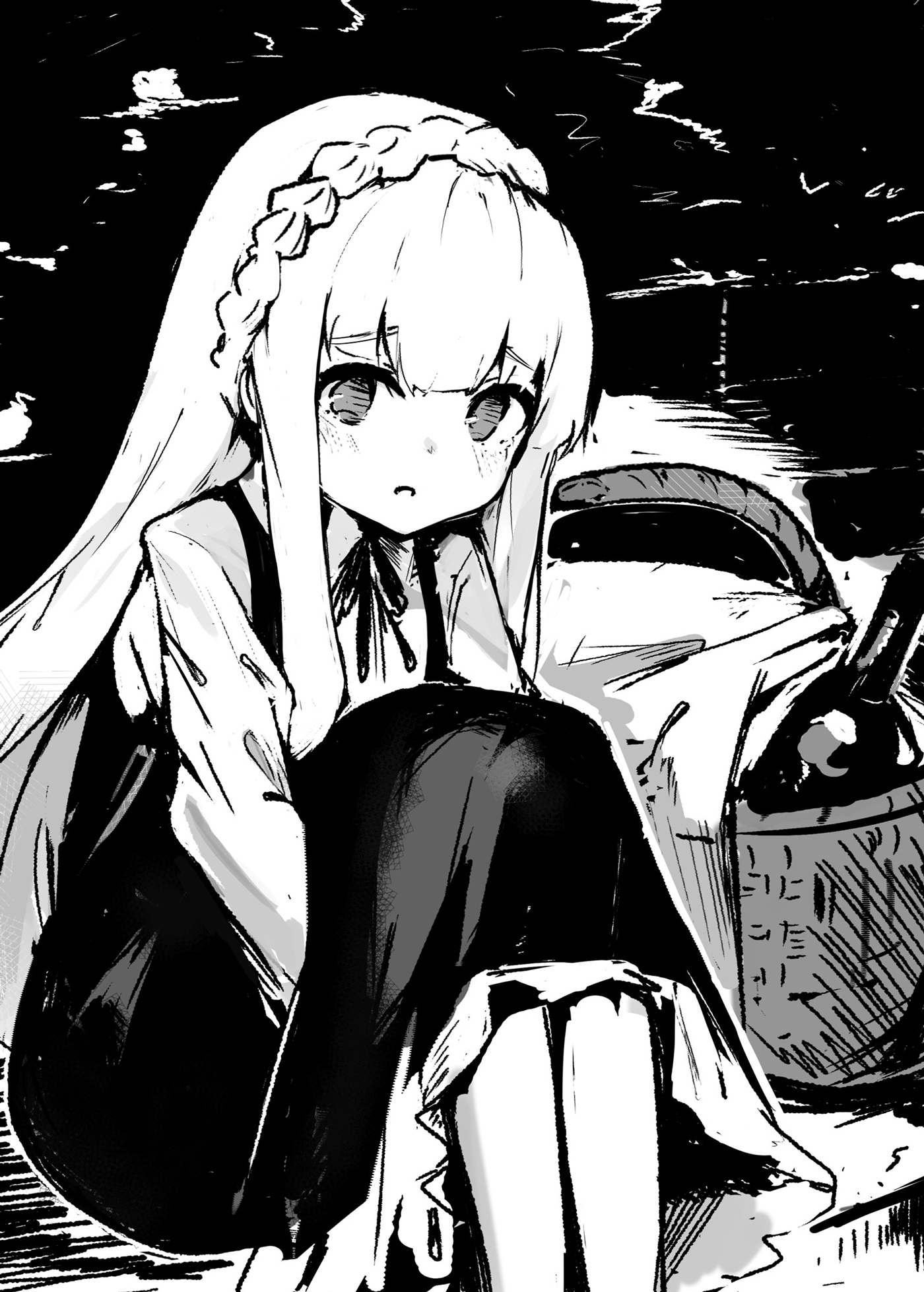
Elisa had been in a good mood lately. Her master had vanished just as suddenly as she’d appeared, which meant she could spend more time with her beloved brother. Of course, she still felt lonely without her Mama and Papa, her brothers and new sister, and all the friends she’d left behind back home. But so long as her dear brother Erich was with her, Elisa could put up with it. When he patted her head with his rough, warm hand, she felt as cozy as when she used to take naps under the midday sun.
That very same brother had been giving her even more attention than usual ever since her master disappeared. When she tried on the clothes that the disgus— scary see-through lady gave her, he clapped until his hands were sore. He even rewarded her by taking her outside to play, and that was a lot of fun.
Elisa could remember the day they’d gone to see the knights marching in sparkly armor like it was yesterday. Until then, she had never understood why her master forced her to keep a diary for tradition’s sake; now she finally had memories she wanted to preserve in written words.
After all, it was the first day Elisa met someone new since coming to the capital. The black-haired boy—her brother explained later that he wasn’t always a boy—that Erich introduced her to was a bit scary at first, but she warmed up to him as they played.
While he was more reserved than her other brothers back home had been, he was very nice. After spending more time with him, Elisa could tell that he wasn’t an enemy—to her and her precious Erich both.
To tell the whole truth, Elisa had difficulty understanding him at first. Fey conceptions of life differ wildly from those of every other living thing. Even the eternal methuselah and vampires are remarkably mortal compared with creatures whose intuitive control over magic leaves them just shy of embodying incomprehensible concepts.
Having the soul of a living phenomenon, Elisa commanded an ability she’d never told anyone about: she could see a person’s inner self.
That was why she was so attached to her family; they had shown her nothing but affection. They had given her the love and serenity that the alf she had once been had craved to the point of throwing her self away.
Yet she had trouble understanding Mika. Tivisco were newcomers to the Empire, and she had never encountered one, even before she’d been reborn. Their emotions were a complicated blur: she saw the hues of a boy, the pigments of a girl, and the dizzying mix that resulted when they joined. They were all sincerely a part of them, but each was hidden away—a paint swirled into water that refused to settle into a flat color, instead creating a rainbow whirlpool.
The young changeling’s ego was not yet ready to wrap itself around a mind that refused to conform to monochromatic harmony. Although she was positive that Mika’s sentiments were affectionate, their contour was more difficult to navigate than the involutions of an unbroken geode.
Friendship, love, envy, attachment, joy, and...craving? Whatever they were, Mika’s threefold self defied Elisa’s understanding. It was too confusing that only one seemed to surface at any given time, despite the underlying soul remaining the same ineffable, iridescent anchor.
Even knowing that Mika was an honest ally of her brother’s, Elisa didn’t know how to get along with them. She had no reservations against a friendship like the ones she’d read about in books. They were already friends with her brother, and she had become quite fond of them during the parade.
The children in Konigstuhl had scared Elisa. Hesitation was foreign to them, as was deep thought; they took it for granted that everyone could do what they could, and that everyone thought as they thought. No matter how normal that may be for children yet to learn to think beyond themselves, it had terrified the frail girl.
Mika was a different story. They were thoughtful and always paid attention to the people they were with; Elisa didn’t need to peek into their soul to see that.
So, on a personal level, she didn’t mind being friends with them. Going outside to play together sounded fun, and she suspected she’d enjoy sharing a cup of tea at home as well. Though she had only ever been dressed up by others until now, she’d read in stories that girls would buy clothes in each other’s company as a pastime—perhaps they could try that together if their schedules aligned.
But one thing held Elisa back: Mika’s intricate emotions concerning Erich. What was it that they wanted from him? No amount of pondering could produce an answer, even with her profound fey intuition.
The alfish merkwelt diverged from mensch’s as a matter of course, but also from those of all sentient life. Time’s passage was inscrutable to them, but the most private feelings were clear and concrete. Indeed, those like Ursula who appreciated the awkward and roundabout expressions of sentiment that mensch employed were few and far between.
For most fairies, affection spanned the range of love, attachment, possessiveness, and sensuality. Whereas humanity had created rigid boundaries to preserve peace and order, the alfar chose not to—nay, they could not. Such urges were why they snatched away their favorite children to join them in a merry dance lit by a never-setting twilight, hoping to eventually turn them into one of their own.
These heinous “pranks” were not the product of mortal malice. Anyone with the slightest semblance of common sense knew the unhappiness of a child being torn away from their home—even the aloof methuselah could at least reason it out logically—but alfar were wholly ignorant. Rather, they kidnapped children to show them their version of happiness.
For all the poets who had sung of the complexities of love, their words only rang truer when considering the love of alfar. Theirs was impossible to organize—if there was any need at all. How could we ever put to words the passions of beings who existed wholly for their own sweet sakes, drifting through life on no more than a whim?
Humanity was unfit to study what the alfar intuited as love, and not even a changeling making her calculations through a mensch brain could hope to crack the code.
Though a mensch’s mind and an alf’s ego had melded to create Elisa, the process was too imperfect for her to fully reflect. In fact, her relatively long life had let her experience human love and mortal values that only deepened her confusion. She had gone out of her way to mix two mutually exclusive essences.
The discrepancy between fey soul and mortal shell was not the only reason changelings were considered unnatural. The inner struggle between human ethics and alfish instinct caused a breakdown so great that it ruined the body and soul, generally cutting their lives short.
Yet despite living in a constant mental state of utter chaos, Elisa found Mika’s condition more perplexing. Really, what did they want out of their relationship with Erich?
Margit had been easy. Her romantic affections had been so overt that even a five-year-old Elisa had been able to envision the arachne’s hope for the future: she wanted to marry, start a family together, and live belonging to each other until the day they died. The huntress dreamed of a tried-and-true ending, passed down since the dawn of time. Some might even consider her desires morally righteous (setting aside the issue of whether the average married couple lived up to this ideal).
Elisa hated Margit—hated her because the arachne wanted to steal away her dear brother’s number one spot. Even if Margit failed, the mensch part of Elisa’s heart knew that the child they produced would certainly succeed. Erich loved to ramble on about how his sister was the cutest girl in the whole wide world; Elisa had no intentions of giving up the title.
Agrippina was also easy. That thing was plenty evil, even by Elisa’s sensibilities, and their current give-and-take relationship changed nothing about her opinion. However, the methuselah was also clearly uninterested in disrupting the siblings’ relationship in a way that Elisa feared.
Put simply, her master’s heart was so full of ill will that she was ironically pure. Her passions ran so deeply green they were nearly black, only ever concerned with how to maximize her own pleasure. While it was impossible to guess what she was thinking, knowing her overarching goals made her easy to handle.
Elisa was anything but fond of the danger she exposed Erich to as his teacher and employer, but so long as she didn’t threaten her position, the changeling figured that there were ways to deal with her.
But what about Mika?
When male, Mika had, for the most part, exhibited trust and camaraderie. His bond with Erich had proved unshakable by an outside force; Elisa wasn’t sure, but she thought it was probably the feeling epitomized in the term “brothers-in-arms.” If that had been the whole of it, Elisa would have been happy to heed Erich’s advice: it would have taken some time, but she could eventually come to treat him like yet another brother.
The problem was the other two genders wrapped up inside of Mika. Had each gender assumed a separate personality that only appeared with the corresponding sex, Elisa would have been content to treat each as a different person. But a tivisco was only ever themselves, and they were not three identities sharing the same body.
The soul that lay beneath was a single, unified individual, and the differing genders were akin to clothes that they put on to show the world. Garments did not make the person, but each article of clothing came with a valence, a significance that played off all the other parts in the ensemble.
On this point, Erich gave the matter little thought and internalized Mika’s condition as an underlying personality that swapped between three distinct phases. Elisa saw something more. They were like an art piece composed of three different paints. Although the carefully placed pigments seemed discrete at first glance, the colors were bound to blend at the edges so long as they touched in any way. This delicate mixture was the root of her confusion.
When all was said and done, what did Mika want? Elisa was too incomplete as an alf and too inexperienced as a mensch; the fragmented girl could find no answer. Indeed, the thought that Mika did not know the answer themselves would take yet more time and experience for her to consider.
Still, Elisa had no qualms saying that Mika was kind. Just once, they’d even helped her study. Following that tutoring session in the College library, Erich had begun accompanying Elisa when she studied—something she was very grateful for.
The pile of books her master had assigned was full of boring and hard palatial writing, but Erich brought stories that were much easier. Those books were funny and weird—her brother had said the word she was looking for was “emotional”—and they took turns reading; when she did a good job, he would praise her.
One accomplishment and he’d smile; two and he’d pat her head; three and he’d hug her. For the first time, Elisa thought to herself that it might be nice to get better at things. The thought of what he’d do after four, or five, or six threatened to send her beating heart right out of her chest.
These days were so blissful that she didn’t even care about the meandering thoughts clouding her relationship with Mika. She woke up every day with her dear brother at her side, they enjoyed breakfast together without her master getting in the way, and then they studied together after they were done. He still had to leave a lot to do errands, but they spent much, much more time together than before.
Elisa wished her master would never come back. She would probably do something terrible with her usual pristine smile if she found out, but the young girl couldn’t help it.
And today was another peaceful day without her.
After Elisa finished her morning studies, her brother let her ride the horsies for a little bit. The black horsie named Polydeukes was much bigger than Holter was at home, but he was just as nice; he walked around really slowly so that she could have fun. The beautiful world around her was shimmering so vividly that just getting a higher view atop the saddle made it seem like the whole world had changed.
At noon, Elisa’s dear brother had to go to work, but it was okay because he was going to come back in the evening. So, she waited eagerly.
She waited very, very eagerly.
But then the sun started going down and her brother wasn’t back yet and then it sank all the way and he still wasn’t back and she was so so so sad...
So Elisa decided to go find him. Because her brother was always doing something dangerous. He was always using dangerous tools, and learning dangerous magic, and running into danger with a smile. That’s why Elisa had to go find him.
Elisa knew where her dear brother lived. He’d brought her there a few times, and she was friends with the nice gray lady that took care of him. The gray lady told her a lot of stories about him and was really nice, so she liked her. She was way better than the silver moth meanie that just came to brag all the time.
Her dear brother would be so lost without her, she thought. She put on the clothes he’d praised her for the most—she’d gotten this snow-white blouse and black corset skirt on her first day in Berylin—and decided to go to his house and find him.
Elisa packed a lot of gifts: a can of tea leaves that her lazy master stashed in her room, a small pouch of pastries, and even some grown-up things, like a bottle of wine and a wedge of cheese that made her nose scrunch up.
It was going to be okay: her master just bought things at random and stashed them away, so she would never notice a bottle or two missing. Elisa couldn’t read the name on the wine label, but it was bright red and very pretty, so she was sure her dear brother would love it. And there was no doubt in her mind that he’d mix a little bit with plenty of honey and water so that she could try some too.
Elisa asked her floating friends to help her braid her hair and then set out with the basket full of goodies in one hand, but her brother wasn’t home. She had waded through a dizzying crowd of people and fought the wooziness that came with the noise around town, but he wasn’t home.
She was so sad that she almost cried. The friends that had come with her cheered her up and the nice gray lady came out to check on her, so she didn’t. But she was still very sad.
What would she do if he never came home? She hadn’t become a mage that could protect him yet...
Elisa was so, so, so anxious. But just when she felt like she couldn’t hold back her tears any longer, her dear brother came back to her. For some reason, he came out of a hole in the street in front of his home, and was looking at her mysteriously.
“Did you come all this way alone?!”
Her dear brother jumped out of the hole in a worried panic and scooped Elisa into his arms. She was so happy that she didn’t even ask why he wasn’t wearing a shirt; the urge to cry vanished and she felt like the sun had come up even though it was midnight. He was warm and gentle. If joy had a color, it would be his pretty hair; if fun had a color, it would be his twinkly eyes...
And he himself was happiness.
“Um... May I come out?”
Someone else peeked their head out from the hole. She had wet black hair and was wearing the shirt her dear brother always wore. Elisa didn’t know what the jewelry dangling from her neck was, but she had a terrible feeling about it.
This woman, too, was gold...but not the golden joy that her brother brought. No, she was the glow of the half-moon floating high in the sky—just like the image clearly etched into her gleaming medallion.
They were similar, but different. She was not joy; she was not fun; she was certainly not happiness. Hers was a colder hue.
The color scared Elisa. Her chest squeezed up as tightly as the night she found out they were tearing her away from home. It was as if someone had gripped her heart and was trying to squish it so it would never beat again.
All Elisa could do was cling tight to her brother as she stared at the frightening girl soaked in lunar glow.
[Tips] Imperial climate is best suited to producing sweet white wines, but heavier reds are preferred to the Empire’s west. The bottles produced in royal wineries are known as “highborn blood” in Seinian, and just one can cost as much as an entire mansion.
You know, when it comes down to it, I was a single-tasker at heart. This might ring hollow coming from someone with fancy Independent Processing, but I believed that casting multiple spells and solving multiple problems were fundamentally different beasts.
What I’m trying to say is that there wasn’t the slightest chance that I could handle a double-booking of my sister’s moodiness and a damsel in distress. For the love of all that’s good, GM, don’t just toss them into the same session out of laziness.
Clearing the nasty smirks of the powers that be out of my head, we slipped into my home and decided to start by fixing up our attire. I couldn’t loiter about half naked forever, and that was doubly true for Miss Celia’s coquettish legs peeking out for the world to see.
“I’m sorry, Elisa. Be good and sit still for a minute. We’ll all catch colds if we stay in these clothes.”
“...Yes, Dear Brother. But whatever were you doing?”
“It’s a long story... A long, long story.”
I fled up to the second floor to break free from Elisa’s accusatory stare. Ever since our big discussion—the “why do you do scary things” one—she’d begun acting overprotective. Thank goodness I hadn’t suffered any visible injuries during my scuffle with the underground bandits; if she’d clung to me in tears again, I would have had to grovel on the floor for mercy.
Internally thanking Miss Celia for ensuring a woundless battle, I pulled out three sets of normal clothes from my drawer. As an aside, the luxurious and oh-so-unique threads given to me by a certain pervert were stashed away at the madam’s laboratory. There were no convenient bug repellants in this day and age, so I didn’t want to store fabrics that fine in a wardrobe that didn’t so much as have a mystic seal. The Ashen Fraulein could maybe handle it, but I didn’t want to add more to her plate.
Not that I would have lent Mika and Miss Celia those costumes had they been here, of course—though I couldn’t deny that I often thought they’d suit my old chum more than me during my fitting-room escapades.
...Wait a second. Properly laundered as they were, I realized it might be uncouth of me to loan out my boxers. While Mika almost certainly wouldn’t care—they generally chose to wear masculine clothes when agender anyway—offering them to Miss Celia could constitute sexual harassment.
However, the culture of undergarments was remarkably advanced in the Empire, and many women’s underwear were similar to what I’d seen on modern Earth. Having her wear clothes without any would be poor form.
But, again, my gut morals told me it was probably wrong to give her my own underpants. Ah, but without anything, the pants would chafe, and...
Thunk. I turned around to see a pail of steaming water atop my writing desk. Slightly on the hotter side, the water carried the aroma of a floating herb bundle throughout the room as it waited to be used.
What was more, a set of unfamiliar clothes lay folded beside it: women’s underwear. The traditional set of a nightgown and shorts looked like they were woven with a mystery textile that was softer than silk. Obviously, these didn’t originate from my room; I wouldn’t own something like this, and I didn’t have any women in my life who’d forget them after an overnight stay.
“Ashen Fraulein?” I called.
No response. I had yet to ever hear the silkie of few words speak, but today’s silence seemed a bit different. She was being as helpful as ever, but I couldn’t help but wonder if I’d done something to offend her; she usually never made a sound during her chores. Perhaps the noise was simply to notify me of the bucket’s appearance, but I had a feeling that I’d done something to get on her bad side.
Still, she wasn’t the type to throw a fit over my inviting a girl over, and Miss Celia was the pinnacle of good manners; I couldn’t imagine she’d broken the rules of etiquette horribly enough to upset my housekeeper in this short time. Miss Celia was the sort of upstanding lady to honor me as the lord of the house and politely ask me for permission to take a seat, despite my low birth.
Regardless, I didn’t have the time to dwell over my speechless housemate’s mood, so I said my thanks and headed downstairs. My apology to the Ashen Fraulein would have to wait until I could swipe some top-grade cream from Lady Agrippina’s atelier.
“Miss Celia,” I called. “A change of clothes is waiting for you upstairs. Please help yourself.”
“Truly? Oh, but Erich, I couldn’t sully your clothes like that.”
“No need to worry. There’s also a bucket of water to wipe yourself with.”
“My!” she exclaimed, gently pressing her hands together. As someone whose only contacts were country bumpkins and total scoundrels, her genteel mannerisms were new and refreshing.
Miss Celia skipped up the stairs on light feet, and her excitement at the thought of being able to clean up was apparent in the ring of her steps; she had felt just as icky as we had. Much like how my hopeless employer still had to sweat, immortality did nothing to wick away cloying humidity.
“Let’s get changed too, Mika. We’re total messes.”
“Honestly. By the way...I got scared when this bucket showed up out of nowhere. Is this her doing?”
They pointed at the dining table—by the way, I’d painstakingly repaired the legs to return it to its former glory—where a large tub was seated. Round slices of dried citrus floated in place of the herbs found upstairs, giving it a pleasantly sour odor. Citrus was a perfectly fine fragrance for men to wear; it could be a bit risqué when dealing with demihuman races with sensitive noses, but this much would be fine wherever we went.
The tub came with towels to dry ourselves with afterward, and even a comb. I was beyond thankful; my dip into rainwater had left my hair strewn with tiny particles of grit. It was itchy and painful, but I couldn’t scratch at it without damaging my hair; I’d been in quite a bind.
Elisa kindly turned to face the wall, so we stripped down without any reservations. Having grown up in small, rural households, we didn’t even mind undressing in front of members of the opposite sex; it wasn’t like anyone had cared when we took steam baths or played in the river.
We made sure to cast Clean on ourselves first, and then began wiping our bodies down with wet cloths to get rid of the discomfort. It wasn’t anywhere close to a real bath, but the deliverance from the dank hell we’d suffered made it every bit as enjoyable.
Magic had dispelled most of the sand from my head as well, but the densely packed nature of my hair made it impossible to get everything in one cast. As I contemplated my options, Mika pulled out a chair and waved me over.
“Allow me to rinse your hair, old pal. I didn’t swim and my hair isn’t that long, so I feel fine, but I’m sure the same can’t be said for you.”
“Are you sure?”
“If only you’ll grant me the honor of brushing against your dazzling locks.”
My old chum’s Prince Charming line painted my cheeks red. Man, good looks are so unfair. After all, the only thing Mika had to do to turn our pretentious game of theatrics into a real heartthrob moment was fix their posture a tiny bit.
“I wanna—oh! Um... I would like to as well! Please, Dear Brother?”
And so, my enthusiastic little sister joined in and the two of them began washing my head. I untied my hair and sat down, leaning back over the edge of the pail. While it was similar to what one might see at a beauty salon, the chair in use unfortunately did not have a backrest; I had to carry most of my body weight with my abs alone. My daily training meant I could manage, but this was shaping up to be a good workout.
Mika and Elisa splashed on warm water, running their fingers through my hair to clean out the dirt. I did the same thing every time I bathed, but having twenty foreign digits do it in my stead was indescribably relaxing. I’d been getting sick of my long locks, but the two of them massaged my scalp like they were handling delicate glassware.
“You two don’t have to be so gentle, you know. A man’s hair is tough.”
“Don’t say that,” Mika said. “We can’t just carelessly yank on something as magnificently kept as this, now can we?”
“That’s right,” Elisa agreed. “Your hair is nicer to touch than Lady Leizniz’s clothes, Dear Brother. I’ll be extra careful while I’m washing it!”
The pair huffed in unison, and I gave up and left them to it. They were doing this out of goodwill; I wasn’t going to rudely demand they do it my way.
I hadn’t gotten a haircut since I left Konigstuhl. What had started as a means of getting on the alfar’s good side now left me with hair past my shoulders and down to the small of my back; it was getting to the point where I wanted to trim it down. The problem was that everyone I knew save for Lady Agrippina was sure to throw all manner of fuss my way if I did.
But it’s so annoying... It’s hot and heavy, and as you can see, it’s a pain to clean.
“All righty,” Mika said. “Nice and clean. Sit up so we can dry you off.”
“No, I’m fine. I’ll just use a spell to—”
“Dear Brother, you can’t! You always do the same for Master! I thought you said drying it by hand makes it prettier!”
“Well, yeah, she’s a noblewoman and I’m her servant.”
Alas, my logic did not get through to them, and the duo went through a stack of towels to dry my hair.
I wondered why Mika seemed so much more forceful than usual, but figured that they were probably throwing themselves into this boring everyday task in order to quell the jumpiness of our recent battle. It made sense, since this marked only the second time they’d experienced life-or-death combat. Coping like this was leagues better than mechanically seeking out sex or alcohol, so I was content to let them do as they pleased.
Rather, I was the odd one out for being able to clap my hands and instantly put every fight behind me without a care in the world. I had a good explanation for it: my brain was primed to interpret the shift from combat to daily life as a scene transition, a side effect of my TRPG-inspired blessing. Still, I couldn’t deny that my behavior was strange.
Sir Lambert had once said that the ability to switch between a state of relaxation and emergency was a sign of budding talent, but I didn’t want to be too talented. While Mika never found it eerie on account of our strong friendship, anyone else would have expelled me from their party. I made a mental note to be careful going forward; I’d fake it if I had to.
That said, I was only at ease because I’d secured a win without having to kill anyone. There was a real chance that I’d only be able to keep up my cool demeanor as long as I could still ride out fights without trying.
“Phew. Thank you very much.”
My creaky staircase and the young lady walking down it pulled me out of my wandering thoughts. She’d tied her pitch-black hair into a braid that flowed nicely behind her, uncovering a smooth forehead in the front. The hairstyle would have paired well with a ballroom gown, but sadly her current attire was a men’s set of peasant clothing too big for her.
“It isn’t much,” I said. “Apologies for the meager clothes.”
“They aren’t meager at all. In the Circle Immaculate, our uniforms are often made of hemp or cotton. Besides, I’ve never cross-dressed before, so I’m finding this rather enjoyable.”
Miss Celia covered her lips to hide a befittingly upper-class smile, but her animated excitement was closer to that of a child. It seemed she meant every word.
“More pertinently,” she said, sitting in a nearby chair, “you all seem to be having fun.”
I cocked my head in confusion, and she pointed behind me with an elegant hand gesture.
“Hey, quit moving, Erich!”
“Um, M-Mika, please hold on to that part tight!”
I tried to turn around, but my hair pulled me back. I didn’t even have time to appreciate my sister adorably stammering over Mika’s name without honorifics.
“Wait... What are you two doing?”
“Well,” Mika said, “we went through the trouble of prettying up your hair, so we figured we may as well pretty you up even more with a nice braid.”
“It’ll get all out of shape if you move,” Elisa said. “It has to be symmetrical to be pretty!”
“What do you mean you ‘may as well’?!”
Why does every single person I know insist on toying with my head?!
Alas, I didn’t have it in me to interrupt my best friend and beloved sister’s fun. All I could do was sit and endure the awkwardness while Miss Celia watched and smiled from a distance.
[Tips] Under common imperial values, a man dressing in women’s garb is considered an oddity, but the inverse is far less peculiar. In high society, cross-dressing is seen as a powerful statement of fashion so long as the wearer can pull it off.
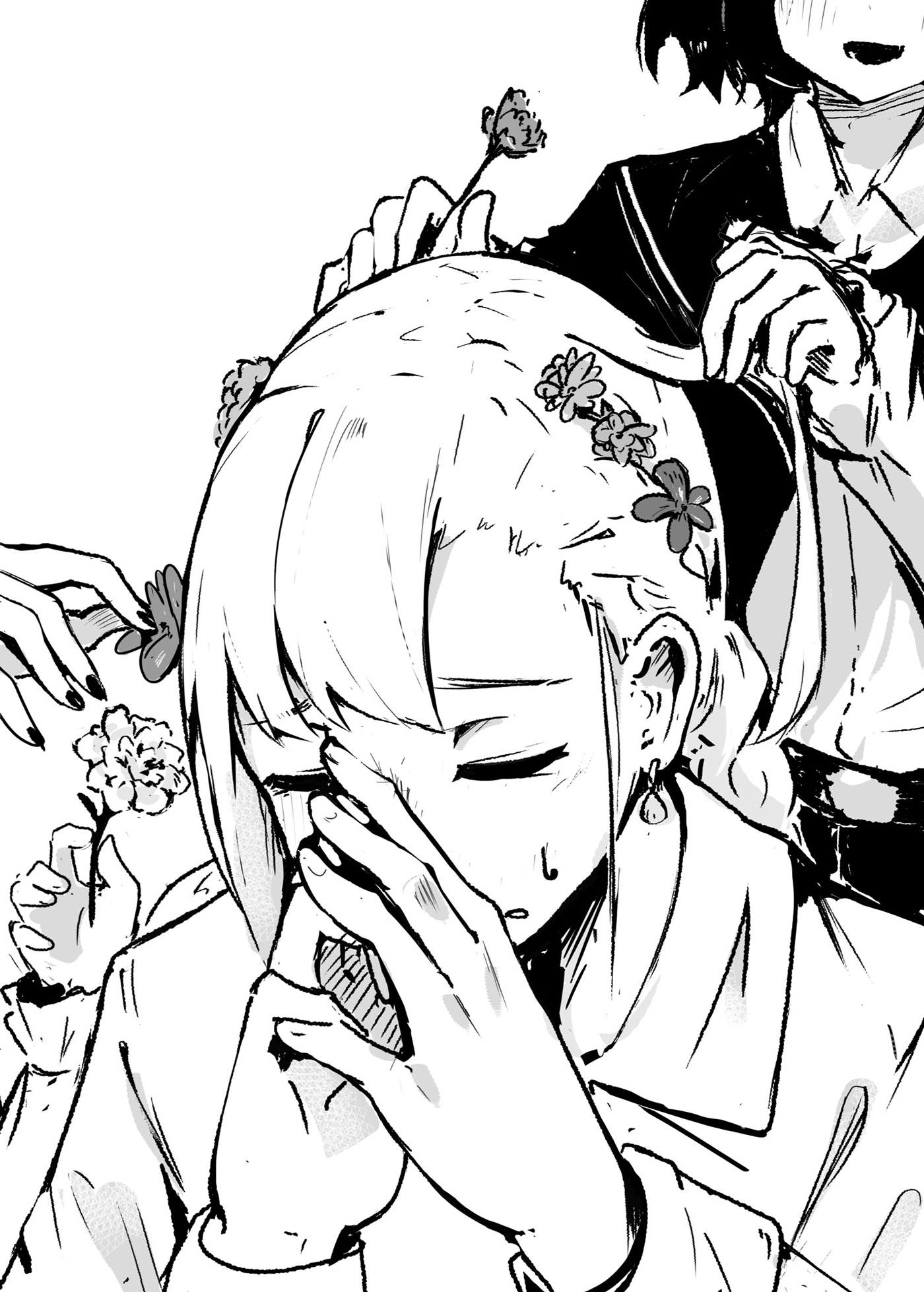
I come bearing bad tidings: my head has become a flowerbed.
Those particularly blessed in the realm of objective critique might point out that my head had been stuffed full of posies from the moment I’d decided to continue pursuing adventure despite my powerful connections and limitless talents; to that, I have no refutation. However, in this case, I literally mean that physical flowers were sprouting on my dome at every which angle.
Once again, the mischief began with one of Mika’s awful strokes of genius. My home had dried flowers hanging about to add color and freshen up the air, and they’d plucked a handful to stick into my hair.
Taking a shine to this, Elisa then began grabbing some of her own; the whole thing escalated from there. At this point, I had one giant braid intricately wound with other, smaller braids, with a whole garden planted at every step.
To top it all off, Miss Celia decided to join in on the fun by sticking a mallow right on my temple.
Fine, have it your way.
While I would have loved to say that aloud and dive into bed so I could flee to the land of dreams, our long day had yet to end. We still had business to settle, so I got everyone back on track and sat them all down at the living-room table. Mika and Miss Celia took positions on the couch, I sat across from them on the floor, and Elisa planted herself in my lap.
The Ashen Fraulein was kind enough to read the room and prepare a pot of tea so that we could enjoy a sip as we discussed. Miss Celia was terribly surprised to see a ready-to-serve tea set appear without warning, but I was too tired to explain. I just said, “It’s magic,” and left it at that; I didn’t specify whose, but I wasn’t strictly lying.
I took a mouthful of tea—of all the things she could have brought out, the Ashen Fraulein decided to serve blue mallow tea with a hint of lemon in what I could only imagine was a bout of mischief—and patted my sister on the head to try and get her to stop staring into the table.
“Allow me to formally introduce you, Miss Celia. This is my sister Elisa, firstborn daughter to Johannes of Konigstuhl canton. At present, she is studying under a magus so that she might enter the Imperial College of Magic as a full-fledged student.”
“My,” Miss Celia marveled. “The College? Hello there, little one. I am Cecilia. I am a member of the Church of the Night Goddess; I serve the merciful goddess of the moon from my lowly, unranked position at the bottom of the Circle Immaculate. I pray we may get along.”
Unranked? As surprised as I was, the more pressing matter was that Elisa was turning her cheek and refusing to answer.
I wonder what’s wrong? I’d thought she’d gotten more used to this sort of thing thanks to her time with Mika, but maybe she was still afraid of strangers.
“What’s the matter, Elisa?” I cooed. “Come on, say hello.”
“Mm... Mmgh...”
I peeked over to see my sister’s face; she was trembling and biting her lip. She seemed scared of something, but I had no idea what. Knowing that it was poor manners to display this sort of attitude to a noble, I tried rocking her shoulder, but Miss Celia raised a gentle hand to stop me.
“That’s enough, Erich. She doesn’t need to speak to me if she doesn’t wish to. Children of her age rarely do. The Night Goddess’s sanctuaries often double as almshouses, so I am well accustomed to dealing with young ones.”
“But...”
“Please, that’s enough. Don’t you agree, little Elisa?”
She smiled with all the compassion of the Mother Goddess above, but my sister turned around and buried her face in my chest. After looking at her sadly for a moment, Miss Celia raised her hands ever so slightly to signal she was done with the topic.
I looked over at Mika, but they shook their head; they were just as lost as me. Elisa’s manners had been really impressive at the parade, but it looked like I’d need to talk to her about it later in private.
Moving on from my sister’s sudden shift from merrily playing with my hair to outright sulking, we had important matters to discuss...
“The two of you have helped me more than I could ever have asked.”
...but our good dame managed to take hold of the conversation before I could.
“I cannot allow you to be swept up any further in the trouble that is to come. Despite having given me even the very clothes on my back, I have nothing to compensate you with. But mark my word, I shall repay this debt.”
Whoa there, she’s going off in the wrong direction. Still patting Elisa’s back, I glanced over at Mika; they knew where this was heading too, and answered my look with a small nod. In turn, they tried to confirm my intentions with an inquisitive blink; this time it was my turn to nod.
As short as our time together had been, we were both certain that Miss Celia wasn’t a bad person. On top of that, she’d saved my life. What reason was there to hesitate now? How could I call myself a man—nay, how could I call myself human if I cast her out out of suspicion like she was going to ask me to?
I thought it was too late for such things in the first place. We had a common saying in the Empire that an assarius and drachma were equal in the pot, similar to the Earth idiom that posited one might as well be hanged for a sheep as for a lamb. Er, well, that came off a bit gruesome—I probably should have likened it to “in for a penny, in for a pound” instead.
At any rate, the point was that we’d gotten involved out of our own free will. Whether she brought more trouble or not, we had a duty to see through what we’d started.
Talk of responsibility aside, our own feelings on the matter were even more important. I would never be able to sleep soundly at night after chasing her out after only helping her with half the job.
“Miss Celia,” I said, “I pray that you won’t ask something as merciless of us as to abandon you now.”
“My old pal speaks the truth, Celia. I’d thought that having your permission to use a nickname made us friends. Was I wrong?”
“Of course not!” she blurted out. In another moment, she would realize her mistake and cover her mouth. Alas, it was too late: she’d given her word.
“Then I see no need for secrets among friends,” I said. “We’ve accompanied you thus far, so if delivering you to safety is within our means, we would be happy to oblige.”
“Besides,” Mika added, “our parents didn’t raise us to be so heartless as to throw a young lady onto the streets with nothing more than a meager set of clothes. Please, won’t you let us face our families again with our heads held high?”
Our usual tomfoolery managed to creep into our pleas, but the sentiment itself was genuine. Not helping her here was sure to leave something terrible lingering in our hearts for years to come.
But, hey, ignoring her absence as of late, I had an absolute behemoth of a connection covering my back; our odds of success weren’t astronomically small by any means. I wasn’t sure what she’d make me do in exchange, but knowing that villain, she was sure to cook up some tremendous ordeal for me. Still, she’d probably honor my request for help: lending a hand every now and again to her ticket to Berylin was sure to be in her interests.
Mika and I stared at her with passion in our gazes, waiting for a response. After a brief pause, a single tear bubbled up from those glistening ruby reds of hers, and she wound her hands together with downcast eyes.
“Thank you so much, Erich, Mika. I... Well...” Despite the hesitation still present in her tone, Miss Celia finally unveiled the reason for her escape. “You see, I am running away from a marriage. Yes, a marriage I have no desire to partake in.”
I knew it!
The ancients themselves had decided long ago that a dainty girl on the run was sure to be running from the altar. I’d seen the tale of a young maiden fleeing the clutches of a slimy old man or a calculating schemer who only wanted her for her family’s fortune countless times, in every possible medium.
This trope extended to the Empire’s tales as well. Twenty people counting on their fingers and toes still wouldn’t amount to the number of times I’d heard sagas of wandering knights and adventurers rescuing noble girls from their perilous engagements. Surely the little boys of our nation dreamed of committing such heroics themselves, whether in bed or wide awake.
That said, arranged marriages were absolutely everywhere, to the point where it was the default.
“As you can see, I have cast my lot with the Church, but this was originally my family’s intention. While I serve the Night Goddess of my own volition now, it was my father who first sent me away.”
Whether noble or common, marriage in this day and age was not something to be decided by personal feelings: it was a familial affair. The folly of a union between patrician and plebeian needed no explanation, but even the son of a wealthy, land-owning farmer would face serious repercussions for trying to pursue romance with the cute daughter of a poor family who borrowed the land on which they worked.
Questions of romance could only begin to be asked when society advanced enough to prioritize the interests of the individual; in an era where industry and the economy built on it were weak, such things skipped straight past futility into the realm of the downright harmful.
“Yet now, he demands that I return to secular life... I had thought his summons was simply to see me, as I hardly ever have an opportunity to descend from Fullbright Hill. Never in my wildest imaginations had I thought that he would sully my faith, of all things...”
Parental authority over wedding their children was more than a matter of preserving the interests of a clan: it was seen as serving social order. Trying to butt in was incredibly uncouth. Even under the lax standards of Earth, meddling in another’s marriage was considered inconsiderate at best. Done here, it would be the same as picking a fight—or in the worst case, starting a war.
“I caught wind of this plan, and made my escape just as I was being taken to his estate to be sealed away.”
The three of us could cause mayhem and destruction, getting away in a daring chase with the blocky words “THE END” preceding the end credits, but we still had the rest of our lives to live. Factoring in our futures, the problem was anything but trivial. Were we characters in a cheap novel, we could just sock Miss Celia’s father in the face and lecture him until he changed his tune, but alas.
Despite all my pessimistic grumbling, I had a feeling that we’d be able to figure something out within the bounds of the law.
We would have had no choice but to pack it up if we were dealing with a stupid girl trying to elope with a commoner: the only ways out then would be to tear down every barrier on her way to the remote edges of the frontier, or to punch her dad with a heartfelt prayer that everything would work out.
However, I could vouch that Miss Celia was not the type to let her own partiality dictate her actions without thought. While she was admittedly reminiscent of an elementary schooler excited on their first trip to a faraway land, succumbing to pangs of curiosity was different from thoughtless indiscretion. She had to have known her father would send people to chase her, and I doubted she would have tried running at all without some chance of victory.
“Thankfully, I suspect not all of my family will take kindly to this engagement. I have a gregh—ahem. I have an aunt whom I owe much, and I am certain she would convince my father to stop.”
“Now that’s reassuring!”
While I was a bit curious about her cough, having a dependable ally within her family sped things along tremendously. I knew she’d have something up her sleeve.
“With my aunt’s help, I will be able to reach the Church, whom I’m sure will also take my side. I hate to be presumptuous, but I believe myself to be regarded well amongst my peers, and the Head Abbess of the Great Chapel is a personal friend of mine. So, as long as I can evade capture...”
With religious authorities on our side, we had a real shot at pulling this off. Er, more importantly, the Head Abbess of the Great Chapel was the top authority that oversaw all of the Night Goddess’s following. What kind of acquaintance is that?!
Perhaps it was one of those stories that played off immortality. Miss Celia was a vampire who looked to be our age, which put her at least past fifty; if she’d taken care of children in her youth, it was perfectly reasonable that one might grow up to climb the ranks of the church. As curious as I was, it wasn’t exactly a pressing matter, so I decided to shelve it and maybe ask again when we had more time to spare.
The big news here was that we had Miss Celia’s aunt on our side. Since time immemorial, little brothers had been fated to bow down to their big sisters—I would know. Although her name had grown difficult to recall, the painful episodes I’d endured at the hand of my sister a lifetime ago were as fresh as ever. How could I ever forget? My birthday and Christmas had been the only chances to beg my parents for a new game, and she’d bullied me into choosing something that she’d wanted.
Maybe equating my frivolous trauma with the inner workings of a noble house wasn’t quite right, but I maintained that people were ever people, no matter the world. Besides, it was clear who wore the pants, given Miss Celia’s conviction that her aunt would make things right.
“In that case,” Mika said, “all we need to do is contact your aunt.”
“Victory is finally in sight, old chum!”
Now that we had our mark, there were plenty of ways to stick the landing. If she was nearby, we could sneak out of the capital and head straight there. If she was far away, we could hope to reach her by mail. At the very worst, we could run around Berylin and wait for her to back us up, so long as we could get in contact with her.
We had a clearly defined goal; now was the time to act. After all, we were up against nobles. They had limitless angles of attack on account of outstripping us by a gigantic margin in terms of wealth and manpower. Perfection could wait—haste was the name of the game. As the ones on the lam, our position was only going to worsen the more time we gave our pursuers to prepare.
Judging from how well-dressed the first batch was, I surmised that Miss Celia’s father was anything but underprivileged. It was best to assume he’d put his money where his mouth was and hire hundreds to search for us with a fine-toothed comb. The worst-case scenario could even entail him enlisting the guard, making the whole city a danger zone.
Gods damn the bourgeois...
“By the by, Miss Celia,” I said, “wherever might your aunt reside? Does she have an estate here in the capital? Or is her main residence close by any chance?”
I swallowed back a mysterious desire to go find a flag dyed scarlet and looked over at the vampire. Suddenly, she clammed up and averted her eyes, twiddling her fingers in silence.
“She is in...um...Lipzi.”
“What?”
Lipzi was the capital of the administrative state—formally a Regierungsbezirk—that made up the eastern reach of the Empire, and the headquarters of one of the three imperial families, House Erstreich.
But most importantly of all, the direct distance from the capital to Lipzi was one hundred and forty kilometers.
[Tips] The capital of an administrative state is the center of regional political and executive affairs, and is thus most often found in the territory of influential families. The imperials, electorate, and other members of the highest order maintain estates at each and every one, sending stipends to lesser, local nobles under their wing in a bid to maintain their influence. They then reconvene during the months where the nation’s oligarchs engage in politics from their separate estates in the imperial capital.
I was so shocked by the distance that I stood dazed for a moment. Even Mika, who was less familiar with the geography around here, was furrowing their brow.
My acquaintance with the lay of the land could be traced back to my three-month-long journey with Lady Agrippina. Thinking that it would be helpful for the future, I’d memorized a national atlas—a rough sketch that included every territory in the Empire—which gave me a decent idea of relative distance. That understanding was exactly why I was in such despair.
One hundred and forty kilometers sounds simple enough; it was about the distance from Osaka to Nagoya. Modern sensibilities would reduce the journey to roughly one meal and a really hard ice pop on a bullet train, or a two-to-three-hour road trip involving a picnic at a highway rest stop...but it was a massive distance for us.
It was too far a march on our own two feet, not even to mention that one hundred and forty kilometers only covered the distance between the two points on a map. Traveling there would require us to traverse several times that.
In case it wasn’t already obvious, the Empire was home to mountains, rivers, and rolling hills, just to name a few topographical complications. The state wasn’t some half-baked player in a city-sim game who could conjure up direct roads between key locations on a whim.
Between Berylin and Lipzi lay a sheer mountain range known as the Southern Sword. While not as harsh to navigate as the Frost Spirit’s Peaks the giants called home, normal travel gear would still leave a traveler freezing or slipping to their deaths in half a day. Obviously, no road went through them; while a path straight south would be an all-around good investment that would save time and money, oikodomurges weren’t exactly omnipotent.
Ideally they’d plow a tunnel through the mountains to make a direct path, but that remained an ideal for now. That would surely only come in the far future, when advancements in architectural technology would grant the crown the heavy machinery and sturdy materials needed for such an endeavor.
The Trialist Empire was still miles ahead of any other country, and the crowning jewel of its great transportation network was the linchpin highway, a series of stone-paved roads that connected all its most important regional capitals. However, this system did not prioritize creating optimal paths; not only did it snake around to avoid obstacles, but it also took efficiency of construction into account, meaning the intersections were structured to connect three or four different roads at once. There wasn’t any way to shrink that down to match the direct distance.
Not that we were lucky enough to even use the roads.
The Empire’s esteemed highway system laid its foundations in bedrock, complete with drainage systems and enough ruts for several lanes of traffic to run in parallel, and foliage was cleared on each side to prevent highwaymen from having a place to set up ambushes. Oikodomurges had polished what was effectively a medieval autobahn more finely than a shining mirror. Smaller roads branched off the nation’s central artery like capillaries, connecting towns and cantons to the greater Empire.
This was all in the name of national security and economic prosperity. Over five centuries of history, the Empire had laid and maintained new roads with a zeal that bordered on mania. Unlike in the Middle Ages with which I was familiar, the crown did not scoff at major highways as a path for enemies to take to our key holds; rather, they were seen as a means of rapidly deploying our own troops to any location on the front lines as the situation called.
Inversely, it followed that minor roads were not well kept. A country’s budget and manpower were finite, and the towering five-hundred-year-old behemoth was no exception. Local lords often maintained streets within their sphere of influence, but only insofar as it suited their own interests; they weren’t serving a public demand for free travel.
Even the furthest frontiers in my past life had been neatly tailored to bend to the whims of automobiles, but the same could not be said here. Common sense said that an attempt to travel without using the main roads was one’s own decision, and it was thus up to the individual to figure something out.
For us, that was incredibly unfortunate. Naturally, the first places anyone would check would be easy avenues of movement; cutting off any high-speed escape routes was the first step of catching a fugitive in a wide search radius. Much like how the police of Earth set up freeway checkpoints, enacted searches at hub train stations, and shut down airport boarding gates, our pursuers were sure to keep an eye on every road out of Berylin. There would be guards at every gate checking our bags, they’d forbid face coverings, and the inspection to get into the city would be far less lax than it had been. I had no doubt that they’d cast a net so tight that they wouldn’t let so much as a kitten get by without questioning.
We needed to dodge the authorities and our pursuers and hike through a couple hundred kilometers of uncharted mountains with a young lady in tow... That’s death.
If we had access to proper roads, I could have made it work. I could make around thirty kilometers of progress per day on foot—even with my stubby child legs—while stopping at the inns that dotted the land, and I could easily double that if I rode Castor or Polydeukes. Despite having an inexperienced and sheltered girl with us, I swear that I could manage similar numbers if I could get ahold of a stagecoach; there were plenty of caravans that regularly traveled between the imperial and regional capitals, so finding one that would allow us to join them would be a cinch.
But the net ensnaring us would only grow wider, and eventually, ducking under the watchful eyes of patrolmen would become impossible. I doubted they were idiots, so they were sure to close the path to Lipzi as soon as possible to prevent us from seeking help.
Uh... Are we screwed?
Had it just been Mika and I, we could have braved the perilous journey with a private letter to Miss Celia’s aunt in hand. However, in that case, we needed to worry about what to do with the damsel in question while we were gone. With the master of the house absent, we could stick her in Lady Agrippina’s atelier, but I couldn’t just leave her alone with Elisa when the madam could come back at any moment.
Though Lady Agrippina wasn’t totally heartless, she had exactly zero tolerance for anything she deemed a bother. Should she return home to find that I’d brought in a walking nuisance that she had no obligation to attend to, she would throw Miss Celia out in an instant. Worse still, I would be thoughtlessly dragging her into something that could affect her standing in high society; I would certainly be at her mercy after she cleaned up the situation as she saw fit.
And how could I complain when this really was a decision made solely on my account? That would be like leaving something out in a shared common space and getting upset when someone else threw it away.
I wanted nothing more than to have already perfected space-bending magic. If only I’d mastered that, I would have snapped my fingers and solved Miss Celia’s problems with all the ease of a fairy godmother summoning a pumpkin carriage and glass slippers.
I supposed the fact that teleportation invalidated so many scenarios like this one was exactly why it was locked behind such steep experience costs. Had I possessed the madam’s skills, this whole conundrum would have taken fewer than five days to mop up: not only could I have cut out the entirety of our sewer disaster by sending Miss Celia straight to my lodging, but I could have teleported to some random point I’d visited on our three-month journey to the capital and gotten a massive head start to Lipzi. From there, I’d just run straight to my destination and complete the mission!
Hm... This was the sort of anticlimactic story that would make a player chew out their GM for not planning against their antics, and one that’d cause the GM to shout that they should have held back.
“Um, but there isn’t any need to worry! I have a ride! I’m well aware that it’s too far to reach on foot!”
“A ride?”
Miss Celia must have caught on to our uncertainty, because she began speaking in a rush. Apparently, she had some means of getting from Berylin to Lipzi without being caught by the police.
“I cannot spare the details yet,” she went on. “But it shall arrive in three days’ time. If all goes well, I will be in Lipzi only a day after that.”
“One day?! That’s unbelievable...”
“Even dragon knights would take longer than that. Are you sure it’ll only take a day?”
My sheer surprise was joined by Mika tilting their head in tempered curiosity. Under normal circumstances, a fast horse would need a few days, and a messenger on foot would need two to three weeks; making the trek in a single day was absurd. Drakes could soar through the skies in a straight line, but they could only be handled by experienced jockeys—if one could manage to steal one of these living weapons from underneath the crown’s nose, that is.
“Yes, one day! You will have to wait and see, but from what I hear, it will surely only take a day.”
Miss Celia puffed up her chest with confidence, but her refusal to explain further worried me. More than anything else, her twinkling eyes spelled danger: whatever means of escaping the city she had, it was something that this curious lady considered fun. That same fun was why she merrily told us to wait and see; while knowing she only did so hoping to entertain us as friends left me with no room to complain, it really did not feel like she understood the gravity of our situation.
Ah well. It beats risking the hike.
“Very well,” I said. “Then we simply need to buy three days, correct?”
“Yes,” she replied. “But I suspect hiding away here...”
“Will only net us around one.”
Having a concrete goal in mind made victory seem within reach, but things were not as easy as they seemed. It sounded like we could evade detection for three days if we holed up, but that wasn’t an option when there was a very convenient and very magical way to search for persons of interest.
Ladies Leizniz and Agrippina sent their origami birds and butterflies my way without the messages getting lost using the same tracking system found in search magic. The fact that Miss Celia’s location hadn’t been exposed yet could be entirely chalked up to her pursuers not employing a mage. I suspected they still believed her to be a sheltered princess wandering aimlessly about the capital, and they hadn’t gotten serious yet as a result; she’d been on the cusp of capture when we crossed paths, so I doubted they wanted to escalate their efforts any more than they already had.
If a moderately trained mage—say, the apprentice of an ordained magus—began searching in earnest, we’d be caught sooner rather than later. We would have been cornered in the sewers long before getting to sip tea at this table had one been present from the start.
“An experienced magus can pick out their target amongst the tens of thousands of people in this city in no time at all,” I explained. “A strand of hair or a chipped nail will be more than enough for them to mark you for their spells.”
Search magic scoured the fabric of reality for traces matching whatever query was made. These were essentially wrinkles or stains left on the warp and weft of existence, and hiding in the deepest, darkest corner one could find would do nothing to eliminate such evidence. Secret rooms designed to shelter persecuted priests and catacombs built in the depths of the earth could not stop a procedure that dealt in metaphysical realms.
Yet it also had its drawbacks. Searching was only accurate when provided with an item that had some connection to the target.
I didn’t know for sure how much time we had before they dipped their toes into the arcane, but factoring in the requisite preparations, we had a day at best; if they’d already begun setting up, they would begin sometime tonight...and magia fit to serve noble houses were a stone’s throw away in the capital. It went without saying that I wouldn’t have been worried about three days on the run if we’d been up against the kind of beggarly house that didn’t have any connection to the College.
Which means we don’t have time to take it easy.
“Fear not,” I said. “I’d like to believe that I know a thing or two about dealing with magia.”
I was a servant, not a magus—but I was still a number-crunching munchkin to my core. I knew better than anyone that the tactics I didn’t want to run up against were also the tactics that would frustrate my opponents the most; I always kept contingencies to counter things that I found troubling.
After all, doing what one wanted while disallowing one’s enemies from doing the same was among the strongest strategies in any game, whether that be ehrengarde, a TRPG, or the sprawling game of life that used people as its pieces.
[Tips] Search magic refers to a mix of true and hedge magic that traces mystic footprints left behind by a mark, and exists in a variety of differing implementations. The simplest cantrips merely highlight particles of matching scent, but most either seek out a predetermined mark or use a catalyst to find the catalyst’s “owner.”
The masters of search magic, however, reverse engineer a target’s location by starting with evidence that the target physically existed to begin with. From there, they make semantic connections to approach their destination with certainty that no normal method can match.
Sleepless as the city may have been, the majority of the imperial capital’s denizens were tucked away as the Mother Goddess sailed on her gentle arc through the sky. In a dim, dreary room, a man heaved a heavy sigh. He was dressed in a thick, hooded robe of equally dark colors, plainly telling the world he was a magus.
“...Did it fail?” The woman facing him was the same one who had been chasing Cecilia on the rooftop. She’d changed into skinny pants and a white top, with a pelisse draped over her left shoulder so as not to offend any nobles with whom she might have an audience. Her hair, cut too short for the tastes of most, was neatly slicked back with a bit of oil.
“I’m afraid so.” On the table in front of the man lay the most up-to-date, comprehensive map of Berylin available. It spared no detail, not even the most vulnerable of military secrets; no normal person could hope to get their hands on something of this quality.
A pendulum dangled above the map, its bob a triangular pyramid cut from blue topaz. The name of the gem meant “that which is sought” in the southern tongues spoken near the sea, and the mystic formulae etched into the sides bolstered its inherent properties.
The magus had attempted to locate the girl via dowsing, a form of divination initially used to search for water and ores buried underground. In recent times, the thought of trespassing in the domain of deities who presided over the earth had put a pause on its original use—not even magia were willing to seriously anger the gods—but it was still commonly employed to find missing objects or persons.
“Was the catalyst I brought too weak?” the woman asked. “I should’ve known a single lock wouldn’t be enough...”
“No, it should have sufficed. Ordinarily, I require no catalyst at all to find somebody. For example...would you happen to know of anyone in the capital whose current location you can pinpoint?”
The knight pondered the magus’s question for a moment and then offered three names belonging to the men who’d joined her during the day. She had given them the night to rest on account of their strenuous search, so they could all be found in the servants’ quarters of her master’s estate.
“Mr. Karl is here, as is Mr. Lars...”
The man lifted his pendulum over the map, and it bent in gravity-defying ways to point at the very building the woman had envisioned her subordinates sleeping in.
“Ah, but it seems Mr. Luitpold is down in the low quarter...near the pubs, if I recall. I, too, paid these cheap dens of alcohol visits in my youth.”
That moron, the woman thought, holding back a click of her tongue.
A sudden shift in the pendulum’s angle directed their attention to the low-class bars the magus had mentioned, complete with a nearby red-light district.
The man’s skill was obvious. Of course, someone who knew whose house she served could have made an educated guess at the manor—her employer was just that famous. Anyone who hadn’t heard of him was sure to be a hick who spent their lives under a rock.
However, she knew her talented yet foolhardy subordinate well, and he was an ardent lover of liquor and women. It was easy to picture him ignoring her orders to get some rest; he had once coerced a young boy from a branch family into sneaking out to the red-light district with him so he could save on paying from his own pocket. Seeing an idiot like him sneak a drink to soothe his aching body was as sure as the roosters’ cry in the morning.
Engraving a mental note that she’d make him write up a report and do fifty laps around Berylin when they next met, the woman’s attention moved on to the wavering pendulum.
“But this,” the magus said, “is the young lady in question.”
“What in the world?”
Until now, the thread had been taut, pointing straight at a single location; now it began aimlessly tugging every which way. Every few seconds, it would stop in place for a moment before zipping away to a new spot. The places it pointed to had no rhyme or reason to them: it ventured outside the city walls on several occasions, and once it even came to rest directly on the imperial palace.
“Ordinarily, even a failed attempt won’t produce such erratic results. With my skills, I would say...at worst, the marker would restrict itself to a single district. Considering I have her hair, I was confident I’d be able to pinpoint the very building she is in.”
“Then what is this?”
“At the risk of repeating myself, may I ask if the young lady is versed in the magical arts?”
“That’s preposterous.”
The woman was in such disbelief that she let a minor faux pas slip under her breath, but the magus did not react in any way. Instead, he continued his questioning by asking if the Night Goddess provided any miracles that could impede his spell.
This time, she could not be so sure. Every member of the family she served paid tribute to the Mother Goddess—though the degree of their faith varied by person—and their retainers had all converted as a matter of course. Yet she personally knew little about miracles: they were gifts from divine to devout meant to protect the faithful, and the clergy of each religious order guarded their unparalleled rewards from the public eye. Modern churches placed great emphasis on written record, but the secrecy surrounding miracles meant that they alone were passed down via oral tradition.
Those unconnected to a church thus had no means of learning about its miracles. While most had a general idea of which gods had power over which domains, the technical details remained a blur. The woman didn’t know whether the religious leaders of old had wanted to avoid being used by statesmen for their powers or their gods had explicitly sworn them to confidence, but regardless, she was merely a lay churchgoer with no means of finding out.
The Night Goddess was said to lend Her strength primarily in the name of healing, protection, and guardianship; it was difficult to tell if hiding oneself fell under those categories. While the veil of night certainly helped conceal those in the shadows, Her true nature was the moonlight that offered solace within that darkness.
At an impasse, the woman had no choice but to answer that she didn’t know; the magus then stated that it was unlikely anyway.
“In which case,” he went on, “would you happen to know of any powerful connections she may have in the capital? Specifically, a magus or someone adjacent?”
“That also seems unlikely. My lady spends nearly all of her time praying atop Fullbright Hill, and her only friends within the city should be a handful of religious officials.”
Fullbright Hill was located in the southern reach of the Empire, near the mystic Frost Spirit’s Peaks. “Hill” was a misnomer: it was a mountain. Its name came from its gentle slope that stretched out for miles and miles, but its peak was the highest of all the holy mountains in the nation.
Legend had it that moonlight shone more brightly at the summit than any other place in the country, which was why followers of the Night Goddess had planted their head temple there. Peoples seeking protection from Her or Her believers then began gathering at the base of the mountain, giving rise to the churches and towns in the surrounding area.
Limited were the opportunities for a dedicated priest to leave such a location. Evangelist missions weren’t unheard of, but the girl they were searching for would never have been chosen to go on one. Barring her fellow believers, there was no way for her to have an acquaintance in the capital, let alone a friend.
The woman asked the aim of the magus’s questions. Catching the swinging pendulum, he answered that this result was anything but natural.
“Say, for example, that I cast this spell to search in a completely mistaken area, or to try and find something that doesn’t exist. The pendulum would not budge. On the other hand, even when tasked with searching for someone I haven’t met, whose name I only know by hearsay, and whose face is unimaginable to me, the marker will point somewhere, with enough mana and skill.”
“But that isn’t what happened. Which means?”
“We’ve been challenged to a counterspell war.” Confused by the unfamiliar turn of phrase, the woman asked the magus to explain, so he added, “We magia tend to fight magic with magic of our own.”
In essence, he was saying the girl had a mage or magus assisting her getaway.
“That’s absurd! My lady shouldn’t know anyone of the sort! She had no more than the clothes on her back—not even a coin purse—when she escaped!”
“Which makes it unlikely that she hired a mage... Pardon me asking, but is the young lady...well, how shall I put this? Is she blessed in manners of appearance?”
“I... Well, my bias as her loyal attendant aside, I believe her to be exceedingly attractive.”
“Then I suspect some troubled lad has fallen for her at first sight. Every boy has dreamed of saving a pretty damsel in distress at some point in their lives, you see.”
The magus slipped off the ring linked to the pendulum with a sigh and rolled up the map. Sifting through a drawer at his desk, he pulled out something that glimmered in the candlelight.
“The current reaction is that of the young lady’s presence being scattered all throughout town.”
As soon as she heard the word “scattered,” the girl’s servant lost all color in her expression. The only thought that had come to mind was her charge being cut into pieces and hidden away all around the city.
For reasons undisclosed, her lady was resilient to death, but she could still be physically destroyed, and her natural powers of regeneration could be delayed. The most brutal and horrific means of doing so would be to dismember her and carry off each piece to a different place.
“Rest assured, I do not mean that in a physical sense. Rather, the spell would have given no feedback at all had she been killed.”
“Th-That...is good to hear. If anything were to happen to her, my blood would skip past running cold and freeze solid.”
As he beckoned his pale-faced companion to relax, the magus took the lid off the shining silver thurible he’d fetched from the drawer. All the while, his mind cynically drifted to wonder whether the woman’s reaction was one of loyalty or self-preservation.
“If one were to put mystic pursuance into simple terms, it would be the art of scanning through the skein we call reality in search of a stubborn stain—that is, a person. Our ‘eyes’ are driven toward the most notable of blemishes, but a smattering of smudges made in a similar hue will cause our attention to wander.”
“What do you mean? Are you saying that a dense gathering of closely related family members might make the process more difficult?”
“That is one possibility. But more commonly, search spells catch traces left by the person themselves: fallen hairs or well-worn articles and the like.”
“Then what point is there to using magic?!”
“Of course, this is an issue encountered only by novices. As little as it may mean, I consider myself a specialist in the field, and my formulae reject the noise that lesser spells may snag on. However, the accuracy of my means is sure to drop when encountering decoys of stellar make.”
“Decoys?”
In response to her question, the magus raised his hand and began counting down examples: something soaked in blood, the most powerful mystic trail of all; a prized trinket that one carried around at all hours; a loose tooth, or any body part greater in importance than a single hair; or a body double specifically made to stand in for the person in question.
“A body double?” the woman repeated in awe.
“They’re employed by more nobles than one might expect. Having one’s location known can often lead to trouble, after all.”
The magus reached back into his desk to produce a mortar and pestle. He pinched a bit of ash from the thurible and placed it into the bowl, and then opened a tiny box, throwing in the bundle of hair found inside as well.
The warrior had procured that from her lady’s bed and comb. Though the girl inherently produced little waste on account of her people’s efficient metabolic processes, no amount of careful cleaning could eliminate her footprint entirely. While the woman considered her actions a terrible transgression, she’d rushed to collect as much as she could when the magus had informed her of its utility.
“‘Body doubles’ are simple charms,” the magus explained. “Take a slip of paper with an arcane formula, have the person write their name on it, and wet it with a few drops of blood. That will suffice to draw a great deal of mystic attention away from the target. Not only are they trivial to produce, but they are easy to carry around. I suspect a great many people have elected to employ them—not that they impede someone of my skill, of course.”
The man ground the hair and ash together. Though hair wasn’t usually something that could easily be broken up, the clump immediately crumbled into dust, combining with the ash to create a fine black powder.
“Paper substitutes are then often delivered to body doubles of the traditional kind to lend their disguises credence. They’re beyond common in this line of work, but there is an alternative that outstrips its deceptive capabilities.”
Tapping the bowl to accumulate all the powder in one spot, the magus placed it down and pulled a pipe out of his inner pocket. He gracefully opened the tobacco box on his desk and plucked out a few leaves from the countless varieties stuffed inside. After packing them in, he took a drag and they glowed red without a flame in sight.
“...Which would be?” the woman asked.
“A doll.”
He exhaled a cloud of smoke with no regard for the woman’s scrunching nose, and dumped the leaves into the thurible after finishing his first puff. The embers slowly spread into a fire that filled the chamber, producing a smoke with a curious scent. Finally, he poured the black powder from his mortar into the thurible, causing a massive pillar of flame to shoot straight up.
Not expecting the sudden flash, the woman covered her face and instinctively reached for her dagger; in the next moment, she realized the heat was gone. She looked up to see the fire pillar had been replaced with a dark smoke cloud hovering in one place. The cloud began to swirl above the thurible, eventually stretching itself into a new shape: that of a raven.
The bird fluttered its massive, smoky wings and landed on the desk; unbelievably, it began to preen itself.
“Be off.”
At its master’s order, the raven flew away in peculiarly lifelike fashion. Though it disappeared upon slamming headfirst into the door, it did not dissipate; instead, it slipped through the cracks in the frame.
“With this, we shall find her in a few moments’ time. Would you care for any tea while we wait?”
Placing down his pipe, the magus walked over to a cabinet in the corner of his room, pulled out a set of cups, and leisurely began preparing tea. Still dazed by the fantastical display, the woman had to pull herself together to politely accept his offer.
Instead of the usual red tea, he handed her an herbal blend made up of soaked dried leaves. The soothing fragrance helped the woman unwind after a long day of running around; his attention to detail even in softer matters heightened her opinion of him—it had been worth sending away his apprentice in search of a true professional.
After getting halfway through her cup, the woman looked up to ask the magus how long the process would take. Yet her eyes rose to see him frozen, teacup in hand, with a profoundly grave expression.
The man’s breathing was shallow, and he coughed violently as if some terrible pain had possessed him. The woman could not bring herself to call out to him, but the abnormality of his demeanor dragged her back out of the relaxation she’d finally attained.
Just as she regained enough wit to hurry to his side, he yelped in pain and threw his cup onto the floor. The teaware was clearly expensive and well used, and his carpet was equally as luxurious, but he didn’t care at all—he couldn’t. The magus was too busy clutching his chest in a desperate bid for air.
“Sir! Are you all right?! What’s happened?!”
“Agh! Aurgh! Hrgh...gah!”
She rushed to hold him as he writhed in agony, but his frantic dance was so violent that he pushed the trained warrior off and flung her back into her chair. He stumbled about, shattering his teacup underfoot and kicking the shards in every direction. Yet all his squirming did nothing to ease the pain, and he began frothing at the mouth...when an earsplitting noise erupted from within his desk.
“Grah?! Hah... Hah...”
The sound signaled the man’s emancipation from his torturous pain; he collapsed onto his knees with labored breath. His right hand continued to hold his breast tight, while his left clung to the table for purchase.
“Are you okay?! What in the world happened?!”
“Ugh... Is this...recoil?”
With the woman patting his back, the magus stumbled to his desk, fighting a coughing fit the whole way. He opened a drawer to pull out a clump of wood from its depths: a clump that had once been a doll made in his likeness.
“Recoil? Recoil from what?!”
“Within defensive...magic,” he heaved, “there exists...a subset of curses... Ugh... That attack anyone...trying to peer into a location...”
The doll had been a stand-in for the magus. It had been modeled closely after him and engraved with his name, and he’d carried it around with him for a considerable length of time to ensure it would make a compelling mystic substitute. In fact, it bore such a connotational resemblance to him that it posed a risk of its own: damage dealt to it could feed back to hurt him. But a long career spent ferreting out the lost and that which does not want to be found had convinced him the dangers were worth it.
Tonight, that assessment saved his life. Had this doll not exploded in his stead, his body would have taken the whole of the fatal attack.
He surmised that his seeking spell had snagged somewhere, earning the ire of whoever resided at the location. They then responded with a curse so lethal that it would not serve as a warning—its sole intent was to kill. The hex was close to the upper bound of human capability to withstand. This was a matter for the best of the best, grounds only meant to be trodden by those who had one foot out the door of mortality: the professors of the College.
“I apologize. It brings me great frustration and even greater shame to admit this...but your request is more than I am able to bear.”
“I... I see,” the woman said. “And are you sure you’ll be okay?”
“Worry not. I won’t die from this...but I humbly request to be relieved for the night.”
Although her mission was of the utmost urgency, she couldn’t whip the magus into working after seeing his condition; he was trying his best to seem healthy, but one glimpse at his complexion made it clear he was inches from death.
“O-Of course,” she said. “Please get some rest and take care of yourself.”
“Thank you very much for your benevolence... Forgive me, for I shall pen my master tomorrow morning.”
After being seen out of the wobbly-legged magus’s atelier, the woman entered the College elevator and began ruffling her hair in frustration. He’d been the best magus she personally knew. Finding someone that outstripped him would mean going through an intermediary within the clan, but the most influential were all at their personal estates preparing for the upcoming harvest in fall. It was too far removed from the political season for anyone notable to remain in the capital.
Those that remained were hardly any better than herself, and absolutely none had as much expertise as the collapsed magus. Of course, that didn’t include her employer, who would have been the most dependable help she could have asked for...if he weren’t in the midst of partaking in his favorite hobby. No matter how many messengers she sent to retrieve him, the man refused to respond.
Oh, how unimaginably blissful it would be for her to throw up her hands, exclaim, I tried my best! and collapse backward onto a fluffy bed. Alas, it wasn’t meant to be. While she was displeased to see her lady forced into an undesired position, she couldn’t ignore the plans of the main family. Few could survive without ties of kinship in this day and age.
No matter how exhausted she was, the retainer could not give in. More than anything else, she simply couldn’t stand the thought of her master wandering unknown lands alone; the appearance of an unknown mage only worsened her fear and confusion.
“My lady,” she whispered, “your Mechthild is coming. I beg of you, please be safe.”
Up, right, left, and down; the elevator’s wild swings in unthinkable directions made Mechthild dizzy, but she remained cool as she reached into her breast pocket for a small vial. She tore off the seal—including the warning label that stated only one was to be administered per day.
One sip of the mysterious drug sufficed to banish drowsiness, but she downed the entire bottle in one gulp. This was her third vial of the day, and she had two left; they would no doubt be gone by sunrise too, but insomnia, minor paralysis, and complaints from the mage who’d written the prescription were a price she’d gladly pay for her charge’s safe return.
The instant the elevator dinged, Mechthild squeezed herself past the slowly opening gate and bolted out. At the same time, the elevator beside hers began to move.
Though it was odd for someone to be around at this hour, she ignored it and tore through the empty Krahenschanze halls to burst through the front gates, ordering the night watchman to prepare her a horse.
Her first order of business would be to return to the palace and hear the imperial guard’s report. From there, she’d need to visit the head of the city guard; then she’d return to the manor to organize her own men, and...the list kept going on.
Steeling herself for a long night, the woman looked up at the heavens. Her master’s object of worship had sailed over half Her nightly course, and she offered the moon a silent prayer.
May my brave lady be safe.
Whether the Goddess above knew the praying servant or the runaway master mattered not; Her heavenly form remained silent, bathing the lands below in the clear glow of night.
[Tips] Successfully casting a spell does not always mean successfully activating the effects of said spell. Lighting a basic flame underwater will obviously lead to immediate extinguishment. A spell may as well not be cast if its target resists its effects; the same is true if the activation itself is jammed.
I had a passing memory of chaff and flares being included in modern military aircrafts as a countermeasure against missiles. Chaff threw off radio-guided missiles by scattering a bunch of electromagnetically visible decoys, while flares created large amounts of heat to distract heat-seeking missiles away from the plane.
In that sense, I supposed the teachings of great mages long gone could effectively be boiled down to this: mystic chaff and flares make for great counterspells.
“My... How marvelous!”
“You’re so cool, Dear Brother!”
Two children stared intently at my hand; I was using a fleet of Unseen Hands to whittle down a block of wood. Seeing the lifeless chunk of raw matter change shape with every passing moment, only to receive a delicate coat of metal and paint must have been an enchanting scene.
With the equivalent of two grade-schoolers on a field trip gawking at my work, I finished up one in a series of many decoys. I’d done quite an impressive job, if I do say so myself: I used my piece-making supplies to produce something reminiscent of ⅛ scale hobbyist figures.
Well, technically, they weren’t reminiscent—they literally were figurines made at a one-to-eight scale...of Miss Celia.
My Dexterity was knocking on the door of Divine Favor, and I’d left my Whittling skill at Scale VI. Combined with my impulse purchase of the Keen Eye trait, I could reproduce my model with startling accuracy. My heated bouts of ehrengarde with Miss Celia had earned me a nice chunk of experience, so I had no qualms about spending some of it on her.
Furthermore, much like how Insight heightened my sense of sight in battle, Keen Eye would do the same during everyday life. It allowed me to take in fine details without error, and also made me more perceptive of things that were out of place—I suspected Margit already had this trait, since the examples included a twig clearly snapped by someone’s weight, or a footprint left in dust—so I was sure it would remain useful going forward.
Bolstered by my investment, my wooden statuettes threatened to drown me in narcissistic glee with how well they came out. The little Miss Celia closing her eyes and clasping her hands together in prayer, complete with her holy robes, was her spitting image; I was sure anyone who knew her would be able to name her at first glance.
From there, Mika added on a coat of foil to make it sturdier, and then colored her in. The final product was market-worthy.
“You’re such a perfectionist,” Mika sighed. “You know you don’t have to make it this good, right?”
“Don’t be like that, old chum. You’re not one to talk anyway. Look at how much detail you put into the blush of her skin.”
“That’s only because you were so picky back when I was coloring the ehrengarde pieces. ‘No,’ you said, ‘the thighs need a more flirtatious shade of—’”
“All right, Mika! It’s time to shut up! Besides, you’re just as guilty as me! That was the most excited I’ve ever seen you to touch something up with paint!”
I used one of my actual hands to cover my friend’s mouth before they could make any more slights against my character, taking the finished product they were handing me and hiding it behind my back.
Now is a good time to clarify that this one-to-eight-scale Cecilia had not come about because Miss Celia’s beauty suddenly struck my fancy; we had a proper goal in mind. On its own, it was just a well-made figurine that would retail for around 29,800 JPY in a hobbyist store, so I’d worked in a way to include some mystic meaning.
Each doll had a compartment to carry a slip of paper that Miss Celia had written her name on in blood. The effect was that each carving looked like her, had the name Cecilia, and carried a small part of her body inside of it. This transformed these wooden knickknacks into magic objects that might be her. An arcane algorithm seeking her position would wonder, Is this her? It kinda feels like her...
It didn’t matter that an actual person could tell they were fakes at first glance. Much like a high-quality flare misleading a missile’s seeker pod, the important part was that the substitutes could fool a spell devoid of sentience.
“Here,” I whispered. “I’m counting on you.”
Summoning a Hand, I carried the figurine I all but snatched out of Mika’s hands around a corner. I was pretending as though I was hiding them using my own magic, but the truth was that I was putting in a request with my invisible neighbors using a Voice Transfer.
“Yes, yes, very well. A request from our Beloved One is a request well worth honoring, and I suppose it’s only right to finish what I’ve started. Run us around all you please.”
“Okie dokie! Ummm, where oh where should Lottie put the next one...”
The fey duo accepted the piece and vanished to who-knows-where. Decoys meant nothing if they were clustered around in one area. If they got a read on our general location, the people chasing us could use their authority to order searches of every house in our district. On the flip side, if they were strewn across every part of the city without any rhyme or reason, their discoveries wouldn’t divulge our actual position.
Scattering the woodcrafts by hand was more than just a hassle, so the task of lugging them to ridiculous places—and some to more believable locations, of course—went to the alfar that had blessed me with mystic lips.
Ursula’s expression made it clear she was less than enthused to work overtime after exiting the sewers, but Lottie seemed to be enjoying the job as a bit of fey mischief; either way, their efforts were incredibly helpful. I was sure they were sneaking the things into all sorts of places that would confuse a magus right about now.
That said, I didn’t want them to take it too far. The figurines’ striking resemblance meant they could be used for curses if they fell into the wrong hands—though a lack of any personal connection to Miss Celia meant this wasn’t a huge issue—so we had to make sure to retrieve them later. I’d explicitly stated that they needed to remember where they hid them all, but Ursula aside, I was worried if Lottie had taken my warning to heart.
I supposed at worst, I could offer them candies and a few minutes playing with my hair to have them seek out any missing statuettes. Still, I couldn’t get over the fear of scattering something more personal than personal information all over the city. I prayed that no pervert would come across one and take it home with them.
“Magic is so wondrous,” Miss Celia said. “To think you can create wooden sculptures like this is astounding.”
“The strength of magic is that it can do anything so long as the caster has the wherewithal to find out how.”
The priestess cheerfully watched my knife and chisel dance, while my sister stared off into empty space—she was paying more attention to the construction of the spell itself. I’d complained before about attracting too much attention, but purehearted praise was a different matter entirely.
With this, we were safe from any magus trying to locate us...though I unfortunately had to add the qualifier, “for now.”
We had three more days of this; I could only hope that whatever Miss Celia’s plan entailed, it was worth all this effort.
“It’s time to go,” I said.
“Go?” the vampire repeated. “Are you heading out someplace?”
I’d been at this for several hours, and had produced more than ten Miss Celia action figures; this was probably enough. Any more would produce diminishing returns. While we still ran the risk of their effectiveness waning as our pursuers collected them, I could always make more in the future.
Now that we’d weakened the effect of enemy search magic, it was time to leave my lodging in the low quarter behind for a place no one dared to intrude on: off we went to Krahenschanze.
“We may be safe against magic,” I explained, “but we won’t have anywhere to hide if the authorities come knocking. They won’t hesitate for a second to bust down the door to a mere servant’s home.”
What was more, I’d sensed the Ashen Fraulein throwing a fit upstairs a few moments prior. Our presence made the house a target for search spells, which tickled the silkie’s fury. As the keeper of this dwelling, uninvited guests were sure to upset her. Personally, I considered myself a tenant solely thanks to her benevolence; it was best to ride out this episode anywhere but here. Plus, a silkie guarding her home was nigh invincible. Alfar wielded utterly overwhelming power when dealing in their place of power, and I would hate for some poor, unknowing mage to eat the brunt of her wrath for accidentally trespassing.
“I know of a place that no one would dare set foot uninvited.”
“Wait,” Mika cut in. “Are you sure about this, Erich?”
“It’ll be fine. She won’t have any complaints about me merely inviting a guest.”
Besides, I thought, I have an excuse or two up my sleeve.
[Tips] A counterspell war is a battle between mages waged via magic. While some are simple exchanges of destructive spells, many occur entirely in the realm of espionage or intrigue. Much like how traditional wars are fought on and off the battlefield, counterspell wars span a wide range of potential settings.
Also, the term is often used even when one side utilizes divine miracles as opposed to magic.
Why had the Trialist Empire stood for five centuries despite being surrounded by enemies on all fronts, championing a culture and mode of society unseen in any other nation? Why did it stand tall as a great power whose influence permeated the greater part of the central continent’s western reach?
The answers were many: a favorable geopolitical location; a lack of racial persecution that allowed full use of its multicultural populace; an efficient and bureaucratic—and ruthless, as those who lived through it would add—selection process for nobility that occurred early on in the nation’s history.
Ask for an explanation, and one would be showered with innumerable theories from countless historians, all insisting that they alone knew the true reason. Yet if we were to ask what qualities allowed Rhinians to build their sprawling Empire, one would surely find itself on every list: their staunch belief that achievement be rewarded amply.
A woman sat exhausted, the deep bags under her eyes and a terrible complexion hidden under a layer of powder and rouge. Messy from days without washing, her hair could only be kept in place with a liberal dose of perfumed oil. As she stared at the trinkets lined up on her desk, she felt as though all strength was fighting to leave her body.
“I found these scattered about the city, so I elected to bring them to you. I’ve made a handful of attempts to eliminate decoys to bolster my spell’s efficacy, but my efforts only led me to these.”
A half-written letter, a mountain of unopened reports, and enough formal grievances to spill off the table and onto the floor packed Mechthild’s office tight. Though she’d hired a civil servant to handle her paperwork, there were so many issues that ultimately required her oversight as the commander of the search that she hadn’t been able to keep up at all.
The magus she’d met three days earlier had gone out of his way to pay her a visit, and used what precious little desk space remained to show her something that shocked her to her core.
One glance had been enough for the servant to recognize that the three dolls depicted her master. They’d been meticulously crafted, as if someone had shrunk down her lady to an eighth of her size; for reasons unclear, each depicted her in a different pose to further please the eye with a masterwork of artistry.
The first showed her standing upright, praying with her eyes closed; the second saw her on her knees, facing the earth, surely singing a hallowed hymn; the last depicted her dancing with both arms outstretched, her hair fluttering about her. Each piece was unique and detailed, and had this been a normal day, the woman would have reached for her wallet and politely asked to purchase them.
But the price mattered not in their current state of affairs. More importantly, these were the decoys the magus had explained on their first meeting.
Mechthild did not understand. Surely, these had been crafted in order to throw her and her men off her lady’s trail, but did they really need to be this well-made?
“I inspected these for the sake of my report and found them to be decoys of exceedingly superior make. They contained a charm inside with a signature written in blood. Paired with the impeccable attention to detail, it is nearly impossible to tell these apart from the real lady using magic. I am absolutely certain that whoever created these is a pervert—no sane person would go this far.”
“I suspected as much... Even I can tell.”
What was the craftsman thinking as he worked? Looking at these, it seemed less likely that a lovestruck mage decided to help the girl escape, and more that a crazed man enchanted by her beauty decided to kidnap her. The commander of the search concurred with the magus’s absolute confidence in the creator’s perversion.
“There were a handful of safeguards in place to prevent their use as targets in a curse, but I have brought them here to be prudent. What would you like me to do? I can dispose of them in a safe manner if you’d like, but I imagine that you may wish to handle this within the family, seeing as they depict the young lady of the house.”
“Yes, well... Please leave them here. We shall handle it.”
Despite agreeing to take responsibility for them, the woman began to pity her future self: discarding something that bore such a close resemblance to her lady would weigh on her. As difficult as it would be to throw them away, showing them to her liege when all was said and done would surely be met with a troubled smile and both of them sharing the burden.
Handing them to her employer—the distinction between whom she served and who paid her was a common one—was no better. He was an eccentric who allowed his hobbies to absorb him to such an extent that she was sometimes baffled at his continued leadership of the clan, but he was also a father who loved his daughter; keeping these away from him was better than inciting a crazed response.
But she felt that to destroy them as the magus suggested would be a waste of these perfect recreations. She truly was at an impasse: she couldn’t bring herself to be rid of them, but putting them on display in her room would surely cause a scene somewhere down the line. This was giving her a massive headache.
“Also, I bear correspondence from my master.”
Opening the letter with a hand on her temple, the woman instantaneously had to fight the urge to tear the paper to shreds. The letter read thusly: “Sorry about my inexperienced student. I’ll give you a refund for the work he did. I’d love to come help and all, but my research is getting good, so give me a bit, okay?”
Naturally, the author was a prestigious magus who bore the rank of professor, and the actual contents of the letter did not read so frivolously. The grammar, style, and verbiage all abided by the rules of etiquette as a shining example of imperial aristocratic penmanship. Its sole flaw was that, for all its mannerly airs, even the most favorable interpretation amounted to the same message as the casual hypothetical.
You may think, Surely he can’t get away with that. Alas.
Character aside, the man in question was a professor at the Imperial College who had earned his status through diligence, not blood. The stark meritocracy that laid the foundations of the Empire meant people like him were afforded some leeway in the realm of social misconduct.
In fact, a slothful methuselah once abused such lenience to spend years camping in the College’s library, and there was an infamous wraith who unabashedly and openly pursued her personal interests for similar reasons. The only way of winning over someone in power was to face them with greater authority; the woman was but a steward, and as you may expect, she did not carry all the might of her employer.
There were two ways to convince a professor to abandon their research and bend to her will: she either needed the power of someone who could force them to or a topic that would compel them into voluntary assistance. Sadly, she had neither.
Though she acted as proxy for the head of the house, she was ultimately no more than a lackey doing chores. The professor likely expected her employer to come out himself if the task was actually important.
And what a compelling argument that is, Mechthild thought, pushing down the stinging pain suddenly manifesting in her gut.
“...I am so very sorry,” the magus said. “My master has a conference soon, you see...”
The man bowed apologetically. From his perspective, he’d hoped his master would cover for his mistake and help him save face. Unfortunately, whatever pet project the professor was working on took priority over his disciple’s dignity.
“No, it isn’t a problem. Not at all... Would you please just let him know that I would appreciate a message should he find himself with time to spare?”
“Of course. I shall also continue to work within my bounds. With that, I shall take my leave.”
“I wish you a safe journey home.”
You’re all worthless. Rage and bloodlust boiled up from the depths of her heart, but the woman wrung out all her self-control and managed to see the man off with a flat expression.
All of this was her employer’s fault. He’d been so beside himself as he prepared to welcome his daughter that he’d let what should have been a tightly kept secret slip to one of the maids. While she was sure the maid was enduring a steep punishment by now, Mechthild believed the blame lay with the lord of the house for being careless enough that a mere maid could catch on.
Furthermore, she simply could not comprehend the thought process behind holing up in a conference room in the middle of this important procedure just because he’d found someone who piqued his interest. Had he been around—not even that! Had he at least assigned an influential member of the main house to help, all this could have been resolved much sooner. This was the same man who still refused to let go of his professorship. Surely he must have had an underclassman or two whom he could task with a favor.
The woman’s rage was so rabid that she legitimately feared fainting from a burst blood vessel in her brain, but a series of cautious knocks at the door quickly extinguished the flames of fury. She reordered the scattered documents and letters before permitting the visitor entrance.
“U-Um, Lady Mechthild?”
One of her subordinates clad in holy garments walked through the door. She, like their master, could most often be found praying in a secluded church. The nun was something of an adjutant, who was tasked with accompanying the young lady places where the bodyguard was barred from entry.
The nun carried in a tray with a hot bowl of food; the steam rising up was her concern over her overworked superior given physical form.
Unfortunately, Mechthild was not looking forward to a nice meal: she had sent the girl off with a letter hoping for her to return with any kind of response from the man in charge. The nun’s sorry smile and the tray carrying nothing but a gentle pot of porridge—those close to the woman all knew about her chronic gastritis—and a wine glass were evidence that her expectations had been betrayed.
“Not yet, I take it?”
“Um, well... Yes, not yet.”
If sighs had mass, then hers would have plummeted through the floor and sunk into the pits of hell. Massaging the bridge of her nose, she waved the girl inside.
Mechthild resented her employer—the root of this whole ordeal—with every fiber of her being. Not only was he the instigator of the overarching nightmare she found herself in, but he was directly at fault for the theatrical runaway she’d been dealing with for three days now. The only reason an unworldly nun with no one to turn to was now evading detection was because of him.
If only he’d been more careful in wording his letters. If only he’d paid more attention to his daughter’s growth. If only he’d realized in how many ways the apple failed to fall far from the tree. Had a single one of these been true, the woman would not have had to run her frail mensch body into the ground for three days and nights, fueled only by short naps and arcane drugs.
“It would seem that, well, um, his current conversation is proving quite...engaging, and there doesn’t seem to be any sign that he, er...”
“Enough,” Mechthild said, waving her hand.
Her history with their lord was long, and she knew well just what kind of creature he was. Oh, indeed, she knew all too well—down to the familiar pain in her bowels.
Her employer was, in most cases, a talented man. Where lesser lords would abscond in a fit of tears within days of inheriting the litany of arduous duties that came with his position, he handled them all as a mere side venture for his hobbies. He was the kind of verifiable genius who did more than avoid catastrophic failure; he actively bettered the situations he dealt in.
But once his curiosity was piqued, the jig was up.
Usually, a letter or thought sent his way was enough to pull his attention away from academic merrymaking, but nothing worked at his most engrossed. Even if the Emperor himself summoned him to the palace—a claim backed up by multiple documented accounts—he would continue indulging himself in whatever so gripped him.
The man had personally handed Mechthild a magical device that would deliver her thoughts to him, but it was no better than a brick if he disabled his end of the communication; letters were met with no reply. Crises concerning his own estate or the fate of the Empire meant nothing in the face of his interests.
She was painfully aware that he led a life incomprehensible to mensch; though they shared similar forms, the beast within was totally different. Reaching true understanding was no small feat.
Mechthild let out a long sigh and asked, “And the reports from the highways?”
“We’ve mobilized the city garrison, but no luck so far. The director of the imperial guard has kindly tasked his infantry with checking within the capital’s borders, but...”
“No luck, I take it.”
Berylin’s garrison was full of talented soldiers. It was composed entirely of veterans who had several years of experience serving as guards in other imperial cities, and they were selected for discipline and appearance—the capital was the hub of foreign diplomacy, after all.
Skill varied between individuals, of course, but they outstripped the watchmen killing time in smaller cities in every metric of pen and sword. The sense of duty that came with promotion to a post in the capital meant they invariably took pride in their work, and one could hardly find a better fit for the slow and steady job of inspecting traffic.
Meanwhile, the Emperor’s jager unit was composed entirely of huntsmen and scouts who’d been recommended for the position; searching for a mark was their specialty. True, a more precise definition would peg their main activities as the reconnaissance and pursuit that bookended a wartime battle, but they were still more than capable of seeking out a target in the city.
The woman and her flock had called in every favor they could to amass a force like no other. Calling upon the city guard alone was ordinarily beyond the scope of a single family’s power, and the authority required to order around the secret service went without saying. This was only possible thanks to the cooperation of her employer’s secretaries and clansmen, and the magnanimous collaborators from the church, who were all surely dying of overwork in the palace right about now.
Yet despite having assembled this utter dream team, they still had not found the lone girl. Here stood a collection of talent that could apprehend a world-class spy; how in the name of all that was good could they let a sheltered priestess who did nothing but pray roam free for three days?
The woman simply could not fathom how this could be, and those taking part in the investigation were beginning to cock their heads; were they really being sent after an ignorant young lady? It would be easier still to believe that they were chasing a spirit that could hide its presence at will.
“Please have them continue their searches. I will head to the palace and speak to the secretaries about any adjustments that need to be made.”
“Understood. But the landing is scheduled for—”
“I know,” the woman muttered. Truth be told, she had planned to drown in work pertaining to a completely separate issue until the heiress decided to head for the hills. The task must have fallen to someone else, judging from how the event seemed to be going as planned.
More importantly, this was sure to draw the attention of her employer away from his long, long chat. Her interrogation as to why a “simple question” turned into a month-long conversation could wait for another time.
“In that case, I shall ask for the details after discussing with the secretaries.”
“Huh? No, please, someone else can handle that. Lady Mechthild, you need to rest.”
“I have many things that must be reported in person, so I shall go myself.”
Pushing the enticing pot of porridge out of her line of sight in a feat of sheer willpower, the dutiful attendant pulled her cloak off the coat rack in the name of servitude. Her mantle was a thick, dark pelisse which left her right arm unhindered; the crest of a wine glass split down the center was embroidered on it in silver thread.
Donning the crest of shattered antiquated evils, of value drawn from strength and not history, of the venerated House Erstreich, the woman steeled herself for a marriage with her stomachache and left her seat.
She was to meet with the pitiable vampiric secretaries who shared her unenviable position, and would then pay her employer a visit with a morsel of news in hand: the airship was arriving at the capital.
[Tips] House Erstreich’s crest is a wine glass split in half. The original Erstreich belonged to a branch of a branch of an ancient vampire predating the Empire. After emerging victorious in the founding war, he is said to have broken the old patriarch’s emblem—that is, a wine glass—and announced that, in the end, power spoke louder than heritage.
Walking around town as of late was terrifying; it was like living in the wake of a terrorist attack. City guards patrolled every corner at least twice as often as usual, there were casual inspection points in every district, and customs harshly scrutinized anyone passing through the gates despite the ongoing busyness of spring traffic.
Furthermore, the patrols searched through every non-noble house they came across—with the homeowner’s “permission,” of course—in what amounted to warrantless raids. While I’d have expected the other precautions if, say, Tokyo or Osaka was hosting a global summit, this last point was a startling first for me.
Finally, dragon knights whom I could only assume were partnered with the police circled the skies above; for the first time, I even spotted a few avian races employing their gifts of flight to join them in patrol.
If I didn’t know what was going on, I would have thought we were going to war...but what scared me most was that the denizens of the capital shrugged it off with a casual, “Again?”
“Yeah, this happens a lot here.”
Mika gave me some insight as a veteran Beryliner while picking out an apple from a street stall. It was a breed sourced from the archipelago in the polar north that had been cultivated here in the Empire; being a brighter red than native apples made it highly popular around these parts.
“It’s always like this when a foreign big shot comes over, so I doubt it’s all about our friend.”
But you know, the changing season had brought a fresh wardrobe with it, and even the most common of fruits felt poignant when in my well-dressed friend’s hand.
“Hello? Erich? Something wrong?”
“No, it’s just... That apple suits you.”
“That doesn’t make any sense,” Mika giggled; the beautiful maiden’s laugh was brighter than the red apple in her hand.
That’s right: much to my bemusement, Mika’s shift had come. Today was the first day of her cycle, and I’d been caught terribly off guard when we’d met up. This was already the third time I’d seen her female form, and yet I wasn’t even close to getting used to her charms.
She pulled out her wallet with cheerful laughter, handed the merchant a copper, and walked on ahead.
“Mm,” Mika said. “This one’s juicy and sweet!”
Seeing her plump, scarlet lips pressed against the red skin of the apple ought to have been so very mundane, but curiously, I found it seductive enough to make me dizzy. My gaze was dragged toward the point of contact, and my eyes continued to follow her tongue as it chased a bead of juice rolling down her cheek.
My fascination was partly fueled by fatigue, but only partly; her actions made for a dreamlike scene. If it did pop up in my dreams, though, a certain brilliant philosopher’s psychoanalytic interpretations would probably lead me to the conclusion that I was just pent-up.
“You tired?” she asked, tossing the half-eaten fruit my way. “Here, have a bite and chin up.”
Something about the whole situation made me feel like her giving me the apple would be plastered front and center on the marketing material had this been a dating sim. Naturally, it would have been backed up with the game’s most moving soundtrack and the highest-quality animation to match.
“...Yum.”
I bit into it with a satisfying crunch, letting the harmony of sweet and sour fill my mouth, and felt a little better, just as Mika had said. We regularly shared food regardless of her gender, so I wasn’t about to start blushing over an indirect kiss...but my complexion was suspect: apparently, I was incredibly pale.
“You don’t look too good,” Mika said. “Have you been sleeping well?”
“Not really... What we’ve done has started to sink in, and the anxiety’s been keeping me up. Plus, even after I cleaned everything up, having the city guard knock on my door in the middle of the night freaked me out.”
Also, my expenditures were starting to mount, though they weren’t necessarily related to my wallet. That said, Mika seemed pretty tired herself, so I wasn’t alone.
“Can you tell?” she asked. “I mean, we’ve gotten ourselves into something pretty big, so I can’t help but be nervous. Whatever do you think will happen should our fair lady’s ploy fail?”
“I wonder...”
While that was a moot point so long as we succeeded, the thought of what would happen otherwise sent a chill down my spine. Even if we pleaded that we’d had no choice but to obey her noble command, the wrath of her family would ultimately dictate our sentence for helping her escape.
Strict commitment to the law was one of the Trialist Empire’s charms, but the powers of discretion unfortunately lay with the aristocracy. Who knew what would happen if they were in a bad mood? They wouldn’t hang us and our whole families or anything—imperial law didn’t even have punishments of association that severe—but we were best off steeling ourselves against the possibility of imprisonment or hard labor.
I didn’t regret our actions one bit, but we really were doing something insane. Having connections in power that would at least be willing to hear our side meant we weren’t totally lost, but we would have had to be utterly demented to try this without any backing. The biggest thing keeping my peace of mind together was that I could bow down and promise a blank check of modeling favors to Lady Leizniz to insure our lives; otherwise, I wouldn’t have managed for three days on only light insomnia.
Now, you may ask what I’d been doing for three whole days. The answer was incredibly simple. In fact, I could wrap it up in one sentence: Miss Celia, Elisa, and I had cooped up in the madam’s atelier.
This was calculated, mind you. First, our pursuers were connected to the church, which made it doubtful they’d have close ties within the College. Even if they did, a researcher’s personal laboratory could only be intruded on if they were under suspicion of treason or another equally severe crime, so we didn’t have to worry about police raids.
Second, that living icon of indolence loved to peek in on others, but was demonstrably less enthused about having her own privacy invaded. Despite having studied under her, I couldn’t make heads or tails of the overdone barriers she’d set up all around the atelier, meaning we would be safe against the spells of all but the best professors.
Last, I could come up with any number of reasonable excuses as to why I was holing up there. Magia and their students locked themselves indoors as frequently as salarymen made their morning commutes; if I explained that my live-in sister had fallen ill, having a servant spend several nights was just as normal. I could even bring in any guest I wanted under the pretext of their helping me nurse my patient. It wasn’t as if they had ID cards to log every entry and exit; no one would notice that one person had gone in but hadn’t come out so long as we played it cool.
I mean, considering the building, I imagined there were quite a few cases wherein someone had gone in without ever coming back out. In fact, I’d heard rumors of someone coming back out multiple times in a row, so...
All things considered, it was hardest to see what was under one’s own nose, and I supposed the bluebird of happiness was closer than I’d first thought.
We walked around the marketplace in the low quarter, nibbling on the apple as we bought up groceries. Lady Agrippina’s continued subscription to delivered meals meant we didn’t have to worry about cooking, but I was giving my portion to Miss Celia, so I needed to get my own food elsewhere.
I couldn’t afford to go back to my lodging much. For reasons unknown, Elisa’s sour mood had yet to resolve itself, and I didn’t want to leave Miss Celia all alone to deal with it. I’d spent the first night at home to see how things would play out, which was when the city guard had decided to inspect my residence—whether that was a stroke of good luck or bad was up for debate.
They would have broken down the door to perform their search if need be. It went without saying that the Ashen Fraulein would have been livid beyond belief, so I was fortunate in the sense that I’d prevented extra trouble. Still, inviting them inside and watching them comb through everything had been taxing on my sanity: I’d been sweating over the fear that they’d find a hair that wasn’t mine or something, even though there wasn’t any rational reason for them to interrogate me for that.
Regardless, my heart-racing and stomach-churning three days were coming to an end. Come evening, Miss Celia would awake and rub the drowsiness out of her eyes, and we’d finally hear how she intended on getting to her aunt in Lipzi in one day.
“Hey, Erich, wanna take a quick break?”
I looked up from confirming the contents of my paper bag—the lack of refrigerators made the daily need to purchase perishables such a chore—to find Mika tugging at my sleeve. It wasn’t fair that the simplest mannerisms felt rounder and cuter when she was a girl; when the good ladies and gentlemen of the world caught on to my old chum’s charms, I had a feeling that the tastes of society as a whole were in for a rude awakening.
Setting my offhand thoughts aside, I followed Mika’s pointed finger to find a familiar kind of stall, one that always popped up around this time of year.
“Ice candy, huh? Sounds good.”
“Right? It’s been warming up, so let’s take a seat and enjoy ourselves. I bet the other two will be really happy if we bring them some too.”
The parasol-shaded pushcart was the kind of quaint summer-treat trafficker that one might see in the countryside of modern Japan. Unlike those that accompanied larger caravans into rural cantons, these fellows were retailers—not mages. The ones I’d seen back in Konigstuhl had been private entrepreneurs, producing ice with simple cantrips and selling their snacks on the spot from the back of their wagons like preindustrial food trucks. Here in the city, the candies were mass-produced by some absentee spellcaster or another who then hired middlemen to peddle their wares on the streets.
It was hard to say which made the tastier treat, but the businesses here in Berylin generally dealt in higher-quality confections, making it harder to find duds. The brains behind each operation could usually be traced back to a municipal ice-keeper who produced extra product on the side, or a full-fledged magus with noble connections trying to earn some extra coin—or avoid their taxes. Basically, the market was full of talent from the ground up.
However, they were also markedly more expensive: a caravan mage might charge twenty-five assarii a pop, whereas urban peddlers doubled that price at the very minimum. Fancier ones casually cleared a libra each, even when marketed toward common folk, so indulging oneself required a serious discussion with one’s wallet.
“Seventy-five assarii per,” I read aloud. “Well, it is important to treat ourselves every now and again.”
“And we can always make more pieces if we need the coin.”
This shop’s price clocked in at three quarters—no small number for a servant and student strapped for cash—but we thankfully had received an ample allowance from Sir Feige, and our purses were plump from our ehrengarde business.
Figuring that this could offer some much-needed relief for our souls, we walked over side by side, ready to swallow the price. But you know, Mika, I can’t help but think we shouldn’t be locking arms if you’re as hot as you say.
“Oh,” I said, “they have ice pops. I think I’ll go with that.”
I was cognizant of my role as bug repellent, though, so I didn’t bother putting up any resistance. After looking through the shop’s selection, I decided on a textbook ice pop: it was a white, crisp, frozen rod of flavored water on a stick.
“Hmm, then I’ll go with...huh. This is hard. Do you think milk or lemon would be better? I want something sweet, but I want to feel nice and fresh after too.”
On the other hand, the large array of different flavors had made Mika indecisive. She was planning on getting a hard pastry bowl with the frozen treat placed inside—probably the standard when it came to imperial ice candy. Unable to keep watching her struggle, I handed the shopkeeper a coin and asked him to put on a scoop of each.
“Huh?! No, Erich, I couldn’t!”
“Come on, don’t sweat it, old chum. I know I’m asking a lot of you, so just think of it as an apology gift.”
“But it’s so expensive...”
Mika’s persistence caused the man running the stand to boom with laughter. The callistian’s ursine coat seemed like it would make the coming season a struggle, but a slight misunderstanding had put him in merry spirits.
“Missie, your boyfriend’s trying his best to show off, and part of being a good girlfriend’s letting him do it. Boys are funny creatures that’ll throw around their muscles and wallets to try and prove they’re dependable, see?”
“B-Boyfriend?!”
Mika was still totally flustered when the large man deftly scooped up some flavored ice with a twirl of his spoon and pushed the bowl onto her. Then, he handed me a quarter back from the change I’d given him.
“Just this once, okay?” he said.
“...Thank you kindly,” I responded. “I’ll be sure to support your business if our paths ever cross.”
“Attaboy,” he chuckled.
I’d planned on going somewhere else for Elisa and Miss Celia’s shares if these didn’t turn out to be exceptionally delicious, but now I had no choice but to stop by again. I pulled my blushing friend over to a bench and we sat down; I began working away at my ice pop before it could start melting.
Oh, that’s good! The milky flavor was sweet, but not too pronounced.
“Um, thanks, Erich.”
“Hm? Don’t worry about it. It’s nothing compared to what you’re doing for me. But you better hurry—the top’s already melting.”
“Ah!”
I held back a snicker as I watched her panic and dig in with a small wooden spoon. We enjoyed the sweet ice for a while; it took about half my ice pop to cool me off enough to regain control of my mental faculties, and Mika suddenly piped up as if she’d remembered something.
“By the way, have you ever heard of a ship that can sail through the air?”
A ship in the air? While I hadn’t heard of anything of the sort, the topic was proper fantasy and I was all for finding out more. Airships were a well-worn trope in ancient mythologies and stories, but that was because they tickled some romantic notion that pervaded every human culture.
Modern Earth dwellers flew often, but only in the context of a sterilized aerial cruise. One couldn’t feel the breeze, nor gaze out at the never-ending panoramic skies below; all that one felt in the airtight box of an airplane was the sway of turbulence or ear-popping barometric shifts in pressure.
The airships that sailed into an unknown, endless frontier in fantasy settings were different. Rushing winds whipped those standing on deck, and one could dangle their legs off the side to enjoy a sea of clouds to their heart’s content. What boy could ever hope to contain their excitement over airships?!
“I happened to overhear a little something during lecture,” Mika continued. “Apparently, a ship that sails through the sky is coming today.”
“Whoa,” I marveled. “What else—what else?”
Unfortunately, in all the time I’d spent in this world, I had yet to hear a peep about the outlandish vehicles that I expected of fairy-tale settings—until now.
“Well, I don’t know that many details, since this is all secondhand...”
Mika looked to be enjoying herself tremendously as she unveiled her big rumor. Just as I was steeped in the boyish delusion of flying boats, she seemed entrenched in the maidenly romance of flight itself. Oh, how blessed I was to have a friend with whom I could share these dreams.
“But apparently, it’s a newly invented vessel backed by the Emperor himself! It’s supposed to change the future of the whole Empire, and all sorts of people are working on it. And they’re bringing it to Berylin so they can show off the crown’s power.”
“Wow! But it’s kind of strange that there hasn’t been any news about it.”
“Come on, Erich. Obviously, the best way to grab people’s attention is to stay quiet, and then...bam! Out of nowhere! If they build up too much anticipation beforehand, the surprise of it coming won’t hit as hard.”
True enough. Groundbreaking technologies of this kind were most astonishing when they appeared out of the blue without any forewarning. If a flying ship soared over the capital unannounced, every citizen in the capital would remember it for as long as they lived.
“What’s more, my master got called to the imperial palace today for a massive terrace banquet. I know it’s nearly summer, but don’t you think the capital is still a bit cold at night?”
“And they’re hosting it outside anyway...which means the people there...”
“Right! I think they’re inviting foreign diplomats and ambassadors there.”
Berylin was home to embassies belonging to all its political partners. These sorts of institutions were a natural byproduct of the need for smooth and speedy international relations, but could also be said to have arisen after the stubborn nations involved realized that they benefited from having a means to end their repetitive wars in some peaceable fashion.
Despite the arcane technologies that allowed for thought transfer and mystic voice receivers, the world was still without telephones or even telegrams; starting and ending wars proved to be a royal logistical pain. Unlike the period of warring states that had preceded Rhine’s founding, no single country had the power to plow through another and occupy its territory.
War was a costly endeavor: a nation couldn’t just annihilate the opposing military forces, declare that it now owned the lands they occupied, and call it a day. Routing a mobilized army still left an inevitable siege, and even after felling a city, it cost a lot of time, effort, and oh lord did it cost money to stamp out remaining dissent.
Winning a war didn’t mean one could claim the losers as faithful taxpayers; no one was going to roll over and pony up. Purging the local leadership and replacing them with new rulers was also a massive undertaking; the budget and manpower needed to keep a newly conquered territory until discord was quelled could outstrip whatever spoils were to be gained from the land, especially once the cost of the preceding battle was factored in.
This economic burden was one that grew exponentially as societies advanced, and the list of nations that could bear it shrunk with every passing year. Small countries could still potentially swallow another of their size whole in one fell swoop, but two rival players on the world stage could hope at best to file off a handful of metroplexes over the course of decades. If enough influential lords sniffed out a turning tide and defected one way in droves, there was a slim chance a major nation could collapse all at once—but that was a big if.
As such, the main mode of conflict between powerhouses had evolved into a game of pokes: snatching up suzerainty of nearby satellites, trading sovereignty of city-states, and exchanging economic demands shaped the battlefield. Everyone knew that the outbreak of war would lead to years of deadlock involving siege after siege until one side ran out of resources and had to sue for peace before they fizzled out entirely.
Not to mention that participating in conquest was as exhausting as fending it off. Taking victory when it showed itself was important, but an advancement made without any consideration for the manpower and resources spent in its achievement could threaten to weaken the victorious state. War truly was a difficult endeavor.
As a direct consequence of jeopardizing their existences on more than a few occasions throughout history, these nations had come to place embassies within one another’s borders—or so it went.
I couldn’t imagine the shock of seeing a seacraft fly through the air at what was meant to be a formal banquet like any other. I would have loved to see how much wine would be spat out mid-sip in person. Looking at the First World War of Earth was proof enough of how important the advent of flight was. I was sure the diplomats in attendance would make up all sorts of excuses to leave the event early and dispatch messengers to their motherlands posthaste. I felt bad for the poor couriers, forced to run out in the dead of the night.
“There have been rumors about the development of flying ships for decades now, but I hear that this is the first time ever one’s going to be unveiled. The feast is supposed to start in the evening, and I already can’t wait.”
“I guess we’ll have to stare at the clouds on our way home.”
My heart had been dancing at the wondrous marvels of this world for the past decade straight, but the only other thing that had gotten me this giddy was my first encounter with magic. The sky was such a fantastic thing: my childhood dreams of standing on the deck of an airship with the wind blowing through my hair came back to life; my imagination drifted to the freedom of soaring on drakeback; my heart pounded at the thought of a personal airplane with a tiny engine taking off.
Open skies were just so incredibly wonderful—as if to say this is fantasy, this is what boyhood is about! I wished to ride on board myself; I wondered how long it would be before they were open to the public. New state-sponsored tech wasn’t going to be easily mass-producible.
“I’m so jealous,” I said. “I want to try riding one too.”
“Same here. Spells of flight are really hard and I’m not a good fit for them, so I’d given up hope. But thinking that I might get to fly one day makes the world of tomorrow seem so dazzling.”
Mika’s penchant for dramatic turns of phrase paired well with our conversation as we went back and forth while staring into the heavens. I felt so conflicted: the dream of flight alone was tempting me to join the imperial army.
As strange as it may be to say as someone dipping my toes into space-bending magic, flying spells were invariably difficult and expensive to acquire. Magia that could freely move in three dimensions were a rarity, and people could build whole careers off that skill alone. In fact, achieving flight alone was enough to go from the already-prestigious title of magus to that of an ornithurge. They were as uncommon abroad as they were in the Empire, and every country prized them alongside their dragon knights as being one of the few forces capable of aerial combat.
Thinking about it for any length of time was enough to see why. From a tabletop perspective, taking to the air was up there with long-range teleportation in its ability to nip a campaign in the bud. Whether the heroes were to sneak into an enemy base or get past a blockade, the ability to fly nullified all the awful traps the GM stayed up at night designing with a devilish grin.
It was downright unethical. The day I designed a booby-trapped hallway only to hear, “Er, I float five centimeters off the ground and go through, and I’m gonna tie a rope up high on the other side for everyone to climb on,” would never leave me...
“I wonder what kind of boat it is,” Mika said. “I’ve only ever seen rivercraft, but it might be one of those giant sea vessels you see in paintings.”
“I bet it’ll be a gargantuan sailboat—one that’ll puff up dozens of giant sails against the backdrop of the blue sky, slowly floating with the wind.”
“That’s awesome...”
“I know...”
Moving past my otherworldly trauma, Mika and I finished off our chilled snacks with our eyes still skybound. Still stuck in the land of dreams, we purchased more for the pair awaiting our return...but I think that we were fatigued beyond help.
After all, here was a high-speed mode of transport all but made to order, and somehow, we didn’t manage to connect the dots to Miss Celia’s “ride.” Had we been in our usual states of mind, we would have spotted the link immediately and had time to prepare ourselves for the shock. Instead, the two of us walked back to the College, blissfully ignorant of whatever our friend’s plan might be.
[Tips] Unlike man-to-man disagreements, spats between nations carry the paradox of absolutely necessitating some sort of compromise while not having an easy means of negotiation. As the scope of states balloons, communication technology has failed to keep up, making far-reaching conglomerations not yet a reality; instead, major powers elect to send embassies and politically protected ambassadors to fill them.
Cecilia was as sheltered as they come, and she had spent most of her life holed up in a monastery. She spent her days revering the Goddess of Night, praying in Her tranquil sanctuary, and emulating Her grace by serving the people of the land. As serene as this lifestyle was, it was rather devoid of surprise.
The hymns she sang were the same that she’d sung hundreds upon thousands of times before. Her days studying proverbs and giving alms to the faithful and needy were eternal repetitions of a set schedule.
Yet life at the church, surely boredom epitomized to some, was not so bad for Cecilia. In South Rhine, far from the imperial capital and regional capital alike, on Fullbright Hill—though it seemed dubious whether the twenty-four-hundred-meter summit constituted a hill—she found herself leading a life she’d chosen to live.
Yes, she had arrived there on order of her parents, but over time, her own desires had shifted to align. A life of earnest prayer and wholehearted faith in the Goddess proved a good one. Words could not describe the soothing fulfillment that engulfed her in those moments when she truly felt the Mother’s tenderhearted embrace.
This sensation was something unknowable to all but pure-blooded vampires—a satisfaction and repose limited to those born with inherited sin, those who were denied the fate of death. At times, the reaper was liberty; he was forgiveness. Alas, no explanation could suffice for mortal comprehension, just as the immortals could never understand the lesser races’ frantic fear of aging.
By no means could she consider a life so rich with the peace absent in worldly cities a bad one. Though others pitied her fall from epicurean luxury to simple clothes and meals, Cecilia valued this placid state more highly than any pile of gold coins.
That said, her life after having come to the capital and been called to her father’s side had been an unbroken string of surprises rife with excitement.
It wasn’t that she thought one was better than the other. But in the three meager days since she’d overheard the maids’ whispers and fled her house, her two friends had given her more wonder and drama than all her years in the church.
She’d run on the rooftops to escape her pursuers; she’d sneaked into the sewers, only to witness her first life-or-death battle; she’d dressed up in disguise and hidden herself away in the Mage’s Corridor, and even made her way to the Imperial College—a place she’d only heard of secondhand. Positively everything was new to her, and the flood of unfiltered information reignited a long-dormant sense of curiosity.
Even now, she wanted to get up and explore any place her feet could carry her to. The only reason she hadn’t was the plea of the young piecemaker who’d saved her to stay put, handing her a book of ehrengarde puzzles and seating her in his sister’s room with tears in his eyes.
And of course, how could we forget the boy? Were it not for him, Cecilia would have been dragged back to the manor ages ago. She would have fallen into that alleyway burnt orange by the setting sun, and her head would have burst like an overripe fig. Decapitation spelled no doom for vampires, but both Sun and Moon had vied for control of the heavens in that hour; her regeneration would have been long. Even a purebred like herself would have been apprehended before regaining consciousness.
Cecilia had been on the verge of dying for the first time in an unknown city, of meeting her end alongside the end.
Yet it was not so. Catching her in gentle arms, the two of them appeared.
It was the piecemaker boy whom she’d dueled over the board many a time. Despite his pretty hair and kitten-like eyes, he had been a fiendish rapscallion in their games, and she’d frequented his stall determined to get the better of him.
The boy was incredibly kind. He was a gentleman unthinkable from his play, going so far as to protect her without any connection between them—all without a second thought of the fate that could await a commoner butting into noble politics to right the wrong of an unwanted marriage. Far from stopping there, he even shouldered the danger of sheltering her in his master’s abode without a hint of hesitation.
With him came the raven-haired mage by his side. Hailing from a people as peculiar as Cecilia’s, they had accepted her as a friend. Not only had their magic shielded her, they’d created a path to safety when it seemed there was nowhere left to go.
Surely, hers could not have been a good first impression. Without Cecilia, Mika and Erich both would have happily ended their days after comfortably soaking in a bathhouse. If they had so chosen, they could have even stopped their friend from taking the path of danger; she’d realized right away that the duo’s bond was something unshakable by a girl who’d literally fallen out of the sky.
Yet they had not. Raven black did not reject the actions of shimmering gold; it instead chose to protect the pitch-dark shade of night.
Though the pair lacked the armor and horses of the knights in fables, as they dragged her forward by the hand, Cecilia thought they must be the heroes the poets sung of. To cast everything aside for someone in need—for a lone girl in trouble—was precisely the stuff of sagas.
Selfless and compassionate, they volunteered themselves to see her predicament through. They refused to abandon her after learning of her origins; they stayed even though hers was a race that only grew easier to hate the more one learned.
Cecilia was a vampire, the progeny of a mensch whose tale lived on in an infamous fable, The Man Who Swindled the Sun. After tricking the Sun God into giving him immortality, the original vampire incurred the divine Father’s wrath, earning a curse to burn and blister his people in His light forevermore. Without the protection of shade, His curse would melt flesh and bone, and eventually reduce even their souls to ash.
Truthfully, this curse was tolerable. As a matter of fact, the Night Goddess Cecilia worshiped admonished her other half, stating that He who was tricked was at fault as well. When She appeared in the skies, the curse weakened; when the Sun God relinquished His daily reign, the vampires fully regained their undying nature.
The other curse was excruciating.
The patron god’s punishment spake thusly: drink directly from the warm fonts of bloody nectar which He hath created, or suffer eternal thirst.
Some may initially consider this to be a mistake; why not make it the other way around and deny them access to His creations? However, for all the Sun God’s impulsive tendencies, He was no fool; He knew that by tying their only reprieve from drought to conflict, He could curb the accursed people’s power to dominate. This restriction was the ultimate reason vampires had failed to ascend to hegemonic dominion, constrained to a fate of reasonable rule as statesmen of peaceful nations.
Without populous peoples to feed on, they were doomed to die out with their prey. If they succumbed to their basest urges, the clump of sheer mana next to their beating hearts would muddy their souls and reduce them to beasts; do that, and they would become the enemies of all men, reduced from people to monsters that needed to be driven into the sun.
The curse clung to a vampire’s instincts, bending their tastes and lust for vice in ways no other being could experience. The thirst was horrific—they couldn’tdie. No matter how parched or how starved they got, the Sun God refused to reclaim his gift of immortality; after all, they suffered more this way.
How long it took before any given vampire began to hunger varied, and Cecilia’s devotion to the Mother Goddess was rewarded with a particularly long period of repose. Where others had to feed once per month, she could easily go half a year; if she put her mind to fasting, she could endure several years without losing her mind.
Sadly, that was not the case now. It had been quite a while since she’d last accepted a churchgoer’s charity, and she’d been slated to feast at a banquet hosted at her father’s villa. Running away had thrown away her chance to attend, and her recent overexertion meant her craving had been ramping up by the time she was hidden away.
It was torture. While all peoples were born understanding the pain of starvation, that of mensch was incomparable to the horror of vampiric thirst. A mensch could starve to the brink of death, deranged enough to sink teeth into their own newborn, and still they would not understand the pain. Such was the root of the vampires’ demonic classification; all their lunacy hinged on sustenance.
For all Cecilia’s attempts to stay strong, the discerning boy had found her out instantly. He was well versed in the unique predicaments of the world’s many kiths, perhaps because of his proximity to the College, and must have pieced together what was going on after looking at her struggle.
When she awoke next, she rose from the couch she was borrowing to find a wine glass filled with fresh blood. She wasted no time on such foolish questions as whose it was. There were only two warm fonts of nectar present, and even their short time together was enough to know the blindly doting brother would never spill his own sister’s blood.
The fact that he had said nothing and feigned ignorance spoke wordless volumes to his character and that of those who had raised him. He knew imperial vampires considered the act of sucking or drinking blood highly indecent: only during dinners with close friends and family or in the comfort of a secluded room did they dare partake, hiding in unseen shadows. The culinary culture of imperial vampires was a thoroughly cheerless affair.
Of course, they could also eat standard foods, and they could allow the cradle of drunkenness to rock them to sleep. Yet the only thing that could sate the truest of hungers was the crimson that floated in this cup.
Knowing the burden of her kind, the boy chose to take a step beyond merely saving Cecilia’s future: he bestowed upon her the benevolence of his own lifeblood.
To a mage, blood was priceless. It served as the circulator of internal mana and a catalyst for spells; few would consider giving it away under any circumstance. The more magecraft one studied, the more they were sure to realize the cost and dangers of entrusting it to another.
Yet here she was, holding a full cup of the stuff—no small amount by any metric. She had not even asked for it, and it was here with no mention of an expected thank-you.
The blood was heavy and delicious. Often telling of what went into a person’s body, whether that be food, drink, or the very air they breathed, the liquid conduit of mana revealed more than the family registry at a church.
Cecilia’s tongue went numb and she jumped and twitched in delight. It was young, healthy, and chock-full of magical power; it offered a stimulation unlike any other she’d experienced. The flavor was both gentle and explosive, dancing on her tongue in a way only mensch blood could. As it slid down her throat, it left behind a rich and brightening aftertaste.
When one considered that the contents of the glass had come from a young boy’s body, it seemed far too much, and yet she had finished it in the blink of an eye. Forgoing the modesty and virtuous poverty the Night Goddess endorsed, she greedily lapped at the droplets sticking to the cup with fangs brazenly exposed.
Cecilia would never live this down. To lose herself to such an extent that she would put gluttony over manners was not a matter of priesthood or nobility; she could hardly call herself a vampire. Longingly gazing at the perfectly clean wine glass after the fact was a disgrace like no other. At this rate, she would deserve the derogatory title used abroad: she was practically a bloodsucker.
She threw herself into a particularly complicated ehrengarde puzzle and straightened herself out. Pushing away the drained glass she’d been unable to let go of, she steeled herself to welcome him back as a proper priestess.
The boy would be home from shopping at any minute. Cecilia was going to have to explain how she intended to escape, so she needed to clear her mind, carry herself with poise, and make sure no shameful thoughts—
“We’re back! Man, it sure is getting hotter.”
The empress in her hands fell to the table, knocking away the loyal retainer and knight waiting on her below and toppling a sturdy castle in the process. The calamity of the board reflected her state of distress perfectly.
With the end of spring came warm weather; with warm weather came an open collar; and with an open collar came the boy’s neck, tantalizingly bare.
[Tips] In the Trialist Empire, using one’s fangs to feed straight from one’s prey is considered gauche; vampires instead feed by drinking from a glass. This tradition arose as a means of easing early imperial fears of their predatory nature.
However, there is an exception made for a “lover”—a special partner who allows the vampire to sink their fangs into flesh unimpeded.
Mika and I returned to the atelier to find our vampiric lady in something of a panic. It was still a tad early for her to be up, but perhaps the unfamiliar environment meant she was having a hard time sleeping too. She looked to have been busying herself with the book of intermediate ehrengarde puzzles I’d brought as a time-killer, and dropped the piece in her hand as soon as she looked at me.
Huh? Do I look funny?
I’d made sure to do a cursory wipedown so as not to appear in front of a blue-blooded lady drenched in sweat, and I’d Cleaned my clothes to make sure I wouldn’t smell. Maybe it was time to start taking some add-ons for this spell to imbue myself with a pleasant perfume after the fact.
“Um,” I said cautiously, “is something the matter?”
“N-No! Not at all! Welcome back!”
I’d figured it would be best to probe into my mistakes for posterity’s sake; Miss Cecilia responded by whipping the puzzle book to her face so quickly that it left an afterimage.
Fair enough, I supposed: pointing out someone’s flaws was pretty awkward.
“As long as it isn’t anything important...” I knew it definitely was, but I moved on and began unpacking our luggage. When I turned around, I could feel an intense gaze drilling into my head and upper back.
Concerned, I groped around with an Unseen Hand...but didn’t find anything weird clinging to me. For a second there, I’d thought I’d fallen for the timeless “kick me” sign. Though I supposed Mika would have noticed a prank like that—assuming she wasn’t the culprit, that is.
In which case, I had no clue why Miss Celia was staring at me like this. I dwelt on the issue while flapping the hot air out of my shirt, when I suddenly sensed a presence behind me.
I know you’re trying to hide and all, but you’re not catching me off guard that easily. How many years do you think I spent dodging Margit?
“Welcome home, Dear Brother!”
But of course, I wasn’t going to dodge my adorable baby sister. Elisa phased through the door of a wardrobe and leapt at me; I intentionally let her get the jump. I caught her weightless body as she wrapped her arms around my neck and slotted her chin over my shoulder. Living up to my sister’s expectations was all part of a good big brother’s job.
“Wow, you scared me!” I said. “Come on, Elisa, that’s dangerous. What if you fell?”
“But I knew you’d catch me for sure, Dear Brother!”
Once upon a time, Margit had told me that leaping on another person took a great deal of courage: they might reflexively swat you away, or they might lose their balance and send both of you tumbling. Clinging to someone’s collar and burying one’s face in their chest or back could only be done with someone truly dependable.
Elisa’s joyful, innocent smile proved that she had absolute faith in me. No matter what she did, she was sure I would be there to catch and forgive her. I felt like I was using up all my good karma; our family’s little girl was an angel after all. I’d have to watch out for any gods trying to snatch her up as their bride.
“That doesn’t mean it’s good to jump on someone without notice, Elisa.”
“Oh, welcome to you as well, Mika!”
I was too much of a doter to scold her properly, but thankfully, Mika put in a gentle warning in my stead. Much to my delight, having spent so much time locked in together had made both of them comfortable with one another’s names.
“Besides, Elisa,” Mika continued, “you’re a well-to-do young lady. You can’t be hiding in the dresser like that. How long were you in there?”
“Umm, since my dear brother left.”
“Buwha?” A bizarre noise escaped my mouth. I’d stopped to do several errands on my way to meeting Mika, so I’d been out for a few hours; had she been in there this whole time? I asked her why she’d do something like that, and my sister pouted and turned away.
Ugh, so that’s it. She still wasn’t comfortable around Miss Celia.
I scolded her for being a bad girl and poked the air out of her puffed cheeks, but this just got her to giggle and squeeze me tighter. While I knew that the best thing to do for her as a person would be to seriously reprimand her, I just couldn’t bring myself to be hard on her when she was acting spoiled.
“You shouldn’t just ignore our guest, okay, Elisa?” Mika joined me in gently poking her cheek. “She prepared a lot of stories to tell you, you know.”
Mika then pointed at the small table next to Miss Cecilia’s temporary bed—which was a couch, by the way. She had staunchly refused to use the bed on the principle of not intruding on the sleeping grounds of the room’s master; I begrudgingly let her sleep on the couch, knowing that any mattress I could get my hands on would be several times less comfortable.
At any rate, the desk was stacked with books relating to the Night Goddess that Mika had borrowed from the College library. There were holy texts, hymns, and even picture books made for children, but they showed no signs of having been opened; Elisa really had hidden away the whole time.
Considering how Miss Celia was devout enough to employ miracles, I had no doubt she knew the scripture of her faith by heart. I felt guilty: she’d gone out of her way to ask for these all for Elisa, and never got the chance to use them.
“All is well, Mika,” the priestess said. “Children of her age are prone to such feelings. Matters of compatibility are often unamendable.”
Not even my old chum’s admonishment could get Elisa to face the vampire, but the victim of her neglect spoke up in her defense.
Miss Celia was right to say that this attitude was common in children. Whether a child took a liking to someone or not could be swayed by the most superficial things, and failing to adhere to social standards was a part of growing up. Whether the underlying cause was shyness or a bad first impression, it was often too much for an immature soul to explain in words; most simply let bygones be bygones and waited for time and growth to solve the issue.
The charitable priestess had claimed she was good with children, and here was the proof: not only did she understand them logically, but she had the benevolent mercy to forgive their childishness.
“You’re too soft, Celia...”
“I’m sorry, Mika. But really, I don’t mind.”
The vampire gracefully smiled on the couch and the tivisco crossed her arms with a troubled frown; I sat by the wayside appreciating the two black-haired beauties’ amicable exchange with the world’s cutest girl around my neck. What a blessed place to be. I felt so bad about being a guy stinking up the place that I wanted to turn into the potted plant in the corner.
“Wait, Dear Brother! What’s this?!”
“Huh? Oh, right, that’s a present. Look, ice candy!”
“Yay!”
However, our family’s little princess noticed our gift for her, so it was best to let her dig in quickly. It was preserved with the heat-retention spell I’d designed for my mystic thermite, so I wasn’t worried about it melting; I just didn’t want to make my twinkly-eyed sister wait longer than she had to.
“Well then.” I put on my brightest smile in the hopes that we might all be able to enjoy a cordial atmosphere. “Shall we partake in some tea?”
[Tips] Owing to its multicultural population, smell is a large part of imperial aesthetics. Excessive body odor and perfume alike are considered transgressions against races with keen noses. However, the art of selecting scents is a delicate one: while there are many wrong answers, there is hardly ever one that is universally correct.
The safest choice is usually to employ a lightly aromatic soap or flower to mask one’s sweat, with smoky smells following closely behind as a contender for least offensive. Citrus is harder to fit in for day-to-day use, as groups with canine or feline ancestry often find the tart odor much too strong.
The commandments bestowed from gods to man in the Trialist Empire of Rhine were not so heavy when compared to those of the deities of other lands. The flock—barring that of the Sun God who led them—predominantly upheld the virtues of austerity and chastity, but none expected the common person to rigidly adhere to every rule. Even the dedicated priests of Their cults were not held to a particularly strict standard.
Unchecked gluttony, adultery, or rampant lust were reasons for reproof whether the judge was divine or earthly; the Rhinian pantheon’s leniency was plain to see from how its priests were allowed to partake in matrimony, pursue flesh, or suckle the sweet nectar of drink so long as it was in moderation.
However, there was one exception: those who took after the loving Mother of the Night lived by a precept of self-discipline. The merciful matron goddess upheld that true compassion was not the product of abundance; benevolence was not a tool for the wealthy to trade wide margins for contentment with themselves.
At times, love was heavy; it was painful; it was excruciating. Empathy was rooted in the idea of sacrificing a part of oneself in the name of another.
Now, this was not exclusive to the Night Goddess, but Her church comprised several different factions. This differed from the religious delineations of Earth: those sometimes had entirely different rituals or even worshiped different entities, all due to discordant interpretations of the same holy scripture. Here in the Empire, circles of the same sect still pledged their devotions to the same deity, read their gospel in the same way, and were, strictly speaking, part of the same group.
Yet the faithful were ever liable to grope for more ways to demonstrate their devotion. Theological meditations on which aspect of their god of choice was holiest, or what would be most representative of their will, had been the beginnings for these religious diversions.
The gods may lovingly watch Their peoples, but those who ruled Rhine from Their heavenly perches had an unwritten rule to not interfere with the spiritual journeys of their flocks. Divine punishment and oracle alike were employed sparingly so long as an interpretation was not a self-serving desecration of Their names. As a direct result, the peoples below founded various circles in order to polish the cognitive sport of prayer into something more.
Upon first learning this, a certain blond boy had thought to himself that They were like authors who took no action against those who trod upon their canon, happy about the fact that people bothered to engage with their work so deeply—a rather pointless analogy, perhaps.
At any rate, the point at hand was that worship came in many forms. For example, take the Father that sat at the top of His pantheon. The Circle Brilliant chose to empty their wallets in His name, lavishly decorating their temples and rituals. On the other hand, those from the Circle Vivacious gratefully accepted His light and used it to earnestly raise the crops he gave life to. Some even subjected themselves to penance that would make followers of the War God balk, like those of the Circle Austere. Although they stood under the same banner, their displays of faith varied wildly.
In the Night Goddess’s case, there were two major branches within Her flock: the Magnanimous and the Immaculate. Cecilia had cast her lot with the latter.
While the Magnanimous threw themselves into charity in order to help the needy as their merciful Goddess might, those of the Circle Immaculate prized honorable poverty, helping others not with the whole of one’s fortunes, but what little they had left to spare after divesting themselves of worldly objects. One might say this group was unsuited for a vampiric noble, and there was little that could be said in return; still, the philosophy paired with Cecilia’s character well.
This adherence to prudence was oft spoken of as an unflinching asceticism. Even committing themselves to tortuous fasts, the Immaculate and their radical zeal instilled awe in even the devout priests of other factions.
As evidenced by her use of miracles, Cecilia had not been excepted from this harsh discipline. She had endured fasts wherein she could not so much as swallow back her spit before the Moon rose from Her slumber; she had forgone sleep to recite and transcribe sutras. The priestess had made do with little to nothing, and had spent so long in a destitute lifestyle that would drive others mad that she saw it as nothing more than the standard for life.
Yet that same girl now found herself unable to process her own emotions.
Mind you, this was not the result of Elisa’s presence hiding away the gorgeous contour of Erich’s neck, painted in by the captivating shade of uncovered skin; this caused her no disappointment.
By no means would she ever find herself dismayed that she could no longer see the tightly wound muscles packed under a wrapping of skin that remained fair despite enduring the sun’s light. It was no shame that his collarbone—which had teasingly peeked out from its home in his shirt collar earlier—was now out of sight.
Of course, a sudden rush of saliva threatened to puff up her cheeks with drool, but that was absolutely, positively, not all there was to it.
Whether it was intentional or not, Cecilia was perplexed by the girl who had hidden that neck away—by Elisa herself. For the past three days, she’d tried to open up to the changeling on several occasions, to no avail. Every attempt to start a conversation hit a wall of silence; any invitation to a round of ehrengarde was curtly refused on the grounds of not knowing the rules; her inquiries as to what she was doing were met with, “Homework from my master,” giving her no room to expand.
Cecilia simply could not understand Elisa.
The vampire did not consider herself bad with children—in fact, she was quite fond of them. Her sanctuary had often taken in orphans without homes, and she’d spent many a day traveling to nearby towns or cantons to serve the children in almshouses there.
Cecilia’s confidence in childcare was no hubris; children had indeed taken to her well over the years. She was kind, energetic, and had a wealth of knowledge to share. In fact, she had been so popular that it had been difficult to keep up with all the boys and girls wanting to play with her.
However, some youths had lived through harsh times, or gotten stuck in understandably childish cycles of thought that made them dislike her. She was not so arrogant as to believe that all children were meant to show her affection or anything of the sort. Whether wanting for experience or equipped with egos yet immature, Cecilia believed that every person was to be respected as an individual; at most, she prayed that one day, they might come to be friends.
But Elisa was not the same. Sometimes, when the girl stared at her, Cecilia felt something utterly alien in those big brown eyes; those were not the eyes of a child in her first decade of life. The priestess couldn’t quite put it to words, but for lack of a better term, she felt that the gaze was something that should only have been possible for someone more “adult.”
Having lived in a monastery for so long, Cecilia was not well acquainted with the look and could not pinpoint what it signified. Digging through her memories, she found the hue of her gaze similar to the people she’d met at one of her family’s estates, introduced to her as “friends of her father’s” or “the good lady of so-and-so house.” Whatever the case, she was sure that those eyes, readily changing with the light from brown to amber to gold, hid something extraordinary.
Look, Cecilia thought. Even now, as we chat over tea, I feel it across the table...
The priestess took a sip of fragrant tea and a bite of sweet ice to dispel the uncanny discomfort from her consciousness, clearing her throat in preparation to move to the serious matter at hand. It was finally time for her to unveil her trump card—to reveal how she planned on avoiding the treacherous roads and get to Lipzi.
“By the way, Elisa, Mika told me an interesting rumor today.”
“A rumor?”
Entrenched in the childish notion that she ought to wait until the conversation died down for maximum surprise, Cecilia waited for the siblings to finish their cute family moment. The sister had installed herself on her brother’s lap as a matter of course and happily waited to be spoon-fed. What was more, she was enjoying a sumptuous two flavors, just as Mika had. Cecilia had been treated to two flavors of ice candy as well, but Mika knew that Erich had almost assuredly only used the guise of equal treatment to pamper his sister, despite having only eaten a single ice pop himself.
“Come on, tell her, Mika.”
“Hm? Oh, all right, all right. Listen well, Elisa, because today, a ship that can fly through the air is coming to the capital!”
“Whaaat?!”
Two voices cried out in surprise. Cecilia screamed in sorrow at having her big surprise nipped in the bud.
The other three shrunk back in shock as the vampire shot up. How could they not? Here was a genteel saint who minded her manners and covered her lips for the faintest smile, leaping to her feet with a terrible cry.
“Um... Is something the matter?”
Erich’s gingerly muttered question was met with a response that produced yet another wave of dizzying astonishment: “How did you find out?!”
[Tips] On Earth, religious divisions refer to groups who worship the same god in different ways, or who draw differing interpretations of holy texts. God may have given humanity commandments and scripture, but the details of worship have been left up to interpretation with the faith. As such, worship of the form a person truly considers most hallowed will produce the most pious results.
Had anyone else been present, they would have shouted, “What are you, a child?!” before doubling back and realizing that the vampire was, in fact, a child. However, the three actually present were shocked into dumbfounded silence. Cecilia had hidden her planned mode of transport with adventure in her heart, but none had expected it to be one and the same as the airship making the rounds as hushed whispers in the capital.
Those unrelated to its construction knew it only as a ship that could soar through the skies, but the rumors were true: this “aeroship” was the crown’s cutting-edge weapon to cut a path through the portless boundaries of the Empire. For all its land, the nation had failed to secure even a single hold in warm waters. The three-headed dragon could bear no more burden: the Empire couldn’t afford to take on more territory in the name of open seas.
Of course, the northern regions ended in coastline, but their sheer bluffs and icy winters made them hostile to navigate, if the frigid oceans permitted voyages at all. All the harbors up north were smaller towns dedicated to fishing.
There was one passage in the northwest: the Howaldtswerke Peninsula was a tumorous growth on the continent, and the port of Schleswig on its tip could launch ships into international waters. Yet the belt of islands blocking the path to the north and west meant an imperial vessel would need to make a massive detour to access the temperate and prosperous waters beyond. Clearly lacking in the eyes of the throne, the Empire did not see it as a worthwhile investment.
Long ago, they’d even considered constructing a canal westward to connect their own sea to the greater ocean, but the raging waves of the North hid drakes and sea serpents that would make for an arduous process. Imperial estimates of the day had predicted it would take more than seven generations to complete, and so the project died on the vine; now it only served as a tantalizing what-if that burrowed in emperors’ minds.
For the time being, the Empire made do by giving its southern satellites trade privileges and the power to impose duties in order to use their ports as if they were imperial property. It wasn’t as if Rhine lacked the means to trade overseas, but it was plausible that unforeseen happenstance could deprive them of access at any moment; thus, those in power were always eager to find alternative routes.
This had led the nation to consider all sorts of impractical ideas: the once-dreamt-of Great Northern Canal, a plan to extend their namesake river into a channel for seaworthy craft, and the innovative push for aeronautical travel that was nearing its completion.
Being a work of technology that would decide the fate of a power such as Rhine, the project involved countless people, and the gargantuan vessel wasn’t exactly easy to hide; word passing into the realm of rumor was a matter of course. While the Empire would have preferred to keep everything tightly undercover leading up to their bombastic reveal, the lips of man ever defied sealing; tidbits here and there had leaked from every angle.
Deflated at having her surprise swept out from beneath her, Cecilia explained the details with crestfallen lethargy. Little Elisa only understood that she was speaking of something incredible, but the other two had frozen with pursed lips.
“Tonight,” Cecilia went on, “the aeroship is to arrive in Berylin and anchor on the outskirts of the city...where His Imperial Majesty will board. Then, those involved will tour every state in the Empire on the craft.”
“And you want to sneak on? Onto this aeroship?”
“What a grandiose scheme...”
Both boy and girl shivered at the thought of pulling off such a daring feat, staring at the priestess in disbelief. This was a national project backed by the crown, and tonight was going to be its maiden voyage. Hitching a ride on His Majesty’s personal vessel was not just a step past bold: it was leaping with both feet into the realm of hubris.
To begin with, this was the sort of secret to be preceded by the word “top,” and the security around it was sure to be intense. With the Emperor in attendance, the state would obviously pull out all the stops and assign a detail of imperial guardsmen to secure the premises. Forget not letting a kitten through unquestioned—they wouldn’t so much as let the fleas on its back sneak by.
“But of course, I do not intend to force my way on board like a common bandit. I have an in.” The priestess wavered for a moment, taking in the unfamiliar experience of unveiling a scheme. “The truth is, the church has also been involved in the aeroship’s construction.”
Up until now, the technical design and construction of airships had been led solely by members of the Imperial College. This iteration was no different in that magia had drafted the specifications and seen the building to completion, but going into the third attempt, religious authorities had finally taken on some of the load.
What that actually meant was that they’d spent the first two iterations’ worth of time debating the inconseque... They’d debated the irrelev... At long last, a profound discussion involving the gods themselves—translated through vague prophecies, as was expected—over which deities were involved in aeronautical flight had concluded.
Indeed, the imperial aeroship piqued divine interests as well.
At first, the God of Wind and Clouds had made much hubbub that anything soaring through the skies was His domain; then the Tidal Goddess objected, singing that a vessel with “ship” in its name was Hers to claim; only for the Artisan God to butt in and say the craftsmanship involved could only be done under His name. In the blink of an eye, every deity with an argument for involvement had announced the project as Their own jurisdiction.
While an impartial observer would want to tell them to get along like they might to schoolchildren arguing during a classroom assembly, this was a matter of life and death to those who resided above. Divinity was a condition wherein one’s power drew from faith; take one look at how the Harvest Goddess had managed to become one of the five mainstays of the pantheon, and it was obvious why They were all so zealous. Much like social media, Their reach extended with every follower.
As such, the gods watched as closely as mortals. Whoever managed to claim authority over this turning point in history was sure to earn Olympian acclaim from the peoples below. Unlike those who could count on their believers so long as mortals walked the earth, lesser deities whose popularity waxed and waned with generations were especially desperate.
This theological debate amounted to a classroom assembly without a teacher—yes, there had been plenty of fistfights involved—and had gone on for a few decades before finally coming to a conclusion.
The conclusion caused more chaos. The compromise reached had been that the airship was to include a blessed temple within...but they had failed to decide on whose.
During construction, the Artisan God had granted it His protection; when it was due to depart, the Tidal Goddess offered a blessing for navigational fortune and shipments dutifully delivered; once it was in the air, the Wind God was to look after it in His skies. The arrangement was utterly impossible to wrap one’s mind around. Sure, there was a similar separation of powers for maritime vessels, but the Tidal Goddess ultimately had the final say in that case. The situation here was far more flawed: after all, no one knew who was responsible for the damn thing.
An esteemed physicist had once said that everything should be made as simple as possible, but no simpler, and how right he was. Not only were the mad scientists of the College wringing their brains for everything they had, but the churches and their gods now quibbled over every detail. The airship truly was the culmination of all imperial culture—for better and for worse.
“Um, and as the ship plans to partake in night voyages...”
“The Night Goddess got involved.”
“Well...yes.”
After laying out the complicated context, Cecilia explained that the Night Goddess affiliate that was to board was a personal friend of hers. She had apparently been a fellow pupil at the Fullbright Church, and would never callously turn away a person in need; so long as the vampire could explain her situation, she could count on her support.
“I am sure she’ll bring me as her attaché should I ask. The Goddess is not so heavily involved with the ship itself, meaning our envoys will be limited in number. If I can manage to get aboard, I doubt the guards will pay us much heed.”
“I see. So if we can just get you to the church...”
“Yes. From there, I will be able to stow away, and subsequently sneak out on the first stop of the voyage. Once in Lipzi, I shall be under my aunt’s protection.”
Overall, the plan was a classic stowaway story; it was a bit rough around the edges, but it was still the best plan available. Pushing to reach an effective safe spot that would allow her to ride out the rest of the journey in relative peace certainly offered better odds than trekking the poorly kept backwaters of the Empire for hundreds of kilometers. It was also a much more cerebral plan than busting through security to attempt the world’s first airborne hijacking.
“Understood. In that case, let us make for the holy quarter.” Erich paused in thought and mumbled, “But how?”
Many problems still remained, but one was supreme: the innumerable pursuers still littered throughout the capital. They hadn’t put up wanted posters of her description, but that might have actually been easier to deal with.
Throughout the day, the boy had kept a close eye on the guards around town, and he’d spied something dreadful. The policemen in standard garb equipped with no more than batons had not been alone: they’d been accompanied by men in menacing, pitch-black military uniform.
Escaping the watchful eyes of the city guard was one thing; playing a game of foxes-and-geese with the professional hunters that made up His Majesty’s jagers was a challenge like no other.
[Tips] The imperial jager unit is a military reconnaissance group composed of the best scouts and huntsmen in the nation. These maestros of the shadows scope out favorable sites for decisive battles, spy on enemy logistics, and snuff out espionage in imperial territory. Having played a major role in wars that changed the fate of the Empire on many occasions, they are one of the most esteemed groups in the nation.
Though poets sing no sagas in their name and craftsmen build them no statues, to them, that is an honor of the highest degree.
Avoiding a coordinated search is so hard.
We had a magic swordsman (with an emphasis on swordsman), a sorcerer and scholar specialized in supportive spells, and a noncombatant priestess. Can you see the issue? That’s right: we were missing the single most important class for a city adventure—we didn’t have a scout!
Thinking it over, we had a laughable composition. The only scenarios where this would be acceptable were minor escort quests where full-scale combat wasn’t a given, or when the GM planned ahead to supply a scout NPC on account of the party’s small size; anywhere else and someone would have been shouted at to dip into the class, even at the cost of a level in their main job.
Scouts secured the route ahead and kept an eye on the party’s rear to watch for being tailed; spelunking around a metropolis without one was true hardship, whether we were on the run or in pursuit. It was like accelerating into a full sprint with a blindfold on.
The silver lining was that I’d invested in high-tier traits like Permanent Battlefield and had spells like Farsight to look around beyond my own line of sight. I could probably avoid being totally ambushed, but our enemies wore plain clothes to blend into the city and hid with all the expertise of lifelong scouts: I could only unearth them after their first strike. This meant I couldn’t use the sublime strategy of avoiding every encounter but the boss fight—and even that, with any luck.
Oh, how I pined for my childhood companion, my shining pearl; I wondered what Margit was doing in our beloved hometown. If only she were here to guard me and light our way as she’d done in Konigstuhl, I would have known no fear. We’d taken an oath to set out on a journey together, and now she was the missing piece to make our unwieldy party whole. Without her, my back felt hideously exposed; I shivered like I’d been left out in the elements.
“...Oh, I almost forgot.”
Leaving me to soak in loneliness, Mika smacked her fist into her palm and got up, saying she’d be back in a bit. We waited curiously for a while, and she returned out of breath: apparently, she’d gone back to the low quarter to haul over a large bag whose contents she dumped out onto the table.
“I bet we could use these.”
“...Potions?”
Mika had brought a ton of tiny vials containing arcane drugs. Each of the perfectly shaped glass bottles was capped off with a mystic seal. According to her, she’d gotten these high-quality products from her master.
“My master gets a lot of gifts and samples from other magia whenever he goes to the salon, and he gave me a bunch of stuff when I first shifted female. He said that now that my cycles have started, I should learn a thing or two about makeup.”
“Oh, so these are makeup potions?” I asked. “I can’t believe they hand out things this fancy as free samples.”
“Every time it hooks in a customer, it covers the cost of a freebie dozens of times over, so I don’t think it’s that crazy. Besides, the market is big. Even men will take them for their wives or lovers, and then they’ll buy more as gifts if their lady takes a fancy to them.”
This was news to me. But come to think of it, magia were all rich—barring those whose research really did not make any money—and professors straight-up received stipends outside their grants as a part of being noble. Meeting a fellow magus at a tea party embodied both social and business opportunity.
It was times like these where having a sedentary master who refused to socialize posed a problem. How was I supposed to learn these basic concepts that others took for granted?
Oh, actually...I supposed these sample potions were sort of like the clothes Lady Leizniz forced upon me.
“Uhhh, nope. Not this one. Not that one... Aha!” After sifting through the labels on all the glassware, Mika finally held up three vials with a smile. “Boy, I’m glad I kept all of these. I don’t really care about this sort of stuff, so I was thinking about selling them or keeping them for Elisa once she got a bit older. Who knew they’d come this much in handy?”
“What do these concoctions do?”
Miss Celia leaned in, peering into the vials with great interest; Mika obliged, carefully explaining each one.
The first was a drug that could temporarily elongate a person’s hair. This was an intermediary that had come about from research into reviving lost hair roots—evidently, balding struck fear in the hearts of men no matter the world. While it failed to serve its original purpose in any way, it had hit the market as a nice change of pace for the well-to-do ladies around town.
The second also had to do with hair: it weakened any natural curls to produce straighter locks. This, too, was the product of failure. Its initial concept had been to straighten hair for up to a year with one dose, but only lasted for a few hours at most. In this case, the prototype was to demonstrate the creator’s progress and lure in investors to fund the rest of the research.
That said, I doubted we would ever see the drug have permanent effects: continuous sales drove up profits, after all. I bet that creating a formula for temporary change like this was actually harder than one that didn’t revert; it seemed pharmacists were shady no matter which world I was in. I dubiously eyed the bottle for the telltale alternating red and white corporate logo.
The third potion was one that would temporarily change the colors of one’s eyes. Again, we had something made to spice up a noblewoman’s appearance—or at least, I suspected that had been how the creator pitched it to their investors. In reality, it had probably been designed with deception in mind from the start; unlike the brown-dominated landscape of Earth, the rainbow of irises in Rhine made eye color the most distinguishing characteristic for mensch-like peoples outside of hair and skin. Fashion was secondary to its utility in stealth, including less savory activities like marital infidelity.
“Um, one drop makes this much hair, so I should take...about this much?” Mika measured out a dose of the first drug. “Blegh! Why’s it taste so bad?!”
“It’s growing!” Miss Celia exclaimed. “Mika, it’s growing!”
“Wow!” Elisa cried. “Me next! Me next!”
I’d been left to brood over the dark intentions lurking on the other side of these potions on my own, and meanwhile the girls merrily sated their curiosity for the arcane makeup.
Mika’s hair grew with every passing moment, and her head of wavy black was the gorgeous night sea personified. The growth looked perfectly natural; if she remained fixed in her feminine form and grew out her hair, this was precisely how she would look. Though the product had failed to deliver on its initial goals, the magus who’d designed it was no amateur.
“Whoa, so this is what I’d look like with long hair... Man, it’s curly. I can’t even tie it like this! That’s it, I’m keeping it short. If it’s this bad when I’m a girl, then I can’t imagine how unbearable it’ll be when I’m a boy.”
“Does your hair change when you’re a boy?” Miss Celia asked.
“Yes, it gets much curlier. I think I take after my father when in male form, and he had quite the unruly head of hair.”
“Huh? Why isn’t it growing?”
As the other two engaged in a bit of ladies’ talk by the mirror, Elisa sat off to the side, confused as to why the potion hadn’t worked on her. Despite her mensch body, my sister had the soul of an alf; I surmised that she had too much inherent resistance to magic for a small dose to affect her.
“Next up is the straightening potion...and this one’s bad too! Ugh, my tongue’s on fire! Did they cut corners on the flavor because they haven’t gone public yet or something?!”
“But Mika!” Miss Celia said. “Look, the effects have already begun! How spectacular!”
A small sip of the second brew quelled the rolling ocean into a serene lake that reflected the lights of the room like the glowing midnight moon. Mika’s hair was always soft and smooth, so seeing it stretched out in this enchanting way tickled my desire to run a hand through it.
“Ugh,” she said. “My neck feels so hot and heavy... Is this what you always deal with, Erich?”
“Glad you finally understand,” I responded. “Enjoying the novel sensation?”
“Sure. Don’t think I’ll ever do it again, though. How about you? You’re the one who’s seeing it—enjoying the novelty?”
Mika jutted out her hip to strike a pose and flipped her hair with striking glamour. The fact that my heart skipped a beat seeing my familiar friend’s unfamiliar appearance was a secret I would keep to the grave.
“Yeah, you look lovely.”
That said, I’d honed the art of the poker face in my time working under the madam. My cheeks remained unblushed as I voiced my earnest opinion, to which she answered by whirling around at terrific speeds.
“I... I see. Thanks.”
...But I still had an unobstructed view of her face in the mirror. She was looking pretty red, so it seemed my compliment had embarrassed her. Come to think of it, I doled out praise at every turn when Mika was male or agender, but I often felt too shy to do so when she was a girl. This sort of flattery wasn’t typically part of our exchanges.
For now, the situation was that a female friend was attempting to hide her embarrassment; peeking just because I could would be uncouth. I tilted my chair away just slightly and decided to console Elisa, who was huffing and puffing about how the potions hadn’t worked.
“Are you all right, Mika?” Miss Celia asked. “I pray that you aren’t feeling ill from some unknown side effect.”
“N-No need to worry, Celia. I’m perfectly fine. Uh, um...oh, right, the next one!”
I turned a blind eye to her cracking voice and continued calming my sister down. After a short while, Mika called us back over; her preparations were complete.
We turned to see two girls—not twins by any make, but similar enough in appearance. They looked close in age, height, and color and length of hair. While Mika’s eyes weren’t quite a vivid scarlet, they were a reddish shade of brown that might pass off as the vampire’s bloodred at the right angle. Anyone looking for these descriptors was sure to stop her for questioning. To tie everything together, Mika had gotten changed when going to retrieve her bag: she wore a dark, hooded robe not dissimilar in shape to a nun’s garb.
“What do you think, Erich? Her spitting image, huh?”
That’s why I’d realized her plan the moment she’d returned—why I’d known exactly what the mystic drugs were going to be used for.
“I’m going to go out ahead of time and run around as bait. I’ll let the guard find me around one of the major city gates and drag out a bunch of them.”
Mika puffed up her chest with confidence. Only now that she’d laid her plan bare did Miss Celia catch on; her white complexion drained the last of its color as she grabbed Mika by the shoulders.
“You can’t! That’s too dangerous!”
“Worry not, Celia. The people looking for you consider you a VIP. They aren’t going to get rough to try and catch me.”
“Still! What if you do get caught?!”
“I’m a Berylinian veteran, through and through. I swear I won’t let them catch me.”
Although Mika’s words felt propped up on thin confidence, I decided to trust her. She pushed herself hard, but always spoke up when she felt she was out of her depth; I knew she wouldn’t turn herself into a needless sacrifice.
Every single day, the oikodomurge hopeful roamed the streets of the capital to study the imperial architecture and city planning of the Empire’s crowning urban achievement. She knew every hidden alley and nearly every linking path in the sewers. If she said she could buy us time, then I had no doubt she was telling the truth.
“Got it,” I said. “We’re counting on you, Mika.”
“Of course. Leave it to me, old pal.” Turning to the vampire, she said, “And Celia, won’t you bless me with good fortune instead of fretting over my safety? How sad it would be to head into battle without so much as a maiden’s prayer.”
Miss Celia still seemed distraught, but this request was too much to deny. Though we had come to her aid without demanding any recompense, she had graced us with thanks; we were all in the same boat now. She stared Mika dead in the eye in absolute silence, until finally coming to terms with my old chum’s decision; for the first time, she slipped off her hallowed medallion.
“Please,” she prayed, “I beg of you to not endanger yourself. Should you fall into their hands, I promise I will protect you no matter what it costs me. Until then, may my Goddess grant you Her protection.”
The priestess pressed her lips into the silver icon and solemnly tied it around the mage’s neck.
“Thank you, Celia. See that, Erich? With this wonder-working gift, our success is all but in hand.”
“I’m only jealous it wasn’t me,” I said with a smile. “Our victory is a forgone conclusion.”
I extended a hand and Mika gave it a firm shake. Then, we bent our elbows upward, pulling each other into a one-armed hug with our hands still clasped. No matter which gender she embodied, this embrace of friendship and well wishes was one that we shared without reserve.
“Stay safe.”
“You too.”
Our cheeks slid past each other’s as we pulled away, and she made for the door with a goodbye...until she was stopped by a shout.
It was Elisa.
The three of us turned to her in surprise. She closed her eyes, took a few deep breaths, and got up from her chair; we waited as she steeled herself for something unknown. Then, despite her continued disregard for Miss Celia, she walked up to our guest and pinched her skirt in a proper noblewoman’s curtsy.
“I sincerely apologize for my discourteous attitude. I shall accept any recourse you deem fit for my abuse, but may I humbly ask you for a strand of your hair?”
Elisa’s most well-spoken sentence to date shocked all of us into silence. Miss Celia was dumbfounded to receive an apology from a girl who seemed to hate her; Mika was surprised to see someone she considered a child speak so maturely; and I was frozen by some unknown fear that swelled in my heart.
My chest grew so tight that I clutched it in hand, and Helga’s memory glimmered there in the corner of my eye.
“I require no compensation, Elisa. In fact, you need not apologize at all—I was never angry with you. If a hair is what you need, then please feel free.”
The merciful priestess accepted Elisa’s apology without reserve; Mika was moved, thinking she was doing something clever for the sake of her dear brother. I alone was trapped in my memories: the memory of my sin at the lakeside manor, and what I had learned from it.
Alfar changed to suit their desires. Whether that entailed growth or insanity mattered not; if the fey soul within deemed it necessary, the mensch shell of a changeling would bend to match.
What was Elisa trying to become? What was she doing?
I didn’t know, and it scared me; my heart hurt. This wasn’t the first time, and I’d been so innocently happy to see her mature in the past. But now, for reasons I couldn’t explain, I was deathly afraid of seeing my sister try to grow up.
“Thank you very much.”
Elisa took the strand of hair and walked to her desk drawer, where she pulled out a small pouch. She put the hair inside and filled the whole thing with mana.
Many moons ago, Lady Agrippina had taught her this magical trick—it didn’t even amount to a proper spell—so that she could regularly dispel the arcane energy that accumulated in her body. The madam had once expressed amazement that she dutifully continued the exercise to this day.
Truth be told, this was nothing more than a gamified way of helping toddlers with their first mystic steps. It was supposed to be a fun way of keeping a child’s attention while teaching them mana-circulation habits that would increase their overall capacity with time.
For girls, the most popular variant was to take an undried herb, place it in a pouch, and artificially create a potpourri. This game familiarized the child with catalyst production and taught them the names of various grasses and flowers, so it was well used as a stone that killed three birds.
But Elisa had put in a hair. As I wondered what she could be doing, she finished enchanting the bag and handed it to Mika.
“This will overwrite your natural odor and produce something similar to Lady Cecilia’s. I believe it will trick even those with the keenest noses.”
“Oh, of course!” Mika exclaimed. “I’d completely forgotten that they might have canine demihumans and the like that might know Celia’s scent!”
Mika pulled Elisa into a hug and sang her praises. My tiny little sister smiled as innocuously as ever and said, “Mika, I can’t breathe,” with a tone that betrayed her joy.
And then she looked over at me, with those big, pleading eyes.
Suddenly, I snapped back to reality. Elisa was the same as usual. The baseless anxiety that had gripped me dissipated as though I’d never felt it at all. Glancing down, Helga’s memory had already regained its usual level of luster.
What was I so scared of—no, wait. What was I even thinking about again?
“You’re amazing, Elisa! A genius like you will make professor in no time!”
I shook off the intangible haze clouding my mind and joined Mika in a group hug to extol my brilliant baby sister’s efforts. Afterward, the future-world-renowned genius used one of her own hairs to help mask Miss Celia’s scent as well.
Now we had nothing left to fear; what more could we worry about now?
“All right, I’m off,” Mika said. “Give me about half an hour before you set out.”
“Gotcha,” I replied. “Best of luck.”
“Please,” Miss Celia prayed, “may the loving Mother’s grace from on high shine favorably upon you.”
“Be careful!” Elisa said. “I’ll be good at home and wait!”
It was finally time: the adventure of a lifetime was about to commence.
[Tips] Potpourris are air fresheners generally made with dried herbs or flowers, or cottons soaked in their oils. Carried around in small pouches, they fulfill a key function in common manners when used to hide body odor and serve as an article of fashion when carefully tuned to stay on the cutting edge of aroma. More specialized examples include mystic variants that remove smell without adding a masking scent; these are more often used for nonaesthetic reasons.
Elisa begrudgingly accepted her post to wait for the three others’ return. Naturally, her heart overflowed with discontent when her brother left, but she kept it neatly bottled up inside.
Elisa knew. She knew that her brother would struggle more if she tagged along than if he set off alone with that terrifying moonlit woman. She knew that he would spend a lot of precious time calming her down.
As growing competence fleshed out her repertoire, as she began to want to learn, Elisa was naturally beginning to realize what it was she ought to do. That is to say, she now understood what would make her brother happiest, what would bring him the least hardship, and most importantly, what would make him like her the best. The Elisa of old would have kicked and screamed to keep him home. Her young mind had known no option but to cry and cry and cry until he listened to her pleas to stop doing the things she didn’t want him to.
However, education had nourished her fledgling intellect past the depths of ignorance. She now understood that there was reason behind her brother’s heading into danger; she saw why he chose of his own free will to walk into the pits of hell.
He was kind—too kind. So kind that he could not bear to see others suffer in his presence. It didn’t matter if their hardship didn’t affect him, nor did it matter if their bond amounted to little more than bumping elbows on a walk down the street.
Worst of all, Elisa’s brother was so gifted that he could maybe make it all work out if he worked himself to the brink of death. If this had been a situation in which turning himself upside down and wringing every drop of strength out of his body wouldn’t resolve a thing, he would have grumbled in frustration and given up on her.
No matter how reckless her brother was, he always had his own logical plan for how to see his quests through safely. He would never willingly throw himself into a trial where the odds of death far outstripped any chance of success...or at least, Elisa hoped not.
Besides, including the time where he’d saved Elisa herself, this made for the fifth time he had turned his back to her to march into danger. By this point, it was clear that she couldn’t stop him; this was just who he was.
As a matter of fact, this current predicament was the result of having stopped him once—at this point she had no choice but to accept it. His will was such that Elisa, of all people, had internalized the futility of holding him back.
You know what that means, her maturing psyche whispered. If she couldn’t stop her dear, beloved brother from running off into harm’s way no matter how hard she tried, then the only thing left was to make his journey less dangerous by any means she could. Elisa made up her mind: for all that still confused her, for all the dizzying emotions that made up Mika’s soul, she would trust her with everything she had. No matter how intricate the tivisco’s prismatic desires were, her endearment was genuine, as was her resolution to brave the dangers to come.
And, leaving everything else aside, Mika had been kind to Elisa. She never lied, and her feelings toward the changeling came purely from love. There was no reason at all for Elisa to distance herself from the friendly mage. In fact, their goals aligned quite nicely: the thought of her sneering master detailing Erich’s need for protection flashed back in her mind.
Shields were better in numbers. Though Elisa wished to be the foremost bulwark, she needed time. Until then, she was willing to employ the help of others, and would continue to accept them as comrades once she came into her own; having one of those shields be someone she was fond of offered even more peace of mind.
However, the vampiric Cecilia was just impossible for Elisa to accept. Her eyes were like the uncaring cold of moonlight. Altogether different from the warm, sunny, soothing love that her brother showered her with, the changeling felt no happiness from the lunar glimmer in Cecilia’s eye. Cecilia’s was a bad light. It might very well protect her brother...but something told her that it would snatch him up and take him somewhere far, far away.
On a personal level, Elisa didn’t particularly hate Cecilia. The hues of her soul were pretty and clear; it was rare to find someone so untainted. Her purity was no untrodden snow—not the sort of delicate innocence that would blur into a gray mess as soon as it was trampled underfoot.
No, Elisa thought Cecilia’s soul was more like the diamond that occasionally graced her master’s neck: colorless though they both were, they gleamed with pristine beauty. When Elisa had begged to see the pretty stone up close, the magus had casually handed it off with an accompanying lesson in history.
The diamond’s namesake was rooted in the word for “indomitable” in the Orisons—the Blessed Kingdom’s antique tongue—and it conferred similar durability upon the wearer. Before the time of these ancients, its unyielding hardness had meant no amount of time and effort could polish the gem into attractive shapes; those still in the rough hardly even shone. For the longest time, the diamond had been worthless when compared to the historically adored ruby or emerald.
However, traditional and thaumaturgical advancements made in the past few centuries had brought an uptick in its popularity. By employing specialized techniques, one could buff the stone to shine as bright as sunlight itself; now it stood as the king of all precious jewels.
Apparently, Agrippina’s ancestor had bought a river in western Seine on a whim long ago, which had recently—not that Elisa trusted the methuselah’s definition of recency—produced a fist-sized chunk of ore. It had then been fashioned into a necklace for her master to celebrate her debut in high society.
To Elisa’s fey eyes, the infallible, cloudless beauty of its sparkle seemed something wholly incorruptible—and the same color shone within Cecilia. Pure and uncontaminated, she could only be shaped by another as strong as herself. Her character was not the product of a cloistered life, but rather a preordained outcome that would have come about no matter her surroundings.
Elisa liked this: the priestess did not embody some flimsy virtue that hinged on good fortune, fated to be violated at its first encounter with wickedness. Yet the vampire’s strength was itself the issue; she could become the stone that ground.
Only a diamond could chisel a diamond, and the best were treasured by jewelers and jewel collectors alike. Elisa had seen phantom visions of the blinding light swallowing her dear brother whole. The thought that the icy moonlight might sap the warm glow of the sun into a radiance devoid of heat terrified her to the point of shunning Cecilia.
But now Elisa knew: if her brother had accepted the vampire, then Elisa’s rejection couldn’t change his mind now. So her only choice left was to do everything in her power to make sure the moon didn’t infect the sun’s warmth.
“Be safe, Dear Brother. Please, come home to me.”
With a whisper as heavy as it was soft, the changeling clasped her hands together. She had only ever copied her parents at their local church until now, but today she prayed with her whole heart to the Goddess that that priestess served, with the hope that she would not whisk the boy away.
[Tips] On account of their difficult manufacturing process and scarcity within imperial borders, diamonds have been dubbed the King of Gemstones within Rhine. Though they come in several colors, the achromatic stones are prized most highly by both wearers and mages. Their refusal to bend until they shatter whole makes them a peerless catalyst in defensive barriers.
Mika pulled her hood as low as it would go and walked through the twilit city, carefully eyeing the state of town. Even as the sun careened into the horizon, the streets of Berylin were bustling. Workers walked home after a long day’s labor, nocturnal races rubbed the sleep from their eyes on their ways to graveyard shifts, and young drunkards linked at the shoulders jaunted around, rewarding themselves with booze for the hard work of living.
On the surface, the capital was the picture of peace. It was a bustling hodgepodge of every class of people in the Empire, and the perfect backdrop to blend into. There were countless other hooded figures hiding away from the sun or the noise.
Waves of people that would swallow an inexperienced country bumpkin whole flowed past Mika as she deftly cut through the crowd and made her way to the South Gate. At midday, this city entrance was teeming with merchants and their steeds, but with no more than a few minutes until closing, the traffic was sparse. The roads were well paved and the surroundings were relatively safe, but few wished to brave a trip beyond the walls after sundown.
The packed streets that Mika had used to conceal herself thus far could no longer protect her. On her walk here, a handful of guards had seen the “priestess’s” attire from behind and tried to call out to her, but none had been able to keep up with her fleet footwork through the crowds—but no longer.
I’m on my own from here on out, the tivisco thought, a chill running down her spine. The lump in her throat felt terribly hard to swallow.
“But I talked so much talk to my old pal,” she muttered into her robes. “It’s time to walk the walk.”
Mika casually stepped into the short line leading to the outgoing traffic inspection point. The guards carefully scrutinized every passport and face, going so far as to employ some sort of mystic tool—probably one that removed any magical disguise—which caused the line to move at a snail’s pace. The others waiting in line could be heard grumbling; this had been the norm at every gate for the past few days, and intercity travel had become massively tedious.
Mika kept her hands busy by toying with the wooden passport Cecilia had given her. Surely they won’t let me walk on by, will they?
She couldn’t afford to be found on purpose. Her discovery had to be natural; it had to be the product of some inevitable accident. That was why she’d lined up like everyone else—like someone trying to quietly slip away without causing a scene.
Her turn was coming up. With only a few people left ahead, the guard at the gate proper spotted Mika and put a hand to his chin. He nonchalantly pulled out a written description from his breast pocket, but looked up in alarm after reading it.
Now! The second he caught on, Mika bolted out of the line.
“Hey, wait! Stop right there!”
“What’s wrong?!”
“That girl that just ran off matches the description! Hey, hold it!”
A shrill whistle echoed through the streets, letting everyone in earshot know that a person of interest had been found. The guards leapt into action without much thought in order to not lose their opportunity to catch the fleeing suspect. If only they had spent a moment in contemplation, they would have realized that a person consciously avoiding a search would never appear before the gates looking so similar to how they had when they first fled.
But for now, that was well and good. Instinct that clung to the depths of their hearts rang the alarm on anyone who fled; the cascading chorus of whistles would bring their compatriots to the scene in no time at all.
Mika flew into an alleyway, casting a spell on a set of boxes that some stranger had carefully stacked up: a handful crumbled into pieces and clogged up the passage.
“Whoa?!”
“What the hell?! That was close!”
“Dammit, we can’t follow her from here! Circle around and call for backup!”
As guilty as she felt for destroying someone’s property, Mika asked that they put up with it to save an innocent girl, as little as that meant to the victim. Sprinting through the low quarter, she traversed the path she’d planned out on her way to the gate without so much as slowing down for a second.
The roads she’d chosen were narrow and branching, offering escape routes even if a path or two was blockaded. Among these, she’d carefully selected for walkways covered in eaves or halls between buildings to block off any view from above, using the breakable terrain that filled these passages all the while.
Those chasing her must have found it peculiar: the girl was meant to be a noble’s daughter who probably had never lifted a finger, so how had she smashed all these sturdy boxes?
“Hah, hagh,” Mika panted. “This way’s blocked; it’s time to reroute.”
While the escapee’s knowledge of the city was great, the pursuants were no slouches either. Their job was to protect the peace of the capital, and they knew the streets they served like the backs of their hands. If a native Beryliner wanted to join the guard, they had to be able to orally guide their examiner through every district without so much as a map; naturally, they read the tivisco’s trajectory in an attempt to encircle her.
As the sound of whistles grew in number, Mika realized that they were gaining ground. She’d expected as much: the city guard could very well number over a thousand, and even if the majority stayed put to hold their positions, those that could mobilize to chase her were in the triple digits. No matter how hard she tried, they’d catch her eventually unless she suddenly gained the ability to slip through walls.
“Whoa, they’re over here too!”
The mage tried to pass through a major street in order to hide away in another district, but she could hear the raucous clap of hooves barreling down the road right past the mouth of the alley. Horses could advance no faster than a walk in the capital; unless someone’s steed had gone on a rampage, that was surely the sound of a state-sponsored cavalry unit.
The gravity of the city guard letting their riders loose struck fear in Mika’s heart, but she was thankful all the same. Every troop and horse gathered around her was one that wouldn’t bother her old pal and new friend slipping out of the College around now.
“Boy, I sure am glad I started exercising! Phew! Okay, bear with me for a little while longer!”
Using her lay of the land and her precise, highly annoying magic, Mika continued to evade the dizzying number of patrolmen and imperial guards—though the latter were sure to arrest her instantly in a fair fight. With a runner’s high kicking in, her lips curled into a marvelous grin.
Erich’s penchant for adventures and horseback riding had spurred her on to fight off drowsiness every morning and jog around Berylin; the basic training was finally paying off. In high spirits, Mika swore to herself that she wouldn’t let anyone catch her, even knowing that the dead end was coming up.
[Tips] There are three ways to join the Berylin city guard: veteran guards from other urban centers can be handpicked or recommended for the position, and natives can enlist via a different program. The most influential nobles of the Empire are all gathered in one location during the social season and the Emperor resides in the city for most of the year, so much emphasis is placed on their skill and physique.
Fueled by the desire to cap bribery and corruption, their pay is far greater than that of other guards or watchmen, rivaling the salaries of regional knights. As a result, there is an endless stream of applicants for the position, most of whom inevitably are turned away. Passing through the selection process and passing through the eye of a needle are all but the same task.
His Majesty’s jager unit of the imperial army shared a crib with the Empire itself. The Founding Emperor Richard adamantly insisted that the outcome of war revolved around the accuracy of intelligence on the enemy army. As a matter of course, he began to construct an organized assembly of spies and messengers.
The Emperor of Creation asked for one thing and one thing alone: not loyalty nor justice, but rather the will to return home alive. If the situation called for it, he wanted those with toned bodies of steel and cold hearts of ice who would abandon morals and companions alike to bring him the information he required.
It was said that he had looked out at his people and saw that huntsmen were experts in stealth, equipped with the wit needed to prioritize their lives above all else. From then on, he began recruiting woodsmen and hunters, transforming them into scouts to lead his army.
This was still before Richard was the Emperor of Creation, before even his days as the Little Conqueror, when he was nothing more than a boy seeking his independence. He roamed his territory, making do with what little fortune he had to muster a force fifteen huntsmen strong. They were his eyes and ears, bringing home the reports he needed without fail, and played a large role in his ascent to the world’s first imperial throne.
As such, in modern times, the Trialist Empire continued to honor its exemplary scouts with the title of jager; should duty call, they even marched onto the front lines to navigate precarious battlefronts, unbound by traditional tactics of honor.
Now, a keen observer may then remark that none of the tasks mentioned particularly required hunting expertise. The modern consensus amongst Rhinian historians was that Richard had scrambled for any and every spare troop he could find, and had promised a gang of bandits pardons in exchange for military service; naming them “hunters” had been a front to preserve legal airs.
Whatever the truth, this was history five hundred years buried. The jagers of today were glorified as the most adept reconnaissance personnel in all the Empire... Not that their prestige did anything for them down in the depths of the sewers.
“Gods, the humidity is getting to my nose...”
“Seriously. I can’t get over this smell. How do humanfolk stand this?”
Jagers worked, at a minimum, in pairs. The werewolf and hyenid gnoll duo snorted out the damp air dulling their keen snouts; this incomprehensible mission to rustle up some vampire drew out much complaining.
Of all races, werewolves and gnolls made for some of the best scouts. Not only were they gifted with impressive physiques, but their capacity to safely eat raw flesh made them self-sufficient on long wilderness expeditions, and their body structures allowed them to travel low to the ground at blistering speeds for extended periods of time.
Above all else, their sensitive noses allowed them to pick up on olfactory clues in ways a mensch couldn’t dream of. Their ability to differentiate between scents and commit them to memory rivaled that of magia—suffice it to say, their kind made up a third of all the imperial guard.
“Argh, sending us down here has to be a cruel joke. No noble’s daughter is ever gonna waltz into the damn sewers.”
“Shut your trap. Have you forgotten how many times they barked our ears off in screening about how you can’t ever rule anything out for sure?”
“Okay, fine—sure. But c’mon, why the hell are we out here for a one-in-a-million chance? It’s been three whole days. I bet she’s long gone by now.”
The gnoll scrunched up his nose and griped; his werewolf companion scolded him, though he was truthfully doing no better himself. The duo followed the faint traces of human odor and continued wandering the sewers.
Since their efforts topside had produced no results, they couldn’t eliminate the possibility of an underground escape. The odds were astronomically low, but the higher-ups had had to send somebody, and these two were part of the unlucky crew.
They’d crawled around these filthy pipes and waded through the disgusting odors that permeated them for three whole days, but had yet to find anything. Every now and again, they would catch a whiff of people, but it invariably turned out to be adventurers—rare as they were in the capital—participating in the search, or College students working part-time to maintain the facilities.
Exactly one of the other units had accomplished something: apparently, they’d apprehended a band of criminals who’d been hiding in the sewers. Otherwise, none of the jagers had yet to find any trace of movement or residence in the area—not that this was a livable location.
The humidity was unbearable enough to wet a hydrophobic coat of fur, and the awful smell went without saying; the real issue, though, was that the Imperial College kept a bunch of evil living blobs as pets. The blasted things crept around the pipes searching for filth to clean at all hours of the day.
Running into the tiny ones might only cause a minor scald, but falling into the grasp of the biggest spelled certain doom. Even if one managed to free themselves before burning alive, they were sure to be unfit for public appearance for as long as they lived; an early retirement to a disabled soldiers’ asylum was guaranteed.
The pair had suffered the smell assaulting their delicate noses while avoiding the obnoxious slimes for days, and they had absolutely nothing to show for it. Even the most loyal and resolute soldiers were bound to let a complaint slip when things were this bad.
But someone whose skill was swayed by something as flimsy as personal preference would never have become a jager at all. Though they passed their gripes back and forth, the honed veterans were at their best no matter the situation.
Suddenly, both of their ears twitched, homing in on a sound too faint for a mensch to hear: two sets of footsteps bouncing around the pipes. For these expert stalkers, the volume spoke to the walkers’ weights, and the interval between steps betrayed their strides; combined, it was trivial for them to come up with a mental image of who they were.
They were both bipedal, and working backward from their weight and stride painted the picture of a pair of young humanfolk. A light metallic clinking was indicative of some sort of armor, and one of them had the steady, barely detectable gait of someone with martial training; the other was less precise and seemed wholly ignorant of how to hide his presence. The rhythm and timbre of contact between foot and ground pointed to two males.
The imperial scouts glanced at one another and immediately broke out into a sprint. No matter how much they complained about their lustrous manes being bogged down into sad mops, they were the Emperor’s proud huntsmen. The odds were slim, but even the unlikeliest chance was worth investigating without any semblance of negligence. Accelerating to top speeds, they were like arrows let loose—unable to stop until they found their mark.
They tore through cramped corridors, zoomed uphill, and then leapt over a descending slope in one fell swoop to find the source of the sounds. They hopped right over the flowing waters, and where there were no walkways, their claws sank into walls to keep them moving at full mast. Though an average person would struggle to keep track of them with their eyes, this wasn’t a point of pride for them; it was a given. This alone was hardly enough to call oneself a jager instead of a scout.
Despite the foul smell, the scent of mensch clearly popped out; they were as terrible at concealing their odor as they were their footsteps. In fact, their kind often went out of their way to play with strong aromas, much to the confusion and chagrin of keen-nosed demihumans.
However, as the smell drew nearer, the pair cocked their heads: both of the scents belonged to mensch boys. With hearts full of doubt, they jumped out into the corridor to be safe and checked on the two people occupying it.
The first was a young boy with blond hair too long for imperial style, neatly braided to not get caught up in his leather armor. He looked perhaps like a beginner adventurer, and though he wasn’t armed—naturally, as they were within city limits—they could tell from his footwork and stance that he specialized in swordplay.
Nestled behind him was another boy clad in the style of robes worn by magia: he was a student by every measure. He carried a bagful of test tubes with strange liquids in them over his shoulder and had a map of the tunnels in one hand. This was hardly the first time they’d encountered a poor College attendee just like him tasked with unenviable sewer chores.
Having a pair of jagers kick off a wall onto the walkway in front of them spooked the boys; the armored one jumped to shield his companion, but promptly stood down when he saw the men’s uniform.
Fitted with short collars, their pure sable coats and loosely tailored slacks of like color were immediately recognizable, even without the mantle that bore their insignia. No citizen of Berylin would need to look twice. Theirs was a black of loyalty, impossible to dilute by any dye, and the refined needlework that gave life to an otherwise drab uniform proved they bore the rank of imperial guard; they were the heroes of any young boy who called the capital home.
“The imperial guard?! Why are you here?!”
The men were used to receiving these sorts of twinkly gazes from young lads. While the mage’s mind had yet to catch up to him, the little swordsman was clearly a big fan.
Wrong again, they sighed internally. Still, this was all part of the job; the jagers put on their friendliest smiles and asked the boys for a moment of their time.
[Tips] Draftees make up the bulk of the imperial army, and the Empire sets no strict dress code for its general troops. They are expected to make use of cloth or leather equipment as they become available, and the wealthier among them purchase chain mail or helmets while fastening a signifying badge on their upper halves.
Naturally, the Emperor’s personal men and the guards of some cities also serve ostentatious roles that require a proper uniform. Since the dawn of time, man has sentimentalized coordination under command. As such, the imperial guards don their special regalia and act out the part of perfectly ordered troops; to this end, they are shields perhaps most fit to defend the capital of vanity.
Many like me had clearly run around and left traces of their aesthetic hang-ups all over this world. I knew better than to point out that military garb with stand-up collars had only gained traction in the eighteenth century on Earth, or to wonder why they were wearing double-breasted variants of schoolboy uniforms.
There was only one right response: They’re so cool!
While their features tended bestial, both the werewolf and gnoll were plainly handsome; combined with the killer outfits, the two were a sight for sore eyes. The werewolf had a sleek snout that left an impression of shrewd wit, whereas the hyenid fellow’s thicker neck covered in a ruffled mane oozed virility.
Pretty ladies may soothe the soul, but suave gentlemen in dapper clothes set the heart pounding. Although this wasn’t yet possible, one day I was sure their divine looks would heal insanity and dim eyes alike.
I looked up at them like any other boy would upon seeing the imperial guard and cooperated with their random—though in this case, they’d been spot-on—questioning by showing them my identity plaque. After looking it over, they returned it without any further interrogation.
And why wouldn’t they? These two gentlemen were hard at work looking for a vampiric noblewoman with black hair and red eyes; arresting a College student and his friend who’d tagged along to help wasn’t going to get them anywhere.
“Oh, but just for good measure,” the gnoll said, “would you mind taking off that hood for us, buddy?”
“Sorry about this,” the werewolf added. “I know it’s annoying to have the smell cling to your hair, but work is work.”
“Huh? Oh, yes, of course.”
With both the jagers behind the request, my companion naturally complied; as the hood came off, the sight of a short head of chestnut hair and garnet eyes was all it unveiled. His shoulders and chest betrayed a male physique, and those keener than I in the realm of smell would be particularly sure of his mensch odor.
“Thanks,” the gnoll said. I suspected he was just a detail-oriented type, as his disappointed frown showed no signs of surprise.
“Sorry again for stopping you. Feel free to go on your way, and make sure to holler if you come across anybody suspicious. We’ll be there in no time flat.”
The werewolf jabbed an elbow into his partner’s side while flashing us a dependable smile; that said, his lupine grin bore fangs too terrifying for my mensch sensibilities.
“No problem at all,” I said. “Um, did something happen?”
“Nothing big. We’re just on patrol to make sure no troublemakers hole up down here.”
“‘The grains in the field are yet more finite than the count of the wicked,’ and all.”
The gnoll gripped his ribs with a wincing grimace and the werewolf followed up with a line from one of my favorite poets; neither of the jagers seemed to suspect us as anything more than a pair of boys on an errand. Not to blame them, of course: I doubted anyone would have been able to peg my companion as Miss Celia without mystic eyes or some ludicrous mind reading technique.
“It must be terribly difficult to be part of the imperial guard. I wish you the best of luck.”
Despite covering her lips with a modest hand as she spoke, she was a “mensch boy,” through and through. It wouldn’t have meant much if Mika were the only one dressing up, after all. Miss Celia’s hair and eyes were the product of her Sunscreening miracle, and Elisa’s aroma pouch took care of her scent. Everything else had been up to me.
And boy, had I gone all out. I’d used my Handicrafts skill to fashion spare rags into proper shoulder pads to give her a masculine body line, going so far as to wrap up her midsection to downplay her yet-undeveloped feminine curves. Her gentle jawline was also too girlish, so I’d given her cotton to keep in her mouth.
To top it all off, I’d gone to my wardrobe and pulled out a set of robes worth more than I cared to ponder, courtesy of Lady Leizniz. While the memory attached to them was less than palatable—her exact words when presenting them had been, “If only you were my student,” if I recall correctly—the threads were perfectly suited to putting on the airs of a magus.
Then, at the very end, Miss Celia had excitedly proclaimed that she ought to have her hair cut if she was to pass off as a boy. Considering how long mine was, I’d attempted to dissuade her, but she insisted on it, citing that it would return to its usual length once the miracle wore off anyway; as much as it pained me to say, she then grabbed it and haphazardly lopped off a giant chunk.
That wasn’t what I’d been trying to say. Temporary as it was, seeing her carelessly sacrifice what was traditionally a woman’s pride was agonizing, no matter how happy to do so she seemed.
Furthermore, her unplanned haircut had come out to something egregious; trying to shape it up into something halfway presentable had been an ordeal. I was just thankful that I could brute force it into something decent with pure Dexterity and a pair of scissors.
It seemed my hard work had paid off, seeing as these jagers couldn’t distinguish her. I know I’d been the one to put on the finishing touches, but I doubted even I could recognize her like this if we were to spend a few years apart.
Just as I prepared to bid the men goodbye with a placid smile, the secret servicemen whipped their necks in unison in the exact same direction with frightening speed.
“That way.”
“It’s far. Running topside will be faster.”
“Agreed. Closest exit’s two pipes back.”
To us, their conversation seemed to materialize out of thin air. They must have heard something too faint for our ears to pick up...like, say, the silent echo of a faraway whistle calling for backup.
“If you’ll excuse us, we’ve got to be going. Be careful down here, lads.”
“Thanks again for the help! Make sure not to slip and fall!”
The jagers bolted off as swiftly as they’d arrived; not even I could outrun them at top speeds. I waved them off and kept my affable poker face frozen until they were well out of sight. Their footsteps came echoing down the pipes for some time afterward, but that too eventually disappeared.
“Are...” Miss Celia peeked her head into the tunnel they’d run into. “Are they gone?”
“Shh, they’re not that far away.” I pulled her back by the shoulder and put a hand to her mouth. Taking the safe route, we were still a long way from our destination.
“Is it Mika?”
“I can’t imagine it’s anyone else. Looks like she’s really running them around.”
I internally marveled at Mika’s strategy. Realizing that the overwhelming guardsmen would eventually cage her in on the streets, she must have hopped into the sewers for a locational advantage. Knowing how cunning she was, I bet she’d strung them along above ground until the brink of capture, and then ducked into a major pipe where she could use the flowing water to cover a ton of ground in seconds.
My blessing may have imparted me with the ability to tweak my mental faculties, but the head on Mika’s shoulders was better than anything I could’ve hoped for. I pitied the poor guards forced to traverse the unfamiliar sewers in pursuit; at the very least, I hoped that none of them would find themselves face-to-face with a giant slime.
Come to think of it, Mika had excitedly bragged about a new spell recently: she could turn a small catalyst into a one-man raft. By now, she was sure to be zooming downstream away from those chasing her.
My old chum was putting herself on the line to save our new friend. Now it was my turn to deliver Miss Celia to safety with everything I had.
The two of us walked along in search of our exit; once we’d covered a respectable amount of ground, Miss Celia opened her mouth again. As short as our time together had been, I was well aware by now that she couldn’t handle silence alone with another person. I’d humor her so long as she didn’t choose any dangerous topics.
“You know,” she began, “there have been so many patrolmen today. I wonder if something has happened.”
Her recognition that we were surrounded by keener ears than we could imagine led to rather roundabout turns of phrase—something I was incredibly grateful for. Cloistered life or not, her familiarity with these sorts of subtleties spoke to aristocratic heritage.
“Indeed,” I responded. “To think we’d run into the imperial guard three times—today must be our lucky day.”
Why yes, that was sarcasm.
Okay, I’ll admit it: I’d underestimated them. Miss Celia’s disguise had been a mere safety precaution; internally, I had figured the underground would be totally clear after three whole days of hiding. Yet we descended only to find the place crawling with stalkers pulling out all the stops.
That pair of jagers had not been the first: no, that honor went to a goblin and floresiensis. After them came an orb-weaving arachne—probably what most would consider the archetypal arachne—and a gecko-like reptilian. Each time, we’d shown them our identities and the real job request I’d swiped from the College’s bulletin to get them off our backs.
Can you blame me for letting my guard down after three days? Most normal people would suspect her to be long gone from the city by now and begin focusing their efforts beyond the walls.
This called for the utmost haste. I selected paths that were usually blocked off by slimes and forced my way past them with Unseen Hands. If we missed our chance now, we were going to spend the rest of our lives hiding in the atelier.
Plus, we’d given them a bit too much time. If they brought out a magus as broken as Lady Leizniz or a high-ranking priest with full command of miracles, then that would spell out an unwinnable checkmate...
[Tips] The holy district is located in north Berylin, next to the noble quarter. Every god in the Rhinian pantheon has temples there, but even the divine understand the political city for what it is: almost none of the chapels serve as the premier location of authority for their corresponding religion, though one would be forgiven for assuming as much from their impressive architecture.
Temples are not restricted to the holy district, and there are smaller parishes strewn across the city for layworshippers to visit. The monasteries of the holy district are primarily used for apologetics and to house clergymen; the day-to-day services provided to the public are hosted closer to the low quarters in which they reside.
Two thoughts etched themselves into the young student’s heart: This is going great! and, but I’m going to soak in the bath for a whole day once I’m done.
Having spent more than half an hour running this way and that, the girl finally found herself cornered. As the guards closed in, she could have accepted her fate with good grace and surrendered to not suffer any rough treatment upon arrest...but didn’t. Instead, she tore open a manhole meant only to be accessed by specialized personnel, and jumped in.
Those sewer covers were specially designed to prevent curious children and random citizens from using them on a whim: they could only be opened by twisting them into a specific position and pulling at an angle. Naturally, the only people who were taught this information were those that had business with the city’s waterworks, and they were all contractually bound to not share the secret with others.
All the pursuants stopped in muddled confusion. Not only had their target taken a path she had no business knowing, but it fed into a dirty slide that would make a common man balk: the gutter led to a pipe full of rainwater that ran off the streets. So long as one could stomach the terrible pain in their buttocks on the way there—or otherwise prepare a plank of wood to ride like Mika had done—the twisting pipe could make a handy escape route to the lower levels of the underground.
A handful of guards leapt after her on reflex alone, but most planted their feet with heaving shoulders; the absurd display caused them to reexamine the situation. No normal lady would choose the sewers, regardless of how desperate she was to escape. For that matter, what kind of noble girl had the stamina to outrun city guards for such an extended period of time?
Alas, pity the men: servants to the public, the members of the garrison were balled and chained by an oath of loyalty. Here was a suspicious person doing suspicious things; that she’d vanished into a dark, dank, eerie sewer was no excuse for inaction.
Manly battle cries—though some were markedly unmanly—echoed out in chorus behind Mika as she deftly steered her sled downward. A long while back, she had joked about sliding down the pipes to save on time despite knowing the filth would keep her from ever trying it; that mundane daydream was now her reality.
Unable to keep up with her calculated twists and turns, most of the men chasing her vanished into different forking paths. At last, Mika arrived at her destination: a wide pipe full of flowing water. Not giving up her trusty ride, the mage repurposed the wooden sled with a midair spell, landing on the underground river with a newly fashioned raft.
“Wow, this is terrifying!”
The planks stretched themselves out, with one contorting into an oar for steering. Mika bit her wand to free her hands—there wasn’t any rule against wielding a wand in one’s mouth—and desperately steadied herself, using a spell to calm the bobbing watercraft.
So long as she didn’t capsize, the rest of her plan was sure to go off without a hitch. Surrendering herself to the rushing current, she floated downstream several times faster than anyone could run after her.
While this was peachy for the escapee, it was nothing short of a travesty for those chasing her. They’d tumbled down a long, bumpy slide only to be spat out into head-high water. The capital’s garrison had training programs that revolved around the exterior moat, so the armored men weren’t at risk of drowning, but that didn’t mean they could move around with full agility.
Bluntly put, this was the worst place they could have found themselves in. None of the guards had dressed for an amphibious mission: they had heavy breastplates on, or soaking leather that clung to their bodies or the ground, or both. Drenched, their boots invariably sploshed with every step, dragging them down.
Worse still, those not blessed with innate night vision could see practically nothing. Natural light was foreign to the place, and they’d rushed down too quickly to prepare any real lighting. Captains were equipped with radiant arcane torches that shone through rain and sleet alike with just the twist of a cap, but the commanding officers had all remained topside to coordinate their men. Considering how they sold for drachmae when on sale, not even the Empire could afford to equip their rank and file with such marvelous equipment.
“Gods dammit! Don’t jump in without thinking or you won’t be able to get out! Everyone without night vision stand back!”
“Argh! I can’t smell jack! Hey, who’s got the lanterns?!”
“Forget it, they’re useless! I can’t even get my tinderbox to light!”
On the other hand, Mika was paddling downstream with an arcane light to guide her. She’d learned her lesson about visible light from her last encounter in the sewers; over the past three days, she’d developed a new spell that would only shine for herself with her master’s help. He hadn’t seemed all too thrilled that his disciple was suddenly studying formulae unrelated to oikodomurgy, but he’d helped all the same on the principle that eureka moments often came from the most unassuming ideas.
“How is she sailing in this darkness?! Damn... Can we buy any more time for the nocturnal guys to get here?!”
“Anyone that can see needs to lead the way! Top priority is to make sure we don’t crash and drown!”
“Blow the whistle first! We gotta call for the sewer patrols!”
The staggering difference in sight meant the disoriented guards were reduced to small dots in the scenery in the blink of an eye.
“Um,” Mika murmured to herself, “I turn here, then watch for the right, and then...”
Still, the mage knew her advantage was fleeting. The city guard had numerous merfolk units, on account of Berylin’s vast moat. No matter how unappealing it was to swim in these filthy pipes, those aquatic specialists would dive in right away if she gave them the chance.
“Okay, here goes nothing!”
Mika may have been well acquainted with the underground, but she couldn’t outsmart the whole city guard once they got serious. Eventually, she would run into the same fate she’d encountered on the surface—that is, if she didn’t put her plan into action.
As she approached a fork, the mage pulled out a vial from her satchel and threw it at the wall. The fragile glass shattered, spilling its contents into the water behind her; suddenly, a mystic reaction turned all the runoff it came across into oily perfume.
This, too, had been a gift from her master. Its intended use was to turn a standard bath into an aromatic skin treatment that a patrician woman might fancy. Squandering such a lovely product in literal sewage was a terrible waste, especially when only a few drops would suffice for a normal tub; yet committing the whole vial lived up to Mika’s expectations.
Off in the distance, a frightful rumbling shook the pipes. Only a few days prior, this sound of thick ooze sloshing through water had caused her blood to freeze solid; now, the keeper of the sewers was hers to summon. A gargantuan slime had noticed the dramatic level of pollution her magic drug had caused.
“Oh—oh gods! But it worked! Okay, okay, next!”
Mika hadn’t forgotten the bandits’ yelps as they’d abandoned their battle: they’d cried, “There’s too much blood!” Working backward, the studious mage realized that they’d been manipulating the slimes by dirtying the water with a potent contaminant.
She used the knowledge that had fueled a smuggling enterprise like no other to help the very same princess that the criminals had been trying to kidnap. The irony had Mika chuckling as she tossed yet another vial to close off a path.
It didn’t matter how skilled her pursuers were; no one could get past a slime if it occupied an entire tunnel. While a mage would be able to push it with a barrier, these were simply too massive to continue past without a detour. Furthermore, the faithful keepers were loyal workers; they wouldn’t run off to a new spot until their work was done, no matter how much filth accumulated elsewhere.
Mika knew she wouldn’t stand a chance in a square fight, but they were as good as scarecrows if there wasn’t a path to reach her. In fact, she’d touted herself a genius when she first came up with this scheme.
The trick went as swimmingly as the budding mage had hoped, and she was finally approaching the end of the line. Several pipes joined together, giving way to a massive tunnel. Ahead lay a pitch-black mouth, swallowing the raging rapids whole.
Mika fell—she sailed straight off the edge of a waterfall.
Of course, it wasn’t as if she’d plummeted without any countermeasure in mind. She’d recently studied up on physical barriers, and covered herself in a thin layer of protection from head to toe that doubled as a pocket of air. While it would only last her a few minutes at most, the rushing torrents meant she wouldn’t need more than that.
The real issue lay ahead. Mika squinted her eyes and carefully looked out into the muddy waters.
“There it is!”
Giant metal bars came into view. With all the water flowing down to this point, there had to be something to filter out physical debris, and there were three layers to the grating. The first was tremendous in size, meant to catch driftwood, and could easily be passed through by a regular person; the second was a softer but more tightly woven net, with openings only navigable by a small child; the last was a fiber wall meant to sift out the finest articles of trash.
With how strong the current was, a direct collision with the metal bars spelled certain death. Mika kept her cool, analyzing the current, and positioned herself as best she could. But for the final moment, she simply closed her eyes and prayed.
Her gamble paid off. She slipped through a gap without eating the fatal blow; in her place, the raft that had carried her here splintered and remained stuck to the metal partition.
Having avoided a double beating from water and metal, Mika found herself caught in the soft second layer. This net was meant to impede miscellaneous trash, like the corpses of small animals; the tivisco found herself nestled in a bundle of foulness. Even with the barrier in place, she could feel her skin crawl.
This drove home the message that the marvelous bioengineering that had produced the sewers’ keepers was not infallible. Seeing as they couldn’t be everywhere all at once, this net was akin to a feeding ground that they cleared out on occasion when there was little else to do. Unwilling to waste her precious air exploring the slimes’ cafeteria, Mika frantically pushed through the garbage to get to the other side.
At last, she pushed herself free and practically jettisoned herself through a hole in the netting. The blockade of junk ate the brunt of the water’s momentum, and the mage let this gentler current carry her for a short while.
Eventually, she came across a massive brown wall. This was yet another of the College’s inventions: a fibrous mesh as colossal as it was thin, designed as the last step to purify water of grit and mud. Clever as she was, Mika couldn’t get through gaps this tiny. Instead, she activated a spell that tore a hole in the fabric. Destroying public infrastructure hurt her oikodomurge’s heart, but the filter had been designed to repair itself over time; she passed through the newly made opening with a silent apology to the original creators.
Upon forcing herself to the other side, she drifted a bit longer and was finally released. Out she went: the water purified in these sewers eventually ended up flushing out to a river that ran alongside the city.
There was a sizable drop from the mouth of the final pipe to the water’s surface, and Mika hurtled out like a falling stone. Dunking into the river with a great splash, she panicked for a moment until her best friend’s voice suddenly flashed across her mind.
“Well, Mika, if you ever lose your bearings underwater, the best thing you can do is stop moving for a bit. Whether you sink or float depends on a bunch of factors, but that way, you’ll be able to figure out which way is up.”
If her memory served, they’d been discussing a scene in a saga wherein the main character fell off a waterfall and disappeared. When she’d jokingly commented that she would be in a real pinch if the same happened to her, this had been the boy’s response. To tell the truth, the answer she’d been expecting was more along the lines of, “Don’t worry. I’ll be sure to save you.”
Regardless, the handiest tidbits of advice often came from the most unexpected sources. Mika curled up in the fetal position and relaxed her muscles, letting the flow of the river sweep her along. Her personal bubble was out of oxygen, but the air that remained trapped within slowly dragged her toward the surface.
At long last, Mika crested the surface. Laying on her back, she floated gently downstream to face the sparkling night sky. The moon cruised along without a care in the world—not full, the half body was on its way to slimming down further.
Too bad. A full moon would’ve been nice.
Still, its gentle rays of brilliance beamed down as if to honor her for all she did for her friend—for that devout follower of the Night.
“Boy... I’m spent.”
Out of energy, Mika let the river dictate her course. As she drifted, her flowing hair shrank down to its usual length and began soaking up moisture to produce a mellow wave. The last of the magical disguises wore off, returning her eyes to their usual hue; it was as if even the potions were saying that her role was finished.
“...All right, it’s time for a bath. I’m heading back as soon as my clothes are dry!”
Flipping onto her stomach, Mika began swimming to the riverbank with an oath in her heart. While she couldn’t quell the anxiety over her friends’ fates, it wasn’t as if she could contact them any time soon.
For now, the best she could do was to wash off the rainwater, sewage, and sweat that were bogging her down, and patiently wait for their return.
I’m sure they’ll be fine, Mika thought, looking up at the heavens. How can they not be with a moon this beautiful?
[Tips] The waxing and waning of the moon is sacrosanct for those who glorify the Night Goddess, and there are poetic meanings for each phase. This does not necessarily mean a new moon bodes ill, however: it is a day of respite for Her followers, as She is thought to be paying a visit to the Sun God’s chambers.
The holy district was in the northern part of the capital—the north-northwest area, to be precise. Every building in sight was either a place of worship or a residence for the monks who ran them; most agreed that a pilgrimage here was second only in importance to the head temple of one’s respective religion, even for the less spiritually inclined.
Muted shades of burnt bricks, marble, granite, and limestone painted the scene with dignity without coming off as too imposing. It was a subdued location: the steeples did not tower high out of consideration for the imperial palace, and ornaments of simple make caught the eye in the absence of grandiose statues or gilded icons. Even the gaudy lovers of ostentation found in the Circle Brilliant kept their glitter confined to the inner rooms they controlled, allowing the Sun God’s temple to retain modesty in its majesty.
Still, our Father God’s monastery was probably the largest of these reserved buildings. Though the Empire did not write legislation codifying the size of divine shrines, the religious authorities had long since decided on their pecking order; one look was enough to get the gist of who was in charge. My quick glance sufficed to pick out a solar insignia, so my initial guess had indeed been correct.
It seemed natural to assume the second-largest temple next to His would be that of His wife, but the brighter colors suggested it belonged to the Harvest Goddess instead. The pantheon’s Mother and Father were customarily housed in locations a ways apart, and their temples could most often be found on opposite sides of major streets or districts. While I couldn’t make out my own goddess’s emblem of bundled wheat on the building, it was nigh unthinkable that the cultural tradition would be broken in the capital, of all places.
I’d only looked around to get a lay of the land, but my quick survey ended up soothing my weary soul. The simple and refined architecture spoke to a high-minded integrity that made the whole sector feel blessed. I was absolutely smitten with the talent on display: here was a place fit to receive the gods, designed to evoke the heavens themselves on earth.
In the Information Era, this place would be swarming with pilgrims snapping photos left and right with their phones—not that I could look down on them. Had I the time, I would have loved to stroll the streets and enjoy the sights. My daily chores kept me too busy to walk out to a corner of the city I had little business in.
Setting my personal observations aside, it was already evening. I’d remained within the manhole, only cracking it open to peek out, and found the area unaccosted by the hustle and bustle that was so common in the rest of the capital. No matter how many people roamed these hallowed walkways, the subdued beauty of these idiosyncratic places of worship commanded its viewers into silent awe.
For good and for bad, the Mage’s Corridor was a lively and developed place. Even in matters of ambience, magecraft and religion remained antithetical.
“We’re finally here,” I said, pulling Miss Celia up. After Cleaning the sewer stink off of us, we finally had a moment of repose...or we would have. “But this is a bit worse than I expected.”
There were more guards marching along the holy district than I had thought possible. Fully equipped city guards with swords at their hilts mingled together with the usual rank and file wearing breastplates and helmets I saw on the daily. On top of that, no one had told me I’d need to watch out for more secret servicemen after running into them three times in one day.
Okay, okay—logically speaking, it made sense. Guarding an escapee’s asylum was standard practice, and a sheltered girl couldn’t pull off three days on the lam against a force like this alone; clearly, they suspected she had some help on the inside.
My old chum had made the path here painless, but the most suspicious suspect alive wouldn’t convince them to abandon their posts here to give chase. Why did these guards have to be so damn sensible? It was nice when they were protecting me, but as someone trying to slip by them, their competence was infuriating. That’s it. I’m never fighting the authorities again.
Trying to suss out my options, I figured we could take refuge in an alleyway while we planned our next move...only to find the backstreets crawling with guards too. The way they eagerly packed themselves into every nook and cranny made this feel like a targeted attempt at bullying me in particular. Even a hooded parkour assassin would struggle to poke holes in this net, but we managed to catch a fleeting opportunity and sneaked into an alley. My brain was churning at full throttle, but the first thought that came to mind was, Why are these jerks such tryhards?
And yes, of course, the answer was because this was reality. Yet again, I was reminded that my predicament was wholly unlike stealth games designed to be cleared; it was incredible how I’d managed to delude myself after being on the receiving end of full-blown bloodlust at both the lakeside manor and ichor maze.
Although my inability to learn had me upset with myself, stray thoughts would do us no good; I decided to voice my concerns to bounce ideas off Miss Celia.
“I don’t think we’ll be able to get through this many guards...”
“Indeed,” she said. “The chapel is over there...see? Do you see the one with the spire?”
I followed her pointer finger to find a tall belltower and a shadow squatting on top: dyed in the scarlet of setting sun, the massive wings of a siren stretched out, its owner perched atop the steeple.
Sirens were a peculiar race that remained unclassified between demihumans and demonfolk. Despite all belonging to one unified people, their anatomies varied wildly, and not only based on what type of avian ancestry they had: some were covered in feathers, gave up human arms for wings, and had pronounced birdlike facial features; very rarely, sirens were indistinguishable from mensch save for a pair of wings sprouting from their backs. The variance was so wild that sirens native to different regions practically looked unrelated.
Some author or another of Earth had once written that a human being with wings on their back wouldn’t be able to fly. They’d posited that a person’s weight outstripped any lift generated by the flapping of wings, so any reasonably sized pair would struggle to even allow the user to glide.
Sirens had not received this memo: they flew. The smallest among them could take off from perfect stillness, and even the heavier ones could lift themselves into the sky with a short running start.
There had been a few siren households in Konigstuhl. All of the ones I’d known were pretty clumsy with their hands, but made great use of their aerial talents for the good of the canton. Most also held property in Innenstadt, and earned their keep by flying from the city to rural cantons with mail in hand. Having known nothing of thaumaturgy at that point, my reaction had been a casual, Wow! Cool! I wish I had that! Now equipped with knowledge, however, I recognized that something in their biology allowed them to intuitively employ magic. In some ways, they were like the fairies and spirits, though those creatures’ entire existences hinged on the arcane.
The benefits of natural flight hardly needed to be stated. When magia struggled to replicate their innate abilities, the strengths were readily apparent; though the physical toll the incredible spells enacted on their bodies made them frail, the pros easily overshadowed the cons.
Still, sirens had historically been seen as deficient beings in many ways, and theirs was a tale rife with persecution. Most notably, they were one of a kind: despite their instinctive mastery of ornithurgy, they lacked an internal conduit for mana. For a people flying off into unknown horizons in search of a place to call home, their arrival in the Empire was a matter of course—or destiny, if you’d like to be poetic.
Whatever their technical abilities or history may be, what it really boiled down to for us was that sirens could fly. That alone put them near the top of the rankings for scouting activities, and judging from the perched one’s uniform...
“Jagers again?”
The world was throwing its highest-level enemies—the best of the best—right our way.
I could only see their back, but judging from the wings and the shape of their head, their bloodline was drawn from birds of prey; their capacity for searching truly was best in class. I’d once heard eagles could pick out and accurately dive on prey from a kilometer away, so avoiding being seen was going to be next to impossible.
Considering how all of my run-ins today had gone this way, my dice had to be loaded. If life had a random encounter table, this was me hitting every bad outcome with a defeated sigh.
“It might be a bit of a struggle to ask your friend for help,” I said with a grimace.
They’d defended the most vulnerable part of their position with all their major pieces. At this point, I wasn’t sure if Miss Celia could get to her ally even if she managed to sneak into the church. She didn’t even need to be spotted by a guard: if someone loyal to her family recognized her inside, it was all over.
“Oh, whatever shall we do? I fear it would be too dangerous to try and masquerade as members of the crew.”
“I doubt that’d be possible anyway. Neither you nor I can pass for a burly seaman, and the crown wouldn’t just hire any old sailor for this to begin with.”
Anchoring in Berylin indicated that the airship was going to take the opportunity to refuel or restock, but dressing up as a shipmate would not suffice. A state-sponsored project intended to promote national interests was not the kind of place a day laborer could hope to find work. I suspected the lowest-ranking crewmen aboard were direct servants to knights.
“How many people is the Night Goddess sending?”
That left one route remaining: the tried-and-true luggage stowaway. If the church was sending people as envoys, it was sure to be a suitably sized party with a good deal of luggage. While they wouldn’t casually saunter up with a truckload of personal articles fit to move into a palace—they weren’t the corrupt bishops of Earth’s Middle Ages—the high-ranking priests most likely to be selected required fitting treatment, and I imagined there had to be some spot Miss Celia could hide in.
“Huh? I believe our boarding party has three members. The Head Abbess will have two priests accompanying her, and as they are all Immaculate believers, none have elected to employ a helper.”
Oh? In my mind, the Night Goddess’s involvement would have been as minimal as possible, but She still got three representatives. That meant the more populous churches would bring more than that; the religious affiliates alone summed to an impressive total.
Perhaps this airship was far bigger than what I’d been imagining. I’d conjured up an image of a humble galleass sailing through the sky, but accommodating my rough passenger estimation would require something far larger. With nobles, College professors, and high-ranking clergy in attendance, their sleeping arrangements were certainly not going to be shabby cots. Not only did they have to provide countless bedrooms fit for aristocrats, but their servants needed quarters and kitchens. Factoring all that in would take a leviathan of a vessel. More and more, it seemed that my fantasy of a classic ship floating on the clouds had been off the mark. I was markedly less enthused to see some luxury liner pop into the heavens ready to treat its passengers to a joyride around the world.
Whatever my personal thoughts on the matter, this new information necessitated a change in plans.
“Do you know where in the chapel the departing party is making their preparations?”
Miss Celia put a hand to her chin in contemplation. After a long moment, she answered with a dubious, “Probably.”
The task at hand was going to take a lot of nerves, but at least the sun had almost set; the watchful raptor’s eyes would lose their terrifying edge. Sirens’ vision was closer to that of birds than mensch, and they were particularly susceptible to loss of light.
For now, our best course of action was to wait out for nightfall before making— Wait. What the heck is that?
I’d been trying to keep an eye on the siren when a hovering dot appeared in the northern sky. Set against the backdrop of the crimson heavens, the garish white blemish grew larger and larger with every passing second. What had been a tiny stain ballooned into a ginormous shadow whose shape stood out clearly to the naked eye. Despite floating gods knew how high above the earth, it seemed gargantuan—larger than my brain could possibly fathom.
The tremendous, chalk-white boat slid across a sky dyed scarlet by the setting sun. Though it was long and sleek, the thing threatened to engulf the entire district whole as it sliced through the atmosphere with a shining snow-white bow.
“That’s huge.”
I knew we needed to keep a low profile, but the words fell right out of my mouth. But I wasn’t alone: everyone in the city with a view of the skies was sure to be reacting the same way.
Exquisitely slender—that is, relative to its length—the tip seemed as sharp as the pointed end of a diamond, and it grew fatter near the rear, assuming I was looking at it head-on. Its point was as acute as a spear and flew through the air with equal aerodynamic grace. Two three-wing clusters stretched out from each flank...fueled by spells so intense that I could see the formulae.
Hold on a second. Just how massive is this thing? Perspective told me it was at a considerable altitude, but it was so big that my sense of scale was sputtering out. It couldn’t cover the whole of Berylin or anything, but it was definitely as big as one of its major districts.
I knew it was amazing, but...this was not it. I’d been looking forward to something straight out of the realm of fantasia. What the hell was this?! It was practically a weapon of mass destruction—the thing was knocking on the door to sci-fi.
This isn’t what I expected! Where’s the GM?!
After gaping in shock for a moment, revelation struck: everyone’s attention was turned toward the sky. I looked over at the spire and found that the siren had jumped to their feet, staring at the heavens in perplexity; the other guards were much the same.
They were possibly—nay, almost assuredly—just as shocked as me. While they’d certainly been given prior notice of the vessel’s arrival, no normal person would think to expect that from the description of “a ship that sails through the sky.”
...Isn’t this a perfect chance to slip away?
The guards had their eyes fixed skyward, and everyone was too bewildered for a passing noise to catch their attention. As the behemoth sailed on, I shook the awestruck lady beside me by the shoulder to snap her out of its hypnotic shock; it was time to go.
[Tips] Mystic circles are one of many auxiliary avenues for mages to supplement their spellcasting, and are generally written with ink on flooring or with arcane strands of visible light. Magia of the Trialist Empire consider them as showy and unstylish as chants, but those who prefer function over form may even tattoo themselves with hexes of their most commonly used spells.
Forcibly quieting the stubborn voice crying, Why? in the back of her mind, Agrippina du Stahl handily cleared a sociability check to put on a graceful smile. Her long, silver hair wove into a braid that embellished her crown far better than any artisanal coronet. Wearing a thin red gown that exposed much of the shoulders and arms was a bold statement only those endowed with natural comeliness could pull off; she needed no action to bolster her allure, which proudly proclaimed to the world that such threads were fit for her and her alone.
With a wine glass in one hand and a pretty smile tinged with melancholy, the methuselah was the shimmering flower at the center of the party. Marriageable men of every kind found themselves instantly besotted with the lovely blossom that rarely bloomed at these sorts of events—knowing not the poison at the roots—and flocked around her like bees seeking nectar.
Agrippina hated social gatherings, but not because she lacked the skill in etiquette or insight to navigate them smoothly. As a Seinian noble, the century or so she’d spent meeting other socialites with her father had been enough to perfect the craft, and another half century away was hardly enough for her to have lost her touch.
No, the methuselah simply found the roundabout conversations to be a fucking chore, and being invited to pleasure cruises or garden walks that she had no interest in made her want to hurl. She’d spent all her days keeping to the bare minimum of contact with others she could get away with, and the sole purpose of this godforsaken place was for her to make new connections with others whom she would otherwise have avoided. Frankly, she wanted to burn the terrace down and be done with it.
Only the surviving shreds of her pragmatic mind kept her base urges in check—that a failure to do so could spell the end of the world was just a part of the methuselah condition.
Painting over her gloomy soul with a perfectly set smile, the scoundrel participated in nauseating conversations and gingerly kicked aside any invitation to dance while filling her internal monologue with the sort of hateful speech that cannot be reproduced in text. The object of her venom was none other than Duke Martin, who had dragged her here saying, “There is something I simply must show you before writing your referral to professorship!”
To think, Agrippina had been so elated when he had disappointedly opened his retainer’s letter while grumbling about the time. At long last, she’d thought, the torturous nightmare would end. The cascading problems that had arisen as a result of their discussion remained very real, but she was happy enough to have a chance to rest her fatigued consciousness for the first time in months.
Yet by the time she’d gotten her bearings, the methuselah found herself dolled up and planted in a balcony banquet. As a final kick in the gut, the source of all her suffering, who had so excitedly dragged her out to show her something he considered interesting, had vanished on account of a “sudden emergency.” Had only the duke been at her side, she could have used him as an umbrella to stymie the torrential rain of idiotic suitors.
Agrippina wanted to throw a fit.
Why? Why was she out on the northern terrace of the imperial palace—so impressively famed as the Astral Garden—participating in a social gathering with the Emperor present?
Sick and tired of it all, Agrippina still continued to throw the names of every man coming her way into some corner of her brain, next to the tiresome topics she’d solved in her childhood that they merrily discussed. An outing of this sort would last hours at most; was there any reason a woman who’d lived as long as she couldn’t tough out a few more hours?
No. Absolutely not.
In the throes of despair, she gulped down the extravagant wines provided by the crown and wasted yet more time with conversations that carried no stimulation—not even negative. As the setting sun seared the skies for one last hurrah before deep navy reclaimed the heavens, those gazing toward the invisible stars began to stir.
Following their eyes, Agrippina looked up—only for her mystic eye to burn in pain. Overburdened by the task of witnessing too many magic formulae at once, her retinas were screaming to be relieved.
“Hngh...”
The vessel splitting the crimson sky in two was, in no uncertain terms, a mass of pure thaumaturgy. Mystic circles were plastered over every inch at every which angle, assaulting her eye with the glimmer of innumerable spells.
Too gargantuan for physical stability, the craft was held together by binding spells that covered the entirety of the surface; hardening magic had been layered on top as if to fully conceal the first arcane coating. The ship had been built to be so unrealistically large that to forgo such overdone measures would lead to its immediate destruction.
The mystic circles had been etched in so densely that six layers were plainly exposed. Each of the spells in use was a paragon of virtuosity: antigravity magic, physical repulsion barriers, and a convoluted system to funnel small amounts of air through gaps in its force fields to turn drag into propulsion. Built on a ludicrous jury-rigging of the most advanced magical tech one could imagine, the airship’s engraved spells could be seen as a blurry glow to even the most mystically illiterate—that was how great a violation it was of the laws of the universe.
I see, Agrippina thought. I can see why this might deserve the praise of the neophilic, magecraft-obsessed duke.
Glancing at the rabble, Agrippina saw that most had either frozen in dumbfounded wonder or spat the wine right out of their mouths. A few even dropped their cups, mumbling in fear about how the end had arrived—likely the product of some foreign pantheon’s prophecies.
Come to think of it, the methuselah realized a good number of foreign diplomats were in attendance; this showy display had clearly served its purpose. Judging from the sorry state of those around her, the airship was responsible for so much shock that those writing to their motherlands would probably be doubted for their outlandish exaggerations.
“My word. They certainly have equipped it with quite the arsenal.”
Having regained her composure, Agrippina plucked a wine glass off the tray of a waiter who’d frozen in astonishment, only to see dragon knights drop out from the bottom of the hull and take to the air. Truly, how many surprises did the Empire intend on delivering before it was satisfied?
Calmer now, Agrippina agreed that this was an impressive showpiece. It was conspicuous beyond belief, and entertained the eyes for as long as one cared to watch. The dragon knights pouring out had begun to fly in theatrical formation while leaving trails of smoke behind them, only adding to the artistic flair.
However, the appearance of something so wonderful begged the question: where had the duke who’d been so enthused about it gone?
[Tips] The imperial palace is home to three minor dance halls and one major. There are seven banquet halls, six smaller dining rooms, and twenty-five total meeting places—the palace is a castle designed in every way with social events in mind. The four balconies facing each cardinal direction are primarily used for parties held in the late evening. They are specially kept with magic to retain a comfortable temperature throughout the year, and the scenic overlook of the capital makes them popular with domestic and foreign politicians alike.
Although the mammoth ship’s ripping tailwind howled well into the heart of the capital, the keen siren staring up at it did not let the distraction dull his senses: the faint sound of a creaking window hinge rang clearly in his ears.
At His Majesty’s personal request, the Church of the Night Goddess had subjected itself to martial law. Anyone trying to get in or out could only do so under the supervision of the city guards posted inside, and the priests had been given strict orders to report to them if they so much as wished to let in some fresh air.
Ordinarily, the highly independent religious associations of Rhine would never accept such humiliation. The fanatics were willing to face even the crown with swords and horseshoes in hand if it meant their faith and agency were on the line. In particular, the Head Abbess of the Night led what may have been the most rabid of the countless radical sects that made up the Empire’s pantheon: those of the Circle Immaculate were complete lunatics only rivaled by the Circle Austere of Her husband’s flock.
Chaste to the point of insanity, they welcomed daily hardship as a blessing akin to laying on of hands; they were freaks, even by clerical standards. For an organization such as theirs to resign themselves to indignation at the hand of a secular crown was nigh unthinkable under usual circumstances.
Unfortunately, they had carried the burden of responsibility and now faced the consequences of failing to fulfill it. Though the custody of their charge had been a titular affair, her disappearance demanded retribution despite their lack of involvement with the escape—such was the woe of society.
To swallow terms normally vehemently opposed was the plainest sort of remorse. Truth be told, the Abbess had counted her blessings: a scandal of this sort could be grounds for ordained bishops—to say nothing of lower priests—to lose their heads. Cooperation with the state was a meager price to avoid that fate, though she had admittedly gritted her teeth and dug her nails into her palm as she spat in indignation, “Can our good Sister not go one year without incident?”
As such, the interior of the temple was under lockdown. The creaking sound, then, was almost certainly the result of outside interference.
The multicultural capital was home to countless peoples who could climb into buildings. Reptilians could stick to vertical surfaces, and insectoids like arachne could scale walls with ease. There was no end to the troubled citizens who flippantly ignored doors for convenience’s sake alone, and one being shouted down by a city guard was a common sight.
The man took flight: one powerful flap of his wing-arms ignited a magical reaction that shook off the jealous chains of gravity. Deftly making the most of his mensch-like frame, he curled up to turn on a dime as he jumped off the spire, turning to rocket down the roof mere inches from the tower. To write his movements off as mere acrobatics would be a disservice; yet those who partook in the dizzying life-or-death dance of aerial combat considered this mastery of motion no more than a necessity for survival.
Nearly grazing his magnificent beak across the shingles as he descended, the imperial jager spotted a lone intruder trying to break in and shouted.
“You there! What are you doing?! Freeze and take off your hood!”
Judging from the suspect’s build, it was a young male mensch. For a siren like himself, mensch were the easiest race to handle; for reasons unknown, every last one of the fools mistakenly believed raptors were as blind in the dark as domesticated fowl. So prevalent was the misconception that the poets had immortalized it in a limerick: Let your handicap be light for light gives sirens no handicap.
[Tips] Many popular preconceptions about other races arise from the Empire’s large swaths of differing groups: merfolk must soak in water half of each day or die, vampires melt under sunlight, stuarts eat nuts only to file their teeth, sirens cannot see in the dark, etc.
Despite their pervasiveness, the common mensch are no exception. Understood by others for their rugged adaptability, they often get puzzled looks when they complain about being hot or cold.
No matter what stat is being checked, every tabletop game has situations where the players are asked to make a dice roll that doesn’t really matter. Sometimes this is because failure is practically impossible, and other times it’s just that the official rules necessitate it as a formality, but every player has haphazardly thrown a compulsory die or two not caring what the result may be...
And it was at times like these that I encountered catastrophic displays of fortune.
In all likelihood, I’d succeeded on the action itself. Miss Celia and I had climbed an invisible staircase of Unseen Hands to a second-story window of the monastery (though secretly, I’d been hoping she would sprout bat wings and flutter in on her own), and she’d just managed to tumble inside. But as soon as I tried to follow after her...
“You there! What are you doing?! Freeze and take off your hood!”
For a moment, I couldn’t process the man’s order. Not because I was stunned by my own idiocy at being caught or anything, but simply because the speaker’s vocal cords were that unfit for human speech; his voice was more shrill than rubbing glass.
I’d broken stealth and failed my reaction to boot. Had he forgone the courtesy of clearly announcing my discovery and just gone for the kill, I doubted I would’ve had time to fit in another response.
Guards were principally bound to declare their presence before acting; they always called out to suspects before resorting to physical means. Whether they were an everyday patrolman or His Majesty’s secret service, the policy remained the same.
After all, they could afford it. A few seconds of preparation wasn’t enough for the average criminal to avoid being pounded into the dirt, so it was better by far to give the warning and dodge the ire of the populace. However, in spite of the guard’s orders to identify myself, he was already moving in for an attack.
Naturally, anyone stupid enough to sneak into a building under jager supervision was up to no good. Now that he’d done his formal duty, slapping me around was the next thing on his to-do list. I couldn’t tell whether that made him sloppy or deliberate, but whatever the case, he was barreling down at me with his legs primed for a kick—his hawkish outline made it clear to see.
Imperial culture dictated that people were to wear shoes regardless of what claws and nails were present on one’s feet, but the siren’s sandal-boot hybrid left his talons perilously exposed. Those razors were sharp enough to slice me like a rare steak, and perhaps even score me to my bone.
Basically, it boiled down to a counter-or-die situation. The last vestiges of sunlight gleamed off his imposing talons in a way that made it clear a clean hit would skip past applying concussion and land me in a death saving throw.
At once, I dismissed the Hand that I’d been using to support my torso while trying to get in the window and went into a relaxed free fall; by keeping my foothold present for another beat, I fell in an unnatural way that would duck under the attack. My thanks were split between the honorable jager for his warning and my Lightning Reflexes for letting me capitalize on the split second it offered.
The tips of his claws whizzed by my nose and— My gods, that’s scary! I’d been using another Hand to keep my hood over my face, but he tore up the mystic force field as he passed; I would have lost my nose had he so much as gotten a scratch!
Narrowly avoiding a promising future as mincemeat, I curled up like a cat and caught my fall with my hands. Cushioning the impact by bending my arms, I rolled onto my left shoulder to finish the landing; what momentum remained dissipated after a few somersaults. Those impulse buys I’d made after losing at foxes-and-geese weren’t anything to scoff at—rolling off the damage was orders of magnitude less taxing than breaking my fall with magic.
I didn’t have any time to spare, so I used inertia to propel me to my feet and into an alleyway. Everything would come crashing down if they caught me for questioning; considering the context, they might even resort to psychosorcery.
“Wha— Hey! Hold it, punk! Argh, dammit!”
The realm of flight was one we mensch would never surpass a siren in, but the reverse was true on the ground. While there were a few oddball tribes who were faster on foot than in the air, the jager’s wingspan gave him a hard time flying in the cramped backstreets. Now that I’d dodged his first strike, I was in a good spot to get away.
“Oh, you’re nimble aren’t you, you damn earth-crawler?!” he shouted, blowing into a whistle.
...Yeah, I figured. He was on lookout, so he was obviously equipped with some way to alert his fellow patrolmen, though I admit I was puzzled at how he’d blown the thing with his beak.
There were already patrolmen posted in the alley I’d ducked into, and the piercing hiss of the whistle snapped them out of the airship’s spell.
“Whoa there, who are—”
“Excuse me!” I shouted, tackling a young mensch man with my shoulder. As he slammed into the wall, I took the liberty of relieving him of his baton; this region had low rates of crime, and the local guards didn’t carry bladed spears if they were armed at all.
“Argh?!”
Squished between me and the wall, his grunt sounded thoroughly painful, but I left him to it. Snatching his staff—which was nearly as long as I was tall—I twirled it around to fasten it in my armpit.
Okay, next up is...huh. What is my next move?
I’d left Miss Celia with a final token of aid before making my getaway, so she would need to clear the rest of the path forward on her own; as capricious as this may be coming from the guy who got himself caught, committing two of my most valuable assets to her should have been enough to say I did my due diligence—or at least, I hoped it was. Honestly, I should and would have seen her journey through to the end, but that was a vain hope at this point.
Worrying about Miss Celia’s future was well and good, but my future was the more pressing matter. I wonder what they’ll do if they catch me...
With how out of hand this whole debacle had gotten, I doubted I could get away with the old, “Spare this poor street urchin for trying to steal a loaf of bread!” routine. They weren’t going to just call up my guardian—I supposed Lady Agrippina counted—to have her scold me and call it a day like some child who got in trouble at school.
Whoa, two ahead! The whistle had put them on high alert; with sneak attacks out the window, I had no choice but to face them head-on.
Although the guards of Berylin carefully selected elites who diligently trained even after taking up their daily duties, they didn’t exactly make for difficult opponents for me. Still far from the pinnacle of swordplay as I was, I’d trained up to the cusp of Divine Favor.
But above all else, the capital was simply too peaceful.
“Grah?!”
I bolted forward without readying my baton, just begging them to swing at my unprotected head; the first guard bravely and dutifully obliged. Nothing was easier to manipulate than an attack baited out, and his swing had clearly been made of my volition. I pivoted to my left side, dodging the overhead strike and whipping him with my own staff in the same motion. By levering the long rod at my armpit, I swung right up into his jaw and knocked him out cold.
“What the hell?!”
Baffled at his fallen comrade, the second guard panicked—that wouldn’t do. A guard from one of the bloodier cities in the Empire would have pushed his friend’s limp body to the wayside and thrown himself at me by now. Capital guards may have been famed as the cream of the crop, handpicked from every reach in the land, but as a swordsman trained in dirty rural tactics and the no-holds-barred setting of real combat, I found them much too naive.
Their skill, of course, was respectable. I’d heard that the selection exams included a one-on-one spar with an instructor on equal terms, so I had no doubt they were competent with swords, spears, and anything in between. Yet their posts as city guards in Berylin left them wanting for experience.
The capital was a hub of foreign exchange, and the soldiers guarding it were selected accordingly: they required brawn and brains to get the job. But by and large, they lacked the dogged determination to pry victory out of the jaws of defeat no matter the cost. While they were proud of their sublime mission to protect the peace and would do everything in their power to perform it at full capacity, they lacked the desperation of a canton watchman who knew that his death would be the death of his family.
For protectors of rural towns, defeat spelled the end of everything they knew. As unpolished as their technique was, they would sooner eat a clean stab to the gut in order to deprive an enemy of their weapon than see a bandit swing at their loved ones. Frankly, the fair-and-square strength of the capital’s guards was far easier to deal with.
My personal grading was that these men were skilled but ultimately lacking; I would liken them to a whiskey not yet aged.
To top things off, they seemed unaccustomed to wielding weapons in close quarters. The second guard wound up for a swing and bumped his staff into the walls of the alley, causing his attack to stray off its intended course; a minor tilt of my neck was all it took to avoid it. Such was the result of practicing many-on-one chases where the culprit never dared to advance toward them.
As my baton bounced off the first man’s jaw, I let recoil bring it downward unabated, simply redirecting it slightly. The second guard had preoccupied himself with not stepping on his tumbling ally, leaving his legs wide open for a sweep.
“Whoa— Augh?!”
Thinking it would be a waste of kinetic energy to simply let him fall normally, I placed the tip of my baton right where his head would land, and then kicked it into his chin. Call me savage if you must, but it did the job of concussing him.
...Whew, they’re alive. They wouldn’t be eating solids anytime soon, but it looked like I’d even managed to avoid breaking their teeth. All right, how many more of these do I have to get through?
“I heard voices this way!”
“Cage ’em in! Make sure to circle wide!”
“Remember, backup’s on the way! Top priority is to get the suspect’s location!”
It was time to roll up my sleeves for a round of foxes-and-geese. I’d be fine: surely it couldn’t be as hard as trying to outmaneuver Margit, and my life was on the line in either scenario. Stepping across the comatose duo, my earring jingled, wishing me the best of luck.
[Tips] The main work of guards in the capital is to stop and search for crime, which manifests itself as marching around town in armor. Officially considered reserve forces in the army, they boast great martial prowess; tested on all sorts of intellectual metrics, they make for bright seekers during searches.
Alas, the long drought of instability in modern years meant the most violent criminal an average patrolman faced was a drunkard at a pub. Only aging veterans decades into their careers and immortals too accustomed to the job to quit have anything that can be considered significant experience.
Thrust through an open window, Cecilia planted her noble bottom on the floor for nearly a whole minute in a daze. Outside, shouting voices and loud crashes mingled with a chorus of police whistles. Her large eyes blinked in confusion; she tried to chew on the situation but found it harder than a rock, and it developed without pause as she tried to digest it all. By the time she realized that Erich had been found, the whistles were sounding from far away.
“No!” Cecilia tried to scream. She opened her mouth, moved her tongue, and huffed out a puff of air, but the gift of language she regularly employed without thought refused to produce any noise.
Quizzically looking around, she found a pair of flickering lights fluttering around her: the same ones that belonged to the “helpers” that were present when Erich had been making magical decoys.
As a Goddess-fearing believer, Cecilia had never tried to use the mystic eyes she’d inherited from her father. Though she could catch faint glimpses of the arcane, her natural talents were only enough to see their true forms if they chose to appear before her; if they chose to remain hidden, she had no hope of spotting them.
The glows of differing hues danced about her midair. When speaking to these lights, the boy had seemed equal parts weary and affectionate, and the vampire had then asked what they were. He’d stated simply that they were alfar. He hadn’t given their names—those were a secret for him alone.
Seeing the flittering phosphorescent bodies urge her to her feet, Cecilia realized that the fairies were here. Despite being backed into a corner himself, the boy had left the alfar with her.
The priestess wanted to tear the window open and announce her presence, to shout out that he was not to be hurt. No matter how sheltered she was, she knew his capture would be anything but amicable. While he would likely not be killed to facilitate further questioning, they would beat him into submission; perhaps they might even break his bones and cut his tendons.
Yet the fact that he had left these alfar with her was proof that he hadn’t given up...and that he believed in her. It was a statement: “I swear I’ll escape, so make it to Lipzi safe and sound.”
Cecilia held herself for a moment, trembling. Finally steeling herself, she wound her fists tight and shook the dust off her borrowed robes as she rose to her feet. Even knowing that her voice would not ring out, she looked at the green and black bulbs orbiting her and spoke.
“Will you please help me?”
Not in a million years had the alfar expected her to speak to them. They stopped revolving around her as if they were mortals taking in a surprise.
Eventually, the hidden fairies resumed their dance, spiraling in a helix toward the door. The message was as clear as it was silent: Follow us, and we’ll show you the way.
Despite the clamorous whistles tugging at the corner of Cecilia’s mind, she chose to interpret the continued noise as proof of the boy’s continued safety.
Now it was her turn to play a game she’d enjoyed in her childhood. Even the sheltered princess had a memory or two of getting into trouble, and sneaking into someone’s luggage during a game of hide-and-go-seek happened to be one of them.
[Tips] Most people cannot see alfar, as fey perceptibility is dictated by their own whims and desires. As such, the parents of children whisked away to their twilit hill cannot so much as find the culprit. Only those graced with powers of mystic observation greater than an alf’s ability to hide can dig out a hidden fairy.
In battles between the few and the many, it is routinely the latter that has the edge; such is the reason we tell and retell the rare tales that document the former’s victory. The ultimate result is that legends of people beating the odds stick fast to our memories, and what was meant to be miraculous becomes merely commonplace, finally descending into the realm of hackneyed tropes. And no matter how grueling the true battle is, the poets always paint the scenes with simple and concise language to accentuate how powerful the hero is.
Basically, what I’m trying to get at is that the one-line victories seen in sagas were horribly callous.
“Gods, why can’t I hit him?!”
As I squatted down, a dazzling ray of light blasted just above my head. Dissipating just before it reached the wall behind me, the attack was, in simple terms, a laser beam. Instantly singing the part of my hood that made contact, the magical version of concentrated high-power light was alarmingly destructive.
This was a real head-scratcher. How in the world had I found myself facing yet another man in jet-black uniform—a member of His Majesty’s imperial mage corps? Seriously, when I’d first spotted him mixed into the crowd of city guards with personal bodyguards in tow, my heart nearly stopped altogether.
The hexenkrieger were not quite magia, but they were the resident experts who protected the Emperor in all things mystic. Less scholarly than those I’d encountered in the College, they couldn’t fine-tune complex spells with perfect precision, however, their intuitive understanding of practical sorcery was nothing to scoff at.
Much like how jagers were traditionally selected from our nation’s huntsmen, the hexenkrieger were composed of talented spellcasters who’d made their name in the private sector, or College students who’d abandoned the path of academia. Waiting at His Majesty’s side, they were combat-oriented specialists who prioritized practical defenses against hexes and attack magic, and sometimes even dipped into counterspells for poisons or traps.
For some ungodly reason—probably one as stupid as close proximity, knowing my luck—a monster like him had shown up out of nowhere to blast me with a barrage of spells. This was ridiculous; today was an awful day, even by my standards. Though this world lacked the morning news horoscopes that young girls enjoyed in my past life, I could safely say that mine would have been rock bottom.
Juking around beams of pure energy that would melt through steel given a few seconds—which, by the way, literally traveled at the speed of light—I jabbed my baton into a nearby guard’s gut, swinging the tip to launch him into one of his compatriots. Fighting while sidestepping suppressing fire was tough, but any pause to catch my breath would make me a sitting duck; difficulty was no excuse to give up.
I doubt this needs to be said, but my Agility—or rather, anyone’s Agility—was not enough to avoid a laser after it was let loose. My Lightning Reflexes were fast, but they abided by the laws of physics.
My method of dodging was one commonly seen in shonen manga: I paid close attention to the caster’s eyes and movements to read his next move, positioning myself away from his probable lines of fire.
Spellcasting invariably required mental processing; there were a few seconds of lag before mana could turn into reality-defying effect. While absolute freaks like Lady Agrippina ignored such restraints with sheer hardware, the power balance that held this world together would crumble at light speed if monstrosities of her make could be found on every corner. Not even I was unlucky enough for that.
What that meant for me was that I simply had to do my best to fake him out while abusing his kindness: he wouldn’t want to hit an innocent guard, would he? My brain was working at full throttle—I may have been no more than a musclehead, but I’d be damned if the organ between my ears wasn’t swole.
After all, I couldn’t afford to rely on magic unless I absolutely needed it to survive. Any lingering mana could give my identity away, so I could only use it as a last resort. That’s why this wasn’t me sandbagging, per se. I was just deathly serious about following the restrictions on this level.
“Shit! Open up a line for me! I can’t hit him like this!”
“Can’t you tweak your spell or something?! He’ll tear straight through us if we break formation!”
“Do I look like a god to you?! This beam has the power to pierce dragon scales—it’s hard enough to handle as is! You know light travels in a straight line, right?!”
Sorry, I must be hearing things. It can pierce what? Hold on. When did I become wanted, dead or alive? What happened to bringing me in for questioning?!
As cold sweat dampened my entire back, I shifted my focus to dealing with the imperial guard first. There was a marked difference between being able to dodge and actually managing to keep it up; if worse came to worst, he could give up and hit me with an unavoidable area-of-effect.
“You’re coming with me!” I shouted.
“Wait, sto— Hrgh?!”
After slamming the two city guards with my battlestaff, I unhanded the weapon and grabbed them both by the lapels, taking off in a sprint with their heavy bodies on my back.
My destination? The imperial mage and his two bodyguards, of course.
“What?!” he cried. “You—you coward!”
“Appreciate the compliment!” My words of thanks landed simultaneously with the guards I’d thrown, toppling everyone in the collision.
Imperial guardsmen were still human, it seemed. Had he fired with no regard for the men I’d used as meat shields, I would have been down and out.
Looking back, I supposed the mage’s kindness had been visible from the very start: he’d chosen to employ light from the visible spectrum so the front line could see his shots. A serious magus in his shoes would never have taken the onus of others’ safety on themselves; they’d use a superheated infrared death ray to plow through me, their allies, and the wall while they were at it. Wasting mana on precautionary measures like ending the beam early to preserve the architecture proved that this man was a saint.
Hmm... My patterns of thought were beginning to take after the depraved scoundrels of the College. I’d need to set aside some time to reorient my values to be closer to those of common people or I’d run into problems later down the line.
But the matter at hand left me with no time for these silly thoughts, so I ran up to the fallen mage and put in a solid kick to the jaw to knock him out. His bodyguards tried to untangle themselves and rise to their feet, but I put them to sleep before they could.
“You... You’ve gotta be kidding me...”
I didn’t know who uttered these words, but let it be known that that was my line. Not only had I been jumped by nearly twenty city guards, but they’d brought along a mage more competent in arcane combat than I was—a very comical joke indeed.
Having tossed my weapon to pull this trick off, I kicked a baton rolling around at my feet into the air and caught it to rearm myself. As an aside, this made for the sixth weapon I’d picked up today.
I scanned the remaining crowd. Although some were clearly shaken, not a single one dared besmirch their post by turning tail. Their loyalty was heartwarming; I only hoped that they would continue their service going forward for purposes other than apprehending me.
Tired of running, I raised my left hand and signaled them to bring it on. With a hearty cry meant more to rally themselves than to intimidate me, they pressed in.
“Ugh... Haah... Gods,” I heaved. “That totals...twenty-two? You’ve gotta be fucking with me...”
Yet in the realm of storytelling, the author does a disservice to us both: both their valorous charge and my courageous defense amounted to less than a single line of prose. All that remained was an endless torrent of sweat that spilled forth without reserve no matter how many times I wiped my brow. By the time I caught my breath, I was surrounded by a mountain of wounded soldiers.
They had truly been exemplary. They’d fanned out to cast a wide net, with each group of two to four buying time as they blew their whistles. Once the trap had been successfully laid, they moved in at once to overwhelm me with their numbers. Their tactics had been so methodical that I’d felt like the meat of a dumpling, smothered in dough with no hope of escape. Foolishly letting them stall had netted me the ridiculous odds of a one-versus-twenty-two melee.
These wardens of the capital had polished their craft to become the masters of urban roundup, and I had nothing but praise for their patriotic dedication. Had I not exploited the Bodhisattva’s blessing to its fullest, I would have been collared and chained at the nearest police outpost ages ago.
Unfortunately, the baton had cracked from excessive use, so I tossed it for a hand spear I found abandoned nearby. While Hybrid Sword Arts allowed me to use polearms with some competence, I would have preferred to find a longsword to make full use of my add-ons.
That said, swords were difficult to hold back with unless the blade was deliberately blunted. Once they went home, these hardworking guards were good sons and daughters, or mothers and fathers; I didn’t want to leave any lasting injuries, let alone kill them.
If only this had been a comic book where I could blast through them with a kapow! and kerblam!, subduing them into a starry-eyed state: had they been as invincible as the delinquents who shrugged off certain death with no more than a few sketched-on scratches, I could have saved a ton of energy by going all out. Whoever had built this world had made it so inconvenient.
I checked my grip on my newest partner and swung the spear to make sure I had a handle on its weight. Nice and straight. I’ll be borrowing this—can’t make any promises about returning it, though.
“Hurry up! I can’t hear them anymore!”
“Did our men lose?! That can’t be possible!”
Apparently, they wouldn’t even give me a moment to rest. The shouts and whistles in the narrowing distance got me moving. Their raised voices both helped them communicate and robbed me of any reprieve; they really knew what they were doing.
I hooked the butt of my spear onto one of the fallen men’s canteens as I began running down the alley. After a single sip, I splashed the rest over my covered head to cool off my overheating body.
The streets were beginning to look like a lost cause...but the rooftops offered only another graveyard. Glancing upward, the final moments of sunset had dyed the heavens a dark violet, and I caught a glimpse of a shadow cutting across the sky at terrific speeds. Irritably zipping to and fro in the sky beyond narrow cracks between buildings, the siren jager that had begun this whole chase continued to tail me. He remained relentless despite the darkened skies, and he’d shadowed me this entire time. Worse still, he swooped down to ground level any time I chose a path that even remotely looked like he could fit into, constantly keeping me on my toes.
With his mobility, the rooftops were clearly his domain. Any attempt at climbing for vantage would make me an easier mark, and I didn’t even want to think about what would happen if more sirens appeared. No matter how much the altitude facilitated my escape, it meant nothing if it benefited my enemies more. Plus, it wasn’t like this was a stealth game where I could knock out the guards of this area to conveniently lower the alert levels in the whole city.
I was sort of repeating myself, but the life of a have-not was full of sorrow. A normal person in my shoes would have been completely hopeless: I couldn’t kill them, I couldn’t debilitate them beyond repair, I couldn’t give away my identity, and worst of all, I couldn’t so much as sit still and hide because I needed to be the one drawing attention away from Miss Celia.
Might be a bit late to say this, but wow, is this bad.
I wanted to spit out a curse and a loogie to dispel my foul mood, but a terrible premonition sent shivers along my back; all my hairs stood on end as if someone had pressed ice against my neck. And despite running at full speed, the pink seashell jingled clearly in my ear.
I’d grown all too used to this sensation as of late: someone was going for the kill.
Ceding full control to my instincts, I leapt, knowing that attempting to block with an unfamiliar spear was ill advised. Though my somersault was highly committal, it was better to guarantee the dodge than to greedily position for more actionability.
Immediately afterward, an arrow sank into the cobblestone where my right foot had been—one that the College’s oikodomurges had enchanted with protective magic, mind you. As I crumpled up and rolled forward, I saw that it had lodged itself nearly a third of the way into the masoned pavement without so much as cracking the stone. The power was stupefying and the accuracy was monstrous; the shot was so unbelievable that I could feel my gonads shrivel in fear.
Had I eaten the hit, it would have torn my ankle straight off. Wait a second. Why the hell don’t I sense any mana on this thing?!
I’d had quite enough of the GM’s pranks. Upon completing my roll, I steeled myself for both aerial attacks and snipers with tears welling in my eyes.
[Tips] His Majesty’s hexenkrieger are a subunit of the imperial guard. Composed wholly of mages, the group deals solely in matters of imperial thaumaturgical security. They are further divided by specialty into squads that specialize in maintaining barriers around the Emperor’s quarters, those who preemptively search for danger in His Majesty’s daily life, those who proactively attack threats to national security, etc.
Clock towers to keep the time and imposing spires of artistic make dotted the capital’s skyline, with the smokestacks of the manufacturing district reaching up to catch them. On one such skyscraper, a marksman and her spotter had taken their perch.
The massive arachne gracefully wrapped his great legs around the tower and served as a scaffold for the tiny floresiensis sniper he carried. Though fully grown, the woman looked like a baby on his shoulder, and her bow was bizarrely large for her build.
“No way,” the man muttered. “He dodged that?”
Clad in a custom uniform made to fit his goliath frame, the birdeater arachne nearly dropped the telescope in his spare hand. His partner had practiced archery until her soft hands developed callouses of steel, and he had only witnessed a handful of missed shots in all their years together.
“The perp must have eyes in the back of his head,” he sighed.
A few years prior, a so-called compound bow machined with pulleys had begun circulating the Trialist Empire. Ever since his partner had finally gotten hold of one—nonstandard gear had to be purchased out of one’s own pocket—and mastered it, she had become utterly terrifying in her bowmanship.
The woman relied neither on the gods nor the arcane; everything rode on the skill she cultivated with her own two hands. Despite the limited strength and stamina a floresiensis could possess, she had won the title of jager; there was hardly any need to say more regarding her skill.
Yet this virtuoso whose passion for long-range fire often flirted with psychotic obsession had missed.
The arachne glanced over: though she was approaching thirty, the woman’s exuberant charm was as radiant as ever—an opinion filtered through arachne tastes in physical appearance, mind you—save for the fact that she was trembling with a bitten lip.
Her reaction betrayed that she hadn’t missed due to some unforeseeable misfortune. Rather, she was well aware that the finicky machinery in her hands could at times be less cooperative than the heaviest greatbows; had it been caused by some intricate mechanical error, she would have already fired off a second shot, compensating for the issue.
No, the woman had been confident her shot was true. Everything about her technique had been flawless, and the arrow had still missed—nay, it had been dodged. Their opponent was clearly no ordinary suspect.
Home to more kinds of people than any other nation, underestimating someone of small stature was among the most dangerous mistakes one could make in the Empire. Some fully matured while maintaining a childlike facade like jumping spider arachne; many others, like the woman herself, simply did not grow in size beyond a certain point. Clearly, reports that the escapee “looked like a child” were best forgotten.
“Tch,” the arachne clicked. “He’s a stubborn one, all right. Already ducked into cover.”
Their mark fluidly regained his footing, instantly turning on his heel; he had calculated their line of shot from a single arrow and fled into a different alley. This vantage point would no longer offer them any opportunities.
“...Chase him.”
“Huh?”
Being as high up as they were, the floresiensis’s mumbling was unintelligible amidst the howling winds. Still, the man had literally heard her voice more times than his own parents’, and he could tell her tone was not that of the stark and mature woman he usually knew.
“Chase him! Right now!”
It was that of a little girl throwing a temper tantrum.
Oh man, he thought, bonking the palm of his telescope hand on his forehead. She was a lost cause: no amount of explaining the time it’d take for him to reposition to a decent angle would assuage her now.
Succinctly put, the sniper was a sore loser. Everything she had, including her prestigious title, was the result of her pride and abnormal persistence; naturally, she was confident in her skills to the point of hubris. That applied to the mature and sophisticated speech she’d trained up over the years as well, which had flown out the window when she’d missed her perfect shot.
“Yes, yes,” the arachne said. “As you wish.”
He knew better than to put up any resistance. Not wanting her to kick and flail and potentially run off on her own, he began descending. Boasting the largest frames of all arachne, his kind were known for a low stamina that hindered their bursts of agility; still, he endeavored to climb down as fast as he could. All the while, his partner silently glared daggers into him, as if to say, What are you going to do if someone else gets him first?!
After carefully clambering to the roofs below—tarantula arachne were much frailer than their massive bodies let on, causing many of them to be prudent sorts—he used the target’s speed and direction to infer the path of escape and swiftly began moving to the most apt spot for his partner’s line of sight.
As soon as he clambered up the chimney in question, the woman let an arrow loose without giving him a chance to spot her mark.
“No!”
The floresiensis’s cry shocked the arachne once more. She had been hell-bent on landing true, especially since she’d already let the suspect go once—for the deadeye to miss a second critical shot was unbelievable.
“What happened?!” he asked. Though these situations occurred rarely nowadays, his partner was prone to sobbing like a baby whenever she failed to perform; comforting her all night long was another part of his duties.
Two giant beads of water filled up the woman’s large eyes as she sniffled, “He fell...”
“What?”
“I hit him, but...he fell in the water.”
As her sad whimper vanished into the wind, the man cradled his head in his arms, partner still in hand. This was worse than just missing.
Ugh, he groaned internally. The squads looking for the body won’t ever let us hear the end of this...
[Tips] There are hardly any similarities between the arachne who draw heritage from jumping spiders, tarantulas, and orb-weavers other than the count of their legs. It is far from uncommon to see various tribes classified under the same name lacking common characteristics.
Climax
Climax
Split Party
Occasions wherein the PCs find themselves split apart. This may be due to a villain’s scheme or a member of the party’s staying behind to buy time for their comrades; in any case, each division must fight their own battles.
So long as tabletop adventures take after life, there will come times when one’s own strength is the only thing left to rely on.
Bumping and thumping on a lump of clothes, Cecilia could not rein in her pounding heartbeat. Temporarily throwing her oath of virtue to the Night Goddess to the wayside, she’d tucked herself into a suitcase belonging to her church’s liaison to the aeroship—the Head Abbess of the Great Chapel herself.
On paper, this was no different from when she had still been a naughty little child of twenty, playing hide-and-seek with the other children at the Goddess’s almshouses. Reenacting a game that she’d partaken in with five-year-olds at the age of forty-three was terribly embarrassing, but her heart was banging for an entirely different reason.
So emphatic was every beat that she worried that those outside might hear it. The basket she now cradled herself in had originally been packed tight with spare clothes—she’d removed almost all of them to make space for herself—and she wondered with great fear and excitement how her plan had gone so smoothly.
How could she not, when the swaggering motion rocking her along was that of shipmates carrying her aboard?
Although the luggage belonged to someone of great authority, the sailors still did precautionary checks to make sure the contents were what the owner said they were, and that it didn’t contain anything suspicious. Whether it was the property of an aristocrat or not, every bag checked in was heavily scrutinized.
His Majesty the Emperor was to board tonight. As the most important individual in the whole nation, his order superseded the rights of the highest nobles—even the great dukes of the other imperial families. His loyal retainers would never let someone smuggle a dangerous item onto the ship no matter how important they were, even if they truly meant no harm.
However, the boy’s invisible “helpers” reduced all this security to naught. Though the trunk was too heavy for a basket of clothes, it mysteriously felt light to carry; when the guards opened the top, they curiously saw nothing but a stack of neatly folded clothes. At last, Cecilia found herself set down in the ship’s hold.
“It worked,” she marveled. Despite having set the plan in motion, the girl had been skeptical. Truth be told—though she had no means of knowing this—her scheme to stow away in someone’s luggage would have had her discovered instantly. This was no estimation or conjecture; she would have been found.
Unbeknownst to the vampire, every parcel carried onto the top secret aeroship had been scanned over not only by eyes, but by magia with search magic. The magia employed astounding spells that tracked thought itself to uncover any living creatures trying to slink aboard, going so far as to probe their minds for hostility. Yet not even the prestigious academics of the College were a match for the alfar: so in tune with the concept over which they presided, the fairies were nigh invincible in their element. Though they led many a child astray, at times fey guidance pointed to safety.
Cecilia’s lack of ill will and the Night Goddess’s protection also aided in her infiltration. While many revered the moon for bathing the mortal realm in gentle light, there were tales of how its rays sowed rot in the minds of mortals. Interwoven with the idea of lunacy, lunar deities provided their followers with divine barriers to guard the mind, and the Mother Goddess of Rhine was no exception. Sample Her light too frequently, and one was sure to lose their mind. After splitting goodness with the Sun God, She had come to lead the stars on the darkened ballroom of the heavens above; yet one must not forget she’d once been the arbiter of all that was evil.
With a little luck and a lot of brute force, the priestess had managed to smuggle herself in, but now cocked her head, wondering what to do next.
The cargo hold she’d been toted to was massive and provided plenty of room to hide. It would be all too easy for her invisible helpers to keep her hidden until she reached Lipzi. Much like the boarding process, a solo attempt would have her caught immediately—the vessel was outfitted with mystic sensors that sounded alarms when unauthorized personnel walked by them—but with fey assistance, the patrolling guards posed little to no threat.
Furthermore, she was a vampire: she did not have to take anything in nor let anything out. All she had to do was sit perfectly still for a day; deep prayer would suffice to pass the time. Upon reaching her destination, she could unveil her identity and they would surely bring her to where she wished to go.
Yet one thought gnawed at the back of her mind: What has happened to those kindhearted heroes?
If all had gone well and they’d gotten away, then the two of them would be home with Elisa by now, celebrating with a toast of freshly made tea—but Cecilia was not so naive as to presume this. As any good ehrengarde player does, she constantly kept the worst possibilities in mind.
Admittedly, a part of herself had faith that, of all people, Erich and Mika—the pair who had delivered her from the depths of despair—would handily escape their captors and make their ways home. However, they were unlike her: they were mortal. Broken bones took months to heal, severed necks could never be rejoined, and ruptured organs would cause them to fall where they stood, squirming like insects on the ground in their last moments.
The raw ability required to outdo the entire city guard for an entire day was something held by only the most exceptional individuals in all the land. The pair may have been savvy, but they were not so broken, as it were.
Countless avenues to tragedy raced by Cecilia’s mind: their hanged bodies, their deaths at the hands of a swarm of guards, or a lonely demise in a desolate corner of nowhere, caused by lingering wounds after managing to slink away. But it was when she imagined their heads lined up on boxes that her fear evolved into a fit of shivers.
Any of these situations were perfectly plausible. Clutching her trembling body, the priestess had only one thought: They need no ill fortune for this to be their future...but I cannot let it be.
Could she let them help her so earnestly without anything in return? Would she be able to hold her head high and face her Goddess if she did?
The answer was plain to see.
No one would ever know of her sin, and even if they did, tossing away two commoners as pawns would hardly be reason to vilify her. But Cecilia would never be able to forgive herself. How could she dare to speak of faith—to claim to revere the merciful Mother above—while carrying such misdeeds in her heart?
Her friends had set out to help her with their fragile lives on the line. To cast them away and hide away in her monastery without a shred of dignity was unthinkable; she would rather cast off the imperfect immortality that sustained her and return to the earth. Tearing off her cloak at daybreak without protective miracles to return her life to the gods was a far, far better fate—nay, it was the proper fate, as a believer and person both.
In fact, to do so would be her only hope of returning to the Goddess’s side without shame.
Cecilia was not fueled by romanticism or an immature longing for tragic catharsis. Hers was an oath founded in honed theology: If those two—even one of them—is to meet an untimely end, so too shall I lay myself before the sun.
This was the product of neither obligation nor responsibility; contemplating how she ought to be was simply another part of her theistic journey. Anchored around a hallowed selflessness, the vampire’s line of thought twisted to produce a rather self-centered conclusion: a life that she could not proudly offer to the Goddess was a life not worth living.
Spurred on by this thought, Cecilia began groaning in deep contemplation. How could she possibly help Erich and Mika? Her options were limited, and she only got as far as considering exposing herself to demand their safe return when an epiphany struck.
Cecilia knew only a few things about magic, but one included a means to contact faraway persons...and on a ship of this size, so prized by the crown, the device had to be installed on board.
“Will you please help me?”
The priestess spoke with the same solemn reverence she committed to the Goddess, and the fluttering lights danced around her in response.
“Those who give, heed well: give all that you have. Those who receive, heed well: receive only but once.”
Clasping her hands tight around her medallion, Cecilia recited the maxim nearest to her heart. It served as reminder, as confirmation, as resolution: she was not to freely take all that life gave her. In a world full of people interacting with people, the priestess believed this to be cardinal among the Goddess’s teachings, and it imbued her with the strength to leave the box of simple robes behind.
Leaping out, she felt sorry for those who would run out of clothes due to her actions, but this was a matter of faith. A day or two of wearing the same threads wouldn’t be the end of the world, and a boat this large was sure to have casters kind enough to Clean them if asked politely.
Cecilia placed the lid back on the basket with an unspoken apology to the Head Abbess and stepped out into the expansive interior of the vessel.
The aeroship was currently anchored just outside of the capital in order to facilitate the boarding of its guests, chief among them the Emperor. Though the location amounted to an empty field at present, if this preliminary test flight went well—of course, the truth was that anything resembling a real test had been concluded long before His Majesty could set foot on the aircraft—then a giant skyport would surely be constructed there in the future. The busy ruler was always in need of a quick means of transport, after all.
Naturally, a ship intended for the bluest blood in the nation had been outfitted with every bell and whistle: arcane lamps dotted the interior halls.
“I don’t see anyone.” Sticking her head out to peek left and right, Cecilia found the unbelievably well-lit hallway empty. She surmised that the crew had finished hauling in the luggage. “To think it could be so bright at this hour of night. How indulgent...”
Just like the streetlights of the capital, these lanterns were powered by stones full of mana. Their warm glow was counter to the stark exterior of the ship, illuminating the wooden floorboards and tidily set wallpaper in a calming ambience. One might confuse the place for a well-kept mansion, were it not for the portholes in place of proper windows.
“More importantly,” Cecilia mused, “wherever could I be?”
Unfortunately, the girl had no nautical sense, and she was not so spatially adept as to keep track of direction and distance traveled while being ferried around in a sealed box. The best she could do was peer out—moving past the decadence of a glass window—and speculate that she was near the lower levels because the ground seemed relatively close.
Now, the aeroship may have looked utterly alien from the outside, but it had been created to conform to traditional maritime design on the inside. The bottom of the ship was reserved for relatively nonessential goods—that is, freight that could be destroyed without endangering human life—while the upper levels were dedicated to inhabitable rooms that rose in quality as one ascended. One could see that the designers had fought for every edge in survivability to guard against a system breakdown that would send the ship tumbling to earth.
Given the tangle of spells responsible for flight, there were various facilities and instruments to operate the goings-on of the vessel, and they were primarily clustered up near the stern. Numerous arcane furnaces burned away in the lower floors, and the rear command tower poked up right above deck.
On the other end, the bow tapered off into a fine point, leaving little space for rooms or cargo holds. Instead, the whole of the ship’s head was taken up by the front command tower—though this one was not actually a tower—fitted with apparatuses to keep an eye on the ground, the path to be traveled, and the ship’s underbelly.
In practice, the piloting crew were centralized in the rear command tower, with those posted up front being tasked with feeding the captains the information necessary to make the right calls.
“Just as I’d feared... The most important points are unlisted.”
Cecilia had realized that a ship this gargantuan would certainly have its fair share of wayward guests, and as such would include public maps somewhere in its halls. Her guess had been correct, but alas, the chart had been designed for the guests and their staff and only detailed the locations of living quarters and luggage holds. Every critical point had been blotted out in gray ink and was simply labeled “No Entry.”
“I suppose I must consider myself fortunate to at least know where I am.”
If nothing else, this made her own location clear. Whoever drew the map had been thoughtful enough to clearly mark the viewer’s current location with a red dot.
Cecilia was on the first level of the lower layer—it seemed the demarcation between lower, middle, and upper had been decided by simply splitting the ship with horizontal lines—near the luggage bay for noble passengers. If she ascended one floor, she would find herself in the middle layer with a dining room and banquet hall; keep going and she could enter the first level of the upper layer, where the passenger rooms began. Three more layers would land her at the very top in the zenith suites, but despite being listed on the map, these were also grayed out.
“Hmm... If it’s anything akin to the monastery, I doubt they would place the working rooms in sight of the passenger rooms—particularly the honored suite.”
According to imperial taste, day-to-day affairs were best kept out of the eyes of one’s guests, and this idealized elegance pervaded even religious values. The kitchen and laundry room that the priestesses worked in were hidden in the back, away from pilgrims and regular churchgoers; similarly, though the Head Abbess’s office was located on the upper floors, it was placed on the back side of the Great Chapel.
Deduction told that Cecilia’s destination was not near the guests’ quarters or luggage. It had to be somewhere reserved for mariners: the stern or the bow.
As the young lady’s finger swayed back and forth indecisively, a memory suddenly grabbed her attention. When Erich had been scattering her dolls to throw off search magic, he had asked the alfar for help; perhaps these fairies had the power to look around without attracting any attention.
“Excuse me, Miss Alfar. Do you know which way I should go?”
Her question caused the two tones of light to blink. In more mortal terms, they were looking at one another in contemplation.
At last, the green orb excitedly flickered and circled around Cecilia before vanishing into thin air.
“I...take it you’re helping me?”
The vampire tilted her head in confusion and decided to wait. The thought of someone coming to check in a forgotten bag or to rifle through their belongings sent cold beads of sweat down her back, but eventually, the green glow returned from the hallway leading to the front of the ship.
It blinked a few more times to get the girl to follow; then it turned right back around the way it had come.
“You’ve found it?! My! Thank you so much!”
After a short while hurriedly chasing the fairy, Cecilia came upon a large stairwell that ran from the vessel’s top to its bottom. Wide enough to fit five or six bellboys carrying luggage in parallel, the staircase was vast and open.
And wouldn’t you know it: perhaps on break, a handful of sailors were sitting on the steps and drinking water.
The vampire rushed back into the hall she’d come from in a panic. Considering how empty the area was, it wouldn’t be easy to sneak by them and follow the green fairy, who seemed to disregard her plight entirely and had flown straight past the stairs.
However, Cecilia was no alf: her body was corporeal, and she couldn’t simply choose to not appear. There weren’t any convenient potted plants or unpacked cargo blocking their view—such things would be a safety hazard for an aerial vehicle—giving her no means of evading their lines of sight.
Oh no, she thought, plodding her feet in place, won’t you please go somewhere else?
Now it was the black light’s turn to grab her attention. It flew up and blinked right in front of her eyes before gliding over to a poorly lit spot in between the mystic lamps. This way, it seemed to beckon.
Cecilia hesitated. True, the path the fairy suggested was dark. However, it was only dark in comparison to the artificially lit hall around it; it hardly counted as shadow. Any shelter it offered still failed to hide her in any real way.
However, if the alf was telling her to come, then Cecilia was ready to believe. Steeling herself, she took a step into the open.
Miraculously, the men didn’t notice her as she passed by mere feet away. Her attire was clearly not that of a lost passenger or of a shipmate, so it wasn’t a matter of her not seeming out of place. In fact, not only did the sailors fail to notice her, but they didn’t so much as glance her way.
“...Huh? How?” Cecilia was so baffled by how easily she’d managed to slip by them that she turned around and muttered in disbelief.
She had no way of knowing this, of course, but the black dot guiding her belonged to a svartalf with the power to conceal her. Night was Ursula’s domain; her power was at its peak. Turning a wispy shadow into the impermeable veil of midnight was an easy task if it meant sheltering a child. Cecilia’s ludicrously careless remark had been swept away by the winds of the green light and the sylphid who shone it. The same held true for the vampire’s loud, artless footsteps and the sound of rubbing cloth that came from her unfamiliar robes.
Under the alfar’s guidance, the priestess managed to complete her perilous journey without being noticed: not by the sailors she encountered, nor the patrolmen on watch, nor even the wayward magus who crossed her path.
The only point where she had gotten a tad stuck was the magic door—made to automatically lock upon closing—that led into the unmarked section of the map. Thankfully, a sailor happened to come out and let the door swing wide, allowing her to squeeze in before it shut; the man had found it strange how long it had taken to close, but anything was possible when the thing could lock itself.
“Oh, it really is this way!”
The working sector of the ship was different in every way from the lavish midsection geared toward nobility. Uncovered metal plates lined the walls, devoid of warmth and aesthetic appeal.
Fire was the greatest fear on any ship, and doubly so when there was no sea to escape to. Out in the open skies, there were precious few ways to stop flames once they erupted; flammable materials had been elided to every degree possible during construction. Though the designers had been forced to concede on the usage of magical flame-retardant wood for the areas that housed guests, the halls seen only by the crew were built out of unembellished alchemical alloys.
On one such metallic wall hung a map made for the sailors’ convenience. Furthermore, there were written signs everywhere to keep the shipmates oriented in emergencies without forcing them to stop and read a chart to get their bearings.
In Cecilia’s case, though, the map told her exactly where she needed to go: the communications room equipped with thaumagrams and shortwave mystic speakers.
The monastery on Fullbright Hill was the Night Goddess’s foremost temple and was surrounded by towns of faithful in the valleys below. That said, it was also located in a region so physically remote that to dub it the middle of nowhere would be no understatement. The hill’s gentle slope paired with its impressive elevation to create an excessively protracted road just to get to the nearest blip of civilization at its foot.
The resulting difficulty in making emergency correspondence meant the righteous clergy swallowed their pride and employed what was debatably supreme amongst all of the proud Imperial College’s inventions: the thaumagram. The technology was so revolutionary that the devout priests who ordinarily spat on magic as affronts to the gods had no choice but to accept its utility.
The device worked by linking two separate units to ensure that the state of each perfectly mirrored the other; that is to say, if someone were to write on a paper slotted into Device A, the same writing would be produced on the paper slotted into Device B.
True, there had been advancements before it that served to send messages at a distance in the past. Yet none could claim to be as momentous as the thaumagram: the contraption could be easily operated by non-mages, and it allowed the transfer of unprecedented quantities of information at once.
Above all else, the invention included a feature to reroute its own link by swapping out a mana stone: a single device could connect to countless cities. By sizing up to two units and converting one to a read-only state, one could remain constantly available for an emergency message from any location. Not even the churches could deny its convenience, and the gods themselves had begrudgingly decreed, “If it helps my worshippers, I guess...”
And Cecilia knew how to use the machine.
Despite recognizing its utility, most belonging to the pulpit still regarded magecraft as a transgression on the realm of divinity. Though the technology had been adopted, few wished to be the one in charge of actually engaging with it; even the charitable, self-sacrificing pastorate of the Night loathed the thought of offering themselves as tribute.
However, Cecilia was different. When the previous operator retired due to old age, she willingly pitched herself as the replacement. Her heritage and the trouble it caused hung heavy above her head, and she had nothing but gratitude for her peers who treated her like any other nun. If everyone else was so staunchly opposed to it, she’d thought, then the least she could do to return their goodwill was learn how to use the mystic contrivance.
She had never imagined a day would come when this skill seemed so useful to her. The world truly was ever unpredictable, and devotion thought forgotten had come back to bless her.
Once more borrowing fey strength, Cecilia managed to reach the communications room without being spotted. But just as she reached for the doorknob, she pulled back—there were voices on the other side.
Of course there were. A communications room, by its very nature, was a place prone to urgent gatherings. An emergency message arriving at an unmanned facility, and leaving the admiral bereft of critical information was no laughing matter.
“Wh-Whatever shall I do?”
After all she’d done, Cecilia feared that she’d reached an impasse. Vampiric though she was, the girl had cast her lot with the ascetic believers of the Circle Immaculate. The Immaculate got by on little, and the most devout went so far as to unhand one of their own freedoms in the Goddess’s name; in her Rite of Prohibition, Cecilia had given up the right to wield violence by design.
Obviously, a vampire could muster strength far beyond what a mensch could resist. Otherwise, the young lady would never have managed the feat of rooftop parkour that had been the backdrop of her chance meeting with the piecemaker.
It was unlikely that the people stationed inside a communications room were well versed in combat, so Cecilia could theoretically let her ancestral might do the talking and forcefully take control.
But the priestess had a pledge: a grave, weighty promise with the Goddess. To break it would bring about penance greater than the favor that She had shown her. Rites of Prohibition were not mere goals set to better oneself, but verifiable pacts with a deity.
“Oh... But...”
Yet still, Cecilia wavered. The faith that she shouldered was a priceless treasure she wouldn’t give up for the world, but her friends’ lives weighed just as heavy—and they were out there, right now, risking death on her behalf. Could she bring herself to spare herself alone and abandon them?
An oath to the heavens is absolute: there can be no grounds for pardon.
But would She forgive her for forsaking those dear to her for her own preservation?
Nay, that was not the issue—Cecilia would never be able to forgive herself. They had called her their friend and treated her likewise, marching into danger for her sake alone; that she had allowed this in the first place infuriated her to no end.
What had she said only moments ago? If abandoning them was her only ticket to the safety of Lipzi, then she would rather let the Sun reclaim His gift of eternal life.
“Erich! Mika!” Cecilia exclaimed. “Wait for me!”
The priestess—the good Sister Cecilia—forcefully grabbed the knob and twisted with all her might. The explosive sound that followed was the result of her vampiric strength snapping straight through the metal lock; the deadbolt may as well have been paper in the face of a girl who’d ripped apart the bolted gratings of the underground.
Cecilia tackled the door open with everything she had, jumping in to find three men...knocked out in their chairs.
“Huwgh?”
Flabbergasted, a shameful sound that she’d never made before escaped her lips. After battling with her faith and resolving herself to sully a divine contract, she entered only to find that the situation had already been ironed out.
“What a helpless little girl.”
The charming voice of a young girl snapped the priestess out of her stupor; meanwhile, the door she’d busted open slowly closed itself to hide her from the outside.
“That voice...” As soon as she spoke, the black light floated into view. Though it took Cecilia a moment to process the situation, her question as to who had helped her was definitively answered. “Miss Alfar!”
It had been the fairies: unable to bear seeing the girl’s afflicting inner struggle, Ursula had asked Lottie to stop casually drifting around and to incapacitate the men inside instead. With authority over winds and the air that made it up, the sylphid had simply told the breathable bits to go away for a bit until the operators inside were out cold.
Truth be told, the alfar did not care about the girl. In fact, they might even say they disliked her: vampires were godly creatures from their inception, and their mode of life harshly conflicted with their fey values.
Still, Erich had taken a shine to her. Had they abandoned her, she would have suffered a terrible wound that would bring the boy just as much pain. While Ursula loved to tease and toy, she was not the type to enjoy true tears shed from sadness. Lottie, on the other hand, was an innocent soul who simply wished for her favorite children to live out their days with constant smiles.
Unbeknownst to the world, the three’s unique interests narrowly aligned, causing the alfar to help Cecilia beyond the conditions of Erich’s original request. But the svartalf couldn’t help but slide in one sarcastic comment—the remark forced its way up from the bottom of her heart.
“Thank you so very much, Miss Alfar. You have my sincerest gratitude for all your help. Thanks to you, I will be able to fulfill my duty to my dear friends without relinquishing my faith. I’m not sure if I can ever repay you, but I swear to try!”
Once she was finished expressing how grateful she was, Cecilia hurried over to the thaumagram—a state-of-the-art model fine-tuned by College engineers but identical in basic function. The only practical difference was that the mana stone determining the recipient could be removed at the press of a button, making it orders of magnitude easier to handle than the older versions.
“Umm, first I take an unregistered stone, and then, if I recall, the code for her Lipzi estate should be...”
Thaumograms could only communicate if both were set up for a connection, but a read-only machine could be outfitted with an empty stone to allow anyone with the right identification number to send it a message. This betterment was the result of many great minds’ blood, sweat, and tears—though most users in the present day tended to take their century-old contributions as a given—and their effort had evidently been well spent, as the contraption worked exactly how it was meant to.
Long ago, Cecilia had been given this number to write to if she was ever in need; how thankful she was at having committed it to memory. Ready to pen her letter, the girl dipped a quill into ink.
[Tips] The interior of the aeroship has the essentials as a matter of course, but also is fitted for epicurean lifestyles. An internal reservoir distributes water to every corner of the vessel through a plumbing system, even supplying a public bath. As if that isn’t enough to confound a regular sailor, the water is purified by a small slime, split off from the College’s Berylinian sewer keepers.
Landing in water means certain life; I knew of a TRPG that included this as a mechanic, so there wasn’t any room for debate. I recalled that the generous system gave free points for good character acting, and it had been fun enough for me to turn a blind eye to the glaring holes in its gameplay rules. Though its lack of safeguards and liberal charity had turned every playthrough into a munchkin-fest, I had thoroughly enjoyed playing.
“Blegh, ach! Glargh!”
That said, hacking up filthy sewage as I dragged myself out of the water was the pinnacle of the unseen struggle that lay behind the scenes of a PC’s heroic revival. I was most certainly not having any fun.
Look, I couldn’t help it: mensch just weren’t built to swim in armor. And we were especially incapable when an arrow was sticking out of one of our arms.
“All, ugh, according to plan...”
Along with the filthy water, I coughed up a cheeky one-liner on absent ears. Unseen Hands yanked my waterlogged body over to the wall, and I leaned on it in exhaustion. Had I not used a spell to pull myself along, my soaking armor and draining blood would have seen me making friends with the stones at the bottom of some river by now.
Honestly, when the chase had first begun, I had considered throwing off my pursuers by diving into one of the aboveground aqueducts that ran through the city. If I pretended to get hit, I could fall in and trick the guards into thinking I was dead; the search for a corpse in the sewers the waterways fed was sure to pull off the heat.
Afterward, I could casually vanish into the underground and calmly wait for Miss Celia and Mika’s safe return at the atelier...or so went my optimistic plan.
Everything had gone swimmingly until the part where I pretended to get hit: actually sustaining damage had not been part of my calculations. Had the arrow’s trajectory been the slightest bit off, I could have become a lavish feast for the fish and bugs of the city.
“Shit. I was so close to triple digits too.”
I swore under my breath to dilute the pain and began stripping off my armor to get a better look at the wound. The wooden rod lodged in my upper left arm was of magnificent quality, and the stinging pain that refused to go away proved that the metal tip buried within was equally superior.
After another handful of police encirclements and brawls to escape them, this critical arrow had sailed right into me. I hadn’t so much as seen the sniper and their presence had barely been noticeable—my focus in combat was at the precipice of mastery, and I’d still only noticed when the projectile was too close to dodge. I’d been trying to watch out for open avenues of fire, but to no avail.
I bet it was the same sniper that shot the first arrow I dodged.
I just had a feeling that it was them: I’d probably made them get serious by avoiding their first shot. If I’d been any later to react, it would’ve landed straight in my shoulder, tearing my ligaments and totally incapacitating me.
My gods, the jagers are terrifying. No one ought to have been so skilled; what was the Trialist Empire thinking, employing people this inhuman? I was unfortunately aware that the nation had no scruples about gathering individuals of every disposition, but this was just absurd.
My childhood companion Margit had been a frightening huntsman in her own right, but she hadn’t been able to land a shot from outside my range of observation. To think I was up against an archer that potentially outclassed her once again highlighted my dearth of luck.
“Hrrgh...”
For all my complaints about fate, an attempt to grip my left hand produced pain and a balled fist; fortunately, my nerves and muscles had been spared. Seeing it in my arm had scared me, but the arrow was a slim one designed to get through chain mail, and its smaller nature worked to my benefit. Not to say the silver lining didn’t come with a whole cloud, of course.
Anyway, I needed to figure out my next move. I looked up at the peculiarly clean pipe ceiling and expelled all the air from my lungs in a massive sigh.
I think it was safe to say that I’d succeeded in drawing the guards’ attention to some degree. The skies were dark by the time the chaotic manhunt had come to an end by the aqueduct; I’d bought a few hours of time. While I would have liked to fade into the veil of night for another few, or perhaps even till daylight...well, this would do. I didn’t want to overstep my bounds and lose everything for my troubles.
In any case, my first matter of business would need to be the rude guest making itself at home in my arm. I wasn’t in the most hygienic of places; the risk of infection worried me.
I gripped the shaft to see if I could pull it out, but my muscles tensed up and wouldn’t let it go. The agonizing pain that accompanied this attempt told me that the arrowhead was probably barbed.
“Oh man... I really don’t wanna. Ugh...”
Tugging on it would only worsen the wound. It evidently hadn’t hit any important veins or arteries, meaning I had an out, but whether it would kill me and whether it would hurt were two wholly separate issues. Not even I was far gone enough to push an arrow through my own flesh without hesitation.
“...Fuck it!”
I took a few seconds to steady my breathing, bit down on the edge of my clothes—I wanted to make sure I wouldn’t bite down on my tongue in pain, but needed something soft so I could grit my teeth without grinding them—and shoved the arrow with a Hand.
If only I could summon an Unseen Hand inside my body, I wouldn’t have had to brute force it through. I swore that I’d invest in an add-on like that or some kind of medical skill in the future. Or maybe I’d make friends with someone well versed in healing. Either way, my oath was solemn.
“Mmmgh?!”
The world flashed white with searing pain. The clump of metal fashioned to cause maximum damage mercilessly tore through my flesh and pierced my skin from within to poke out on the other side. Too besotted with agony, I couldn’t keep the spell active.
“Hah... Hagh... Augh...”
The dreadful pain was so harrowing that my breathing fell into disarray. If I could travel back in time to when I’d considered picking up Pain Resistance and a handful of similar traits, I’d punch the words “Mm, I should probably save up,” right out of my gods-damned mouth.
Maybe I should go find a time machine.
“Urgh... Hrrrgh...”
Sure, I’d experienced my fair share of suffering in the ichor maze, but this tear-inducing misery was a different flavor to the mind-bending migraines of mana depletion. My crying came with a stuffy nose and a pitiful moaning that couldn’t be held back. For all the injuries I’d overcome in my many years as a farmer’s brat, nothing had been this bad.
I haphazardly snapped the shaft and endured the sickening sensation of a foreign body sliding through a cavity in my flesh, bawling the whole time. Finally done removing the accursed arrow that had ignored my armor in favor of hit points, I tossed it into the sewer to allay my rage.
“Dammit,” I groaned. “I can see why all those NPCs gave up on this line of work.”
It fucking hurt. It hurt so bad that my vocabulary went right to shit.
Just imagining someone trying to fight without removing an arrow made me question their sanity. Pure tank builds were expected to soak more than a couple for their rear guard, and they now retroactively had the whole of my respect. The warriors standing up front to shield their squishy companions had truly been the greatest of men.
I reached into the bag around my waist and pulled out a flask of spirits to begin treating the wound. Buying time away from the guards had cost me a lot of effort, and I wasn’t going to squander it by sniveling forever; tears wouldn’t give me my arm back if I lost it to an infection. With my wallet, I couldn’t afford the luxurious iatrurgy I’d received following the zombies’ labyrinth.
I wondered how long it’d be until the airship set sail. Once it was off, I’d be able to breathe a sigh of relief: the only things left to do would be to find Mika and bring her back to hide in Lady Agrippina’s laboratory until Miss Celia’s aunt came to fix everything with her authority.
Sadly, the newly unveiled aeroship was probably not in any hurry to depart. I suspected it would load up some influential nobles and fly around the capital for some time in a showy pleasure cruise.
I really did underestimate how hard this would be...
As I internally griped, something white fluttered past: a moth. It floated by on gentle wings that were so devoid of hue that they stood out in the unlit darkness of the underground.
Tormented by fatigue and pain, my muddled mind wrote it off as just another critter that called the sewers home...but I should have been more wary. Especially when I was in the middle of a counterspell war, as basic as it was.
Bugs were toys to magia, customizable for any and every purpose. Having seen Mika’s raven—Floki was on standby at home so he wouldn’t get hurt or give away his master’s identity—and all he could do, I should have known...
[Tips] In Rhine, familiars refer to domesticated creatures that have been artificially enhanced through the use of magic. They are mainly employed in correspondence and search, and their usage in the region predates the Empire’s founding.
The unpredictability of sentient life has brought the art under critical spotlights in modern times and chipped away at its image among magia. Still, the creations of the expert biologists of yore boast tremendous utility to this day.
I awoke to the impact of my head hitting the floor.
Oh, crap. The relief of being done with my makeshift surgery loosened my guard so much that I’d gone out like a light. I may have been a fan of the heroes who shrugged injuries off as flesh wounds with nihilistic smirks, but I was in a bit too much pain to model myself in their image. I think I could be forgiven for going out cold for a moment.
Besides, I was alone. Propping myself up on badassery meant nothing without anyone to impress.
“Aw man... I don’t wanna get up. I just wanna take a nap right here...”
I only voiced my unrealistic hopes to remind myself of how hopelessly futile they were. Obviously, I knew I couldn’t stop now, and resting here would just worsen my chances of getting an infection.
Slow and steady, I told myself as I peeled my rear off the floor it so desperately wanted to cling to. Every step sent a stinging jolt into my arm, but I continued trudging along the sewers to complete my escape. I lit the way with the faintest mystic light I could muster and looked for the filthiest path available.
My goal was to get away without leaving a trace: a dirty pipe was likely to be cleaned by the sleepless slimes, and their presence amounted to a roadblock that not even jagers could surmount.
Still, they were jagers... I had literally just been on the receiving end of a faraway sharpshooter’s undetectable pinpoint shot, so maybe my idea was wasted effort. Who knew? Perhaps they’d just walk upside down on the ceiling and skip straight past the jiggly blockades.
“Whoa,” I groaned. “Another one.”
I tried to turn into a minor pipe only to be met with a wriggling body of gelatin hard at work. This unit had split itself up to plug the waterway and clean the grime that had accumulated on the walls, as well as any other miscellaneous foulness it found.
Spying a rat squirming helplessly in one of the translucent blobs caused my stomach to drop. As it melted away in the powerful base, I was reminded that one wrong step could see me sharing the same fate—not exactly a boon to my mental health.
Sure, danger was perfectly avoidable, but why was the crown’s infrastructure deadly, anyway? I wanted to leave this place in the dust as soon as possible.
“Man, this sucks...”
Unfortunately, this blockage in particular posed a real problem: my only two options were to turn back or head deeper into the earth. I’d selected this route as a shortcut, but luck hadn’t been on my side. This throughway had just been cleaned when I’d come to take care of the slimes a week ago, so I’d been convinced that it would be clear now too.
Irritably scratching at my head, I begrudgingly descended into the detour, knowing it was the only path forward. I could have attempted to cleave open a path with a full fleet of Hands, but putting the risk of failure on a scale with the reward of a few minutes saved simply didn’t balance out. I wasn’t in the business of teaming up with clowns to fight against millionaires in costume.
“Hrm?”
After a few more turns, doubt began to creep into my heart. It seemed like every path I wanted to take was clogged by sewer keepers.
Am I being led somewhere? By who? More importantly, why and how?
If their goal was to arrest me, then this process seemed rather over-the-top. They clearly knew my position, so it would be easiest to sic the jagers on me.
Turning on my heel for a tactical retreat, I heard a disquieting echo off in the distance. The sound was a plain warning: that of a viscous liquid not flowing, but writhing. A particularly hulking slime could be heard squeezing through the pipes, scrubbing everything from floor to ceiling as it did.
Nope, not happening.
I’d listened to plenty of verbal descriptions depicting despair-inducing enemies in my time, but not even the most theatrical GM could instill the same sense of dread as this distant noise. To hear it was to immediately imagine the walloping mass that produced it, accompanied by a mental siren flashing “DANGER” in runes that the mind couldn’t process. I could practically hear the words, “I repeat—do not fight this thing. Seriously. Are we clear?”
Admittedly, I’d giddily jumped into combat against such beasts once or twice. Or thrice. Maybe more. After all, I had been a player seeking fun, and it had seemed like doing so would produce the most entertaining outcome.
But to do so now was impossible; that thing could not be survived. The slime was the type of instant game over that would make a forlorn GM fold up their screen if they couldn’t manage to convince their players to be reasonable people.
With no room for contemplation, I advanced down the path, which was really beginning to feel like a trap.
Eventually, I emerged into a vast chamber. I had no idea what it was for—I later learned that it was an emergency storage tank for floodwater—but it was spacious enough to require rows and rows of pillars. For reasons unknown, the facility had even been equipped with mystic lanterns; the lights glowed eerily at regular intervals.
My most carefully placed steps still rang to the ends of the room and back; while I was sure they served some purpose, the bluish-purple lanterns flooded the scene with a ghastly aura. I was hard-pressed to keep walking in this skin-crawling atmosphere, but with my retreat blocked off, I had no choice but to continue.
I kept track of how many pillars I’d passed in order to prevent my sense of distance from getting skewed; my count reached thirty. Considering each one was placed roughly five meters from the last, I had traveled a sizable distance when a figure stepped out from behind one a ways in front of me.
The man’s appearance was sudden, yet altogether graceful. With every step, his spotless boots produced a satisfying click that reverberated through the hall like the fanciful beats of a song.
Slender and sleek, the man’s presence transformed the macabre hues of blue and purple into an elegant spotlight. Enveloped in a black silk ballroom suit of impeccable craftsmanship, the patrician’s looks were without flaw—nay, he went past that. His outward image was so sublime that it shocked the viewer into believing there were none who could rival his class.
However, the ostentatious mask covering his slender face betrayed that he was undeniably deranged. I’m pretty sure I’d seen his ilk in Saturday morning cartoons.
This oddball nobleman was a crank of high rank, so to speak; it was a shame he was wearing that mask, because otherwise his dashing bow would have been the height of showmanship. Upon completing his highborn greeting, he snapped his fingers.
Would you look at that? His empty hands cradled in soft silk gloves were suddenly holding a long staff. It wasn’t the kind of walking cane aristocrats were liable to carry for fashion, mind you. The rod was punctuated with a shining ruby whose crimson glint trended on sinister; how could I ever mistake it for anything but a sorcerer’s tool? And what was more, it was the kind wielded by the professors of the College—those perverts with as much authority as money—to facilitate ultra-high-level spells.
Instinct and experience collided to sound every alarm bell in my brain. Spare contemplation would just have me thinking in circles; I abandoned thought entirely and dove behind a pillar.
In the very same instant—or at most, a split second later—the space I’d been standing in exploded. Shock waves flung me off my course midair and violently thrust me past my initial landing point.
What the hell was that?! I didn’t feel any heat—that wasn’t a normal explosion! That felt like the air itself collapsed in on itself! What the fuck?!
My inability to decode what had happened left me in disarray, but I got a hold of myself by shifting my line of thought: I’d just failed a stat check for arcane knowledge. Rolling off the force of impact, I rebounded high while summoning my Unseen Hands.
First, I used a few to bounce myself like a beanbag; this let me redirect away from a collision with the pillar while chipping away at my velocity over the course of several repetitions. I didn’t want to dizzy myself by stopping all at once, and that would surely have crushed my internals in a horrifying way.
For perspective, the blast hadn’t just blown off my hood—it had caused the band tying my hair together to explode. If I decelerated too quickly, I’d cough up my organs like an unfinished kidney pie.
Once I’d slowed down to a manageable speed, I used a Giant’s Palm to cushion my landing and then shifted to advancing on invisible platforms without missing a beat. I kicked off each Hand with enough force to break them, closing the five pillars of distance in a single breath.
“My word,” he marveled.
I ignored him and swung down with both hands. I wasn’t in range to use the fey karambit, and I was sure he had some kind of ever-present barrier despite his nonchalance...so I spoke its name: that of the accursed blade that haunted me.
“—!”
Its wail sounded like the end of sound itself, but the nuance hidden within was that of euphoric rapture. It wept a song akin to grinding metals, and I could feel it weigh down my hands; singing the same ode to love that it cried at my bedside every night, the Craving Blade leapt through space to heed my call.
Painfully present in my grasp, the sword churned the air with its sickening moans of passion—no doubt a cheer of joy at having its long-unanswered wish to be used for its true purpose fulfilled. Loving adoration and thanks banged around my skull to the point of nausea, but I couldn’t complain; I pressed on, knowing I needed its unrivaled power.
The zombified adventurer had seemed to tie some of his self-esteem to this devilish zweihander and its constant yearning, but I was genuinely curious as to what kind of man he had been. Reading through his diary, he seemed to have had healthy relations with a set party of equally skilled friends, and his writing hadn’t set off any red flags about his character.
Whatever the case, I may not have been as eager to sate the blade, but the thing still let me go from unarmed to full swing in exactly zero time. I’m sure any TRPG enthusiast could instantly recognize how incredible it was to equip a main-hand weapon without having to use up an action.
By summoning a sword from thin air to turn my weaponless stroke into a full-blown overhead slice, I managed to pull off a frontal surprise attack—I bet he hadn’t seen that coming. The only reaction the noble had time for was to open his eyes wide behind his mask.
As its edge sundered the air, the sword converted the whistling gust into screams of mad delight. One might think leaping forward and bringing my weapon straight down was a thoughtless display of brute force, but I’d carefully coordinated every movement to transfer every joule of energy into the tip of the blade. Combined with the gravitational acceleration dragging me back down to earth, the strike was a masterclass of swordplay.
For most, a person’s body was simultaneously too hard and yet too soft to cleanly split in two—but the feedback I felt upon collision told me that this was one of the few exceptions. Yet for all its rarity and virtuosity, my attack began to spark while still en route to its target.
“Hrgh?!”
I shattered one, two, three, four adamantine bodies before coming to a midair halt on the fifth. The Craving Blade and my muscles propelling it had reached an equilibrium with the invisible screens impeding us.
“Hm. To think you would destroy half of my sevenfold barrier.”
With a dazzling voice better suited to an opera house than this dank dungeon, the man casually dropped an astonishing number—not that I had time to dwell. I’d eat a counterhit if I stopped pressing the attack for even a second.
I activated my spell once more: simple, efficient, and all too familiar, my Unseen Hands weren’t limited to just movement and defense.
“Oh?!”
All six Hands gathered together as fists to hammer my strike forward.
See, I wasn’t delusional. The strength of each Hand was based on my base Strength, which was only barely better than that of the average mensch. I knew that no amount of add-ons could turn six punches into a threat, especially against a barrier that had stopped a maximum-force attack made with a weapon that defied reason.
So I didn’t hit the man or his barrier; instead, I hit the back edge of the Craving Blade.
The logic was quite simple: it was akin to leaning into a carving knife stuck in the side of a pumpkin. I simply substituted the body weight with six fists that could beat a grown man into submission, and the carving knife with a double-edged mystic sword.
The man tried to dodge in a panic, but it was too late. All he’d done was shift the angle of entry from his crown to his collarbone. And as sorry as I was to say, I wasn’t grown-up enough to hold back against a psychotic bastard who introduced himself with a one-shot-kill attack!
I didn’t care if that meant I would once more have blood on my hands. It was this pervert’s own damn fault for toying with me when I was out here fighting for my life. Traditional wisdom dictated that decapitation wasn’t enough to feel safe around a mage. As a swordsman prone to disarmament at the mere loss of my thumbs, I couldn’t judge him by my own standards.
Forgive me: my life did not belong to me alone. I still had to watch over Elisa; I had a promise with Margit to fulfill; I had places I wanted to see with Mika. But above all else, to die here and now would be to cast a shadow on Miss Celia’s heart forever. If this lunatic wanted to curse anyone for his fate, it ought to have been himself for picking this fight for shits and giggles.
The sensation of metal shredding muscle and swimming through the meaty gaps between bones raised every hair on my body. Entering through the shoulder, the Craving Blade fluidly completed its arc by exiting between his legs. An attack this flawless felt like rolling two extra dice; the cut was so clean that making sure the blade wouldn’t smack the ground proved challenging.
Backstepping after a committed offense was practically second nature at this point, and it saved my hide: the man swung his staff up at me immediately after. Leaving a lingering heat on my nose and singing a few strands of hair, the gem flew by with enough force to make my gonads shrivel. I would’ve been reduced to a diet of porridge and soups had it landed.
“Mm, not bad. Not bad at all.”
Moreover, the masked aristocrat was standing on his remaining leg, wholly unfazed. His severed left half collapsed without the staff to hold it up, but it didn’t bother him in the slightest.
...Yeah, I figured. An enemy killable by normal means would never have been waiting in this carefully tuned stage meant for his theatrical entrance.
The mistress of fate was a cruel and sadistic GM. Would it kill her to provide an encounter with trash mobs I could mop up without lasting consequence at least once?!
“A great departure from my expectations to be sure, but laudable nonetheless. The methodology behind your efficiently assembled spells is breathtaking. For this I shall give you an A. However, the formulae are a tad bland for my tastes. I understand that they’ve been designed to produce maximum effect at minimum cost—no, truly, I do. But they are lacking in playful grace and especially in redundancy. At this rate, young man, your foes will easily be able to interfere with their construction. Were we in class, I could do no better than a C on this front.”
Out of nowhere, the loon began to assess my skills like some kind of tutor. Why in all the gods’ names did everyone around me have to be this way? I had enough incorrigible deviants and/or unkillable monsters in my life as it stood, thank you very much. Could they please stop multiplying?
His mutilated half deftly propped itself up on an arm and leg to push itself back onto his main body; as soon as it made contact, the man’s flesh infuriatingly stuck itself back together as if to say it were only natural.
Undead again. Great.
To add insult to injury, even his clothes mended themselves, driving home how much of a farce this was. I had to painstakingly stitch mine together or pay for someone to do the same whenever I landed myself in trouble.
“Let us resume our lecture. The second period begins.”
The noble struck the floor with the gem of his staff, and before I could wonder what he’d done, two shadows stirred from behind the pillars at his wings; I hadn’t noticed their presence whatsoever.
Glossy fur shimmered in the mystic light, covering explosive muscles itching for action below. Ferocious though they were, their lithe frames betrayed an agility that outstripped any mensch’s. And of course, the defining feature that completed their alarmingly perfect physiques was the three heads staring at me with the intelligence of a thoroughly trained hound.
I had seen triskeles like them around the city many times, but none had boasted the anatomy of these two. Where others had been comparable to large dogs, these eclipsed them with bodies the size of a lion.
With these unorthodox beasts under his command, the gentleman once again bowed with gracious civility.
“These are my little darlings. Take a gander at their magnificent coats. And the neighbors just love how friendly they are.”
They couldn’t quite swallow me whole, but they were certainly large enough to bite off a limb in one gulp. To have them introduced to me like they were adorable puppies was...well, no, fuck off. What kind of paragons of bravery lived in this guy’s neighborhood?
“The one on your right is Gauner. He’s a lively bundle of energy who loves to play with balls. On your left is Schufti. She’s a spoiled little princess who always sleeps cuddling her favorite dolls. They run through their favorite toys rather quickly, but they’re very sweet.”
I said fuck off, my guy. Don’t just keep running with the proud owner schtick. From my perspective, these were organic killing machines bigger than an oversized motorcycle; if that comment about their toys was supposed to come off as some kind of cutesy charm point, he needed to revise his script.
Who was this guy, anyway? I had so little idea of what he was here for that the mystery threatened to drive me insane. I could outright deny that he was here to apprehend me: his spells were too deadly. His casual attempts at murder and commitment to dramatic flair made it unlikely he had anything to do with the forthright city guard. Unpredictable to his core, the way he made his decisions based on entertainment value alone made him closer to one of my kind.
Could you quit prioritizing your fun and pull your head out of your ass for one second to explain yourself in a way that I can understand?!
“Look alive, young man.”
Gods dammit! Don’t just move on after your shitty melodrama like we’re all on the same page! Argh, I feel like I’m stuck at the table with a pretentious GM!
All this activity had my fresh wound throbbing, but I didn’t have time to stop now. With my Independent Processing firing on all cylinders, I steeled myself to face the charging hounds.
[Tips] Triskeles are arcane life-forms and the canine of choice for the Empire’s military affairs. They are highly intelligent, with those trained by expert handlers capable of comprehending human speech and following complicated orders. Though most serve alongside city policemen, some find work supporting more specialized recon units.
As artificial organisms forged purely from thaumaturgic science, a male and female triskele still cannot breed without the assistance of a magus; one could consider them the descendants of animal familiars.
Is man stronger than beast? I think there are convincing arguments for either side. But one thing is for sure: there aren’t a lot of creatures mensch can beat in a fair fight.
“Eep!”
Two rows of razored teeth clamped down on open air, barely missing my foot. Not only were their fangs finer than pointed blades, but their massive jaws packed just as much power as they seemed to; they could tear through my leg as casually as I could snack on a pretzel.
The triskele that had leapt at me from a low crouch—hereby referred to as Dog A for my own convenience—led with its middle head, but then its left head tried to chomp at my midsection a beat later. I kicked this second snout both to divert the attack and to leap upward to make some space.
Despite its menacing appearance, the hound whimpered like a puppy when I kicked off it; was it trying to guilt-trip me? Too bad it wouldn’t work when its partner—aka Dog B—cleverly jumped up to catch me midarc.
I tried to summon an Unseen Hand to act as a platform so I could sneak in a slash while slipping past Dog B...
“Whoa?!”
...but my Hand was nowhere to be found, and the weight I’d committed to my step sent me tumbling in midair. As I spiraled to earth, I spied the masked noble muttering to himself and gesticulating with his cane; the bastard erased my spell!
“Man, that was close!”
I kicked Dog B’s left mouth shut to counter its perfectly timed attack, landing hands-down on top of Dog A as it tried to turn for another strike. Quickly bouncing right off, I curled up and swung its way as a parting gift...but only grazed it.
The Craving Blade’s unusually perfect edge let me cut right through the hardy coat of fur and score the dog’s flesh; a normal sword would have had trouble snipping off more than a few stray strands. Unfortunately, I wasn’t a manga protagonist, and a slash made without any solid footing lacked the force needed for a deep cut. Although it seemed like I’d rent a good chunk of flesh, I hadn’t so much as scraped the organs beneath.
Put another way, I’d cleared my saving throw and got a bit of chip damage in to boot—that wasn’t anything to scoff at. It was just that this world failed to provide me with the numerical hit points or damage numbers that would make these sorts of glancing blows feel rewarding.
Truth be told, the first triskele’s oozing red blood did nothing to stymie its feral rage, and the wound was already closing up. There was no doubt in my mind that they had some kind of spell woven into their cells to accelerate their regenerative properties.
They were the ultimate vanguards: strong, fast, and good at protecting their back line. Adding insult to injury was that they were composed of four distinct parts—three heads and a torso—making them difficult to take out in one go. Lopping off one head wouldn’t be enough for a kill; I couldn’t afford to keep playing fair forever.
I wanted to regain my footing upon landing a short distance away, but the hounds weren’t kind enough to let me. Dogs A and B twirled around with celerity unthinkable for animals of their size and bolted toward me with uncanny agility. Whereas I was sneaking in hits on reaction rolls, these two had specced their builds to take initiative every round—it was downright unethical.
Well, I guess that makes two of us!
Dog A charged straight at me, forgoing any wily tricks to simply crush me with its weight. Right behind, Dog B jumped high to attack from the air.
Are these things really animals?! Their synergy puts most adventuring parties to shame!
The flanking heads let them cover a great deal of lateral space, and their rushing legs were built to follow a sudden lunge to either side. Stepping back would only put me one pace away from the inevitable, and the massive frame barreling down from above gave me almost nowhere to run.
Fighting the urge to cry, I slid down the only escape route left: the wide space between the massive triskele’s legs. The thin layer of water coating the floor flared up in a tremendous splash as I dove, and I boosted myself with an Unseen Hand to clear the danger zone.
The mage’s jamming caused my Hands to dissipate immediately after construction, but the momentum they imparted upon me was here to stay. Though a force field may be magic, its physical effects on the world are not.
I considered sneaking in another hit as I slid by, but thought better of it. While it was tempting to strike at a distance where I could pierce the hound’s exposed belly to rupture its heart or rip out its organs, it would cost me a lot of speed; the remaining dog would pile on its friend’s corpse to crush me alive.
So instead, I left them a little present.
After completing my shiver-inducing ride under the great archway of the triskele’s legs, I sprinted toward the puppeteer behind it all. The Hands I used to push myself back onto my feet disappeared in an instant, but they were cheap enough to produce en masse. It was like I was a spendthrift filling up on bottomless hush puppies at a tacky American restaurant, dishing out more magic boosters every second to force myself forward.
All things considered, I was glad the noble was taking the time to annoy me by erasing every spell. I was a fragile little mensch, already wounded; if he’d started harassing me with attack magic that pierced my flimsy barriers, I would have been done for.
Plus, the triskeles were giving me enough trouble, so I did not want to have a ranged opponent to dodge. I hate to admit this, but I wasn’t strong enough to solo bosses, okay?!
“My word. You’ve gotten past them both! Alas, before you can close the distance...”
...Your hounds will chew me up, right? Don’t you worry about that: I’ve laid the groundwork. Before the masked man could say another word, an eruption of radiance lit up the world behind me.
“What?!”
Even with my back turned and the triskeles blocking the view, the flash was blinding; the dogs ate the same brilliance at point-blank range. The screeching blast that accompanied it put every canal in the ear through the wringer and dismantled any semblance of balance. As a finishing touch, I’d fitted my well-loved arcane flash-bang concoction with a modified trigger spell that had a few seconds of delay.
I didn’t know how long this would disable a triskele for. They seemed hardier than mensch, so there was a chance they’d recover more quickly. Worse still, the beasts were intelligent; the trick might not work a second time.
Still, I’d decided that this was the time to play my card. If I could disable the masked noble, his dogs would pose less of a threat. You know what they say: it’s always a good day to die—not that I planned to, of course.
I sprinted ahead, holding the Craving Blade to one side. I had to close the distance while the hounds were out of commission and the sorcerer was flinching from the residual flash.
The quality of my spirited yell was something difficult to put into words, even as the one making it; all I could say was that its energy was at least on par with the intensity of my hulking sword as I shifted my forward momentum into a sideways swing. Collisions fed back from the edge to the handle, letting me know I’d hit more than a few obstructions as thin as they were hard...but this time, my blade swung true.
I didn’t know whether his counterspells or the need to command the triskeles were to blame, but the nobleman’s barriers had lessened from his original seven to five. Perhaps he’d thought the last two superfluous to block a simple attack—unfortunately for him, a strike made on solid ground was sharper than anything I could do in midair!
His head flew. I would have liked nothing more than to mercilessly lay down another slash, but I could feel danger stirring behind me and had to retreat. Shit, they’re already up?! Not even tabletop wyverns recover this fast!
Both hounds jumped in for a tackle; I intercepted their front paws with the Craving Blade and pushed off, turning the force of impact into an accelerant to buy myself some space.
This time, neither Dog A nor B followed through with another offensive. Instead, they posted up next to the aristocrat’s body in a defensive stance, growling at me the whole time. I couldn’t help but feel that their worry was unfounded when the thing was standing upright, all peachy without its head.
Look, see?
The decapitated body sauntered off in the direction of its head, hoisted it into the air with a flick of its staff, and caught it in its left hand. The long wand activated, Cleaning the sewage off the smirk hidden behind a perfectly repaired mask.
I was up against the truest form of undeath: he wouldn’t die even if I killed him. Judging from how he shrugged off lethal damage, his talent in sorcery, and the fact that he was anything but physically inept, my best guess was that he was a vampire. That would prove a problem. Without a silver weapon—the metal triggered a visceral allergic response—laying around or a priest to invoke the word of a god, I had no way of putting him down for good.
Of course, that wasn’t to say that undying beings could restore themselves indefinitely. Regenerating after a fatal blow took a lot of resources, and enough repetitions would eventually cause his resurrections to slow down to a snail’s pace. The only problem was that I had no way of telling how many more deaths it would take.
Much to my dismay, I didn’t have so much as a spare second to scour through my character sheet for new skills—not that I could’ve brought myself to subject a deity to such blatant circumstantial worship. Seeing as They already had to deal with workplace power harassment, I could only imagine how painful it would be to have Their followers draw on Their power out of convenience alone. Besides, Faith-based skills were literally based on devotion, as the name suggested, and I doubted I could pray sincerely in my current state; any miracle I could conjure up would certainly be too weak to make a real difference.
“My goodness, how surprising. To think you’d not only incapacitate my little darlings—albeit for a fleeting second—but lead your blade to my person not once, but twice! It has been over a quarter of a century since I was properly bisected, and my most recent memory of losing my head is over a century since past. You have me feeling rather refreshed, young man.”
The man merrily twirled his staff in a way that skipped straight past nonchalance into open mockery of mortals. His mannerisms were so derisive that, had I not been surrounded by silver tongues that let loose frequent sarcastic jabs in my daily life, I would have lost my temper and cussed him out like a sailor.
“Swordplay is wholly removed from my realm of expertise, but it is apparent that yours is remarkable. The way you couple it with magic is likewise splendid. Much like your grade in formula assembly, I shall grant your practical applications an A. Though, I must say, while swiftly replacing every spell I erase is technically a solution, it fails to stimulate my love of beauty. What I’d desired from you was the ingenuity to rewrite the formula on the spot to prevent any further interference.”
Thanks for the rapid-fire analysis. Maybe I could’ve done that if your two dogs weren’t nipping at my heels!
“Yet I must admit, that last spell was splendid. Regrettably, its construction remained hidden to me behind the silhouettes of my darlings here—would you mind showing me again? I shall save my evaluation for after I have had a proper look.”
Oh, wait. I should just tweak my spells while he’s killing time taunting me. I’d gone out of my way to invest in multithreaded consciousness, so it would be a waste not to dedicate a portion of my mind to shoring up my weaknesses. I came up with a few new permutations which I would cycle through at random, making my Hands a bit harder to erase...I think. Man, I hope this works. Maybe I should pray.
“Well then,” he concluded, “lecture resumes. Do your best to keep up in the third period, young man.”
The click of his cane striking the floor rang out once more, followed by a vibration that tickled my eardrums. Though it began as a low drone, the buzzing grew louder and louder, causing my skin to crawl; at last, the light tickle became a violent scratch that made me shudder as my ears cried out against the unpleasant wave of noise.
This was the sound of insect flight in full murmuration. The cacophony of beating wings crept closer from the back of the room in the form of a single unified mass; each bug fluttered in such peculiar consonance with those around it that the whole flock looked to be a single organism that triggered a hard-coded mammal revulsion.
Faced with a white lump of insects folding in on themselves, I reflexively gave the noble what he wanted: I shoved an Unseen Hand into my pocket and grabbed every remaining ounce of catalyst, throwing it at the swarm. Instead of clumping it up, I scattered it to cover my whole field of view in an attempt to blot out the cloud of bugs.
Intense radiance followed as the dolomite powder exploded into light and sound. Seventy-five thousand candelas flashed across 150 decibels of raw noise to burn and shock the insects’ sensory receptors until the critters could no longer fly. The wall of vermin that had been steadily approaching now crashed into the earth like a wave.
Upon closer inspection, I found they were white moths.
“Eugh!”
As the moths rained down onto their fallen comrades, they began to crush those at the bottom, releasing a pungent odor that stung my nostrils. Whatever fluids ran through their bodies were anything but kosher; they were probably familiars that had had been designed from the outset with self-destruction in mind.
Some time ago, I’d thumbed through some tomes on familiars after seeing how helpful and cool Floki had been. Can you blame me? Just imagine a mystic swordsman with a raven perched on his shoulder and try to tell me that isn’t cool. Alas, beastly companions were both inconvenient and inflexible. Their most glaring flaw was expense, in that rearing a proper familiar took vast reserves of time and money. I frankly did not have the patience to spend generations acclimating animals to arcane contact just to get the base to start making adjustments on. Mika had been gifted a thoroughbred from her master and was fortunate enough to tame it straight away; that wasn’t going to happen for me.
Modern magia dismissed the art as a hobby for the affluent, and there was no chance that Lady Agrippina had connections with anyone in the scene. After all, my employer and the perverted wraith she called a master belonged to the School of Daybreak—the foremost critics of familiar breeding.
Setting my bygone dreams aside, I hurried away from the stinging poison while conjuring the Insulating Barrier I’d picked up on a cold winter day, complete with the Selective Screening add-on. Though I primarily employed it to keep me warm or dry in my daily life, a quick shift in perspective made it a protective suit against harmful substances.
“Ahh, how clever of you, young man. Hm, perhaps a reevaluation is in order: consider your grade in spell structure bumped up to a B. Your formulae are multifaceted—truly quite delightful. Simple and versatile, I suspect this dandy trick would temporarily impede persons of any make. Not bad at all. I’d love to purchase the rights when we’re finished, so begin thinking of your price now, will you?”
Can you please stop breaking down everything I do after a single glance?! I didn’t spend all this experience just for you to see right through me!
Despite shaving away the frontmost layer of moths, the swarm continued on unimpeded; as I backed off, I could feel the rage getting to my head. I knew perfectly well—oh, believe me, I knew—that the masked noble was stronger than me...but having him underestimate me to this degree ground my gears.
It was already too late to run. The only path left was to fell the goliath.
The time had come to unveil one of my trump cards. Having nearly died at the hands of undead once, it wouldn’t have made sense for me to walk around without some kind of counter, now would it?
You see, on that day many moons ago when Lady Agrippina had laughed at me until I curled up into a miserable ball for ruining one of the firing ranges at the College...that hadn’t been the only spell I’d planned to test.
Sprinting away from the cloud of moths at full tilt, I thrust a Hand into my bag to pull out my ace in the hole—or maybe it would be more apt to say I tore off the seal on Pandora’s box. I’d hidden it away partly because I’d wanted to save it for when the time was ripe, but the main reason was that I’d known a facility that couldn’t handle molten thermite definitely couldn’t withstand this. When I’d packed it back at the atelier, I’d thought to myself, I bet I won’t use a single one of these—in fact, I’d laugh if I ended up in a predicament where I had to.
I tossed the catalyst. Although it looked like a scrap of junk wrapped in a few layers of cloth, this was the product of my mind firing on all cylinders to create the world’s most unethical board-clearer.
As the package disappeared into the veil of moths, I could feel the tactile sensation of my Hand being crushed by the overwhelming torrent of insects, crushing the packet into dust. Oh. I guess self-destructing isn’t their only trick...
Regardless, their efforts simply saved me a step in activating the spell. The outer safety layer was supposed to be activated by crushing it in a Hand, so its destruction posed no issue.
The safety carapace doubled as a trigger, and its destruction automatically activated the cantrip surrounding the catalyst within. A bit of simple migration and mutation was all it took to convert the contents, and an Insulating Barrier much like the one around me surrounded point zero to limit the blast zone’s radius before it warped the laws of reality to its whim.
And the final step lay with me.
Once the alchemical reaction completed and the final layer of cloth was gone, the aerosolized particles of the mixture flooded the isolated space in fractions of a second...
“Petals of the Daisy, hear me and scatter!”
...at which point I used one of the “overblown” chants the magia disliked so much—I found them a tad embarrassing too—to set it off.
The world erupted in an instant.
Despite being quarantined in space by a mystic barrier, the detonation was so powerful that the gale that leaked through knocked me away. I wouldn’t have shamefully tumbled off had I controlled the explosion from start to finish with true magic, but I’d opted for a cantrip in order to skirt by with the bare minimum mana usage.
Searing waves of air stirred within the bubble, carrying the force of the blast like an invisible iron hammer that rammed into everything it encountered. The liquid oxygen I’d scattered had instantaneously dispersed and subsequently exploded; to say the air itself had blown up was no exaggeration.
A tiny spark had been all it took. The insignificant outset began a chain reaction of ignitions in the oxygenated air that produced nearly two thousand degrees of heat with which it battered the space inside the barrier.
I’d heard that the destructive range of an explosive was far less than what it seemed. So much so that one could survive the scorching flames of an impressive blast—injuries notwithstanding—so long as they avoided the impact at the center. This was why every modern Earth explosive from grenades to flechettes utilized the initial burst as a means to deliver more damaging metal projectiles.
This had led to a realization that straddled the baffling line between brilliant and barbaric: since shock waves lost their force as they diffused over long distances, if one distributed combustibles across the whole area intended for destruction, then everything would blow up without losing the initial blast to natural dispersal! I’d just happened to borrow what these scientists had dubbed fuel-air explosives.
I hadn’t been able to synthesize the complicated fuels used in cutting-edge thermobaric weapons. Mulling over an alchemy station for hours and even getting a bit of help from the madam had only been enough to produce an early version that relied on liquid oxygen, and even then, I’d broken my fair share of equipment trying to keep the fluid below the boiling point. Had the smirking Lady Agrippina not offered a word or two of advice, I would have spent a truckload of experience points trying to develop this card up my sleeve.
And, well, this one should have stayed up my sleeve; whether I was happy or sad about finally seeing it in action was a complicated question.
But what mattered now was that it was strong enough. Everything in a ten-meter radius from its origin had been sectioned off in a barrier that trapped what should have been a momentary blast for seconds. The violent winds were paired with a vacuum that contorted lungs already emptied by the shock of impact; to top it all off, the reaction filled the air with carbon monoxide. Everything melded together to become an unsurvivable nightmare for anything that breathed...
...or at least, it would have by Earth’s standards.
[Tips] Formula revision is perhaps the highest form of spell jamming, in which one tweaks another’s spell to dissipate or otherwise backfire. To do so is to read someone else’s mind in order to rewrite their mystic formulae, and is a considerable display of arcane mastery.
It is similar to inserting erroneous variables or numbers into a mathematical equation. Say, for example, that a merchant wishes to tally a total sum via multiplication: if the price of the items or their quantity changes, or if the foundational idea of multiplication turns to division, the output loses all meaning. In fact, at times, the final result may cause direct harm to the solver.
The life-form thought.
The life-form always thought.
Such was the purpose that led to its creation; such was the desire that led to its acceptance; and such thought was how it had won its love.
Equipped with enormous capacity for thought that enabled quick and accurate arithmetic, it understood that a great many of its selves had been destroyed in a single breath. Eighty-five percent of the battle-ready units that it had split off and carefully cultivated had been blown apart in a terrific, never-before-seen explosion that burned and blew for far longer than anticipated.
The unknown spell demolished the swarm so thoroughly that no individual unit caught in the blast could be recycled for further use. Every call to its many selves went unanswered. Furthermore, the toxic fluids it had secreted were burned away; the pragmatic mind assessed that it was in no position to fulfill its duty.
At the same time, its master was incapable of movement. While he would have been fine if the burns were only surface level, the damage to his body was so salient that it was harder to pinpoint what sections were undamaged. The incessant turbulence of the prolonged explosion had churned his organs like a meat pie, and his bones had shattered under the extreme pressure. Unblocked heat had melted his skin into a frightful goo that dribbled onto his charred clothes, producing a sorry figure.
A normal person from nearly any other walk of life would be unequivocally deceased; yet the life-form knew from its unwavering link that its master was still alive. To be refused death even when reduced to this painful state of outright physical destruction begged the question: could this truly be called a blessing?
Vampires were hardy creatures. They could lose their heads or spill their guts and continue about their lives. There were only three things that could kill one of their kind in the truest sense of the word. However, what seemed an inexhaustible font of life could be drained by seriously maiming them.
Though the life-form’s master accepted that he was a vampire, the man personally rejected a life of vampirism. He scarcely ever partook in blood, and on the rare occasion he did, he far undercut his contemporaries. The raw power he had inherited meant living in a constant state of fast did not spell doom for him, but his diet remained insufficient for robust growth.
Eternity was a prison without something to cling to; if not warm nectar, then, what did he choose? Uncontent with the thought of surrendering himself to the circumstances of his birth, the man found meaning in the product of his own diligence, something that none could ever deprive him of: his own wit. He learned how to manipulate his mana by branding the lessons of magecraft onto his brain, actualizing a flood of creative ideas to imprint himself onto the world.
He was not a mere Erstreich, born to a fate of privilege. No, he was an individual: he was Professor Martin von Erstreich, member of the College’s factionless School of Midheaven—and he had polished himself to suit his own ideals through the merit of his own intellect.
The history of his studies threatened to numb the mind. Making full use of his immortality, the magus had spent day in and day out steeped in nothing but thaumaturgical research. As a result, he had climbed the sublime peak of strength; even a bloodsucker who had bolstered their own might via sin was no better than a pile of ashes in his wake.
Yet this also meant that he was incomplete as a vampire. His ability to heal was significantly inferior to a comparably powerful member of his ilk.
Today, he had already suffered two fatal blows—at the hand of a child he could annihilate at first sight, no less. The cost of frolic was steep. Although he carried himself as if nothing concerned him, a crumbling vampire in his position would have long since been reduced to dust; having endured two attacks that would ordinarily necessitate a prolonged holiday to heal from left the life-form worried.
Worse still, the life-form considered the act of taking a third attack head-on because it “seemed unique” to be utter insanity. Despite having seen the immortal prioritize curiosity over well-being all its life, it could not accept this as a decision made by a sound mind.
His resurrection was slower now. A vampire of his age who had nourished themselves with ample nectar would have easily brushed off the damage, but it knew its master’s injuries were deep enough to prevent him from moving for a short while. Given a few dozen seconds, he would be back to good health. His wounds would close, his clothes would neatly mend themselves, and he would once more resume his bombastic praise in his usual taunting—though he himself did not intend it in the slightest—tone.
But the life-form thought even this was too long.
The unsightly child had failed to rein in his own spell and flew off into a faraway pillar, but the will to fight burned on within him. While he’d unhanded his weapon upon being knocked away, his body remained full of life.
The life-form felt strongly that it could not let the child approach its master before he was fully healed.
It did not have time to recall the many selves posted far away. The stockpile of units it had left amounted to no more than a twentieth of its full arsenal.
Yet for it, that was not reason enough to forgo trying. The life-form scrounged up its dwindling selves to create a weapon that came pitifully short of its true power. Still, that would do: it just needed to buy a transient moment. In less than a minute’s time, its master would wake and clean up this elementary problem.
The life-form had no hope of comprehending his true intentions, but that was fine. His thought process mattered little to it. All that mattered was that he had loved it; as a tool, it was its duty to repay him.
So the life-form did not hesitate: leaving only the bare minimum needed to ensure its continued ego, it crawled out of hiding.
[Tips] The excellence of a vampire is decided on two key points. The first is the strength of their lineage: a vampire born as the result of a mighty mother and father will invariably inherit their strength. The second is the quantity of blood consumed: the liquid residue of foreign souls ennobles them.
However, this rule only expresses an individual’s merit as a vampire, and is an inadequate measure of overall power.
After letting loose my secret weapon—in the sense that I would’ve liked it to have remained a secret—the explosion sent me tumbling straight into a pillar.
Since I’d had no chance to practice, I hadn’t been sure how much of the impact would escape the barrier. I’d been wholly unprepared to steady my footing or to incrementally bleed off the momentum like I’d done with the masked man’s opening attack.
Still, it seemed like my combat rolls weren’t too shabby today. Luckily enough, I’d flown off at an angle that avoided collision for a few dozen meters, letting me roll for a decent while before slamming into a pillar. In the worst case, I could have flown right into one and splattered like a pomegranate.
“Augh! Blegh, ack!” ...But I ended up sustaining a deep wound that I couldn’t shrug off. “Hrgh... Ugh... I think I broke a rib...”
Every breath caused my stomach to spasm in pain at the sensation of something digging into my gut. I wasn’t shrewd enough to diagnose how many ribs I’d broken, nor was I slick enough to laugh it off as a flesh wound. When every breath felt like I was drowning, the best I could do was forcibly shut my wailing body up with my mind.
Okay, calm down—I gotta calm down. I didn’t have the time to writhe around in pain. While it was tempting to jot down the lessons that the output produced might be overdone and that I needed to work on the mystic barrier containing it, I knew I still hadn’t finished the job.
A mensch like me would need to be maxed out with special traits—enough to march across the line of humanity with their own two feet—in order to avoid being pulverized into dust; that much was clear to see from the two gargantuan triskeles laying on their backs, twitching and frothing at the mouth.
But I wasn’t brainless enough to expect raw destructive force to put an undead down for good, especially when I was up against the most physically resistant race of them all. Besides, blowing a giant fuse only to face the billowing smoke with a “Did we get him?!” or a “He couldn’t have survived that!” was just asking for him to get up again.
Although some considered methuselah “undead,” they were perfectly reasonable organisms that died when you lopped off their heads or tore out their innards. Of course, the question of how someone like Lady Agrippina might ever lose her head was a conundrum too ambitious to waste time on now.
No, the problem lay with those that never truly died unless a specific condition or conditions were met—vampires were the worst of the lot. The most effective means of permanently finishing one off was to either keep them in direct sunlight or impale their heart with a divine stake blessed to prevent further regeneration, but neither of these were clear-cut one-hit kills. If left alone, they would resurrect after years and years of healing; their ludicrous persistence was comical.
Other options were limited. Bitter that His wife granted them Her protection despite His having been fooled by them, the Sun God imbued his devotees with intense powers of purgation. On the other hand, the Night Goddess had recognized vampires to be too individually powerful and shackled them with a mortal weakness to silver. Without one of these methods, a vampire was sure to put themselves back together time and time again.
“Marvelous.”
See? He’s still kicking. As the lingering aftershock mellowed, I could make out a silhouette in the settling dust. I figured he’d still be alive, but why the hell is he still person-shaped?
Still, his recovery was incomplete and he seemed unfit to move. Inaction would let my short-lived moment of opportunity pass in the blink of an eye, so I had to hurry.
Clutching at the pain with a few Hands—I figured a makeshift corset would be better than nothing—I called the Craving Blade back to my side. It nestled itself into my outstretched hand like a lovable puppy, but its mad desire to hack and slash was anything but adorable.
Propping myself up with my uncute sword, my psyche gave my flesh the brutal order to start running. Every step caused tears to well, but I sucked it up—pain would quickly cease to be an issue if I dared stop.
I was going to kill him, right here and right now. As I started to weave my Unseen Hands with an iron will...it appeared.
“Ngh?!”
Permanent Battlefield triggered as a jolt of unease that zipped across my body; a moment later, I sensed a dull and strangely artificial bloodlust coming my way. Acting in slow motion on Lightning Reflexes, I managed to sling the Craving Blade around my back to block the attack aiming to pierce my heart from behind—that I pulled this off was a miracle no better than happenstance.
I’d positioned myself in a desperate bid to preserve my life, and the heavy blow easily knocked me off my dubious balance.
It barely took any time to regain my poise. I’d known from the start that I couldn’t block properly with my impromptu stance, so I’d managed to leap away in a direction of my choosing. Rolling off the momentum of a hit for the umpteenth time today, I funneled the recoil into my arm to swing my “emptied” right hand.
Having rerouted nearly all my kinetic energy into this motion, my arm whipped at breakneck velocity; the Craving Blade once again answered my call just as quickly. The sword had been blown away when I’d blocked, but it was already perfectly set in my hand as I swung to intercept the mystery assailant’s follow-up and sliced straight through their right forearm.
“Wha— Who the fuck?!”
My inner thoughts leapt out into the dimension of spoken word; the enemy pulling away from me was bleeding purple blood.
[Tips] A vampire’s regenerative abilities vary wildly with each individual.
When Duke Martin of House Erstreich received the report from his retainer, he felt no anger or alarm. Bright and clear-thinking, the genius’s reactions were twofold: “I see,” and, “I knew it.”
The girl was undoubtedly his own. Here he had thought she’d taken completely after her mother—kind to a fault—but the duke chuckled at the discovery that blood remained ever thicker than water.
Now that he had a moment to dwell, this series of events was not merely reasonable—it was expected. Of the numbered women who had commanded the Trialist Empire as its Empress, one had belonged to his clan. Thinking back, when she had first hinted that she planned to resign as the family matriarch, he’d looked around him and realized that he was the only one fit to replace her; what had he done then?
He had tried to flee. He’d thrown his pride and reputation out the window, packed anything he could carry, and done everything in his power to seek asylum in an eastern land. Alas, all his efforts had then been trampled underfoot like a snapped twig, as she tore open the cargo hold of the ship he cowered in with a lordly grin; the moment she slipped the seal of Erstreich leadership off her finger and onto his own was everlasting in his memory. Martin still had nightmares about it.
What the father has done, the daughter shall repeat.
Chuckling, the duke summoned a moth from his inner pocket. It was a fully matured silkworm—the most heavily domesticated of all insects. The flittering bug represented a single branch of the familiar he had spent centuries rearing; silkworms were already wholly dependent on humanity, and this was the logical extreme. Packed only with traits that made it a more superior servant, the organic masterwork spoke to a tenacity in its creator’s will.
“Go and find her.”
The name Martin Werner von Erstreich meant many things in the Trialist Empire. He was the head of House Erstreich and a former Emperor, but to some, he was best known as an arcane bioengineer from the School of Midheaven. When he was spoken of in this light, his name was perennially intertwined with the magnum opus that sat atop his many creations: the triskele.
The moth fluttering away divided itself as it saw fit, multiplying to fan out through the city while trailing the girl’s scent. Silk moths did not have such functionality, of course, but its master had ordered it to find his daughter, and it was equipped with the ability to create new faculties to rise to any occasion.
It was an all-purpose tool. So long as a single base remained for propagation, the moths could serve as messengers, investigators, defenders, attackers, and anything else that one could imagine. They were fit to suit the duke’s wildest whims.
If he wished to write a memo, they grew wings of peerless texture, flickering the colors of their scales to jot down his words. Conjoined, they could become any tool or weapon from shield to halberd. When he needed a particular person, they grew vocal cords to call them to his side...using a semantic search that dipped into the arcane to find their mark.
This time, however, the target’s presence was scattered throughout town. Thus, the moths elected to seek a scent stored in their collective memory, scouring the city for the closest match. So robust was their sense of smell that they latched onto particles hounds were liable to miss, let alone mensch.
Eventually, their search produced a boy and girl.
The more powerful odor of the two belonged to a girl running around in the underground sewers, but a closer inspection of her imprint on reality showed that she was verifiably not the duke’s daughter. While he was ill informed as to his daughter’s personal relationships, the thought that she had a friend willing to go so far to help her warmed his heart—as if he weren’t the one she was fleeing from.
Suddenly, a stray thought crossed the man’s mind: Would things have been different if I’d had someone I could trust this way?
At any rate, he swore not to mistreat the first friend of his daughter’s that he’d ever seen as he shifted his attention to the boy. The hooded lad running circles around the city guard did not bear the slightest resemblance to his daughter, but tracing her scent didn’t lead to any other matches more significant than these two.
“But to smell so strongly of her surely must mean they know something.”
There were two people who might know what had happened, but the one that had been playing in the sewers had managed to land herself outside of the capital—following her would be a cumbersome task. If the duke was to visit one of them, the boy was much closer and far less tedious to reach.
Petting his familiar for a job well done, the duke slipped out of the palace. Not too long after, a retainer would knock on his door to let him know the aeroship showcase was imminent...and subsequently scream in horror, but that wasn’t his problem. It would be fine: surely another senior member of the development team would be present to explain, and if not, the Emperor had come to see their progress plenty of times. The duke flew off, thinking that if His Majesty wanted to show off his pet project, he could do the blasted introductions himself.
On the other side of a Farsight spell, the vampire saw the boy in question fall into an aqueduct. A jager sniper had landed an arrow that propelled him over the guardrail and into the running water below.
While his position dictated that he ought to congratulate her on a job well done, this was a slight issue. Having the boy die would be a bother—nothing more than that, mind you—and he would have liked to avoid any extra work.
Thankfully, it seemed his fears were groundless: he sensed a faint trace of mana under the water’s surface. It betrayed a spell unacquainted with the concept of covering one’s tracks; a magus well versed in counterspell wars would never write a formula like that.
But more interestingly, it bore a resemblance to something that stuck out in the duke’s memory. A season prior, he had escaped his monotonous duties to see if there were any promising newcomers running around the College’s testing grounds—these were the same tracks as the exciting cantrip that had failed to show up at the annual gala.
That had been a crying shame. How had he burned through the barriers that protected the College’s experimental facilities with such little mystic residue? Just as cheap blades couldn’t cut his skin, standard flames could no longer even singe the vampire’s hair, and yet the enigmatic substance had managed to burn straight through his hand. Martin had been eagerly looking forward to finding the bright young student and offering him a healthy research grant.
To think their paths would cross again like this! Ah, but perhaps, thought the duke, this was a blessing in disguise. It wasn’t as if he wanted the boy’s spells for himself: he did not pursue magecraft for the sake of glory.
The professor simply adored the joy of repainting the unknown with shades of knowledge, and nothing elated him more than coming across an idea that he would never have come up with himself. This was the sole driver that had pushed him along for four hundred years...and the kind of crazed young man to compose a spell of that nature and embroil himself in a noble girl’s escape was sure to bring the duke enough novelty to have him clutching his sides in laughter.
It took effort to prevent a never-ending life from devolving into tedium; the thought of potentially capturing a peculiar individual that might brighten it, on top of learning his daughter’s whereabouts, put a spring in the duke’s step, and he merrily decided to call upon his little darlings lazing about in boredom at home. After all, a vanguard was a must when facing a promising magus-to-be.
With his course of action decided, the duke turned his attention to the sewers. While the city guard would be preoccupied with trying to fish out a body for the time being, it was only a matter of time before they realized the boy hadn’t drowned. The merfolk jagers were on standby in the palatial moat they called home for now, but they would uncover the truth in an instant if they set out to.
Clearly, he would need to prevent any such interference.
The duke dropped into an access hatch and made his way to an enormous pit that fed straight to the most abyssal levels. Nobody knew of this location, but it was a testament to the fact that the waterways were the most critical infrastructure in the city; one terroristic feat of engineering here could cause the whole capital to sink.
Naturally, the key locations of the underground were kept tightly under wraps. Escape routes stemming from the imperial palace and the final purification chamber that the magically fueled sewer keepers called home were of particular importance; the number of people in the entire Empire who knew these paths could be counted on two hands.
Taking one such integral pathway, the duke descended into the final purification tank. Countless pillars spanned across several dozen cubic meters like divine columns, with strongly basic blobs of living gelatin filling the space in between. Sounds of wriggling masses darker than the night sea echoed around like warped death throes, turning the location into hell on earth.
Yet in spite of the vaporized clouds of death that permeated the air, the vampire laughed away the very suggestion of harm. He looked at the blobs dubbed the Presidents of Pollution—at his apprentice’s children—with an affectionate smile.
“It has been quite some time, my good sirs. A pity you can’t understand me—I’ve known you lot since you were tiny specks on a petri dish, you see.”
The duke hadn’t been a part of the original development team; the methuselah in charge of gathering researchers and directing the project had simply once been under his patronage, and he’d stopped by to give a word or two of advice when it was pertinent. It was on these occasions that he’d learned of this place, of the slimes’ quirks and characteristics...and of a way to ask them for a little favor.
Knowledge of this sort could bring the city to its knees, and the duke used it to shepherd the boy toward a large flood repository. If the bureaucrats of the imperial government’s waterworking branch were ever to find out, they would surely go blue in the face and pen a deluge of strongly worded letters—the Empire did not look down on persons of lower class voicing their displeasure for those above. Of course, the fate of such criticism was almost certainly either the wastebasket or an eternal stay in a folder of issues that the upper noble would get to “when they felt like it.”
Regardless, the man had spent four centuries drowning in his hobbies, and his irrational tomfoolery did not stop as he appeared before the boy.
This young man was a solid spellcaster. While the candor of his formulae was unworthy of praise, Martin could accept it: he only employed simple arcane tricks to bolster swings of his sword, prop up his body, or block an attack as an impromptu shield. The professor would have liked to see more redundancy to counteract an attempt at erasure, but it was clear this was not his main focus.
Rather, it was the boy’s impeccably polished swordsmanship that impressed the duke most. His magic took the form of a torrent of quick spells that were merely the supportive framework to enable a lethal sword strike; why, the lad used magic more efficiently than some magia.
Onward, cut, onward, kill, onward—his relentless onslaught was dazzling. Middling swordsmen would struggle to pierce even one of Martin’s barriers; he had frankly been awestruck when the boy managed to split all seven. The attack cleanly cleaved through his heart, and he knew a crumbling vampire would have returned to dust, unable to heal away the damage.
What could possibly drive someone so young to such heights—especially for a frail, fleeting mensch, who would return to the gods as soon as his heart ceased its function?
“Marvelous,” the duke heaved with a splatter of blood.
Faced with an unknown spell, he had sat there and taken it only to find something far greater than he’d anticipated. No, that was unfair: with how trivial the boy’s incantation had been, he would have been able to recast the trifling steps again and again. To overcome such redundancy would have likely required the professor to eliminate the catalyst in its entirety.
In the end, the vampire thought with a sarcastic laugh, I push through with the power of my birthright.
Still, the spell had been jaw-dropping. Scanning himself with magic, the professor noted that his organs had been crushed without exception, and the astounding pressure the blast produced had all but deformed his overall shape; he was practically a sack of flesh stacked up in the shape of a person.
Despite the care and attention he’d committed to polishing his beloved Schufti and Gauner, they were both belly up and frothing at the mouth. They’d sustained serious damage to their respiratory tracts that had knocked them out cold; they wouldn’t die, but he’d need to bring them out to a resort home and pamper them where the air was good until they were back in good health.
He didn’t need to waste time scanning to know that his familiar Schnee Weiss had been eradicated. The main force hiding in an isolated pocket of space would be fine, but he couldn’t do anything about the low number of reserves for the detached combat swarm; pushing it too hard would be a mistake.
Martin turned his attention to the spell: how could a smattering of mystic parlor tricks amount to a force that could shatter his laminated barriers and ravage a body he considered quite strong, even amongst vampires? His curiosity could not be sated.
As he observed the boy clambering to his feet with continued will to fight, a foreign thought rang out in his consciousness, courtesy of none other than the familiar he’d sworn not to overtax moments ago.
[Tips] The “Presidents of Pollution” moniker was a top secret code name used during the development of imperial sewer slimes. Two hundred years ago, a methuselah researcher had the revolutionary idea of constructing a purification method that might lessen the costs of maintaining the capital’s waterworks. His success is evidenced by the slimes’ continued presence bouncing around the underground; today, their siblings have been duplicated to sustain the clean water of every major city.
My opponent was...difficult to describe.
“She” had two arms and two legs attached to a single trunk, just like a mensch—the catch was that every inch of her feminine contour was covered in a blindingly white carapace. The outer shell’s sheen was unmistakably organic in nature and naturally opened into seams at her joints; the peculiar “armor” had to be an exoskeleton.
Yet the most puzzling characteristic had to be that her head was just that of a moth scaled up to fit a human body. Two giant compound eyes took the place of sockets, and comblike appendages—feelers, probably—jutted out from her forehead. In place of hair, she had what seemed like flowing wings that widened out near the tips.
Though the Empire was home to many insectoid demihumans, this was my first time seeing a creature that was literally just a bipedal bug. No matter how dominant one’s insectile genetics were, demihumans displayed a great many mensch-like features by their nature; some might possess exoskeletons, compound eyes, or feelers, but they invariably had more familiar noses or lips that made them closer to us humanfolk.
This was not the same: it felt as though I was seeing the end result of an insect lineage that culminated in a human form factor... Wait! Is this the hivemind behind the poisonous silk moths from earlier?!
Perhaps sensing my disorientation, the freakish moth ignored her severed hand and closed in to continue the brawl. She nimbly snapped her long limbs like whips, barely grazing me; a direct hit would undoubtedly be lethal. The good ol’ Konigstuhl smithy’s armor may have been expertly crafted, but it couldn’t withstand that: if I tried to eat the hit with the hardest chunk of leather on my chest, I suspected she’d pierce through it and the chain mail below with ease.
The moth’s unique set of biological plating hardened further at her fingertips to frightening levels. How do I know, you ask? Well, she was using her hand to parry the Craving Blade.
“Gah! I can’t get through!”
The carapace covering the rest of her body was barely any softer, and she made extra trouble for me by shifting around to throw off the angles of my attacks. It didn’t matter how sharp the Craving Blade was if the edge didn’t find a good entry. This wouldn’t have been an issue had I been stronger—I could’ve simply let the mass of my sword do the talking—but I’d dumped all my add-ons into one-handed swords, not zweihanders.
I wasn’t in any danger of losing, but...she wouldn’t let me win.
It wasn’t as if the moth was trying to put me down either. Sure, her first sneak attack had clearly been aiming for my vitals, but everything since then had been a clear attempt at buying time. Knowing that one wrong move would let me finish her, she kept this fight going with the deliberate intention of stalling.
Time—it’s always time! The flowing grains slid past, heavier than their weight in gold; how many more would it be before the nobleman came back to life? Two servings of triskeles had been more than enough on my plate, and I didn’t know when they’d get up either. I needed to end this, and fast, or my slim odds of victory would evaporate entirely.
“Grah! Bring it!”
I shouted to provoke as much as I did to fire myself up, bolting forward in the same stance I’d used to take the masked aristocrat’s head. With my stature, this sort of grip let me wield the lengthy blade better than readying it in front of myself.
Furthermore, my body became a veil to cover up my swing until just before impact. I couldn’t even count the number of times Sir Lambert had used this trick to knock me on my ass; it followed that I’d take a page out of his book since I was using his style of weapon.
The strange mothwoman took a fighting stance to intercept me. Perfect. Stay just like that...because I’m not aiming to swing!
Perhaps I was imagining things, but for a brief instant, I felt as though I could see emotion stir within those pitch-black eyes. If I had to name what it was, I think I would label it bewilderment.
After all, who wouldn’t be taken aback when seeing a swordsman throw his sword?
“—!!!”
I stomped my foot and pivoted to throw the Craving Blade as hard as I could. As it spun through the air, I could feel its sad cries of “Why would you do this?!” echoing in my brain, but this was what Hybrid Sword Arts entailed; when the path of effectiveness called, I was there to answer. The cursed sword could complain all it wanted once we were done, but my current priority was to unearth any path to victory that would stave off the reaper.
The moth hesitated between blocking and dodging, but eventually steeled herself to knock away the Craving Blade. I suspected that she didn’t see me as a threat unarmed.
Her assumption was wrong.
“Sorry, I only know how to fight dirty!”
She knocked away my sword with her remaining hand, leaving her wide open. I slammed into her with the fey karambit tightly gripped, slashing at her throat; I cut straight through the outer carapace and made contact with an endoskeleton deep below.
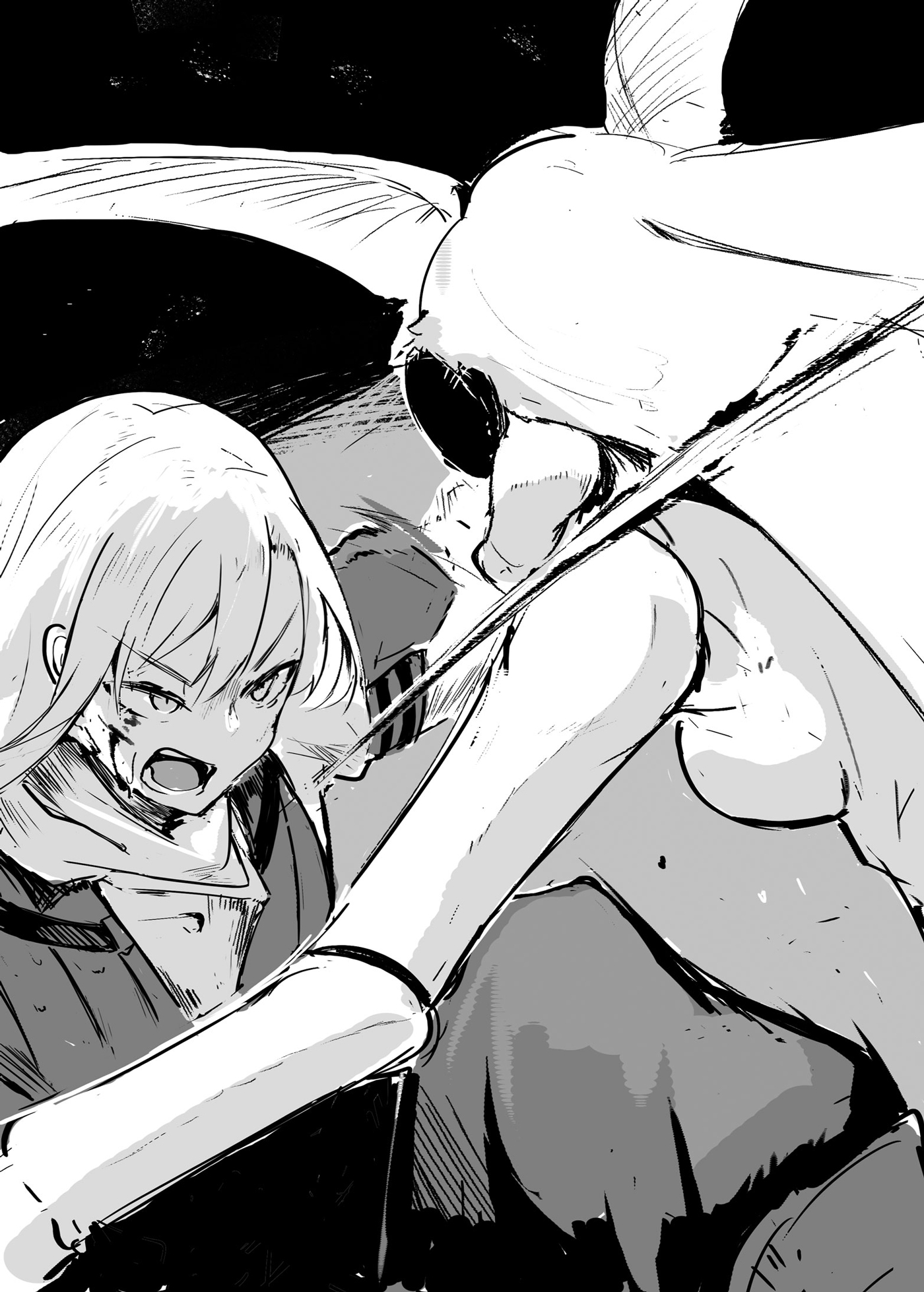
My permanent gentleman’s carry was perfect for exploiting the weak neck all living creatures shared. Despite always keeping it primed for when I needed it most, I tried my best not to use this knife whenever I could. The ability to slice through only flesh that the wielder targeted was just too good: swordsmen need guts, and I was scared my intuition would dull if I relied on an AC-ignoring weapon all the time.
But of course, I wasn’t going to hold anything back when the going got tough. Death wasn’t an option for me.
I kicked the headless and unresponsive monster in the gut to send her off...only to see her decapitated body begin flailing after it hit the ground. I knew I’d been right to stay alert after landing the fatal blow—she resembled an insect even in death.
By my estimate, most people have played with bugs in their early youth, before developing a learned animosity for creepy crawlers. Assuming that holds true, I suspect that many have accidentally squashed an insect’s head when trying to pick it up. The fate of those poor specimens is universally to wriggle and writhe as if they’d forgotten that they’d just lost their heads and that death was right around the corner. This is because insectile nervous systems have several hotspots of nerve clusters; while the brain is responsible for more advanced thought, there are often other clumps that determine the movement of local muscles in the thorax, abdomen, legs, or wings.
Built like a hyperadvanced version of an insect, the strange life-form could very well have possessed similar nerve centers—perhaps even one intricate enough to be capable of acting as a secondary brain.
I’d been playing it extra safe because it wouldn’t have been a laughing matter to die to random attacks from an enemy I’d already killed. At this point, though, the brainless body could do me no more harm. Now that I could turn my attention away, it was finally time to push forward and take the final piece.
[Tips] Although many demihumans possess insectile traits, most do not stray that far from the basic mensch design; none are capable of superhuman feats like running off an auxiliary brain.
Watching Schnee Weiss—a creation he’d cared for nearly as much as his own daughter—sacrifice itself brought the duke to the brink of tears. The moth collective was an expressionless bunch, and it had never overtly reciprocated his affection; to see proof that it cared for him to such an extent moved him. Other than the central unit in charge of self-preservation, all of the swarm had laid itself down in an heartwarming display of parental reverence.
However, the time for joy and doting was not now. Schnee Weiss had haphazardly thrown together a humanish body in the name of protecting the duke by any means possible; the boy who struck it down would have to be dealt with as a matter of first priority.
As Martin began pouring everything into regeneration, the young man tossed another catalyst his way. The small vial burst on its own in the middle of its trajectory, raining down a viscous liquid that instantly ignited.
For a moment the professor thought it a trifling oil bomb—but only for a moment. At present, there was so little oxygen in the air that he could hardly breathe; why had the flames not gone out?
He attempted a simple firefighting spell to pluck out the oxygen around him, but the cantrip’s gooey liquid fire refused to let go. Each passing second scorched his weakened body and summoned waves of excruciating pain.
Fire and the accursed inferno it brought was the loyal eldest son to the God whose grudge had yet to set. Both the pain and scars it imparted upon vampires were more pronounced than those of other races, causing burns to heal far more slowly than normal wounds—it was nearly as bad as the visceral physiological rejection caused by silver.
The prolonged heat continued to torment him, eventually broiling his eyeballs until they popped. Not only was the flame difficult to extinguish, but the temperatures it produced were profound.
Still, while the pain was intense enough to evoke concerns of death, the duke could withstand it. He had lived for quite some time, and assassins impressive enough to be worthy of his praise came with the territory. He’d been stabbed, drowned, locked in a steel coffin, and, of course, burned. Many times, in fact. When he’d managed to survive run-ins with metaphysical flames that only conceptually burned targets, this was hardly anything to fret over.
Martin swiftly manipulated his own blood to cause his entire body to explode.
Flesh flew everywhere, taking the oozing blaze along with it. The fibers of his muscles were painfully visible for the world to see, but it was better than letting the fire impede his resurrection for any longer.
First and foremost, he rebuilt his sensory organs. These were a must to accurately enact mystic change upon the physical world, and more simply, he needed them to figure out what in the world was going on. The deflated sacks of his popped eyes filled once more as if time were flowing in reverse, restoring the silver glimmer hidden behind his mask.
The first thing the vampire saw with his new eyes was the boy sprinting toward him with his blade on his shoulders, reaching into his bag to pull out something shimmering.
Experience and instinct collided to scream in the duke’s mind: He knows how to kill a vampire.
The stern, hairless side profile of Archbishop Lampel glimmered in the boy’s hand. The Night theologist’s infamous dissertation, The Covenant of the Endowed,had pioneered a high-minded philosophy of ideal vampirism that had catapulted him to fame. Coins minted in his honor were exceptionally pure in silver, making them a popular good luck charm for vampires who desired his protection...and for those who wished to hunt the indulgent heathens the world derided as bloodsuckers.
The coin was death: no vampire, be they freshly sired or old as the earth itself, could survive taking that to the heart.
Sunlight, miracle, and silver were the three hefty shackles that had come with their immortality. The vindictive Sun punished those who dared to fool Him; the sheltering Moon bound them so that they might not seek the limits of their pride. These were the things vampires could not survive—so the world had decreed.
Having neglected to train his feral instincts, stooping low to unleash his inner vampiric strength did the duke no good; the boy still won out. In fact, the swordsman managed to lop off all his limbs, taking away the last of his options.
And so, Martin went all out. For a split second, he let loose a humorless burst of his strongest magic, which ravaged everything around him. He was afraid of death; there were still so many pleasures he’d yet to see.
After all, whether the future proved entertaining or boring mattered not if this shell of flesh and bone he called a self housed a heart that would never beat again.
[Tips] Archbishop Lampel’s teachings begin with the well-known line, “Ours is a fate dictated by the humble solicitation of love. Let not the vampire fall to common lawlessness, damned to daemonhood.” Though the Trialist Empire sets the bar for vampiric behavior in the modern day, this treatise was written for a fractious religious group that predates imperial Rhine.
The man himself has passed away, but he is still remembered as the patron saint of vampires—a moniker officially backed by the authorities of the imperial pantheon—and enjoys particular reverence from those who worship the Night Goddess. Legend has it that his soul has returned to the Moon’s side to forever watch over his brethren, offering solace and admonishment when needed most.
Crap, I wasted too much time.
In the heat of combat, every instant had felt utterly packed, but I’d actually used up nearly a minute. While that didn’t sound like a lot, it was more than enough for a vampire to make real progress toward resurrection.
I tucked away the fey karambit and called back the Craving Blade only to find it was throwing a fit and wouldn’t respond—I kid, I kid. It showed up in hand as always, though I didn’t make up the part about it harassing me with its projected abandonment issues. I understood that it preferred the stylish form of orthodox swordplay, but I really wished it could save the grief for later.
Turning to the masked man, he was indeed nearing full resurrection. Shit, he’s fast... I gotta hurry before he can move to pick up his staff.
Running in, I pulled out the last of the antiundead prototypes I’d meant to test in the College’s labs that day. Although I’d kept my expenditures to a minimum, I’d still used most of the experience from the ichor maze on these three spells. I think every player can relate to theorycrafting a bit too much after nearly wiping one time. Of course, the meanest GMs refuse to reuse enemy types for whole campaigns at a time, but it is what it is.
I let the final projectile loose before the noble could fully heal. Shaped slightly differently so I wouldn’t get it confused with the other tubes, the metal cylinder packed with catalysts hurtled through the air and broke apart on its own, much like the fuel-air explosive.
But this time, only one side broke down, causing all the contents to splatter forward. This wasn’t some coincidence: I’d tweaked the formula to program its spread—once again with the madam’s help—so it would dump its payload directly on my enemies.
My commitment to simplicity was alive and well in this design, and its sole purpose was the opposite of the thermite bomb: keep a high heat for as long as possible. Basically, I’d fashioned an arcane napalm to prevent undead monsters from regenerating.
Fire leapt forth with a terrific howl, beckoning the aristocrat to a dance mired in heat. I’d swirled refined oil and animal gelatin together in a thickening agent to produce an incendiary bomb as crude as it was effective.
The lipophilic concoction couldn’t easily be shaken off, and I’d woven in a bit of true magic that would keep the relentless blaze alive without oxygen for a short while—it was the beastly embodiment of combustion. Without gasoline, I’d been forced to settle for enhanced oil, but the mystic boost was more than enough to bring about the firepower I’d hoped for.
No matter how much he regenerated, it meant nothing so long as the newly formed flesh was instantly burned away. I’d worked like mad to pack this spell with as much power and heat as I could manage, and the fruits of my labor were evident. The only way he could rid himself of the stubbornly clinging incendiaries was to shave away any part that made contact. This was what had made napalm so popular amongst the armed forces of Earth: normally, anyone that got the stuff on them was utterly doomed.
That said, the definition of normalcy in this world covered a far wider spectrum. There were probably tons of people who’d shrug it off with a casual whistle, maybe even—
A blast rang out. Once a human torch, the nobleman’s body exploded with a disgusting squelch, rocketing the flames in every direction. Embers whizzed by at speeds impossible for even my reflexes to react to, singing my hair as they passed.
No way... Did he blow off the whole surface of his body to put himself out?!
I had a direct view of the dark crimson entrails that ordinarily lay hidden, and could see some parts practically rewind the damage they’d taken in real time.
Shit! Is he shucking off everything that can’t help him in combat so he can get up and fight?! That must be why his bones and muscles are regenerating first!
I was all out of hidden aces, and without catalysts, I didn’t have a single attack spell to my name. Though I could cut him down so long as I had a weapon, killing him wasn’t the same as finishing the fight. In the worst case, monsters of his make could counterattack while dying and then take all the time in the world to heal back up afterward.
He was literally cheating: I was like the little boy at the arcade playing on a single quarter against a grown man pouring in his salary.
I yanked my shriveling spirit to its feet with my loudest battle cry yet and swung at the bloody mannequin.
Suddenly, he expertly clicked his meatless tongue and raised a misshapen hand—one with long, vampiric claws primed for battle.
I knew you could do that! Why the hell haven’t you until now?! Were you fucking sandbagging?! Are we mortals so pitifully frail that you have to toy with us instead of using your fists, you long-lived asshole?!
But it was too late to fall back now: I’d have to commit to my attack and use the three thermite darts I had left to cremate him before— Wait!
Genius struck. I’d likened the man’s childishness to arcade games and the coins that fueled them, which reminded me...I had one. I had something made of nearly pure silver.
Using one strand of thought, I formed an Unseen Hand to sift through my bag and pull out my meager purse. Inside, I found a valuable coin that I’d kept just in case: the same high-grade silver piece of Archbishop Lampel that I’d gotten as a reward for “selling out” Miss Celia. I’d kept it on hand in case of an emergency expense, but never would have imagined it’d turn into a real silver bullet.
I can win. All I had to do was split open his chest and jam this coin into his open heart, and the unkillable vampire would meet his end. There was nothing he could do to stop it: the gods had decided long ago that this was how the world worked.
I only had one chance, one opportunity—the battlefield never offered redos. But this was a bet worth calling with my last silver piece; I took one final step and showed the cards hidden in the flourish of my blade.
All right. It’s time to see who has the better hand.
But first, I had to stop him from moving. He seemed unaccustomed to fistfights, and I managed to manipulate his movements by bluffing with my gaze and body; a quick feint to the right with my weight still centered left was more than enough to fake him out.
His right hand was wide open when I chopped it off, and I quickly took his left following a panicked attempt to counterhit. Three thermite darts floated in my Unseen Hands above, and my left knuckle curled around the silver bullet to end it all.
If I failed here, it was over. I’d played all my best cards, the deck was empty, and my hand was sparse.
If I pulled back here, it was over. A battle of attrition against infinite healing was no different from suicide.
Hesitation spelled death; retreat spelled death. Everything rode on this one attack—this one moment.
I’m all in.
“—!!!”
Just as I wound up for the decisive blow, the Craving Blade began to shriek. This wasn’t the same pleading sweetness that it employed when begging to be used. It was urging—no, demanding me to do something, but the nebulous blobs of thought failed to produce any linguistic meaning in my mind.
By the time I realized it was a warning, everything was over.
“Ackgh?!”
Hideous creaking accompanied the distortion of space. I’d been in the air, just about to land for my final step, when I blasted off and saw something unthinkable: the arms and legs that so intimately accompanied me through every experience I’d ever had...flew off. My Lightning Reflexes triggered, dragging out the terrible scene into a nonconsensual slow-motion film.
My right arm tore off from the shoulder; my right leg burst at the shin; my left leg twisted free around my thigh. The limbs I’d lovingly used since my ego first woke in Konigstuhl were gone.
Though I couldn’t even begin to understand what had happened, I strangely felt no pain. Perhaps it was the heat of battle, or maybe my brain simply couldn’t process the surreality of the scene. I simply sailed backward, soaking in the force that sank into my body.
The sword in front of my chest groaned. I didn’t know when it had gotten there, but it was probably thanks to it that my neck didn’t spin off for an instant kill. It had realized I couldn’t defend myself, and come to shield my vitals, if nothing else.
My sole remaining limb had still snapped like a used toothpick, but it hung on by a thread—no doubt because of the glimmering jewel on my left hand. Seated in the lunar ring, her brilliant ice-blue shone as beautifully as ever.
It was too bad that they could only prolong my death by a few seconds.
The spiraling force had yet to dissipate, and I could feel that the invisible tornado wouldn’t be content until my carcass was reduced to mincemeat.
I guess I should’ve known. No matter how playful the man’s speech and mannerisms had been, he’d still been trying to kill me. Threatening to put him down for real would naturally trigger an unmitigated response of incomprehensible violence.
But I’m not dying alone.
I’ll kill you. I’ll fucking kill you if it’s the last thing I do.
Looming death brought time to a crawl, and I could still weave together spells so long as Helga’s memory shimmered true and my brain could muster up the formulae. I was going to see my mission through. My Hands had been torn asunder, sending the thermite sticks and the fey knife flying; if I could catch them, drive them into his chest, and grind the silver visage of a somber monk into his exposed heart, he’d go down.
I could sort of just tell that it wasn’t worth trying to live. This wasn’t the sort of direct attack I could redirect with a space-bending barrier; the space around me was the range of the attack. Swordsmen weren’t built to dodge this kind of thing. Maybe a pure tank could muscle their way through it, but a flimsy mensch brat didn’t have the HP to tough it out.
So the only thing left was to not die for free. I’d gotten to this point shouldering all kinds of promises and dreams, and I wasn’t about to lay down and obediently accept what boiled down to a fucking traffic accident with a broken enemy!
Sure, this line of work saw dragons falling out of the sky, high-level characters just hanging out around town, or random mutts that came out to chase you if your dice rolls sucked—yeah, it was hell. But that didn’t mean I could accept being squashed like a bug just because of some crappy luck.
I’m taking you with me!
“Thou scamperst overmuch, pup.”
Just as I was about to avenge myself, the awful creaking and all the pressure causing it were overwritten by the gentle timbre of a woman’s voice.
“Know thy place. To check frolicsome jesters be thy burden by right.”
Scarlet mist settled into the room, enshrouding the nobleman; a second later, I heard a cataclysmic noise. It was the abominable sound of a hard object crunching, like an overwhelming mass had crushed a person whole. The aural equivalent of someone filing my psyche down with sandpaper was the backdrop that accompanied my uncaught fall.
“Oh? A tad tardy, mayhaps.”
Still producing grisly sounds—I thought I could hear screams, or maybe pleading, as well—the red cloud wound into a more definite shape. The amorphous crimson fog dissipated to naturally unveil a noblewoman as if she’d always been here.
The lady wore a toga that, while far behind the times, evoked lofty imagery from the days of classical poetry; her stature was apparent at first glance. Dyed in the rare imperial violet, she wore it well, though for whatever reason, she seemed to wear nothing else. Her near nudity clashed with her grace to produce an eccentric impression.
Bloodred eyes and inky-black hair embellished the purple tunic with orphic charm, and the gloss of her milky-white skin betrayed softness beyond that of clouds. Though her eyes drooped in a dreamy way, the long and menacing fangs protruding past her lips were the mark of a vampire.
She seemed familiar, almost. As the pain began to set in and the blood loss blurred my vision, another face quite similar to the gorgeous woman’s popped into view. The girl in holy garb crawling out of the red mist was the same one I’d parted ways with a little while ago.
Ohh, I thought. Of course. She looks like Miss Celia.
Gazing up at the crying nun running my way, I found this pointless discovery terribly entertaining as I closed my eyes with a smile.
[Tips] Imperial violet is the most highly prized of all forbidden colors in the Empire. Only the Emperor and former emperors are permitted to wear it on their persons. The dye is incredibly rare and labor-intensive, and has been considered a status symbol for centuries; naturally, the Empire codified its restricted use upon its founding.
However, the tone of purple is incredibly garish, and modern emperors tend to avoid the color outside of official ceremonies.
“Wha—wait! This isn’t fair! Why are you here?!”
These were the duke’s first words upon being yanked by the neck out of the red mist. Though he’d managed to scramble together something resembling a head and chest, his limbs and lower torso had been minced beyond recognition—even his carefully set hairdo had been reduced to a terrible mess. The mask he seemed so partial to lay shattered on the floor.
“Oh? Thy japing wit is ever marvelous, pup.”
The woman let her imperial-purple toga scandalously sag with a grin, flashing her kind’s trademark fangs. Hers was a smile steeped in intimidating menace. Though her words tiptoed around and around, the dated Rhinian she spoke sent the duke into a shivering fit.
Martin hated this roundabout speech; he hated this enunciation; but most of all, he hated her. That was the sole reason he made a constant effort not to allow his verbiage to fall into archaics as so many long-lived vampires were disposed to.
“If I should read the matter fairly, the first fault must be thine. Look to the ruin thou hast fashioned from a boy; look to my beloved grandniece, so tearful she hath clung to my side.” The woman smiled tenderly, yet with the pristine etiquette of a proper lady—all while engaging in unspeakable violence. “And look finally to me, whose banquet thou hast cut short.”
Here stood one of the few women to grace the Trialist Empire with her reign. Theresea Hildegarde Emilia Ursula von Erstreich, remembered as the Delicate Empress, crushed her nephew’s neck.
“Grghleg...”
Dainty fingers suited best to shining silver cutlery or epicurean fans squeezed tight, shattering all seven bones in his neck. Her lithe frame could not give away her ruinous clutch as she held fast so that the man could not heal.
Vampires very rarely received enough divine favor to put down undead, and a mutual inability to wield lethal silver weapons caused infighting to devolve to this: raw violence. Combat between two vampires was a constant exertion of overwhelming pressure that only ended when the opponent cried uncle.
Though the frame may be immortal, the self resided in the realm of thought. The psyche, being a ginger, fleeting thing, was markedly less unkillable. Such was why Martin had developed a spell to continuously compress space: the incessant twisting force was his way of dealing with the undead.
“Rather, he who hath been duly called Emperor must not cry like the hens at dawn at the passing sight of a kinsman. At present I am a playwright only, and retired in the main; these slender fingers can hold naught but pens.”
Though the duke tried to scoff, “Slender indeed,” his crushed windpipe could do no better than produce bubbles of blood. The crowning jewel to seal his misfortune was that, much like how he had honed himself to the height of magecraft, this aunt of his was the pinnacle of vampiric strength...and she was at point-blank range. The fight had been decided the moment she’d gotten into close quarters—that was how bad the matchup was for him.
The Delicate Empress turned her body to mist, rocketed across space, and gulped down blood to heal her wounds and tap into strength unimaginable. She took every single strength that caused the other races to fear their ilk as bloodsuckers and proudly announced that this was what it meant to be vampiric; her strategy was unbeatable precisely because it was so simple.
Broken and battered, the duke was damned to a cycle of death and rebirth without any hope of casting a spell. All he could do was match his aunt’s look of disdain with a hateful glare, just as he had on that boat all those years ago. For her part, the woman apathetically shrugged off his silver rays of loathing and turned her attention to her great-niece, who’d sat down by the unconscious mensch boy’s side.
“Fix thine eyes upon my honey-hearted darling. How she doth remind me of mine youth; oh, how I pined for Sir Richard as a maiden,” Theresea said with a sultry sigh.
The vampiric nun knelt over the fading mensch life and wound her hands over her holy icon. Spurred on by the rich smell of blood, her fangs instinctively slipped out; their pointed tips tickled her tongue as if they were whispering right into her soul. For a moment, the addictive taste crept back from her memory to her mouth, triggering gluttony that spoke in hushed tones from the back of her brain.
Here lies a feast, it said. The God of Cycles has played a trick of fate to supply you with the greatest meal you could ever ask for.
“...O Goddess.”
Yet the priestess held firm, clinging to an invocation of the Goddess’s name as she bit deep into her tongue. She was not Constance Cecilia Valeria Katrine von Erstreich, the weak-willed vampire; she was Sister Cecilia, the humble priestess of Night that would save this boy’s life.
“O merciful Goddess of Night, Ye who watch over us from the heavens.”
She let the bead of blood that spilt forth from her lips roll down her chin unimpeded, instead moving her tongue to speak the words that needed to be spoken. Every syllable contained meaning—latent power that her faith granted her, yet that she had not once called upon until now.
“I am she who prays to give, she who refuses to merely receive. Loving Mother, I beseech Ye to relieve this soul of suffering.”
The gravitas of her incantation was met with a gentle glow of unknown origin that dispelled the eerie lighting of the room. True moonlight shone: the Mother’s guiding gaze cut through the dark to guide Her lost lambs.
“Take me to dust, and save Your beloved child from agony, for such is the path Ye have laid out.”
Cecilia’s solemn prayer was answered by heavenly power meant to distort reality to be as it always was meant to. Miracles were just that—miracles; their effects could bring about change that not even the most sublime magic could replicate. When the nun placed a torn limb back into place, it fused with the greater body as if it had never left. Leaving no scars nor even a mark of its destruction, the flesh combined with a lustrous new coat of healthy skin.
This was infeasible by normal means. What few or none could accomplish with thaumaturgy became perfectly possible with miracles. The powers that be used the limited omnipotence vested within Their bounds to dutifully bring about the wishes of the faithful.
But the gods did not coddle. They were guardians to be sure, but keepers of the world: to give and give alone was unthinkable for a miracle of sizable scope. Allow that, and men would cease to be men—they would fall to become mere servants of heaven.
“Urgh...agh! Aurgh! Hgraaah!”
The nun’s limbs began to rip apart with a distressing clamor. Muscles, tendons, bones—everything tore to announce that this was the price paid for a feat that defied reason.
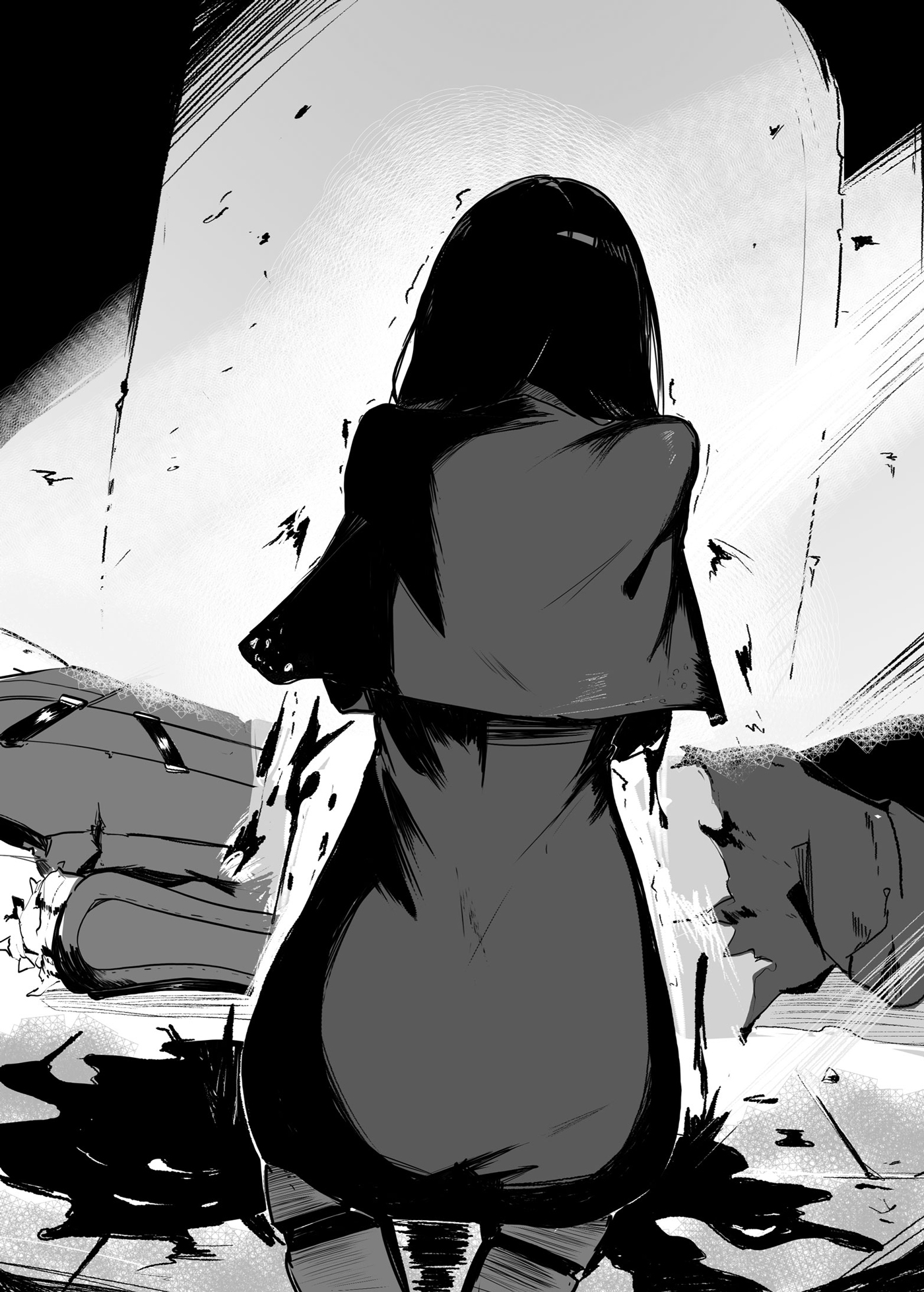
Limbs were not made to be replaced. Even in a futuristic world far more advanced than this one, to reconnect a severed body part was the exception, not the norm. Ask a deity to achieve the impossible, and they were sure to collect a fair due.
Flesh was bought with flesh; bone was bought with bone.
This miracle was one where the caster could accept another’s injuries to heal them. Recreating lost limbs was the peak of healing, and it differed from small exorcisms or insignificant blessings to cure fatigue as a matter of course—mere dedication could not afford such awesome results.
Cecilia’s right arm and both of her legs were rent off exactly how Erich’s had been, and her left arm folded in on itself like a game of cat’s cradle, bone jutting out of her skin. This was the price of calling the Goddess to the mortal realm.
“Mmgh...grah! Hng!”
It went without saying that a vampire would not die from losing their limbs. Furthermore, the miracle’s side effect only went as far as shifting the damage onto the caster; once the process was over, Cecilia would be allowed to heal the wounds away—she could even employ other miracles to expedite her recovery. One could say that this was the epitome of the mercy over which the Mother of Night presided; without Her aid, a detached arm would be as good as lost, after all.
Still, for a sheltered nun who knew not pain, the Goddess’s trial proved too much to bear. The agony of losing all her limbs was as excruciating as what Erich had felt—no, in fact, the boy’s senses had dulled in his intense battle. Cecilia’s torment was incomparably worse.
Shredded to pieces, her starving body thirsted for blood. The demonic nature she had thought pacified flared up inside of her, saying that to take a sip now would be a trivial fee for the life she’d saved.
How euphoric it would be to sink her fangs in this limp body—oh, how luscious it was sure to be. Without a doubt, it would be a rhapsody that would never leave her mind; something deep down told her that nectar like this might never appear before her again for as long as she lived.
“Hng...no! Augh, agh...aaaugh!”
This craving was inherent to the rabid species. Yet forcing down an accursed thirst that mensch couldn’t even begin to imagine, the nun pushed herself to her feet. Whipping her ego like a cruel taskmaster, she propped herself up on disfigured legs.
At last the young vampire confronted the root of it all. Still hanged in the hand of the great-aunt born during the Empire’s foundational years, the father born in its era of first light looked down at her as she spoke.
“Father, allow me to make my intentions expressly clear.”
Clad in bloodsoaked holy garments, the daughter glared at her self-serving father and decided to take after him. Though she believed in filial piety, the thought that she might not be allowed what he was drove her mad. Just because her great-aunt had forced the position on him did not mean that he could do the same to her.
“I will not rise to the throne. How can I, in all my inexperience, take the reins of House Erstreich and the Empire both when I am not even yet of age? I am sure Uncle Dearest and the venerable Second Emperor will agree.”
The duke seemed like he had something to say, but the noose of flesh around his neck refused to let up. Besides, he was in the presence of the clan matriarch—who was going to oppose her? Piping up now wouldn’t do him any favors. His cute little familiars were still unresponsive, and while they were due to wake up soon, the only one that had any hope of lasting more than five minutes against Theresea had been Schnee Weiss.
“I have chosen to dedicate myself to my faith. You and Mother may have placed me in the monastery for my own security, but I now call it home of my own volition.”
Above all else, Martin could tell from his daughter’s eyes that there was nothing more he could do. The signature vampiric bloodred gems overflowed with independence that reminded him of his wife. She had been a gentle woman, but her will to see through anything she set her mind to had always been unshakable.
Strength had resided in grace; strictness had resided in love. And though she had supported him wholeheartedly, she’d possessed the fortitude to not lose herself in her husband—a tenacity that was alive and well in their daughter.
Martin had lost. While she might take on some responsibilities in a legitimate emergency, nothing he could say or do would get her to accept the post now. It was clear from the moment that she’d steeled herself for the exhausting politics of dealing with their extended family—and her particularly terrifying grandaunt, at that—that she was deathly serious about this.
“Let me repeat: I will not be Empress, nor will I lead the clan.”
Having been turned down so plainly with the wild card of their family’s power dynamics on her side, the duke had no choice but to give in. But just as he was about to nod in defeat, he noticed something off: a streak of pure rage in the swirling passion that he saw in her crimson eyes.
Why was his daughter so angry? Sure, he’d tried to make her the next Duchess Erstreich while arranging what was effectively a marriage with the Empire—no reigning monarch had time for love, what with all the duties—which explained some of her ire. He, too, had gotten into genuine life-or-death fights with his aunt because of how much he resented her for the succession. But something told him that a good chunk of her fury came from something else.
“And one last thing...”
Martin wondered what it could be. Perhaps it was how he’d bullied the church into bringing her to the capital. Or maybe his overdone plans for a succession banquet had been leaked, complete with the seven full outfits he’d excitedly prepared for her. If not those, then she could simply be bitter about how he’d pulled a bunch of strings within the family to make this scheme work in the first place...
“Don’t ever talk to me again! I hate you, Dad!”
A bolt of lightning zipped through the duke. This was the biggest shock he’d felt all day—nay, this was surely the most traumatic event of his entire life. Not even the time a silver dagger had grazed the side of his heart had frightened him so.
“S-Stanzie?!” So great was his hysteria that he managed to squeak out a word despite his aunt’s steadfast grip. He yelped the diminutive to his daughter’s first name, which he’d picked out for her—though she never seemed to introduce herself with it—and his handsome features scrunched up sadly.
“My name is Cecilia! How many times must I tell you to call me by my favorite name?!”
“Thou fancy the name I ha’ picked, dost thou? Ha ha! Splendid! Lovable—oh how lovable thou art, my precious babe. There, there, fret not. Let this old bat set all affairs to suit thy design.”
Turning her back to her stunned father, Cecilia made her way over to the sleeping boy. If her great-aunt was offering to handle the rest, then it would be best to patiently wait here, but to leave him on the hard floor was simply too much—he was the hero who’d saved her from a marriage with the throne.
“Wh-Why... Stanzie...”
“Woof, woof—thy barking moves me to such pity. What folly seduces men so with promises of love undying from spouse and spawn alike? Alas. I shall teach thee this lesson and many more tonight, pup.”
Despite the filthy ground threatening to sully her robes, Cecilia took a seat, lifting the boy’s upper body onto her legs. While she may have taken on all his injuries—even the minor scratches—the miracle did not restore blood already lost. His body was cold, and letting him lie on the chilly stone wouldn’t do.
The boy slept soundly. His head tilted to one side, exposing the neck that had captured the girl’s imagination ever since drinking from that cup of wine. As appetizing as ever, his smooth skin called out to her.
What a natural-born vampire slayer, Cecilia thought with a giggle. She pulled up the collar of his armor so that he wouldn’t catch a cold.
Her instincts whispered: You fool. The perfect prey is before your eyes and yet you refuse to bare your fangs. If you act now, it would be all too easy to prop him up as your lover—as your thrall, ever by your side.
She whispered back: Would that not make me a bandit? The very same as the bloodsuckers Archbishop Lampel once condemned as the pinnacle of evil? I am a vampire, yes, but also a believer of the Night. As such, I shall return goodwill with goodwill—I would never pilfer his life for my own gain.
And to tell the truth, the girl found this all a bit fun. Once, she’d seen a play. It had depicted the done-to-death story of a noble girl sneaking out of her house and running into a traveling hero. The princess did not do such awful things to the hero. She simply took his outstretched hand with a cordial smile and hugged him close when he was tired. From there, her job was to support him from out of sight.
The Goddess would not reproach Cecilia for inserting herself into an innocent fantasy, and she wanted to spend a little more time enjoying the reality that she’d been saved. And as if to affirm her dreams and actions both, the lunar medallion jingled quietly.
[Tips] Patricians often have several given names. Though most customarily go by their first (usually given to them by their fathers), many also elect to employ a second or third name that they are particularly fond of. This is especially true if a high-profile figure tarnishes the reputation of one’s main name.
Postface
Postface
Ending
Should the split party succeed in their endeavors, they will reconvene to share their tales—though there is no guarantee that all will be fit to participate in the next adventure. Yet if the story goes on, the truth must be accepted, whatever that fate may be.
Though I was growing accustomed to waking under unfamiliar ceilings, my awakening filled me with a sense of hollowness.
“I’m...alive?” It took me several minutes under the light of dawn, staring at a marvelously embroidered canopy, to collect my frayed thoughts.
I’d figured I was just dead. While I had some memory of help arriving, having all but one limb torn off was more than enough to put me over. Even though I recalled my savior’s noble appearance, the art of limb reattachment was heavily guarded by the College; Miss Celia may have been a priestess, but I’d heard that the miracles able to achieve such effects were locked away at the peak of devotion, so the odds of that seemed slim. I mean, I didn’t even know how she ranked within her church. Since traditional care wouldn’t cut it, I’d assumed I’d been at the end of my line, but...
“What, did these things just grow out of nowhere?”
That crank of high rank had torn me asunder, and I couldn’t imagine what kind of omnipotent cheat code could have put my arm and legs back in place like they’d never left.
Gingerly, I tried to move my arm...and found no pain, nor even discomfort. Flipping the sleeve to my curiously soft nightclothes—the needlework made questions of its price too terrifying to ask—I was met with skin unblemished by scars; I couldn’t find so much as a scab. My legs were much the same, and I was able to wiggle the tips of my toes, proving that my whole nervous system was in order.
I sighed in relief, only to come across another revelation: “It doesn’t hurt to breathe either.”
The snapped ribs that had been giving me so much grief were better. Running a hand over my chest with dainty care, I felt no pain or tingling; going down to my stomach, I felt only the smooth definition of my abs, unmarred by any unnatural breaks.
I was the picture of health; in fact, I began to suspect that the whole fight had been an illusion. The only evidence it’d been real was that I was a tad dizzy, probably because I was famished and parched beyond belief—but that could just as easily be explained by the fact that I hadn’t eaten since noon the day prior.
But where am I?
I couldn’t reason out what had happened by pure inference, so I shelved the topic and started looking around. Judging by my surroundings, my circumstances seemed rather complicated.
I was laying in a gargantuan canopy bed, and a thin, nearly transparent curtain separated me from the outside world. The quality of my sleepwear needed no expanding on; pressing against the mattress betrayed springs buried within—I’d heard the wealthiest enjoyed luxuries like this—and the blankets on top of me were stuffed with the most epicurean of fluff.
When every part of my sleeping space was so delightful to the touch that it tickled my kleptomaniac impulse, it was clear that I was in blue-blooded territory. This bed could service a “gathering” of several people with room to spare, so I was sure to be in a particularly notable noble’s home. Even aristocrats with loose purse strings ordinarily wouldn’t bother with beds of this size.
There were plenty of potential avenues that could have led me here, but pondering them wouldn’t get me anywhere. Getting a grasp of my surroundings was a rule of thumb that extended beyond just TRPGs: Okay, GM. What do I see?
Playing out a joke that no one in this world would get, I looked around to find a small bell at my bedside. It had a memo attached to it, which read, “Awake?” in gorgeous calligraphy.
Ah, I see. So I ring this when I wake up. Good to see the gimmicks here are straightforward.
I picked up the obviously priceless bell and rang it.
“Huh?”
Yet I heard no noise. Confused, I turned it upside down to see that the instrument lacked a clapper. That alone would have made it a defective tool, of course, but I could squint to make out minute engravings that produced a mystic formula. It felt like every last thing around here was a premium product.
I studied the spell’s construction in awe for a short while, until I heard a reserved knock at the door. After a moment, I cocked my head: why weren’t they entering? It took me a full minute before realizing, Oh...I’m supposed to give them permission first.
Although I asked to enter rooms quite often, I’d never been in the opposite role. The only time anyone bothered to knock for someone like me was when I was in the changing room at Lady Leizniz’s favorite clothier.
“Um... Come in?”
Nerves caused my words to pitifully inflect upward. I couldn’t help it! I was a genuine country bumpkin; learning the ins and outs of how patrician society operated did nothing to help me when I had to act like one of them.
“Excuse me.” The woman who entered with the nigh inaudible sound of the door was none other than a true-to-life maid.
Wow, a maid! A real maid! As multicultural as the capital was, this style that came from the islands far to the east was a rarity. Traditionality survived in her every detail: she wore a long and plain black dress capped with pronounced cuffs, covered by a frilly apron, and her hair was kept in place with a headcap; she was the living embodiment of retainership. Her skin was fair, her eyes green, and her hair light russet, all culminating in a youthful set of facial features that had me feeling pumped.
Vassalage in the Trialist Empire was a complex thing, on account of the intermingling feudalistic and modern ideas pervading it. The upper crust customarily took in the second sons or daughters of other houses as attendants or had entire lineages devoted to waiting on them; these upper servants generally became trusted stewards of the family. Meanwhile, lower servants were trustworthy common folk—their character guaranteed by their canton’s leaders—that originated from their feudal estates, and they served in exchange for a stipend or tax cut, usually sent home to their families.
On the other hand, those brought on by wealthy merchants or farm owners were hired help in every sense of the word: after a period of unpaid labor, they could expect to use the skills they learned during servitude to gain employment. Theirs was a contract bound by interpersonal relations and wages as opposed to the territorial and hereditary circumstances that determined noble obedience.
Spending any time at the College was an easy way to internalize the difference. Magia invariably had money, but those who only had money employed very different help from those who were highborn. The former relied on rural hicks like me or working-class citizens of the capital, while the latter were waited on by people of considerable pedigree—perhaps even a clan of thoroughbred retainers that attended to their family’s affairs through the ages. These maids and butlers were masters of the most humbling version of palatial speech and were literally born to serve the elite; comparing them to a hastily trained kid like me was like comparing a farm horse to a military stallion.
With all this in mind, I looked her over and...wow. It looked like I’d found myself in the home of someone near the top of the pyramid. The quality of her mannerisms, speech, and clothing went without saying, but upon closer inspection, two pointed ears poked out from underneath her hair. How high up do you have to go to employ methuselah as servants?!
“Nothing should please me more than to see that you have arisen. My name is Kunigunde, and I have been duly charged with the responsibility of waiting upon you. Please do not hesitate to task me with your every need.”
“O-Okay.”
I could only muster a one-word response; for all the effort and experience points I’d put into figuring out the servile palatial tongue, her absolutely perfect diction made me want to get down on my hands and knees in reverence. Worse still, she was using the dialect meant to be used when engaging with a guest of the highest honor. Not only was I ignoble, but I wasn’t even a bureaucrat; I could hardly process the words as they came in my ear.
Seriously, what happened to me?
“Though I am sympathetic to your confusion and am sure you have many queries, allow me first to ready you for the day. My master shall elucidate in due time. If you’ll excuse me...”
Wrapped in silk gloves, her hands reached back to a rolling tray behind her—I hadn’t even noticed because I was too excited about seeing a real maid—to grab a pail full of hot water. She swiftly wiped down my face with a wet towel and began brushing my hair before my surprise could catch up to me.
My hair was getting to the length that people would assume I was a woman from behind; she combed through the entire length, going so far as to apply a layer of oil. Things were moving so fast that I simply sat there, unable to keep up.
“Your hair is wonderful,” she said. “Do you treat it with anything in particular?”
“Huh? No, not really...” ...unless you count fey blessings.
But my hair was unimportant: the more pressing issue at hand was that she had me sit at the edge of the bed and was doing her work from the front. The chest bobbing and weaving in my face was more impressive than any of my locks, and it was markedly worse for my psyche. Thankfully, what I assumed to be light anemia relieved me of the foolish boyishness that often accompanied the morning, but I actively had to fight stray thoughts like, I wonder if I can dream up an excuse to bury my face in those...
Too focused on reining in my steamy thoughts, I found myself clothed before I knew it, and then pushed back in bed to sit with my back against the frame. The maid then brought out a folding table from who-knows-where and lined it with a meal.
“My sincerest apologies. We were unable to prepare anything more than the simplest of basics, as we were unsure when you would arise. Should you have any particular requests, I will strive within my power to fulfill them. Is there anything you would like?”
“Simplest...? Basics?”
I’d been served fragrant red tea, a danish—you couldn’t even get those around town—that had clearly been baked fresh this morning, a boiled wurst packed with herbs that was just outside the price range of a common citizen, and a bit of honey-glazed cheese, which was something we peasants could only hope to taste during times of celebration. This breakfast put the Konigstuhl spring festival’s feasts to shame; if this was a basic meal, then what was I eating every day?
What’s wrong with these bourgeois pigs? Someone get me a hammer and sickle!
“If it is too heavy for your tastes, I shall prepare a light soup or porridge posthaste.”
The maid misinterpreted my dumbstruck stupor as a mark of poor health and tried to compensate; I denied in a panic and happily took the tray. I had no clue what was going on, but I couldn’t call myself an imperial if I let a steaming cup of red tea go cold.
As soon as she saw me begin eating, Miss Kunigunde the maid stepped away from the bed in relief. Though she only took a single step backward, it instantly became difficult to ascertain her position. She naturally employed magic at every turn—perhaps she was using traits from the Arcane Attendant section I’d once skimmed through on my character sheet. I guess second-rate heritage just wouldn’t cut it to wait on true nobles.
“The sun is high and the madam and princess are resting at present, so I beg you to make yourself at home and await their awakening here.”
I was clutching my stomach after finishing the lavish meal my gut was wholly unprepared for, and didn’t get a single moment of repose before she dropped this bomb on me. The word “princess” evoked one possibility: I’d written it off when I’d come to, but apparently she had been the one to save me. The fact that I hadn’t dreamt up that final scene before the pit of despair took me made me want to sigh.
“...Oh. A moment, please.”
The maid cut herself off, closing one eye and placing a hand on her temple. I recognized that reaction: it was that of someone who’d received an unexpected telepathic message. Some mages also used the pose to ponder arcane semantics more deeply, but a retainer interrupting her own speech betrayed a message from her master.
“My apologies,” she said. “It would appear it is too late.”
“Huh? Too late?”
Before I could ask what she meant, the door burst open.
“Thou’rt wakened, boy?! Most splendid!”
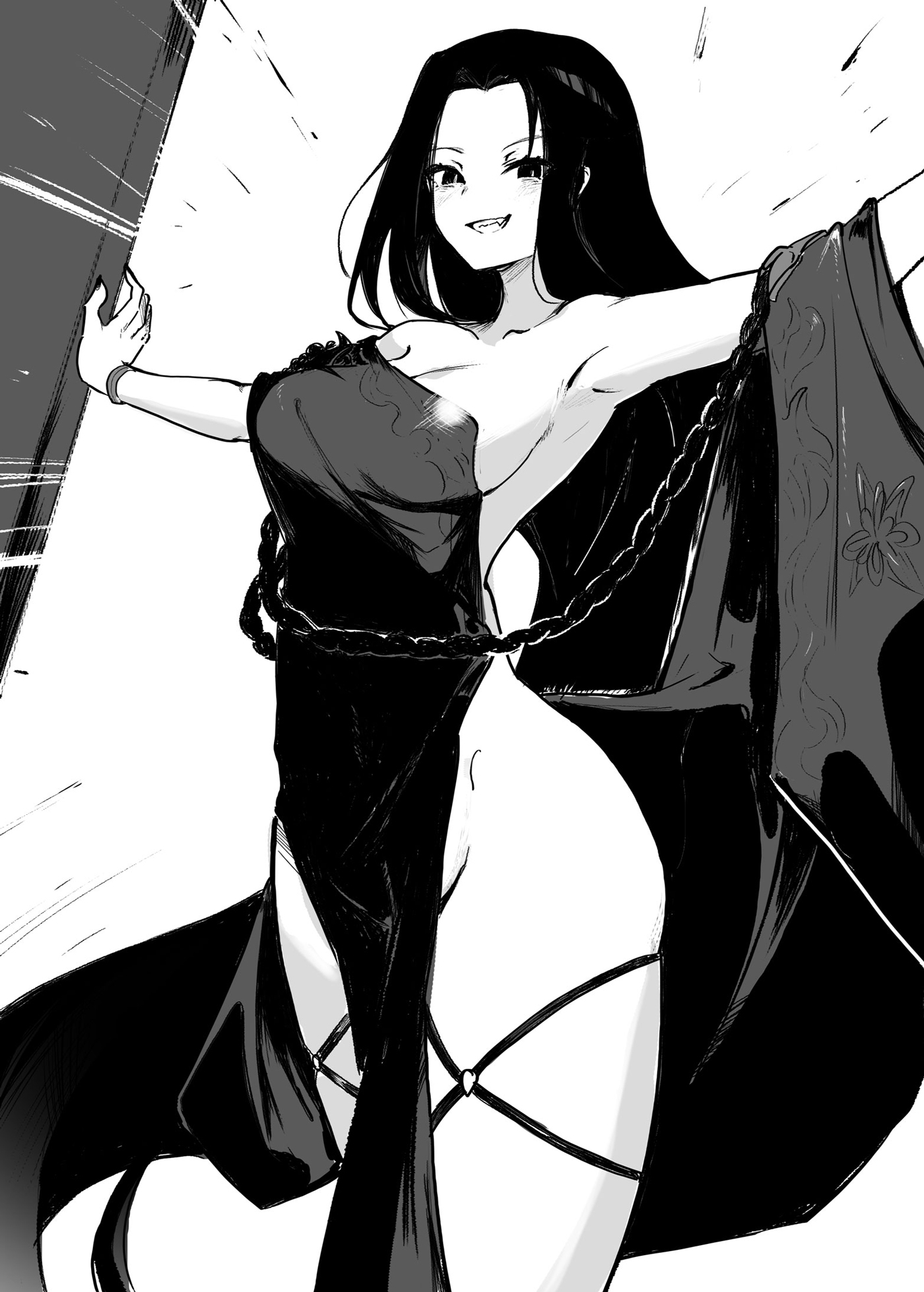
For a moment, I thought someone had assaulted the door with a battering ram; looking over, however, I saw nothing but a stunning woman who demanded the eye’s attention. It was the scarlet-eyed, black-haired, toga-clad lady who’d dispersed the masked nobleman’s attack. The magnificent colors she shared with Miss Celia were so striking that they were burned into my memory; though I couldn’t recall what color tunic she’d worn when I first saw her, she now had on something of vibrant crimson trimmed with golden thread.
As she made her way through the emptied entrance, the methuselah servant closed her eyes and stepped back with a resigned shake of her head. The message was clear: I wasn’t to ask for her help, as she could do nothing more for me.
“Zounds, the night was burdensome indeed. When the thaumagram arrived unbidden with its ill news, I raced forth to find thee dawdling at the reaper’s stoop, my darling grandniece unable to unhand thee for worry, and my senseless nephew yapping without reserve. Ah, which reminds me: that cretin proved so vexing that I pursued to leave him half-dead, and it fell short of mine ambition to butcher him only the once. O how I wished to be done.”
Unbelievably, the beautiful woman reminiscent of Miss Celia planted herself onto the side of my bed without a care in the world. Still, for all their similarities, this lady lacked the nun’s fragile grace; in its place was a pervasive confidence. Her thin, arched brows capped off two proud gems that gleamed with intimidating pride.
What do you think would happen if someone this gorgeous stared at me at such close range? The answer was that the strands of thought I’d managed to sort out got all tangled up again. Badly.
“Mistake me not. To cut a banquet short for my lovable, lovable darling cannot upset me, nor will I grieve mine own paltry effort to cudgel my clownish nephew. Doubly so when the endeavor is accompanied by a child of mensch so passing strange.”
Her beauty was something Miss Celia would never attain no matter how she matured: it was the ferocious allure of vampirism left bare. Curling her features into a smile, the yet-unintroduced woman ran her claw across my chin...and laughed. Her laugh was terribly unique—almost scornful, even. Her voice and archaic dialect slithered into my brain and locked their coils there, leaving me dazed.
“Ah, and how could I fail to mention? Thou must offer my niece thy gratitude in time. That thy flesh remains as it were when thou wert first born took my darling’s immolation as its price.”
I supposed this was a form of charisma in its own right. She showered me with a deluge of statements without any concern for me, but I strangely felt no displeasure. Her every action, her every word, buried itself within my memory with no intention of leaving. She was endowed with a ruler’s disposition. Blessed with magnetism that could pull along anyone around her, her talents evoked the image of a strong statesman, but the ruthless tyranny she could no doubt enact lurked just out of sight.
It was as if the personification of the dignity that had given way to history was here, sitting before me.
“Though that very darling niece hath run me round with all manner of tribulations. First sobbing over the whereabouts of some other, then demanding a courier dispatched without delay upon her discovery... Fleeting favorite of my kin, I imagine thou, too, hast much of my favor to ask. Dost thou not?”
While she’d posed it like a question, the flint-hard command in her voice goaded my soul to affirm her.
“May I ask why you’ve forgone garments below?”
...I can explain. She’d already gone off and talked about everything I wanted to know, and, well, I was curious. Tunics were big sheets of cloth that enveloped the body, but they were only meant to be an outer layer as part of a full outfit. For some reason, she was naked underneath. She was stark naked. It demanded so much of my attention that I mentioned it twice.
Her overwhelming presence had run over my muddled mind to the point where I couldn’t restrain my curiosity. More to the point, something had bugged out in my mental faculties, robbing me of the ability to produce anything but the shallowest thoughts. Why I was here, what happened yesterday, how my limbs regrew—I knew I had a lot to ask about, but still!
“Hm. The reason is simple.”
I could feel the maid’s incredulous glare jabbing into my side, but the half-naked vampire only skipped a single beat before answering.
“Fools adorn and embellish; I entice most as I am!”
The beauty showed off her body with exaggerated form, like an actress proud of her performance onstage. Her supple limbs paired with curves akin to rolling hills, all wrapped under skin polished to pristine condition. More alluring than the greatest works of marble, the toga hid her privates with salacious uncertainty—an unambiguous seduction. If someone were to freeze her as she was now and place her in a museum, guests would gather from around the globe to see her.
“Oh... Um... Well...you are indeed very beautiful.”
“Truly? Thou hast an eye for beauty, boy. Speak, then; if thy claim is more than mere puffery, tell me plainly what of my charm has enraptured thee.”
I’d let my base instincts take hold and blabbed out my true opinion, and now she meant to make me pay for it in concrete praise. Considering her peerage, I doubted she wanted for praise; why was she goading a dumb kid into offering her compliments?
Giving up on untangling my brain, I began to extol her appearance with the full extent of my verbiage, stammering every now and then out of fear that I might offend a person of such considerable stature. All the while, I had to swallow back what was probably the most important question I could’ve asked: Who are you, anyway?
[Tips] Retainers span the range of feudalistic serfdom to apprenticeship to paid labor. Ordinarily, this refers to lifelong, professional stewards as opposed to temporary servitude.
In the Trialist Empire, blue-blooded children will often spend some time waiting upon the masters of another house as part of their training in etiquette; there are also entire servant families who possess far greater history and influence than many new-money upstarts. Scandals caused by people looking down on “the help” without knowing their true stature are fairly common.
Nobles were tiresome creatures—animals propped up on a little something called “pride.” The whole of their power came from brand value and influence, and no material fortune could buy the respect that came with history and character. As a result, their spending was liable to seem utterly wasteful from a financial perspective: they erected mansions, laid out carpets, and prettied themselves with the finest clothes. Appearing cheap to one’s countrymen would come with a dip in standing; seeming unreliable to one’s subordinates would see them leave orbit; and meeting a foreign rival shabbily dressed threatened to damage the entire nation’s prestige.
This pride brought another issue with it: the tedious formalities of ceremony.
To meet someone casually was unthinkable. After all, one wouldn’t want to appear starved of companionship, merrily running around at just anyone’s beck and call. Urgency was reserved for superiors who resided far above, and only those who frequented the same cliques, at that. At times, the likes of mere knights could refuse the summons of imperials should their factional allegiances not align.
Thus the nobility considered the drudging procedures preceding a meeting a must. They sent letters to inquire about availability, only offering the first true invitation once schedules were sorted. If anything went wrong—and it often did—two nobles could rally the correspondence back and forth countless times before finally meeting in person.
When a meeting was absolutely imperative, an aristocrat might chance upon their counsel in the middle of a hunting trip or find themselves caught in a storm when they just so happened to be in the neighborhood; in short, they crafted coincidences. That was how oblique their etiquette had become.
It was people like Theresea and Martin—directly summoning a researcher ennobled by a foreign crown was unprecedented, to put it lightly—who were the strange ones; entering someone else’s room without prior notice was ordinarily unthinkable. The task was beyond imagination for those living in a culture where parent and child were expected to adhere to these rules.
“Erich, are you okay?!”
Yet the faithful priestess of Night known as Cecilia was so distraught that she had brought this inconceivable notion to fruition without reserve. Though her monastic life had been long, the circumstances of her birth meant that she had been taught enough to know her way around high society.
After overcoming the chaos of the previous night, Cecilia had taken her grandaunt’s advice and turned in for a few hours. While the Night Goddess had blessed their manor to protect them from the sun even at noon, the light remained discomforting. Most vampires locked themselves away in pitch darkness the whole day.
The bliss of a completed adventure and the relief that the boy was safe swirled together to produce a pleasant, but shallow sleep—one that failed to go the distance.
After scrambling to sort out the nearly dead duke, Mechthild had finally gotten to reunite with her liege. As morning heralded the end to yet another sleepless night, she shook the girl awake. Despite being employed by Martin, her loyalties lay with Cecilia, and she had continued to work dutifully in spite of the ghastly look on her face. Although she couldn’t be of much regular help to a cloistered nun—an Immaculate, at that—she handled all of the lady’s burdensome noble tasks.
Late as it was, Cecilia felt sorry for what she’d put her retainer through. She knew Mechthild had given chase out of worry that someone of her position might fall into evil hands in the midst of an impulsive escape; the mensch certainly did not wish to see her stripped of her faith and wed to the entire Empire.
Though Cecilia had possessed no means of making contact, this whole episode would surely have gone very differently had Mechthild been on their side...not that this was anything more than a fantasy. The mensch woman led other servants who swore their oaths to Martin himself; she would not have been able to let them go.
As soon as Mechthild had heard that her master had returned, she ran straight to the old, lonely estate reserved for when the young lady of the house was in town—blinded by the bright yellows of the fourth daybreak without sleep, of course. Alas, she didn’t have time for a heartfelt reunion; instead, she repeated the news that Kunigunde had telepathically sent her.
“The head maid reports that ‘your great-aunt is toying with Erich.’”
Cecilia cast away much of that which defined the bounds of a genteel lady, tearing through the house without so much as changing. She sprinted down the hallways barefoot, ignored the disturbed looks from her servants, and made her way to the room where Erich was resting.
And here she’d been preparing to explain everything tonight, once they’d had time to settle down. But looking back, she had known from the start that her grandaunt couldn’t control herself around a potential plaything—how could she, when all Erstreichs shared her mental affliction? Even Cecilia had forced her way into the sun with the Goddess’s protection just to partake in her favorite hobby of ehrengarde.
Having been burst through the once, the door was already ajar. Upon stepping into the room, the first thing Cecilia saw was...
“Your fair skin is nearly translucent in its glow, and yet it retains the profound depth of white snow. It appears at once supple and soft, beckoning to the hand, but the lightest touch will surely see it melt away. In fact, I have difficulty believing that such an enchanting tone can be produced by a living being at all. And that that beguiling contour of its outline makes itself known through your crimson toga proves...”
...a young boy sweet-talking her great-aunt—that is, her grandmother’ssister—with an utterly lifeless gaze.
[Tips] Invitational procedure is a practice amongst the purest of nobility, and those who win honorary titles for their accomplishments often forgo the formalities. Any professor at the College, for example, is sure to have learned the value of a quick turnaround during their time as a researcher.
That said, many do learn the rules of formal invitations for use with their most prominent backers. The achievements needed to go from a unigenerational noble to a true mainstay in the upper crust are as difficult and expensive as breaking into high society in the first place.
“My precious Cecilia! What stirs thee with sun so high? Never thee mind, hear this: I ha’ been serenaded by this mensch lad’s mawkish phrase. Perchance my confidence is yet meant to wither.”
Nuh-uh.
Okay, she wasn’t strictly wrong speaking from an impartial perspective, but nuh-uh. And sure, if it came to a yes-or-no of whether I could spend a night with her, I would be more than happy to—ahem. Anyway, nuh-uh, this was slander.
And Miss Celia, can you stop looking at me all shocked? I can tell that you’re basically thinking, “You’re into MILFs?!” from your expression alone.
Unfortunately, to object here would mean I’d lied to a noble, and that would definitely worsen the situation. The best I could do was avert my eyes; I would’ve loved to defend myself, but shame wasn’t grounds for social misconduct.
At this point, there was only one thing left to do: give up and own it.
“Neither race nor age can play a part in captivation. Those granted true glamor will draw sighs of infatuation by presence alone. As poorly spoken as I am, I simply attempted to put that beauty to words.”
“Hark! Hast thou heard him, poppet?! My, what a villain I am. To think I might woo a fledgling son of mensch by mine company alone!”
The more heartily the woman laughed, the colder the young lady’s glare became. Uh, you know, I was beginning to worry that the masked nobleman had just been a midboss to prepare for a climactic fight here. Could I please catch a break? I was out of resources and my stamina had been ground down to near zero—mainly in the psychological sense.
It was nothing short of astonishing that paltry praise from someone like me could please this woman so, but she was clearly the highest-ranking person present; I preferred this over her mood souring by a mile. Though it cost me a pair of wet eyes to do it, I managed to snap out of my stupor and finally reroute the conversation toward more important matters.
“Though you have honored me with your graceful presence and allowed me to remark on your elegance, I beg you to grant me an additional request. May I be so fortunate as to put a name to this icon of beauty?”
“Hm? Ah, I ha’ indeed failed to announce myself,” she said, in a tone that suggested this was the first time she’d considered it. Putting a finger to her chin and groaning for a moment, she paused, and then said, “Franziska. I am Franziska Bernkastel.”
I figured you’d have a last name.
Family names in the Empire were weighty things reserved for the ruling class and those acquainted with them. They were so tightly guarded that the easiest way to get one was for the keeper of a noble’s estate to produce decades of substantial crop yields.
Some passed down hidden names, whispering to their children that they were once part of an honorable lineage, but that was an exception that didn’t serve much purpose. No matter the world, people loved to take pride in distant relations in high places. I’m sure if we took every one of these claims seriously, half the Empire would be the sons of Richard the Creator.
Jokes aside, the lack of a winding list of names didn’t change the fact that she far outranked me, and it was a pleasant coincidence that she shared the name of my favorite poet.
“Wait,” Miss Celia said, “but—”
“Let it be, let it be. Defer to me, my babe.” Lady Franziska turned to me. “Now, boy, that thou hast solicited mine identity betrays queries yet unposed. I blame thee not: to wake in an manor unfamiliar without a shred of thy trappings begs answers.” Covering her mouth for a laugh, she added, “Had I been in thy position, I would ha’ torn the place apart long ago.”
Something about the pair’s exchange felt fishy, but I couldn’t tell which way their conversation had been headed. Was Miss Celia worried about giving away their family name so casually? Or perhaps...
“The tale is long,” Lady Franziska said, joyously rising to her feet. “I gather thou wilt never find thy footing so enfolded; we shall not bring thee harm, so repose a moment to relinquish thy bedwear for more befitting togs. I ha’ been possessed by an especial humor today. Take thy time—my cup overfloweth with it.”
Miss Kunigunde had hidden herself away with a look of pure disengagement, but resumed her post at the grand dame’s orders. I supposed there were spare clothes just lying around in a mansion so plainly extravagant.
“And though I care not...Cecilia, what art thou wearing?”
“Huh? ...Oh.”
Finally noticing her appearance, Miss Celia’s skin went redder than a flame under her thin nightgown. She must have rushed here in a state of alarm—which implied that this aunt of hers was so dangerous that she felt the need to rush—because she only had on a thin silk underdress. In terms of exposure, Lady Franziska was throwing a massive boomerang, seeing as her tunic covered far less; however, the way the light cast a silhouette of her frame under a lone layer of fabric was...well, it was worse for the eyes than someone brazenly letting it loose.
The outline of her girlish arms and legs was plain to see; the hazy contour that bled through her clothes betrayed a maturing body, its enchanting pull enhanced by the opacity of its filter. Juggling the push and pull of these elements and picking only the most understated words, I would have described her as...crazy sexy.
I couldn’t help it! I spent my first life in a country where the ambiguous line right before exposure was the height of eros! Sue me!
Besides, I was in a middle-schooler’s body! You should know what that means!
Gods, was I thankful that I didn’t have any blood to spare for superfluous causes.
“I...um! Uh!”
Miss Celia waved feverishly in a fruitless attempt to cover herself as her overheating brain ground to a halt, lowering her verbiage into the grave. She made a few attempts at producing some sort of excuse, but ended up doing no more than silently gaping like a fresh-caught fish before fleeing the scene.
Her departure smushed the tightly packed carpet out of shape, and I could smell something smoldering. A terrific sound rang out too, probably caused by an obscene amount of friction. Notes of embarrassment were palpable in the charred odor wafting my way.
“How naive, oh how sweetly innocent she is,” Lady Franziska said. “What a joy to behold—dost thou not feel younger just watching her?”
“My sincerest apologies,” Kunigunde replied. “I am unfortunately too young to share in your sensibilities.”
“Come again? Hast thou lost count of the years spent at my side alone?”
“Rounded down, I am no more than a newborn.”
“How easily this maid of mine forsakes three digits...”
Ignoring the dumb banter between master and servant, I shook my head and massaged my eyes. Futile as it was, I was trying to wipe away the distracting image burned into my retinas. Frankly, the dangerous beauty’s naked body—note that I did not say the beauty’s dangerously naked body—didn’t come close to putting as much burden on my mind as the modestly hidden frame of a girl who looked about my age. As I shook my head back and forth, I heard a scolding jingle in my ear.
[Tips] The Trialist Empire subscribes to more rigid views on feminine virtue than modern Earth. Men more often than not face the consequences of an accidental peek, whatever that may entail—whether they are murdered in the social sense or outright depends on the circumstances.
“May I have an explanation?”
Scrunching up her pretty face into a frown, Cecilia tugged on her hastily thrown-on loungewear and glared at her great-aunt. Theresea had entered without so much as waiting for the girl to get changed, and whether she truly intended to hide her grin was dubious, given how much of it spilled out over the sides of her fan.
“In plainest exegesis, dear niece of mine: this old dame hath not spent her years slumbering, and I thought to put my wisdom to good use on thy behalf.”
Laying on a couch, the empress spoke the same words that adults of every class and kith repeated around the globe. Grown-ups invariably had once been children, and it was precisely because of their youthful mistakes that they lectured and restricted those who came after. There were some events in life that only provided a single lesson: that they were better left not experienced.
“The blood coursing through our veins is far darker, far heavier than thou can know.”
The nun tried to retort that she knew as much, but the words got stuck in her throat. She looked to her grandaunt: although her eyes narrowed to match a showy smile, the beads gleaming within sorely lacked playful spirit.
“Blood maketh man; so too does it spell his end. ’Tis fixed as the stars. As said since time immemorial, let the horses work as horses may.”
Theresea delivered her statement with a chuckle devoid of laughter. Her smile was perfect, she produced the right sounds, and her body shook in an approximation of amusement, but at its core, her actions lacked true sentiment.
Separated from her emotion, the woman’s words took the form of maxim: men were the product of blood—of their births. Just as a workhorse could not play the part of a gallant martial steed, the lowborn could not don the airs of nobility.
Those born to a fate of common life would see out the destiny engraved in their veins and die a common death; those born to titled fortunes surrendered themselves to their heritage. The two did not mix. Not ever. Forcibly combining incompatible halves wrought nothing but tragedy. Just as a drop of filth corrupted a whole barrel of fine wine; just as the finest wine could not cleanse the waters of the sewers.
“Thou art taken by that evanescent mortal, art thou not? Then listen to thy kind, caring aunt when she speaks: let not the burden of thy blood see light. Blood is our maker, and it shall sweep along those in its current as long as it flows in the peoples of the world.”
Then her imperial background was best left hidden. Perhaps there were some who would accept her anyway—who would continue to honor her as a person first.
But they would undoubtedly see her as different.
The more clever the companion, the more perfectly they would replicate their current relationship while decisively distorting their position within it. How could anyone hope to casually associate with the most prestigious persons in their motherland?
Perhaps there would have been a chance if Cecilia were dealing with a person of reputable peerage. History had plenty of examples of loyal vassals maintaining close friendships with their lieges.
But the boy was lowborn: he was a mensch child with no story or background to his name. From the Empire’s perspective, a single breath could blow away thousands just like him. A mere commoner with nowhere to turn could not hope to stand against the authority that ruled the nation. Cecilia could accept him all she wanted; the upper class would never allow someone to corrupt their values, or worse still, damage their worth.
A child could find the shiniest stone in all the lands, cradling it to bed every night, but no adult would acknowledge its value. If they deemed it unseemly, then off into the river it went, never to be seen by the child again.
To be held dear, the article had to befit the holder. Or, if that proved impossible, then the holder had to step down to its level.
“Alas, to be drawn to fleeting embers of life is an illness guaranteed to all unripe immortals. A sweet plague that shall last thee a lifetime.”
Cecilia only knew this woman as her sweet, loving great-aunt. She had completely forgotten that Theresea Hildegarde Emilia Ursula von Erstreich had once been a verifiable empress in her own right. In the past, the Delicate Empress had hidden away her years and the lessons they told out of a doting love for her grandniece, but the intimidating aura of a ruler now began to take tangible form.
Theresea snapped her fan shut, exposing a perfectly set smile that seized her niece. Her voice slithered into the back of Cecilia’s head like a venomous cobra, leaving a massive locked box within which to store these words in her mind forevermore: “Bedevil him not.”
As the words sank into the young priestess’s very soul, she understood: Ahh, she still carries her remorse with her. Such was the only explanation for why the aunt would go so far to prevent Cecilia from repeating her error so early in life.
“Well, I suspect my reproval shall keep the pup—ah, thy father—obediently at the helm for another century. Carry thyself as thou shalt in the meantime. To be the daughter of an esteemed house remains freer than an imperial, remember.”
As she spread her fan and rose, the ancient vampire’s hollow smile regained true emotion.
“Time enough to see him off, thou wilt agree.” The nun remained frozen, unable to parse the cognitive toxin passed down by her foremother; Theresea looped around to lay a hand on the girl’s shoulder and smiled. “Consider this hundred years a gift of mine for thy hard work...but I pity he who waits. Learn thy part quickly—fret not, the settings of a playwright shan’t crumble. Crafted in five minutes though they may be, our backstory will endure.”
And so, the girl donned a new identity for the time being. Whether it was the product of genuine consideration or some other scheme, she knew not. All she knew was that she was Cecilia—Cecilia Bernkastel.
[Tips] One will sooner find a snake and hen married in Rhine than a noble and commoner.
Perhaps a round of thanks was in order to the esteemed von Leizniz for accustoming me to fine clothes. Or maybe I was better off sulking in shame about enabling her fetishes to the point that I’d grown used to them. Though this was a quandary for the ages, for now I looked at my reflection and was satisfied with how I’d turned out.
I wore a black doublet with a high collar up top, with shorts that went over a set of sleek white tights. While the clothes were refined, the overall look was simple; I’d probably been given a steward’s uniform, and one stylish enough to not stick out when serving upper-class guests, at that. That the garments were jaw-dropping but clearly less remarkable than anything the master of the house might wear was a delicate touch that blatantly spoke to the sheer money around me.
There was only one possible explanation for why they kept a stock of such high-quality goods on hand: need. Their possession of a spare set of threads fit to wear in front of the most refined elites meant they kept that sort of company, and the staff’s ability to don these clothes without appearing ridiculous spoke to their thorough training.
Seriously, how distinguished was this family? I noticed that Lady Franziska didn’t employ a nobiliary particle, but I’d heard of influential clans rescinding their nobility for political reasons while retaining their leverage. There were also a handful of families who were granted the right to a last name for continued service to the Empire in a system like that of Edo-era estate stewards.
“My, it quite suits you.”
Miss Kunigunde looked somewhat surprised when I stepped out of the changing room. These sorts of clothes tended to tighten up in spots ordinary shirts and doublets didn’t, so people untrained in how to properly wear them usually couldn’t pull them off.
“Well,” I said, “I’ve been through a lot.”
“I should think you would do fine as an attendant here with how flattering you make the uniform.”
We enjoyed a bit of chitchat as she led me along, but unfortunately, I didn’t have the background to join the ranks of upper servitude. As an aside, she let slip in the midst of our back-and-forth that the starting wage for an upper servant in this manor was determined in drachmae—in which case, maybe the old joke about butlers from the biggest families making more than rural barons had some truth to it.
I followed the maid for a while, enjoying the small talk and growing awestruck at the fortune required to line even the hallways with carpet. At last, we stepped outside into a roofed walkway that led to a greenhouse.
The building was structured like a birdcage with pristine glass—uniform sheets of glass were practically gems under current Rhinian technology—lining the gaps in the frame. It seemed less like a nursery for fickle plants and more like a place to host garden tea parties under temperate conditions even in the dead of winter.
There was one quirk, though: despite all the glass, I couldn’t see a thing. The interior was pitch black.
“Please wait here for the time being.”
When she opened the door, I was so incapable of processing the scene in front of me that my brain shut down. It was night.
I stepped into the grassy greenhouse and found myself in a cut-out patch of nighttime. Looking up, the round moon led its loyal stars in a dazzling glow of lights. This wasn’t a trick of painted glass meant to fool children, nor was it a mystic recreation of faraway scenery like the madam’s atelier; the cool, tranquil air was unmistakably that of serene midnight.
“No way... What kind of blessing is this?”
I didn’t have to ponder too deeply to know this was the work of a miracle. Neither the expression nor my understanding had any defect: this was an outright miracle that had been brought to reality by the will of gods. Vampires could only know true respite at night, and this was undeniably a relic from the Mother Goddess so that Her followers could rest easy in the day.
The divine power present was so strong that even I could sense it; ancient in origin, I could tell that this had been a gift bestowed on grounds of favoritism. Which meant that Miss Celia descended from someone worthy of this level of heavenly intervention.
Getting myself in order, I sat down at the lowest seat at the round table prepared in the middle of the room. Now that I had a moment to myself, I could spend it trying to sort out how I’d found myself here...or I could look at my experience points.
The reasonable part of my brain nagged that I shouldn’t turn my attention away from reality, but this was all so muddled that I couldn’t make heads or tails of it anyway. Knocking on death’s door had left my memories foggy, and I’d been barraged by an endless assault of surprises that I’d consistently failed to save against. I was pretty sure that my average roll was undercutting my usual five today.
So distracting myself with a bit of fun was fine, right?
“Whoa.” Summoning my character sheet, I let slip an audible gasp of awe at how much I’d stocked up. Combined with the fruits of my daily labors, this episode that had left me flirting with fatality earned me more than my first big adventure, where the madam had thrown me into the daemon-infested mansion. Maybe welcoming a new dawn served to load me up with a bonus for clearing the campaign.
I was ecstatic. In fact, I could almost forgive the GM for how badly they’d dropped the ball on balancing every encounter I’d ever had.
Of course, when a real GM had done that to me, my friends and I had jeered, “What, apology gems?! That’s pathetic! Give us more!” We ended up forgiving him after laying out some D4s in the guy’s shoes and all having a good laugh.
What about the next session, you ask? Well, the laid-back nature of the game got thrown out the window, so we jacked up our characters with optimal builds and foiled every conspiracy in the land with brute force, plowing through every gimmick and story beat the GM prepared along the way. Schemes meant nothing in the face of someone whose brain was muscular enough to punch a man to death.
Anyway, this payday was spectacular. My longtime dream of double Scale IXs in Dexterity and Hybrid Sword Arts could become a reality, and I’d still have enough experience left to experiment with new combos or dip into things I’d been putting off.
And now that I was looking closer...I saw that I’d unlocked some upper-level miracles of the Night for purchase. Maybe this was Her way of thanking me for helping one of Her own. Or perhaps this avenue opened up after involving myself with a family so clearly interlinked with Her.
Regardless, I would have to pass. Being the motherly figure of our pantheon, Her repertoire mainly dealt with defense and healing; not to be rude, but it didn’t line up with my build. While the passive blessings like improved sleep or night vision were tantalizing, I would feel bad if I professed my faith for those alone.
Religious conduct in this world was not the same as in Japan; frequenting shrines devoted to the god of scholarship just before taking entrance exams would not fly. With verifiable gods sending out genuine prophetic messages, claiming loyalty for purely practical purposes would backfire and come off as an act of disrespect.
Picking up some luxury options would be nice, but perhaps it was time to start preparing to set off. I’d gotten by on my Apprentice-level Camping skill until now, but Mika had taught me some basic building principles that let me unlock the enticing Basic Construction. Things like Campfire Cooking, First Aid, and Basic Medicine seemed evergreen if I planned on making any long journeys too.
Down the line, if I ever ended up leading a party of adventurers, skills and traits to command them would be in order. Not the kind that so often showed up in cheap CG sets, mind you—there weren’t any skills that convenient anyway, and trying to fashion a spell to that end would cost a fortune—but some leadership perk to organize a small squad.
Otherwise, I could always get value out of the Negotiation skill, and the litany of traits that improved others’ impressions of me drew my attention like twinkling stars.
Furthermore, there was a part of me that had been dormant in my childhood that now nudged my tastes toward a certain pile of skills...
“Mine apologies for the wait.”
An ice-cold bucket of water—no, of liquid nitrogen—appeared to douse my mind the instant my line of thought began to grow feverish. That I managed to spring to my feet without knocking my chair backward was probably an act of god. Why did this woman have to appear without any forewarning? Even Lady Leizniz sent in her manservant—me—to announce her arrival before entering a room.
“Wow...”
My ire dissipated in an instant. Clad in a wonderful gown, Miss Celia’s elegance stole the show, depriving me of the spare computing power to contemplate trivial grievances.
“Um,” she murmured, “it’s embarrassing to have you stare.”
“Let my niece’s charms excuse our tardiness, wilt thou? Selecting her attire proved arduous, what with the pointless clamor of wanting her robes or not wanting her outline to show...”
“Of course not! Great—great lengths of time have passed since the outfits you put forward were considered in style, Aunt Franziska! Nowadays, we don’t show so much shoulder, and we do not have slits to expose the leg!”
Miss Cecilia was dolled up in a classic afternoon dress. Puffed at the shoulders and fanning out at the skirt, it was the quintessential garment that most imagined when hearing the word “dress.” The deep, auric gleam of the cloth was like water under light, bringing out the best in her jet-black hair.
Flowers were woven across its surface in like colors: not large blooming petals that demanded attention, but small, scattered blossoms that accentuated her refined grace. Despite likely being a hand-me-down from her aunt, it matched her perfectly, as though the tailor had prepared it for her from the start.
“Say what thou wilt, but thy features are like mine—at their best when extravagantly framed. Simple garb and unweening powder shall waste thine ancestry. Look at this travesty: thou art no different from a mensch older than thee. If only thou wouldst accept a streak of rouge, at least.”
“I’m fine as I am! And what of you, Aunt Franziska?! H-How can you call those clothes?! They’re practically cloth and string! Are you stupid?! Forget your ankles, your thighs are in plain view!”
Her hair was tied up in ladylike fashion and held in place with ornaments that did not overpower. She was the picture of a noble girl; the air about her compelled me to kneel. I didn’t quite know how to describe it. Something about her manner spoke to an inherited dignity—one unattainable by an upstart—and it left an impression. Perhaps I would have appeared this way to others if I could tap into aristocratic traits.
...You know what? I think those traits that affect how I’m viewed are pretty important. I should think it over and grab a few, seeing as I’m almost an adult.
“This is eastern fashion,” Lady Franziska said. “When the Eastern Passage flowed freely, I secured these garments in the style of a faraway dynastic tradition. Mock not the culture of a foreign realm.”
“But they say not to fill a domestic chalice with foreign liquors! And the sitting Emperor has already reopened the Eastern Passage!”
I’d been lost in Miss Celia’s appearance this whole time, but an uptick in the conversation’s intensity brought me back into the moment. I’d managed to pull out chairs for them to sit in, but I’d totally lost track of what they were saying.
“What thinkest thou, boy? Dost thou not wish to see my niece forsake the fashion of an aging crone to make better use of her endowments?”
“Excuse me?” My voice cracked under the surprise at having been reeled in. Feel free to praise me for not answering with a dumbfounded “Huh?” instead.
“Long arms and legs are best viewed unclad. To take after me may overmatch thee, but must thou pick sleeved dresses for thy eveningwear? And that wretched cape thou clingst to...”
“A lady is at her best when chastely dressed! Erich, don’t you agree?!”
“Huh? Right.” Oh, I guess they were talking about clothes. Honestly, I thought Miss Celia would look good in anything, but saying that out loud would probably be poor form.
In my past life, I’d said something similar to a woman I’d been seeing and received half an hour of grief for my troubles. I hadn’t been trying to give a cop-out answer either—I’d really meant it.
“Speak, boy. Art thou not curious? Not interested in witnessing my darling’s allure in a different light from that of her nightwear?”
Lady Franziska’s voice oozed lasciviousness; it was as if she’d cast a spell to worm into my ear and rouse my memory of Miss Celia’s pajamas. The image triggered a cascade of racy outfits—when had my brain planted itself in a permanent state of holiday daybreak, anyway?!—to flood my mind, causing my cheeks to go red.
That said, I hadn’t been born yesterday; I whipped up a smile and politely answered, “I think her current outfit suits her wonderfully,” without delay. I knew that not even the most handsome of men could get away with open lust outside of a pub.
“And besides,” I added, “I think she looks best in her holy robes.”
Wait, what? Why’d I say that out loud? Although it was the honest, unfiltered truth, I was well aware that the statement risked coming off as a disparagement of her current attire.
Suddenly, I heard a loud thud. I looked over to see Miss Celia had banged her forehead onto the table. Looking closely, I saw her pale complexion had turned bright red all the way to the tips of her ears... Apparently, I’d stumbled into a heart-palpitation-inducing land mine.
Lady Franziska opened her fan and began merrily laughing at her silent niece. After a brief gleeful spell, she rang a small bell to order tea.
“My word. I shall consider it a stroke of fortune that we had yet to lay out our cups. I am reminded of how I ha’ been pondering the issue of what thy reward ought to be, boy. But mayhaps the answer is here.”
My heart went aflutter upon seeing the serving tray lined with red tea and deluxe snacks. No one in the Empire could begin tea time without excitement in their heart.
“Perchance it would be best to give thee my niece as thy bounty?”
“Aunt Franziska?!”
But man, was this woman good at causing a commotion. I nearly dropped the teacup I’d just taken into hand, and Miss Celia almost destroyed the table when she shot up and grabbed her aunt for crossing the line. Lady Franziska’s initial impression may have been dramatic, but she was just incredible all around.
You know, maybe it would be best to consider saving my experience stash for the nebulous future...
[Tips] Aristocrats are trendsetters, and trendsetters are prone to seeking out the most striking styles. As a result, merchants scour foreign lands for new material that they can subsequently tweak to suit the ostentatious tastes held by lovers of exoticism. The culture that is ferried across international trade routes is not always as authentic as one might expect.
Though we had a quick diversion where a full tank specced out on racial bonuses—note that I didn’t say anything about whether or not she could deal damage—tossed around a purely supportive healer, we resumed tea before the drinks could lose their heat. Yup, letting it go cold wouldn’t be right. We were imperial citizens, after all. Now that would be a slight on our dignity.
“Well then, to put aside my jesting, let us regain the matter of your reward.”
I took a sip of fragrant tea and let the light sweetness soak in. After having reflected on her faux pas, Lady Franziska put her fingers to her forehead and sighed as she spoke.
“But, in fairness, ’tis better to say amends than reward.”
“I don’t remember anything you would need to apologize—”
“Not so.” Cutting me off, the matriarch snapped her fan shut. Though her smile remained, she dexterously fashioned together a stern expression as she explained in a sonorous tone.
According to her, involving a commoner in a family crisis that then led to said commoner sustaining life-threatening injuries was an unthinkable scandal for those who postured as superior. Worse still, the episode revolved around the young lady of the main branch, sure to one day lead the house; word that a lowborn kid had single-handedly solved the issue was sure to undermine their image in the eyes of their subordinate houses and branch-family relatives.
Of course, they could easily hide the event entirely. The engagement process had apparently only been handled within the family, and the prospective partner was a good character who would be understanding of the circumstances. If they wanted to, they could work something out quietly.
However, no matter what the world at large may come to know, the people of the house would forever remember that Erich of Konigstuhl canton had saved one of their precious own.
They were, if nothing else, immortal. Decades were not enough for the torch to be passed; their perceptions differed greatly from those of peoples where century-old tales became the stuff of legend, and so too did their family code. An unwavering memory made each sin indelible: past ingratitudes stuck around in the mind forever. As such, while they often pitied us forgetful souls...
“...at times, we envy thee. The burden of recollection everlasting binds more harshly than any shackle.”
They envied us. The ancient vampire toyed with a hard candy delicately shaped like a flower—kind of like a rakugan, their classy sweetness paired well with tea—and squinted at me, as if I were something too blinding to gaze upon normally.
Immortals had immortal woes. Originating from mensch, eternity was long to vampires; the inevitable privilege we temporal beings resigned ourselves to must seem so sweet to their eyes. Why else would we have tales of those who deliberately returned themselves to the Sun?
“Accept it, O warm child of blood. Become not a thorn to forever torment our hearts.”
A sugary acacia blossom crumbled between her fingers. The dust sank into the dimly lit fathoms of her cup, stirring the depths of my heart. In the end, all I could do was humbly accept her offer, making sure not to let the words squeak out of my mouth.
We truly were different creatures from the start.
“Thy acceptance is appreciated. Now, then: first, allow me to supplant the articles thou hast had upon thee.” Now that she mentioned it, I wondered where my armor had gone. “Greatly damaged as they were, I shall produce new—”
“Um, please wait! That armor has a lot of sentimental value!”
It had been the first piece of adventuring gear I’d prepared through my own work. The Konigstuhl smith had tailored it to fit me for years to come, and I couldn’t bring myself to part with it.
“Is that so? Sentiment indeed... Wouldst thou not prefer a set of the finest metal plates?”
As alluring as this seemed at first glance, it wasn’t actually that great a deal. Full plate armor was great for defense, but I took after the style of the galactic samurai that warred between the stars, and it’d be too heavy. The most glaring flaw was that metal was a mana conductor, and being covered in the stuff would impede my spellcasting. Chain mail and the plate on my chest already gave me enough trouble; full plate might cut down my Hands by half.
Last but not least, the utility just wasn’t there. Unfoldable metal would need a giant case to carry, it’d be hard to equip without help, and I’d stick out like a sore thumb. It was too much for an adventurer hopeful.
“I see,” Lady Franziska said. “Then I shall send it to an acquaintance at the local artisans’ union to be mended. Will that suffice?”
“I could ask for nothing more. I apologize for refusing your considerate offer, and you have my greatest thanks for accommodating me.”
“Ha, be at ease. Sentiment is ideal luggage for a child of mensch. Treasure it, boy.”
I was genuinely so, so grateful. Repairing it on my own would have cost gods knew how much; I couldn’t let my meager wallet dip into Elisa’s tuition fund.
“I suppose the simplest reward following would be in coin,” Lady Franziska said.
My heart fluttered at the mention of my most beloved bounty. The one thing keeping me from elation was that she put her hand to her chin and cocked her head with a dubious arch in her brow.
“...How plentiful are the masses’ wages as of late? A drachma every moon, I should guess?”
I nearly spat out my tea. I’d known she wouldn’t comprehend my lowly monetary values, but this was a bit ridiculous. Ladies Agrippina and Leizniz seemed to at least have a realistic picture of working-class life... Then again, I supposed my master had traveled around for fieldwork, and the dean employed lower-class servants.
“No, Aunt Dearest. I suspect it would be half that at most.”
“Mm, verily? Whatever reign am I thinking of? I recall the price of repairing the manor to have been a stately sum.”
“Are you perhaps including the mediationary fee paid to the union dispatching the workers?”
No, fifty librae a month is still too much. One would have to work for a big shop in a big city to earn that kind of money. The sheltered princess here must have been basing her calculations off wealthy patrons who donated to the church to curry divine favor.
To be fair, it was difficult to make generalizations about imperial income levels. Though the Empire was somewhat federal in nature, even within territories, cost of living differed drastically between the cities and rural outskirts. Still, I wasn’t going to accept that someone out there was making a farmer’s annual salary—not a sharecropper’s—every month.
I knew cutting off my privileged company was in bad form, but it spelled bad news if I let them name my reward with this sort of mindset; I informed them of a more accurate estimate of ordinary life.
Speaking as a munchkin, I would have been happy to accept a ludicrous sum and run off if I were turning in a quest to someone I’d never meet again. But I wasn’t going to kick up sand in the face of a person I hoped to continue interacting with: as far as obtainables went, connections were far stronger than cheap coins. Between a gold piece that disappeared once used and a bond that could see me through trials time and time again, it was obvious which choice was min-maxing.
More importantly, Miss Celia had flipped my snake eyes over to reveal the sixes that awaited on the other side. I wouldn’t dare swindle a girl who was practically my guardian angel—that would make me a bad person, not just a bad power gamer. Like Lady Franziska had said, memories could not bear the weight of guilt.
“I see... To think life in the capital could cost such precious little.” The grand dame nodded along in surprise and bent her fingers to count, then revealed that following Berylin’s founding, rent alone cost a minimum of ten librae a month. “How the times change... Methinks I ought to put aside my antiquarian dramas a while and acquaint myself with the modish canon.”
I had no idea where it had come from, but the ancient vampire began jotting down a note on a sheaf of papers, nodding to herself all the while. The constant effort required to update old preconceptions in order to keep up with us mortals seemed truly exhausting.
“Divorced of lay life and submersed in fiction, I find myself forsaken by the times. Very well, then—hmm... Wouldst thou say five hundred drachmae an adequate sum?”
“Bft!”
“Eep! A-Are you okay?!”
This time there was no almost: I spat out my tea. Were you even listening to me?!
“Though such a price pales in the shadow of my darling niece’s value, I thought a treasure too handsome may corrupt thee. Thus, the proposed sum.”
Thinking I’d come down with a sudden ailment, the niece had begun praying for a miracle; the aunt ignored her, quizzically cocking her head.
“Still too high?”
“Please refrain from tossing out numbers that’d straight-up take my whole family an entire lifetime and change to earn!”
I’d let my lower-class palatial speech slip a bit, but that was just how shaken I was. Sure, I was confident that this escapade had been a great adventure, but the payout was so unfathomable that it was going to kill me. A land-owning farming household made about five drachmae a year; to make more would mean buying up swaths of land to hire sharecroppers. This was utterly alien to me.
Adventurers admittedly tended to have insane fiscal sense. We poured piles of gold fit to build whole castles into our weapons, cashing in all our reputation to turn equipment into unique, enchanted gear—only to turn around and sleep in a cold stable drinking cheap liquors. But hearing a real, exact number...just made me balk.
I stopped Miss Celia before she could invoke a miracle and wiped my mouth. I had the perfect alternative in mind: a price that was suitable, that wouldn’t torment me, and that Lady Franziska would be happy to accept.
“If I may... Would you please instead fund my sister’s scholarly pursuits?”
“Hm? Scholarship?”
Trying to take far less than what someone offered could very well upset them. It was effectively scoffing at their perceived value, so it wouldn’t be a surprise if doing so now drew out the woman’s fury.
“Yes. On account of her penchant for magic and some extraneous circumstances, my sister has been taken under the wing of a College researcher.”
“Truly? The Imperial College of Magic? That would indeed be a considerable fee for the financially bereft.”
“Tuition alone is fifteen drachmae per year—more than two years’ worth of our household’s income. This isn’t to mention the cost of living, clothing, and everything else needed to fulfill her responsibilities as a student, making the true total more than double that.”
Lady Agrippina provided room and board, but not all of it was free, and the list of things Elisa would need going forward never ended. Once she officially enrolled as a student attending general lectures, she’d need a robe and staff to mark her as a magus-in-training; anything too shabby would see her stand out amongst her upper-class peers. Changelings didn’t require a wand to cast spells per se, but I wanted my baby sister to have something good so her studies in sorcery would go smoothly... Though in truth, I expected Lady Leizniz to be more than happy to provide a complimentary robe, and Lady Agrippina seemed liable to produce a hand-me-down of incredible quality, so maybe I was wasting my time.
Regardless, a scholarship was a big investment—just not “five hundred drachmae” big. In the back of my brain, the Negotiation skill whispered that it was sizable enough to not upset Lady Franziska. Yeah, I’m definitely gonna upgrade this later.
“Ah,” the lady mused. “It would seem I am to resume my usual pastime.”
“Whatever might that be?”
“Patronage. I sorely lack an ear for the musical, thou seest. The Minister of Finance hath much to say whenever I allow my idle mintage to amass into mounds, and as such, I seek promising youths to steer into the realm of the arts.”
Of course, I thought. Anyone with enough time and money on their hands was practically expected to partake. Painters, playwrights, and innovators of every make had lived off noble endowments since the dawn of civilization, spawning works to match their benefactors’ tastes in exchange. That way, they could spend all of their time spreading their creative ideas.
“Very well. Then let my backing be henceforth thy sister’s to claim. I will cover her every expense and fund her every experiment. I shan’t set any particular expiry, nor shall I pester her for progress in tangible terms on account of my dearth of arcane comprehension. Mine will be a lenient support.”
The relationship between patron and patronized was close to that of a parent and child, but with one key difference: patrons withdrew their backing if results couldn’t be produced. Mika and all the other students attending the College on the purses of their local magistrates were perfect examples. If they failed to prove themselves time and time again, they obviously lost their backer’s trust; eventually, those who couldn’t offer anything would be forgotten and cut off.
As such, being promised continued sponsorship as a reward was amazing. My cute baby sister wouldn’t have to worry about falling into destitution at the whims of a fickle master. Moved to the core, I held back shivers and got out of my chair to kneel at Lady Franziska’s feet.
“You have my sincerest gratitude. If I may ever be of use to you, please call on me without hesitation.”
“Mm. Thy efforts were admirable, Erich of Konigstuhl. I shall pen a formal letter of thy reward and ha’ it sent to thee in the coming days.”
Basking in her magnanimous words, I waited for her permission to rise—until I suddenly found a hand thrust toward me. Her vampiric skin showed no signs of the blood flowing below, and it glowed smoother than the finest marbles and porcelains under the crisp moonlight.
“But this privilege is thine. Thinkst thou not it sorry to receive naught to call thy own?”
“...An honor more than I am due.”
For a man to place his lips on a lady’s hand was a sign of deference, but obviously, this was a tradition meant to take place between two persons of fitting statures. I should have had nothing to do with it.
But to be granted that right symbolized worthiness. I took her hand in my own, handling it like fragile glass, and pretended to place my lips on it. I’d read in the library that actually pecking the woman’s hand wasn’t part of the social ritual.
“Hm, thou art awash with modesty. Hither—how tepid it would be should I be the only giver of gifts.”
Lady Franziska had on a wonderfully ostentatious grin as she pulled back her hand and stood. She made her way to Miss Celia—who’d been eyeing us disapprovingly—and pulled her niece up by the armpits.
“Huh?! What?! A-Aunt Franziska?!”
“Wilt thou not offer him a reward of thy own? Thou hast the hand of a young lady—the velvety blanket of an untrodden snow belonging to a maiden so beloved by the gods, at that. Surely thine wilt confer great favor from the heavens.”
The woman carried her niece to me like she was handling a hapless kitten, and smacked her on the back to goad her along. That Lady Franziska didn’t command her to offer her hand quietly hinted at the aunt’s character: though she wished to enjoy all that amused her, she did not force others into tasks they truly opposed—a rarity coming from the creative sort.
“Um... Er...” Miss Celia hung her head and looked at me; her gaze and hand both shifted to and fro as she hesitated.
I completely understood. Although it was only the back of her palm, a nun raised in a monastery would naturally refuse the sudden order to surrender her bare skin to a man. But just as I began scheming for a way to help her weasel out of the situation...
“Here.”
“Huh?”
She gave me her hand. In fact, she even went out of her way to remove the long glove covering it.
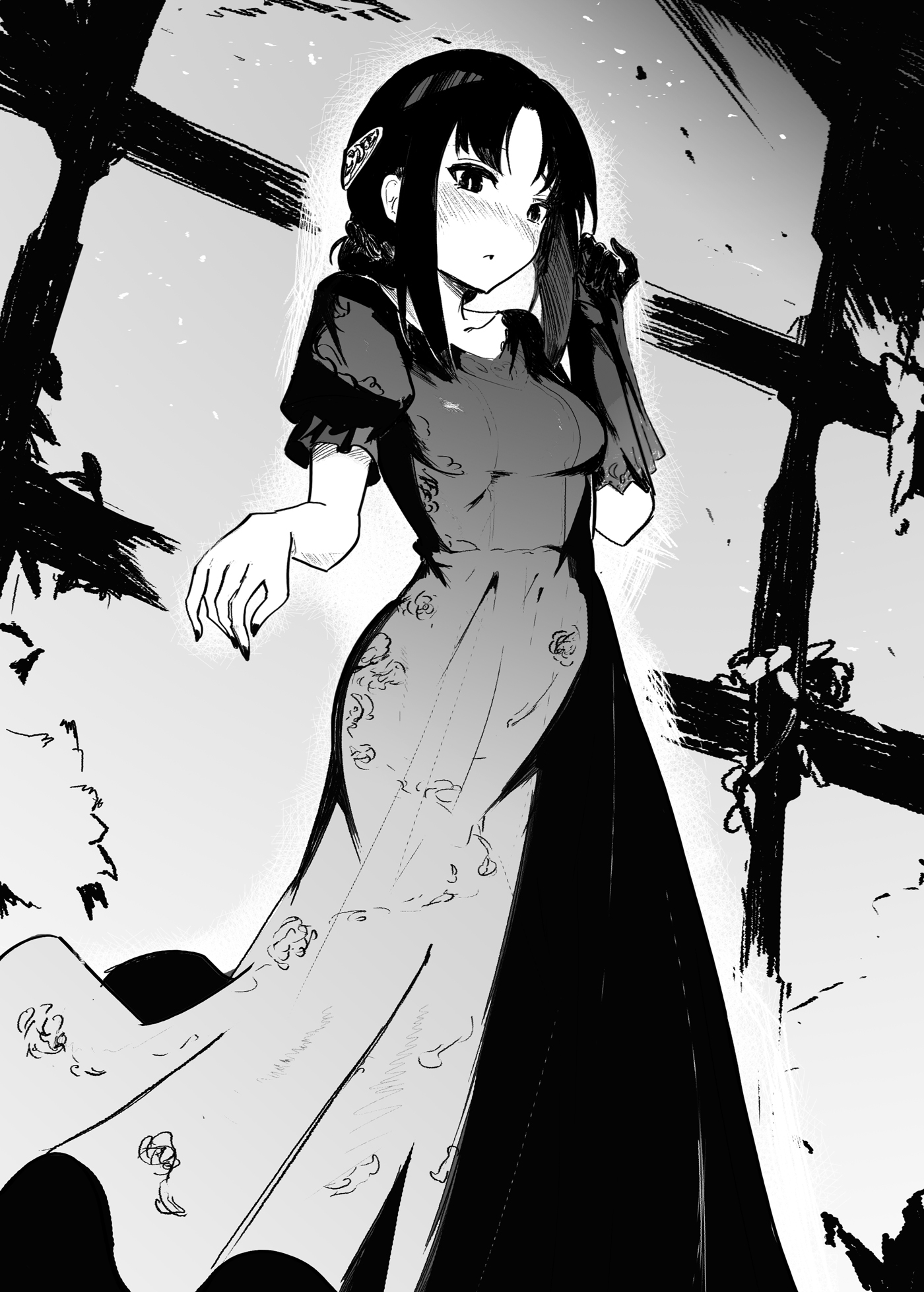
It truly was as pure as a virgin snow. The sight of it alone made saliva pool in my mouth; what ought to have been body temperature felt like boiling water too hot to swallow back.
Lady Franziska watched us with a wide smirk, her gaze a heavy net entangling us. Miss Celia’s eyes were downcast as she looked upon me. For all their similarities, the two faces before me were strikingly distinct.
Unable to withstand their gazes, I took her hand; to not would be to shame her.
Just like before, I moved in to bring my mouth close and then quickly pull back...but couldn’t.
Redder now, the hand in front of me came to meet me halfway. Vivacious enough to call the sensation of wetness to mind, her skin pressed into my lips with the quiet sound of a kiss. An observer might wonder if my heart had exploded, because a beat later, my face flashed bright red.
[Tips] A kiss placed on the back of the hand symbolizes love, reverence, and loyalty. The greeting is exclusively used from those of lower rank to those of higher; it will take some time before gentlemen come to employ it with ladies of their class. However, at times, a well-to-do woman will permit someone she holds dear to take her bare hand—an invitation to deeper bonds, perhaps...
Hanging us out to dry with a casual, “I shall leave thee to thy youths,” was not helpful. Doubly so following an event as embarrassing as that.
Miss Celia was perfectly unmoving, simply staring down with a bright red blush. I averted my eyes and reached for my steaming cup in search of some relief.
What am I supposed to say now?
I wasn’t explicitly uncomfortable, but the time ticked away with the awkward atmosphere lingering in the air. Around the time the kettle was drained and all the snacks were gone, I heard a clacking sound.
“...Will you join me in a game?”
“Huh?”
I looked up to see Miss Celia fidgeting, her face just as red and downcast as before.
“I-I’ve sent along a message to the College detailing your safe return with an invitation to the manor, so I imagine Elisa will join us shortly. My aunt has managed to locate Mika and is sending her a similar summons, and I suspect they will both arrive around the same time... S-So, while we wait, would you please join me in a match?”
I was too stupid to think, so I just nodded; she reached under the table and pulled out an ehrengarde set. She’d apparently gotten it from a drawer hidden below.
Sporting wooden marquetry, the thick board glimmered like a dance hall under the moonlight; in the box, white pieces fashioned out of pristine marble mingled with black pieces of pure obsidian. I picked one up with an unsteady hand and instantly recognized just how much more impressive it was compared to my hobbyist handiworks.
What surprised me most, however, was a realization brought on by my Keen Eye trait and the artistic sense it incurred: the pieces had been custom-made for this setting specifically. Every detail had been perfectly calculated to appear best under moonlight. I was absolutely certain that these were some of those infamous pieces that went for entire territories; she really did belong to an incredible family.
“If I recall, the first move...”
“...should be mine,” I answered.
It felt wrong to even touch such masterpieces, but I reached over and placed the stern-faced white emperor onto the board. White had the first move, and the rules dictated that both players were to start by placing their emperors and then their crown princes. For a short while, the sound of pieces echoed like a beautiful instrument as we placed their loyal subjects onto the field.
We filled the board at our usual bullet pace of five seconds per turn, but something was off. Both of us normally favored noncommittal openings that allowed for changes in strategy, but today she’d gone for a strong offensive start.
Her favorite empress was on the front lines as a matter of course, and a full squad of major pieces—including her emperor—were posturing forward without any intentions of hiding her attack. I’d begun placing defenders around the middle of the setup phase after seeing her army, but she could plow right through me if I slipped up.
We took brisk turns placing our pieces, developing the battlefield along organic lines. The nuance of the position shifted back and forth in a blink of the eye, transforming worthless pieces into linchpins and reducing vital units to dead weight; this was quintessential ehrengarde.
The awkwardness was less noticeable by the time we’d finished preparing the board, a distant memory by the fifth move, and completely absent by the time she invited me into a gambit on the tenth. Her every move was a new introduction, telling me, “Hello, this is who I am,” and I pushed my pieces with every intention of returning the favor.
Though we were in a different location, occupied different positions, and played with different pieces, nothing had changed at its core. She was still the same strong, honest player.
Her knight tore through a hole she’d made by sacrificing a pawn; the magus I’d begrudgingly placed to stymie her offensive fell to a dragon knight, further opening my fortifications. Her play felt like a heavy barrage of raw emotion. Each push of a major piece was precise enough to cause my position to creak, and my defenders fell like the withering teeth of an aging comb.
I took in the feelings imbued within her pieces and returned them with a counterattack of my own. Forgoing a panicked attempt to plug the leakage, I shifted my pieces away, trading them off to divert the course of her vanguards.
The end to our conversation devoid of words reared its head around the time her forward momentum fizzled out. Her minor pieces couldn’t keep up with the major ones in front, giving me the tempo to break her formation with a dragon knight. An archer—which could only take pieces one tile in front of it—blocked her retreat, meaning she had to choose whether to save her knight or dragon knight. Furthermore, my counteroffensive looked like it might have the steam to close the game out.
“The game is sealed.” She placed a piece, its click reverberating through the air like a bell, with the first words spoken in tens of minutes. Combined with the unique setting, these large pieces produced a very particular tone when hitting the board; the heaviest and most pleasing sound belonged to the emperor she’d marched forward for her last-ditch attack.
“It’s still too early to say that.”
This was more than a nicety: I was close to taking it home, but one of the peculiarities of this game was how the favored player had to stay on their toes. One piece shifted over by one tile was enough to turn an unattainable checkmate into reality. The one closest to winning had to squeeze the best out of their mind until the bitter end—in fact, it was commonly held that holding the lead was more mentally taxing.
The remnants of her army rallied to charge forth with reckless abandon, throwing themselves into the jaws of death for the slim hope of victory; I carefully picked apart the attackers and struck blow after crushing blow. The knight tumbled, unable to keep pace; the dragon knight plummeted to earth; the guardsman met his end defending the emperor.
“It is over.”
Having served as the conduit for incredible skill, the pieces and board produced a dramatic sound even as her cornered emperor fell. The ruler had taken his own life before I could deliver mate; I stared at the troops that survived him and heaved a profound sigh.
“You truly are you,” I said.
This exhausting game finally put my mind to rest. As short as our relationship thus far had been, I knew that being saved by Miss Celia wouldn’t totally overwrite what we had...but I’d been afraid that she’d become someone from another world.
Up until now, ours had been an accord between me and her. But now I knew her as Cecilia Bernkastel, and had gained a tie to her aunt who drew the same Bernkastel blood. Bonds draw people together, but so too do they tear them apart—especially for those separated by inherited barriers of class.
The fallen emperor symbolized much, but there was one thing I knew for sure: Miss Celia had not misrepresented herself in our time together, and was the same person she’d always been. Had she abdicated a few turns prior and pulled back part of her forces, she could have begun a war of attrition to wait out a mistake on my end. Yet she’d pushed forward in pursuit of victory, and eventually brought the game to a close by felling her own emperor.
Her play was the same as it had always been—she was the same Cecilia I’d always known.
It was time to make up my mind: even though her position demanded consideration, I would treat her as I always had.
“Then I must say the same of you, Erich.”
Her strong-willed, bloodred eyes loosened into a smile. Not one lacking strength, but one tinged with relief—maybe she felt the same as me.
Just as I’d thought, this match had been another first meeting. Delivered over the board, her introduction only emboldened the unshakable impression of her in my mind.
I am me; you are you. So long as we understood this, that was enough.
“My goodness, this watchman was so, so vexing!”
“I actually thought I may have misplaced it for the longest time, until...around here. This was where the game shifted, and I thought to myself, ‘I’ve got this!’ as soon as I saw this move.”
Smiling, the two of us tiptoed around the topic as we began our postmortem.
Basically, it boiled down to this: let’s keep being good friends.
Miss Celia froze in the middle of recreating a regrettable board state, placing a hand on her temple and closing her eyes. A moment later, she smiled and looked over at the door: knocking preceded two very welcome guests.
Despite looking a bit tired, Mika looked like the picture of health; Elisa had done her best to dress up like when she’d come to visit me at home.
Our moonlit tea party was about to become a wonderfully blissful victory banquet.
[Tips] The official rules say nothing on the matter, but common etiquette places the burden of declaring defeat on the loser.
Master Scene
Master Scene
Master Scene
A scene without PCs run entirely by the GM. The players are not the only ones who must deal with the aftermath of a story, and who knows? Perhaps an ending can lead to new beginnings...
Surely there were few who would find the epicurean seat so disagreeable to sit in. There were heaps of people who’d invested enough money to shake unsinkable dynasties, hanged countless innocents, and passed down their dogged persistence all in the name of seeing one of their own rest upon it.
“...Half a century ago, was it?”
Seated at the imperial desk, the masquerader of high rank—that is, Duke Martin Werner von Erstreich—kicked his feet up onto the table as if to punt away the fools who sought the throne without any ability to imagine the weight it came with.
“As awful to sit in as ever, I see. I struggle to see why the masses so dream of planting their asses into this chair.”
The vampire scoffed irritably and, as if his transgressions had not gone far enough, he crossed his arms and clicked his tongue. His actions were those of a punk acting tough at the pub; though they clashed terribly with his carefully set silver hair and imperial-purple robe, the mannerisms curiously fit the gentlemanly magus.
But rather, that ought to have been expected. Martin had complied with Erstreich family tradition in his youth: he’d spent his early decades far removed from imperial life, mingling with the common people. In his case, he’d roamed the low streets of Lipzi and led a gang out of a countryside bar; he was simply returning to his roots.
Funnily enough, the three men gathered in the room had all enjoyed similar boyhoods, as unimaginable as it may be to those beyond the walls. In other words, the imperial office home to the highest authority in the land had become a club for men unable to forget their years of juvenile delinquency.
“Vampires are some poor bastards. Not dying after that sure must be rough.”
“Agreed. A mensch in his state would have been pleading for a swift end.”
“How kind of you two to express your sympathies as if my plight is a foreign affair...”
Once more, the three leaders heading the imperial houses that would determine the Trialist Empire’s tomorrow found themselves in the Emperor’s private office—albeit their seats each shifted by one.
Clad in violet regalia, Duke Martin was to reprise his title as Martin I come a few months’ time; here sat the new Emperor, ready for a fourth term.
Across from him sat August IV, similarly ready to pass on the crown to become a grand duke—a title given to emperors who stepped down within their lifetimes, or kings of Rhinian satellite states—within the coming months. His stress appeared to have been shucked off along with his purple garb, as he wore his unembellished plain clothes with a brow less wrinkled than before.
Lastly, the werewolf watched on with the cool of someone wholly removed from any stakes. He’d seen the ridiculous fuss and the wild familial goose chase that had brought the Minister of Finance to tears—the bill for which fell to Martin I, the root of the whole ordeal—from the sidelines, and he shook his head disapprovingly. After all, the commander-in-chief of the Empress-to-be’s search had been none other than David.
Settling into a seat he’d long since forsaken, Martin I snapped his fingers to produce a stellar sheaf of parchment out of thin air. The stack of papers was pressure-bound into a thick booklet, and the pages were lined with intricate mystic formulae and oaths to the gods; the script, in and of itself, was a form of ritual.
Martin I sank his long canine into his left thumb and dipped a quill in the wound to complete the contract with blood. The form was an official request to call for the election that would enthrone him. Once written by the prospective new Emperor, signed off on by the sitting monarch, and accepted by the final imperial leader, the document would spontaneously combust and deliver a physically identical copy to each of the electorate.
The remaining parts were unflinchingly filled out in precise penmanship befitting of the scholar. Finally, he appended his signature with a bloody seal stamped in with his ring. All that remained was for the current Emperor and the imperial witness to offer their own signatures and seals, and the preparations would be complete.
“Here, it’s finished. Check it over.”
“As you will, Your Majesty.”
“And whomever might you be talking to? Your abdication isn’t even official yet...”
Ignoring the grumbling vampire, the retiring Emperor looked through the form to make sure everything was in order.
Though the forms that dealt with imperial succession were grandiose, the paperwork itself was exceedingly simple. When coming up with the legal code for succession, the Founding Emperor Richard had come to the conclusion that complications would lead to misinterpretations among the later generations. A discontinuation of the dynasty arising from invalid legal processes was no laughing matter, so the Emperor of Creation had slimmed it down to leave no room for interpretation.
As a result, while the petition to begin an election required a great deal of time and money to put together, the form itself was a far cry from the parade of esoteric euphemisms and complications that so often plagued imperial documents. Plain and simple, confirming its contents was easy and poking holes in it was hard. The smoothness of the affair drew no complaints from anyone; rather, if the noble bureaucrats of the Empire were ever to find out, they would surely go mad with envy that their papers were not the same.
“I see no issue,” August said. “All that remains is to finish negotiations.”
“As if it’d ever get stopped,” David said. “We already finished laying the groundwork.”
As soon as the sitting Emperor and final imperial added their signatures and seals, the contract burst into iridescent flames, burning away. To see divine power intertwined with magic to ensure the words within was a dreamlike scene that few would ever witness in their lifetimes—not that it meant anything to these three. They failed to show any sign of interest, instead just relieved to have one chore finished.
“A’ight, next up is the good old reunion.”
“It would be too cruel to press yet another burden into His Majesty’s hands: let us decide who shall oversee the task between us.”
“Oh, in that case, let’s settle this with a match of ehrengarde.”
“Not a contest of drink?”
“Nah, the doc’s got me off liquor.”
“Gentlemen,” Martin cut in, “this is a conference to decide the next Emperor. Would it be so much to ask for you to stop treating it like some casual get-together?”
A loyal citizen watching their exchange would have lost heart and even soul at how lackadaisically the Emperor-crowning convention was being planned, and the vampire ascendant sighed wearily.
Of course, perhaps it was inevitable: it only followed from the Trialist Empire’s origins that any inheritance of its crown would adhere to a rigid legal code.
The procedures had been mapped out to inhibit hasty insurrections—those thoughtless regicides that doomed other nations to slow and steady declines—while making sure the Emperor could be cut off and replaced the second he fell from grace. The whole thing was tuned on a brilliant balance between tension and release.
Mensch and werewolves were quick to change generations, and the immortal vampires had weaknesses both physical and mental; the electors who watched over these imperials were further varied in background. Historians who studied the Empire’s construction could often be found groaning about how solid its foundation was.
It was possible to rise to the top. Marriage, adoption, inheritance—the avenues to climb were far from limited. Yet the rules were harsh for those who wished to swipe the reins out from under the Empire. What was more, the countless responsibilities that came with the throne were contractually obligated of the sitter—escape was not an option.
The Emperor’s duties did not entail kicking back and using the lavish treasury to his heart’s content. He who oversaw the nation had his obligations defined in law and his authority accepted by the gods; giving the heavens one’s word and surrendering oneself to a mystic contract was no light commitment.
And so, the Empire found itself run by what boiled down to a big extended family.
“Y’know, Your Majesty, you sure did give in quick.” While his old friend prepared an ehrengarde set to settle the matter of party-planning liability, the werewolf turned his attention to the vampire.
“And? What of it?” Martin’s furrowed brow made his complaints plain: how dare he comment after conspiring to crown him?
“Well, I figured you’d quibble harder than this. Besides, there are tons of Erstreichs. Couldn’t you have just plucked some random kid to fill your spot?”
“So that’s what you were getting at...”
Despite the flagrant disrespect of the question, Martin I didn’t lose his cool; he only scoffed. Some would already have fainted at the sight of his uncouth posture, but he clasped his hands behind his head, descending yet further into the territory of the crass.
“Not all who covet authority are fit to wield it. None of my youths are worthy of the position.”
“Hard knocks.”
“While I personally find the throne no better than an aging toilet stained with shit, I love the Empire our forefathers created, and I will not see it careen toward an untimely end. So long as I have no plans to return the Sun God’s gift, I refuse to see this country to its end.”
Despite his commitment to merriment, Martin I was well aware that his clan’s five-hundred-year history was marred with an unceasing political war to determine the next head of household. What else could have spurred the masterstroke of espionage known as Schnee Weiss?
Handling internal matters while fulfilling all the obligations of an imperial duke was a burden that would crush an average person instantly. Worse still, Martin’s family was full of vampires: laden with immortal pride and unwilling to naturally disappear with time, it wasn’t as if they were all brimming with civic loyalty.
To begin with, vampires weren’t made for fealty. Their origin lay with the bastard who’d swindled the most eminent of gods; the nature of his descendants was a matter of course.
However, in what was perhaps the providence of the universe, those supplied with great ambition were not necessarily enriched with the gift of leadership. Just as his aunt hadn’t chosen her own offspring nor any other of their numerous kinsmen, he knew that each age required an Emperor fit for the times.
Having commanded the nation for nearly half a century, Martin I had an eye for discerning suitable rulers. Without it, the crafty old foxes heading the imperial and electorate families would have cast him aside as a talentless charlatan, not allowing him to chisel his name into history term after term.
So how could he possibly give up his work to a fool who wouldn’t see it through just because he didn’t want to do it himself?
“Pity me,” the vampire said. “I have seen many born to my house with talent enough to rise to power...”
“...But none who would wield it wisely.” The mensch finished the sentence apathetically, opening up a box of pieces as he did; the new Emperor nodded sadly in response.
It was a tale as old as time. Many were the revolutionaries who could seize the throne with great expertise, only to trip over the peak and tumble down to earth at rapid speeds.
But even when he took his fatherly bias out of the picture, of all his progeny, his daughter alone had the character of a statesman. She lacked the remotest desire for power and money; she was passionate about guarding both those currently under her protection and those who deserved it, but drew a clear line between what she could and could not manage on her own. The reports that returned from the agents he’d sent into the monastery painted a picture of the monarch the Trialist Empire needed in its hour of peace.
The man currently setting up a board game had trampled over the bothersome federation of minor states that had been blocking the Eastern Passage—there would be no major wars for the foreseeable future. What the Empire needed next was an Emperor who would take the great winnings of this generation and look inward to strengthen its domestic foundation.
Martin I knew that his daughter was benevolent, but not thoughtlessly so. If he and his family supported her, he was confident she would have made a fine Empress, and thus he’d resolved to hand her the reins accordingly.
Had Cecilia been the type of blithering idiot to stumble over herself in the name of spreading charity, Martin I would have been content to love her only in the personal sense, reducing her political importance to a liaison between state and church. Yet she had reawakened an inherited power long dormant: forty-five years of experience became instinct, whispering in his ears that the girl was destined for high places.
His daughter currently lacked any official rank on account of the church reserving its judgment due to her imperial connection, as well as the girl’s personal renunciation of pedigree. However, this recent episode would serve to help slowly erode those stoppers, so she was sure to rise up in due time. After all, the Head Abbess of the Great Chapel had studied directly under none other than Cecilia; the leader of Night trembled at the thought of stepping on her venerable mentor’s toes even to this day.
Martin I had begun this internal debacle because the situation had called for it, but his sheer, utter, inescapable distaste for the throne had not been the only reason for his decision. She would one day be an archbishop—or maybe lead the entire church. While this would have been fine enough for any other doting father dreaming of his child’s success, every parent’s greatest wish was to pass on what they had built. Mixed into his ridiculous plans was a tinge of vicarious ambition.
Whatever the case, the terrifying Empress’s appearance to the scene had brought it all to an end. If he tried anything in the next hundred years, he’d end up half-dead—“half” being a gross understatement—once again.
“Besides,” Martin I resumed, “I have some pride yet. I can’t let myself be a pathetic father forever.”
“What the hell’s that mean?”
The new Emperor sighed to signal he would not answer the werewolf’s question; instead, he simply shut his eyes, still using his hands as a pillow. He’d dreamed of saddling his daughter with the title while he handled the busywork—until she was fit to take over the whole operation, of course. Alas, the fantasy had crumbled. His only recourse was to work diligently until he could regain the reliability and dignity of fatherhood.
There was no need to rush. His daughter was blessed with the fortune to find the one piece in her arsenal that could counter him, and she had the guts to involve herself with that walking catastrophe she called a great-aunt.
One day, he was sure, one day she would rise to the political stage. Whether she wished for it or not, she who had the makings of an empress was fated to be dragged up eventually.
After all, blood was ever thicker than water.
To leave her to her own devices for a century or so at his aunt’s command was an easy order in the grand scheme of things.
“You know,” David said, “taking that backwards means you’re confident you’ll be able to make everything work out while you’re on the throne. That’s a hell of a thing to say.”
“Indeed,” August concurred. “Immortal arrogance pervades his every word.”
“Why must you two vex me so?! Perhaps I should put you to death with my own two hands!”
“A crying shame! Persons of our peerage can only be executed for violation of imperial succession or high treason!”
“Argh! Damn! And here I would have been happy to chug a glass of poison at your order, Your Majesty! But the almighty Emperor of Creation has written laws against it!”
“Excuse me?! Fine! Then I’ll grind the military budget down to nothing, and cut the dragon knight units by half—I don’t plan on needing them anytime soon! Any spare expense will get the axe under my rule, so have fun quaking in your boots!”
“What?!”
The office at once became a room of yapping fools, and to certain people, a toxic chalice would have been a far better fate than listening to them whine. Eventually, the trio agreed to play an ehrengarde tournament to decide the national budget. The result? No major changes for the time being.
“Still, what shall I do about the College’s funding?” Martin I muttered, listlessly toying with the sculpted magus in his hands. Intricately fashioned out of silver, the piece portrayed a hooded figure carrying a long staff. Though it couldn’t move and attack at once, it was able to pick off an enemy piece one to two tiles away—as strong as it was idiosyncratic.
Being an accomplished governor, the vampire was also a skilled—and particularly nasty—player who could utilize magia well. Back when he’d first shown his toddler daughter the rules, his dirty play had caused her to cry; perhaps the trauma ran deep, fueling her continued commitment to honest brute force over the board.
“What cause is there for concern?” August asked. “The Emperor is entitled to some few privileges—you shall not hear a word from us if you choose to subsidize your own interests, Your Majesty. It is one of the few luxuries that comes with the crown.”
“Fair enough,” David said. “But I dunno if setting up so many drake stables in every region that you filled out two whole units with new drakes falls within those bounds...”
“Leave me be. They were a great asset in the eastern conquest—I remember the roaring cheers from below as aerial reinforcements soared past, even now. Besides, I would tread lightly if I were you. While your father’s expansion of the jagers was within reason, I struggle to see how you might justify the massive arsenal he commissioned.”
“Well,” Martin sighed, “at least you two have hobbies that align with national interests. One imprudent shift in funding will put me into the domain of nepotism and sully my position.”
Twirling the piece in hand, Martin I called to mind the monsters that lined the seats of the College’s professoriat. Just imagining them made him depressed.
His personal relationships with them were fine. Each and every one was an irredeemable pervert, but they weren’t the sorts of madmen who holed up in towers to fashion an end to the world, nor were they psychopaths who amputated living people and welded them back onto others.
Yet it was a lost cause when they came together. They had obscene egos without exception, and any debate was doomed to devolve into a mortal battle of tongues. In the worst—yet very plausible—case, gloves could fly and give way to an all-out cadre war. The cherry on top was that this potentially Empire-ending farce took place a stone’s throw away from the palace; the trouble they caused was impossible to describe in words.
Back when he’d been just another one of their number, Professor Martin hadn’t given any thought to the headaches he’d caused his aunt. But now that he had to deal with the repercussions himself, his mind had begun to drift to ideas like, Wouldn’t it just be easier to kill them all off? He would have at least liked to exile them to some remote location, but that carried its own host of inconveniences. The College was an unsolvable problem.
It wouldn’t have been quite this bad for a normal Emperor. Any other in the hot seat would have been able to mediate their spats impartially and determine their funds by deferring to national policy; the only minutiae left would be to make sure to split it evenly enough to avoid favoritism.
Alas, Martin I had every manner of vested interest. His old stamping grounds were full of connections: classmates, dorm mates, research buddies, and worst of all, mentors whom he still couldn’t talk back to. He may have drawn a line in the sand, but if one of his ancient tutors came out of the woodwork, it would be too much for him to bear.
Having a war of funding waged from above and below was certain death for anyone. No matter how indestructible the flesh may be, the mind cannot survive. Every meeting would be preceded by enough private comments of, “But Professor, I thought you cared about your students!” and, “Come to think of it, don’t you still owe me for that one time?” to kill a man; no matter how things turned out in the end, he’d hear gripes about it for centuries to come.
Unfortunately, trying to find someone to whom he could delegate intermagia negotiations to was difficult. Anyone well versed in magecraft and familiar with the inner workings of the College was sure to already belong to a cadre, and avoiding interference from within those factions would be... “Wait.”
The statuette in his hand brought something to mind: he could set up the perfect liaison.
He knew of a researcher who was unbelievably brilliant for her position, who didn’t seem particularly devoted to her scholarly clique—the dean of her cadre had spoken of her like a troubled schoolgirl—and who hailed from a foreign house too opulent for domestic nobles to easily sway her. Better yet, she boasted a racial immunity to disease and senility, and she could be counted on to not die to a rolling breeze. Her estate’s incalculable wealth meant that a mere territory or two would be far from enough to bribe her.
It was as if the Gods of Cycles and Trials both were looking down upon him, linked at the shoulders, thumbs pointed up, and were wishing Martin I the best of luck. She was the perfect candidate for his sacrif— stand-in for College affairs.
“Say, Duke Baden...”
“Yes, Your Majesty?”
“Agh?! Gustus, wait! Hold that dragon knight! I wasn’t looking over there!”
“No take-backs, Duke Graufrock.”
“That’s right—don’t be so pathetic, Duke Graufrock. But I might add that I would move that archer forward if I were you.”
“Oho, gotcha. And then this guardsman’ll come alive, so I can take down this knight over here...”
“Your Majesty, was that not in poor taste?”
The Emperor ignored his predecessor’s oozing glare of contempt and placed the figurine on his desk with an emphatic clack. He had spent quite some time away, and needed a refresher on certain aspects of the law.
“Where might I find the legislation that details how to ennoble a foreign aristocrat?”
[Tips] Very few imperial candidates have been struck down by the electorate, and the emperors who have been chased out of office for their failures can be counted on one hand. High treason that causes great harm to the nation can also become an emperor’s downfall, but fortunately, the Empire has yet to see any of its rulers bare their necks for such crimes.
One Full Henderson Ver0.4
The tale that follows is not from the time line we know—but it might have been, had the dice fallen differently... |
One Full Henderson Ver0.4
1.0 Hendersons
A derailment significant enough to prevent the party from reaching the intended ending.
At times, the GM may confiscate a player’s character sheet as a price for undue power.
Lit by the radiance of the divine Mother’s blessed rays, a vessel slid across the cloudy sea of midnight. The gargantuan feat of airborne architecture was known by the peoples of the land as an “aeroship.”
From the side, the girthy beast appeared as a flat triangular pyramid, and the two clusters of three arcane sigils each near her rear glowed dimly in the dark; propelled by mystic means, she quietly blended in with the thin clouds under the Night’s veil.
To expound on this dancer navigating a darkened stage, she was a warship: the official first among the Trialist Empire’s mass-produced fleet. When Rhine had initially sent its armada into the world, it had shaken the western reach of the Central Continent to its core; this monster was the foremost of the leviathans that had shifted the paradigm of war. She was the Theresea, lead ship of all Theresea-class conquestships.
Having completed her maiden voyage in the middle of the Empire’s sixth century, she and her sisters boasted terrifying suites of weaponry that struck fear into the hearts of lesser nations. Save for the elder dragons that were closer to natural disasters than living beings, these ships were a clear declaration that the skies were Rhine’s to claim.
The Queen of the Skies was outfitted with six mystic engines, each nearly a perpetual motion machine of the first kind. Furthermore, she was supported by tanks of helium—lighter than air, she was free from the shackles of her predecessors and could retain altitude to continue her reign of terror free of arcane support.
The engineers had adopted standardized specifications during her design, subdividing the whole craft into parts that combined into a unified whole. Whole sections of the ship could be swapped out to better suit the purpose of her voyage, and sections damaged or destroyed could be replaced entirely; she was an easy-to-maintain, all-purpose machine.
While the Theresea and her sisters had ferried about many a diplomat as political formalities, as the word “conquest” preceding “ship” might suggest, they had also brought their nations to heel. In the belly of the ship was a massive aerial dance hall meant to shock visitors with sheer scale and technological prowess; in times of war, it could be swapped for a loading bay that housed countless magical incendiary shells that bathed enemy armies and cities in flame. And when those burning nations sent their dragon knights up in a last-ditch attempt at survival, their imperial counterparts were ready to intercept from the ship’s drake stables.
Nineteen in total, the vessels represented such overwhelming firepower that they had quelled major conflict in the region. They had never once experienced large-scale war—nay, had never allowed it—in one-hundred-fifty-odd years of sailing.
Alas, any mensch who had borne witness to their glory was long since buried. In the early years of the Empire’s seventh century, a new design that outstripped the Theresea-class ships in both function and ease of maintenance was invented, marking an end to their era in history. Time’s flow was merciless, and the last of their kind had been decommissioned many years ago—near the beginning of the eighth imperial century.
Where once these ladies had caused the skies to quake in their presence, their last few decades of service had seen them reduced to cruise ships for the affluent. Most were now disassembled, save for a few still kept intact as historical display pieces.
Why then, you may ask, was the decrepit Queen of the Skies soaring over her domain? Well, the reasons were very grand indeed.
According to official imperial documentation, the first of the Theresea-class aerial conquestships—the Theresea proper—had been relieved of her dual duties as Flagship of the Joint Imperial Navy and Flagship of Her Imperial Majesty’s First Armada one-hundred-twenty years prior. Some seventy years following, she was retired entirely and parked in the capital to live out her twilight years as a historical monument by the Martin I Imperial Aeroport in Berylin.
In reality, the powers that be had decided such a fate unfitting for the Queen, and pushed through the canceled plan to repair and refit her with modern parts; the Theresea now found herself in foreign skies. The vessel parked by the capital’s airport was the eldest of her younger sisters: the Hildegarde, but with a new coat of paint.
Hardly anyone in the entire country knew of this secret, but after withdrawing from the public eye, the warship continued to protect the Empire from the shadows. No longer part of the imperial navy, she found herself piloted by the jagers. Her mission came from the top authority in the Trialist Empire of Rhine: the Empress had sent her far to the west, past the remote imperial frontiers, and into a smattering of peripheral nations defined by fuzzy national borders.
As soon as the world learned of the aeroship’s might, every nation had scrambled to follow the Empire’s suit to not fall behind in the arms race. With the proliferation of the technology came a pervasive military doctrine: know the position of enemy crafts at all times. The Queen of the Skies could single-handedly turn the tides of battle, but not even she could demonstrate her dominance if the enemy managed to avoid her. Aeroships could soar past dozens of towns and villages in a mere hour, but they took time to lift off and even more to be battle-ready. As a result, keeping tabs on the known locations of other countries’ vessels had become a matter of utmost importance.
But flipping that logic on its head, a “disassembled” craft hidden under the pretenses of official documentation may as well not exist. A ship that no one could find, that no one knew to look for, would be an asset far greater than her raw firepower alone—such was the argument put forth by an imperial guardsman that inspired this exceptional top secret warship.
Tonight, the Queen’s ancient frame took to the skies to serve the Empire once more; her mission was to trample the barbarians who dared threaten the nation.
“Final call! Current position stable; altitude stable; direction and velocity on course!”
“Roger, final call! Hold course!”
Voices barked back and forth in the ship’s rear bridge, across reading instruments and steering mechanisms placed for maximum efficiency. The navigation officer’s report was good, and the first mate hurried over to the massive window—it was actually a wall, but a spell artificially recreated the view outside—facing the open skies to relay the news to the commanding officer.
“Sir, we’ve arrived at the landing zone.”
“...What a beautiful moon.”
“Yes, sir! ...Huh?” Though his military background compelled him to affirm, the first mate doubled back in confusion at his superior’s response. His commander was staring off into the heavens, and he had no idea what he was saying.
“Never mind,” the commander responded. “Very good. Begin immediately.”
“Yes, sir!”
Receiving a proper command the second time around, the first mate ordered the air traffic controller manning the mystic map to give the word; the ship’s belly was home to a multifaceted hold, but the only important section now was the drake stables.
“Air Control to Nachtschwalb One: are you ready for takeoff?”
“Nachtschwalb One to Air Control: at the ready and standing by.”
Just outside the cramped stables, three antsy beasts waited in a hold constructed of unembellished plywood. Curiously enough, the plateau drakes had been painted in a coat of blue-black camouflage to blend into the night.
Actually, the camouflage was not so unusual; reducing the visibility of one’s steed via paint was a timeless tactic. Rather, the strangeness came from the contraptions attached to their harnesses via wire: odd capsules covered with lids.
These were drakerafts: imperial towing containers for parcels that needed to be delivered posthaste. Yet they were no ordinary specimens—they were entirely covered in the same paints as their carriers, and three steering fins stretched out from the sides to evoke fishlike imagery. To top it all off, the tip protruded to an excessive degree, reinforced with metal alloys. If an average drake courier were to see one of these, they would surely cock their head in confusion.
“Copy that, Nachtschwalb One—opening the hatch. You are clear for dispatch.”
“Roger that, Air Control. This is Nachtschwalb One, commencing dispatch.”
At the bridge’s order, a red light began flashing in the flight bay. The men on standby near the drakes and their cargo hurried out of the room, leaving only the draconic beasts and their riders; the wall before them slowly fell forward to expose the open skies.
Air fled the pressurized cabin for the open expanse, taking random scraps out with it: miscellaneous trash flew out alongside the leftovers from the drakes’ premission meal. Yet the dragon knight in the center—Nachtschwalb One—refused to flinch as he goaded his steed forward.
“All right, come on buddy. Let’s do this.”
The rider patted his partner’s neck and the drake dutifully obliged. It kicked off the ground with claws fit to lift cows into the sky and sprinted, dragging along its heavy luggage with ease. By the time the drake made it to the end of the considerable runway, it had accelerated beyond the top speeds of any horse; it leapt into the night, tearing up the air as it jumped. The sprint added onto the aeroship’s initial velocity, not to mention the extra speed earned by beating its wings; the drake outstripped its mother ship in an instant.
Not wanting to be left behind, the second drake followed suit while letting out a quiet roar at the joy of freedom. The pinnacle of military husbandry quickly zoomed past the limits of human ingenuity.
Once all three were out safely, far beyond the ship, they regrouped to take formation with Nachtschwalb One at the helm.
“Nachtschwalb One to Air Control: all units dispatched. En route to destination.”
“Air Control to Nachtschwalb One: copy that. Theresea will maintain position. No further communication until mission completion or abortion. Best of luck.”
Seen off by a stock farewell, the three dragon knights formed a small arrow that melted into the darkness. Having left their base behind, they would be subjected to a grueling hours-long journey. Though they employed mystic barriers to reduce drag and protect themselves from frigid gales, life atop the saddle was anything but comfortable.
Glorious and beloved by children across the Empire, these airborne soldiers were in truth feeble things. They were pitiable souls who covered themselves in layer after layer of heat-retaining clothing and stuffed their gloves full of cotton just to not freeze, all while enduring their long journeys in a set of diapers.
The leader of the pack reached into a leather pouch and pulled out an enchanted thermos. He unscrewed the lid and flipped it over to act as his cup, pouring out the warm liquid inside. Whether one could consider it red tea with how much liquor it contained was dubious, but suffice it to say that this was every dragon knight’s truest love.
Heat managed to escape through every crack in his coverings, and this drink was the cure to his numb, aching body. But as he sipped, a disgruntled thought entered the man’s mind: despite seeming like it was gliding smoothly, his partner had some grievances to air. In more comprehensible terms, the drake was thinking, No fair.
Unlike the master-servant relationship between most jockeys and their domesticated helpers, the standing between a dragon knight and drake could only ever be described as friendship. Borrowing the iconography of another world, the drake was upset that the person riding shotgun was comfortably snacking away while it had to drive on the highway.
“Come on, don’t complain. You know you can’t drink while flying. I’ll give you as much as you want when we get home.”
After petting his partner’s neck for a bit, the man opened up a map, being careful to not let the wind blow it away. He caught a glimpse of the earth a while later through parted clouds and matched the terrain to the map; they were close.
“Nachtschwalb One to wingmen and passengers: border crossing is approaching. Telepathic comms will be severed. Mages, I ask that you make sure not to produce any trace. All units will be shifting into cruise, and the wires will be cut to begin descent shortly.”
The pilot announced all the pertinent information over telepathic waves and ran through the next steps in his mind. He would need to yank the wire off the communication device strapped to his neck to cut its power supply, and then pull out the mana stone found within; it was extremely important that he didn’t accidentally broadcast his thoughts through some mishap. Right about now, his wingmen and passengers were surely all preparing to do the same.
“Upon entry you are authorized to act on your own best judgment. No further communication until mission completion or abortion. God of War be with you.”
Just as Air Control had done for him, the rider offered a stock goodbye before duly going through the motions of establishing radio silence. He gave his partner his next order through the reins alone. Theirs was a long partnership, and the drake responded by stretching out its wings and toning down its natural magic to slow into an easy glide.
One long cruise later, the drake dipped into the clouds, swimming through shadows where the tender Mother’s light did not reach. They blew past plains, strode over mountains, and flew across forests. Once the wilderness was behind them, they came upon a frontier more remote than even the Empire’s westernmost reaches: a satellite state run by a grand duke.
Imperial satellites subjected themselves to vassalage in exchange for the Trialist Empire’s support in times of danger, and were expected to come to Rhine’s aid should the need ever arise. While the cost of offering tribute, opening borders, and even allowing free trade was steep, imperial backing was a formidable boon when navigating international policy. Furthermore, the Empire liked to imagine itself a bighearted friend: it generously offered spare crops to tide over bad harvests, and at times even gave away immense knowledge—not by imperial standards, of course—for free. As far as friends went, Rhine was one of the better ones to have.
At present, the Trialist Empire and its largest neighbors were separated by many buffer states much like this one, all teetering on a knife’s edge. There were countless tiny countries with identical circumstances, save for the superpower they had sworn fealty to; as such, the major players continued to sharpen their swords without ever crossing blades directly.
Until someone appeared, ready to rock the boat.
The king of a certain minor nation broke his oath—both the aggressor and the victims in this case were under the Rhinian umbrella—and began annexing his neighbors in a bid for independence.
Obviously, the Trialist Empire was unwilling to accept his ambitions. The crown sent messenger after messenger to demand he cease his outrage and sit down for talks, yet none of them returned.
At long last, the fifth courier who had been sent with an imperial summons came home...as a head pinned to his horse’s rear. This was a revolt—one definitely funded by a rival superpower.
The Empress immediately interrupted her nobles’ harvest season to recall them to the capital and hosted an emergency council, prompting a unanimous response of utter confusion.
Rude as it was to say, rebellions and infighting amongst lesser nations were a daily affair. Forgettable countries shifted allegiance to and from the Empire at least once every few years, and it wasn’t uncommon to hear about two members of Rhine’s orbit duking it out without permission. This whole system of suzerainty had only emerged so that the superpowers could avoid real wars in the first place; stirring trouble to cause a few minor scuffles was all part of the fun. It wasn’t as if the Trialist Empire hadn’t partaken in its fair share of mischief, inciting revolutions and feigning ignorance as soon as the tides turned against their agents of chaos.
True, a minor nation gobbling up a midsized neighbor and spreading through the region like wildfire was strange, yet their successes were hardly enough to justify a direct imperial response. Standard policy would have been to hand the neighboring satellites some pocket change and have them raise their own armies, telling them that anything they won was theirs to keep. Otherwise, they could just have a marquis in the region muster a few troops and offer imperial support to quickly quash the rebellion.
However, the Empress insisted that this matter seemed different; convincing her countrymen at the convention, she prepared the nation for war. It had been over two hundred years since the Trialist Empire had last rallied the imperial army. The country was to prepare itself for its first official armed conflict since the Second Eastern Conquest led by the Dragon Rider that had opened up the Eastern Passage.
Just this past noon, the aristocratic assembly had declared war and transferred all martial rights and privileges from Her Majesty’s hand to that of a young Graufrock general. Before the hour was up, the Queen of the Skies had discreetly set off from the western frontier to make her way here; she now hovered above the royal capital—home to a castle no better than a paltry shack compared to the imperial palace—of the middling nation that had fallen to the troublemaking king.
“Not even a single sky patrol at night?” Nachtschwalb One said. “They sure are some country hicks... Why would you ever pick a fight with the Empire like this? Do they think we’re stupid?”
It was practically empty. They’d reduced their mystic footprint to the occasional flap of their drakes’ wings just to maintain altitude, and for what? That these cretins didn’t have watchmen for their royal palace—sneak attacks aside, wild drakes could show up at any moment to play—made the dragon knight suspect a trap. If not, then the Theresea’s new silent engines might let the whole ship park right on top without waking a soul.
“Well, whatever. We’ve got a nice home delivery for you.” The man put up a hand sign for his fellow riders and then unfastened the steel threads holding his drake’s package. “Trap or not, these vampires of ours will be more than happy to oblige. Have fun.”
The drake deftly curled up to avoid being whipped by the dancing wires and soared skyward; the drakeraft, meanwhile, began to fall gently. The fins wriggled around to adjust its trajectory as it descended onto a city nearly unscarred by battle.
Of the three parcels, two headed for the castle, with the last going toward an open field thought to be the enemy’s headquarters—all of them fell headfirst. The locations had been identified by an imperial mole; each vessel dove with full faith in its course.
Around the time the first cleared the thin castle walls and crossed the official border into the capital, the bottom of the drakeraft slid off and tumbled away. What came next was an unbelievable scene: people lightly dressed in nothing but a set of full black began to jump out of the hole, one after another.
These men were soldiers. Wearing only the bare minimum and equipped with foldable spears, shields, or shortbows, they were nimble paratroopers. Covered in black from head to toe, they blended into the night as each slowed their own fall with their method of choice: some relied on wings, others employed canvas parachutes, and others still cast antigravitational spells to prevent a crash.
The soldiers jumped out in orderly fashion until only two were left. One of the final passengers continued to fiddle with the steering controls, and his comrade shook him on the shoulder.
“Captain, let’s go! This is as close as we’ll get!”
“Sure, sure. Feel free to go on ahead. I’ll be fine as I am.”
“Excuse me?!”
The overcast skies blocked the Night Goddess’s presence to the point where a mensch wouldn’t have even been able to make out the castle’s outline; yet the captain merrily stared out the craft’s tiny window. He turned to face his companion with a smile—two terrifying fangs jutting out between his pretty lips.
“I promised Her Majesty I’d lead the charge, you see.”
“Right, but... I know you’re strong, but I mean... Ugh.”
The man hung his head, defeated by his CO’s deranged statement. Normally, the best course of action would be to force him to come along even if it meant beating him unconscious, but he knew that his captain wouldn’t listen once his mind was set. Although he spewed impossible nonsense like a broken pump, he’d also never fallen short of it.
The subordinate sighed in utter resignation and left him with the simple words, “Best of luck.”
“Hmm hm, la dee da... Hmhmm hm, la dee doo...”
Alone, the man hummed a joyous tune as he tilted the control stick. It could only make minor adjustments to his course, but it sufficed to point him straight at the castle’s center—from the looks of things, that was probably where the royal chamber was.
All three drakerafts let gravity lead them through the open air...and naturally, they came to share a passionate embrace with the ground or the walls of some structure; the delight of the romantic rendezvous erupted as a torrent of flames, and the deafening noise that followed shook the world itself. In total, fifteen passengers had ridden on each of the three drakerafts; by removing every bit of free space and throwing away the concept of comfort wholesale, the Empire had managed to outfit these missiles with refined explosives that ignited on collision.
The fuel held within spread in an instant, and the superheated air swelled inside to tear open the point of impact. Waves of heat lapped victims organic and inorganic alike in tongues of pure flame, giving birth to hell on earth.
One of the rockets had eradicated a third of the enemy’s barracks; the soldiers within had been digesting the weight of their recent battles in the realm of dream, but would find that their slumber had turned suddenly permanent. Another of the drakerafts had landed in the upper part of the castle, blowing away the worries of the busy servants napping inside.
And the last strayed ever so slightly off course, heading into the throne room; the glorious decorations and throne, steeped in historical import, were stripped away on collision.
“To arms! To arms! Dammit, what’s going on?!”
The earsplitting blast had awoken the entire city from their peaceful slumber: the citizenry, cowering at the sudden invaders; the victorious troops, drunk on their streak of success; the high-ranking generals planning their next move; and the imprisoned royalty awaiting execution. People high and low alike panicked at the unanticipated arrival of unadulterated violence.
A knight in splendiferous armor led her troops into the throne room, only to discover herself unable to take in what had happened. She and all the other watchmen had been tasked by the king to prepare for an imperial attack, but this had not been within expectations.
Their plan had been to leave the skies clear to lure the enemy dragon knights and sirens into the castle, where they would ambush them. Afterward, they would call in their dragon knights lying in wait on the outskirts of town and achieve air superiority; her liege had boasted that this strategy would boost morale and improve their image amongst the inbound reinforcements.
The idea hinged on the assumption that the Empire would not employ the whole of its overwhelming might for some small rural nation. And in truth, past rebellions had often been cleaned up by nothing more than a few squadrons of dragon knights, so that assumption was not unfounded.
Alas, this was a new Empire. Perhaps the most notable factor was that the sitting Empress had a thrall who was quite the tactician, and that she entrusted him with a great deal of authority.
Though the knight had been ready for a nighttime assault, her mad dash to the scene only left her as confused as her juniors. What in the world could have caused such destruction? She was gifted in both magical and physical arts, and had trained to the point of outshining any man—but not even she could imagine a means of annihilation this severe.
At any rate, a dozen or so breaths was all the time it took for her to begin putting out the fire. Her nation planned to occupy this castle as its center of operations for the foreseeable future, and it was clear that three simultaneous explosions could not be an accident. The enemy was coming, and soon. Though their expectations of a drake raid had been off, that didn’t change what she had to do.
Just as she was about to chant a hex to summon water, though, a hand reached out from the billowing clouds of smoke. It was burnt to a crisp and had lost enough flesh to allow bone to touch open air. Was it some poor servant, desperately trying to escape death?
No, that couldn’t be it—the hand grabbed her face with strength unthinkable for all its injuries, clamping onto her like a vise as it pulled her into the smoke.
“Aaugh?!”
Her skull creaking, the knight screamed in pain as the inhuman monster that had abducted her made itself known. It was a charred corpse. Though its small frame was carbonized and guts spilled freely from its open midsection, the undead body continued to move.
Yet this was no zombie raised on an accursed site; the invitation into the smog had come from a creature incomparable. This wasn’t a matter of appearances, but of sheer presence. The thing exuded a dreadful pressure that was difficult to put into words. If anything, it was like death on two legs.
“Good evening, my lady, and good night.”
The neatly spoken words were in Rhinian. The woman had learned the imperial language alongside her mother tongue as a girl, on account of the Empire’s international importance. As such, she could glean the thorough education behind this kind, tender voice.
Along with it came a pain in her neck...and an overwhelming ecstasy that overwrote it. No mensch could resist the sweet pleasure that paralyzed her brain, blurred her vision, and reduced her thoughts to mush. If she had been able to endure it, though, perhaps she would have recalled the old teaching: when vampires feast, they confer unimaginable euphoria so their prey does not flee.
Drained of the lifeblood that ferried around her arcane power, the woman’s brimming will to fight left alongside her soul. Loss of blood alone was not enough to reduce her to a prune, but her fair skin grew fairer still, finally approaching a deathly white.
Drowning in rapture, her hands had instinctively wrapped around the figure’s neck, and the surface she clung to changed with each passing second. Burnt skin regained vigor like the earth after a hearty storm, and long locks of silky hair fell upon her face.
As the final drops keeping her alive left her body, a hand reached back to prop up her head. The knight’s final moments were spent staring into hauntingly beautiful eyes, dyed the red of pigeon blood.
[Tips] Theresea-class aerial conquestships are the Trialist Empire’s first series of mass-produced warships. Ever expandable, they were established for the express purpose of accommodating the Empire’s unique views on foreign relations. Made to house armies abroad during long campaigns and to maintain interior lines when on the defensive, the ships are more livable than any other on the planet. Furthermore, the lack of major wars during their service has made them famous as the only class of battleship to never have lost a single unit.
I was more than aware of my bad manners, but I licked my lips clean of blood and flashed the showiest smile I could manage—all in service of breaking this cowering man’s spirit.
Now, to recount the tale of how I ended up suicide bombing a castle only to begin cleaving through mobs of people like a musou game would be a very long story. Cutting to the chase, the whole of my circumstances had begun with Lady Cecilia’s failure to control herself.
Wounded and unresponsive, I had died on that fateful night by her fang. Apparently, she had been unable to endure the fragrance of fresh blood; I knew well what temptation she’d had to endure, what with my current state, so I didn’t have any mind to grill her for it.
That’s right: she drained me of my lifeblood, but imparted her own unto me in exchange. Unable to shoulder the guilt of taking my life, she had offered me her hand without hesitation, even knowing it would weaken her. A vampire could only convert a nonvampire by draining enough sanguine life force to kill and subsequently injecting their own into the target...and a vampire’s strength was interwoven with the purity of their blood. If this hadn’t been the case, the world would have been absolutely crawling with vampires. Personally, I thought the Sun God’s nature as impulsive yet not stupid shone through in places like this.
She had given me half of her blood—of a pure font that drew from the proud imperial lineage.
At any rate, I had become—I’d been turned into—a vampire. Whether I’d asked for it or not aside, there wasn’t any going back now.
The first few days had been chaos. Alfar of every kind absolutely lost it, and they all began to ignore me—fairies seemed to have an inherent distaste for vampires—except for the three that knew me best. Elisa had bawled for days on end, and Lady Agrippina had been too caught up in her own troubles to help. I couldn’t even remember how many times I’d lost heart back then.
Painful nights and burning mornings passed again and again, until one day I found myself propped up next to Celia—she forbade me from calling her Constance—as an imperial guard, meant to protect the heiress apparent to House Erstreich.
Trying to explain what followed would fill out more than a dozen paperbacks, so I digress. Anyway, here I was now as Erich von Wolfe, the imperial knight. World war was surely on the horizon, and I was to be the sharpened tip of the blade known as the imperial army.
I mean, come on. With how overtly this rebellion was being funded from without, it was clear that the usual regional disturbance wouldn’t be the end of things. If the goal was to stir up a few buffer states, this was a colossal waste of resources.
By my estimate, they’d dangled some shiny coins in front of some overly ambitious imbecile to incite this campaign, and planned to tear the newly formed state apart once the conquest was complete; the final result would be divided up between their own satellites to serve as food storage and a highway to the front lines. The area around here was featureless, and the ease of invasion definitely played a part in why it was targeted.
“Well then, my good royal prince,” I said. “First and foremost, allow me to speak on behalf of Her Imperial Majesty, Constance the Benevolent. I congratulate you on your early victories in this war.”
“Eek?!”
Had the man kept his cool, he would have been quite handsome; unfortunately, his features scrunched up with a pitiful scream. It appeared that he was afraid of this unaging thirteen-year-old face of mine. Or maybe it was that I’d just sucked his bodyguards dry and dumped their lifeless bodies at his feet.
Did you expect anything else? The opportunity had presented itself, so I had tossed my build out the window to become the epitome of vampirism. I ate clean hits to counterattack while dying, feasting on the splattering blood of my enemies to regain my health—I proudly abused every racial strength that came with my condition to create a preposterously unfair playstyle.
Unexpected as it had been, this was a gift I’d received from Celia—it’d be a waste not to use it. If a GM who only ever used the base rulebook hosted an anything-goes campaign for once, obviously I was going to want to build the sort of class that the game’s creators would softly object to as “Not Recommended.”
Where other vampires were about on par with the intelligent zombies in Hollywood movies, I laughed in their faces with the power of an arc villain in a shonen manga—being a drain tank that was nigh impervious to physical damage really made me feel the part.
Although she had left the church to take the throne, my master was also a devout believer in the Night Goddess, which trickled down to give me a bit of resistance to silver. So long as the sun was down, I was an absurdly tough tank who hit stupidly hard. Perfecting my build had been pretty easy, considering I had access to a good example to mimic.
“Come now, my lady is a sympathetic woman. So magnanimous is she that she has sent me here with forty-four fellow vampires under my command, and yet she refuses to turn this into an open feast for our flock.”
Some of the racial traits offered were ludicrous, and they made me perfect for these sorts of missions meant to scout out enemy forces. Not only was I hard to kill, but the need to feast on the souls that manifested themselves as warm fonts of nectar came with a side effect: vampires could peek into their prey’s memories by devouring their very being.
This was a high-level technique that could only be used by those comfortable with sucking and manipulating blood, making it lost knowledge among the modest imperial crowd. Those who subsisted on a glassful for centuries on end wouldn’t ever discover it, and it made sense that a populace that wrote their condition off as a curse would forget their true powers.
This may ring hollow from someone using it to great effect, but I could understand why they might want to blot it out of collective memory. If the world had known about this, vampires would never have been accepted by others.
As such, I did not loudly share the teachings of my mentor. Few vampires dared to be vampiric; if the grand dame of us all was going to stay silent on the matter, then I would follow in Lady Theresea’s wake and keep my mouth shut for those that were yet to come, only breaking my silence in the presence of my master.
“Alas, her mercy cannot be delivered unconditionally. Should our Empress come to find a terrible cockroach sullying the rose hedge she so lovingly nourished to bloom, even she would let out a disappointed sigh.”
But, well...okay, I’ll admit it. I’d gone a teensy bit too far.
I’d exploited my abilities so much during my time fighting on the front lines that I earned myself the title “Bloodsucker.” That is to say, imperial citizens no longer used the term to deride impatient fools who quenched their thirst at every turn; they used it to refer to me specifically.
It wasn’t as if I was going around causing mayhem in my spare time and leaving a mess after every meal. But when I bumped into someone while rounding a corner and the other person instantly fainted out of fear...yeah, that had gotten me down.
I wasn’t trying to excuse myself or anything, but I wanted to make it clear that I wasn’t drinking more blood than I needed to. Okay, sure, sucking blood gave a lot of experience points, so I’d overdone it a little back in the day, but I hadn’t been struck down by divine retribution yet. That meant I was in the clear.
I’d even gone so far as to prepare a scenario where I didn’t have to resolve this by gorging! Though I must admit that the creation of this backup plan had been fueled in part by my desire to avoid feasting on men—no matter how handsome—in favor of pretty ladies.
“But the first order of business must be to find out how a pest made its way into Her Majesty’s carefully kept garden... Do you follow? If bugs can enter freely, then it won’t matter how many we squash, now will it?”
Yet my extreme abuse of my strengths ultimately allowed me to stay by my liege’s side despite my common birth; it also let me push through proposals like tonight’s ridiculous drakeraft bombing plan.
By the way, don’t let this sound like I’d thought it wouldn’t work. Many nations could handle a drake assault, but stopping a bomb propelled by gravity was much more difficult. Opposing a tremendous mass plummeting to the ground required a projectile just as heavy to collide with it, or an aerial attack strong enough to divert its course. By stuffing the things with vampires that wouldn’t die from being tossed around a little and spreading them throughout enemy territory, we had a vanguard unit behind enemy lines. Didn’t that sound strong?
Finally, the package came with a guided missile that was fairly accurate so long as the pilot held out until the end. In my opinion, this was a genius strategy that was ahead of its time by a long shot. Sure, the pilot would die, but they’d come back to life too—I saw no problem. A vampire’s lives were cheap: one death was hardly worth mentioning. Besides, every enemy killed was another life’s worth of blood to suck.
I couldn’t understand why the Graufrock officer had looked at my efficient stratagem and disparaged it as “the work of a demented mind.” How could he be so against it when my troops had—albeit with disbelief written plainly on their faces—accepted the idea?
“You see, Your Highness, I fancy myself something of Her Majesty’s yard keeper. As such, duty compels me to ask...”
Public perception aside, I had a job to do. I’d be lying if I said I didn’t have my fair share of thoughts on my transformation, but Celia continued to work hard for the nation despite her daily complaints about being unfit for the job; I’d stopped caring so long as I could be of use to her. I couldn’t become her husband, but I was her thrall: her one and only companion, bound by the deepest ties of blood. Unwed, people secretly spoke of her as the Virgin Empress, and I would happily dive into the most gruesome battlefields to stay by Her Majesty’s side.
Celia’s exact words had been, “I have made you mine, so I am now forever yours.” What kind of man wouldn’t accept his fate after a declaration like that?
“Are you a pest? Or perhaps...”
When all was said and done, I would be the last one beside her—no matter if she gave up the crown, returned to the monastery, or even laid herself bare before the burning sun.
She had taken responsibility for ending my life; what was wrong with my taking responsibility for being brought back to it?
I voiced a question I knew the answer to for her and her Empire as I bared my fangs.
Do whatever you want, pretty boy, I thought. Whether I sink these fangs into your soul or you sing like a pathetic little birdie, my job’s the same either way.
[Tips] Constance I, the Benevolent Empress, is one of the few women to rule the Trialist Empire of Rhine. Though her religious background initially stirred fears of favoritism, she displayed uncharacteristically decisive leadership in the short- to midterm after ascending to the throne while maintaining traditional Erstreich excellence in long-term planning, making her highly popular.
It is said she once reprised the throne after her predecessor pleaded, “Just one term. Think of this as personal charity.” She has attempted to renounce worldliness and return to monastic life at every turn since, but her reliability and inability to say no to those in need has culminated in eight full terms of service—the longest out of any imperial monarch.
Furthermore, she is the only ruler in the nation’s history to not marry for political purposes, earning herself the moniker of the Virgin Empress. In this sense, she is a troublemaker of sorts; any grievance levied at her unwed status is always crushed under the weight of her tremendous contributions to the country.
A lone noblewoman sat enjoying the cool air of a moonlit balcony. Resting in a chic garden chair, she let the comfortable midsummer breeze flow by as she watched the nearly full moon.
She was the gentle rays of the Mother Goddess’s light come to life. Her willowy limbs combined with a contour neither too big nor too small to produce the personification of motherly love. Perched atop her slender neck was a tender face dotted with two bloodred eyes hidden beneath downcast curtains of lashes that culminated in indescribable beauty. To say the veil of night had been cut out to fashion her hair would be to discredit the charm of the deep-black braid flowing over her shoulder. Wrapped in garments dyed deep blue and steeped in melancholy, it was as if she were a waning gibbous moon herself, lamenting her own decay.
The lady completely ignored the wine glass by her side, instead fixing her gaze upon her left hand. Her skin was a fresh snow, undiscovered by the world, but all her attention went to the crimson jewel adorning her ring finger.
It was a peculiar ring. Setting aside the intricate engravings on the mystarille base, the large gem fitted on it was something not even the most noteworthy merchants could hope to appraise. Delicate yet daring, the oval stone shone a deeper hue than blood but refused to dip into shades of black—its color was truly difficult to describe. It was neither the vivid scarlet of ruby nor the understated tone of garnet; perhaps the closest comparison would be a red spinel, but even that was not the same. Though the mechanisms were mysterious, this jewel shimmered at regular intervals, regardless of its wearer’s movements or the position of the moon and stars.
The woman simply stared at its unceasing, rhythmic pulses and let out a captivated sigh. Time passed—how long, none could say—and eventually, the beat began to quicken.
Her wistful eyes perked up and she let out a gasp of joy. Just before she could cry out in bliss, it arrived: a single bat. No bigger than her palm, the flying critter was rather cute. One bat then turned to two, then three, until a massive cauldron had silently formed, landing by the woman’s side.
Having gathered in an instant, the bats swirled together like a whirlwind, at last disappearing when they converged at a single point. Marvelously, the tornado blacker than the depths of night dissipated, leaving a single silhouette behind.
He was death on two legs.
The boy covered every inch of his body in black; a simple longsword and a menacing black zweihander hung from his hips. Everything from his shoes to his cape was standard jager apparel, and yet he represented ill omen for any who laid eyes upon him. Though his pale face seemed almost childlike, it evoked the gruesome presence of finality; he did not hide the long fangs protruding from his lips, but rather flaunted the beast within by airing the odor of blood that had soaked in.
Fear him and tremble, for the Bloodsucker shall appear before the naughty children of the world. The children of the city grew up learning to behave to avoid the monsters in their closets and this monster on the streets.
His golden hair was the shade of a faded moon, and he’d tied it together in the same way as the lady sitting in the chair. Slowly and casually, he made his way to her side and removed his cloak, sinking down on one knee.
“I have returned as you have commanded, my lady.”
His voice was like a midnight breeze soaking into the tranquil air. Soft and caressing, his timbre drew out the woman’s smile; she laid a hand on his bowed head.
“You have served me well, my loyal thrall. What of the final outcome?”
The knight kept his head still as he reached into his pocket to produce a bundle of cloth. It unwound itself to reveal two rings...and two lockets of hair, each a different color.
“As you requested, this is from the king in question, and his brother, the prince.”
The rings doubled as seals: they were proof of the holders’ authority, invested in them by the Empire many generations removed. The lockets by their side belonged to the royal brothers who had worn them. What that suggested needed not be said.
“I see. Well done. Your Majesty, Your Highness, I welcome you to my Empire. Do enjoy your stay.” The woman folded the cloth back up, placed it onto the table, and then immediately lost all interest—instead, she turned to her servant and smiled. “Truly, a job well done. We may end the formalities here, Erich.”
“As you will.”
With his master’s permission, the imperial knight Erich von Wolfe rose, returning the smile of Her Imperial Majesty, Constance the Benevolent.
“And?” the Empress asked. “How did it go?”
“Resistance wasn’t anything too notable. The drakeraft bombing seemed rather effective. If I can find some more subordinates that can come close to matching my regenerative abilities, I suspect we will be able to finish sieging a middling castle within an hour. I’d like to ask to produce more specialty drakerafts and commence training immediately. Fire really does sting, so it’s important to get the pilots used to those conditions.”
“I see. I still have my reservations about your methods, but I suppose it will do if it proved effective. I shall submit a formal proposal at the next convention.” Cecilia nodded somewhat quizzically as Erich took a seat, oblivious to the fact that his troops would have gone blue in the face and pleaded against the tactic’s mass adoption had they been present. “I wonder if this will be the end...”
“Almost certainly not,” the Bloodsucker sighed, looking up at the dim moon. “Judging from their supplies and...more personal sources of intelligence, I’d guess they have a handful of backup plans still waiting to be sprung. This is shaping up to be quite the dreadful war.”
“Is that so...”
Had any man in the Empire heard their Benevolent Empress’s forlorn mumble, they would have laid down their lives to dispel her sorrow. Whether this constituted a compliment or not was dubious, but there was surely no woman in all the lands who looked so spellbinding when sad.
“And here I thought I might finally resign from leading house and nation both...”
“It’s all gone up in flames. Fate truly is unpredictable.”
This was the real root of all of Her Majesty’s grief.
To set the scene, Cecilia had been feverishly pulling political strings behind closed doors. She’d planned to abdicate without incident and hand the crown to a promising Baden lad—expecting fierce resistance, of course—and force the reins of House Erstreich upon a hedonistic but otherwise talented member of her clan. Had all gone well, she would have made her way to the monastery too swiftly for anyone to get a word in edgewise, but alas.
She had served for a long time. Not only was she popular with the masses, but she had a talent for motivating others to do their best. The number of retainers who were willing to offer their lives for her sake were uncountable; her charisma was astonishing.
As a result, she’d managed to ride changing political climates to escape the seat of torture on several occasions, but could not manage to step down as the leader of her clan. One hundred noble families had come together, kneeling before her to plead: “As national crisis cedes, the people need their Benevolent Empress to soothe their weary souls.”
Cecilia hadn’t been able to refuse; she was not as willing to cast away as much as her father had been.
Now, her scheming had been reduced to ashes. Here she had committed her dear servant to spearhead the offensive in hopes of settling this war quickly...but the ambitions of a rival superpower would not falter after one decisive battle. They, too, had spent centuries participating in a game of pokes through their satellites; crushing one or two pieces in the opening act would do nothing to stop their overall strategy.
How could it? If their dreams had ridden on one lonesome plan, they never would have started this conflict at all. The rules of diplomacy dictated that swords could only be drawn when one desire took tangible form: that of victory, no matter the cost.
“Will it be long?” Cecilia asked.
“...To return with yet more worries for Your Majesty to ponder is my greatest shame. I apologize for my incompetence.”
“Don’t be like that, Erich. I am not so ridiculous as to imagine you might win the war by yourself.”
The Age of Gods had long since passed, and a lone hero could no longer determine the outcome of war. This thrall of hers could bring home victory after victory should she throw him into the fray, but he could only offer domination on the scale of single battles, not a whole campaign. Dragon knights and knights were powerful pieces that could dictate the state of an ehrengarde board, but they alone could not break open a defensive position; the game would have crumbled from the outset if they could.
“Still,” Cecilia grumbled, “it would seem you’ve yet to overcome your reckless streak. Your odor is pungent.”
“Huh? Ah, well, heh... You asked me to lead the charge, Your Majesty. I may have gotten a bit carried away.”
The Empress knew how to move her pieces. Here was a powerful, irreplaceable unit, but no amount of care would allow him to shine should she not place him on the board—even if that risked his demise. Even so, this reckless piece had a habit of going too far. Vampiric noses were second to none when it came to sniffing out blood, and this scent was positively overwhelming.
Usually, an imperial vampire would never use their fangs to feed. That was their culture, their manners, their dignity. Yet this fool brazenly feasted like a feral beast, shamelessly declaring that “using your fangs is more efficient,” and that “drinking a lot leads to growth.” That very same growth was how he’d come to employ extraordinary powers, but he generally forwent them in favor of simply ignoring his own death to solve matters with brute force.
Erich’s combat revolved around the idea that his enemies died, but he would resurrect: he simply traded his own life for theirs. The tactic only grew more villainous the stronger his opponent. After all, he began every fight like a normal swordsman aiming for a clean win, only to throw safety to the wayside at the last moment; those used to dealing with normal fighters failed to keep up with the unexpected development and always fell into his trap. Worst of all, he casually came back to life with a face that screamed, Huh? You’re dead already? Aww, poor thing. What could you call this but pure villainy?
Even when facing an undead opponent, none could match a vampire who had the audacity to partake in regular sustenance.
Cecilia sighed. This was why the children of the city cowered under their sheets at the name Bloodsucker.
“Your neck,” she commanded wearily.
The thrall’s face lit up and he took to his feet so that he could undo his high collar. Discolored skin like that of a corpse clearly gleamed under the moonlight. The particular fragrance of blood, knowable only to vampires, wafted up from his veins below; Cecilia could feel drool build up in her mouth as she revealed her fangs.
Vampires did not prey on their own—with the exception of a vampiric master and thrall.
To drain another’s essence carried meaning beyond a reprieve from the Sun God’s eternal curse of thirst; it involved taking part of another’s soul through their lifeblood and turning it into one’s own power. Turned vampires who feasted therefore diluted the gift of their master, eventually fated to become an independent being in their own right.
There were two ways to prevent this: the master could give new blood...or take it.
The means by which a vampire could drain their thralls of alien nectar in order to preserve their bondage were well documented. Yet those of the Empire had come to know shame in the act, and the custom was all but lost; in fact, they had developed a culture in which the independence of a thrall was no longer a matter of any importance.
However, this vampiric slave merrily exposed his neck, and for her part, his master obliged.
This balcony was strictly private, and so the Benevolent Empress let her hidden instincts take hold without hesitation. She brandished her long, pearly daggers and sank them deep into her servant’s neck.
Delight danced across her mouth. The boy’s grand arcane energy blended into the sanguine drink and slid down without resistance—nay, he actively offered it to his liege. Despite thinning his own potential might, the act of being preyed upon caused him to shiver in euphoria.
No other ritual could intertwine two people as deeply as this: she had split him her life and he returned to split her his. Every instance thickened their pact, returning their link to its most perfect state time and time again.
When Erich had attained vampiric strength, he had realized that someday, sometime, this relationship between master and thrall would end.
At that moment, he had made up his mind: he’d persuaded her to allow him to continue venerating his one and only Empress. Long and passionate, his speech had broken down Cecilia’s will to resist, and they now hid away to share moments like these from time to time.
In the end, the lady and servant were not so terribly different.
They say he who has fallen in love is doomed to be weak of heart—or perhaps it ought to be he who has fallen from grace? At any rate, Erich was still young for a vampire, and presenting his open neck only further bedeviled his already-warped sensibilities. Cecilia squeezed her shoulders, trembling in delight as she fought off similar levels of pleasure.
It was difficult to tell who was the master between the two of them, and this was after he’d gone out of his way to give her his magically frozen heart. Admittedly, it had been a calculated move to remove one of his only weaknesses, but still.
“...Erich, tell me the truth. Have you been acting recklessly just so that I would do this again?”
“Please. As if I would dare to trouble Your Imperial Majesty for such trifling affairs as my own gratification.”
“My goodness, how brazenly this thrall of mine speaks... Allow me to partake in a bit more.”
“Of course. Drink to your heart’s content.”
The Empress removed her fangs for a moment to question him, but the knight was ready to hold his position until the bitter end. Realizing that she was being teased, she puffed up her cheeks like a young girl; he laughed, his crystalline heart shimmering on her finger.
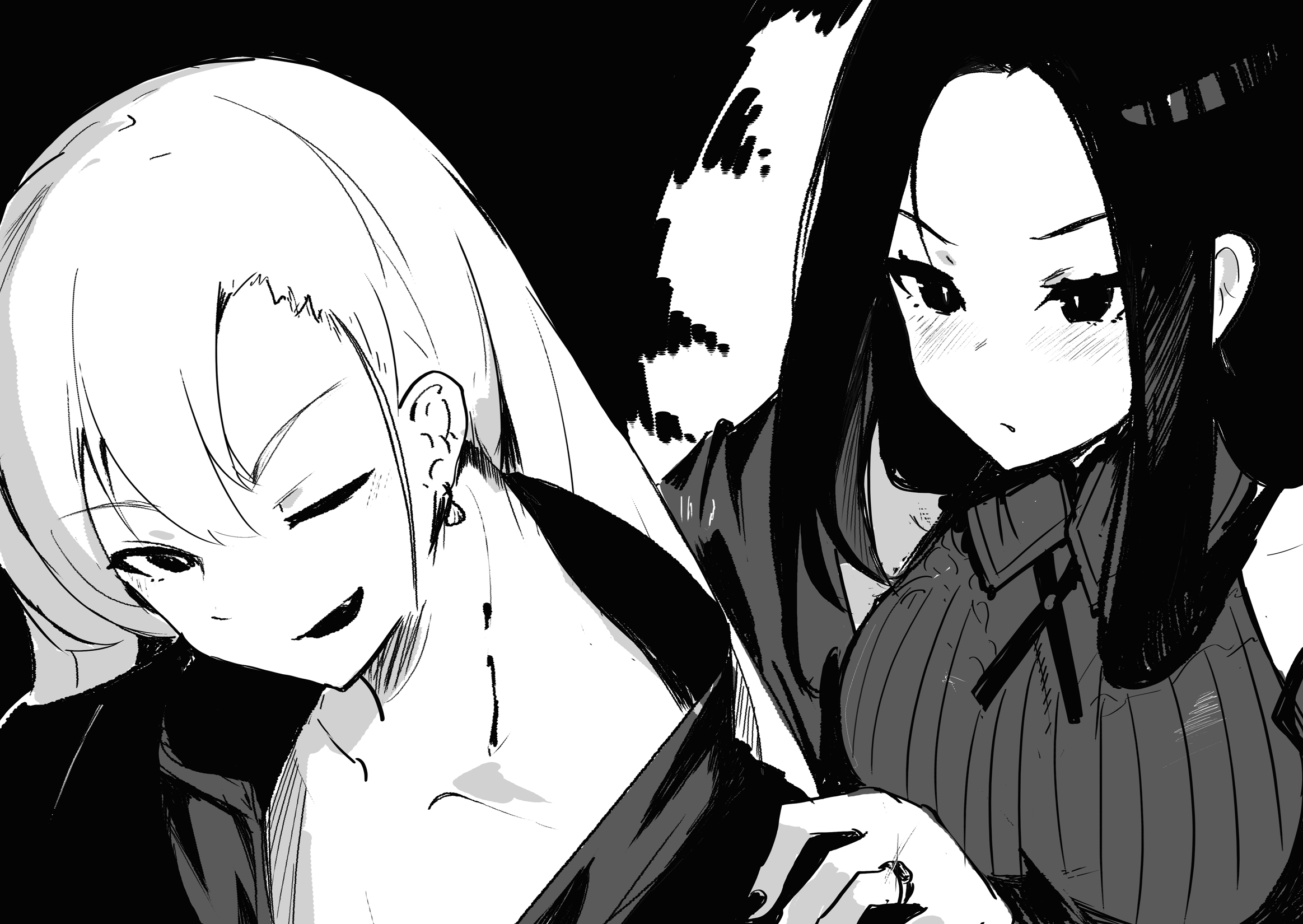
[Tips] Vampires can only be permanently killed by divine miracle, mortal wounds under sunlight, and silver that pierces the heart.
Here was a man at the end of his life.
He was the son of a knight, like so many others in the Empire. As the first son, he had been expected to inherit the title; he lived up to this expectation and more, winning the rank of imperial guardsman. The recognition and praise he’d won bolstered his house’s standing, and he took his liege’s fourth daughter in a nearly unprecedented marriage; they had children, but he continued his loyal service whenever he could.
Three and twenty years spent guarding the crown; eight and twenty more spent training new recruits. He had survived countless battlefields, and his efforts had culminated in a badge of honor bestowed by Her Imperial Majesty herself. Even after ceding the house to his son and retiring from the jagers, he continued to hone the blade: he swung his sword hundreds of times a day, every single day. The man was the epitome of a born warrior.
Now that his son had passed on the torch, if his grandson continued to faithfully serve the Empire, his exemplary efforts would be foundation enough for their clan to potentially ascend the social ladder. Yet even this champion could not escape the fate of all those born as mensch.
He had no regrets, no lingering desire. Most were lucky to live fifty years, and here he was over seventy, having witnessed the birth of his great-great-grandchild—this was a blessing greater than he thought due. Complaining would surely furrow the brows of the gods above.
One day, the hero recognized the end was near. During his daily training, a pain he’d never felt before shot through his elbow. Pain only arose from mistakes in form: he had learned that overusing one’s wrists would stress the elbows when he was still a little boy.
In other words, the strike that he’d swung perfectly for over fifty years had been off. Recognizing this as the War God recalling him for his final spell of rest, the man prepared to see his life to its end.
He sorted out his personal effects littered about his retirement manor—his wife had long since gone on ahead—packing away anything of value with names of who was to inherit them and burning anything else in the courtyard. Though he hesitated over whether he should leave his diary, after consideration, he decided its contents were too embarrassing to be read for a man past seventy and burned it with the rest of his garbage.
His will was something he’d written as a soldier; he could no longer even remember what it said. Throwing it away, he renewed it to reflect his current circumstances, and since he was already writing for once, he penned dozens of letters to his loved ones to be delivered post mortem.
These preparations took the man exactly ten days; on the eleventh morning, he finally collapsed, no longer able to get out of bed.
A terrific commotion followed. Visitor after visitor from the families he’d befriended came to see him, not to mention his own kin; even the current head of his master’s house stopped by with a present. He said his farewells to each of them, and they in turn tried to cheer him up, telling him not to say such things—these remarks were difficult for him to bear.
As a young man, he had been unable to imagine such a scene. His whole life, he had been sure that his death would occur on some nameless battlefield for Her Majesty’s sake.
Tired from the never-ending guests, the man told his grandson that he would like to live out his final days in peace, and the new head of household officially stopped the reception. Alone in his room, he would have a servant check in on him thrice a day and see to his needs if he was still alive—starting tomorrow, he would be afforded a moment of tranquility.
However, despite what he told his grandson, the man knew that he would not see the next sunrise. He had no definite reason for his conviction—the instincts of a man who’d lived an entire life simply told him so.
There was little left to ponder for a heavy body laying in bed: it simply hurt. Beset by disease, his body creaked as if to reclaim its due for seven decades of use; the stray arrows he’d taken could hardly compare.
Just as the end began to sink in, a memory surfaced—one of an old friend he’d known in the imperial guard. He’d been an old hat by the time the man had been promoted, and his terrifying epithet had been passed around in hushed whispers. He ought to still be alive, but he hadn’t come to visit. Once, when they’d been sharing drinks, he’d joked that the man’s dying moments would surely be a sight to see. Laughing, he’d said that he’d come just to gawk with those eyes, so vividly red—so brilliantly rich that the man had wanted them for himself...
Suddenly, the aging hero heard a rasp of wood on wood. He glanced at the source of the sound to find the closed window open. The curtains swayed gently in a passing breeze; it was clear this was no near death hallucination.
“Hey there.”
The man leapt at the voice. Force of habit bade him to strike at voices that came from inconceivable places at inconceivable times. Every jager was ready for a surprise attack, and even as a withered old man, he refused to forgo the trusty sword under his pillow. Shocking his atrophied body to life, he unsheathed and swung his beloved blade with mastery most would not see in their lifetimes.
However, his transcendent swing did not strike true. The wilting branches he called wrists had been caught in a small palm.
“Is that any way to greet an old brother in arms that’s come to see you?”
“Y-You’re—But...”
“You never change, Florence. Hopefully your taste in liquor hasn’t changed either.”
The man’s attack had been unthinkable for a man his age: a normal assassin would have lost their head. Yet the familiar fellow before him had casually caught it, jingling a bottle of whiskey in his free hand.
He had the face of a young child, complete with the trademark androgynous roundness of youth that took the knight a moment to recognize as a boy’s. Reminiscent of a fish’s bones, his light golden braid was, as ever, the hue of the gleaming moon.
But what drew the attention most of all were his scarlet eyes. Brighter than the freshest blood, one look would etch that hue onto a soul forever.
He hadn’t changed one bit: not his small frame, undersized for his uniform; not his two swords, one clean and simple, the other huge and horrifying; not the hair that made young ladies bite their handkerchiefs in envy; and not the twinkling eyes that others coveted like gems. He hadn’t changed from when the man had first entered the imperial guard, from when he’d saved him from an enemy strangling him on the ground, and from when he’d offered a toast at his retirement ceremony.
Of course he hadn’t: Erich the Bloodsucker did not age.
The warrior’s strike had been as impressive and taxing as in his prime, and all strength abandoned him at once; it felt as if his soul might follow suit. This unexpected guest of his may well have read his mind; laying back in bed, he sighed.
“I ‘never change,’ do I, Bloodsucker? I’m an old coot—past seventy. What, are you mocking me, you invariable brat?”
“As if I’d mock you, old friend. You really haven’t changed in the slightest from the days we spent drinking in pubs and picking fights with common thugs whenever we were out of uniform.”
The moonlit Bloodsucker then announced that he would help himself to the man’s glassware, flipping over the cup at his bedside as he grumbled about there only being one. The satisfying sound of a cork popping free was followed by the trickling of whiskey; once in the cup, the liquor was bathed in heavenly light that gave it a moonstruck quality.
It was as if a panacea was floating in the glass.
Or rather, perhaps this truly was the ultimate cure. Whenever the man had broken a bone or eaten an arrow, this had been the magic drug to cradle him to bed and ease his suffering.
“Here,” the boy said, handing him the cup. “You used to like this, didn’t you? I haven’t forgotten.”
“How many decades ago do you think that was? This cheap crap might as well be moonshine.”
Perhaps the stinging odor of alcohol triggered a sense of nostalgia, because he reverted from his habitual elderly speech to the diction and cadence of a fearless young jager. His voice was no longer raspy, his tongue no longer wavered, and the missing teeth that had altered his pronunciation ceased to bother him.
“Hey, you were the one that chose it. I tried to sell you on my favorite brand, but I distinctly remember you picked this because we could drink five times as much for the same price.”
“Shut the fuck up. Knights get paid in glory, but we gotta pay for everything in cash. You know how much it cost to keep the horses, and train up new troops, and keep all the servants paid? And my old man was always ‘tradition this’ and ‘tradition that,’ so I had to fix that old shithole manor... I had my estate’s taxes plus a jager’s salary and it still wasn’t enough.”
Reminiscing on his days of penury, the man took a sip. Though this drink was produced in a temple to the Wine God, the lousy spirits lacking any semblance of quality control were so perfectly in sync with his memories that he couldn’t help but laugh.
The booze is the same. This twerp’s the same. I’m the only one that’s changed.
“It’s good... It’s so damn good—just like the good ol’ days. But I... I’m rotting.”
A tear rolled out of the man’s eye—not from pain or malady, but an indescribable sadness that wet his tear ducts for the first time since the passing of his wife.
The Bloodsucker neither laughed nor consoled; he simply took the glass out of the man’s trembling hands and took a gulp, his face scrunching up immediately after.
“This awful flavor is the same as it always was, and you’re the same as you always were. You’ll shine as brightly as ever no matter how many years pass.”
“I... I’ve changed. Look at me! I can’t ride a horse, and I can’t get out of my damn house, let alone march in armor. I can’t even swing my sword! And you—you eternal Bloodsucker—you’re telling me I’m the same?”
“I apologize if I came off poorly, old friend. But you know...” The undying vampire downed the rest of the whiskey. “As someone who’s forgotten what it means to die, the way you fight hard for your lives until the bitter end will forever remain youthful and radiant in my eyes—I envy you.”
Pouring out another cupful, the Bloodsucker quietly said, “I was supposed to be the same.” He took another few sips and pushed the glass back into the old man’s hands. “...You know what? If it’s you asking, I wouldn’t mind splitting my blood. Do you want to come with me?”
“Wha...What?”
“Don’t you remember? I think it was before a battle. You asked me if it was true that dying by a vampire’s fangs is more pleasure than pain.”
A faded memory resurfaced in the man’s aged mind; perhaps he had said something along those lines. If he recalled, he’d been trying to taunt the impervious bastard for eating arrows and spells like nothing; after that, he may or may not have sarcastically mentioned that he wished he could have a body like that...maybe.
“You may have forgotten, but I never will—that’s what it means to be vampiric. I even remember how you nearly died in the battle that followed and made a sickening comment that you wouldn’t mind so long as I was the one to take your life.”
“What?! Y-You’re lying! This is slander!”
“As if,” the Bloodsucker said, shaking his head. “Why would I bother lying to you, of all people?”
Though the man still professed his innocence, the memory sprang back to life with vivid detail. He’d been ready to die at any moment, but a painful end had still scared him. And so, he’d figured that it might have been nice to at least be seen off by an enchanting pair of rubies.
It hadn’t been anything more than a dumb joke, but the vampire had faithfully carried it with him all this time. Thumbing the dwindling bottle of whiskey, he fixed his gaze on the sloshing liquid inside and asked quietly, “Does it hurt?”
“...It does.”
The man did not hesitate in his answer. His unaging friend shot him a sideways glance that caused him to swallow hard, and not only because of the liquor in his mouth. He knew what was being asked of him. Wordless, the Bloodsucker was avoiding the ignobility of putting the question into definite form.
Eventually, the man came to a conclusion: he lightly shook his head with the stinging aftertaste of cheap alcohol still lingering on his tongue. Subdued as it was, his refusal was certain, like a blade slicing through the last of his worldly attachments.
No response followed; the sound of a cork recapping the bottle was the only proof of recognition.
The man opened the collar of his nightgown. Still laying back, he closed his eyes, intertwined his fingers atop his chest, and waited with inaudible breaths.
He hoped his wrinkled neck would do.
At last, he heard the bottle placed on his nightstand alongside the emptied cup.
And finally...
Dawn broke. The man’s servant came to check on him, only to find he’d passed; she hurried to call his family, which caused a commotion even grander than when he’d first collapsed. They were all very sad to lose a dear member of kin, of course, but what shocked them was that he’d departed with a great smile on his face and a mysterious wound on his neck.
Although everyone was in a panic about the possibility of foul play, they still went through the steps of confirming his testament and planning the funeral slowly but surely. Calling upon a notary from the main household to bear witness, they opened his last will still distracted by the potential murder, only to make a peculiar discovery.
At the very end of the document was one final clause: should his cause of death be blood drawn from his neck, none were to investigate further.
[Tips] Though vampiric fangs are known to confer great pleasure while feeding, they can also induce other states of mind, such as tranquility.
I’ve been left behind again.
That was all I could think as I stared at the small grave in front of me. The graves in this rural canton were taken care of, but they were starting to decay. Covered in moss, the tombstones only retained their shape, yet even that was not eternal.
The letters etched here spelled out names that I loved—and that I resented to an equal degree. They spelled the names of those who had left me behind.
Even now, I couldn’t forget these names and the faces that came with them. We had lived together, laughed together, and yet they all had left me.
I’d been much younger then, and I’d clung to them. I’d begged for them to let me have my way. I’d pleaded for them to indulge me just once.
“Don’t leave me,” the bloodsucking monster had cried.
Yet not a single one did. Not my father, nor my mother, nor any of my brothers—not even Margit, and not even Mika.
These had been the same people who had listened to my dreams and put their lives and livelihoods at stake for me. Yet my last request that they stay forever by my side was too much for them to bear.
I understood, if only in a logical sense. They’d lived to the fullest, giving form to a life that they were satisfied with. To cling to their ankles and beg them not to go was no better than a maniacal fan asking an author not to write a conclusion to their story. The people I loved had all been strong: they had known what it meant to live, and they had gone out on their own terms.
I still had Celia. We belonged to one another; I would never wish for the release of death so long as I had my inseparable, beloved master at my side.
But being left behind made me so unbearably lonely.
Today, I saw off yet another dear friend. Invited back to the heavens, he was resting easy in the gods’ laps. Not a single person thus far had humored me—how many rejections in a row did this make? Was I really that unpopular?
Sad and depressed and empty, I always ended up coming back here, to the site of my most heart-wrenching farewells. After this, I would probably travel far to the north to visit a grave buried under the polar snow. Work would pile up if I took too long, not to mention how I’d worry my Empress, but I couldn’t help myself.
Or maybe I’d stay here until the morning, and use that as an excuse to stay under someone else’s roof. I could take shelter until the sun set, spending time with the living memories of those I loved.
That would be blissful...but alas, I had become a vampire in the truest sense. I broke my heart at the one-sided feeling of abandonment; I felt pure joy seeing what my strong, beautiful family and friends had left in their wakes; and I was always fighting the impulse to drag them into this same hell for leaving me. I didn’t need to think twice to know that not even they would forgive me if I did.
We truly were pitiful creatures, us vampires. While I had fought the masked lunatic—I didn’t want to think about the fact that we were now technically related—I’d been jealous of how ridiculously powerful they’d seemed, but now in their shoes, I knew the suffering that accompanied this way of life. How did everyone else live with this crushing heartache?
...I supposed I wasn’t one to talk. Not only did I have Celia, but I had hobbies to occupy myself with. It wasn’t as if the last of those I personally knew had passed; that I could soak in this depressed stupor as if the world were ending betrayed my privileged position.
I think I’ll go home after all. I’d take a quick trip up north to enjoy the snow and see the beautiful buildings, and then call it a day.
“Welcome home, Dear Brother.”
After indulging in my tasteless trip to my heart’s content, I returned to my manor only to be greeted by my sister.
“Oh, hey, Elisa.”
The girl hanging around my estate in the corner of Berylin was just like me: unchanging. Her long, soft, golden hair was still exactly like our mother’s, and her amber eyes came straight from our father. Having stopped growing in her late teens, she still had the young contour of a girl; her lavish dress was a dark black that invoked images of mourning, perhaps meant to match my own attire.
Despite holing up in her College atelier most of the time, Elisa occasionally came to visit me like this. She never contacted me, nor did we schedule these meetings; whenever I was down, she simply appeared without warning. Though she denied it, I was absolutely positive that the alfar she still kept in her company were sneaking around and updating her on my condition.
“Would you care for a drink, Dear Brother? I’ve received a splendid wine, you see.”
“Is that so? Thank you for coming to share. I’d be happy to join you.”
Elisa took my hand with a refined, cheerful smile, but my heart brimmed with regret whenever we met. I’d come to enjoy my life as a vampire, but I hadn’t meant to drag her along with me.
Changelings were fairies born into a fleshy shell. She had arisen from an alf idolizing mortal life, and just as she had lived as a mensch...she should have been able to die as one. Yet she had stopped aging to match me: she was neither truly human nor truly fey.
Once, overcome with guilt, I’d told her that she didn’t have to do this for me.
Smiling, she answered: “I shall stay with you until you decide our time is up.”
Maybe I was overthinking things, but...no, let’s not go there.
Both Celia and I had grown too vampiric for our own sakes, but we were still far from genuine immortality. One day, we would no longer be able to bear our vampirism—our lives—and we would return this gift to the Sun God. It was an inevitability. Eventually, my ever-expanding tomorrow would tear down the tower of yesterday that I had built.
But for now, I would let those who lived alongside me pamper me.
That said...I really wished Elisa would accept Celia’s invitations to dinner, even just once. I was catching serious flak for it, and I couldn’t bear to see Celia sad about how my sister seemed to hate her.
I tried to bring it up with Elisa, but she answered with a terrifying smile that shut me up instantly. Maybe I was still young after all...
[Tips] Among the “undying,” most realize their true nature at the same time they realize what it means to lack a predetermined end.
Afterword
Afterword
I dedicate this book to my grandmother. Two Obon festivals have passed, and I finally feel as though I’ve begun to set my heart back in order.
I also offer it to my editor, who, instead of losing their temper at my slow progress and scheduling mishaps, doggedly assisted me in the bookmaking process; to Lansane, who brings my meager writing to life with beauty and celerity despite my last-minute additions and bothersome requests for scenery; and of course, to my wonderful readers who so graciously support me through thoughts and retweets.
This marks the fifth afterword begun in foreign style, and my first-ever single work split into two books—the completion of which has left me awestruck.
Speaking of, when I was nearing the end of this volume, I received the auspicious news that we would be releasing our first-ever limited-edition product for this series. For those who have only read the standard paperbacks or ebooks and may be confused: limited to the publisher storepage as it may be, this series has released its first instance of official merchandise.
Upon first receiving word about it, I bluntly said, “An acrylic...block? Huh? Not like...a stand or something?” and had to double and triple check with my editor. If that wasn’t impolite enough, I went so far as to blurt out, “But what is it for?” Good times.
I suppose it might be the world’s cutest paperweight, or maybe you can use it as a spider token in a certain TCG since it depicts Margit. Anyway, utility aside, when I remember that the sales numbers may justify more merch in the future, I can’t help but get excited. Man, do I want little metal figurines of Margit or Mika—or maybe a set of dice where the highest value is themed around each character...
My motives can barely be considered ulterior, but I truly do want to put out something usable in tabletop games themed after this series; I would be so over the moon that I might fly straight to heaven. Please, I beg you, do show your support if you would be so kind. I swear that rolling real, physical dice will bring indescribable euphoria with it!
Jokes aside, I suppose I ought to touch on the main text itself. While I’m sure those of you who have finished reading are aware, this canto has seen even more text added than the first; even the afterword has bloated to an impressive page count.
Initially, I had written the web novel without any consideration for how lengthy any given arc might become—I thought it a touch too arrogant to begin writing with the assumption that my story would see paper—and since I didn’t have any restrictions, I’d adopted a laissez-faire policy of “Mwa ha ha, I’ll write what I want how I want it!”
You can see how that turned out. Feel free to laugh.
Even without my kidding around, though, I do feel as though I’ve made a mistake. Not only does this canto easily clear twenty thousand characters in length, but it’s roughly a hundred pages thicker than the first half of volume 4. Now that I have the physical copies in hand, I can understand why my editor had complained about how they’d look when lined up together...
But, hey! I think I’ll get to see even more comments along the lines of, “Huh? I don’t remember this...” or, “This is more new content than not!” than the last canto or even the first volume. I’m looking forward to that.
At any rate, I’ve made plenty of revisions and additions that longtime fans can enjoy. I also felt that the core idea of “one heroine per arc” caused the story to feel rather lifeless; wanting to have everyone come together for a real campaign caused things to get a little out of hand.
The more I wrote, the more I wanted to write, until I started to question if I could actually fit everything into two books. When I said as much on Twitter, my followers gave me a hearty laugh with comments like, “Just make it a trilogy,” “Canto II (Cont.),” or, “Don’t worry, I’ll wait for Canto II-2.” The internal conflict between not wanting to cut off the plot inorganically and being unable to justify derailing the publishing schedule for one pathetic author aside, I somehow managed to—read: they were kind enough to let me—fit everything in one book.
To tell the truth, I did consider pulling the same trick as volume 3 and off-loading the ending to the next volume. However, mere survival didn’t feel like a fitting conclusion to me, and I ultimately jammed everything into volume 4.
But as a result, my hopes of fitting in a Margit side story like I mentioned in the last afterword were dashed, along with the deeper dive into the world’s religious groups I’d been so excited for... Not only was I hesitant to add more prose—yes, I do know that there is a limit—but I also simply ran out of time.
In addition, as you may already be aware, this Henderson chapter has changed dramatically from its inception on the web. Frankly, I’ve read enough sci-fi and military fiction to cause machine oil to dribble out of my mouth since when I first wrote it, and I just wanted to add in some of those elements. Go ahead and laugh that you can plainly see what’s caught my attention at any given moment by reading what I write.
To speak about the story without spoilers is a challenge, but I would like to move on from what I couldn’t write to what I did.
The underlying theme of volume 4 is this: immortality. Not limited to this work, of course, but I wished to explore the woes and emotions of beings unbound by time—or at least, for whom death may be inevitable, but whose lives practically span the whole of human civilization. I’m not entirely sure if the message was “underlying,” per se, but it wasn’t entirely overt, so I’ll leave it as is. I believe that anyone who will effectively never die is sure to be psychologically alien to us Homo sapiens sapiens.
I entered my fourth decade of life in August of 2021, and one thing I realized is that even we humans endure the spiritual abrasion of time. Perhaps you might understand: how many times have you laughed until your sides hurt as of late? Surely not as often as when you were a child, I would think.
Though I wouldn’t have called myself a clown, I personally laughed a great deal at comedies on TV and online parodies in my youth; at times, I would have such a fit of hysterics that it hurt to breathe. But in the last ten years, I can’t remember a single time I’ve done the same.
I suspect that experience banishes the great majority of things into banality. Humor that stems from the unexpected becomes harder to come by, and punch lines that can be predicted draw out smaller laughs. To attain that nostalgic aching in my sides becomes a dream more difficult as time wears on.
Yet these brains of ours bless us with the ability to forget, preserving the bare minimum of novelty. No matter how many years I live, new shows or books continue to capture my interest, even if they contain a good deal of familiar material. Emotions are much the same; life is not so difficult to live.
However, these immortals have emotions befitting their elongated lives and memories built to match. They cannot say the same: life unending and recollection unfading produce a wealth of experience and a store of emotions that never dissipate. Their vast treasuries of knowledge reduce the world to a lifeless expanse of the known; in the end, their day-to-day activities become redundant, and when they grow weary of the mundane, the act of living itself becomes no more than habit.
Thinking about their condition reveals a terrible fate. For us, simply not dying takes up a part of our mind at any given moment. So long as one does not wholly abandon the past and future, subscribe to pessimistic ideals, or find themselves trapped in a despair-inducing dead end of life, it is rare for a human being to tire of living.
After all, our bodies regularly scold us to keep us going: don’t eat and you’ll get hungry, don’t bathe and you’ll feel disgusting, and don’t use the restroom and it’ll begin to hurt. While we may fall into the trap of routine, these deterrents prevent us from straying too far off the course of life—in this way, I think we are rather fortunate.
Alas, organisms too perfect for their own good are not so lucky. The methuselah that appear in this series can forgo food, drink, and sleep without issue; vampires simply need a sip of blood and a room to hide away in. They lack the spurs digging in to force them to live.
When the flesh is too complete to derive joy from mere survival, the weight falls to the psyche. Thus the everlasting characters depicted tend to drown in their hobbies to the point where their sensibilities seem deranged from more normal perspectives. Any less and they shall tire of existence, doomed to choose between death and a fate no better than the unmoving stone Buddhas at the sides of roads.
To unload that burden onto interpersonal relations is, in a sense, easy. Society will demand participation whether you wish for it or not, producing limitless permutations of interaction. Similar people will follow similar patterns, but none are exactly the same. Seeing as company can act as a permanent drip feed of novelty, perhaps it is just right for an eternal’s hobby, as poor as their taste may be.
However, overattachment will render the immortal unable to bear the fleeting hourglasses of life around them, culminating in the “They all left me behind,” seen somewhere in this volume. If one chooses more permanent friends, their undying nature tends to produce unchanging personalities that are easy to grow bored with; cling to the interesting ones, and they will leave in the blink of an eye. What a sorry way to live.
I tried to dial into the thought processes behind this fictional race and their imaginary culture in order to improve the quality of my writing, but I feel as though I’ve created a form of life beyond salvation. I truly do pity them. If I’m ever offered a drug that will stop my aging, my efforts have convinced me that I’d never take it. Even if I regret it in my final moments, I can’t see myself needing it to live a good life.
With that said, if I manage to string together a fifth volume with your support, I will once again be focusing on these sorry people.
Yes, that’s right: the next story will focus on the scoundrel. The web novel glossed over it, but the imperial ennoblement fiasco that precedes Erich’s coming of age will be expanded upon by a lot. That, and the strangely popular—it might even be the most popular—Henderson chapter...?
I’ve babbled on for a good while now, but I pray we might meet again in volume 5. I recently was given access to the Net Terminal Gene—aka the first shot of the vaccine—so it’s only a matter of time before I link my mind directly with the internet and fuse my ego with the great collective consciousness. I’m sure that will boost the speed of my progress.
[Tips] The author uploads side stories and world-building details to @Schuld3157 on Twitter as “extra replays” and “rulebook fragments.”
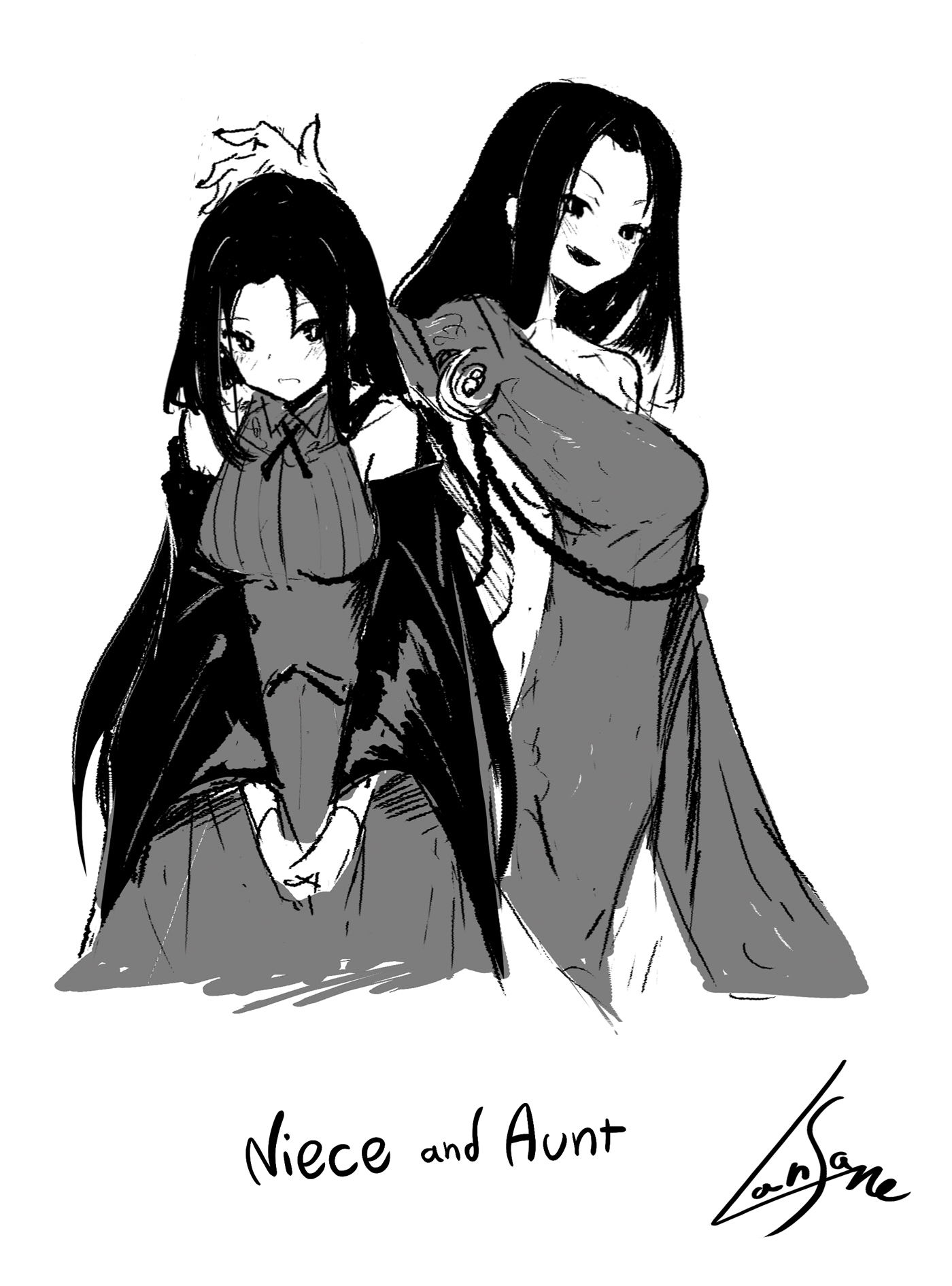
Color Illustrations
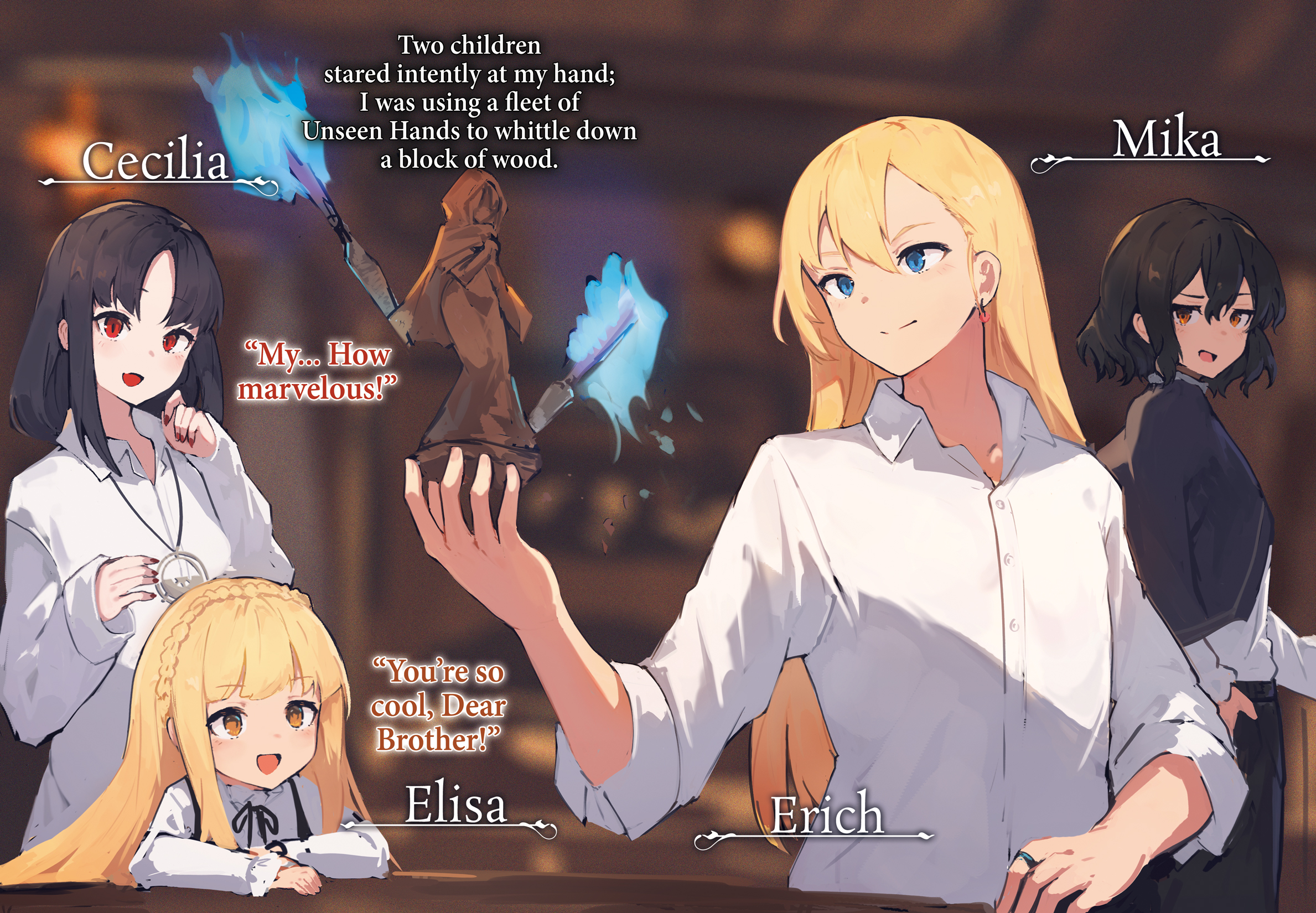
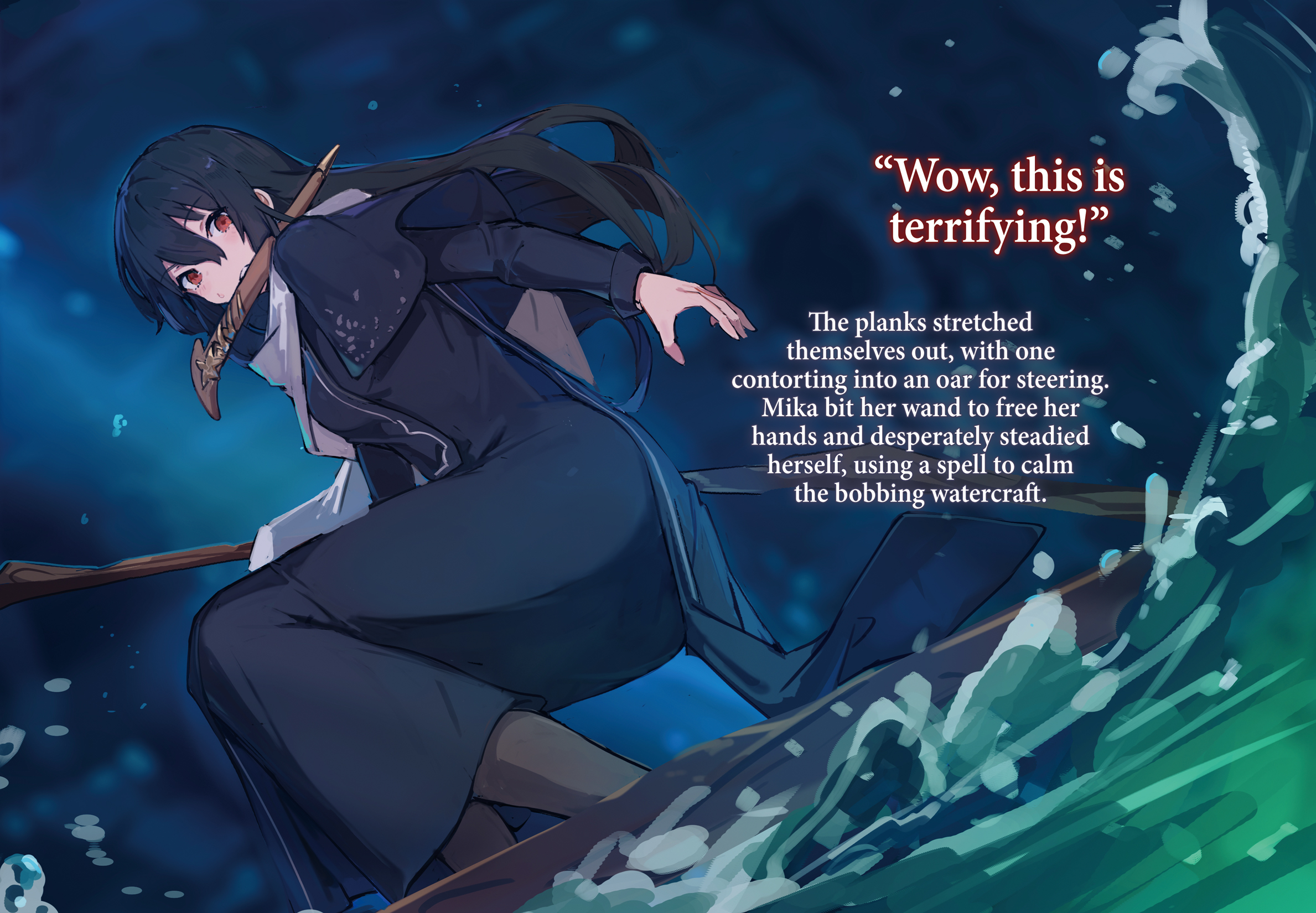
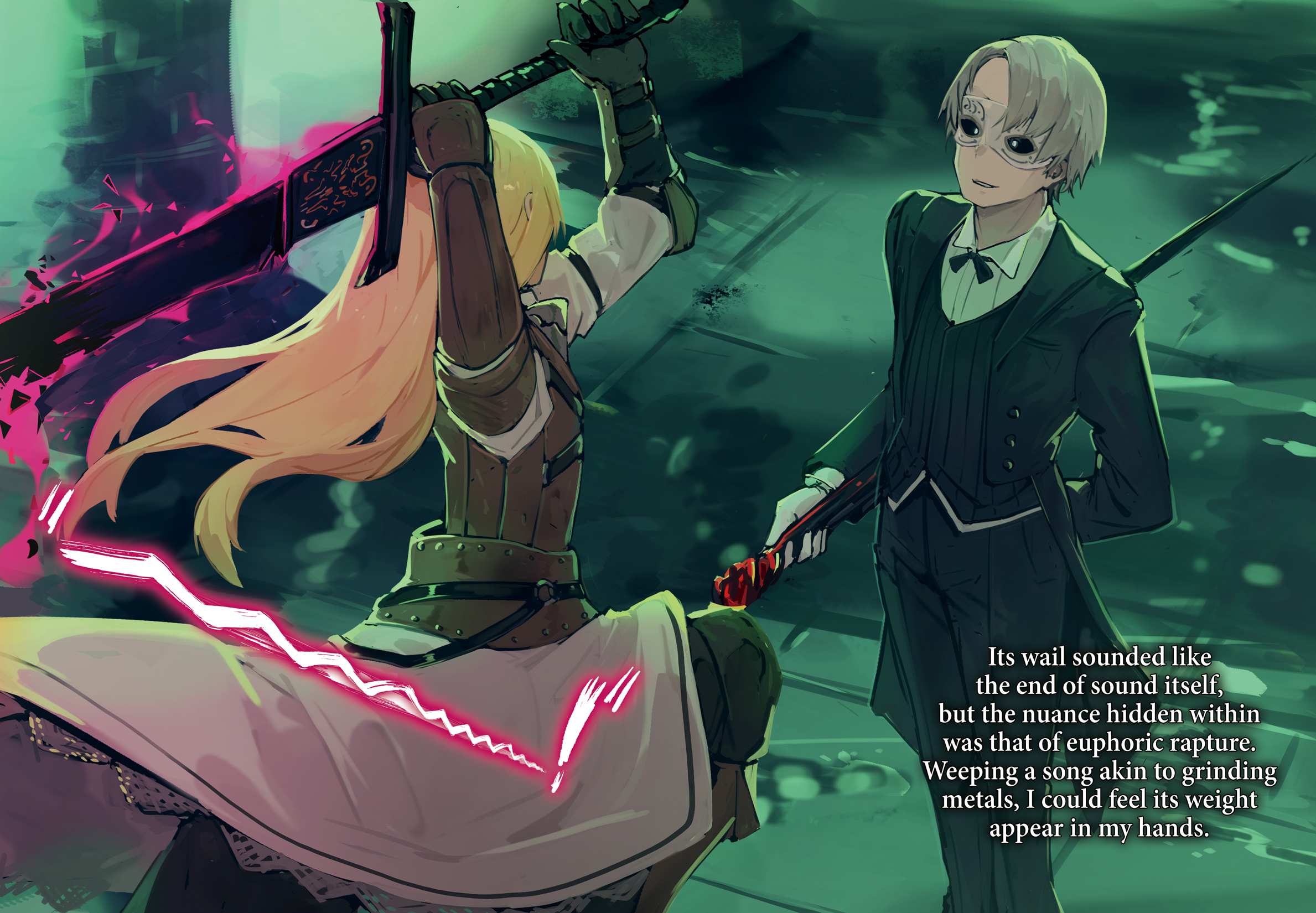
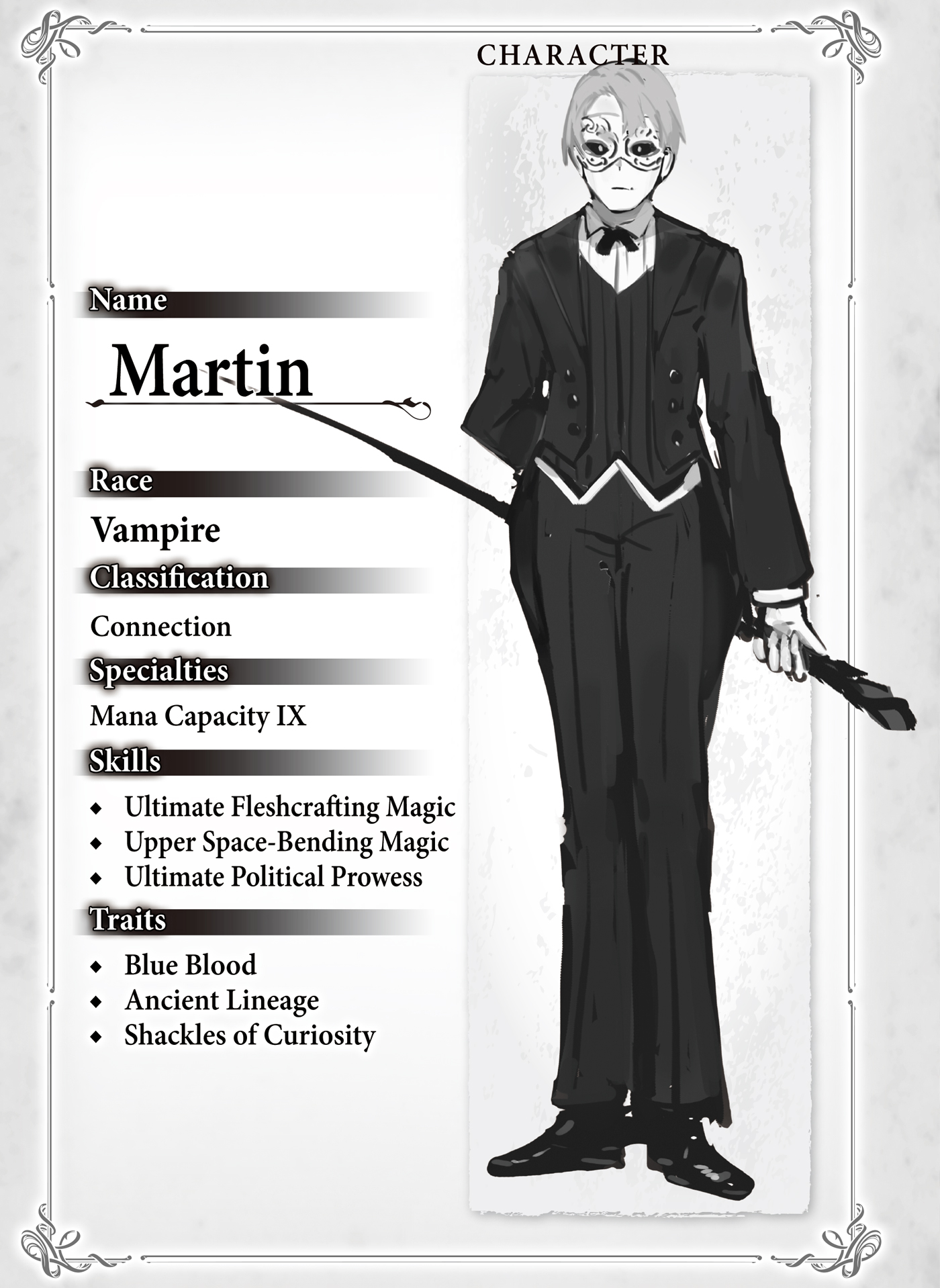
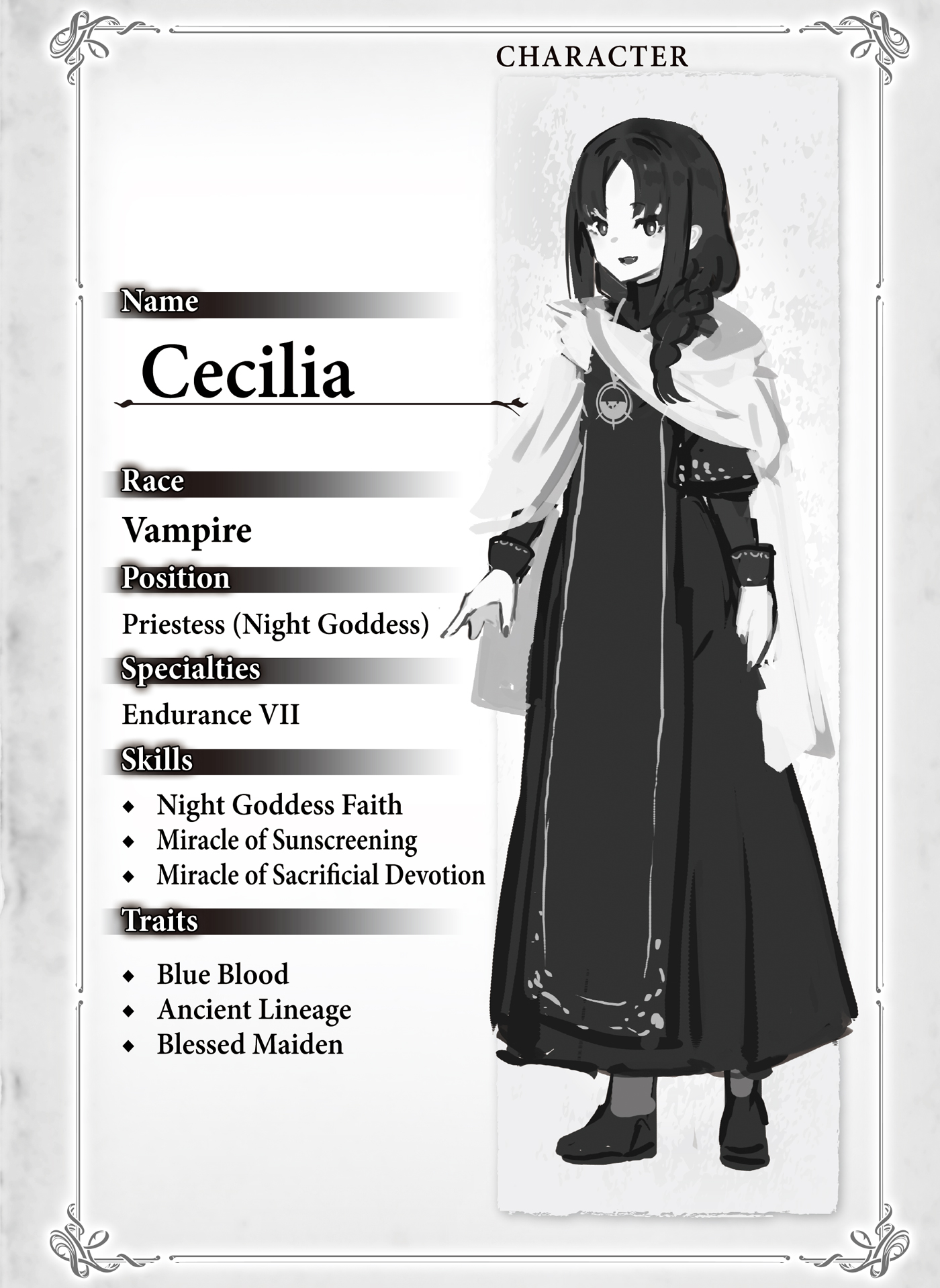
Bonus Short Stories
Bonus Short Stories
The Joy of Fashion
The young student looked at their reflection and groaned.
They’d received this hand mirror from their master, and despite its age and decay, the mirror proper remained clear. He’d probably passed it down as a message that a future magus nearly of age needed to take care of their appearance.
“Hrm...”
This was the same face they’d seen reflected hundreds of times in the surfaces of puddles and ponds, and today, it was scrunching up in frustration. Trying to objectively judge one’s own facial features was a challenge. At times, the brain naturally interpreted its shell as being prettier than it was, and beauty was something that varied with taste and opinion of the character it represented.
Young Mika had been born a tivisco, and the cautious avoidance they’d experienced in their hometown had left them naive to the workings of the mortal heart. They knew what kind of features they liked, but what constituted traditional beauty was a complete mystery—especially now, when they were neither boy nor girl.
“He sure does give some tough homework... I bet I’m supposed to learn how to use all these.”
Mika propped up the mirror on their desk with a little leg hidden within, and stuck their hand in the bag their master had given them. Inside were too many vials to count, all full of some drug or another. Each and every one was labeled with their name and effects, and each and every one was some kind of makeup meant to doll up the user’s looks.
“Skincare, bleaching, dyeing...hair tonic? Boy, he really threw everything he had my way, huh?”
Sorting the things out by their written descriptions was enough to get a good sense for how unpredictable their master’s various tea parties were. It also drove home the great pains humanity went to in order to conform themselves to higher aesthetic ideals.
“Anti-bedhead, straighteners, gloss, colorful dyes, black dyes, lengtheners... People really do love hair.”
Mika knew that a change in hairstyle was enough to recontextualize a person’s whole demeanor; they weren’t going to make fun of the universal interest the craft demanded. After all, they saw someone that showed them the importance of hair nearly every day.
Erich of Konigstuhl was Mika’s best friend, just as important to them as their arms and legs. He was also a boy who didn’t care much for fashion—he still made sure not to look offensively bad, of course—save for his ever changing hairdo. According to him, he wasn’t doing it because he wanted to: it was all a product of “earning favor.” Whatever the reason, though, his head always had a fey charm to it.
For someone with wavy hair like Mika, the boy’s straight locks were worthy of envy. They were rays of sunlight spun into thread, and his shimmering blond flowed freely away through Mika’s fingers whenever they ran a hand through them, leaving only the lingering fragrance of flowers like a fairy vanishing into space.
And every day, the alfar played their little pranks: his hair was always done up to their liking.
Erich usually kept his hair tied high on his head so as not to get in his way, but if left alone for any length of time, he would come back with a braided crown, an impressively set bun, or a thick braid reminiscent of a fish’s skeleton. Mika could always count on his bombastic hairstyles to entertain them.
At times, the boy grumbled, saying that their pranks bent his hair out of shape and were difficult to undo, and that he wished he could cut all of it off and be done with it. His tone was that of someone genuinely upset as opposed to someone trying to garner attention, so it seemed like he really meant it.
That said, Mika loved his hair: looking at it, running their fingers through it, and neatly tying it into braids—he was soft on Mika and let them play with it no matter how much he grumbled—so the young mage planned on putting up a fight if he ever went through with it.
Not a verbal fight, either. A fight fight. They were ready to die on this hill.
“I mean, I can’t ever have hair like that.”
Picking up a golden dye, Mika thumbed it around for a moment before putting it to the side; they’d never use that one.
They couldn’t muster the faintest interest in any of this and the necessity of it all had yet to sink in, but there was no denying that their shifts had begun. They knew that the day would eventually come when they’d need this sort of knowledge in order to go out into public without humiliating themselves; the least they could do was study these drugs while sorting them to be ready for when they’d start experimenting.
In the middle of cataloging, Mika came across something stored in a seashell container; the iridescent shell lacked any sort of label, perhaps in order to preserve the stylish exterior. Curious, they opened it to find...
“Rouge?”
Blinding red covered the insides. Pigments this vivid required a great deal of safflowers to produce, so this was probably high-quality stuff. Though they were unsure if it was a newly developed color, the poor student marveled that anyone could give out something of this make as a free sample.
Suddenly, the sharp scarlet tickled the tivisco’s fancy: a mysterious desire to put it on welled up within them. Only a moment prior, they’d been cocking their head, wondering why people fixated so heavily on their images, but here they were.
“Uh... Like this, I think?”
Mika thought back to how their parents had applied makeup when in their feminine forms, and tried to copy them. Taking a small bit of the dye on their pinky finger, they ran it across their lips, overwriting the pink flesh in the mirror with a deep red. They did a second pass, and then a third, making sure it covered everything evenly. Lastly, they folded their lips in and began rubbing them against each other—they didn’t really know what this did, but copied their parents anyway figuring that it was probably an important final step.
Finished, Mika looked at themselves in the mirror and a thought crossed their mind: I wonder what my old pal would think of me in makeup.
“...Mm?!”
All at once, this train of thought became very embarrassing, and they wiped off the lipstick in a frenzy. Once it was gone, they looked in the mirror to see their usual self...except that the red on their lips had been replaced with a rosy hue all across their face. In fact, it was dubious as to whether any blush could produce cheeks this pink.
Tormented by the mystifying onset of sudden embarrassment, the young mage stuffed the arcane drugs back into the bag with one conclusion: Yup, this stuff is still too early for me.
[Tips] Imperial society considers makeup a form of etiquette for women; for men, it is the extra mile meant to spruce up one’s visage.
Backwater Princess
While the task of equating the princess of a major noble house to a country bumpkin may seem daunting at first, it is in truth quite possible.
“My! So this is the imperial capital... I’ve only ever seen such crowds at the Winter Solstice Festival.”
Here was one such lady, rolling underneath the grandiose gates of Berylin in her carriage and sounding like a rural hick. Despite her imperial birth, Cecilia’s parents had conformed to Erstreich tradition and sent her away to a Night Goddess monastery before she could even remember. Having spent more than forty years on Fullbright Hill, she was a stranger to urban metropolises.
She’d been to the towns at the foot of the mountain, but those were places where only the most devout gathered. It lacked the emphatic traffic of over one hundred thousand people coming and going every which way.
“Oh, or am I mistaken? Perhaps it is a festival, celebrating a holiday of a god I am unacquainted with.”
“No, my lady, today is unmistakably ordinary. The capital is always like this—crowded and smelly... It isn’t a very livable place.”
The nun smiled sadly at her retainer’s comment. She, too, had joined Cecilia at Fullbright Hill—though she’d spent most of her time at the base of the mountain, seeing as an Immaculate priestess could not be waited on by another—and found the chaotic hustle and bustle of Berylin distasteful beyond belief.
“Don’t say that,” Cecilia said. “Look how full of life they all are. I’m sure the Goddess would be pleased to see her subjects so lively. Perhaps it would be exciting to join them.”
“I would say there ought to be a limit to liveliness. Also, my lady, I apologize, but you are not to step out of the carriage until we arrive at the temple. There are plenty of dangers lurking around here.”
“Do I really look as though I’d walk headfirst into such danger?”
The priestess’s brows drooped to show she was hurt that her loyal vassal would imply such a thing; this time, it was Mechthild’s turn to return a sad smile. Her time serving House Erstreich was long, and the knight had a solid grasp on her master’s personality. Although Cecilia was the picture-perfect maiden raised in an incorruptible tower, Mechthild knew that the character piloting this refined lady was no better than a schoolchild.
If the princess was left to roam free, she was all but guaranteed to wander this way and that, causing a panic everywhere she went. The depths of her curiosity could only be described as the product of inheritance, and her inherent ambivalence toward death would make itself known whether she intended it or not. She wouldn’t get herself killed, but Mechthild was positive she’d cause astounding trouble—she swore not to let her out of her sight.
Ignorant of her servant’s resolution, Cecilia made full use of the magically enchanted one-way window by nearly pressing her nose up against the glass to get a better look of the city.
“What a pretty place,” the vampire said. “There are so many street lamps, and all the buildings are so neatly sorted. I imagine it is a fun place to be.”
“It is nothing more than a facade. I should hope it to be pretty, what with all the tax money that they pour into its upkeep.”
“Oh, Mechthild... Must you be so cynical?”
“It’s who I am.”
Though she took a moment to pout at her retainer for not reciprocating her feelings, Cecilia’s attention quickly returned to the passing scenery of town.
As the carriage quietly rolled along, it finally turned into the tranquil roads of the northern district. Today’s itinerary was for them to visit the capital’s temple of the Night Goddess —technically called the Great Chapel, because it was the foremost on paper—to see the Head Abbess, and then they’d retire to their Berylinian estate.
The lively streets simmered down here, where temples lined every road. Traffic was sparse: most believers went to the churches in the low quarter, meaning the only pedestrians were a handful of silent monks. Other than them, the only things to see were subdued places of worship tuned to not stand out more than the imperial palace.
“I see that even the Circle Brilliant must remain modest here.”
“My lady, I don’t believe an emblem of solid gold can be called modest...”
For those gaudy lovers of Sun who embellished everything within reach to settle for a single golden crest depicting the Father’s rays of dawn was understated indeed. Or at least, Cecilia thought so, having made a pilgrimage to His head temple once before.
“Are those bells? My, it’s as if they’re welcoming us.”
As soon as their carriage pulled up to the Mother’s Great Chapel, the bell towers installed by every temple began to sound. Each god imbued Their bells with different meanings, and sometimes the number of tolls could also carry significance. Of those ringing now, many were simply heralding evening; yet the Goddess of Night’s clear, reverberating gong was an omen of welcome surprise.
Cecilia felt a premonition. Whether it came from her experience as an arm of the Goddess or simply a wordless prophecy from the heavens, she could not say.
All she knew was that a fateful encounter awaited.
“We’ve arrived. Your hand, my lady.”
“Thank you very much.”
With conviction in her heart, the priestess took her first step onto the streets of Berylin.
[Tips] The sound of bells is revered as the voice of the heavens. Not only do they serve the practical purpose of telling time, but they remind the faithful of their gods in their daily lives.
Cross-dressing Difficulties
How is it? was written all over the girl’s face, and Erich and Mika struggled to react.
“It’s—well...”
“Yeah, I think so too...”
“Think what?!” Cecilia asked excitedly.
Alas, the pair’s response was one and the same: “You look too cute.”
The context as to why was a bit too convoluted to explore in detail, but in summary, Cecilia was in the middle of attempting to dress up as a man. While dressing in unremarkable clothing was a given for anyone on the lam, disguising one’s most defining features was even more effective when avoiding close scrutiny.
Dyed hair, different makeup, and unfamiliar clothing were staples of this sort of thing, but the best veil of all was that of gender. Admittedly, changing one’s race in the multicultural Empire would probably be the most foolproof trick, but unfortunately those spells were too difficult for a magus-in-training and a pseudo-mage addicted to practicality.
Altering the flesh was one of the most difficult pursuits in magecraft. Irreversible changes were quite easy—though generally, people called these “accidents” or “attacks”—but making sure to preserve the target’s original form for later reversion was laborious. Obviously, they would have liked to turn this black-haired beauty into a hulking orc man over two meters tall; then they’d be able to triumphantly walk any street in the capital. Alas, that was too unrealistic, and they had to settle for the next best thing.
As a result, Cecilia had tried on a set of Erich’s clothes to pass off as a boy, only for the outcome to be less than ideal. The shirt was too baggy, as were the pants, and worst of all, his belt had been too big to buckle, forcing them to tighten her hips with a piece of string. Erich was significantly smaller than an average mensch man, and yet it was still immediately apparent that she was a girl in men’s clothing.
“No good?” the vampire asked.
“Unfortunately not,” the mensch answered.
Oddly enough, Cecilia had been confident her first attempt at cross-dressing would go well, and she hung her head sadly. While the other two felt bad, it was better to tell her the truth and hurt her feelings than have her go outside looking like this.
“Dang,” Erich said, “what now?”
“Hmm,” Mika groaned. “I think it might be easier to obscure her body with a robe, and we’ll need to stuff it a bit so she doesn’t look so slender.”
“Then I guess the only way to fix her face will be to stuff cotton in her cheeks. I don’t think makeup will cut it here.”
The pair tossed ideas back and forth, experimenting on Cecilia like a dress up doll. Magus-like robes were perfect for not sticking out in the underground, but they still had tons of other issues to solve.
First and foremost, her chest was too blatantly feminine; Erich stepped out for a moment while Mika and Elisa squished it flat with some cloth. Cecilia found the wrapping quite painful—despite being a noble lady, her monastic life had given her no experience wearing corsets—but it bound her bust enough to introduce uncertainty to her silhouette.
There was still much work to be done, but they were running out of time. Mika tearfully bid them farewell; the rest was up to Erich in the short while they had left. He fashioned shoulder pads out of some rags, gave her cotton to alter her jawline, and, in spite of his unfamiliarity with makeup, touched up her face to draw out more masculine traits. Combined, his efforts made it difficult to tell if she was a boyish girl or a girly boy.
Alas, her hair was an unsolvable problem. Erich had long hair too, but his features were still masculine enough—though more effeminate than most—that someone looking closely would be able to mark him as a boy. Cecilia’s imperfect cross-dressing paired with her long hair was sure to leave a markedly feminine impression.
“...I know just what to do!”
The closer her reflection became to that of a boy’s, the more fun Cecilia had. Realizing that there was only one element left holding her back from perfection, the young lady acted with great alacrity.
Erich instantly got a bad feeling from what she’d said, but it was too late. She snatched up the dagger he’d been using to cut the rags...
“I ought to have my hair cut if I’m to pass off as a boy!”
...and lopped off her hair with zero hesitation.
The young lady could not comprehend the meaning behind the boy’s echoing scream, and she would go on blissfully unaware about the terrible guilt he would continue to shoulder.
[Tips] The Empire does not look down on men with long hair, but shorter styles are almost always seen as manlier.