The Nemophila Girl
The Nemophila Girl
Life was preposterous. Lucia Fano, age six, knew that much for a fact.
The Kingdom of Ordine was said to be the largest and most prosperous nation on this continent, and the royal capital was said to be the most charming and splendid of all its areas. However, capital-native Lucia was born with deep green hair and eyes of oversaturated blue; her skin was pallid, her stature slight, and her looks modest and unremarkable. Dahlia, a friend who lived near Lucia’s grandmother, was a girl with red hair and bright green eyes. When she smiled, it was as though her namesake flower had blossomed. A slightly older playmate of theirs, Irma, had glossy hair the color of black tea and eyes to match, if slightly redder in hue. Her dexterity was exhibited in the braids she did herself, and she was very pretty. The girls around Lucia, every single one of them, were bolder, prettier, and cuter than herself.
Lucia knew she was unassuming. But despite that, she wanted to be cuter and prettier, and so every day, she brushed her hair neat, washed her face thoroughly, and put on her freshly laundered blue dress. Yet earlier today, some boys playing in the neighborhood had said, “You sure are like a dayflower, Lucia.”
Dayflower: a weed, small, blue, and forgettable, one that grew out of the cracks in an alleyway—how mean! But Lucia had failed to voice how much the comparison had irked her, instead running away with tears in her eyes. She was frustrated at herself for not having been able to say anything in response; she hated that about herself. She would’ve rather been blessed with height, gleaming blonde hair, and rare purple eyes. She would’ve rather been a beauty whom others compared to a rose or a lily. If only that were the case, then she would be able to wear the cute clothes that she wanted to. She would look good in the lemon yellow dress with white lacing her maternal grandmother suggested. She would look good with a long, glossy blue ribbon and a pair of red shoes with flowers all over. But she knew she would never be a girl who looked good in cutesy fashion like that.
“How preposterous.” That was a word Lucia had heard her father mutter under his breath yesterday. She had asked him what it meant, and he’d replied that it was “when things don’t make sense and you won’t stand for it.” To describe her as a dayflower was to say that the cute clothes she loved wouldn’t fit her. If that wasn’t preposterous, then she didn’t know what was. It wasn’t as though the boys had been picking on her, yet her vision was getting blurrier by the moment. Going home now and letting her family see her in tears would only make them worry, and so Lucia headed down the alley a stone’s throw from her home.
Once the evening sun dried her tears, Lucia would leave, go home, and wash her face—so she decided as she squeezed past the white walls of a warehouse. However, she realized someone had beaten her to the punch.
Though it was spring, the man had on a hooded black cloak, and he was perched on a stoop in the alleyway—perhaps he was one of those people called “perverts” that Lucia’s family always warned her about? She thought she ought to turn back while she had yet to be discovered, but the man pressed one hand against his nose and then proceeded to sniffle. It looked like there was already someone occupying the crying corner.
Lucia dug through her pockets and, after overcoming her hesitation, sped toward the man with a handkerchief clenched in her fist. “Here, please take this!”
He must’ve not noticed Lucia at all—he shrieked. “Whuh?! Oh.” His suntanned skin and tea-brown hair appeared for a split second before disappearing under his hood again. He had also shown his tea-brown eyes, which exposed the fact he had been crying. Though she couldn’t tell for certain through her own veil of tears, he seemed to be slightly older than Lucia’s brother, who was four years older than her. The young adult pulled his hood back down and refused the handkerchief. “Thank you, but I wouldn’t want to soil it.”
“It’s okay; I have two!” Lucia had to carry at least one lest she use her sleeves and dirty them, as there would be no excusing herself when her clothes got washed. She laid the white handkerchief on the youth’s knee and sat down on a step a short distance away from him. Then, Lucia took the second one out of her pocket, scrubbed at her eyes and cheeks, and assaulted it with her snot; she planned to secretly wash her hanky when she got into the bath tonight.
“Very well, then. Thank you.” He dabbed at his face underneath his hood, then blew his nose thrice with vigor; it caught Lucia off guard and even made her forget she had been crying. “Sorry for getting your handkerchief dirty. Would a silver piece be enough to cover it?”
“That one was just for practice; you can have it.”
“Sorry—practice?”
“Embroidery is a part of our family business.” The handkerchief she had given him was one of the ones she’d started out with. The Fano family ran a workshop that made socks and gloves, so Lucia had been practicing the craft since before she entered primary school. She wanted to make beautiful artwork like flowers and birds, as her mother and grandmother did, but at the moment, she barely had her cross-stitch down. As such, the handkerchief in the young man’s hand was littered with blue crosses.
It seemed like he was looking down at his new present, though she wasn’t certain, as she couldn’t see past his hood. “Such beautiful handiwork, and I’ve ruined it. Please forgive me.”
“It’s beautiful? You really mean it?” In her excitement at being complimented, her attempt to speak politely had come crashing to a halt.
He continued with the same calmness. “Yes, truly. Your stitches are so uniform. See, when my mother tried to do needlework, her handkerchief came out like a bag without an opening. It’s amazing that someone your age is capable of so much.”
The young man’s words brought a smile to Lucia’s heart, but she worried for him as well. “Does it hurt somewhere? Or did someone yell at you?” It was possible that he was a new neighbor whom she hadn’t met before. Perhaps he had come to the capital to make money. In every trade, there were many apprentices his age, and maybe his family or his master had yelled at him, he was feeling homesick, or he had gotten in a fight with his siblings or friends—there were endless reasons that would make a kid cry, just as her friends had said something to make her cry.
“No, uh, the crespelle I bought at the stall was a little too spicy. That’s all,” he said, his voice cracking. Must’ve been one spicy crespelle.
Crespelle were thick wheat crepes with various ingredients inside, all wrapped up into a rectangle. There were many choices too, like vegetables fried with meat; chopped prawn, octopus, squid, or kraken; onions sautéed with herbs; and even cubed fruits with a drizzle of honey. Different stalls offered different fillings and sauces, and with the endless combinations, there was no getting bored. Lucia often visited the crespelle stalls as well—she had them with a bowl of leftover vegetable soup for lunch or dinner when her family was too busy with work.
“Too much hot mustard?” she asked sagely.
The youth paused for a moment. “Yeah. Guess so.”
“Yeah, that happens to me too. Next time, you’ll have to try it with tomato sauce or even just salt.”
“I’ll keep that in mind.” He pulled his hood down with his fingertips after a breeze shifted it, and, with some hesitation, he asked, “If I may ask, what got an adorable little lady like you crying?”
Lucia froze. “Adorable little lady” were words that no one had ever used to describe her, and she felt herself blushing. She wasn’t sure if she should tell him the truth or not, but she decided to be honest with him as he had been with her. “Someone said I’m like a dayflower.” As the words tumbled out, her tears were about to do the same.
“Dayflower?” the youth repeated, as though he didn’t quite understand.
Well, she supposed he wouldn’t without any sort of explanation. “A boy who lives around here said that I’m like a dayflower. My hair is green and my eyes are blue, and I guess I’m small and boring. But it’s not like I asked to be born like this. Dresses with white lace and pretty ribbons won’t suit me, and that’s just preposterous.”
“Preposterous, you say?”
“My dad said it means ‘when things don’t make sense and you won’t stand for it.’”
“Yeah, I suppose many things in life can be preposterous...” He put his hand to his mouth and cleared his throat. “Well, I think dayflowers are cute. Besides, if you want to wear clothing with lace, then who’s to say you can’t?”
“I know I won’t look good in it...” When she imagined herself in that dress, her voice shrank and there was a prickling feeling in the back of her nose.
The young man’s voice grew, however. “You know, I think you’re more of a nemophila.”
“What’s that?” Lucia tilted her head quizzically; she had neither heard of nor seen a flower by that name.
“They’re blue like the sky. A ways down the eastern highway, there’s a place where they grow as far as you can see, making you wonder if you were looking up instead of down. They may be short little flowers, but they’re the prettiest of them all,” he said with a terrible longing in his voice.
Nemophila, the blooms that turned earth to firmament—Lucia couldn’t imagine what that’d look like. As someone who lived in the capital, she had seen large gardens and courtyards before, but never a field of flowers that stretched beyond the horizon. She had never even imagined a patch of sky blue flowers before.
He continued, “If you say you won’t look good and just give up here, you’ll never be able to wear that dress, you know? Pay no mind to what others think and wear what you like to wear. I’m sure both lace and ribbon would be perfect on you.”
It was as though his voice was reverberating in her chest. Lucia knew he had a good point. She had indeed already given up before even trying. She was feeling sorry for herself, having convinced herself the clothes she wanted to wear wouldn’t suit her, and those words struck deep. The cute clothes she so loved and that pretty ribbon she so wanted to put in her hair were right before her, yet she hadn’t been able to try them on or even reach for them. Lucia worried about how others would think, how others would laugh; she’d hate to be made fun of. But simply giving up here and now would mean that ribbon and those frills would be forever objects of desire, never to be within her grasp.
Lucia was done being a coward and done feeling sorry for herself. “Do you really think I’m like a nemophila? Do you really think I’d look good in lace and a ribbon?”
“I do. I’ll be your guarantor.” When the youth gave her a firm nod of the head, his slitted eye, imbued with the setting sun, had been laid bare for a split second, causing Lucia’s heart to skip a beat.
She knew not what kind of flower it was, but at that very moment, she knew she wanted to become a nemophila-like person.
The two of them fell silent for a while as numerous shadows fell onto the alleyway and crows cawed in the distance. The sun burned a deeper red now, and perhaps it was time for her to fly back to her own nest.
“It’s getting late. Allow me to take you home,” the youth said as he slowly rose to his feet. He turned out to be even taller than her brother, and Lucia had to crane her neck to see all of him. “May I take your hand, milady?”
“Oh, um, I’m fine! I live really close by!”
“Then I shall take you close to your residence.”
Was this the so-called “escort” thing that she had only ever heard of from her mother and grandmother? “Th-Thank you. Very much.” Lucia timidly placed her fingers onto his outreached palm and shuffled out into the street. The shadows were at their longest as he carefully matched her stride; she had never known a single person so courteous in her whole life. It was all too disappointing when they reached home quickly.
“Are you sure you’ll be fine from here?”
“Mm-hmm! Thank you and see you, uh...”—it was now that Lucia finally realized she had never asked for his name, and in all the excitement and nervousness of her first time being escorted, she could but blurt out what she saw in those eyes, which looked to be signaling the end of the day—“Mr. Sunset!”
“Mr. Sunset...” He laughed for the first time as the daylight painted him red; those thin lips of his drew a perfect arc. “I hope to see you again as well, Lady Nemophila.” The youth pressed his right hand to his left shoulder and bowed ever so elegantly before disappearing into the dying light. She pursued him with her eyes for as long as she could.
Feeling as though she had just lived through a dream, Lucia entered her red brick home to immediately find her brother.
“Oh, hey, Lucia. I was just about to go get you; it’s almost dinner.”
“Maxy! Show me your illustrated guide!”
“What, the one for plants?” asked Massimo, four years her elder and with the same rich blue eyes.
As he had an interest in vegetable dyes, he had bought this very precious illustrated reference guide to flora. Quality, heavyweight papers were bound between covers with woodcut linework, then hand-painted in color, making for a very high-end product the likes of which did not see much ownership among the common folk. With vim and vigor, Massimo had toiled in the family factory for half a year, then invested all his hard-earned money into this book.
Lucia was curious about a specific flower, and she pleaded to borrow his prized possession. He agreed on the sole condition that she look with her eyes and not her hands. When they entered Massimo’s room, he donned a pair of white fabric gloves before taking the flora reference book out of its case and staggering with it back to his sister.
“So? What kind of flower are you looking for, Lucia?”
“Nemophila!”
“Oh, yeah, it’s in here somewhere.” Massimo flipped to the index and quickly found the entry. “Here it is—an azure flower that blooms in springtime.”
There it was in the middle of the page, the flower with a center of white that turned to blue at the tips of each petal. The depiction of the three stems was indeed cute but hardly striking—how alike they were, Lucia supposed. But just as she let her shoulders slump, Massimo flipped the page, revealing a double-spread of a field of nemophila against the backdrop of a bright, blue sky with the sun hanging above.
“It’s so pretty!”
“What a sight. It looks like there’s a patch of them along the eastern highway. Says here, ‘A top sightseeing choice situated near coaching inns, perfect for traveling couples’—aw, come on! I spent a fortune on this illustrated guide only to find it has this junk in it...” Awkward as he was around girls, Massimo sounded a little dispirited, but Lucia’s mind was elsewhere.
Perhaps the anthologists really liked nemophilas, or perhaps they were advertising these tourist attractions. Whatever the case, as she regarded the sky and field of blue, Lucia’s heart turned bright and sunny too. They were not boring. They were small but absolutely adorable. They were beautiful. They were the most fabulous flowers she’d ever seen.
“Apparently, it means ‘lovely’ and ‘success’ in the language of flowers. Two completely different directions, if you ask me.”
Though he seemed to find it confusing, Lucia found it wonderful—what could be better than finding success while dressed in lovely, cute clothes? That had to be what she wanted.
Massimo turned to his sister, who was grinning from ear to ear, and asked, “What’s up with the sudden urge to look up nemophila? You wouldn’t have seen them nearby.”
“Someone told me I seem like a nemophila flower!”
“Huh?” His eyes shot wide. He didn’t bother to close the book before clarifying with her, “Lucia, who said that to you?”
“A gentleman I’ve never seen before.”
“What?!”
Afterward, Massimo interrogated Lucia about the details, then informed the rest of their family, who in turn warned her not to speak to strangers in quiet, empty places or loiter outside when it was late. They even forbade her from going alone into that alley again. Despite Lucia—with her brother in tow, of course—repeatedly waiting in the alley and hanging around the area, she never saw that young man again.
“Maybe Lucia was just dreaming,” her family whispered to themselves as they fretted for her safety. But she knew it had been no dream. That man had been there and said what he did. Since that day under evening glow when she had been told she was like a nemophila, Lucia had made a resolution to herself: to wear the clothes and the hair accessories she so loved and to love what she wore, no matter what opinions others may have. Just as Mr. Sunset had said, she was determined not to use others as an excuse to give up.
Though there was one regret that pained her every time she revisited that memory. “I should have asked for his name...”
Dreams for the Future and the Couturier
Dreams for the Future and the Couturier
“Just what do I put down for my dreams for the future?” A few years into primary school, Lucia scratched her head over the milky-white sheet of paper that had been handed out to her.
This was a primary school that many children in the capital of Ordine attended. It offered tutelage in many subjects, including language arts, arithmetic, science, social studies, physical education, national law, and introductory magics. The kingdom was known for its many powerful mages and its production of magic crystals, and even her primary-school classmates were instructed on the ins and outs of magic. In addition, those belonging to the former group had to take practical lessons in controlling their gifts, but that had nothing to do with Lucia—she had little of that stuff they called magic.
Apart from the core curriculum, there were also electives. Advancing in each course required passing the current level, and because different people moved at different paces, the ages of new and graduating students were inevitably rather varied. However, the system in the neighboring nation of Ehrlichia was that children were automatically enrolled at a certain age—so Lucia had been shocked to learn in social studies.
It was currently language arts, and the milky-white sheet of paper stared back at Lucia. Her assignment was given on the blackboard: dreams for the future. Before leaving the room, the teacher had told them to get it completed over the weekend and submit it next week, and the students had already begun chatting among each other about what they were going to write.
“What are you going to put down?”
“Carpenter! I’mma follow in my pop’s footsteps.”
“Adventurer for me! You?”
“I want to put down ‘sailor.’ But as the eldest son, I’ll have to take over the family business, so I guess cordwainer.”
“But that’s your dream, isn’t it?!”
“Yeah, but if ma and pa see it, they’re gonna be sad...”
The children’s aspirations ranged widely, and the favorites were knight, mage, city guard, and adventurer. Knights of the Order of Beast Hunters, who traveled the kingdom battling monsters, also saw great popularity, but the first step was to join the royal knights, and that was a particularly tall hurdle for commoners. Mariner was enjoying a boom too, likely influenced by the grand ships flying the Eastern Kingdom’s flag that were anchored in the harbor; many children now hoped to travel abroad. Others voiced that they wanted to continue the family business or become a chef, farmer, or herder, to name just a few professions.
However, not all of them were talking about their dreams. The group of aristocratic boys diagonally across from Lucia were wearing awfully sullen expressions.
“As if I have any choices to make. The future has already been decided for me, and that is to advance to college to study civil service, then go back to the territories to succeed the family title.”
“Maybe you could write something like wishing to bring prosperity to your lands.”
“That could work. Are you going back to your family’s domain?”
“No. My elder brother is our heir, and he has a son with his second wife, so I don’t want to cause any misunderstandings by going back. I’m thinking I’ll take chivalric studies in college, then enter an order. If that doesn’t work out, maybe I could apply to be a border guard.”
These sons of noble families normally frolicked like other boys, but when it came to talk of the future, they suddenly seemed old before their time.
“If I’m already betrothed, should I write ‘becoming a wife’ or ‘marriage,’ or perhaps something like ‘aiding my partner’s family’?”
“Yes, that is quite the conundrum. I shall be taking my future husband into our family, so I am likewise befuddled. ‘Administering our domain’ doesn’t quite seem like an aspiration either...”
A group of noble demoiselles comported themselves with even greater maturity. One of them sounded as though she’d had a fiancé from an early age; she was just about the same age as Lucia, but they seemed worlds apart. Before Lucia entered primary school, she had fantasized that the nobility must enjoy unimaginable glamour and splendor, but such was not the case, as she found out after studying with them. Many of them did indeed have wealth, but that made them no different from the children of prominent merchant families. There were also those who were somewhat self-centered, but they, too, became realists in the face of their futures. Nobles sure had it rough as well.
“Dreams for the future...” As Lucia stared at the blank page in her hands and mulled over her task yet again, she noticed the rhythmical scratching of stylus on paper. She looked over to her left to find that her friend had already filled in half her sheet of paper—trying to finish her homework before the school day ended, no doubt. “You’ve long since decided what you’ll do in the future, right, Dahlia?”
“Magical toolmaker!” came the instant response; Lucia never would have imagined anything else.
The girl who sat to Lucia’s left was someone whom she had occasionally played with when they were little and someone who had been a dear friend ever since their entrance ceremony—Dahlia Rossetti. She had red hair and green eyes, and she was a bit taller than Lucia.
Magical toolmaking was a profession that used ingredients like magic crystals and monster parts to craft tools with various effects. Here in the Kingdom of Ordine, it was a standard occupation for those endowed with magic.
Dahlia had a deep fondness for magical tools. Perhaps because her father was a magical toolmaker, as had been his father before him, the obsession had already taken hold of her by the time Lucia had met her when they were five. Dahlia even had her own workspace beside her father’s in the family workshop. She had her own books as well as crystals and materials. These crystals, which contained magical energy, powered the tools—though, for example, fire crystals posed a risk of burns. There had also been cases in which children had drowned from messing around with water crystals. Despite the apparent dangers, Dahlia’s father had allowed her to tinker with them—in hindsight, it seemed to Lucia like a case of endangerment, but perhaps it was the right choice, given the person Dahlia had become. That was also why she always endeavored to get all of her homework done at school—so she could go home and study under her father. If she had said half of her was made up of magical tools, Lucia wouldn’t have been surprised.
“So you’ll study magical toolmaking in college? With your grades, I’m sure you can try for mage studies.”
“Nah. I’m just going to take the toolmaking exam. And if I fail, I’ll try again.”
The popular majors in college were mage, chivalric, and civil service studies. Magical toolmaking was considered a tier below, but that definitely made no difference to Dahlia. There were those who attended mage school and became toolmakers too, but that didn’t seem to be something she was considering either. Maybe that much was obvious, since she had never expressed any sort of interest in other potential occupations.
“What about you, Lucia? Have you decided on anything?”
“A seamstress, I guess. That, or I help out with the family business making socks and gloves. I’ll save some money and make cute clothes for myself,” she said, halting Dahlia’s graphite stroke midsentence.
“You don’t want to design clothes, then sell them?”
That hadn’t crossed Lucia’s mind. “Designing clothes is—well, I’d have to either go to school for it or apprentice for years at someone’s workshop...” Designing and sewing clothes from scratch fell under the occupation of a couturier. The idea of it all was very exciting, but she had heard that it was very much hard work. Couturiers realized concepts; the form, color, fabric, and everything in between were their decision, and that required extensive knowledge and technique—it was not easy. Besides, going to a design school wasn’t cheap, and becoming someone’s live-in apprentice would only be possible if Lucia had the right connections. Though she was just a child, she was an asset to the Fano Workshop; it might make things hard for them if she left. The more she dwelled upon the prospect, the more troubled she felt.
“You can’t design and make clothes by yourself?” Dahlia’s clear green eyes were fixed on Lucia.
“I, erm, would like to buy used or affordable clothing and make it pretty with lace and ribbons, but making clothes from nothing is difficult. I wouldn’t know how to, anyway.”
“But your sketches and your stitching are so good. I’m sure if you study, you’ll be able to make the cute clothes you want to make.”
It was strange—Dahlia’s expression, brimming with confidence, made Lucia begin to believe in herself too. The very idea of turning her dream clothes into a reality had her agog. “Do you, um, really think so?”
“I do,” Dahlia said. “Listen, after I finish writing this thing, why don’t you and I go to the library to check out a few books on clothing?”
“That sounds good, Dahlia! Thank you!”
Within five minutes, Dahlia had her essay completed, and the duo went to submit it, astonishing the teacher with the speed. Then, hand in hand, they walked to the library. Dahlia and the librarian found too many books to borrow at once, so Lucia jotted down all of the titles and then plowed through them one at a time. The school library only allowed each student to check out two paper books at a time, while the expensive vellum books were for use only in the reference room; naturally, she ended up spending a lot of time there. Dahlia sometimes kept her company, but partway through her research project, Lucia often found herself alone, devouring the books and taking notes.
She believed she could become a clothier without formal schooling. There were many steps and processes to sewing clothes, but learning them piecemeal was surely no hardship. That was what Lucia believed, and the path ahead of her became brighter. Myriad materials for fabric and thread, differences in attire between each nation and region, the basics of making a garment, mending an existing one—Lucia’s reading materials taught her everything.
The Order of Beast Hunters, adventurers, and the like slew the terrifying monsters that cropped up all around the Kingdom of Ordine, and Lucia was shocked to find out that was the source of many enchantment materials. She also learned that there were monster silkworms that produced a thread stronger than regular silk and that there were these domesticated monsters called baphomet that gave really warm wool. Lucia had seen specialty fabrics at home before, but discovering materials, their characteristics, and their sources really excited her.
What enraptured Lucia the most was dressmaking. A single sheet of fabric could be transformed into an exquisite raiment with just a pair of scissors and some thread, like a butterfly gaining its wings. Maybe, and just maybe, I’ll have the chance to craft cute and pretty clothes to my heart’s content for a living—so she thought when she visited the bookstore alone to buy her first sewing pattern book. A half year’s worth of allowance bought her a great treasure.
One day, as Lucia was spinning thread on a wheel, her brother asked her, “Have you been getting more homework lately, Lucia? If you need help with anything, just ask me or even your friends.”
“No, it’s been the same lately. I’ve just been doing a little studying.”
“You know, sis, you’re smart—you don’t have to stay at home and make socks and gloves for the rest of your life.”
“Huh?” Lucia didn’t fully understand what his words or his difficult expression meant. Ordine’s age of majority was sixteen; that was also the marriageable age here. The noble girls who had entered school the same year as her had said that marriage was a foregone conclusion when they turned that age, regardless of whether they had graduated college by then. Massimo was soon to turn fifteen. Had he found himself a partner without Lucia knowing? Was he planning to get married after he became a legal adult, like in a year or two? Was he saying she’d be in the way? “Maxy, are you telling me I should get married off to someone sooner than later? Did you find someone you love?”
“What?! No! You’re way too young for that sort of stuff! And what brought that up, anyway?!” he snapped, making Lucia question why she worried for him.
“Hey, you kids getting into a spat? Haven’t seen one of those between you two in a long while,” said their father with a bit of a smile as he walked in with a case of thread.
“Dad! Tell Lucia she doesn’t need to get married yet.”
“Whoa, I didn’t know you had a guy in your life like that, Lucia. Er, I mean, hold your horses!”
“You two hold your horses!” It had been some time since she had last raised her voice. Lucia then came clean about how she was aspiring to be a couturier and was studying to fulfill her goal—hence coming home later than usual—and she even told them all about the expensive book with patterns included.
Massimo was flabbergasted, while their father stood there in silence. “Oh, so that’s the kind of studying you’re doing.”
“What did you think I was studying for, Max?”
“Stuff for college, like language arts and math. You’re smarter than me, Lucia—if you graduate from civil service studies, I’m sure you can find a good job at a guild or with the government.”
Lucia had no desire for that sort of career, nor did she intend on going to college. Hearing her brother say that was also somewhat surprising. “I haven’t even considered that. And our grades aren’t that different. I’m a little better at arithmetic, but you’re way better at science.”
“Look, the gloves and socks we make aren’t that profitable except in large orders. The profit margins on stuff for nobles are bigger, but we don’t get that many orders for those either. Since you’ve always said you want to wear pretty clothes, I thought you might want to work at a good place that pays well or even marry someone from a wealthy family...”
“No way. Manners aren’t for me, and while I do want to wear pretty clothes, making them by myself is way more fun.” The slight exasperation in her voice really eased her father and brother’s worries. “You’re not planning to get married, Max?”
“Why would you ask something like that of someone without one female friend?”
“Wha—not a single one?”
“Guh...” Having had salt rubbed in his wounds, Massimo clung to the wall, suffering.
She wondered if she had an obligation as his sister to peel him off, but her father interrupted her thought by calling her name. “Lucia, daddy has a friend who’s a couturier. Do you want me to ask him if he could show you around his workshop?”
“That’d be amazing, daddy! Yes, please!” Lucia dazzled him with the brightest smile.
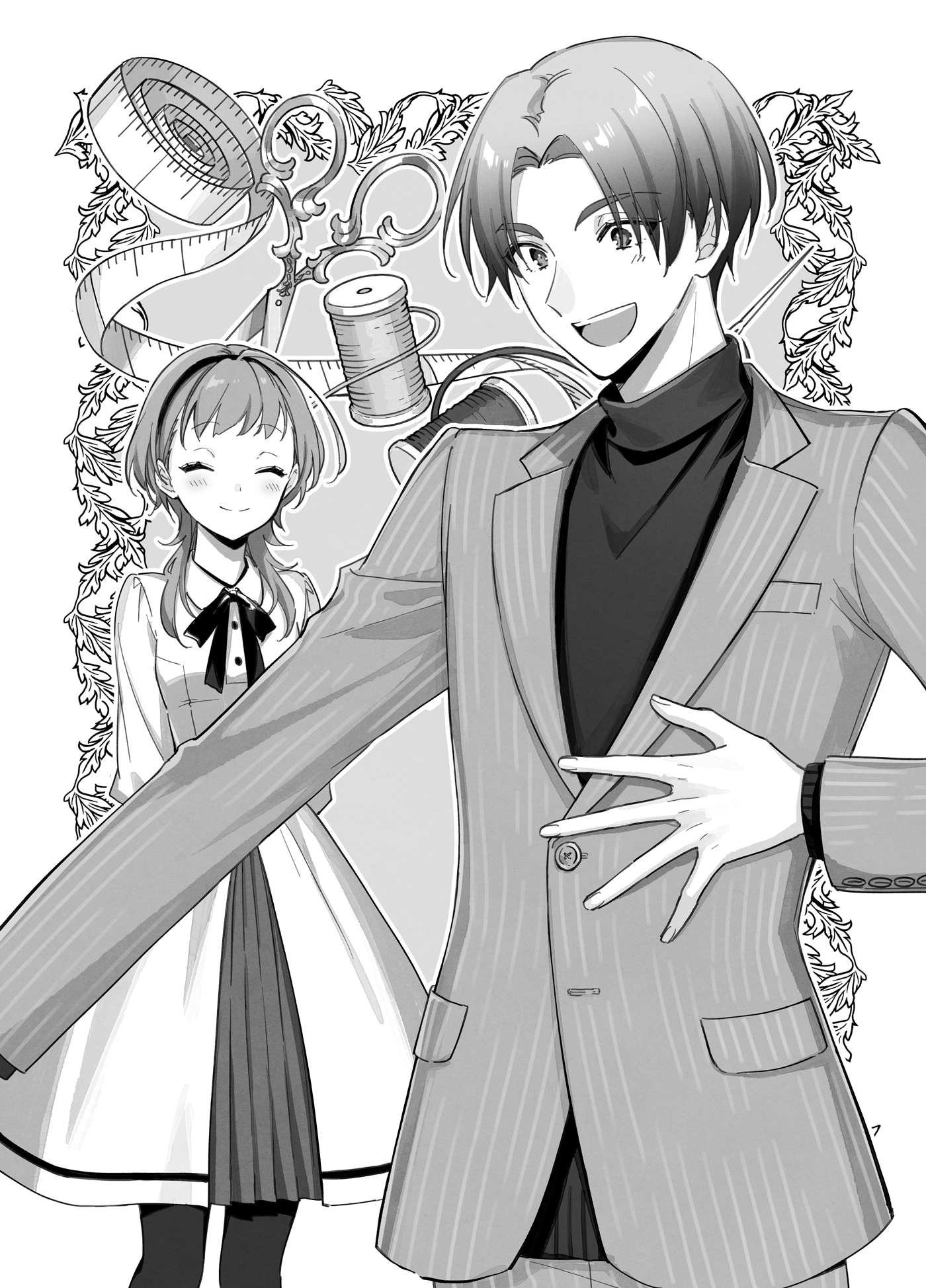
Within a few days, Lucia and her father visited the bowels of the South District. The area was famed for its nightlife, and a few steps farther down the road was a place where only adults were allowed—the red-light district. Lucia was a little on edge; she had never ventured here before. She had been directed to stay wrapped up in her cloak. It was hard to see out of her hood, but even her father was dressed similarly, so she dared not do otherwise.
At the edge of the entertainment district was a three-story building constructed of gray bricks—that was where her father stopped. The ground level was an eatery that had a scattering of customers, although lunchtime was still some hours away. There were patrons in gorgeous clothing—perhaps workers of the red-light district—and people in collarless shirts armed with swords—perhaps their guards; Lucia tensed up at the sight. However, her father paid them no mind as he walked in and greeted the employee inside; then father and daughter headed upstairs.
On the second floor was a set of black double-leaf doors, and affixed to the front of one was a large brass plate bearing the name “Jacquetta.” Underneath that was “Dresses & Suits” in Ordinato, Ehrlichian, and two other languages that Lucia could not recognize.
“That’s the script they use in Išrana, and below that is the one from the Eastern Kingdom. I’m guessing they all translate to ‘Dresses & Suits.’” If the sign was any indication of the diversity of his clientele, this Jacquetta person must be very impressive. Lucia’s father took off his hood, then looked into her eyes. “Listen, Lucia, daddy’s friend is—Ranieri is a bit of an eccentric, but he’s harmless. His skills as a couturier are indisputable, though.”
After a moment’s hesitation, she replied with a simple “Okay.” She decided against asking him to clarify what “a bit of an eccentric” meant; all that mattered were the couturier’s skills, because Lucia had oodles of questions prepared.
Lucia gave the plate by the doors three taps with the mallet, and the doors flew open.
Out came a man in a black suit with silver pinstriping. He addressed her father with utmost informality and herself with a cutesy nickname. “There you are, Rubert! And you must be Lucy!”
Although it was the middle of day, his suit gleamed before Lucia’s eyes. He had on a glossy black satin shirt, and around his collar was a white necktie that reflected all colors of the rainbow—it must’ve been woven out of some kind of monster material or thread. Peeking out of the sleeves of his pin-striped suit jacket were cuff links made of iridescent white nacre, the link on one side in the shape of scissors and the other in the shape of a rose. Finally, his shoes—laceless and the same silver as the pinstriping. His style was showy for a man, and so very intricately stylish; Lucia couldn’t look away.
“Sorry to take up your time, Ranieri,” her father said.
But the couturier said nothing to acknowledge the apology, and instead, he stared back at Lucia. Ranieri had a head full of silver hair that darkened at the tips. His eyes were black. He had no wrinkles or blemishes; he couldn’t possibly be coeval with her father.
Lucia hurried to introduce herself. “M-My name is Lucia Fano. It is a pleasure to meet you, and thank you very much for giving me your time today.” Today, Lucia had dressed herself in the finest clothes she owned. The navy blue short-sleeve was a hand-me-down from her mother, but Lucia thought it looked rather nice on herself. It had been a little loose, so she’d followed a book to tailor it to her frame, although she’d only had to adjust the shoulders and the bodice. She had also tried her hand at stitching white lace onto the waist, collar, sleeves, and the hemline. Finally, she had added a sash belt that was one shade darker to lift and accentuate her waistline. And though her mother had forbidden her from wearing pumps until she finished growing, she had slipped on a pair of blue kitten heels.
“I see, I see.” Just as Ranieri met her gaze, his smile made his eyes narrow almost to vanishing. “I’m Ranieri Jacquetta. It’s my pleasure to meet a charming couturier like yourself.”
“I’m, um, still just a stu—”
“Rubert, this girl will be a couturier.”
“What makes you say that?”
“The moment I opened that door, she was looking at my clothes. She made sure my colors all matched, then checked out my shoes and accessories—all before she looked at my face.”
It was only then that Lucia realized what she had done. “I’m so sorry!” That she’d been captivated by his style was no excuse for being rude to someone she had just met.
“There’s nothing to apologize for; such is natural for people like us. Though I must caution you to do it on the sly when dealing with anyone else—temper the intensity of your gaze, especially with men,” Ranieri said, smiling once again. “The first thing a couturier looks at is the other party’s attire; how can I possibly stop you from doing that? Oh, and I see you have tailored your dress. May I ask—from whom did you learn to do so?”
“I followed a book, tried it on, and adjusted as needed...” All she’d done was follow the printed instructions.
“Would you please turn around for me?” And when she did, Ranieri said, “Oh, my. Such deep understanding of technique at your age? I think we can dive straight into things.” Still glowing, he invited his guests inside.
His studio could hardly have been described as spacious, but there were four tables covered in neat lines of buttons and piles of all kinds of fabrics and lacing. There were red, white, blue, and yellow dresses, looking like a field of flowers.
“These two white dresses here are for a wedding reception. My vision is to coordinate them while giving each a unique style,” Ranieri said, showing off two dresses that were still basted together. Even though they had been turned inside out, it was obvious how carefully both were stitched. The sketches showed that one was tighter fitting, with lace, while the other was frillier. They must’ve been for a pair of brides; same-sex marriages weren’t particularly uncommon in the Kingdom of Ordine. These matching—but not identical—white dresses were absolutely wonderful, and Lucia would have loved to see the two brides try them on.
He continued, “These red and blue ones are for clients who work in this red-light district. As there is always the risk of spills when serving drinks, the dresses are made from cotton so they can be easily washed.”
“Smart—no need to have them purified this way,” commented Rubert, sounding impressed. High-quality fabrics such as silk and the like had to be taken to the launderers to be cleaned with purification magic, so the knowledge that the dress could be washed with water would put the wearer’s mind more at ease.
On the fourth table was an open sketchbook depicting a lemon yellow dress, and on the mannequin beside it was the real thing. Judging by the size, it must be for a child. Ribbons and puff made it a very cute piece.
“It’s so adorable! This must be magic!” Lucia couldn’t keep her excitement in check.
“Thank you, but this is no magic.” Ranieri flipped through the sketchbook and showed page after page of scale patterns, notes, measurements, and calculations. As Lucia was astounded by how fine the details were, Ranieri pulled out a crate with the dress’s sewing patterns from under the table. The papers were stacked up thick, likely from countless modifications and corrections. “Think, design, calculate, draw the template, cut the fabric, baste, adjust—believe me, whenever any one of these stages goes wrong, I’m tempted to hurl everything out the window.”
“But you still go through with it all?”
“I sure do. Can’t make clothes if I skip any of those steps.”
“Then it really is like magic—after all, you took such a cute design and turned it into a cute dress.” How wonderful it was to bring imagination to reality.
“That’s very kind of you to say. How about I show you my treasure trove next?” Ranieri took his guests farther into the building, where he opened a seemingly decorative curtain mounted on a wall; in reality, it concealed a door. “Here is my vault of materials for fabrics and threads.”
Thick curtains covered the windows, blacking out the entire room.
He explained, “Fabrics fade in sunlight, you see. The windows are only ever opened for ventilation.” Ranieri drew the curtains, revealing shelves packed full of fabrics and threads in all sorts of colors. A numbered piece of cloth was sewn to each item. In the back of the room were multiple large, silvery magically sealed chests. “Everything is organized according to a numbering system in a ledger. In the back are all the monster fabrics and threads.”
“I told you the ledger was a good idea,” said Rubert. “Avalanches happened far too often back then.”
“Hey, that was supposed to be a secret!” Ranieri was laughing, but he also sounded a little serious. They seemed to be close friends based on the way they joked with each other.
“Dad, have you and Mr. Jacquetta been friends for a while?” Lucia asked.
“We were in the same class in primary school, and we’ve been friends since the entrance ceremony.”
“Just as I had gotten lost on my way to our classroom and was about to start bawling, Rubert found me,” Ranieri explained.
Lucia stared off in the distance as she recalled how she had gotten lost on her first day of school—although she and her father had been in opposite roles.
“I had gotten lost and had been crying too, so Ranieri lent me his handkerchief. It was only after that we held hands and hunted for our classroom.”
“Oh...” Apparently, she and her father were not so dissimilar. Perhaps the Fano children all got lost on their entrance ceremony day; she decided she would ask her brother once she got home.
“Now, here’s fabric made from thread spun by monster silkworms. Here’s regular silk. Go ahead, feel the difference.” Ranieri retrieved one from a magically sealed chest and one off a rack, then handed both to Lucia.
They looked very similar. Both were extremely fine, smooth, and glossy—undoubtedly high-quality silk. However, she was utterly shocked after feeling them. The monster silk had a great feel; it was slick and slippery. Lucia could get used to this. “The monster silk is so slickery!”
“Slickery! I couldn’t have put it better!” Ranieri said, guffawing. “Monster silk is very dense. It’s magical, which makes it tough, so nobles tend to have it made into underwear for an extra bit of protection. It is susceptible to getting hot in the summer—speaking of which, the coolest thing for hot weather is a shirt of cheap, coarse-woven hemp.” Just because something was expensive didn’t mean it was the best. Still, cheap, coarse hemp was prickly and stiff, so that wouldn’t be too comfortable either.
He dug into the monster silk and scratched at it with his fingernail, but no one would have been the wiser—obviously, the piece of fabric did not tear, but moreover, there wasn’t even a single mark left on it. “Properly made monster silk is seriously durable, but materials from monsters can be so durable, processing and crafting with them can be difficult too.” From the inner pocket of his jacket, Ranieri brought out a pair of scissors, the blades of which had a bluish-silver gleam to them—different than anything Lucia had ever used before. “Ordinary scissors would chip; these are plated with mythril. It would be preferable if they were forged entirely from the stuff, but with that kind of money, I could buy a good horse.”
Lucia did not know how much a horse cost, let alone a good one, but she surmised it must be a lot. The pair of mythril-plated scissors snipped through the fabric without making any noise, rending a handkerchief-sized piece. There was just the slightest difference in shade between the two sides of the white patch, and Lucia couldn’t help but stare at just how finely woven it was.
“Here, a souvenir for you to take home. Ingrain this texture into your memory.”
She took the slice of jelly into her hands. “Thank you so much, Mr. Jacquetta!” She beamed; one more great treasure for her own collection.
“You’re very welcome. And please, Mr. Jacquetta is my father; use my first name, Lucy—no, that’s a rather patronizing way for me to address a fellow clothier like yourself, Ms. Lucia.”
“Just ‘Lucia’ is fine.” Lucia was but a whelp in his presence; she couldn’t have him address her with such excess formality.
However, Ranieri made a surprising proposal. “Very well—then please call me by just my first name. We are equals as clothiers, after all.”
“Aren’t you being a little too generous, Ranieri? The girl’s just started studying to become a couturier. She might even change her mind in the future,” said Rubert. Her father must’ve been shocked too.
But Ranieri shook his head and turned to Lucia. His black eyes narrowed like a feline’s as he smiled. “No, this girl is a couturier—she and I are the same creature.”
Her heart pounded in her chest. Lucia was still a child, yet this master of the trade saw a couturier in her. He did not belittle her for age or gender. What choice did she have but to give it her all and then some, studying until she reached where he was now? “I’ll give it everything I’ve got, Ranieri!”
“Do just that, Lucia!” The two of them, having met today and already calling each other by their first names, clasped hands tightly and shook on it.
“Thought you didn’t take apprentices,” Rubert said.
Lucia perked up her ears. It would have been a dream to study under someone like him. But a child like her would only get in the way of his work. Besides, her family had a workshop too. She had many excuses but could utter none of them.
Ranieri replied, “I don’t. If I were to do so, my apprentice would make the same clothes I make. Someone young and inexperienced might plagiarize the work of others. Furthermore, in some workshops, an apprentice’s only purpose is to copy their master. You understand that much.”
Her father hesitated. “Yeah.”
“I’m not saying it’s a bad thing either. Following in the footsteps of a predecessor can also be a craftsperson’s path. But to create something new and to light up others’ eyes is something that comes from the soul.”
“Huh...” she muttered.
“Yes, and even if you can, wouldn’t copying me simply be boring? Why be me when you can be yourself, Lucia? Sketch what you want to make. If one day you find yourself wanting to create the same thing as someone else, it will not be too late then to become their apprentice.”
The dresses Ranieri had shown her were charming and adorable. However, if someone had asked Lucia whether she would want to keep producing the same pieces forever, she wouldn’t have had an answer right now.
“Start by learning how to sketch. I am here for you if there is anything you don’t understand about making clothes. For specific techniques, turn to a specialist instead. I know your own family has some of the best stitchers around, and I also have skilled patternmakers and cutters I can introduce you to if needed,” he said, seeing right through her doubt.
“So not a master but a mentor, then? What do I owe you for that?” Rubert asked.
“Hm, let’s see. I shall take a dozen socks made by your own hands, then, Rubert.”
“Okay. I’ll throw in a case of stout too.”
“Oh, what a treat!”
“It won’t be much, but I can make it up to you too!” The pocket money Lucia made from helping out at her family’s factory would be enough to buy a few bottles of ale, she thought.
But Ranieri burst out laughing before she could say that. “All right, then, Lucia, I shall have you make me a stylish suit one day.”
“Just you wait!”
Since that day, Lucia had been visiting and studying under Ranieri. She and her father sometimes went to Ranieri’s studio, and he would sometimes pop up at the Fano residence too, but it was a little hard to coordinate their schedules, as everyone was busy with their own work. Furthermore, both men had instructed Lucia not to talk about being Ranieri’s mentee. His studio was located in the red-light district and many of his clients worked there—nothing good could come of the world knowing that a child like Lucia was frequenting a place like that.
And despite only being a primary schooler, she understood it was a sensitive matter. When Lucia visited his studio, she was bombarded by quarreling voices in the distance as she passed by staggering drunks; she finally understood why it was necessary that she wear a hood. Still, without fail, she felt great anticipation every time she prepared to go.
Lucia could not wait to grow—both in age and in skill. The first thing Ranieri taught her was design sketching—transforming a three-dimensional article of clothing in her mind into multiple two-dimensional patterns on paper—which proved as difficult as it was fun. At his studio, Ranieri also introduced Lucia to a patternmaker and cutter, both of whom were very patient in teaching her from zero. Her mother and grandmother had a lot to teach her about stitching, and it only got more and more in depth. She had begun with sewing on buttons, mending, and hemming, and before long, Lucia had learned how to sew a skirt.
On the other hand, her grades at school had begun to slip. Her career guidance teacher showed much concern, but the fact of the matter was that Lucia struggled to keep several balls in the air at once. She informed the teacher that her plan for after she graduated from primary school was to work for her family while simultaneously working toward becoming a couturier. As she had her parents’ approval, her teacher did nothing to stop her from pursuing her dream. However, the teacher did say that couturiers needed good arithmetic and mental calculation skills and gave Lucia extra homework. Lucia thought about retorting that the career guidance teacher also taught math, but she had already witnessed how much trouble her father and brother had with calculating rows for the knitting machine, and so she obediently worked on her mental math.
That was all she got out of her education. After graduating primary school, Lucia worked for her family’s factory and made clothes of her own.
Seasons came and went, and one day, when Lucia was at Ranieri’s studio, a noble’s messenger arrived seeking a quote for a ball gown. Not only did the couturier refuse on the grounds that he lacked the necessary skills to sew for a noblewoman, he didn’t even invite the messenger inside. Lucia didn’t understand—even saying nothing of his qualifications, the job would have allowed him access to exclusive materials, and a noblewoman’s dress would sell for a lot. However, the whole situation clearly had him ruffled, and she decided not to pry.
But she couldn’t get it out of her mind, and on their way home, she asked her father, “Ranieri’s capable of making such nice clothes. Why did he refuse?”
“Well, uh...” Rubert hesitated before looking into his daughter’s eyes. “You might work for a firm one day, so maybe you ought to hear this. See, Ranieri used to regularly make clothes for nobles until one day, he made some of them very unhappy and was subsequently forced to resign from the factory.”
“Did they not like what he made?” Ranieri’s clothes were absolutely gorgeous and charming, but perhaps they hadn’t been to the noble’s tastes.
“No, quite the opposite, actually—the noble loved it so much, they wanted him all for themselves.”
“And he refused?”
“Mm-hmm. Said he wanted to make clothes for everybody who asked him to do so. People of noble or common birth, people here or abroad, people of the red-light district, people of every status and gender—just as long as they would ask for his service, he would make clothes for them. That was his dream,” Rubert explained. And it was a very noble one at that, but something finally clicked for Lucia. “The nobles found his answer dissatisfactory. They strong-armed the firm he was working for, and Ranieri was fired. They immediately sent him packing—all he had on him were the scissors and tape measure in his hip pouch and the pincushion on his left wrist.”
“Poor guy...” How cruel they had all been to Ranieri. How could they have treated him like that? His clothes—cute, pretty, or cool—were loved by both nobles and commoners. Or rather, how could the nobility be so narrow-minded? Lucia fumed.
“So, he decided to go to the red-light district, where his clients were, and he rented the second and third floors of that gray building. The cloth merchant loaned him fabric and thread, I brought an iron, his other friends brought him food—almost everything was borrowed when he started there, but look at him now. Incredible, isn’t he?”
“Absolutely!” Admiration for this man swelled up from the bottom of her heart. However, there was one more thing on her mind. “He’s great at what he does, but he’s really good with beauty as well.”
Ranieri was a complete stranger to the concept of middle-age spread. His skin and hair shone. His face displayed barely any wrinkles. Judging by just his looks, it was unimaginable that he was the same age as her parents. Lucia would come to understand it more as she grew up: Ranieri was nothing short of impressive. It was as though his body actively resisted aging.
“He’s always put a lot of effort into his looks, you know? He probably spends half of what he makes on beauty. He takes hour-long baths, and his makeup skills are superb. The guy even takes this incredibly bitter stuff made of powdered juvenile monsters.”
It was obvious enough why he needed bath time and cosmetics, but what was that last part? “That doesn’t hurt him, does it?”
“It’s good for the stomach, actually. What did he say it was? Skybat? Ingesting their ground-up flesh makes your hair and skin all shiny the next day, and it even smooths out wrinkles in the long run.”
“That’s amazing!” Something like that was without a doubt prohibitively expensive. Lucia supposed if she started on that powdered skybat at her age, she would be able to keep her youth. Perhaps it would be a good way to be able to keep wearing cute clothes forever, she thought.
But her father was not enthused. “He let me try it one time, and let me tell you, there was no way I’d voluntarily have some a second time. Nuh-uh. No way. That stuff doesn’t even taste like it’s edible. The moment it entered my mouth, there was nothing but bitterness in my world.”
“It was that bad? You couldn’t even gulp it down without tasting it?”
“The bitterness came back up from my stomach. It kept coming back up for three whole days, and everything I ate was bitter. Maybe it wouldn’t be bad for someone trying to go on a diet, but—oh. Maybe that’s why the guy never gains any weight.”
Yummy food was one of the joys of life—even if that monster powder could turn back the clock, Lucia decided to give up on the idea altogether.
By the time Lucia designed and sewed her first men’s suit, six years had elapsed since she first stepped foot in Ranieri’s studio.
“Your tuition fee!”
It was the day before the winter fete, and Lucia presented her mentor with a suit and a sweater. The single-breasted jacket was on the longer and looser side, while the pockets were just deep enough to fit a tape measure. The matching trousers were very slightly tapered for a slimmer fit, and their length was matched, down to the millimeter, to the height of the silver shoes he always wore. The trousers had been sewn out of quality wool dyed an understated moon gray—a shade of gray that was ever so slightly cool. However, a careful look under sunlight revealed subtle gleaming strips of silver.
“Hey! This is blended with baphomet, isn’t it?”
“Correct!” Monster fabrics were priced out of Lucia’s reach, but she had been able to scrape together enough savings to buy a baphomet blend. She had scrutinized her options, chosen the one with the best luster, and given it a prewash before carefully applying her fundamentals.
Ranieri took the jacket into his hands and smiled so broadly, his jaw seemed to have dislocated. “Lucia...”
The jacket lining was black. On the left side was an inner pocket for his tools, just like in his usual jacket. On the right side was a pocket for his little abacus. Painstakingly embroidered on the back lining were a tape measure, a needle with thread, and a pair of scissors. Anyone else might think it a shame that her needlework wasn’t visible from the outside, but when the idea had struck Lucia, she had known right away that it was very Ranieri. Glittering silver and white monster thread on a black backdrop were his colors, and the hidden embroidery exuded couturier.
There was one more piece: a thin black turtleneck sweater crafted by the head manager of the Fano Workshop. While most of it was machine-knit out of premium wool, the armholes and the side adjustment had been done by hand. Its creator, standing beside Lucia, grinned at Ranieri.
“Let me go try these on,” Ranieri said before disappearing into his treasure trove and coming back with a broad smile. The moon gray suit and black sweater combo looked so good on him. “Thank you, Lucia and Rubert! It fits perfectly!”
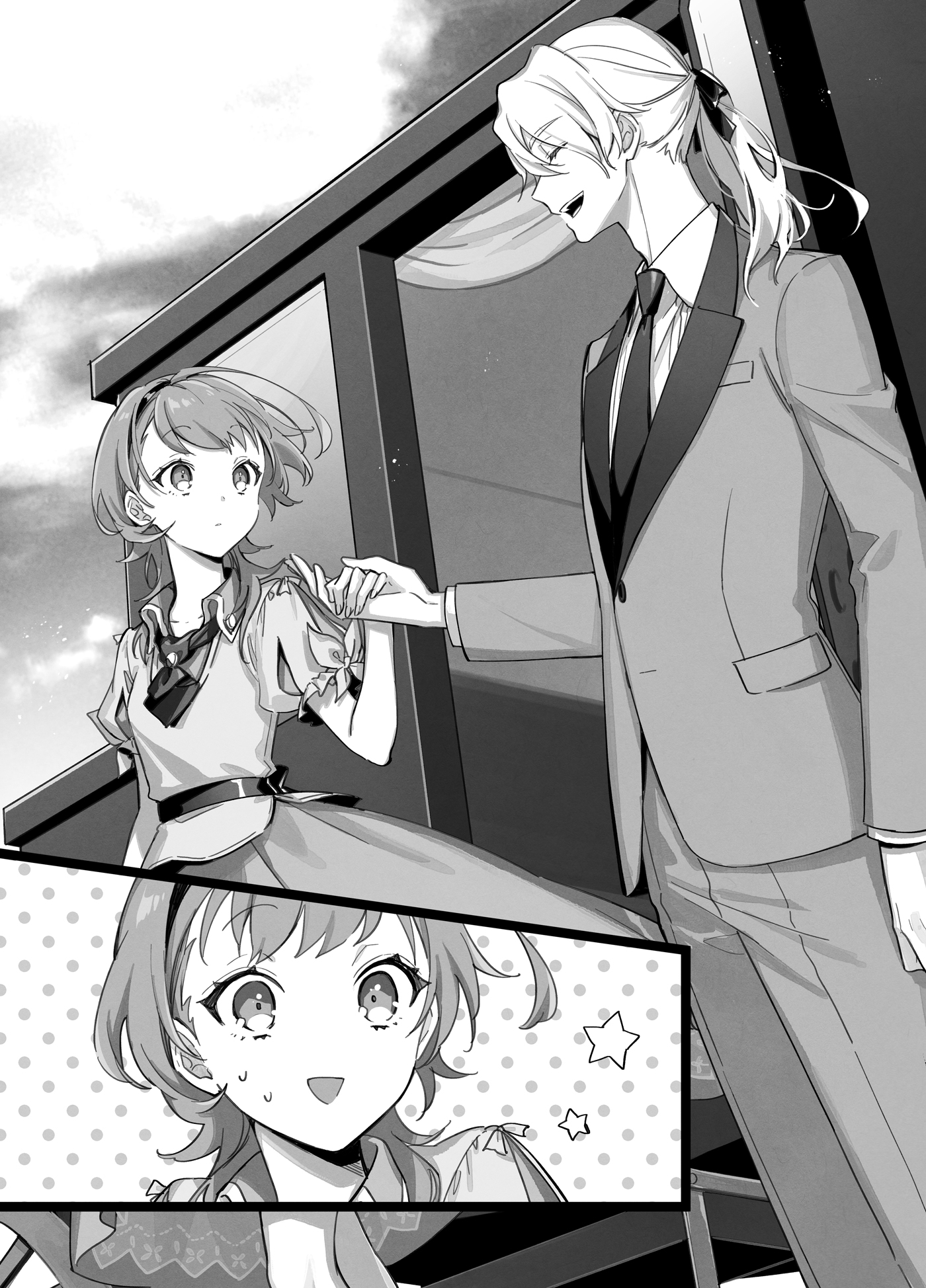
Afterward, they cleared a workbench and toasted with wine. They ordered food from the eatery downstairs to celebrate the winter festival a day early—and to commemorate Lucia having become a full-fledged clothier.
“This is the first time someone has ever put so much thought into making clothes for me. You’re ready, Lucia—be proud and declare yourself a couturier. Remember, though, that this is only your first step on a long, steep path uphill.” Ranieri mixed words of encouragement into his praise, perhaps unsurprisingly.
The suit Lucia had made him was certainly designed well and finely detailed, but it was nowhere near the level of the clothes Ranieri usually wore—that much had been obvious as soon as he put on the outfit. She swore to herself that the next time she gave him a present, she would make something that suited him better.
As they dined, Ranieri sang her praises, saying how comfortable and beautiful the suit was, and they shot the breeze. Then, a sudden announcement: “I’m departing for the Eastern Kingdom next week, by the way.”
“Excuse me?” asked her father.
In the same instant, Lucia asked, “For pleasure?”
Ranieri’s smile turned his eyes as thin as thread. “The silk and needlework over there are amazing, you know? I’m thinking I’ll take my time and tour the country.”
“And just how much time are you planning to take?” asked Rubert.
“One year? Perhaps three? Who’s to say? Since it’ll be an extended trip, I’m hoping to see Išrana and Ehrlichia as well. One day, I hope to travel the world and see what everybody wears. I’m not getting any younger, so it’s now or never.”
“What about your studio?”
“I think I’ll close up shop and turn it into storage; the people downstairs can use the space. I’ll let the cloth merchant handle my fabrics.”
Lucia said, “That’s quite the sudden trip...”
“I unexpectedly managed to snag a ticket for a sailing ship to the Eastern Kingdom. Oh, Lucia, you take some of my tools, fabric, thread, and mannequins off my hands.”
“I don’t need any of that—just don’t go!” was what she wanted to say. But Ranieri was the same age as her father—better to take a long trip abroad now rather than later. What she did say was “Please tell me when your departure is. I’ll come see you off at the port.”
“No way, Lucia. I’m not ready for the waterworks.”
“I’m not going to cry!” she asserted, already in tears, but perhaps that was because of the wine. Lucia polished off the remnants of her glass and bellowed, “I’m going to see you off with a smile!”
“Lucia...” Ranieri fixed his black eyes on her and displayed a pained expression before reverting to his usual sunny smile. “The one who will be crying is me.”
In the end, Lucia did not see Ranieri off when he set sail for the Eastern Kingdom—as luck would have it, the Fano Workshop had been hit with a huge order and she did not have the time to spare.
“Do you think Ranieri is going to write us letters, dad?”
Rubert sighed at the knitting machine. “He’s not much of a writer. I don’t think I’ve ever gotten a single letter from him before.”
Much later, Lucia received parcels addressed to her, like a sign of Ranieri’s successful embarkation: a familiar mannequin, sewing basket, and a chest of drawers—still filled with fabrics and threads—that barely squeezed into her room. It had been years since she last saw him—he could’ve at least sent a short letter or even a greeting card, she thought as she dug through her new gifts. She froze up when she opened the leather sewing basket. There it was, a pair of scissors with mythril plating on only its blades, the pair that was always tucked against his chest inside his jacket’s inner pocket. Her tears fell as she grasped it in her hands, and she wiped them away with that white monster silk square—her treasured handkerchief.
“Once Ranieri comes home, I’ll make him a dashing three-piece suit. It’ll look even better on him, fit him even better!” Lucia swore to herself. That way, she would shock him by demonstrating how far she had climbed up that long, steep path.
Since then, Lucia had gotten numerous chances to work at other factories too. She had a simple reason for taking those opportunities whenever they appeared: money. The Fano Workshop dealt mostly in socks and gloves—maybe vests and sweaters once in a while, but usually garments that weren’t highly priced and didn’t sell in large quantities. The family business put plenty of food on the table, but Lucia now had a dream.
Every time she had visited Ranieri’s studio, there had been different dresses out, but they had always been lovely. Every time she passed by display windows on the street, her heart raced. One day, she would have her own atelier like Ranieri’s and a store to sell the clothes she made—that was Lucia’s dream. The most conservative estimates she came up with were still extravagant sums far out of her reach, but that was no reason to give up. Ranieri had taught her: no matter how long and steep that path was, keep walking and someday she would reach her goals.
There was one more thing. Whenever anxious thoughts of inadequacy and powerlessness filled her heart, she vividly remembered a voice calling out to her. “If you say you won’t look good and just give up here, you’ll never be able to wear that dress, you know? Pay no mind to what others think and wear what you like to wear. I’m sure both lace and ribbon would be perfect on you.” So Mr. Sunset, that boy in the alley, had said.
She was no longer the weeping dayflower she had been. She wore ribbons in her hair and lace on her clothes, and she followed the path she wanted for herself—she was a nemophila. Giving up was no longer an option for Lucia.
The Master of the Tailors’ Guild and the Wyvern
The Master of the Tailors’ Guild and the Wyvern
Three years had passed since Lucia inherited Ranieri’s scissors. Bathed by the afternoon sun, she was checking over the day’s delivery. There was nary a cloud in the blue sky, bringing to mind the phrase “a wyvern out of the azure”—an idiom in the Kingdom of Ordine to describe something that was sudden and unexpected. Today, a behemoth of a wyvern descended from the welkin, landing on the Fano Workshop doorstep.
“Please forgive my sudden intrusion. I have been sent by the master of the Tailors’ Guild, Fortunato Luini, who wishes an audience with the head manager of the Fano Workshop.”
Midway through the announcement, Rubert slumped against the wall and then sank to the floor, hunched over. His family rushed over to him, fearing a medical emergency, but the real cause of his collapse was immediately made apparent.
“Mr. Fano! Are you all right? Shall I call for a physician? No, I’ll take you to the temple aboard my—” Right behind the messenger and voicing his great concern for Rubert was another man—tall, lean, and with blond hair that dazzled onlookers and blue eyes that evoked the ocean. Without a single doubt, this had to be the guildmaster of the Tailors’ in the flesh.
Lucia’s home, the Fano Workshop, made socks, gloves, and the like. Naturally, they had business with the Tailors’ Guild, which purchased and sold their products. However, here was the guildmaster, the man at the top of the guild’s hierarchy and the current head of the Luini Viscountcy to boot. It was uncommon for anyone at the workshop to ever speak with him directly, but if such an occasion were to arise, the guild would have scheduled in advance before summoning Rubert. Even if they had business with the Fano Workshop, ordinarily, advance notice would be sent before the noble visited. Opening the front door to find this behemoth wyvern must’ve been too much for Lucia’s timid father.
Her mother bowed deeply. “Oh, I’m so sorry about the commotion my husband is causing! He’s probably a little shocked.”
While Lucia’s grandfather and brother pinned their eyes to the ground in hopes of blending in with the background, Lucia and her mother carried Rubert to a chair in the workshop, then made sure his heart was fine and he wasn’t otherwise ill. Thankfully, it was just nerves.
“Forgive me for not sending prior notice.”
“It’s no bother at all. It’s a very humble place, but please come in.”
Lucia was enchanted by the guildmaster as he walked in, but she managed to keep herself from being rude and staring. Fortunato was wearing a white shirt made of summer silk underneath a silver-gray suit sewn from a summer fabric. The suit had a sheen to it, likely from monster silk, and looking at it up close showed that it had been interwoven with three different colors of thread, making it a very luxurious fabric. His trousers appeared to be straight cut, but there was in fact a very subtle tapering toward the hem. The whole outfit enhanced his youth and figure. Peeking out from the breast pocket of his jacket was a piece of fabric—likely not a pair of gloves but a glossy blue pocket square that matched his eyes. He was already rather tall, yet he made the interesting choice of highlighting his upper body. Furthermore, only close inspection made it apparent that his horsehide shoes were dark gray; otherwise, they came off as black, but that was enough to make them look light and summery. Lucia would’ve loved to whip out her sketchbook and capture his outfit from top to bottom. She’d had expectations for the guildmaster of the Tailors’, and they had been exceeded.
Afterward, she got a good look at Fortunato’s face. His features were lean and toned, his eyes bright and clear, and his skin smooth and flawless. His blond hair was brushed backward, tied together by a thin black ribbon—likely some kind of monster fabric as well—coming together to give off a well-groomed image. He looked to be in his late twenties, thirty years of age at most, though rumors had him pegged in his prime years of thirty-five or six; maybe noblemen just took really good care of themselves. The rumors also said that his wife was incredibly beautiful.
Natural good looks and a great sense of style—no better descriptors for a man’s appearance. Fortunato’s face and body would have made for a perfect mannequin in a shopwindow. Lucia felt it was just a teensy bit preposterous that she hadn’t been blessed with a decent stature, but it was what it was. And at the end of the day, seeing someone—no matter their sex or gender—dressed up in fashionable clothes that suited them was always a learning experience for her. The Tailors’ guildmaster had won himself fans of all genders too, but maybe that wasn’t much of a surprise—when they spoke of the man named Fortunato Luini, more than anything, they spoke of how skilled a couturier he was.
That man, now sitting on the Fanos’ dingy, ratty sofa, said, “This may be very sudden, but I understand that the magical toolmaker Dahlia Rossetti had previously asked your workshop to develop prototypes for her invention, the toe sock, and I am here to today to discuss its production and bringing it to market.”
“Dahlia...” muttered Lucia. Everything made sense once she heard the name of her redheaded, green-eyed friend.
Dahlia Rossetti was a young and capable magical toolmaker who used magic crystals, slimes, and other monster materials to craft goods for everyday life, such as the hot water dispenser and the dryer. Not only was she very good at producing the tools, she was also very good at coming up with new ones. In fact, she had recently invented the waterproof cloth. Since then, she and Lucia had had the chance to work together more often as Lucia used the new fabric to make raincoats and rain ponchos. Even now, her friend had tasked her with making cute designs for a raincoat.
The first time Lucia had met Dahlia was when they could barely speak. It was only when her family had been busy with work that Lucia was sent to her grandmother, who lived in the West District. Her grandmother had always been very welcoming to the kids in the neighborhood and would let them play at her home. The two who Lucia hung out with the most were Dahlia and Irma—the former was about half a year older than Lucia, while the latter was a few years older. The three of them got along very well, and they still got together from time to time now, long after having graduated from primary school. Lucia was especially close with Dahlia, as they had entered school at the same time, studied, and played together. They hung out after graduating too, including sleepovers at Dahlia’s home—the Green Tower—and vice versa, where the girls chatted through the night.
That Fortunato mentioned Dahlia’s name came as no surprise to Lucia. Dahlia’s late father had been a baron and a magical toolmaker and she herself was a skilled toolmaker too. More than anything, though, that was Dahlia’s disposition, or maybe it wouldn’t be wrong to call it her innate nature. It was in her nature to be dragged into—rather, to drag others into everything; this was not new.
On their first day of primary school, Lucia had been on the verge of tears and a boy had been bawling; both had gotten lost. Dahlia had acted very maturely and guided the two of them to their classroom, though Lucia had later had a good laugh when she learned that Dahlia had been lost too. Dahlia had then privately mentioned to the teacher how the path from the auditorium to the classroom was a little confusing and suggested the school put up signs on entrance ceremony day so that no other poor newcomer would get lost. The teacher had listened with a big smile and fully supported her idea. The following month, the school had prescribed locations for maps and floor plans and posted them on each floor. It had proven to be a big hit with kids who got lost, of course, but even the faculty had found the implementation very useful.
There was one time during gym class when a student had run into Dahlia during a race, sending her to the ground face-first, and both of them had gone to the nurse’s office to get some healing magic. Although Dahlia had been bleeding from her face, she had insisted her injuries were minor and that the other student, who was sobbing with a scraped knee, should get looked at first. The nurse had been touched by her selflessness—a highborn student would likely have demanded to be treated first, and the average girl would likely have demanded that an injury to her face be treated first. Afterward, the one with the scraped knee had confessed that the accident had been feigned; the truth was that the other student had collided with Dahlia on purpose. A teacher had then explained how important it was to play nice with each other and listened to the other student’s problems right there in the nurse’s office. But Lucia knew the truth, as she had accompanied Dahlia. While Dahlia had been considerate of the sobbing student, she had also eyed the bottles of potions and medicinal herbs on the shelf intently as she waited for her turn.
Another memorable incident was the first time Dahlia had been late to class. On her way to school, she had come across a little child who had gotten lost. She had tried to leave the child with a city guard, but the child had only been able to bawl and gesture wildly when asked for a home address, and so the three of them had walked together to find the child’s home. This had all been in spite of the fact Dahlia had an important exam that day. After reuniting child and parents, she’d sped off without introducing herself, leaving the child’s parents to identify that benevolent and mysterious stranger by her school uniform. As it turned out, the father was a diplomat, and the mother and child had only recently arrived from Ehrlichia; the language barrier had made being lost a terrible ordeal. In the end, the couple had been deeply moved by this experience and proclaimed that the students in Ordine were most kindhearted. Perhaps the story had then spread, perhaps it was a coincidence, but the following year, there had been a great influx of students from the neighboring nation. Dahlia had breathed a sigh of relief when she was allowed to retake that exam, but all the cramming she had done the night before had evaporated and she was left on the verge of tears; the headmaster’s subsequent praises for her heroic deeds had meant little.
Despite getting dragged into others’ business and dragging others into her business, Dahlia showed kindness to whomever she met even if it didn’t always work out in her favor. That was who Dahlia was.
However, there was one thing Fortunato had said that caught Lucia’s attention. “The toe sock, did you say?” she asked to clarify, as it was something that Dahlia had asked her to make.
Dahlia’s father Carlo had despised wearing leather shoes in the summer, so he had asked his daughter if she had any ideas to fight sweaty feet. What she had come up with were socks with toes like the fingers of a glove. Lucia had split her sides at how goofy they looked even as she used both the sock-knitting machine and glove-knitting machine to make ten pairs for her friend, who would then enchant them with a fire crystal to create socks with a mild drying effect. When Dahlia had finally gotten her hands on them, she’d cackled like a kid about to play a prank on someone. Unfortunately, Carlo had suddenly passed away without ever having tried them on, and that left Lucia with the questions of why the toe socks were making a reappearance and why the Tailors’ guildmaster would come to her family’s factory.
“That is correct. We have recently received an urgent order for large numbers of toe socks, you see, and so I’ve come to beseech Mr. Fano to accompany me to the Merchants’ Guild to see to this matter.”
“Sorry, I, uh—ooh, I don’t feel so good...” Rubert turned even paler as he oozed into his seat like a blue slime. He did not look as though he would get up any time soon.
Mrs. Fano smiled at Rubert, then shouted at Grandpa Fano, who was in the same room, “Father! Please take his place.”
“Well, I, erm, oh, my memory is as limited as the years ahead of me, I’m afraid... Say, what was I doing just now?”
Who was it that had just been spinning thread three times as fast as the young’uns? Lucia stared at her grandfather, who quickly averted his gaze.
Mrs. Fano called up Lucia’s brother next. “Massimo!”
“I’ve got deliveries to make today, and, uh...oh! A shipment of thread is coming later today, and you know how heavy those get...”
Lucia looked toward her brother as his voice trailed off into nothingness, but he didn’t dare to meet her eyes either. She could’ve sworn that just thirty minutes ago, Max had said that it was rare to have a day with so few deliveries to make and suggested that the whole family go out for dinner—unless she had been hit with rapid-onset memory loss, just like her grandpa? And that case of thread that was coming in later today was something even Lucia could have carried from the doorway to the shelf.
“Lucia,” her mother began with eyes unusually clear and blue and a troubling serenity in her voice, “you’ve just been promoted to assistant manager. You are the one who originally made those socks for Dahlia, so I’m sure you’re the most familiar with them.”
“Whuh?” Assistant manager of what, their family workshop of five? It wasn’t as though this promotion would come with a pay raise either. And were none of the Fano men going to at least pretend to be cool and take charge? Lucia’s father was still slumped in his seat, her grandfather was deliberately clearing his throat, and her brother was mesmerized by the workbench and did not look toward the women in the room. What a preposterous situation, one that left her without a single option.
But then, inspiration struck Lucia. Sure, she was the one who made the socks, but agreeing to go would give her the chance to see the Merchants’ Guild, somewhere she hadn’t been often. And since Fortunato was to attend this meeting, it was likely other nobles would be present as well. Maybe she would get to see their outfits or even clothes from other parts of the world—this was a fantastic opportunity to be had.
“Sure, I’ll go!” Lucia said, only to remember her current getup—a work jacket over a dress that she didn’t mind getting covered in clinging threads. Going to the Merchants’ as is would be uncouth. “I’m so sorry! May I have some time to tidy myself up first?”
“Of course. Take as much time as you need,” Fortunato said with a smile.
Lucia excused herself before quickly walking out to the hallway and then scampering from the hallway to her room. The white mannequin in her room was clothed in the culmination of all her efforts, which had been completed just the day before yesterday—an aqua blue dress with puffy short sleeves that alternated between aqua and straw and were tied up at the cuffs with bows; around the collar was a short, wine red cravat; and the ribbon was tied slightly above her waistline to accentuate the length of the skirt. In this, she would not be uncouth.
She paired her dress with a thin white coat that she had finished a while ago, a pair of long skin-colored silk socks, white heels, and white gloves. In her usual slightly oversized leather bag, she packed a sketchbook, stationery, and two handkerchiefs. There was no time to fix her tied hair, but she chose to touch up her makeup with some lipstick and a light layer of face powder. All the sewing and laundering had her hands chapped, but there was little she could do about that. Lucia was now ready to return to the workshop.
“Thank you very much for your patience!” announced Lucia, and she felt her whole family look at her with approval for her outfit—maybe that wasn’t so surprising, as she had surveyed them while she fitted and adjusted the dress throughout the last month.
She did worry about what Fortunato thought. As rushed as she was, she would still be among aristocratic company, and she didn’t know whether her attire was appropriate. With a bit of anxiety rumbling inside, Lucia turned toward Fortunato and saw his blue eyes pointed at her—or rather, toward her clothes, scrutinizing her just as she had done unto him when he first entered the workshop. The sparkle in his blue eyes shifted around, and the suspense was killing her.
The aqua dress had been adapted to fit her frame. It was made of a summer wool-cotton blend and not silk, due to budget constraints. Her cravat was cut from cloth too, albeit a high-quality one. Her shoes had been purchased on sale, while her bag was something for students; she had been using it since her own time as one. Lucia was scrimping and saving however she could.
After the slightest nod of the head, Fortunato beamed—that ought to be a passing grade. He said, “That is a wonderful outfit, Miss Fano. Now, shall we?” Fortunato stood up and extended his palm—he was the guildmaster of the Tailors’ and the head of a viscountcy, so maybe escorting a lady was natural for him, even if she was a commoner. Lucia panicked for a moment, but she recalled her childhood, when a youth with tea-red hair had done the same thing, and reminded herself that this was not her first time.
Lucia put on a perfunctory smile and laid her fingers upon his palm.
Their coach arrived at an attention-demanding five-story black brick building in the Central District—the Merchants’ guildhall. The three sets of doors never stopped swinging; both foot and carriage traffic were considerable. The Fanos visited the Tailors’ Guild often but the Merchants’ rarely, and Lucia was just a tad nervous.
At that moment, stepping out of the building were men dressed in peculiar long clothing in dark shades like black and navy. Many of them had black hair as well—likely folk from the Eastern Kingdom. More than half of them had long, narrow-bladed swords strapped to their hips; maybe guards for a dignitary?
Lucia took a step inside the guildhall and found herself immersed in the din of voices counting coins, the clattering of abaci, and what seemed to be all the languages of the world. People from all nations were here on the first floor of the Merchants’: there were men dressed in shiny leather vests and matching boots—whom Lucia presumed to be from Ehrlichia—and ahead of them were people draped in tan fabric with beautifully embroidered sashes, suggesting the desert nation of Išrana. Lucia only stole quick glances, lest she be rude, but she was positive that she could hang around here all day admiring the different costumes. Some were shaking their heads as though they were in a disagreement, while others were going through documents with big smiles and sharing handshakes as though they had just concluded negotiations. There was nothing similar to the Tailors’; the atmosphere here was like no other.
A clerk greeted the guests. “We have been expecting you, Viscount Luini and members of the Tailors’ Guild. Welcome to the Merchants’ Guild.”
The clerk took them up to the top floor. It was so high up here, the windows showed only blue—enough to make one quiver. Finely woven ivory fabric made for a luxurious wallpaper, while the floors were slabs of bright gray marble and covered with red carpeting so plush, it could snap heels. Made for the nobility in no uncertain terms, this was the Merchants’ Guild’s conference room; it must have been for special guests, and Lucia reckoned she would never have had the chance to step in here if not for this occasion.
She had never before seen an ebony desk so large. Sitting around it were a number of people she did not recognize. Lucia was plenty nervous in the presence of the Tailors’ guildmaster Fortunato, let alone the vice-guildmasters of the Merchants’ and the Adventurers’—both of whom were also from viscount families. The three of them had brought along lowborn staff, but Lucia seemed to be the youngest of anyone here.
However, Lucia looked toward her friend, the cause of all of this, and mouthed, “What’s going on?”
Dahlia, looking absolutely terrified, answered in the same manner, “I don’t know.” It must have been a classic case of Dahlia getting dragged into things. It had likely started out as a gesture of kindness from her, or—as she would have said—she made a “small correction,” and that snowball must’ve tumbled and tumbled until it had now become an avalanche. Lucia graciously surrendered herself to the situation—there would be time afterward to grill her friend.
Sitting beside Dahlia, who was dripping with cold sweat, was a really pretty boy. His black hair, golden eyes, and beautifully sculpted face were sure to catch the attention of everyone around him. It all would all make sense when he introduced himself later: Volfred Scalfarotto. He was the son of the Scalfarotto Earldom, famed for their production of water crystals. Volfred himself was famed for being one of the handsomest men in the city, if not the handsomest; Lucia knew his name because everyone in her industry clamored about how they would do anything to get the chance to dress him up in one outfit after another, and now she understood completely.
“Thank you very much for having me here today, Sir Scalfarotto, Chairwoman Rossetti. I am Lucia Fano, assistant manager of the Fano Workshop.”
After Lucia had introduced herself, the meeting was thrown into chaos, to put it mildly. The captain of the royal knights’ Order of Beast Hunters had placed an urgent commission on Dahlia’s inventions—the toe socks and drying insoles. Lucia had thought this meeting was about how to tackle it, but apparently, there was a “Plan for the Introduction of Toe Socks and Drying Insoles to the Order of Beast Hunters” already submitted. The order had been given the go-ahead, and the size was in the realm of triple digits, with regular purchases planned in the future. It was dizzying; this wasn’t about to be a crisis, this was already a crisis. If it were Lucia’s father in her place, he would undoubtedly have collapsed to the ground and needed to be shuttled away.
“Assistant Manager Fano, with the Fano Workshop running at full capacity, how many pairs of these socks do you suppose could be produced per day?” asked Fortunato.
Lucia’s back stiffened like a board at being addressed by her new title. “By hand, no more than twenty pairs.” Producing the socks required the use of both the sock-knitting machine and the glove-knitting machine. Furthermore, the big toe and little toe needed to be completed by hand; their lengths and methods differed from those for the fingers of gloves.
As she explained the challenges, Lucia racked her brains for a solution. Working with the machinists, she could have the glove-knitting machine adapted for the toes, and that should enable her to simply stitch the toe section onto the rest of the sock. That was the best idea she had at the moment, and she suggested it. Fortunato accepted it right away, saying that he would call on a technician as soon as possible.
The location and personnel would be arranged by the Tailors’ Guild. Most likely, Lucia’s role would be limited to explaining the toe socks in the beginning before someone from the guild staff took over the project, meaning that this ordeal wouldn’t be a burden on the Fano Workshop; she breathed a sigh of relief. Regardless, her nervousness had drenched her brow in sweat. There was still the matter of the insoles, but it seemed like those would be delegated to a cordwainer and a mage. Lucia could finally thaw her face, which had frozen stiff. Perhaps it was better for her to be nervous, however.
“Regardless, producing these toe socks is going to be a slow business,” said Madam Jedda, the vice-guildmaster of the Merchants’, with a sigh.
“Oh... I suppose you could always make the socks from cloth. Lucia, say you made the main part of the socks from some material with good elasticity—perhaps woven with unicorn or bicorn hair—and stitched that to the toe section. Would that work?”
That would allow them to dispense with knitting; they would simply have to cut the fabric. “So all we’d have to do is stitch the two sections together. That’s a great idea, Dahlia! Oh, excuse me.” Lucia apologized in a panic; she had gotten a little excited and forgotten her manners. However, unicorns and bicorns were very rare monsters. Any fabric blended from their hair was extremely expensive, and that might not suit the toe socks.
It was then the staff member from the Adventurers’ Guild snapped and aired his grievances—with Dahlia, at least. Dahlia had needed a great deal of powdered blue slime when she had come up with the waterproof cloth. And after sales began, there had been a huge demand for it for use on wagon bonnets and tents. Of course, that meant many blue slimes had been needed. Lucia had been present during those times. She had seen the mostly dehydrated and translucent blue slimes being dried at the Green Tower, a sight that elicited images of a witch’s home. Apparently, the same thing had happened at the Adventurers’ Guild.
That hadn’t been the first time monsters were needed in great numbers either. For Carlo’s hot water dispenser, he had needed kraken. The dryer had needed sand lizard. And the Adventurers’ staff member revealed that he’d had to personally go hunt those monsters. His grave voice made it plain just how much he had suffered for the Rossettis, and Lucia could but sympathize with him. The act of invention was no easy job, but securing the materials and setting up production was just as difficult.
When the conference had finally concluded, Lucia chased after Dahlia, who had gone to the powder room. When she caught up, Lucia called out to her friend, and Dahlia turned around with a very troubled expression. That wasn’t just the vestiges of her earlier worries either.
It had been a while since the two of them had caught up with each other, what with their private ordeals. Dahlia had been engaged, and Lucia had promised to go visit and celebrate with Dahlia and her man after they had settled into their new home. Dahlia had yet to learn, but Lucia’s maternal grandma had fallen ill at the end of winter, and Lucia had accompanied her on every visit to the temple. Her grandma had then passed away, and the Fanos had been busy dealing with the aftermath too, so Lucia hadn’t had the chance to see Dahlia until today.
It was through Irma that Lucia had learned that Dahlia’s engagement was a matter of the past. Lucia had worried, but before she could go see Dahlia, the latter had sent a letter requesting that more cute fabric for raincoats be sent to the Green Tower, as though nothing were wrong in her life. Lucia, assuming that Dahlia didn’t want to talk about the break-up if not in person, had given her some space. Now that they were together in person, Lucia could tell that Dahlia wasn’t just toughing things out. Dahlia wasn’t a big fan of people beating around the bush, and so Lucia asked her directly.
“It was mutual,” so Dahlia claimed. But the corners of her mouth twitched ever so slightly. The girl wore her heart on her sleeve—that hadn’t changed since primary school.
Lucia then asked what the truth was. That was when she learned that Dahlia’s ex-fiancé had broken up with her to marry another woman. Lucia questioned the sanity of Dahlia’s ex-fiancé, Tobias Orlando. He was a fellow magical toolmaker and the second son of Orlando & Co. Meanwhile, Dahlia had a great personality and was cute, smart, good with housework, and terrific at magical toolmaking. What a complete bonehead Tobias was to throw her away for another woman. Besides, Dahlia and Tobias were fellow apprentices under Carlo; that made it even more of a mystery that he would do such a thing.
Furthermore, Tobias was—by all standards—decent looking. He was a quiet young man who had carried everything for Dahlia, warned her of any puddles in her way, and had Dahlia walk on the side of the road farthest from traffic. On rainy days, he had been perfect with an umbrella, covering her even if it meant getting one of his shoulders drenched. He had seemed like such a good guy—how mistaken Lucia had been. As childish as it was, Lucia debated whether she should even acknowledge his presence if they met in the future. Dahlia, though, said not a single word to disparage her ex-fiancé; instead, she just looked at peace. She seemed so much older and more mature than Lucia.
Lucia changed topics and asked about Earl Scalfarotto’s son, hardly inconspicuous when he had been sitting next to Dahlia earlier. He was so handsome, and Dahlia was fresh out of her engagement; Lucia was just a little worried. Dahlia simply said that he was a “friend assisting her with magical tools” and left it at that. She claimed she wasn’t interested in romance at this time; there was no infatuation with his face. Are you really okay? Are you really not hurting? There wasn’t much Lucia could have done even if she were to ask that, and she couldn’t find anything more tactful to say either. Dahlia even went so far as to fret over Lucia instead, afraid that she had dragged her into the whole toe socks thing. She was truly, genuinely kind.
“Don’t sweat it. This job’s gonna be a great earner, so I’m definitely not complaining,” Lucia replied with too much cheer in her voice. How could she not? “Maybe it’ll even help me save up for my own workshop! That’s still a long ways off, of course, but you’ve gotta dream big, right?”
“I believe in you, Lucia.” Dahlia’s green eyes finally curved in a soft smile.
Lucia’s dream was to one day own an atelier-cum-shop so she could make clothes that suited each individual client who walked in. When she was sixteen, she had been ridiculed at a certain workshop:
“You need a reality check if you think someone like you could run an atelier of your own.”
“How much do you think that’s gonna cost? You know that’s impossible without some sort of nobleman as your patron.”
“Why don’t you just marry yourself off to a couturier who actually makes money?”
An atelier with a shopfront didn’t just require money for materials but also money for land and employees. Lucia knew that much. Many took the path of apprenticeship, then inherited their master’s workshop and started a store to sell their own work. Some others used connections with nobles or affluent mercantile families to get their own workshops set up and then made bespoke clothes for customers. However, there weren’t many who had both a workshop and a storefront at the same time.
Still, why did they feel a need to jump straight to a nobleman’s patronage or marriage? Lucia well understood that she was a young common woman with no noble titles or wealth to speak of. Because she wanted to become a couturier with her own atelier, she worked hard studying, researching, saving, and—above all else—diligently training and improving her skills. Their mockery had had her down in the dumps, but Lucia had managed to eat her sadness away with Dahlia that time. It was then she had made a promise to herself that she would never make fun of others for their dreams. Determination and grit went a long way. Then again, the funds for an atelier with a shopfront were still far beyond her grasp.
“Allow me to take you back to the workshop,” said Fortunato after they had finished with their business at the Merchants’ Guild. When they boarded the coach, the attendant who had accompanied Fortunato on their trip here went out to deliver some documents. “Forgive me. I had him deliver something that was time sensitive. I shall borrow someone from the Merchants’.”
“Hm? What for?” Lucia was as frank as could be—she genuinely did not understand why he was apologizing.
“I would hate for an unmarried woman to feel uncomfortable being alone in a coach with a married man.”
“Oh, I don’t mind at all. If anything, I would feel terrible for taking up the precious time of someone from the Merchants’ Guild.”
Fortunato’s expression softened upon her insistence. “I appreciate you accommodating me, Miss Fano.”
But that wasn’t her being accommodating—she had merely spoken her mind. Maybe that was just a difference in values between the nobility and the common folk. Lucia adjusted the bag in her hands.
He continued, “Miss Fano, if I may ask—who created the outfit that you are wearing currently?”
“It’s my own work.”
“It’s very well done. And the template?”
There it was. Such a shame that even the master of the Tailors’ Guild was like this. Who made your clothes? Whose design was it? Whose patterns were they?—or in other words, “It can’t possibly be your own original design.”
“It’s an original. I sketched the design, made the patterns, and sewed it together.”
Fortunato’s eyes grew wide—it looked like Lucia had been spot on. “I humbly apologize; I’m very embarrassed. At which design school did you study, Miss Fano? Or did you perhaps take up an apprenticeship somewhere outside your family’s workshop?”
“No, neither of those. I had some mentoring in things like cutting and tailoring, but as a designer, I’m self taught.”
“Self taught, you say? That’s incredible. You must have endeavored very hard to get to your level at such a young age.”
“I wouldn’t call it ‘endeavoring,’ per se—it was a lot of fun.” She could feel herself blushing from the flattery.
He continued on the topic of clothing. “There is quite a lot of talk surrounding that Sir Volfred Scalfarotto, even at the Tailors’ Guild. What do you make of him?”
Lucia recalled the youth beside Dahlia. Black hair, golden eyes, and a face that demanded attention. Tall and fit, which blessed him with the ability to look good in a wide variety of styles. He was fantastic in his knight’s dress uniform, and going with that, the first thing that came to Lucia’s mind was the typical nobleman’s full evening dress, then maybe a colored tailcoat—she’d like some time to entertain this idea. “Oh, yes, something formal like his uniform is perfect on him, but I think a more casual style would be just as fine. How about a white cotton shirt one size too large with slim-fitting black trousers, paired with dark gray wingtips like the ones you are wearing now, Mr. Fortunato? Or maybe a finely woven unbleached linen blazer without lapels would also be a good look on him.”
Fortunato paused for a quick moment. “Hm, indeed, that does sound like it would suit Sir Volfred very well. Perhaps I have more to learn about putting together an outfit.”
Excuse me? What he’s currently wearing is perfect! “Mr. Fortunato, how could you possibly improve on what you’re wearing right now?! Silver-gray summer silk was such an excellent choice for your suit; it looks so light, despite being an interwoven fabric. The amount of white you’re showing underneath is just right as well. The subtle tapering and slightly shortened hem of your trousers make them so summery. And your shoes—the way they’re very dark gray but not black makes them light too, which balances so well with your outfit; I figured Sir Scalfarotto would look—” Lucia finally caught that she had been blathering.
She was flustered by how impolite she must’ve been, but the man sitting across from her had curved eyes and fingers pressed together at his mouth. He said, “Thank you very much for your compliments, Miss Fano; no other words can please a clothier so. Oh, and would you please call me Forto instead? I’m sure we’ll be working more with each other in the near future, and my name can be a bit of a mouthful when we’re in the thick of things.”
“Please call me Lucia as well, then, Mr. Forto; if you were to use my last name, everyone in our workshop would respond to you.”
“Very well, Miss Lucia.”
Miss Lucia—that brought back bad memories. “Erm, would you kindly drop the ‘Miss’ as well, Mr. Forto?”
“Have I caused offense?”
“It isn’t anything that serious, but I would appreciate it if men in the industry omitted the honorific. You see, um—well, I’m sure it depends on the workshop, but these ‘Misses’ are relegated to subservient roles in the workplace.”
“I hope you can pardon me for the disrespect. I assure you that I was ignorant of this usage—”
“Oh, I know it isn’t true in every workshop, so it is only natural that you might not have heard of it. Besides, I’m sure it is the polite thing to do in the Tailors’ Guild, so please know that I don’t blame you either,” she said. Forto was the Tailors’ guildmaster and a viscount, so it was probably just how he usually addressed other women, and it wasn’t something Lucia had learned either until she worked at another workshop.
Being called “Miss Lucia” wasn’t something she disliked per se, and the people there at the workshop had been very kind to her. However, when she was there, she had only been assigned duties like serving tea, cleaning, and waiting on guests. She hadn’t carried a single heavy case of thread or fabric or touched a pair of cutter’s shears—she had barely gotten to hold a needle once every two weeks. All the women in that workshop had been dismissed as simple help.
“Very well, Lucia. Allow me to sincerely thank you again for coming along with me on such short notice today, and I must say I’m very pleased with how smoothly it went.”
“I’m glad to have been at least a little useful.” She was relieved that she had managed to get through the hard part.
“It’ll get busier from here on out. The first shipment is for the Order of Beast Hunters, but it will be something of a scramble for contracts in the future. If anyone tries to interfere with you or your family’s business, please let me know right away—I shall deal with them for you.”
“A-Are things going to be that bad?” Lucia hadn’t quite understood everything at the meeting earlier. If she had heard correctly, the toe socks and the drying insoles were to be sold as a set, and that would keep the insides of shoes nice and dry. However, there were all sorts of socks and insoles for sale today, and it wasn’t as though people couldn’t simply change out their socks. There were even breathable fabric shoes for summertime. Things couldn’t possibly be so bad.
“I’m sure it will go beyond just the Beast Hunters. Every knight in the castle, every leather shoe—wearing civil servant, noble, adventurer, and high-end merchant will want toe socks and drying insoles for themselves. They are bound to spread all over the capital—nay, to every corner of the nation, in time.”
“Huh?” All of a sudden, this affair was starting to sound much bigger than she had initially thought. Were there really so many people afflicted with athlete’s foot? “Is, um, athlete’s foot really that common?”
“It’s not about athlete’s foot. When the knights do battle against monsters or other people, a lapse in concentration could prove fatal. And it isn’t just knights either—bureaucrats, traders, and anyone else would find it difficult to focus with an itch,” he said with a pained expression—almost like he had firsthand experience.
“I never knew...”
“Perhaps this will get my point across: imagine if you had many mosquito bites on your feet that were painfully itchy around the clock, and you had shoes on all day. Do you think you would be able to focus on cutting or sewing?”
“No way!” Lucia exclaimed. Now she really knew what he meant—and that he had definitely had athlete’s foot before. She decided to never bring this topic up to others.
“Expeditions often lead the Beast Hunters into environments with rough ground. Knights’ leather boots are durable but not at all breathable. If they wear the same boots for three days during summer training sessions, they acquire an absolutely unpleasant stench. I remember in college, whenever I passed by the knights’ shoe racks, I had to hold my breath.”
“That sounds awful...” Any kind of footwear would be smelly in the summer, let alone leather shoes. Sandals were nice and breezy, but even so, the soles would get sweaty and sticky with enough walking. Even without toe socks, insoles enchanted with green slime would have helped so much.
“Shoes for adventurers prioritize durability over breathability too, and noblemen wear leather shoes all year round. Merchants dealing in high-end wares don’t have the luxury of being able to wear canvas shoes or sandals either. Even commoners have to wear leather shoes for formal events.”
“The insoles would be great in work shoes or sandals. Oh, and boots can get stuffy in the winter too. There are so many applications.” Lucia understood completely now; these products would definitely sell well.
“Good products appropriately marketed are bound to reach everyone in the world. If we have enough made—”
But before Forto could finish his sentence, the horses whinnied and the coach jerked. Lucia’s back was slammed against the cabin as her bag fell to the floor.
“I’m terribly sorry! I had to suddenly brake as a person darted across the road, but we managed to avoid colliding into each other!” said the driver, reporting on the situation. Collisions weren’t exactly uncommon in the capital’s Central District, so it was a good thing that no one had been hurt.
“Are you all right, Lucia?”
“Yes, I’m perfectly fine. Oh!” She realized her bag had been knocked open and the contents had spilled across the floor of the cabin. She began picking up her belongings, but her sketchbook was lying open by Forto’s feet.
“Is this your work?”
“Um, yes, it is!”
Forto delicately picked it up with both hands and studied the illustration of an aqua dress with decorated sleeves—the sketch of the piece she was wearing currently. She had written that she wanted it to be made of silk, and the difference in the end product was painful.
“I understand this is rude of me to ask, Lucia, but may I have a look?”
“Well, uh...” She hesitated. The pages were filled with chicken scratch legible only to the one person she’d thought was going to see it. There were notes she jotted down, like restaurant menus and her favorite food stalls—
He interrupted her panicking. “You have my guarantee as a fellow clothier that I shall never plagiarize your designs.” Forto’s eyes and voice were full of sincerity, causing her to subconsciously hold her breath.
Lucia would never suspect him of wanting to do such a thing. “Oh, no, I’m not worried about that at all! I’m just, um, embarrassed about the dinner menus I have copied down in there. But please, by all means!”
Forto responded to her flustering with wholehearted gratitude. “Thank you very much, Lucia.” He pored over each page, flicking his eyes around without making a single sound. Sometimes the corners of his mouth and eyes would curl upward, sometimes he would squint at the sketchbook, but he did not make a single comment on what he was seeing.
Her stomach churned. It was like she was back in primary school and she had just handed in a late assignment at the staff office, and the teacher was checking it over on the spot. At the climax of her dread, the coach came to a stop—they must have arrived in front of Lucia’s home.
“Your designs are beautiful and, above all else, joyful. I look forward to seeing any one of these realized.” Forto had a tender smile when he passed the sketchbook back to her, but that was undoubtedly a good-luck-and-work-hard-on-this-new-journey kind of smile.
If this man before her was a wyvern, then Lucia was a tiny lizard skulking in an alleyway. She yearned to have the chance one day to take a look at Forto’s designs too. But she must’ve been really tired after a long day like today to have been daydreaming like this.
“It would be unfair to a skilled couturier such as yourself to leave it at this—would you like to take a look at my designs next time?”
“I would love to!” she more or less yelped out. Lucia would have forked over gold pieces to see the designs of Forto, guildmaster of the Tailor’s. That was just a turn of phrase, though—she could but muster a silver piece, at best. She tried to maintain the little composure she had left as she stowed her sketchbook back inside her bag.
“Tomorrow, I shall be turning the conference room in the Tailors’ Guild into the temporary workshop for the toe socks. I would also like to get construction started on the dedicated factory and a warehouse, but I need to have the staff trained first. Could I ask for your help with that matter, Lucia?”
“I would be delighted!” The thought of the book of Forto’s designs danced in her head as she cheerfully answered in the affirmative. Brief the members of the Tailors’ Guild, write down instructions on how to get started, provide details for the managers, speak with the craftspeople—once she had all that completed and the personnel trained, then she should have fulfilled her role. The trainer position should make her decent money as well, and maybe she would finally be able to afford some monster thread—how exciting would that be?!
“Are you aiming to be a couturier catering to nobles and the upper class? Or perhaps you would like to own many stores to sell your clothes to the masses?”
The sudden question had her thinking for the right answer. She couldn’t just smile politely and say “That would be nice”; that wouldn’t satisfactorily answer the question. She didn’t want to lie to the Tailors’ guildmaster—rather, she didn’t want to lie to such a well-established couturier. Lucia answered, “Neither—I would like to come up with pieces to suit my clients on an individual basis.”
“I see. That is a wonderful aspiration.”
Forto did not laugh at her. He did not dismiss, discourage, or try to dissuade her but instead showed his support, and that made her ecstatic.
“Do mind your step.” When the coach’s door opened, he alighted first, then extended his hand for her.
Noblemen helped women on and off carriages, Lucia remembered, and she amicably placed her hand on top of his, though she was embarrassed about her chipped and damaged fingernails. However, the extended hand that she took had calluses on the tips of its thumb, index, and middle fingers—the unique sign of a needleworker; Forto must have done a lot of sewing by hand.
Master of the Tailors’ Guild Fortunato Luini was unequivocally a couturier.
As he helped her off the coach, the senior couturier had a radiant smile, as he said, “Lucia, thank you for taking on the trainer position—the Magical Garment Factory’s interim head manager.”
The day’s greatest wyvern had just crash-landed.
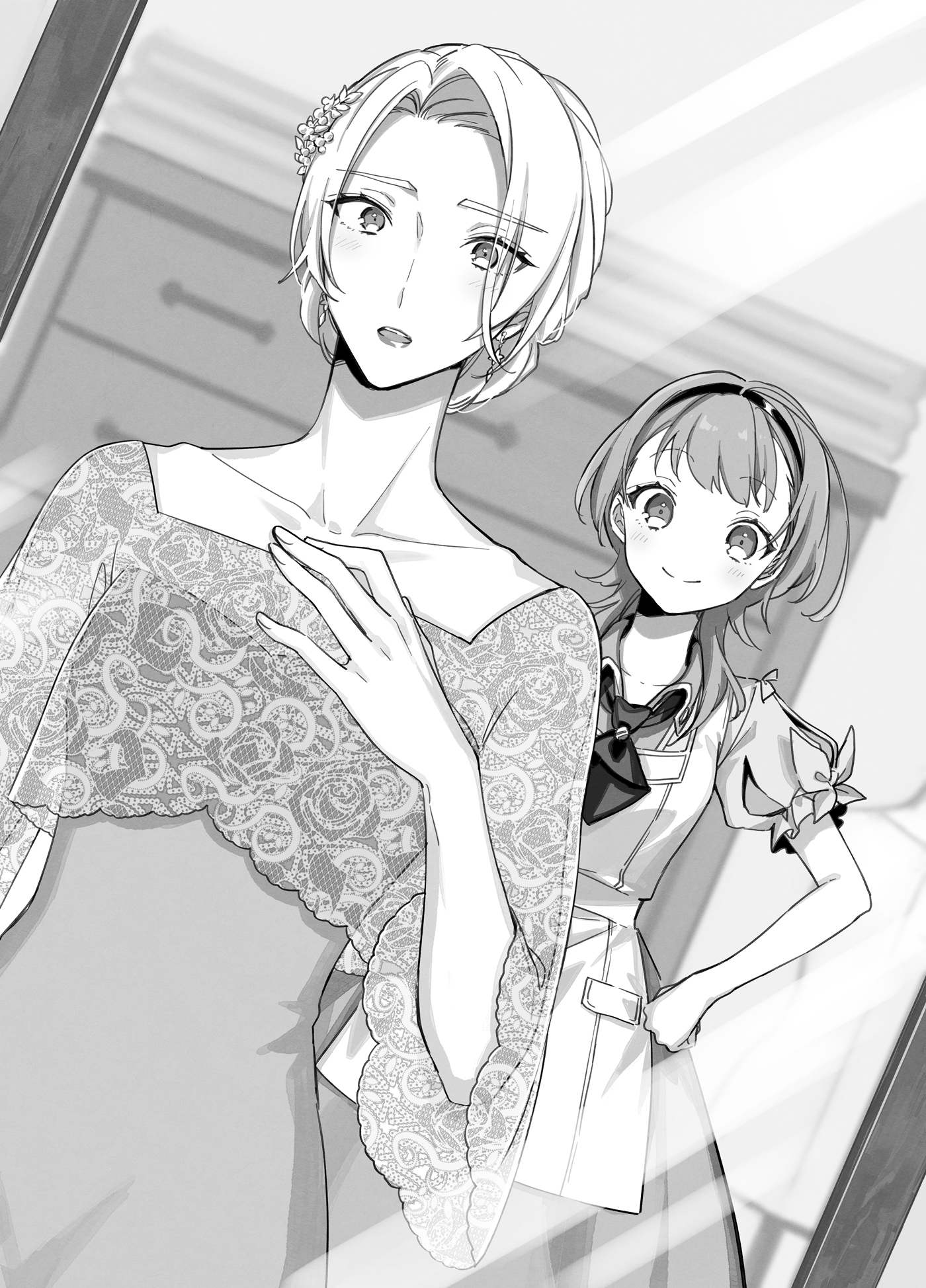
The Magical Garment Factory
The Magical Garment Factory
The morning sun struck Lucia’s clearly sleep-deprived face, which she proceeded to completely drench with cold water. Last night, she had failed to sleep a wink, and so she had embroidered upon the chest of her camisole a nemophila—the symbol of Lucia’s promise to herself to be ever courageous. For her first day of work, she’d planned to wear the same outfit she had yesterday, and she had carefully wiped down the collar and sleeves.
Yesterday evening, a white envelope trimmed in gold had arrived for her father. It was a letter from guildmaster Forto officially requesting that Fano Workshop’s Assistant Manager Lucia temporarily work at the Tailors’ Guild—in other words, asking to have her on loan. The initial contract was for half a year, and every month, she would be paid an amount that was close to the Fano Workshop’s monthly net profit. It was an exceptional sum for her services. What had caught her family’s attention was her job title at the temporary factory that would produce the toe socks, among other products: Head Manager.
The news left Rubert in a daze. “Lucia, how did this...”
“Dunno,” she said, childlike in her response.
Her grandfather nodded. “It’s because Lucia’s so cute!” However had he reached that conclusion? But since the last time he had said something like that was when she was still a child, she took the compliment without making a fuss.
“Lucia, if you don’t want to, you should say no,” her mother said plainly. Behind them, Rubert asked if it was even a request they could refuse, but no one answered him.
“Of course I’m going to accept it. The workshop’s leaky windows need fixing and our current winding machine’s getting old. Plus, I want to buy more fabric to make clothes with. Besides, Dahlia is the one who originally got me involved in this project; I want to make it a success.”
“Do you really want to accept it?”
“Yeah, I do! When will we get a chance like this again?”
“All right. Just remember to let us know if you ever run into any difficulty. You’re not alone in this, okay?”
“Okay, mom.” The confidence Lucia had in taking on his challenge was surely because of her family’s support. It was a blessing that she’d always have a place to call home, and Lucia knew that well.
Massimo then asked, “Promise me you’re not going to marry anyone out of the blue.”
Lucia responded to the inane comment by ramming her shoulder as hard as she could into him.
Now, this morning, Forto came to take Lucia to the Tailors’ Guild; the neighbors stared, mouths agape, looking as though they all wanted to bombard her with the same question: why the guildmaster would personally come pick her up. The reason for his presence became clear when Forto greeted Rubert, then presented him with a basket crammed with an assortment of very fancy fruit—a get-well-soon gift; the sight of her father fainting at the door yesterday must’ve had the guildmaster worrying. Since no one in the family had really shown him much concern, Rubert was extremely touched by the gesture.
Forto led Lucia to the temporary workshop for the toe socks—the large conference room at the back of the third floor of the guildhall. Her first impression was that it was a waste of such a nice room. It was all very functional—the pure white walls with not a single mark, dark brown floorboards coated in a shiny layer of wax, and the white and brown furniture; the room itself enhanced the clothes of everyone in it. It was here that Lucia would meet the others on the team and present the toe socks to them.
Six people sat around the circular white table, including the guildmaster who had assembled everyone, and who now said, “The details are in the document before you, everyone. The toe socks and drying insoles are a joint undertaking between the Tailors’, Merchants’, and Adventurers’ Guilds. As these products are somewhat related to magical tools, the new facility has been named accordingly: the Magical Garment Factory. I have secured a plot of land for it just now, and we are now proceeding with its construction and readying the warehouse. In the meantime, I would like this team to quickly finish the spade work and set up the system for mass production.”
The five others nodded along as they read the files on the table. Lucia wasn’t sure whether it was typical for a new business venture to secure land in one night or if it was only because of the powers of all three guilds combined that funding had come so easily, but the suddenness of it all shook her a little. She understood that there was no use panicking over it, and she took a few deep breaths and sat up straight.
Forto continued, “We have the pleasure of welcoming Fano Workshop’s Lucia Fano as interim head manager of the Magical Garment Factory during this transitional phase.”
She stood up at her introduction. “My name is Lucia Fano. I’m looking forward to working with everyone.”
While briefing Lucia on the coach ride here, Forto had explained that two management-level staff members had been transferred from the guild to this team; one was an expert on monster materials and the other on accessories.
The next to stand up was a young man with green eyes as bright as day and green hair so dark it may as well have been black. “I’m Dante Cassini, and I will be in charge of monster materials. Pleased to make your acquaintance.” He had on an olive vest, a fine linen shirt, slightly slim-fitting trousers, and shined brown shoes—an outfit somewhat put together for the summer weather.
“Playing to the depth of his knowledge of enchantments, he will be the assistant manager of the Magical Garment Factory,” Forto said. However, Dante sat there open mouthed.
Beside him, a very pretty lady with long, blonde hair pulled her lips into the shape of a smile. “My name is Hestia Tonolo, and I’m here as the head of accessories. It is a pleasure to meet everyone.” Her white blouse, made of a high-quality fabric, had frills leading from her neck to her ample chest. She wore a fitted midnight blue maxi skirt with a shallow slit at the back, tied tightly around her waist. Not only did it show her gorgeous figure to the best advantage, it was classy. Just getting the chance to see Dante and Hestia’s outfits made coming here today worthwhile for Lucia.
Next were two knitting machine technicians, then a retainer mage. The machinists often came to the Fano Workshop, and they and Lucia had already built rapport. They bashfully introduced themselves in a few polite words. Though a retainer, the mage was not a full-time employee—coming to the guildhall only when there was work to be done, apparently. Maybe that should have been obvious, as there were only so many mages in Ordine and each was very valuable.
Lucia then placed samples of the toe socks and drying insoles on the table and began explaining their construction. The former were enchanted with a fire crystal for a mild drying effect, while the latter had desiccated green slime powder fixed to them for a wicking effect. They were effective at reducing moisture inside shoes, providing maneuverability during intense physical activity, and preventing diseases—namely, athlete’s foot. When she brought up that last point, all the men in the room, aside from Forto, shifted in their seats. They were all wearing leather shoes and it was summer. Lucia needed and wanted to ask no more.
However, the audience was more engrossed in the toe socks than in her description of them, which made Lucia somewhat nervous. She’d sewed the sample together hastily and the tie-offs were just slightly cruder than she would’ve liked—she hoped that they wouldn’t judge her sewing skills based on these examples.
After the explanation, tea was served to everyone present. The technicians looked over their diagrams as they sipped their beverages; it seemed like they had already been developing ideas for the knitting machine conversion. The mage had the toe socks and drying insoles in his left hand and would wag his right index finger from time to time, suggesting that he was thinking on how to enchant them.
“Any questions so far?” asked Forto.
“Just one, if I may.” Dante, the chief of monster materials, raised his hand.
“Please go ahead.”
“Mr. Forto, even if it is an interim title, you have appointed Miss Lucia as head manager for this joint project between us three guilds. Is this some sort of mistake?” His ice-green eyes smiled as he deliberately addressed her that way, and the thorns of his sarcasm needled her.
Lucia, though, felt no anger toward him. The age of majority in Ordine was sixteen. She was soon to be twenty-two, and to Dante, she must’ve seemed like a twerp, still wet behind the ears. Furthermore, it wasn’t as though she had worked in a well-known fashion studio, nor did she have any noble titles. She couldn’t blame anyone for having doubts about or giving attitude to a mere girl like her in such an important position, even if it was only temporary.
“I have made no mistake.” Forto planted his elbows on the table and intertwined his fingers as he slowly curved one corner of his lips upward. At first, he looked like he would placate Dante by saying that it was only for half a year or that she was only the manager on paper, but no. “If you are discontent with my decision, Dante, I urge you to step down from this project.” No one made a single sound, yet everyone showed their shock.
“I apologize,” Dante said in a quiet voice as he leaned back in his chair.
Lucia noticed the air in the room felt chillier.
Thus concluded today’s introductory meeting. Forto returned to his duties as guildmaster, and everybody else prepared to go their respective ways. Lucia would soon begin a briefing session with the technicians, with Hestia there for support.
While everyone, save for Forto, was still in the conference room, one of the technicians patted Lucia on the shoulder. “Tough day today, eh, Lucy?”
She subconsciously gulped; what a blunt way to put it when the person who had just shown his dissatisfaction was still in the room.
But the machinist, with somewhat of a wink, continued. “I heard your pops Rubert collapsed yesterday. Everything all right?” He jogged the documents in his hand against the table, and Lucia saw that the words “play along with it” were written on the cover page.
“Thank you very much for your concern. It should be a quick recovery.”
“He’s not confined to bed or nothing, is he?”
“No, he has the energy to move around. In fact, my father sobbed when Mr. Forto came to send his well-wishes this morning.” She wasn’t fibbing—Rubert had been overjoyed, though he hadn’t been able to stand for a while afterward.
“His heart’s never been too good, so make sure he gets some good rest.”
The other machinist joined in, saying, “Good thing he has his son to look after the family workshop while his daughter stands in for this project.”
Lucia thanked both of them and sat up in her seat. She felt the others had perked up their ears at the conversation. The technicians had been so kind as to help her concoct a backstory in order to deflect criticism from her. The two of them had been visiting the workshop since she was toddling, and they were more or less family to her at this point.
“Okay, let’s get this knitting machine adapted!” Lucia was bursting with energy as she began her work.
Dante, who now found himself as the Magical Garment Factory’s assistant manager, knocked on the door of the Tailors’ guildmaster’s office. He entered the room after the attendant opened the door and Forto gave his permission. Dante had changed into a jacket and straightened his collar.
“Mr. Forto, may I please have some of your time?”
Gleaming white wallpaper, dark marble flooring polished to a brilliant finish, and black furniture adorned the room. Not a single paper was out of place here, and just as flawless was the blue that appeared through the windows. No matter how many times Dante visited, he felt a little uncomfortable at how picture perfect things were.
“Of course. Could we get coffees, please?” After issuing that request to his attendant, Forto offered his guest a seat on the sofa, and the attendant departed, leaving the two of them to chat privately. “You have something on your mind and I am busy today, Dante, so please feel free to skip the pleasantries and be frank with me.”
Dante took the offer and avoided mincing words. “Very well, then. I cannot deal with it.”
“To what is ‘it’ referring?” Forto curved the corners of his lips upward and softly sighed—a calculated move.
“I am sure you understand I am talking about Miss Fano.”
“And what objections do you have?”
“She’s too young and cute. She’ll succumb either to everyone belittling her or to the envy they point her way. If that doesn’t happen, then perhaps she’ll fall to a love affair or whatnot.” The girl was, what, twenty-one going on twenty-two? She looked even younger than that—or rather, it would probably have been more apt to say she looked less mature. The Tailors’ Guild was a garden of splendor in which romances bloomed among people self confident in their appearances. Others in the industry who visited the guildhall were equally glamorous, and some would pluck all the flowers if they could. When those who knew only the straight and narrow were exposed to this world, they often lost their way.
“You worry too much; she is rather quite resilient, you see.”
“Wait, are there threads tying Miss Fano to powerful families?” To Dante, her unsophisticated background was plain to see, but she could still be well connected.
But Forto shook his head. “No, not a single one. She is genuinely a couturier from the Fano Workshop.”
On the table were three sheets of parchment, and when Forto showed Dante, he finally understood. Written at the top was her name: Lucia Fano. That was all Dante saw, but he could deduce that it was a background check. That Forto had been able to get a detailed report, including her employment history and personal relationships, in less than a day spoke to the man’s influence and reach, though that was perhaps only normal for the guildmaster of the Tailors’ and the head of a viscountcy.
Forto continued, “You needn’t play the villain, Dante.”
“I’m not. I just wanted to throw a bit of a tantrum about not being appointed head manager.” There was some truth in that. The castle, guilds, and, before long, many nobles would be conducting business with them, and as far as Dante knew, he would have been better suited to the position—he had more experience and better tolerance against exposure to criticism. Truth be told, however, he would’ve humbly declined had Forto asked him.
“How about trying out the title of vice-guildmaster, then? I would like to have another one, actually.”
“Absolutely not—that sounds like a real pain.”
Forto couldn’t stop himself from laughing aloud at the rude response. That was the third time he had asked Dante too. Worse yet was that it was serious. The current vice-guildmaster set a very high standard by speaking four languages, which enabled him to hop around the world purchasing not only fabric and thread but also hides, pelts, and, recently, breeding pairs of monsters like baphomets and monster silkworms. His frequent absences from the Tailors’ Guild had given birth to a nickname: the Visionary Vice.
Dante continued, “As they say, the right person for the right job, Mr. Forto. My intellect is such that I couldn’t even get into college, I speak no other languages, and I have no facility for keeping numbers straight.”
“Well, we do employ accountants. In any case, I’m more than certain you would be a great fit as a vice-guildmaster.”
Even with a tutor, Dante had failed the college entrance exam three times, so his mother had thrown him into clothing design school instead. Not only had he relished his youth there, the man he was currently speaking to had chosen him for a job in the Tailors’ Guild. Dante couldn’t be more appreciative of how things had turned out. Those without a college education hardly ever made it to the executive or even managerial level. However, now that Forto was the guildmaster, promotions came for competency and interpersonal skills more so than age or schooling. That was how Dante had been able to achieve his title of Chief of Monster Materials, and now he was even assistant manager of the Magical Garment Factory—quite the success by any measure.
“I’m glad I can count on you to support Lucia with this new project,” Forto said.
“Thank you for the opportunity.” Dante gave a small bow of the head, and his boss nodded back and tucked the parchment away in a file organizer.
However, Dante couldn’t help but dwell on how Forto had used her first name. A “Miss” or “Ms.” would have been appropriate for an unwed young woman, and “Lady” would have been proper for a noblewoman, yet here he was attaching no title, no honorific to her name—no nothing—a level of familiarity that Forto ordinarily reserved for his wife, daughter, and a select few of his relatives.
“Forgive me for asking, but have you taken a liking to Miss Fano, sir?” If so, then Dante would change his attitude too.
“Regardless of your implication, I truly have taken a liking to her as a couturier.”
“You think very highly of her. So, depending on her performance, you plan to take her as your second wife?”
“Not at all, and that’s despite my wife urging me to find someone soon. But I really don’t have the time to even entertain that.” Forto’s voice had no particular affect, and he seemed truly candid.
“Then are you planning on training her to join the executive team?”
“That’s not a bad idea. Lucia didn’t refuse me when I asked her to be head manager either.”
“Well, she—Mr. Forto, you were the one offering her the role; do you really think she felt she was in any position to decline?” There was no way she could defy the will of the guildmaster of the Tailors’ and the head of a viscountcy. Besides, she had been headhunted by someone with such fine looks that people on the street would turn around to catch a second glimpse if they passed him by—a young commoner woman like that wouldn’t hesitate. Well, to be fair, Forto, too, had handpicked Dante at the design school upon seeing the dress he’d had made, but Dante had known that refusal wasn’t an option.
“You’re mistaken, Dante. Lucia is a bona fide couturier. I have no ulterior feelings for her.”
“None at all, sir?”
“When we first met, the first thing Lucia did was to examine my clothes. She only looked at my face a while later. She complimented me on neither my face, lineage, nor status but rather on the fit of my clothes and shoes and the balance of color in my outfit.”
“Ah...” That was Dante’s verbal acknowledgment of his mistake.
Lucia’s words must’ve won over the couturier inside Forto. There were myriad women who clamored about those things he didn’t have a choice about. There were rumors that Forto’s wife had a weak constitution, so many were very eager to replace her. However, there were few who complimented his clothes, clothes that he personally designed and had a part in sewing together. Seeing his boss so happy and content was enough for Dante; he now wholeheartedly agreed with Forto’s choice to appoint Lucia. After all, he had picked her because he liked her as a couturier.
Forto said, “Of course, if Lucia comes asking for help, we ought to extend our hands. We ought to be the coat that protects her from wind and rain. But perhaps we won’t be required to do anything at all.”
“Huh. Really?” Dante recalled the green-haired woman whom he had just seen earlier: striking yet not garish, strong yet endlessly cheerful—like a blue chicory flower that had been well cared for. As a couturier, she must’ve really endeared herself to Forto. All that remained to be seen was whether she could make it as head manager. Dante wasn’t about to shirk his duties as her assistant, but he would insist that she step down if she wasn’t capable. The Tailors’ Guild was a place where one’s work and skills determined one’s position—no exceptions for this project or even for someone Forto liked.
Dante, moving only his lips, murmured, “All right. Let’s see what she’s got.”
“All right, I’ll leave it to you two, then!” said Lucia.
“Count on it!” the machinists responded in chorus, and that wrapped up their meeting.
Earlier, the guild had graciously provided lunch, and the four of them—the machinists, Hestia, and Lucia—dined together; the dainty sandwiches, ham steaks, and lemon tea had looked as though they were a set meal from a nice restaurant. Not only had the sandwiches looked attractive, they had plenty of fresh, tasty filling too. As Lucia was relishing her food, Hestia had offered half of her fruit-and-cream sandwich. Lucia had gratefully accepted it, as it was one of her favorites.
That little morale booster had restored Lucia’s motivation, and she and the technicians spent the afternoon firming up the plans to adapt the knitting machines for toe socks. They had decided to abandon the idea of using one machine to do everything; instead, they had gone down the route of having a machine for each toe size and configuring them so that they could knit the big and pinky toes too. That way, the factory could keep pumping out socks without needing adjustments. As toes came in all shapes, they had also concluded that they would need to make modifications and variations in the future.
Before heading home for the day, the machinists had hurried to put on the toe sock samples they received from Lucia. In fact, they had asked for extra pairs, promising they’d sneak in a visit to the Fano Workshop and check on her father; Lucia, grateful for their thoughtfulness, had told them she’d get more samples for research and given them a wink and a nod. Hestia had also left to deal with the replacements for her previous role.
Aside from the maid, Lucia was alone in the room as she began writing a summary of the day’s progress for Forto. Fortunately, she had a few example reports on which she could model her own, but she was nonetheless nervous about writing her first. When she finished, she deliberated whether to bring it to Forto directly or hand it to the maid so that he wouldn’t be bothered—that was when the guildmaster showed up.
“Lucia, are you all done with meetings for the day?”
“Yes, and I have finished the report as well. Here.”
“I should like to take a look at the prototypes when the technicians finish them,” he said after running his eyes across the page, on which the ink had yet to dry. “I am counting on you to train the stitchers starting tomorrow.”
“Understood, sir.”
“Oh, and I would like you to accompany me today to do some preparatory work for the inauguration of the Magical Garment Factory.”
Forto had previously said he’d secured some land—that must’ve been for either the factory or the warehouse. Lucia wasn’t sure she would be of any help with that sort of stuff, but she was determined to learn as much as she could. The two of them left the room.
Outside the window of the guild carriage, the brown pavers turned to gray—a telltale sign they had now entered the noble’s quarter. Lucia sat up straight and stiff. She worried she’d cause Forto trouble, as she didn’t know the first thing about etiquette.
“We have arrived,” the guildmaster said.
“Oh...”
In the crystal glass shopwindow were dresses in brilliant reds and yellows. This was undoubtedly a high-class establishment, one where Lucia ordinarily would not dare to open doors. She would make an exception today, though—perhaps they were here to scout talent for the Magical Garment Factory. In any case, she was grateful for this opportunity to learn, and she took Forto’s hand.
“It’s a pleasure to have you here again, Lord Luini. I see you have brought a very charming lady with you today,” said a clerk.
“She is one of the head managers with the Tailors’ Guild. As we shall be visiting the castle on business, I am hoping to see what styles you have that would be appropriate for the occasion and could be tailored within the day.”
“I shall be right back with some options for you.”
Lucia found herself frozen in place. “Visiting the castle? Me?”
“For the Order of Beast Hunters’ delivery. It will be simple—set the goods down and we shall be on our way. I shall be there too, of course, so you needn’t worry.”
It might be simple to him; to her, it was anything but. The castle was somewhere out of her reach, a different world altogether. Just being here in the nobles’ quarter had her heart leaping out of her chest—how could she possibly survive there?
However, what Forto said next had her even more frazzled. “Go ahead; pick out whichever speaks to you. The shop will make the necessary adjustments right away.”
“I—uh, okay?”
A pair of clerks wheeled out a rack with nothing but clothes that Lucia aspired to wear. “How about this one?”
They picked a couple outfits. The first consisted of a thin white coat and a smart, slightly slim-fitting silk dress in a cool gray. It had a very professional look but was far too mature for Lucia; it would probably have suited Hestia better. The second was a long dress in a pale rose color. It was stunning, but it didn’t seem as though it would be suitable for work, as it looked hard to move around in. The color was also perhaps a little too flirtatious for Lucia, but it might have looked good on her friend Dahlia. At any rate, both those choices were very fancy, and they felt phenomenal in the hand, but their price tags—rather, the lack thereof—had Lucia anxious.
“I think these two would look wonderful on you,” said Forto, as he took two more outfits from the rack and laid them on the table.
One was a lacy, summery-blue dress made from a high-quality fabric, paired with a coat in a matching color with a bow on the back. The other consisted of an ivory blouse, a skirt on the longer side in the same color, and a coat with lace. Without the latter, the outfit seemed like it would be quite comfortable to work in. It looked proper and just a little cute too—as expected, a great choice from Forto.
He continued, “Why don’t you go try these two on? And let’s get your current outfit remade in silk; I’d like to borrow the patterns if you still have them. I promise your design will be kept confidential too. However, I suggest that the skirt be lengthened another four centimeters—though it is absolutely stunning as is, the sofas in the castle are very plush.”
Lucia started at the barrage of words. The clothes were so gorgeous and adorable that she’d been entranced, but now her biggest concern had come back to her. “Mr. Forto, um, maybe next month would be better...” There were no price tags on anything here—she knew she could afford absolutely none of them, unless the purchase were taken from her paycheck. Or perhaps the store would allow her to pay it in installments, seeing how she was a member of the Tailors’ Guild. That would be ideal, but—
“Forgive me, Lucia. I know you must much prefer to wear something of your own design, but I ask that you make do with these today. The captain of the Order of Beast Hunters is a marquis, so we ought to adhere strictly to the dress code,” he said, genuinely apologetic.
“Oh, no, these are all very beautiful, but they would be wasted on someone like me.” The thought of getting them dirty as she worked was terrifying as well.
“Nonsense. For the head manager of the Magical Garment Factory to wear the clothes I designed is good publicity. Consider it an advertising expense.”
Lucia’s head spun for a moment. It made so much sense that these were his own work—they were at peak form and function. She could really learn something from them; her designs were often focused on cuteness to the point of being hard to move around in. Regardless, although she didn’t think she would make for a good poster girl, her newly instated title was bound to bring attention to her. She figured she should take really good care of these clothes and treat them as though she’d borrowed them from Forto. She had a feeling that starting from tomorrow, she would never be allowed to slip up when it came to her dress, her hairstyle, makeup, or anything else. Lucia forced a smile onto her face, then hurried toward the changing room.
“Once you are finished with that, let’s get you sorted with a protective bracelet or necklace,” Forto said.
She stopped in her tracks and turned to him. “What for?”
“In the guild, you will be handling monster materials. Everyone in a managerial position wears a similar magical tool that provides resistance against poison, confusion, and whatnot.” He made a good point—they would be using a surprising variety of monster materials, like monster silk, baphomet wool, and even green slime powder for the drying insoles. “The guild will provide you with one, so would you prefer a bracelet or a necklace?”
“The necklace, then, please; a bracelet would get in the way of my work.” Fine bracelets were the style among young women at the moment, perhaps because they admired wedding bracelets. However, Lucia usually had a pincushion on her left wrist, and anything else would get in the way.
“Very well. The pendants are usually made from white stone, but we could use gemstone too. Do you prefer any particular color?”
Green would match her hair and dark blue would match her eyes—both very safe choices—but neither of those got her excited. There was one color, though, that brought her bravery and confidence. “Sky blue, please!”
Lost Property and Keeping Tidy
Lost Property and Keeping Tidy
The next morning, Lucia found Dante outside in a carriage waiting to pick her up for work. Judging by his attitude yesterday, it seemed like her being chief of the Magical Garment Factory didn’t sit well with him. Still, he was the assistant manager and they would be working together from now on—she didn’t want any more animosity between them. They shared few words on the carriage ride, but they did manage to greet each other, discuss the weather, and make small talk about upcoming summer wear, and that was enough.
Lucia—wearing the same aqua blue dress as she had yesterday but with a clothier’s apron on top, just in case—was tasked with training the stitchers to knit toe socks on the machines. Their title of “stitcher” was more or less a term of convenience, as they were also experts on knitting machines. There were seven women and four men, and almost all of them looked to be older than her.
Hestia handed each person an information packet.
“Let us get started,” Lucia said. The audience—some with readied pen and paper, some with neutral expressions, and some with pleasant smiles—gave her their full attention. “Currently, the technicians are developing a dedicated toe sock—knitting machine, which should take ten days or so to complete. Our first batch will therefore need to employ knitting machines for regular socks to make the foot part and knitting machines for gloves to make the toes. Then the two parts need to be sewn together.”
She placed a few pairs of toe socks on the table, startling some of the trainees. Their reaction was natural enough, as the shape of the socks was indeed quite striking. According to Dahlia, some had likened them to parts a monster would shed—poetic and, frankly, not that far off, thought Lucia. As she looked over her notes, she asked, “Any questions so far?”
“If I may, Head Manager?”
“Please, go ahead.”
“I see that these socks are made from cotton. Will the materials change for summer or winter use?”
“The current plan is to blend the cotton with three parts flax for summer, while the winter version will have three parts wool instead. However, it depends on whether the blended fibers will take the green slime powder enchantment well. This matter will require some time, as we have to discuss it with the magical toolmaker who invented the toe socks.” Dahlia was already drowning in work, writing the manual for the formula and enchantment processes, not to mention all the formalities involved in securing legal protection for her designs; Lucia ought to allow her a breather before throwing more onto her plate.
A man with a becoming dark gray beard asked, “Miss Fano, if the blend had more flax, wouldn’t it be more durable and resistant to fraying?”
“Are you certain about that? Linen frays easily.” She instinctively and perhaps curtly corrected him.
“Pardon me; I had it mixed up in my head. Guess I’m growing old.” He hung his head as Dante, sitting beside him, patted him on the shoulder. The bearded man didn’t look that old, but there were many whose appearances didn’t match up with their age. Besides, Lucia would be rubbing salt his wounds if she were to ask his age; better to let sleeping dogs lie.
Another stitcher asked, “As the Beast Hunters would like the toe socks with reinforced toes, soles, and heels, would it be better to start with stronger thread or double knitting?”
“It will be a problem if the socks are too thick to fit inside their boots or if the feel of the tread is different in combat, so any sudden changes might be unwise. Furthermore, some wearers may find they perspire too much in the winter, and they may not want a thicker sock. I believe this topic is worth revisiting after we fulfill our first order.”
Lucia had discussed and noted down all of this with Forto during their carriage ride home last night, then once again with her family when she got back; nothing was harder than trying to produce something based on poor instructions. The Fanos had eaten food-stall crespelle for dinner that night, but Lucia had been so caught up in the conversation, she had failed to even notice she was done eating. It felt almost like a bit of a shame.
She then answered more questions from her audience, pertaining to topics such as the size of the needles for the knitting machines and tolerances for the thread. Though Lucia hadn’t expected so many queries, they were mostly about very fundamental considerations, so she had little trouble answering them. In fact, she was glad everybody on this project was so scrupulous.
Afterward, Lucia gave a demonstration on how to operate the machines and made one foot and one toe section. She then bound off the ends of both sections and proceeded to adjust the big and little toes to perfection. Her father said her knitting was still too slow and her mother said her sewing was still too crude; Lucia was terrified now that her skills were on display in front of professional stitchers.
When she was done, each of the stitchers tried their hand at the processes. It seemed that many of them had never made socks before, as they worked the machines with caution. Some, however, readily knitted and sewed a sock—the bearded man being one of them. “Miss Fano, how long have you operated these knitting machines?” he asked, handing her a toe sock as though he wanted her to check over his work.
“Umm, if I’m only counting hands-on experience, then around sixteen or seventeen years.”
“Wait, what? Forgive me for asking, but may I know your age?”
“I’ll be turning twenty-two this year. As my family runs a workshop, I started handling the machines as soon as I could. My experience says little about my expertise, though.” Lucia had been around the workshop for as long as she could remember, since her family was always there. She would mess around and spin the knitting machines (and, in the process, create problems for her family to go back and fix), but by age six, she had effectively become part of her family’s workforce.
“Have you been sewing for a long time as well? Your technique is very impressive.”
“Thank you very much for saying so, though I realize I still have much to learn.” She had sewn and embroidered from an early age too, but it had only been nine years since she’d first picked up the needle and embraced her couturier dream. Not to mention, she had been in school or working for the family workshop for some of those years. The bearded man’s toe sock had beautiful stitches, and the thread joints very much reminded her that she had a long way to go.
“‘Head Manager’ is a bit wordy, so would you mind if I called you ‘chief’ or ‘boss’ instead?”
The question evoked what Forto had said before—that “Fortunato” had too many syllables, so he preferred being called “Forto.” Perhaps there was a tacit understanding among everyone in the Tailors’ Guild. And indeed, either of the choices he’d offered was much quicker to say than “Miss Fano” or “Head Manager Fano”—it just made sense to save time wherever possible.
“The former, if you please,” Lucia said. It was the cooler of the two.
“All right, then, chief. Please call me Zilo. Zistavolo Contini is even more of a mouthful, and I could never spell it right as a kid; I genuinely resented my parents for it.”
Lucia couldn’t stop herself from laughing out loud.
While the rest of the team continued practicing until evening, Forto had summoned Lucia right after lunch. She visited his office and received the necklace they had discussed yesterday. In a sense, it was a rule that the higher-ups in the Tailors’ Guild wear a protective accessory. The pendant was a beautiful sky blue and would’ve made for a nice accent, but Lucia tucked it into her clothes, as it had to have skin contact. The gold chain tickled the back of her neck; she wasn’t used to wearing a necklace.
Lucia hurried to return to the temporary workshop to assist the team in their training. Some of them weren’t yet able to seam the two parts of the toe sock while keeping the big toe and pinky toe in balance. As Lucia gave them tips on the part where the stitches reduced and tricks for each of the sizes, the day had vanished.
“Okay, let’s wrap up here today, and we’ll continue tomorrow. Thank you, everyone,” Lucia said, ending the workday. With just a bit more practice tomorrow, they would be ready to start producing salable toe socks—so Zilo appraised the team. And with Dante agreeing as well, Lucia was plenty confident. She took off her apron and got ready to head home, but it was then that she noticed she was missing a sewing needle.
“Are you not going home yet, Head Manager?”
“No overtime today, I hope?” asked a pair of stitchers.
“Just the report to finish. See you tomorrow,” answered Lucia.
The two young ladies, as well as the rest of the stitchers, said their goodbyes and left with their sewing baskets in hand.
Hestia was next. “I have to attend to some business regarding my replacement, but is there anything I can help you with before I go?”
“I’m fine, but thank you so much! See you tomorrow!”
Lucia couldn’t possibly ask for help; it was her own fault she’d lost the needle. Besides, Hestia had other work to deal with. Dante also left for a meeting regarding his previous role, and that left Lucia alone in the room.
Once she’d finished the report, she double-checked her pincushion and proved that she had counted correctly the first time. “Come out, come out, wherever you are,” she called out to the missing sewing needle in a quiet voice. Lucia checked her clothes inside and out, her apron, her seat, and every single toe sock they had made.
Search until the missing needle is found—that was the code of textile artists. It might have fallen onto the floor or gotten mixed up in the product, and getting someone injured was a great disgrace. The couturier Lucia revered, Ranieri, had taught her that keeping track of one’s needles at all times was an ironclad rule. Count when taking a needle, count when returning a needle—it had been her routine for ten years now.
Lucia pulled out all the chairs, crawled on the ground, and searched the room from corner to corner. This would be no quick task.
“Letting someone call him Zilo on the first day?” In the guildmaster’s office, Forto was signing the piled-up paperwork.
“Right? She is full of surprises, that Head Manager Fano. Not only does she know her stuff about the toe socks, she even has a good understanding of materials. She didn’t even fall for Zilo’s claim that linen doesn’t fray easily.”
The more flax in a blend, the likelier it was to fray, but Zilo had deliberately said the opposite, and Lucia had caught his mistake right away. In fact, she had seemed as though she couldn’t believe he’d make such an obvious mistake.
Dante adjusted his seat on the sofa, then put on a pair of white gloves and opened the magically sealed box on the table. Inside was a piece of hide from a monster called the fangdeer. They looked like any other brown-furred deer, but they had body strengthening magic, incredible agility, a devastating kick, and—as their name would suggest—terrible fangs, all of which made them a vicious monster. However, their hide was thin and soft yet strong, making it a perfect material for gloves. This example, too, was intended to be fashioned into a pair of gloves for a high-ranking noblewoman. Dante had left the inspection for his replacement to complete, but his replacement wasn’t yet confident and had begged Dante to take a look for himself. Sure enough, the hide had a very fine blemish, which barred it from being top grade.
“How much more time do you think your replacement needs?” asked Forto.
“I would say another three months. It was so sudden, after all.” Dante had yet to really do much in his new role, one that Forto had put him in after less than a day of deliberation. At the end of the day, this project had the full support of the royal knights’ Order of Beast Hunters, the Merchants’ Guild, and the Adventurers’ Guild, so it couldn’t fail no matter how rough the going got—so Forto must’ve been thinking when he’d made his snap judgment, Dante assumed.
The others had been quick to respond too:
“If that is your command,” said Dante.
“If it means a pay raise,” said Hestia.
“Sounds neat,” said Zilo, on behalf of all the stitchers.
Forto had told them to respond when they individually made up their minds about the reassignment, and every one of them had accepted that same day.
“Despite her youth, Ms. Head Manager has seventeen years of experience with knitting machines, and she seems to be just as experienced in sewing.”
“She was born in the Fano Workshop, you see.”
“Do you want to know what Zilo said to me in the hallway? ‘She’s got eighty percent of my knitting and seventy of my sewing. If she’s too green, then so are a third of all the guild’s stitchers,’” Dante said with a bit of a smirk.
The nib of Forto’s pen halted. “Lucia is even proficient in both knitting and sewing?”
“What else is she good at?”
“Her design sketches are sublime.” The guildmaster giggled, potentially giving off the wrong impression. Forto’s expression was tender, like he was reminiscing about his love. But no, it was her skills as a couturier that had charmed Forto. It was exactly the same expression that, when he was younger, had landed him in a bit of hot water when he was mesmerized by a noblewoman’s dress—so Dante had heard from veterans, though he had no intention of asking his boss about it.
“This second-rate fangdeer hide won’t do. I’ll return it to the Adventurers’ tomorrow and ask them to replace it,” said Dante. It wasn’t as though it was completely unusable, but good wasn’t good enough, especially not for a duchess.
“Shame. What a big injury for such a young, healthy specimen,” Forto said, after he walked over, donned white gloves, and took the piece of hide into his hands. “We cannot use this for someone such as Lady Altea.”
Dante returned it to the box and closed the lid. The last remnants of sunlight had disappeared already, and his stomach rumbled.
“Oh, I just noticed,” Forto continued, “Lucia has yet to hand in the report—though I have told her that she needn’t write one every single day.”
“When we left, she said she was going to stay behind to write it.”
“I shall go take a look. Come with me, Lotta.”
Heeding the call, Lotta, carrying a thin black staff, followed his master. The attendant always seemed to be invisible, but that was what made him effective as a bodyguard. There was also a feeling of magical energy and chilliness emitting from Lotta; Dante didn’t dare to walk too close to him. The three of them went down to the third floor.
Dante was rather relieved to see that the conference room was still lit and there seemed to be someone inside. He knocked on the door and gingerly cracked it open.
“Stop! Hold it right there, please!” Lucia, most definitely alone in there, frantically poked her head out of the room.
“Is something the matter?”
“I’m sorry, I seem to have dropped one of my sewing needles, but I will head home as soon as I find it.”
“And these toe socks here?”
“Everything on that cart was made today and met all standards, and I’ve collected them so that I can maybe hand them out to the team. I have looked through them one by one, so I’m sure that my needle isn’t lost in there.” The rather large pile of toe socks had been neatly folded; it must’ve taken her quite some time.
“Are you positive, Head Manager?” Dante asked.
“Absolutely. I count my needles when I take one from my pincushion and I count again when I put one back.”
Forto asked, “Where have you looked so far, Lucia?”
“I have searched through the tools, garments, tables, and underneath all the chairs too. All that should be left is under the table,” she answered as a bead of sweat trickled down her brow. A patch on her flare skirt had been slightly darkened; perhaps she had been searching on all fours. The chairs had been pushed up against the wall, so that left the conference table and the workbenches.
“Allow me to move the table; I have body strengthening magic.”
“Thank you so much, Mr. Forto.”
“But of course. This is what we clothiers and stitchers do.”
Oh, just look at him. Looking at Forto’s profile, it all made sense to Dante. That was the expression not of the master of the Tailors’ Guild nor of a viscount but of a couturier.
They spent some time looking for the missing needle but to no avail.
“I think we have done a thorough job,” Forto said. “Perhaps it was mixed up in someone else’s sewing kit?”
“I don’t think so; I didn’t lend my needles to anyone.”
The green-haired girl looked terribly guilty, and as a clothier, Dante empathized. Every stitcher in the guild knew the code of the needle. But surely, as careful as they all were, accidents hap—before he could finish his thought, a stinging pain came to his head. Could someone have taken Lucia’s needle intentionally? Dante drove his suspicion away and turned to Forto. “It’s probably gotten too dark to keep searching. Maybe we will easily find the needle tomorrow.”
“You’re right. Let us search again tomorrow,” Forto said with a smile as Lotta helped him into his jacket.
“I’m sorry to have caused everyone so much trouble...”
That Lucia was heartbroken was plain to see, yet Dante could not find the right line to comfort her. Instead, he gently patted her on her petite shoulder. “I’m sure the needle will turn up tomorrow, Head Manager Fano.”
“Thank you for your kind words, Assistant Manager Cassini.”
Being called “Assistant Manager Cassini” just did not sit right with him.
“Looks like we’re moving to a new room today,” said a stitcher.
“How hectic, considering we were so busy yesterday too,” said another. The two young stitchers shared a laugh as they walked in. Today, the temporary Magical Garment Factory team was not in the room where they had practiced knitting and sewing yesterday but in a room that was just a little smaller, although it was on the third floor as well.
“Good morning, Mr. Cassini.”
“Good morning,” he said in return, before continuing in a bit of a growl, “Isn’t there someone you’re forgetting?”
“Huh?”
Sitting two seats away from him was Lucia—the head manager—whom they should have greeted first, but maybe the stitchers didn’t feel close to her yet. They were around her age or slightly older than her too. Not to mention, Dante had risen through the ranks in the guild, so it wasn’t surprising they’d give him more respect.
She might as well greet them first. “Good morning,” said Lucia, deliberately using her regular tone. The lack of sleep showed on her face, but a skillful application of makeup and her bright blue dress did well to conceal her tiredness. She had come in first thing in the morning to look for the missing needle, which remained missing. Dante had helped too, ruining the perfectly ironed creases on his trousers.
“Good morning, Head Manager.” Fortunately, the stitchers were smiling when they greeted her in turn.
The other stitchers trickled in, and once everyone was assembled, it was time to begin the workday. “Good morning, everyone. I apologize for the sudden change of plans and for the inconvenience, but our usual room is being searched, as I lost a needle yesterday,” Lucia said, bowing deeply. Knowing how busy everyone was, she felt awfully guilty for kicking up such a fuss.
“A needle, you say?”
“Oh, no, did you drop it somewhere?”
“Imagine being the head manager and losing a sewing needle...”
Some sounded surprised, while others traded whispers. It was as she’d expected—Lucia, too, thought it shameful on her own part.
Zilo, who was sitting across from her, barked at the others, “Sewing baskets on the table! Now!”
“Huh?” Some of the stitchers seemed a little perplexed, but every one of them gave in to his fervor and lined their kits up on the table.
“Starting from my right,” Zilo explained, “you will state how many needles you have inside and then open your basket.”
“Twelve sewing needles and forty marking pins.”
“I have ten needles, thirty-six pins, and another twenty needles in my backup case.” It came as no shock that these professionals knew their tools exactly.
However, the chain of voices came to a halt. The next person in line, a young woman, had a pallid face. Her hands hovered over her sewing basket. “I, uhh, I have eleven sewing needles and forty marking pins,” she squeaked. Perhaps she was nervous having so many pairs of eyes on her.
“I thought you carried ten needles,” said Zilo.
“No! I have eleven...”
“Show us, then.”
But she still refused to open her basket, and so Dante approached her. “Excuse me,” he said. Without making any accusations, he exposed the contents of her kit and placed her pincushion on the table. He then took a loupe out of his pocket and scrutinized each sewing needle. “All of these needles are guild-supplied sewing needles, save for one.”
“I-I’m sorry! I must have accidentally mixed up the head manager’s needle with my own...”
Despite having turned the conference upside down, Lucia couldn’t find the missing needle, and now she knew why. In any case, she was glad that no one had been inadvertently stuck.
“I should hope that, as a stitcher, you haven’t forgotten the code of the needle,” pressed Zilo.
“I’m truly sorry! I was careless and didn’t count my—”
Hearing that brought a wide smile to Dante’s face. “That was no careless mistake, was it? I remember that yesterday, you counted your needles right in front of me. You would have noticed your so-called mistake then, wouldn’t you?”
Despite his cheerfulness, Lucia felt as though the room had frozen over.
“And you,” Dante continued, turning to the woman beside the stitcher, “you sneered and said something about losing a sewing needle, despite the head manager not having specified what kind of needle. You’re complicit in this, I presume.”
“No! I, uh, I was just thinking about how we were sewing the two parts of the sock together yesterday, so I presumed it was a sewing needle! I have nothing to do with this—I swear!”
“Hey! You told me to do it because you said it’d be funny!”
“I was just kidding! I didn’t tell you to do anything!”
“You were the one who suggested we prank her!”
The conversation devolved into a squabble between two culprits who had hidden someone else’s belongings as a “joke,” making them less mature than a bunch of primary schoolchildren.
“Goodness...” The young male stitcher who had just snickered to himself had probably meant to do so more quietly, but it was loud enough that Lucia heard and then turned to him, and he quickly dipped his head in apology. If anything, she was glad he could find humor in the situation.
“Stitchers have no business messing with needles, you boneheads!” Zilo shouted. He’d clearly had enough of the bickering. “You two are starting as trainees again!”
“You can’t be serious, Zilo? They were handpicked to be among the few stitchers for this joint project between the three guilds and the castle. They deserve a harsher punishment—they ought to be fired,” said Dante, and the color drained completely from the culprits’ faces. Naturally, the stitchers had been selected for the Magical Garment Factory based on their skill and speed, and they likely would’ve received a bump in pay too. It seemed as though character hadn’t been taken into consideration, however.
“I’m sorry! Please don’t fire me!”
“Please forgive me! It’s not in protest of our head manager!”
They were right in front of Lucia, yet they felt so distant. There was something she didn’t understand, though. “May I?”
“Please, Head Manager. Reprimand them all you want,” Dante said.
“I’d like to ask you two about why you did it.”
“We...”
“Is it because I, a young woman, suddenly became head manager and am being better compensated, despite a seeming lack of any particular talent?”
“No...” The noncommittal “no” was more or less a “yes.” But it was understandable that they would think that way; Lucia, too, had envied those whose fortunes seemed to have fallen into their laps—not that she had ever resorted to such mean deeds.
“Head Manager, how shall we deal with these two?” asked Dante.
“It isn’t up to me; let me speak to Mr. Forto about this matter. But I don’t intend to have them fired.”
“How magnanimous of you,” he said, almost flabbergasted by her answer.
Though Lucia didn’t know how many years the culprits had been working at the guild, she knew they had definitely been employed longer than her. They were led by a very experienced stitcher. And above all else—“They work quickly, and their stitches are superb. It would be a shame if the guild relinquished such distinguished individuals.”
The young male stitcher who had previously snickered couldn’t help laughing outright, much to the dismay of everyone around him. Well, save for one person, perhaps—Zilo chortled for the longest out of everyone.
“It can’t have been easy today, Lucia,” said Forto in the carriage returning to the Fano residence.
She almost instinctively agreed, but she caught herself at the last moment and put on a smile instead.
After discovering the whereabouts of her missing sewing needle, Lucia had gone to report the incident to Forto. He had quickly made time for it, and, along with Zilo, they had discussed what to do with the two stitchers. She had apologized for being so lenient—though she had been the victim, the culprits were still her subordinates, even if just temporarily. Zilo, too, had apologized, saying that their inappropriate actions were reflective of his instruction.
Forto had listened in silence. In the end, he had sentenced the culprits to three months of training to requalify as stitchers before their positions would be reinstated. In addition, the overtime pay for those who had looked for Lucia’s sewing needle yesterday and the wages for those who had been in the meeting this morning were to be garnished from the two stitchers’ wages. Lucia had then informed the culprits, who voiced their utmost gratitude and apologized again afterward. It was a bit of a shame to lose such skilled craftswomen, even if it was only for the time being.
The team had spent the rest of the day making up for lost time; everybody had made a serious effort in their hands-on practice. In the afternoon, Lucia had experimented with splitting up the stitchers into two camps—those who were especially proficient at operating a knitting machine and those who were especially proficient at sewing—and found increased efficiency. With the current machines running at full capacity, the team would be able to produce sixty pairs of toe socks per day.
Then, during teatime, the prototypes of the drying insoles had arrived. Lucia had distributed a pair to each member of the team. She had cut hers to fit into her pumps, and even now, they were still crisp and comfortable; Lucia had wanted to deify the drying insoles’ inventor, Dahlia. Everyone had asked for dibs before going home.
“Lucia, as head manager, you had the right to be stricter,” Forto said.
“With the two stitchers?”
“Indeed. Dante suggested they be fired, didn’t he? That would be a fitting punishment for theft. You would even be in the right to have me call their personal guarantors and sternly reprimand them and the offenders.” Joining the Tailors’ Guild required a personal guarantor—usually one’s parent or kin. But to have both guarantor and guarantee appear before the guildmaster for an admonishment? That seemed awfully cruel.
“I understand that, but it would be a shame to have them suffer through that.”
“You wouldn’t pity the offenders but the choice?”
“I don’t pity them at all—they are adults who did what they did.” Lucia felt no sympathy for those who chose to take what wasn’t theirs, nor remorse for her own response. “But they are very skilled and efficient with the knitting machine, and their seaming is neat and careful. I have faith that after this incident, they will do good work for the guild. Someone’s quality of work and quality of character are separate, after all.”
“You may be young, but you have such a way with leadership...” Forto said, straining a smile.
Lucia, too, could but admit that there was a bit of dissonance. To chase her dream of founding her own atelier, Lucia had worked all sorts of part-time jobs. In moments when she could be spared from her family’s workshop, she had been a seamstress, cleaner, salesclerk, and chaperone to hospitals and temples. During summer and winter fetes, she had worked back of house as a prep cook.
With so many workplaces and positions under her belt, the most important skill she had learned was handling interpersonal relationships. In the beginning, there had been times when she had bawled, but learning how people interacted with one another was inevitable in the process of gaining all that experience. Everyone had people with whom they were or were not a good match and others they liked or disliked—such was unavoidable, such was the human condition. Furthermore, those who were good at their jobs were not necessarily good as people; conversely, those who were kind were not necessarily productive. Having fun working with a friend was best, but failing that, being polite and working as coworkers was fine.
As he took out a little white carton adorned with an adorable floral pattern, Forto said, “I’m glad I asked you to be head manager. These are originally gifts for my clients, but I have one extra, and it is yours if you would like to have it. My wife and I are trying to watch our weight and our daughter is being mindful of dental caries, so it would be best if this temptation were off my hands.” He opened the carton, revealing little flower-shaped candies delicately and individually wrapped in vivid shades of red, pink, yellow, aqua, and white paper, like a field of flowers.
“Thank you!” Lucia showed no diffidence accepting his present, which was soon to be her treat as she sewed into the night.
Perhaps Lucia’s cheerfulness is naught but a pretense, that candor would expose the hurt within—such had been Forto’s fear, but it turned out to be unfounded. Her eyes were sparkling at the sight of those sweets; there was no gloom to be found in her face. After graduating from primary school, Lucia had taken up temporary jobs as she studied to become a couturier—that much was written in her background check, but now he understood how hard she worked.
Going purely by her age, it would have been no surprise if Lucia had cried or gotten angry during this episode. He would’ve understood if she had questioned why he had hired people like that. But not once had she lost her composure; rather, she apologized for her subordinate of one day. She had even gone as far as to say how “it would be a shame” and “work and quality of character are separate.” The woman whom he had scouted to be Head Manager of the Magical Garment Factory seemed to be a talented leader, though, truth be told, Forto was more interested in her abilities as a couturier.
“As promised, Lucia—here are three of my sketchbooks. You can take as much time as you like with them, and if there’s anything inside that you would like to reference, just let me know; you can use any of them so long as it hasn’t been made already.” Packed in a black leather case were the three sketchbooks, which he had made sure didn’t contain any unsavory notes. They were the newest ones in his collection, so there shouldn’t be any designs that were too outdated.
“Thank you so much!” She cast the box of candies aside and stretched both hands as far as she could; he couldn’t help smiling in return. Lucia opened the leather case and flipped through the pages. “Is this a numbering system, Mr. Forto?”
“Yes, that’s the ninety-seventh one in your hands—I’m just on my one hundredth,” he said, noting the number on the top-right corner. That was a lot of sketches, if he did say so himself. There was nothing he enjoyed more than revisiting his old designs while enjoying a drink.
“That is incredible, considering how busy you are...”
The pages in the sketchbook she had shown him the other day were light brown, smaller, and inferior in quality; next time, he ought to give her the ones he used. “What number are you on now, Lucia?”
“Um, I’m only at sixty-one; I know I have a long way to go...”
One hundred was the page count he had reached after drawing for eighteen years; Lucia, having lived fewer than four years beyond that point, was at sixty-one. Although the one she had shown him was a little thinner than his own, she had filled both sides of every page—Forto was struck by a wave of emotion. Numbers weren’t everything, but quantity of practice was important. “Say, Lucia, would you be so kind as to show me your sketchbook again, and perhaps a few other ones too?”
“I’d love to go through them with you!” she exclaimed. “Oh, uh, my older drawings aren’t very good, and there might be random stuff in there, like my schoolwork—but if you’re okay with that?”
“Of course. Speaking of which, the cheese crespelle stall at the park looked delectable. I’d like to give it a try one day.” At one end of the Central District park was a stall that made crespelle stuffed with cheese, which seemed to be one of Lucia’s favorites. She had written about what sauces would go well with them and what combinations of cheeses would be delicious, and she had even sketched them out in her book. Forto vividly remembered that—along with her designs of dresses.
With a slight blush, his subordinate beamed. “They’re really, really good! Maybe you could go with your family one day!”
The Knight and the Dress
The Knight and the Dress
Ten was the number of days it had taken Lucia to become accustomed to working at the Tailors’ Guild. After they’d spent two days producing the toe socks, the replacement stitchers had arrived and begun training. They were still in a trial-and-error phase, but progress was quicker than she had expected. Prototypes of the specialized knitting machines had arrived today as well, along with three new members. Lucia could hardly say she was close to any member of the team—save for maybe Zilo—but the distance was at least not interfering with their work. Their first delivery to the Order of Beast Hunters seemed likely to be a cinch.
In addition, on the plot of land for the permanent Magical Garment Factory, demolition of the existing building had been completed and site preparation was underway. Though a factory was undoubtedly quicker to design than a noble’s mansion, Lucia felt terrible for the architects, as they’d had to finish the blueprints in a mere three days, and her concern for them had been justified when she saw them staggering into the guildmaster’s office. The architects had sported dark circles under their eyes, but their smiles had been bright as they expressed how thankful they were for the triple pay. And while they were there, Lucia had taken a look at the estimated costs of constructing the Magical Garment Factory, though it had been no help as a reference for her future atelier.
“All righty!” With the report finished, Lucia had completed her tasks for the day. As she was walking up the staircase, she crossed paths with a group of men dressed in the costume of the desert nation of Išrana, who were going down. As soon as they saw her, they stopped in their tracks, stepped aside, and nodded to her as they let her by. Lucia, as an employee of the guild, probably should have given way to the guests, but this sort of thing was a form of chivalry among the eminences of Išrana.
Lucia took a good look at the men as she walked by and found that their clothing wasn’t very ornate, but maybe the high-quality fabric and the number of layers were considered ornamental. All of them wore long sashes from their hips, each differently colored and patterned. According to Forto, those were indicators of one’s clan and status; Lucia found it shocking that they could not choose what they wore. Likewise, in neighboring Ehrlichia, people who cross-dressed were apparently subject to extreme discrimination, which sounded very unjust to Lucia.
There was no such rule here in Ordine, and people were free to dress however they wanted. They may have been given grief in the past, but nowadays, the worst anyone got was a curious glance. In the capital, it was considered normal for women to wear trousers, and there were men who wore long skirts too. And here at the Tailors’ Guild, the variety of styles was truly a sight to behold. Having that choice to dress yourself to accommodate your work and lifestyle was convenient and freeing—as the light-footed woman climbed the remainder of the steps, she thanked her lucky stars that she had been born in this nation.
“Excuse me, Mr. Forto! I’m here with the report.” Lucia knocked on the door and waited for his approval before entering.
“Oh, thank you, Lucia...” he eked out. “All done already, are you?” If anything, he was the one who was all done—Forto was all but sprawling on the sofa. Across from him sat a woman with blonde hair, presumably a client. “This here is Miss Jasmine Enrici, a cousin on my father’s side and the daughter of a baron. Her wedding is coming up next year, and—”
“A year’s time is long—there is many a slip twixt the cup and the lip, Lord Forto...” Her voice was so melancholic that Lucia wanted to plop down the report and hightail it out of there, not that a noblewoman’s wedding was any business of an outsider’s anyway. “Forgive me for rambling prior to offering my introduction. I am Jasmine Enrici, royal guard. I am indebted to the Tailors’ Guild for my uniforms and the like. My education as a noblewoman ended in college, when my education in chivalric studies began, so I pray you pardon me for my manner of speech.”
She had paired a sateen dress shirt woven from white cotton with a flat navy blue maxi skirt. Below that were black pumps over a pair of silk stockings. Her outfit looked like it belonged on a clerk or a receptionist, but Jasmine’s lean and tall body made it an attractive ensemble. Her golden hair had just the slightest hint of waviness and was tied into a shoulder-length ponytail. Her blue-gray eyes were striking and her features finely chiseled—it took no stretch of the imagination to see Jasmine and Forto as cousins.
“My name is Lucia Fano. I appreciate the opportunity to work together with the castle during my stint here at the Magical Garment Factory.”
“How charming you are...” Jasmine almost sighed her words out as she looked at Lucia. A nobleman was obliged to pay a compliment to a woman upon first meeting her. Maybe a noblewoman who was a knight had to do the same.
In any case, Lucia could not refuse but rather gracefully accept whenever someone called her cute—that was her own rule. She smiled and said, “Thank you very much, Lady Enrici.”
“If only I were as cute as you are, then I would suit my dress...” she mumbled, then glanced at the white dress box on the table.
Lucia’s curiosity got the better of her. “Would that be the dress for your engagement party?”
“Er, it was my mother’s when she was young—she suggested it to me, as I am lost on what to wear. However, the size is far too small for me; I cannot even fit my arms through the sleeves.”
“Jasmine came today to discuss this issue, but the event is in four days, you see.” Poor Forto had an expression not of exhaustion but of despondency. If they decided on a design by the end of the day and immediately got multiple stitchers working in shifts, then there was an off chance that a dress could be made in time—that was if it were a regular dress. A dress fit for a noble’s wedding or engagement party ordinarily took six months to a full year—so Lucia had heard before, but Jasmine must’ve had special circumstances.
“Apologies, Lord Forto; I failed to account for how much physical training has widened my shoulders. The waist was somewhat loose back then, so I thought it might do.”
“I will not allow a cousin of mine to wear her debutante dress as her engagement dress,” he growled back. “Regardless, the groom should have bought you your engagement dress! What became of that?”
“The lieutenant and I, erm, are ignorant of such noble matters...”
“What kind of fool do you take me for, Jasmine?” The blue of his irises crashed over her like a bitingly cold wave.
She waved the white flag. “I said that wearing a dress just the one time is an utter waste! I said that I had a dress I liked!”
“That dress was for your sixteen-year-old self; surely it’s obvious your twenty-four-year-old self needs another dress,” Forto said. “If you had told me last year, I could have handmade you one.”
“For various reasons, my funds are tight, and—”
“Obviously, I would’ve given it to you as a present!” Forto boomed like thunder.
It seemed like there was more where that came from, and so Lucia quickly interrupted. “Mr. Forto, we still have some time left, so let’s get on with it now!”
“Y-You are very gracious, Madam Fano. Erm, this is the style my mother recommended to me, but...” From the box, Jasmine took out a slightly older white dress. The flowing shoulders formed puff sleeves, the bust had plenty of lace, there was a ribbon tied around the waist at the back, and frills trimmed the hem—very cute. “If people saw me wearing that, they would lose their lunch...”
Hearing the despair and heartbreak in her voice, Lucia empathized. That dress was very much the opposite of Jasmine’s image.
“This is the style of your mother’s time—lots of frills and lacing was supposedly what noblewomen appreciated back then,” Forto explained.
There were trends that came and trends that went, and this dress belonged to the latter group. This year’s look was a slightly slim-fitting top paired with a voluminous, flared bottom, but a trend was just that—there was no need to chase it if it didn’t suit one’s style or taste. As for Jasmine, she would look good in a simple dress that highlighted her height.
Jasmine said, “I would be satisfied with a rental, Lord Forto, as long as it fits my size and does not make me so unsightly...”
“Allow me to be frank with you—we do not carry many rental dresses your size. If we hurry and finalize a design and put a rush order in with the stitchers, we may be able—if just barely—to sew you something bespoke.”
“I, um, would prefer a rental. And my budget is three gold at most...”
Her voice shrank to nearly nothing, to which Forto responded with a heavy, weary sigh. “You spent your savings on your sister’s wedding this spring, did you not?”
Jasmine paused. “My sister had to move to Ehrlichia to become a bride; it was necessary that she have a large dowry in case anything were to happen.”
“So? Do you think three pieces of gold can purchase you a dress designed by the master of the Tailors’ Guild and urgently sewn together by skilled stitchers?”
“My deepest apologies, Lord Forto, for presuming upon your kindness and for insulting the Tailors’ Guild. I shall turn to a store—”
“Lucia!” he hollered, interrupting Jasmine’s anguishing.
“Yes, sir!”
“As the head manager of the Magical Garment Factory, you ought to familiarize yourself with dresses for nobles. Will you seize this opportunity to gain practical experience in designing and crafting an engagement dress? You will be handsomely remunerated for this overtime work.”
If the dress was a product of training, then Jasmine would surely have an easier time accepting it gratis. Though Forto had the financial means to make a gift of the dress and the power to put in a sudden request of the Tailors’ Guild, this also made for a good excuse. Furthermore, this was a chance for Lucia to learn more about dresses and make extra money. I have the best boss in the world!
Lucia grinned from ear to ear. “My pleasure!”
As Jasmine was an unmarried woman, taking her measurements was not something Forto could do; instead, while he chipped away at the mountain of paperwork on his desk, the two women had left for another room so that Lucia could take measurements and gather information from Jasmine. They would return to the guildmaster’s office when finished.
“Please be at ease, Lady Enrici.”
In the center of this room was a large white leather sofa on which the visibly tense Jasmine sat. Lucia scanned the documents in a leather folder.
Lucia continued, “Just to confirm, for the engagement party at the viscount’s estate, we are planning an evening gown for you.” Earlier, Forto had angled the paperwork away from Jasmine before putting down his name as the payer; he worked and acted expeditiously.
“Erm, I am terribly sorry to have dragged you into this trouble, Madam Fano.”
“Please don’t be! In fact, I am delighted to have this chance. I will do my utmost to make you something you are happy with, but as this is my first time making an evening gown for a noblewoman, I beg for your forgiveness for any mistakes stemming from my inexperience.” Her client was the daughter of a baron and a royal guard at the castle, and this was a dress for the announcement of her engagement to her fiancé, who was from a viscount family—ordinarily, a commoner like Lucia would never have had a job like this handed to her so casually.
“You needn’t fret. I studied chivalric studies in college and have been a knight ever since; I am much less experienced in these matters, but I know I am in good hands.”
“Thank you very much for the kind words,” Lucia said. “Let us get started, then, Lady Enrici. May I know your preference for the cut of your dress? Do you have any favorite colors or patterns?”
“In that case, I would ask that it fit somewhat loosely and that it cover my arms.”
“Is there a particular reason to hide your arms?”
“My upper arms are, erm, rather large, especially my left.” Jasmine looked pained to reveal that information as she clutched her left bicep with her hand. “We guards carry a shield in one hand and a sword in the other, so building up muscle is unavoidable for us. A dress can hide my long legs, but showing my upper arms would be grotesque. Hell, the other knights ridiculed them as looking like logs, saying ‘For a Jasmine, you’re quite the oak.’”
Those dang jerks! How dare they plant that insecurity into her head? Lucia wanted to protest on her behalf. “I see it as proof of your duty in the castle.”
“Aye, my superior officer—rather, my betrothed said the same: ‘A knight ought not to be ashamed but proud of having muscular arms.’”
“How wonderful!”
“Too wonderful for the likes of me,” said Jasmine, smiling softly. Her stiff knightlike expression softened into a young lady’s, and that spoke volumes about her feelings for her fiancé.
“What sort of person is your partner?”
“He is a lieutenant of the royal guards and my superior. Our fathers are longtime friends, and as we were both still single at our age, they decided on our marriage a year and a half ago. The lieutenant is very capable, and he deserves a much better bride, but perhaps he is too kind to refuse me.”
“Did you hear that from someone?”
“No, but the announcement of our engagement has been delayed for a year, and perhaps he isn’t interested...” That was an assumption based on nothing from the horse’s mouth. Jasmine looked at the ground. “At any rate, I have a man’s figure—a knight’s uniform or menswear would likely suit me better.”
Lucia pouted just a bit at the self-deprecation. “Lady Enrici, if another female knight in your order boasted about her sword arm and her strapping muscles, what would you say to her?”
“Well, I would commend her for her admirable efforts in tempering her body.”
“Then why won’t you say the same to yourself?”
“I—see, uh, I... As a knight, I am proud; as a woman, I am, erm, often kept at distance? How should I put this?” She searched for words. “Have you ever been to the knights’ wing in the castle?”
“No, I have not.”
“There are many beautiful women in the castle, and compared to them, I am seen as a man.”
“Might that be just a baseless idea?”
Jasmine hesitated before continuing, “There was one rainy day when I trained outdoors. I was caked in mud afterward, and a towel failed to wipe away all of it. I entered the bath’s changing room, where I was met with screams.”
“Huh?”
“They saw me as a man. Thankfully, the female guards who then rushed in were friends of mine, and everybody was able to laugh off the incident. Such is my body, Madam Fano—repulsive.”
She inadvertently raised her voice. “Nonsense, Lady Enrici—you are more than beautiful!” It was definitely because of her height and uniform and not her appearance that Jasmine had been mistaken for a man.
The way Jasmine looked like she was about to break into tears reminded Lucia of the day she had been called a dayflower—a time when her self-confidence had been at zero, a time when “cute” and “pretty” had been foreign descriptors. Today, however, she was well aware of how cute and how pretty she was.
Every single person—no matter their age, sex, or gender—had beauty. Don’t compare yourself to others but find your true self. Dressing in different clothes than your usual style did not make you a different person; it simply reflected a different side of you. Besides, Jasmine’s features were like Forto’s in the sense that she was tall, fit, and gorgeous—so much so that Lucia could have spent a whole day dressing her up in everything from tailcoats to gowns if given the chance, not that she could make such a request.
“You needn’t force yourself to appease me, Madam Fano. Look at my hands—if not for gloves, dancing in a ball would not be a possibility for me.” Thick calluses dotted Jasmine’s open palms. It was a sign of experience with the sword and shield; it was a sign of a proper knight.
“Your hands are just lovely! Here, look at mine.” Lucia extended her right hand. There were white calluses on the left side of the tip of her index finger and the tip of her thumb, a kind exclusive to needleworkers. “These are a clothier’s and stitcher’s pride, and they prove that someone has worked very hard at sewing. As long as they don’t snag on fabric, I will not trim them. I will not use a potion to cure them. I will not entertain anyone trying to shame me for my fingers.”
Jasmine’s eyes shot wide, then she smiled. “You are a genuine couturier...”
“Thank you. And I do a lot for my love of cute and pretty clothes, and because I want to be a clothier who makes what she wants to wear.”
“May I ask what that entails?”
“It includes diet, exercise, skincare, makeup, and examining what others wear.”
“There is nothing else to be careful about...” Jasmine may have been put off by it, but Lucia wasn’t fazed.
“That’s just a part of it. For my diet, I try to eat enough fruits and vegetables and restrain myself from eating too much and anything too greasy. For exercise, I try to walk as much as I can and I always do forty each of sit-ups, push-ups, and squats before I bathe.”
“Hold on. Does a couturier’s work require that much physical strength? I can’t imagine a needle or a pair of scissors weighing very much.”
“A bolt of fabric and a wooden case of thread weigh quite a bit. Carrying leather goods and clothing with many layers or holding a clothes iron for extended periods of time can be quite demanding too.”
“I never knew.”
“Going back to what I was talking about... For skincare, I make sure I remove my makeup and take a bath in the evening, no matter how exhausted I may be. Afterward, I put on lotion. I wash my face after waking up and then immediately apply makeup. Once every year, I go to a cosmetics store to get advice on products and techniques. I use hair oil every time I shampoo, then dry it with a dryer. I get my hair cut once a month, and I make an appointment for next month’s while I’m there.”
“How impressive; putting some lotion on my face is all I manage. I presume that you are very particular about your clothes too?”
“I have a mannequin at home that is my exact height so that I can easily see from the side and back how something fits. I don’t own very many pieces, so I try to vary my outfits with different accessories.” Not only was the white mannequin in Lucia’s room exactly her height, its measurements were just about the same as well. Although Lucia had had it constructed out of thin sheet metal, it had originally been quite heavy. For help, Lucia had turned to her magical toolmaker friend Dahlia, who had warned of her lack of proficiency in weight reduction enchantments but ultimately was successful. If it hadn’t been for her, Lucia wouldn’t be able to move the mannequin on her own.
“Your effort is commendable. I, on the other hand, do very little for myself. I suppose this is the result of my negligence.” Jasmine cast her gaze to the ground as she ran her fingers through her hair, snagging along the way.
But to Lucia, frizzy hair and callous hands shouted to the world that Jasmine was a diligent royal guard. “Those are the results of your hard work training as a knight! I only do what I do so I can become a clothier, you know? I’m sure there is a dress that suits you and your brand of beauty, Lady Enrici!”
“Thank you, Madam Fano. I entrust the matter to you.”
Lucia was very pleased to be appreciated. “Thank you! All right, now let me get you to take everything off.”
“E-Everything?”
“By that I mean everything, including your shoes but excepting your undergarments. Allow me to take your measurements along with a close look at your physique.”
Jasmine did as instructed and stepped onto the thin cloth atop the carpet. Then Lucia gauged her shoulders, bust, hips, arms, and more and ascertained her frame and build. Her healthy, youthful look was indicative of her training as a knight, and there was sure to be athletic brawn packed in her body. Her breasts were fuller than they had seemed, and her waistline was high, meaning that she had long arms and legs. Though she was insecure about her muscular arms, they were perfectly in balance with the rest of her body. And while it was true that her left was slightly thicker than her right, it was nigh imperceptible. Her carriage was undeniably knightlike, but it was charming—far more so than a mannequin in a shop window. Especially attractive was the shape of her back.
Jasmine was beautiful.
“Hideous, am I not?”
“Whuh?” The odd noise was unintended; Lucia had been too busy admiring the view.
“This body is the product of toil. Although I am a royal knight, I have little body strengthening magic, and so I make up for it by building more muscle. There can’t be many dresses that would suit a body like mine.”
“What are you going on about? I was just mesmerized by you.”
“Huh?” This time, it was Jasmine making the odd noise.
“You are absolutely beautiful!”
“It’s the first time I have been told this. I appreciate it, even if it is flattery...”
Lucia wanted to refute the soft, meek words. More pressing was the implication. O fiancé of Jasmine, have you truly never complimented your love on her beauty? If Lucia were acquainted with him, she would give him a lashing right now. That had happened with her friend Irma’s fiancé too—though he was now a great husband, Lucia had once told him off for not expressing his attraction to his fiancée. For a while, he had been afraid of Lucia, but she regretted nothing. Shortly after that, Irma had suddenly become a lot prettier as well, so her fiancé must’ve taken the advice.
“It is not flattery!” said Lucia after walking up to Jasmine. “You may be conscious of your arms, but they are by no means too bulky, nor are they too unbalanced. Your muscles are beautiful and healthy, and I believe they are very attractive.”
“Attractive, you say?”
“I assume it is due to your physical training, but the skin on your neck is taut and your collarbones are prominent, and a necklace or lace would look very good on you; you could forgo foundation garments. A dress with a high waist would bring out a more feminine figure, and your good posture would help with it. You come off as very elegant!”
“I, um, thank you...” It took but a second for her to turn fully pink, and that was very endearing—in a way that was mature, not childlike.
“What is most mesmerizing is the shape of your back! It would be such a waste if you kept it covered! I’d admire it all day if I could!”
“M-Madam Fano! You are very kind to say so, but...”
“Don’t worry—I don’t flirt with my clients!” Lucia’s joke elicited a smile from Jasmine.
After they finished and as Jasmine dressed herself, Lucia was brimming with ideas. She was envisioning a backless dress that would showcase the female knight’s beauty, but as Jasmine might not be keen on something so revealing, a lot of lacing in the same color as the dress might be good. Maybe fine lace around the arms would look good too. But this announcement party was a ball, and so Jasmine’s dress had to be comfortable and maneuverable. Lucia considered a tighter waist and a slightly flared skirt. A longer dress would have been tasteful too, but Lucia wrote herself a note to make sure the cut wouldn’t trip Jasmine up, since she wasn’t used to wearing anything like that.
With a spring in her step, Lucia returned to the guildmaster’s office with Jasmine. Forto had just finished signing the last document in his pile. “Perfect timing. Shall we take a break and discuss designs?”
The three of them entered a cozy drawing room inside the guildhall, and within minutes, a maid pushed in a cart loaded with profiteroles and an assortment of cakes with milk tea and coffee as accompaniment. The table was so heavily laden with sweets that it was enough for tonight’s dinner.
“You have grown wider but also taller since your debutante ball, so I believe your dress should do the same. A standard, classic cut would suit you very well,” Forto said with a profiterole in one hand and Jasmine’s measurements in the other.
“You learned that just by seeing the numbers, Lord Forto?” she asked.
“I can get a good idea of someone’s shape by the numbers, and I can tell how much muscle someone has by their neck and wrists.” With such intuition, no wonder he was the master of the Tailors’ Guild. It would probably have been best not to tell others about his powers, however. “Just a corset should be fine. A fabric with a little elasticity would suit you too. As for the design, have you an idea already, Lucia?”
Lucia flipped open her sketchbook and sent pencil gliding across paper. “Umm, I’m thinking a backless dress to show off the goods, some lace around the upper body for modesty, and lace sleeves. An opal green would also be nice.”
“I see. Personally, I believe an off-the-shoulder princess dress would look good.” Forto opened his own sketchbook and started drawing as well; his looked quite nice too.
All eyes were on Jasmine, who was silently savoring her cheesecake. “I-I am good with either!” She seemed like she was going to choke on her bite, and a servant gently set down a cup of milk tea in front of her.
“I think that the off-the-shoulder, closed-back look is more elegant.”
“I must disagree. The open back and lace combination is more than classy enough,” said Lucia. This was the first time they had disagreed since they met, and though their words were amicable, the looks in their eyes made it clear that both were far from willing to concede.
“With her hair tied up, Jasmine can show off her lovely neck and shoulders. With it being a classic off-the-shoulder dress, her upper arms would be accentuated while keeping them covered. Jasmine would look wonderful in this.” The way he was insisting made Lucia question whether he had intended to give her this opportunity to learn to design.
“While I agree that Lady Enrici’s shoulders are wonderful, she feels uneasy about the imbalance between her left and right arms. And her shapely back is one of her most attractive features—I have seen it for myself! The dress ought to display her back, and it ought to have see-through lace and loose floral pattern lace sleeves. It is for her engagement party, so the dress needs to be pretty and cute!”
“Oh, you two, no need to quarrel...” But Jasmine was powerless—Lucia had a vivid image of what would look good, and she was not about to back down without a fight. Jasmine would look best in a backless dress with lace sleeves, and if Forto thought otherwise, then he’d better come up with good reasons why.
“Yes, the lace sleeves are very cute, but the off-the-shoulder look would better befit a noblewoman, don’t you think?”
He made a good point; that was indeed more sophisticated. But there was still one more year until Jasmine would be married to a nobleman, so she should take the chance to look cute now. It was then that Lucia realized something. “Mr. Forto, would you say yours might be better as a wedding dress?”
“Oh...”
Three, two, one—“Let’s go with that!” they shouted at the same time.
“P-Please, slow down! Lord Forto, my funds are—”
“Fret not. Your fiancé’s superior’s wife is a good friend of mine,” he said. Lucia wondered if that relationship wasn’t too distant and, more crucially, what it had to do with anything, but she decided perhaps it was better to remain curious. After all, whatever her boss had in mind was sure to turn out well. “It is a viscount’s duty to have a dress made for his bride for their wedding day, and if I introduce him to my employee—an employee of such great promise—he is sure to go through with it.”
That sounded like a recommendation that Jasmine’s fiancé could not refuse and a chance that Lucia would love to have. In the end, both designs were put forth to be made.
“It’s got to be this,” Lucia said to no one in particular, grinning as she rubbed the smooth, opal green fabric between her fingers. The color was soft but bright, with the slightest hint of gray; this was no plain, boring green. The double-thread silk had a strong luster, changing shades when viewed from different angles, shimmering like a field of grass rustling in the wind. Her concern was for its price, but Forto—her boss, the Tailors’ guildmaster, and Jasmine’s cousin—had signed off on it with a smile. Lucia was a little anxious about messing up such nice fabric, but this was a rare opportunity.
“Here are the designs, and we’ll be modeling it from this dress—” Yesterday, under Forto’s instructions, Lucia had taken a dress from the storeroom. The day before that, she had worked through the night to hammer out the final design, then, in the morning, used the similarly shaped dress and fitted it to Jasmine before disassembling it to make the fundamental patterns. Today, cutters had cut the fabric and stitchers had begun sewing nonstop. They would alternate in two shifts until the dress was finished. Tomorrow, Lucia would have Jasmine try on the final product and do a final fitting.
Though it wasn’t uncommon to do so for an urgent order such as this one, taking apart a perfectly good dress just to trace it for patterns had made Lucia ache. It wouldn’t be completely wasted, though, as the disassembled dress would be reassembled one size smaller and be used for a child.
At noon, Forto came by to help during his lunch break. “Allow me to lend a hand.” Lucia had given the reins of the Magical Garment Factory to Dante for two hours, and she used the time to get Forto’s approval on the final design and to do some sewing. Lunch for her would be two servings of fruit juice; chugging both at the same time should be filling enough.
The opal green fabric was durable, but even where two layers met, Forto sewed with no difficulty.
“He is so quick...” The young stitchers watched in amazement, as did Lucia.
Forto smiled as they looked on. “This is merely my mythril needle and body strengthening spell at work.”
But sewing wasn’t all about strength—he was like a machine deftly making accurate stitches without tangling thread once. Even the experienced stitcher beside him, who wore a monocle, was working like a knitting machine. Another stitcher was punching through a stiff belt with a needle as easily as poking holes through paper; it must’ve been body strengthening magic.
Lucia finally caught herself admiring the veterans’ handiwork and slacking off. “Ack! You’ve gotta step it up too, Lucia!”
The others smiled at how endearing she was giving herself a pep talk, and they pushed themselves harder too.
The dress had finally been finished at noon on the day of the engagement party. After they received their bonus pay from Forto, the stitchers had been split between those who took naps and those who went home for the day. Ashen rings surrounded their bloodshot eyes, yet they were so cheerful, clapping and congratulating each other on a job well done. Just as Lucia was feeling a little light headed, Forto’s attendant brought her a glass bottle containing a very expensive liquid; she drank her first potion, and how offensive to the senses it was.
Jasmine arrived a short while after lunch. After she put on her new green dress, Forto entered the drawing room, along with a pair of stitchers who had a bit of life left in them, to give her a final fitting. Not a single hair could be out of place on a noblewoman’s head.
“Do you think we ought to lower the lace on the back by a finger’s width?” Forto asked.
“I think that is a good idea,” Lucia replied. “What do you think about her sleeves?”
“A little shorter would be fine, but seeing as how Jasmine will be dancing and moving her arms, they are perfect as is.”
Lucia may have made the design, but she knew nothing about nobles’ engagement announcements or balls, so she took Forto’s suggestions wherever she could. She could not allow Jasmine to lose face. Meanwhile, Jasmine acted like a posable figurine, silently standing there in front of the mirror. Such a big day should have been a joyous occasion, but nervousness had her frozen solid.
The opal green dress fit her just right, and no further adjustments were needed. Its shape was a classic for soirees—neither too loose nor too tight. The décolletage was modest, but the center of the back was open rather wide. The lace, braided into an intricate pattern, had been color matched to the silk, then sewn on top as a layer, unifying the look; it hung loosely over her clavicles to her chest, over half of her back, and just above her elbows on the sides, resembling a cape. The slight transparency allowed glimpses of her toned biceps and was very alluring, and though Jasmine had been terribly self-conscious about it, her arms looked very healthy as they flowed from her back.
Foundation garments weren’t really necessary, though Jasmine did wear a somewhat stiff bust support to prevent her breasts from swaying too much when dancing. Lucia had been a little skeptical when Forto asserted that a corset wouldn’t even be needed, but the final fitting had her convinced. Jasmine stood with wonderful posture, showing her shapely figure; she must be absolutely gorgeous when she danced without a corset. The stitchers had been somewhat concerned, but there was no reason to doubt the judgment of Forto, the guildmaster who was familiar with soirees and balls.
Jasmine’s slightly wavy golden locks gleamed from her recent trip to the hairdresser’s, but now came the Tailors’ Guild’s own cosmetologist, who set Jasmine’s soft hair in place with hidden pins after doing it up in a chignon—a bun, as commoners knew it—and then added, as decoration, a floret-shaped hair ornament studded with jewels.
She also had makeup meticulously applied—first primer and foundation, then a light layer of face powder so as not to take away from her natural healthy-looking, slightly tanned complexion. Her eyebrows were shaped, her cheeks rouged, and a glossy vermilion applied to her lips. As Lucia gazed with admiration, she was shocked to learn that there were setting powders and lipsticks made from kraken. But nothing was worse than makeup coming off during a dance party, so the krakens’ sacrifice would not be in vain. Lucia tucked this information away into the back of her mind so she could tell her friend who often handled monster materials all about it.
The next step was to accessorize. Jasmine put on a pair of floral earrings that matched her headpiece, then a polished engagement bracelet; she was terrified of damaging the bracelet during training, so she normally hung it from her neck on a leather strap. Lucia and the stitchers were amazed by the engagement bracelet Jasmine’s noble fiancé had given her.
Once everything was complete, Jasmine finally lifted her gaze from the floor. She had bloomed—not like the flower she had been named after but like a large rose.
“And you are set! You look absolutely gorgeous!” Lucia said, bringing Jasmine to the large mirror in the room.
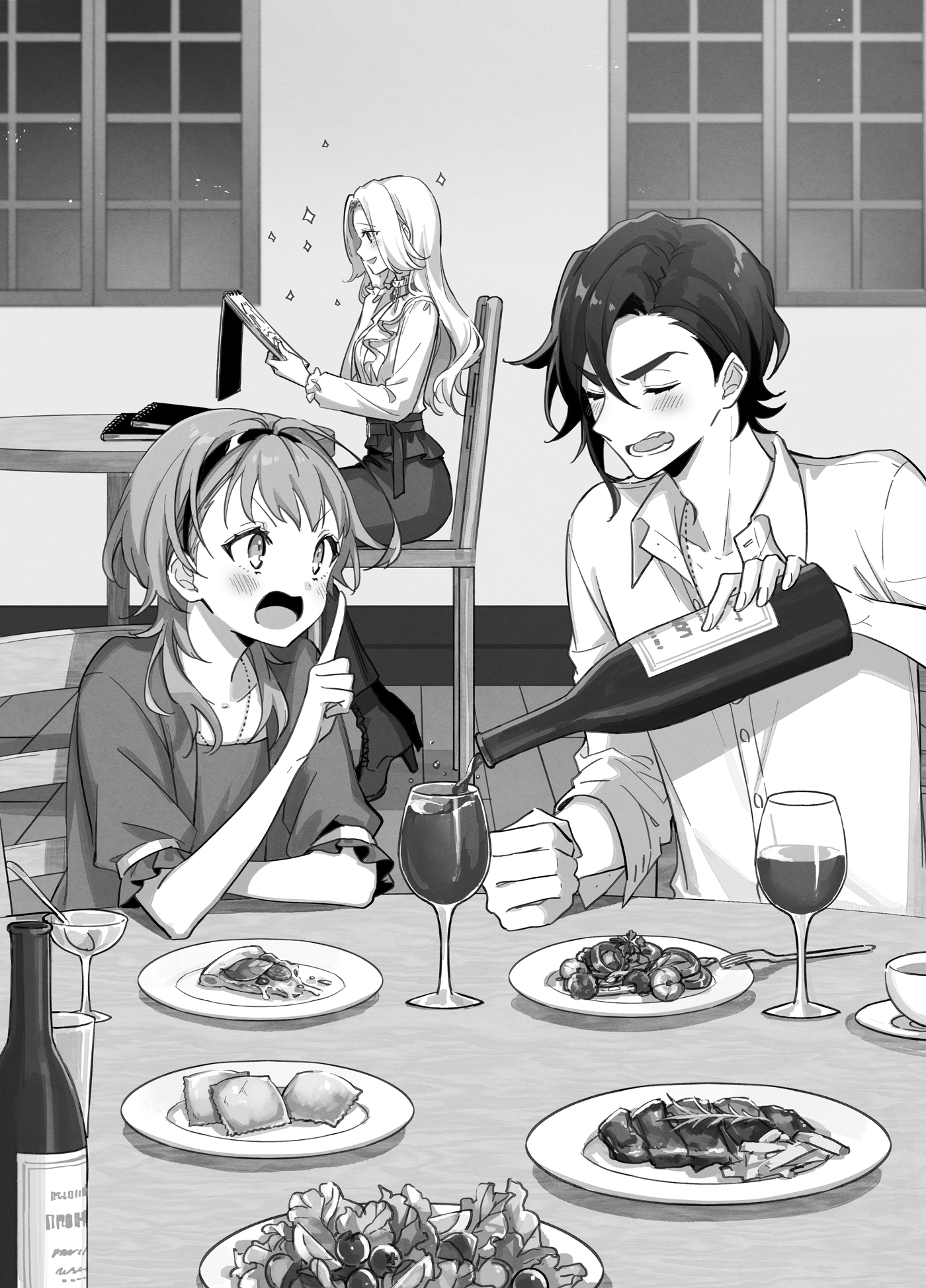
However, timidity and anxiety seemed to plague her as she looked at her reflection—was she maybe dissatisfied with something? They still had time to fix it if that was the case.
Lucia hurried and asked, “Lady Enrici, is there something that isn’t to your liking?”
“Hold on... How did I turn out like...”
“Is it the dress? Or perhaps something else?”
“Apologies. There is nothing wrong at all. It is simply that, well, the person in the mirror is so pretty, she didn’t seem like me. I suppose I, um, am not used to this, so it’s rather, you know...” Jasmine said, averting her gaze from her reflection. “E-Everyone has worked so hard for me, and I am truly grateful...”
She was stunning. Seeing her in the opal green outfit brought broad smiles to Lucia, the stitchers, and the cosmetologist. There was one outlier, however. “Did I not tell you so, Jasmine?! Your beauty during your debutante was no fluke—you are beautiful. You don’t have to keep avoiding dresses—”
“Forgive me. My anxieties about the size of my arms gripped me, and I couldn’t bear wearing a dress...” Those knight buddies of hers who had said that her arms were like logs, that she was more oak than jasmine—they truly deserved no quarter; those words had been such a heavy burden on her.
“I have drawn a hundred dresses that would suit you perfectly, you know? In any case, I’m glad that you have learned just how beautiful you are. You will have many special occasions and many dresses to look forward to now, be they for your wedding or any other kind of formal event,” Forto said with a big smile. He had already instated himself as her private couturier, and there was no refusing him anymore.
“It is simply because of the exquisite dress and makeup; I’m not...”
When Jasmine began fretting again, Lucia stepped in. “When someone calls you beautiful, it is a rule to never reject the compliment but rather smile and say thank you.”
“I have not heard of that rule,” Jasmine replied.
“It’s a personal one, from my grandmother. It’s a rule you follow to become even prettier, she said.”
“I shall keep that in mind...”
“That is wonderful advice,” Forto said, nodding.
Jasmine asked, “Do I really not need a corset, though? I’m concerned about my size...”
“The first two dances are with your fiancé, the next one with your father-in-law, and then you will be going around thanking everyone, correct?”
“That is the plan, yes.”
“Then I recommend you omit the corset this time. Tonight, dance with your fiancé to your heart’s content.”
“The lieutenant is not much of a dancer...”
“But you are, or at least were, right? If your fiancé suggests you dance with another man from outside the family, then you come to me immediately and I shall talk with him at length.” Forto’s smile was oddly threatening; perhaps it was a big no-no for a nobleman not to dance with his fiancée.
“You have my thanks, Lord Forto, but for now, please allow me to defer my gratuity to you.” It was a custom among nobles to give the clothier a bonus.
“Credit where credit is due—the dress is Lucia’s design, so please give it to her instead.”
“Thank you, Madam Fano. I promise I shall bring you the tip on another day.”
Lucia said, “That won’t be necessary; this was all part of my training, and I got paid for my services already!” There was a lot she’d had to learn for the first time, like what suited nobles and what suited dancing, and the final product differed quite a bit from her original sketches—she could not accept the tip.
“The gratuity is a matter of etiquette for nobles. It may not be very much, but I hope that you will not refuse me.”
“I appreciate the sentiment. Umm, how about this? I would like to make all sorts of clothes, so could you please instead recommend me as an option if you hear someone is looking to have something made?”
“Very well. Truth be told, I would have preferred to keep you a secret, but I shall tell everyone of you,” Jasmine said, finally in a smiling and joking mood, fortunately. “May I have the honor to address you as Madam Lucia? And you by my first name as well.”
“Of course, Lady Jasmine!” Forto may have been Jasmine’s personal couturier, but as long as he would allow it, Lucia would love to lend her hand to the knight again in the future.
“My deepest gratitude to you, Madam Lucia. It is thanks to you, Lord Forto, and everyone else that I found a semblance of self-confidence.” Baby steps—aim to start off small and get the ball rolling, and one day, she would be proud of herself.
“You truly are beautiful, Lady Jasmine—I’m sure your fiancé will fall head over heels for you once again!”
“Th-Thank you very much for the compliment.” She forced her words out before looking away again. “I wonder if others will mistake me for someone else tonight, or perhaps they will be disillusioned when they see me without my dress and with my makeup removed...”
Forto said, “Are you still going to wallow in self-pity, Jasmine? You are still—”
“Mr. Forto, I’m leaving the rest to you!” Smiling, Lucia dashed out of the room as she remembered she had somewhere to go.
“My apologies for having you escort me; I understand a guildmaster must be very busy.”
Forto, in full evening dress, replied in a deliberately loud voice, “Fret not—I had no other business to attend to. Besides, this is an honor.”
The setting sun outside of the windows drew long shadows. Ordinarily, Jasmine’s fiancé should have come to the Tailors’ Guild to pick her up. However, it seemed that something had happened at the castle—he had sent an urgent message that he would not make it in time, and he asked for Forto to take Jasmine to the estate in his stead. The cousins could but pray for his safety.
A few days ago, Forto had been irked by how little confidence Jasmine had in herself, and he had looked into her fiancé. The lieutenant of the royal guards was a very upright man—he did not drink, gamble, or set foot in the red-light district. His hobbies included working out, which he shared with Jasmine. He seemed a little taciturn and brusque, but the stereotypical knight was not famed for eloquence. Their marriage had been postponed due to his obsession with finding the perfect gemstones for her marriage bracelet and because he had still been preparing their new home, but Forto had no business telling her the truth. He had gladly accepted the task of providing escort to his darling cousin.
“Thank you for everything, Lord Forto...”
“You needn’t thank me—Lucia, the stitchers, and the cosmetologist did all the work. If the chance arises, I hope you will tell others about Lucia.” He couldn’t see Jasmine ever being able to accept gifts with a smile; that may simply have been difficult for a noblewoman.
“Lord Forto, there is something for which I want to thank you in particular.”
“What might that be?”
“The very first day I had trained with the sword, I decided that I would become a knight. You may not remember this, but we said that we would all become knights that day.”
On the contrary, Forto remembered every last detail. Right before Forto entered college for chivalric studies, his uncle had asked him to show his cousin sword training. That cousin’s very little sister—Jasmine—had joined as well, and when learning the fundamentals, she had shown aptitude for the martial art. Forto had praised the siblings, and when the brother voiced that he wanted to become a royal knight, his sister had said the same. Forto had revealed it was the same for him, and he and his young cousins had vowed to achieve their common goal.
“‘The three of us shall become chivalric protectors of Ordine’—it went a little something like that, right?” Forto asked. But he was unable to fulfill his promise—he had cast aside the sword and knocked on the door of the Tailors’ Guild. It was not a choice he regretted, but the fire of longing to be a knight still burned within him, and the flames of failure still singed him. It had been a while since he was conscious of it, however. “Forgive me for failing to keep my word. I regret my helplessness in this matter.”
“Nonsense, Lord Forto. You have become a proper viscount and guildmaster, and you have such talented people working under you—rather, that much is indeed true, but I cannot help seeing you as a knight as well.”
“A compliment on my fitness, perhaps?”
“Not that, but rather—how should I put it? Ah! The needle is your sword! Both yours and Madame Lucia’s!” Jasmine stared straight at him with her blue-gray eyes, perhaps not picking up on his joking tone. “Forgive me, that was an odd thing to say...”
From the day she had first gripped the sword, she had aimed to be a knight, enrolling in chivalric studies and finally becoming a royal guard—Jasmine had stayed true to her path. Hearing someone like her to say that to him, Forto felt very proud. But the hard truth was that he could be a knight no more.
“We are clothiers—the needle and scissors are our weapons,” he said with a beaming smile.
Jasmine nodded solemnly.
Forto continued, “For you—courtesy of Lucia.” From a large pastel pink carton, he brandished an adorable bouquet of faintly cream-colored flowers—flowers that shared the name of the recipient. The scent perfumed the cabin.
After Jasmine had been made ready, Lucia had hurried to a nearby florist, then passed the box to Forto before he boarded the coach. “Lady Jasmine’s fiancé has never told her that she is pretty before—how thoughtless! Compliments give others confidence in themselves, so, Mr. Forto, make sure you compliment her on your way there!” she had said. Her menacing look had intimidated even him, but he couldn’t have agreed more.
“What a delightful scent!” Jasmine smiled so innocently, just as she had when he first held the sword. She was so beautiful.
The coach began to slow down—it seemed they had reached their destination. As he alighted first so that he could offer his gloved hand to the lady, Forto had to stifle his laughter at the sight of her sniffing the bouquet. “Congratulations on your engagement, Jasmine. Tonight, there is not a single person as beautiful as you.”
The noblewoman hesitated for a moment, but then she accepted the compliment with a smile most endearing. “Thank you very much.”
Jasmine, still entranced, reclined on the sofa in the parlor. Her fiancé had finally returned from the castle and was currently changing into his evening attire. Her mother-in-law and brother-in-law had already come by to see her, and so Jasmine had some time to rest. Today was the day of her engagement announcement, after all—she couldn’t be wandering around the halls without her betrothed. The in-laws were here to handle reception and Jasmine would be on her feet all night, so they had said she ought to take whatever rest she could get now. She was still nervous being in a dress, and so she had gladly accepted the offer.
“Apologies for my tardiness!”
“I am glad you have returned safely, sir.”
“Oh. Uh, thank you.” Jasmine’s superior—rather, her fiancé had returned in the nick of time, but when he saw her, he froze up. He then hurried to fix his bow tie, although it was not one bit out of place; the wing collar on his shirt must’ve been a little tight.
“Was there an issue at the castle?” She was curious as to why he had been summoned; he’d had the past two days off to prepare for this special day.
“The baphomet belonging to Section III, Bureau of Magical Toolmaking escaped, and so our squad was called to capture it.”
“Them again?” Unlike the first and the second, which crafted necessities for the castle, the third section was nominally a research unit—nominally, as it was said that those who failed to become mages or civil servants were “contained” there. As one might have imagined, problems were frequent and plentiful. When Jasmine had just started working at the castle, the third section had caused a small fire with a supposedly maladjusted tool. They had since caused other problems, such as a minor explosion arising from experiments on magic crystals, a leak, craters in the ground, and the escape of a baphomet that they were keeping for whatever mysterious reason—nothing good had ever come out of the third section. They were a group to give a wide berth—so most in the castle likely believed.
“Must be something in their diet, but they’re now able to fly three times higher...”
“That is incredible...”
Though they looked like regular sheep, baphomets were monsters with potent magic. They could not attack, but they had great physical strength and the ability to jump like few others. Furthermore, a close look would reveal a glare in their eyes and a nasty temperament to match, and they even bullied the weak with their kicks. The last time the third section’s baphomet had escaped, Jasmine was the one who’d had to chase after it, but baphomets could jump high and far, making her work very laborious. Hearing that it was now three times as capable made her head ache.
Jasmine continued, “Did you capture it with a net like on the previous occasion?”
“No, this time it ran into the Beast Hunters’ training grounds—one of them caught the beast without so much as a tool.”
“Barehanded?!” That was impressive, even for a knight who fought monsters on the regular; whoever it was must’ve been very strong and agile.
“While the baphomet was in the Scarlet Armor’s hands, it trembled and teared up like the gentlest little lamb you’d ever see.”
“That baphomet?”
“Aye, the very same.”
Pull the other leg! His answer boggled her mind, but that must have been one impressive knight. A Scarlet Armor—one of the Beast Hunters’ front line—must have had enough combat experience and prowess to terrify the baphomet.
“‘What a shiny coat of wool. It must’ve been very well cared for,’ he said, and it even baaed back like a sweet lamb. After we returned it to the custody of Section III, we tied three steel cables to it to prevent it from running off again, but it remained well tempered for some reason...”
Jasmine sympathized with her superior officer, who sounded frustrated that he’d lost in this situation—the baphomet had somehow been able to tell the difference in might between the royal guards and the Beast Hunters. “I suppose this calls for more training.”
“You’re right; I ought to start working on myself again tomorrow,” he said, clenching his fist as she did likewise. Suddenly, the lieutenant sniffed the air. “What a delightful scent.”
“Look at these! I received such an adorable bouquet!”
When she produced the jasmines from Lucia, he took a step closer but then furrowed his brows—perhaps its fragrance was too strong. He asked, “Are these from Viscount Luini?”
“No, they are from Madam Lucia Fano, head manager of the Magical Garment Factory. She was the couturier who designed this lovely dress for me,” Jasmine said, inadvertently boasting.
“The dress—it, um, looks good on you.”
“Thank you.” Today was the day they would announce their engagement, but that was no flattery on his part, and the simple fact that he had complimented her dress made Jasmine so very happy.
“It’s time; shall we?”
He offered his hand so naturally, but Jasmine took a moment to realize that he wanted to escort her. She stiffened her back and laid her hand on his. Then, the couple departed the room.
Everyone came to congratulate Jasmine, and she greeted them in turn. Everyone complimented her on her looks, but such was a novelty, and she still felt uneasy. Still, when they had commented how lovely her outfit was and what a nice dress she had on, she returned a smile. Forto, Lucia, and the rest of the Tailors’ Guild had worked so hard to make such a beautiful dress for her, it must have suited her fine—so she was convincing herself as she made her way to her superior officer.
The venue was a viscount’s estate, so there could only be so many guests, yet Jasmine couldn’t shake her nervousness, as she was unaccustomed to such glamorous occasions. But as she and he were both royal guards, the vice-commander of the Third Knights’ Regiment and the vice-captain of the Order of the Beast Hunters had graced the couple with their attendance. Jasmine couldn’t help but get a little excited when she thanked the two vices for coming.
It had been explained that because of the small size of the viscount’s estate, the dancers were to take turns, but the reception hall was plenty big for Jasmine. A sparkly magical chandelier hung from the ceiling, and the red carpeting around the dance floor slowed the tread of all who walked upon it. It was a party in their honor, so the newly official couple had to take the first dance alone. To be frank, Jasmine’s stomach churned. But there was little else she could do but pretend like everything was all right as she and her fiancé walked to the center of the dance floor.
“Hnk!” The moment they had taken their positions, an odd noise came from her superior officer.
“Is something the matter, sir?”
He hesitated before stammering out, “No, nothing at all. Let’s go around and thank everyone after the second dance.”
“But the plan was for me to have the third dance with your father—”
“Well, I sure hope he can find someone else, then,” he said, almost pleadingly.
Jasmine was stunned. Was she so terrible a dancer? She had put in quite a lot of practice in preparation for this event, and her instructor had even given her the seal of approval, but perhaps she was devoid of grace and elegance after all. “Forgive me, milord—I did not intend to cause you such trouble with my poor carriage...”
“No, that’s not it...” he whispered as he looked away from her. The prelude had already begun, but they were still conversing in hushed tones. “You’re not wearing a corset today...”
“Yes, they said I could forgo it.”
“But you are dancing with others today...”
“I apologize if my waistline is unflattering...”
“No, that’s not it...” He gritted his teeth like he had a splitting ache in his head. “There’s nothing but a single layer of cloth between you and the world...”
“Ah, you needn’t worry, milord, as this opal green fabric is very durable—it will not tear under some light dancing—”
“No, that’s not it!” he repeated, failing for a third time to get his point across. He seemed like a different person today; he was ordinarily so cogent in his explanations during duty. Officer Offish—that was the nickname the others called her betrothed—blushed a bright red as he said, “What if someone else wanted to dance with you?”
“That will not happen. The only other person the schedule has me dancing with is your father,” she explained. “Sir, have you been drinking?”
“Not a single drop; I only had grape juice earlier.”
He had said he did not want to drink, not even for the toast. He was not a drinker; one sip had him flushed—that much she knew. One time, her father had come and offered him a drink, and by the time it was empty, her fiancé was sprawling on the sofa.
He continued, “I forgot—being so roundabout with you won’t work.”
“I beg your pardon. I have no understanding of how to be a noblewoman, only a knight.”
“You don’t need my pardon. You are perfect the way you are, so just be by my side.”
That was no grape juice in his glass—he must be drunk! But once the music started, it must go on, and she danced her steps.
He leaned in and whispered, “And no more ‘sirs’ or thinking of me as your superior officer outside of work, Jasmine.”
It certainly was a queer way to address one’s fiancé, and she kept that in mind for the future. “Very well, Lord Rodi.”
“No ‘Lord’ either.”
Now that was a challenge; so suddenly calling him by his first name was enough of a hurdle. She opened her mouth in silence, only to lock eyes with him so closely and intimately; his deep blue eyes had only her in them.
“Jasmine, you are truly gorgeous tonight.”
“Ngk!”
Normally, he wouldn’t—or rather, he had never said anything like this to her. The couple continued dancing. She turned as he placed his warm hand on her back to support her. It had never been this warm before; perhaps it was because she wasn’t wearing a corset. It was equal parts calming and disquieting. Her cheeks were hot, her face was hot, and—most of all—her chest was hot. Bright red was her fiancé as well, seemingly drunk.
“Jasmine, please don’t dance with anyone else but me tonight—I do not wish for anyone else to lay their hands on you.”
After the ball, the very intimate couple was suddenly on everyone’s lips. They had shared five dances and did not stop until a family member approached to ask them to take a break. The royal guard lieutenant and his subordinate had been so busy with their work that their wedding had been delayed, but word was that the future groom had said that he strongly desired to marry his betrothed as soon as possible. People came up to congratulate the couple, and at the end of the discussion between both sides of the family, it was decided that the couple would be wedded in four months’ time—the minimum length of an engagement for nobles.
Furthermore, the following week, the stitchers Lucia had befriended came crying to her. They’d originally had a whole year to prepare Jasmine’s wedding dress, but that had been cut down by two-thirds. Forto’s design of an off-the-shoulder dress featured a long fluffy train and plentiful fine floral embroidery. The shortened schedule meant the Tailors’ would need more stitchers, and Forto and Lucia would secretly be doing some sewing as well.
Dinner with the Magical Garment Factory
Dinner with the Magical Garment Factory
Two weeks had passed since the Magical Garment Factory began working at full tilt. They had managed to install systems to mass-produce both the toe socks and the drying insoles, and so the team responsible as well as the one in charge of the thread for the socks planned to go out for dinner tonight. The venue was a three-story restaurant—a place known for its meat and seafood, and they served alcohol to boot—in the Central District, close to the boundary with the South District. The Tailors’ Guild had reserved the entirety of the third floor, and the meal would be expensed by the guild as well. Once the day’s quota had been fulfilled, everybody took off for the dinner.
As Lucia had a healthy appetite, she decided to wear a straight-hanging shift dress and a jacket on the longer side, both bright blue. The hem of the dress and both sleeves of the jacket had white sateen ribbons tied around them. They were her designs and had been sewn together not by guildmembers but stitchers at a workshop, and both pieces had turned out wonderful. Lucia put them on only after swearing to herself that she would not spill a single drop of wine, and after packing some stain remover just in case.
“To the prosperity of the Magical Garment Factory! Cheers!”
“Cheers!”
In spite of it being a Tailors’ Guild dinner, it was fortunately nowhere near formal but simply a social event. Unfortunately, though, Forto and Zilo still had some work to finish up, but they had said that they’d make it if they could.
After the toast, the meal began. People were chatting with their neighbors, and Lucia listened closely as she tucked into her meal. First on her plate was a mix of seafood and vegetables panfried in butter. It was incredible how delicately cooked it was—the vegetables were tender crisp, while the kraken and prawns were toothsome and springy. Everything may have been cooked separately or prepped in a special manner, but one way or another, it seemed impossible to replicate at home.
As for the conversation, people at the table were chatting about couture, but the topic soon moved on to trendy clothing and knickknack stores. Someone mentioned a particular store that sold raincoats with floral prints such as lily of the valley and miniature roses—the ones that Lucia had sewn from Dahlia’s waterproof cloth.
“The one with the little roses was so cute! A bit pricey, but I’m thinking it could bring me some sunshine on a rainy day.”
“Ooh, I wonder if they’ll have some for us guys too; maybe one with stripes? I’ll be able to tell which one’s mine at a glance.”
It brought a smile to Lucia’s face; plus, it was good feedback. She was a little too preoccupied with other matters at the moment, but it’d be nice to make a slew of raincoats with different patterns one day.
“Head Manager Fano, would you care for some fritto misto?” asked a stitcher. “I just had zucchini with cheese and some olives stuffed with meat.”
“That sounds lovely; I’d love some, thank you.”
Fritto misto—in other words, a deep-fried assortment of food, but this particular restaurant made it interesting by cutting up the ingredients into a variety of shapes, which, once cooked, were nigh indistinguishable, with the batter acting as a veil. Lucia’s first bite turned out to be the minced zucchini and cheese mixture, which was perfect for the season. Next, she had tomato with something like kraken or octopus, and the combination was a delight in textures and flavors. The beef-stuffed olives were delicious as well.
There was also pizza with salami, cheese, and a whole nursery of fresh basil on top; potato gnocchi with cheese; fried chicken smothered with herbs; pounded and pressed beef grilled with plenty of spices sprinkled atop; and a salad and fruit platter. Looking at them all, Lucia reckoned she could raven most of these dishes. But she had self-control, so she decided to start with a little plate of her favorites, then order more of whatever she liked best. Lucia freely helped herself to the pizza and then some of the hard-to-get bright red oranges.
Once everyone finished their first helping, they began moving around and mingling with others in the room. Some were on to their next drink, some were making merry, and some were relishing their dessert. Lucia tried some of the lemon sherbet that Hestia had recommended; nothing was quite as good as a cold treat after a big meal.
Then, as if out of nowhere, Dante appeared right beside her. “More wine for you, Head Manager Fano?” Perhaps he’d had quite a bit of drink already; he looked very relaxed, having taken off his jacket and done away with his tie.
“May I have some sparkling water instead?” Lucia had had a bit of red wine for the toast, but she wasn’t a very strong drinker, so she played it safe for her second round.
Dante did as asked, passing her a fresh glass of bubbly water. “Wishing you good health, Head Manager.”
“And here’s to yours, Assistant Manager Cassini. Cheers.” She had been calling Zilo by his first name since the day they met, and she used “Ms.” with Hestia and “Ms.” or “Mr.” with nearly all of the stitchers. However, to this day, Lucia called this Dante Cassini—the second son of a viscountcy and a top prospect for an executive position in the Tailors’, so Forto had told her—by his full title of “Assistant Manager Cassini.” Her contract was for a half year, and once that was over, she figured he would take over as the Magical Garment Factory’s head manager.
“Ms. Jasmine looked wonderful in that opal green dress. Everyone was raving about how classy and stunning it was too.”
“Oh, how wonderful to hear! Did you attend Lady Jasmine’s ball as well?”
“Yes, I did. Our families belong to the same faction,” Dante explained. “One of our mutual friends could not believe how beautiful she was. He said he felt as though he’d missed out, especially since he and Ms. Jasmine were college classmates.”
Dante’s friend reminded Lucia of the boor who had said Jasmine was like an oak, though he probably wasn’t the same person. Regardless, Lucia would have loved to boast of Jasmine. “Do you often go to soirees?”
“Not at all, or at least not by choice—a yet-to-be-betrothed person often gets dragged to those kinds of events by their parents.”
“That can’t be easy, I imagine...” The population of nobles was small to begin with, and even fewer were of marriageable age; to be a noble looking for another noble must be quite tough. It seemed to be a universal truth that parents and relatives, regardless of status, urged the younger generation to get married soon—though, that being said, Lucia’s family had never done so with either Max or herself.
“How about you, Head Manager Fano? Do you have any plans for engagement or marriage soon?”
“No, none.”
“Why not take a look within the guild? I am far from the only bachelor.”
“I’m focusing on my career at the moment,” Lucia said, simply to be polite, as she finished the last bite of her lemon sherbet—cold, tart, and joyous; the portion was a little larger than she would’ve liked, however. She grabbed her bag, excused herself, and left for the washroom.
Fortunately, the water closet hadn’t been occupied, and on the way back, Lucia heard her name. The stitchers were obviously trying to speak in hushed tones, but their voices reflected perfectly into the hallway.
“The head manager’s getup sure is cute today. I’m so jealous.”
“Yeah, it’s great, but the design is kinda unique. Judging by the shape of the shoulders, it’s probably made to order. Do you think it might be Mr. Fortunato’s work?”
“Oh, totally. Mr. Fortunato is definitely backing her.”
“I heard that she’s the illegitimate daughter of the guildmaster’s father.”
“No way! Does that make her Mr. Fortunato’s sister?”
Mere sensational gossip. Lucia could burn some time out here before going in and feigning that she hadn’t heard a single thing, but no—that would be admitting defeat. It wasn’t as though she didn’t understand how the stitchers felt. A young woman like her suddenly starting out near the top was bound to catch some attention. But as long as she was still in this role, and even if it was just on paper, she was their superior.
Lucia entered the room and stomped up to them, loudly announcing, “Thank you for the kind compliments on my outfit!” A male stitcher spat out his red wine, making quite a mess; Lucia thought she had better lend him her stain remover later.
“Um, Head Manager Fano, you...”
“No, we were just, erm...”
She had prepared for the worst, but these stitchers, who were slightly older than her, were kind of endearing in how they were floundering, and she hadn’t been prepared for that. “Oh, yes, I heard everything in the hallway.”
“Sorry! I was just curious about the rumors I’d heard, but I figured I shouldn’t ask you either...”
“Forgive me, I thought you were related to Mr. Fortunato, so I didn’t know how I should treat you...”
They clearly apologized and laid out their reasons—better than if they had tried to gloss over the issue or snapped at her in return.
“If you can make heads and tails of it—and even fins and a pair of wings—then that isn’t a rumor, that’s some sort of flying fish!” said Lucia. The thread manager started coughing and choking. “My clothes are my own design, not Mr. Forto’s. Neither is he my brother; we are not related at all.”
The tension in the room was so thick, you could cut it with a knife. Even people at the tables were dead silent as they perked up their ears. Nobody looked shocked, so the rumors must’ve spread quite far already. Although work life and private life were two separate matters, a single misstep would jeopardize both the Forto family and the Fano Workshop, and any negative attention it brought to her work would be a huge problem. Besides, leaving things in the air would make the workplace so awkward—Lucia walked to Dante’s table, grabbed a new glass, then filled it half full of wine.
“Head Manager...Fano?” he said, punctuating his words with a moment of silence.
Before he could finish, though, she slammed the wine back. Frankly, it was the opposite of good—a dry red had never been Lucia’s favorite, and it burned as it went down. However, it did make for a good social lubricant. “There’s no way we can work together with these feelings all bottled up inside, so if the veterans of the guild will permit it, why don’t we be honest with each other?”
A clap came from Dante’s hands, piercing the silence of the room. “Exciting! Head Manager Fano, how about we lay everything bare and no one gets punished for anything they say tonight?”
“Sounds good!” she responded, genuinely eager to do this.
“All right, lemme go first, then. They say you’re Mr. Forto’s mistress and that’s why you’re the head manager—any truth to that?” Dante deliberately kept his tone more casual to instigate the crowd, and Lucia followed suit.
“Nuts to that. The toe socks were invented by my friend and I was the first one who made them—that’s why I was suddenly appointed as the interim head manager. Besides, Mr. Forto and I aren’t nearly on the same level—we’re as different as a kraken and an itty-bitty squid!” At that analogy, a nearby stitcher had a hard time stifling laughter and soon failed. Others in the vicinity couldn’t help but chuckle as well. “Next!”
“Erm, how about you being Mr. Fortunato’s father’s daughter, Head Manager? Are you Mr. Fortunato’s sister?”
“Relay this message to whoever you heard it from: you should visit a physician or a priest, because your eyes need checking out.”
“Whoever doesn’t believe her ought to head over to the Fano Workshop! The chief there and our head manager are cut from the same cloth!” said the thread manager supportively. He frequented her family’s workshop, and he was well acquainted with her father—with her whole family. As an aside, Lucia took after her father too. Some said she and her brother also resembled her grandfather and mother. Perhaps the Fanos all looked like each other, but that idea didn’t really sit well with Lucia.
A stitcher said, “I was wondering if that necklace of yours wasn’t a present from Mr. Fortunato.” What an eagle-eyed individual.
Lucia pulled on the gold chain around her neck, freeing the pendant from under her clothes. “This is a guild-supplied magical tool. Supposedly, every manager gets one for protection against poison and confusion and whatnot. Since I handle monster materials, Mr. Forto said I ought to have it.”
“Isn’t that, like, just an excuse to give it to you?” asked another stitcher.
“Wouldn’t one of the loaner bracelets be fine anyway?” asked yet another one. It was the first time Lucia had heard that there were bracelets available to borrow.
“Eyes over here! I have one of those too.” Dante reeled up the silver chain from underneath his shirt, fishing out a vivid emerald-green boulder. “Managers who do business with nobles need these. In the past, a greenhorn from the guild got drugged when he went out. Some dunderhead did it to get information on a specific high-ranking noblewoman’s dress for the next season.”
This was news to Lucia as well. Had it been another noblewoman’s plan to come out with a better, prettier design? “Oh, gosh. Was that person okay?”
Hestia’s eyes opened wide too. “Hold on, I haven’t heard this story either!”
“It was before your time. The greenhorn couldn’t help blabbering, so afterward, he went to the noblewoman to apologize and to say that he’d come up with a whole new dress for her. Not only did she pay for the costs incurred, she gifted the Tailors’ forty of these really expensive triply enchanted necklaces.”
“Was that just a drop in the bucket for her?!”
Lucia had no reference for how much a necklace with three enchantments would ordinarily cost; she decided to ask her magical toolmaking friend next time.
Dante continued, “So, the next season came and another noblewoman was seen wearing a dress that looked awfully similar to the original dress. Her last name is no longer listed on the register of noble families.”
“What incredible influence!” Lucia exclaimed. Causing a whole family to disappear over a single dress—talk about merciless.
“How terrifying!”
“That didn’t actually happen, did it, Assistant Manager Cassini?!” asked Lucia.
Dante smirked as he looked around the room. “This is one of our guild’s toppest secrets. If this gets out to anyone, you’ll all be treated as guilty!”
“Mr. Cassini! What did you do this to us for?!”
“Eep! Our assistant manager’s some sort of monster!” said Lucia, as the whole room burst into laughter. Everybody got a little rowdier after that.
“My, how frightening. I suppose I have finally learned the truth about my workplace,” said the blonde, bringing a glass to her mouth as she sat down beside Lucia.
“Had you not heard of this story yet either, Ms. Hestia?”
“Not at all. Oh, and call me by just my first name, chief.”
“It might take me a little while to get used to it, um, Hestia.”
The fair lady put on a sweet smile; it was quite the powerful weapon even at this distance. “To be honest, I had the wrong idea about you and Mr. Fortunato too. Sorry, chief.”
“We’re just an ordinary superior and subordinate, a veteran couturier and a novice clothier. He has taught me a lot about noble attire, so I suppose that would make him a teacher of sorts as well,” Lucia said, pausing to wet her lips from the glass of sweet fruit wine she had received. Sure, she and Forto might have stayed at the guildhall late to look for a missing needle or to sew a dress, but there had always been others with them, so that couldn’t have caused any problems. “Still, I can’t think of what could have caused the misunderstanding.”
Hestia seemed a little embarrassed; her slightly bluish-purple eyes wandered before at last looking down at the table. “He and I have worked together for four years now, but Mr. Fortunato still calls me ‘Miss Hestia,’ yet he calls you by just your first name already. That’s why I thought you two were intimate in that sense.”
“Oh, about that—” Lucia proceeded to explain her prior experience at another workshop and the way “young misses” had been relegated to menial tasks, hence her request that Forto not address her that way. Next thing she noticed, all the other women nearby were listening in.
“Is that how it is?”
“Why not try speaking to Mr. Forto about it, Hestia? I’m almost certain he would be happy to call you by your name.”
“I’ll keep that in mind, thanks.”
“Sorry for butting in! I would much prefer that he continue to call me ‘Miss,’ since no one else does so!” said a stitcher. That made sense; it was a very personal choice, after all. Others began discussing the same topic.
Hestia asked Lucia, “You said that you designed your clothes; did you do it all by yourself?”
“Yep, just me and my pencil. Here, take a look!” Lucia took a sketchbook out of her bag and flipped to the dress she was currently wearing, though it was a little embarrassing how black the page looked—all of the space around the illustrations was filled in with notes and calculations.
“This is incredible. I’m sorry for having made so many assumptions about you, chief. Won’t you let me treat you to lunch for a week by way of apology?” Hestia had done nothing wrong—her attitude had not changed one bit during work. However, this might be a good opportunity.
“There’s nothing you need to apologize for, but I do have a favor I want to ask of you.”
“If it’s anything I can do, please do tell.”
“Model clothes for me!”
“Come again?”
“I want to make cool clothes and cute clothes for women with a mature sort of beauty like yours! But the thing is, I don’t have anyone close to me to be my model, and they wouldn’t look right on me either...” Not everything she wanted to make would necessarily look good on her, and Hestia was tall and had long limbs and the right feel.
“I’ll model as many outfits as you want, chief, but I’m not sure if what you wear would suit me...”
“I’m thinking more like this—you’d definitely look great in this style, Hestia!” Lucia flipped through her sketchbook again, then pointed to a drawing near the end—a black dress that was formfitting down to the knees, where it flared out like a flower soon to bloom. The neckline was low and wide, but a short coat would easily provide the wearer more modesty. The idea was for the silhouette to be grown up and to resemble a mermaid, but there were sprinklings of ribbons and lace all around. It was targeted at taller women who wanted to look both seductive and cute.
“Whoa...” Her light purple eyes grew wide as she stared mesmerized at the design.
Lucia wondered—was Hestia appalled by it? Was she wondering where and when she would wear something like this? Or was she going to say it looked difficult to make?
Hestia softly sighed, then said, “What a wonderful dress. I would really, really love to wear this...” It was as though she was standing in front of a shopwindow, smitten by a dress on display, staring and yearning.
It warmed the clothier’s heart. I’ve got to make it, get her in it, and do whatever I can to get the fabric and lace! Lucia then remembered there was a design in another sketchbook for a casual, everyday dress that Hestia would look great in too. “Um, I have another book here that might have some pieces that would look good on you. Please let me know if you’d like to wear any of these.”
The young blonde’s eyes sparkled. “Thank you! I’d love to borrow these from you!”
What in the world...? Forto, having finally arrived, was bewildered at the sight. The team had worked well together up to this afternoon, but they had seemed like no more than colleagues. Right now, though, they were like relatives catching up at a wedding reception, pouring each other drinks and making banter. Sitting at the table by the wall was Hestia, entranced by Lucia’s sketchbooks—understandably so; it would almost have been a crime to speak to her now. Most baffling were the pair at the center table, who were just about pressing up against each other and boisterously laughing and chatting.
“There’s no point chasing what’s in; people should just wear what suits them and what they like!”
“You can say that again! I have pieces that are trendy, sure, but my philosophy is never to wear something just because it’s what others are wearing.” Dante was already speaking like a commoner.
Lucia was no more reserved. “Right?! Flared on flared is all the rage this year, but having both fitted and flared is great too, so long as it fits the wearer’s body shape and the occasion. And skirt length! A little adjustment here and there, and whoops—you’ve changed it by two fingerbreadths and now your legs look too thick!”
“Oh, I know! Two fingerbreadths and you’re looking like the least stylish man in town! I don’t know how some people just don’t care.” Dante refilled Lucia’s glass, the fruit wine nearly overflowing. “This one time, a nobleman came in with trousers that were different lengths to suit his summer shoes and winter shoes, and, despite me pleading with him not to, he insisted on making the pant lengths the same, simply saying he didn’t care. Boy, was that soul-crushing...”
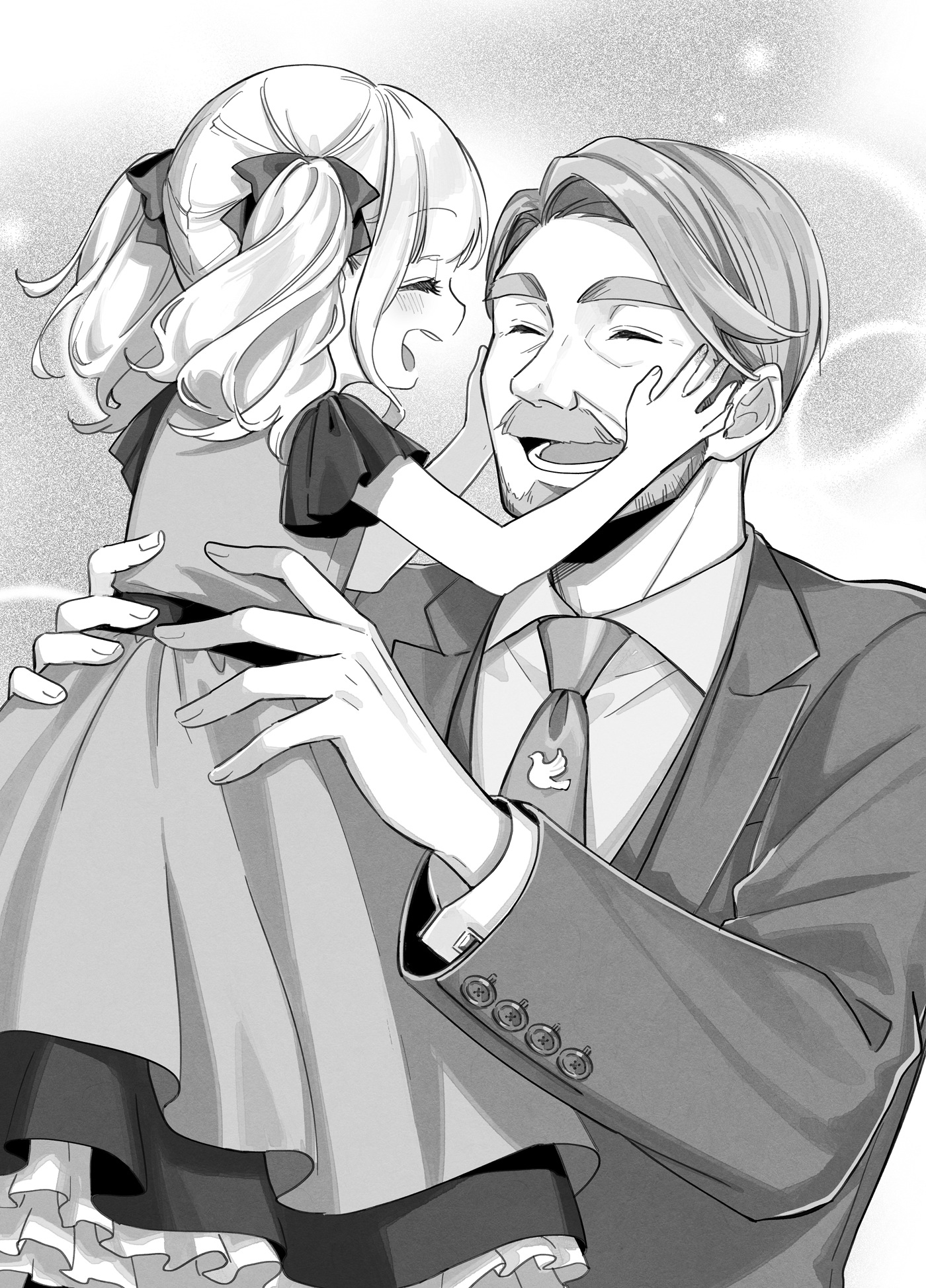
“Tell me he wasn’t a high-ranking nobleman. In any case, he should’ve known that the heels of different shoes are different...”
“I wanted to shout, ‘Just because you’re the same height doesn’t mean your heels are all the same height!’”
“For real!”
This time, Lucia poured for Dante, who had to slurp from the rim of his glass before he could pick it up. He said, “It wasn’t like I made the suggestion so he would pay me more for labor—I just wanted him to look halfway decent!”
“Some people, right?! There was a noblewoman whose color was vermilion, but despite loving it, she didn’t want to be too flashy, so she wore really light pink and tried to pair it with something blue.”
“What a shame! There is nothing cohesive about that at all!”
Kindred spirits—that was the only term for those two. Forto didn’t want to interrupt, but the conversation sounded rather interesting, and he slowly made his way to the table.
“Mr. Forto!”
“Mr. Fortooo!”
Both of them noticed him before he could greet them. Lucia shifted one seat over so that she and Dante flanked Forto. Without asking, she then put down a fresh glass, which Dante filled with red wine. It seemed that Forto wasn’t interrupting them after all.
“You two seem like you’re having a jolly time,” said Forto.
Lucia replied, “Oh, yes, we were just talking about pant and skirt lengths!”
“That is very much a couturier’s thing to care about.”
“And also clients with no sense of fashion!” added Dante.
“I sincerely beg that you two keep the contents of that conversation between you...” Forto was so glad he had booked off the whole floor today. It was rare to see Dante this inebriated too.
Lucia included her boss in the conversation. “You’re a couturier too, Mr. Forto—is there anything you just don’t understand or any outfits that bug you?”
He loosened his collar. Fortunately, no one here was tied—that was to say, no one here was relaying information to a noble family. Dante was from a viscountcy, but they had rapport and Forto trusted him enough, so this might be a good time to be candid. Forto said, “It bothers me that if the components of a man’s three-piece suit don’t match in both color and material, it is said to be unbecoming and improper.”
“Is that right? That would be too casual?”
“Yeah, I’ve been called a ‘mannerless punk’ in a more formal setting before, but of course, they didn’t have the nerve to say that to my face,” said Dante.
“A darker waistcoat helps to slim the body, and having one part of your outfit in a slightly different shade is quite stylish. Of course, it would not be suitable for a wedding or a funeral, but I can’t see why it would be disrespectful in any other situation.”
Once upon a time, when Forto had just entered the Tailors’ Guild, he had made an ass of himself by visiting a high-ranking noble’s estate while wearing a darker vest. The nobleman’s missus had taken Forto aside and pointed out the problem. Then she had even covered for him and told her husband that Forto had ‘gotten sick from the carriage ride and couldn’t change before coming.’ The incident had cemented in him the idea that noblemen ought to have more freedom in their dress.
“Hm? Mr. Forto, the silver-gray three-piece you usually wear features a waistcoat in a darker shade, does it not?” asked Lucia.
“Yeah, it’s literally one shade darker on the color chart, isn’t it?”
The two couturiers seemed to be really invested in this; bashful he was to be stared at, but nothing could have pleased him more as a professional in this trade. “Indeed. But it’s not a problem so long as nobody notices.”
“Our guildmaster is so clever!”
He had finally drained his glass, but it was once again filled with wine. It was quite timely too, as a platter of cheeses and salami and a basil pizza, one of Forto’s favorites, arrived almost immediately afterward—likely by arrangement of his attendant. Forto helped himself to the food, then continued, “In a different way, I have been curious about the state of men’s socks as of late.”
“In what way?”
“Is it because the toe socks aren’t very pretty?”
“No, the toe socks are functionally elegant.” Truth be told, he had been a little disgusted the first time he had seen the toe socks; they looked like a monster’s shedding, and he had felt that they were less than acceptable. However, when he put them on, he had learned that they were like gloves for feet. They were so comfortable to wear and walk around in, and they made the wearer so much more comfortable as well. Thereafter, Forto had come to see the toe socks like a pair of gloves—a necessity with elegance in its functionality. “Rather, the length of socks has been bothering me. As you know, short socks are popular this summer, but a man will show his skin when he crosses his legs. Do you find that unattractive as well?”
“I see you prefer over-the-calf, Mr. Forto,” Lucia said.
“It doesn’t bother me; I think shorter socks have their place in the summer, as they’re just a little bit cooler,” said Dante.
Unlike the former, the latter did not understand. But think about it—“A man sits down in his perfectly ironed trousers, his shoes gleam brilliantly, and then his leg hairs stick out—surely that’s absolutely out of line?”
“I-I see...”
“Oh...”
The visual aid must have helped both of them. Having established his idea, Forto elaborated, “The only thing worse than wearing short socks is not wearing any at all with a pair of dress shoes.”
A pair of leather shoes took hours to craft—many more than clothing. Not only that, it took time to break in as well. To knowingly damage the shoes and forgo socks was blasphemy.
He continued, “If you want to go barefoot, try sandals.”
“But there are people who wear leather shoes without socks, like my grandpa and my friend’s father. Once the drying insoles get popular enough, wearing dress shoes barefoot might just become a trend,” said Lucia, telling a horror story.
“Gods, I hope not...” Perhaps a toe sock and drying insole set ought to be marketed toward men.
As Forto took a bite of his second slice of pizza, Dante filled the other man’s glass. “Since we’ve got such good company here tonight, can we talk about colors for a moment?”
“By all means. How about what colors noblemen ought to avoid?”
“What colors are those?” Lucia looked as though she was filled with equal parts curiosity and skepticism.
“A gentleman’s shoes are black or brown—this is a topic noblemen mustn’t touch upon when political factions and hierarchy are at play.”
“Mr. Forto, are you sure you want to talk about that while I’m here?” Dante asked, his cold eyes lighting up.
“Sure, Dante. When else would I get the chance but today?” he said. “A gentleman’s shoes are black, but he has a choice from a deep black to a gray. Depending on what he wears, brown is a viable option as well, but it wouldn’t be suitable for anything formal, like a funeral, and therefore black is the gentleman’s color.”
“So, black is versatile...” Lucia muttered, hitting the nail on the head as she sipped her fruit wine. Formal situations called for black shoes, and in case of the unexpected, having around a pair of black shoes made of top-quality leather would protect its owner. Black was the color of the nobility.
“Leather shoes are made of leather, and leathers are originally the color of the hide they are tanned from. Dark brown shoes are sold at the same price as black shoes, there are many dyes to make leather brown, and they develop a fine patina with age.” The green-haired man heaved a heavy sigh as he looked at his shoes—well polished to a deep brown. “Besides, there are a lot more shades of brown than there are of black. It can be tinged with red, tinged with green, darker or lighter. There is so much freedom in brown—brown is the color for a nobleman’s shoes.”
“So, brown offers many options...” With both hands on her glass, Lucia took another sip of her fruit wine. Her eyes, evocative of the oceans, angled downward. Just as Forto thought she might have been swayed by Dante’s theory, she spoke. “Black and brown both encapsulate their own ideas and principles, and I doubt there will ever be one answer. I suppose that is also why people are proud of Ordine.”
Forto couldn’t exactly disagree, but she wasn’t very convincing.
Lucia then said, “How about this? Since you’re both couturiers, why don’t you two swap?”
“Swap?”
“Assistant Manager Cassini wears Mr. Forto’s choice of black shoes, while Mr. Forto wears Assistant Manager Cassini’s favorite brown shoes. Then, each of you tries to coordinate your own outfit with the clothes that you have. Every nobleman client has his own take on the issue, right? Wouldn’t it be great to be able to make a great outfit and to find more combinations that you enjoy?” She finally breathed again, then grinned. It certainly sounded like a fantastic exercise for a clothier to sharpen his senses. “Okay, I’m not going to lie—I just want to see Mr. Forto and Assistant Manager Cassini and your fashionable outfits!”
“And here I was thinking you had a great idea!” said Dante. Good thing she was too honest for her own good.
“Regardless, the idea sounds rather interesting, so why don’t we give it a try? If you would like to join me, Dante, I shall call a cordwainer.”
“Sounds good, Mr. Forto. Would you mind if I invite my go-to cordwainer to the guild as well?”
“Of course not.” Even Forto owned a pair of brown shoes. It was the obvious choice when visiting clients who liked the color. Pairing his own clothes with shoes that Dante chose—for someone who didn’t mix and match outfits, it seemed likely to be quite the learning experience. Not only did Lucia have a good sense for fashion, she was very clever and creative too. “Lucia, how about becoming an in-house couturier for nobles? I’m sure you would have clients lining up for your services.”
“Thank you, but no thank you—my dream is to own my own atelier someday.” Her expression may have been tired and drunken, but that innocent smile of hers couldn’t have been more genuine.
However, if Forto had a choice in the matter, he would rather she stay with the guild for a long time than start her own workshop; he did not want to lose such a brilliant couturier and manager. “Your own atelier, you say? Well, since you are the most familiar with the toe socks, I ask that you please become the Magical Garment Factory’s head manager.” Lucia stared blankly at him; perhaps she hadn’t heard him clearly. Or perhaps his request hadn’t been explicit enough—Forto wanted her not to be an interim but the official head manager. Before he could explain, though, someone else piped up.
“Head Manager Fano!” Dante—sitting to his left—slid his seat backward and leaned over behind Forto toward Lucia—sitting to his right. “Assistant Manager Cassini is far too long; please call me by just my first name.”
“Very well, Dante!” There truly was no couturier more suitable for the role than Lucia. It had taken her nary a moment to rally the team and to develop such great relationships with everyone. All three managers—Zilo, Hestia, and now Dante—had her calling them by their first names, and she did not hesitate to address them in like fashion.
“Glad to have you on the team, boss!”
“‘Boss’?! No, ‘chief’! Chief is good!” But Lucia would be shrieking in opposition soon. Days after this night, she would be pale in the face as she signed a contract that formally emplaced her as the official head manager of the Magical Garment Factory.
The Old Man and His Granddaughter
The Old Man and His Granddaughter
An old man agonized.
For over twenty years, he had been a heavy knight in the Kingdom of Ordine’s Second Knights’ Regiment. He had even taken part in the battle against the hydra. After his term of service concluded, he had succeeded his father and worked diligently in administering their viscounty northeast of the royal capital. He had been blessed with a lovely wife, children, and grandchildren, good health even in his advanced age, and—after his son succeeded as the head of the viscountcy—a comfortable retirement. There had been a few rough waves, but for him, this voyage called life could undoubtedly have been called smooth sailing.
Yet here, at this point in time, he was agonizing. In the parlor of his villa within the nobles’ quarter of the capital, he was terribly nervous.
“G-Good day...to you...gr-grand...father...” Before him, faltering in her greeting, was his granddaughter, Annalisa, age five. With delicate golden curls, porcelain skin, rosy cheeks, and crisp blue eyes, she was more adorable than any doll. His youngest daughter had brought her to see him today. Close examination revealed that Annalisa was, as she had been the previous time they met, a bunny trembling before a wolf.
He knew the reason full well: himself. His great, brawny physique had been a source of pride when he was a knight—it was said others would even mistake him for a bear. His countenance had been described as knightly and imposing—a fair match for even a bear, his good friend had always said. The years had brought upon the old man a head full of white and a face gouged with deep rhytids. On top of that, he had intimidating black eyes and an impressive thick beard befitting the head of a viscountcy. He wore a black three-piece suit and black shoes, a combination that would never betray its wearer on any occasion. Though he did not wear a sword on his waist, he carried a black and silver cane. In other words, to his granddaughter, he looked like a very, very scary person.
Last time, she had clung to her mother and dared not approach him. But surely enough, she stood before him today. Perhaps if he spoke with utmost gentleness, she would understand that he was not one to fear.
The old man mustered the biggest smile he had. “Annalisa, are you in good health?”
There was no response. She bit her lip. A tear here, a tear there, then great globs came flowing out.
“So, there you have it. Would you happen to have any clothes that won’t make my granddaughter cry, Forto?”
“Master, is this what you meant when you said you had something private to discuss?”
“No, I, uh—well, yes. It was an excuse; I simply wanted to witness you thriving.”
Lucia had been summoned to the guildmaster’s office to deliver her daily report and to confirm the production estimates, but here she was listening in on a curious conversation. Yes, she had received permission to enter the room despite the presence of a guest, but she couldn’t help but feel like she was intruding as she approached her superior. “Pardon me, I’m here to deliver the report.”
“Thank you, Lucia,” said Forto. “Master, this is Head Manager Fano of the Magical Garment Factory. Lucia, this is Lord Arturo, the former head of the Viscountcy of Testino and a friend of my father’s.”
“My, what an enchanting young lady. The name is Arturo Testino. How fortunate I am to have the chance to meet you today, Miss Fano.” He did indeed appear to be a nobleman—he must compliment a woman upon meeting her; such was the rule in polite society, one that had shocked Lucia the first time she learned about it from her team members. Then again, compliments made people happy—and that in turn likely facilitated good relationships—so it made sense.
She felt like she had finally become used to the lip service, and she smiled. “Thank you very much. My name is Lucia Fano, and I am delighted to make your acquaintance.”
On the other side of Forto was a man approaching his golden years with just a trace of color left in his hair. It took only a glance at his muscular physique to glean that he had definitely been a knight. He wore a navy three-piece suit, a white silk shirt with a tall collar, a navy necktie, and cuff links made of deep blue gemstones. It was a classy outfit, if imposing; just being in the same room with him was nerve racking.
Forto had addressed the man as his master earlier, though he didn’t look like a couturier. As if he had read her mind, Forto said, “When I was a child, Lord Arturo taught me swordsmanship, hence me calling him ‘master’ in private.”
Arturo added, “His father is a spearman, you see, so he had me teach his young boy how to wield a sword. I must say it is somewhat embarrassing to be called master after all these years, but he has grown up to be a fine man.”
“Unfortunately, I have failed to become a knight, and although I succeeded to the viscountcy, that was simply how things played out.” He softly laughed at himself.
“Nonsense, Forto!” the old man bellowed. “You have revived your family and you are the natural choice to head it. In fact, I would approve of no one else to be the head of the Viscountcy of Luini.”
Lucia had heard rumors about this as well. The Luini Viscountcy had once been on the brink of financial ruin. But Forto had joined the Tailors’ Guild and endeavored in his work not only to restore his family but to become the holder of the title. She had thought it was just a bunch of tall tales, but after joining the guild herself, she no longer doubted it at all—if there was anyone whose fashion sense and skills as a couturier could have saved their family, it was Forto.
“Master, I—” For a split second, the distressed Forto looked as though he were a young boy again. He laughed at himself again.
“You can always become a knight after you retire from your position as guildmaster, and I shall once again train you to fight with a sword. Well, you will only be old enough to retire in, what, twenty years? And I shall already have departed for the next world by then, but you can turn to my sons; any of them would be overjoyed to instruct you, Forto. Anyway, an old man like me ought not to be so didactic.” Arturo cleared his throat, then turned his black eyes toward Lucia. “I have just spoken to Forto about this too, but my granddaughter cowers in fear because of my appearance; she is always on the verge of tears—or rather, she does indeed bawl at the very sight of me.”
It wasn’t as though she couldn’t see where he was coming from. “Is she perhaps at the age where she shies away from those unfamiliar?”
“She presses her cheeks against my wife when she holds her; she smiles at the stewards, butlers, maids, and tutors; she even giggles at the sight of the menacing guard dogs.” The huge man shrank, but any grandfather would if he were less favored than a guard dog. “I know she tries her best not to cry, and the family does whatever they can to help, so I do not stay in the same room for long. But still, seeing my own granddaughter hold back tears at the sight of me is far too painful...”
“Perhaps you could keep your distance and see her when she is older?”
“You are the devil, Forto!”
“Mr. Forto, that’s not...”
Arturo and Lucia responded at the same time, then looked at each other. Any grandparent would want to be with their grandchild while they were still young. Lucia had tremendous fun just seeing her relatives’ babies and toddlers. Forto didn’t seem to be very sentimental about that sort of thing; his daughter was still young, so maybe he would understand in another twenty years.
“Well, perhaps he makes a good point. I was mistaken in thinking new clothes could possibly remedy my problem. I only travel from the territories to the capital once a half year, and I only get to see my youngest daughter’s child a handful of times each visit—it would be too much to hope that I could force her not to be terrified of an unfamiliar dotard like myself.” Apparently grandpa lived far away, so it wasn’t as though the granddaughter could get used to his looks. All of Lucia’s family and even most of her relatives lived in the capital; she could imagine the distance being difficult. Arturo continued, “Besides, the one wearing the clothes would still be me, after all; it would be a miracle if the Great Black Bear could be dressed up to be charming.”
Lucia had to admit that Arturo did look rather frightening at first glance and that she did think of him as rather ursine; he may have been up there in age, but he did not look as though his muscles were withering anytime soon—he must still be regularly working out. “May I ask what kind of clothes you usually wear, sir?”
“What I am wearing now, either navy or black. All the same style, and the same as always.” It was the quintessential three-piece suit—richly dyed, made of quality materials, and fitted right—the kind of outfit in which you’d never be underdressed. At the same time, the very proper outfit had virtually no character. If that was what he had always worn, it would be hard to ask him to dress down in brighter colors and softer lines. Arturo sighed as he looked off into the distance. “It had been a while since the last time, but I attended a dance the day before yesterday, and was I ever surprised. Men wore tailcoats of bright blues and greens as well as light-colored suits. Perhaps it is because fashion in the capital is different, but young’uns nowadays sure have much freedom to dress how they like...”
“I wouldn’t go so far as to say that, but even people of your generation have been wearing blue and green suits, master. How about trying one in a flat shade, something like this?” Forto turned toward the dress form in one corner of the room. The jacket it wore was yet to be completed and still turned inside out. Though tacking stitches littered the lustrous green fabric, it was nonetheless beautiful.
“Forget it, Forto. Even at my age, a pretty boy such as yourself would look fine in those clothes. And that is a handsome suit, but it would hardly become a man with only a handful of years.” Arturo, laughing wistfully, put his hand to his beard.
“I don’t think that is true—”
“You know, back in my day, we didn’t have the luxury of caring about our looks. A young man’s vocation was his worth—you made battle as a knight or otherwise, plowed through paperwork as a civil servant, or piled profit upon profit as a merchant—and that was a thousand times more important. That was how we presented ourselves.” He looked enviously at the dress form; Arturo would undoubtedly have worn it if he were younger.
Before Lucia knew it, words tumbled out of her mouth. “Wouldn’t, um, one’s looks be a way of presenting oneself as well?”
“Perhaps true for you, Miss Fano—a young noblewoman would prize her physical appearance more than a man.”
“I am a commoner...”
“Is that right? Do forgive me.”
But that wasn’t the point she wanted to get across anyway. Lucia searched deep and hard for an analogy. “Umm, what I was trying to say is more that one’s appearance is like a knight’s sword and shield—a cheap, thin piece of leather armor does not inspire confidence. Besides, wouldn’t even a young knight command respect with a famed sword?” She understood she knew little about the particulars of being a knight.
“Sword and shield, you say?” Arturo contemplated her words.
“All that glisters is not gold, but there are times when clothes do make the man. One wouldn’t want food made by a chef with a soiled apron, and a physician with stained scrubs just wouldn’t do either. Your current outfit, too, is something that befits a man in your position, Lord Testino.”
“Well, I leave it all to my wife,” he said, looking at his cuff links. “But you are correct—a calming presence and appearance are important.”
“Then how about we slightly modify your outfit so we can present your calming presence to your granddaughter?”
“Would that it were possible. But you know they call me the Great Black Bear; I’m not so sure if anything can be done.” That troubled expression looked very much like that of a growling bear. It was clear that Arturo cared deeply for his granddaughter, and she should not be crying when she saw him.
“Even if they say you resemble a great bear, I am confident that there is a gentle ol’ grandpa underneath all that fur!” Oh, crap. Lucia silently gasped after she said that. She had phrased it as politely as she could, but to say what she had to a nobleman was surely too disrespectful. At the very least, “gentle ol’ grandpa” should’ve been “gentle ol’ grandfather.” She turned to Forto, who was pressing his fingers against his lips and looking away from her. It seemed like he was just as troubled, as there was little he could say to cover for her mistake.
The blood drained from Lucia’s face, but as she opened her mouth to profusely apologize, Arturo spoke first. “Very well. If it is possible, then I would like to become a ‘gentle ol’ grandpa’ who does not make his granddaughter cry. Miss Fano, Forto, may I entrust you with this matter?”
“With pleasure,” she said.
“Of course!” Forto said at the same instant.
They moved to a drawing room for nobles, where Forto removed his jacket and rolled up his sleeves. “We don’t have the time to make something from scratch,” he said.
Only five days remained until Arturo returned to Testino lands, and he would next visit the capital in a half year’s time. Furthermore, he would be seeing his granddaughter again tomorrow afternoon; likewise, the next time after that would be in half a year. Even declaring a Tailors’ Guild emergency wouldn’t suffice to make something from scratch for tomorrow afternoon. After Lucia and Forto discussed the matter, they had decided to alter the color of Arturo’s current suit and to change out his shirt.
“May we borrow your three-piece suit? We shall be adjusting it, as well as providing you with a new shirt,” Forto said.
“Sure, but you had in mind to change its color?” asked Arturo.
“Yes—we plan to brighten the color and give it some shine.”
This was where the retainer mage would step in. Lucia had asked Dahlia how she would bring more shininess to silk, and the toolmaker had supposed that an enchantment of powdered great white mollusk pearl would work—how very exciting.
Forto continued, “I shall send your couturier a letter of apology afterward.”
“Oh, no need. That clothier works under our family, and I was the one who put you up to this task.”
“Some couturiers loathe others modifying their work, you see.”
“Is that right?”
“I imagine that a blacksmith would not appreciate others altering a sword they had crafted.”
“Oh, like that!”
There was surprisingly more in common between knights and couturiers than she had thought; Forto had gotten his point across. He had Arturo change out of his suit and into a robe, and the old knight looked at the guildmaster with unease.
“We shall take in your trousers by a bit,” Forto said. Maybe what he had in mind was similar to his own style of pants; the slimmer fit might look more stylish. “Everything looks bigger from a child’s low angle, so I am thinking we ought to make you less intimidating.”
Putting himself in a child’s shoes—that was brilliant. Forto smoothly threaded his needle and began stitching the inside-out trousers. He was quick and accurate, and more than that, his mythril needle and body strengthening magic made his movements look so effortless. Lucia was just a little envious.
“Lucia, would you please go to the storeroom and pick out a few shirts in his size? Something that would look good with glossy navy double-thread silk number thirteen in the suit fabric catalog. Please find a suitable necktie as well.”
“On it!” She rushed out of the drawing room and headed downstairs. The guild always kept some stock of shirts and underwear for samples or urgent requests. There weren’t any dresses or the like, as they were usually made to order, but she would be able to find exactly what she needed for this occasion. As she slid down the steps, she caught sight of a familiar face. “Zilo!”
“Chief, I’ve exchanged the thread that was out of spec. I just need your sig—”
“Am I ever glad to see you! I need your help, Zilo!”
“Was there more that was out of spec? Did you get complaints?”
“Facial hair!”
“Huh? I can’t shave a woman, y’know? A man’s beard is a different story, but a woman’s peach fuzz—”
“Wait, are you a barber, Zilo?”
“I’ve only helped out my own family a bit. Hold on, what are you getting at anyway?” he asked, stroking his dark gray beard. “Boss Lucia, would you please explain what you are thinking while keeping in mind the order of events?”
“Okay...” As they walked to the stockroom and she picked out a few shirts, Lucia explained the whole story to Zilo. A child might consider a long, shaggy beard something scary, but cleanly shaving Arturo didn’t seem like the correct answer either. “And so I thought if I need an amazing beard, I should ask someone with an amazing beard!”
Zilo rubbed his temple as he thoughtfully put away the shirts she had taken out but rejected. “Well, if you’re going to compliment me like that, then how can I turn you down? Take me to him later, chief.”
“Thank you!”
Zilo asked for five minutes, then left the room. In the meantime, Lucia searched for two shirts, one pearl gray and the other cream, and both with daring cutaway collars. Cutaway collars were much shorter than regular collars, and their pointed tips spread almost horizontally across—they “cut away” from the face. Though they may not have been suitable for ceremonies, they gave the wearer lightness and youth. Lucia matched the shirts with soft, glossy neckties—aqua blue and bright, pale yellow. Lastly, after a moment of hesitation, she took the decorative pin out of her sewing basket and tucked it into her pocket, thinking it might prove useful later.
“All right, I’m ready whenever you are, chief.”
“Wow! Zilo, you’re stunning!”
He had changed into a navy suit and a white shirt with a standing collar, and he had slicked his hair back—completely changing his image. He wasn’t wearing his usual work boots but a pair of well-shined brown dress shoes that were obviously very high quality. Zilo looked like a couturier to the nobility.
“Thank you very much, chief. This is my standard outfit when I have to deal with nobles. Now, shall we get going?”
“Okay! You know, you’re such a feast for the eyes, I kinda wish you would wear this every day.”
“Chief Lucia, you truly are—” Zilo stopped midsentence to smile and scratch his brow. “I know you’re being genuine, but I can’t lug stuff around in a suit while keeping it in shape. The fabric would be torn to shreds and get covered in lint; it won’t be good for work. And gods above, I am sweltering.”
“So, stretchability, durability, and breathability? Well, I suppose it’s hard to fix all three...”
As they chatted about fabrics, the two made their way up to the drawing room.
“Excuse the intrusion. My name is Zistavolo Contini—” After they exchanged introductions, Zilo studied Arturo’s face.
The seated nobleman’s eyebrows were long and bushy. His beard started from his ears and under his nose and wrapped around his jaw. His facial hair was as thick as the hair on his head; no amount of brushing would tame it. Age had made his eyes droop a bit, and his lips were thick. His jawline was strong but not sharp. One could argue that Arturo looked scary, but even so, he looked far from callous.
Zilo asked, “Would you allow me to do one eyebrow to see if it pleases you?”
“Please.” Arturo’s already stern face became even sterner as he nodded; from what Lucia had gathered in the short time since they had met, he was likely just nervous, as he seemed to be a kind, gentle man.
After draping a white cape around Arturo, Zilo silently trimmed his eyebrow with a pair of scissors. He then used a small comb and a blue-silver razor for thinning. Zilo took a step back to examine his work before going back in and shaping it some more. His skill suggested he had a future as a barber. With one eyebrow narrowed by a third, Arturo already looked so much more approachable.
“Cover the left side of your face and look into this hand mirror.”
Arturo did as Zilo instructed. “Not much of a change, is it?”
What is he talking about?! It’s a huge change! But Lucia held her tongue; their perspectives were different.
“Allow me to do both sides, then. May I also trim down your beard by about half?”
“I’m in your hands; do as you see fit. Feel free to lop it all off,” he flatly replied, as though he were about to be beheaded or something. His current look—his hair, eyebrows, beard, and either of his black or navy three-piece suits—befit the head of a viscountcy; perhaps it was his armor.
“Very good, sir.” With a bit of a smirk, Zilo shaped the other eyebrow to match, then took a pair of scissors to the beard. Arturo had his eyes closed all the while so as not to let hair fall in them, and he did not verify the work done on his face.
“Whoa...” Lucia couldn’t keep herself from voicing her amazement. Zilo had said he would take off half of the beard, but the mountain of hair on the cape suggested that it was already past that point. She cast a sidelong glance at Forto, who looked to be rather amused at the situation.
When Zilo was finished, he brushed all the stray trimmings off of the client’s face and removed the cape. He combed Arturo’s hair and loosely swept it backward. Then, he extended the hand mirror. “Take a look, Lord Testino.”
Arturo’s eyebrows were now about a third of their original thickness, softening his slightly drooping eyes. His once long and scruffy beard was now thin, gently bordering his face and making his features look rounder. His mustache had become crisp and fresh, and no longer did it obstruct his smile.
“Oh!” he exclaimed into the mirror, smiling as he viewed himself from different angles. The nobleman didn’t seem to think his facial hair was too short. It looked so completely natural on him that one would think that was how it had always been. “I look so much younger...”
“One step closer to becoming a gentle ol’ grandpa, master,” said Forto.
“This much is enough, is it not? I doubt she would cry anymore.”
“You ought to aim higher—she should giggle when she sees you.”
He chuckled. “I myself am already doing so. I leave the rest in your capable hands.”
As Arturo took his refreshed suit, Lucia left the room, saying that she would order some tea for everyone. When she returned with the maid, he had already finished changing.
“Wow! Very sharp, Lord Testino!” Lucia said.
The pearl-enchanted three-piece was shinier and brighter than before. The trousers had a slight taper, and the jacket’s sleeves were half a finger’s width shorter, displaying his cuff links for the world to see. He wore the jacket unbuttoned to reveal his waistcoat, which was one tone more vivid, likely as a result of the adjustment to the enchantment’s strength. Arturo wore the cream shirt with the cutaway collar and had added a big knot in the form of the aqua necktie. He looked no less like a former viscount but more like a merry nobleman. His image was even fitting for a present head of a viscountcy. It was wonderful.
“Thank you, Head Manager Fano.” The old man sported a blush and smile, now enhanced by his trimmed brow and facial hair. He seemed that much more affable too.
“I’m certain your wife will love your new look as well.”
“I imagine she will ask me for a new dress to suit the new me. When that time comes, guildmaster, be sure to give me a deal.”
“Anything for the missus.” Judging by the way Forto spoke, he and the Testinos must be close.
“Forto, Head Manager Fano, and Sir Contini, I thank you from the bottom of my heart. Perhaps my granddaughter will be able to see me without shedding a tear. All that is left is to pray for good fortune,” Arturo said, caressing his tie.
“Um, Lord Testino, would you like to put this on as well?” Lucia brandished the pin from her pocket. It was the perfect size to hold the aqua necktie he had chosen, so she wanted to recommend that he wear it.
“What fine craftsmanship. It is a beautiful bird.” It was a white dove made from polished shell.
“I was thinking this dove would perhaps go well with your aqua tie, sir.”
Zilo affixed it for Arturo. It looked like the dove was spreading its wings in the open skies.
“This is very nice...”
“Is that from the guild’s stock, Lucia?” asked Forto.
“This is something from me. It’s something a commoner would wear, but I thought it would match Lord Testino.”
“How thoughtful of you,” Arturo said. “May I purchase it from you?”
“Please have it. I received it as a good-luck charm.”
“A charm? What for?” Forto wasn’t familiar with the meaning behind the pin, and apparently, neither was anyone else. Lucia herself had only learned of it by chance.
“In Ehrlichia, a white dove is a blessing that fosters closer relationships with those around the wearer. Once it has worked its powers, it is passed on to someone else.” She had learned that from a book of her brother’s, while the pin and several other copies had been crafted by her grandmother from common materials she had on hand. The day Lucia had decided to work at the Tailors’ Guild, she had put the pin in her sewing basket in hopes that she would make friends with her colleagues. There had been hurdles, but the charm had worked its magic, and her relationships with the Magical Garment Factory team members and some of the stitchers were now even better than she had expected. It was time she passed on the white dove.
“I never knew of such an Ehrlichian custom. But to take this beautifully made piece without any compensation would be disrespectful to its craftsperson. May I offer a tip for the couturier?”
“The credit goes to Mr. Forto.” Lucia had done none of the design or sewing and had merely chosen a few shirts under Forto’s direction, but curtly refusing a nobleman on behalf of the current head of a viscountcy would have been insolent. “Perhaps if you know of someone wanting a special outfit, you could introduce them to the Tailors’ Guild?”
There were many couturiers and stores that catered only to the aristocracy, and stealing their business didn’t seem right either, but the Tailors’ could be a welcome change of pace for Arturo’s acquaintances. Lucia might be unfamiliar with what a noble would want and the Magical Garment Factory might be busy, so she offered Arturo the guild instead.
“Of course. However, is there anything I could give you as an individual? For the dove.”
Asking him to make friends with his granddaughter would have been awfully weird; that was what he sought to do anyway. Lucia thought about her own grandfather. She respected him for his skill in knitting and loved him for his kind and gentle demeanor. He may have been timid from time to time, but that was true of all Fano men. When Lucia was little, he had lavished her with praise, saying just how cute she was. She had previously mistaken it as lip service, but she now understood how much he cared for his granddaughter—namely, herself. The answer struck her.
“May I ask you to make a promise to use your granddaughter’s name and tell her she is adorable?”
“Erm, she is undoubtedly the most adorable little thing, but everyone tells her that already. Not sure if me doing so would make a difference...”
Arturo’s mumbling had Lucia convinced—he had always presented himself as the stalwart grandfather and had never said those words to her. This was nothing he ought to rely on others for; he must say it in his own words. Others may have said the same thing, but no one could take his place.
“It absolutely will! Make sure you tell her!”
Her emboldened voice had him nodding twice in quick succession. “Very well, I shall—I promise I shall do so.”
Arturo thanked everyone again, then left the drawing room. His valet had been waiting in another room, but when they met up again in the hallway, he stared in silence for five whole seconds. Perhaps the valet was astonished or perhaps he was struggling to hold back his laughter, but whatever the reason, he seemed too hesitant to speak.
“You look superb, sir!” It was hard to tell if he was being honest.
At the carriage station, the Testinos’ longtime coach driver likewise did a double take and froze up before setting off in silence—business as usual.
Arturo had been sure the new clothes looked good on him, but their odd reactions shattered that confidence. He alighted from the coach and trudged inside, where maids greeted him with a surprised look.
“Welcome home, sir!” they said—oddly, with more cheer than usual.
The butler was the only one so far acting normal. “Welcome home, Lord Arturo.”
“I would like your honest opinion—what do you think of my haircut? Does it look unnatural?”
“Not at all, sir; it looks wonderful. It reminds me of when I just started serving you,” he said with a smile.
Arturo’s unease grew. That had been a long time ago, when he was still young; perhaps his new look was unbefitting of the old man that he was now. He stood before the room where the missus was, anxious to open the door. She was not young either; she would not be so easily swayed by his appearance—so Arturo convinced himself, then walked inside. “I’m home.”
“My! You look absolutely charming,” she said, scanning him up and down. “The suit is a lovely color, and your beard reminds me of when we were young. You’re very you—very handsome.”
Seeing that beaming smile of hers made him just a little embarrassed. But Arturo knew she was never one to flatter him, and he could finally breathe. Even then, he failed to find the courage to be honest with her and thank her. “You needn’t flatter me, now.”
“Every word is the truth, dear. Oh, and I have a favor to ask...” Her hazel eyes narrowed like a housecat’s—the sign that she had something she wanted him to buy for her. It had been a while since this last played out, but he had a feeling he knew what she was going to say. “Would you recommend me your new couturier? I can’t help but feel like I need to match this stylish new you.”
“Sure. Let’s go to the Tailors’ Guild together next time.” Arturo was more certain than ever—those couturiers were something special. He would be more than happy to have a new dress made for his wife—hell, he’d make her two. Perhaps a new suit for himself would be good as well. In any case, he had finally found peace as he told his wife about his day.
A new dawn brought on the day of reckoning. Arturo wore the outfit from yesterday and did his hair, beard, and brows as closely as he could to the way the Tailors’ Guild had done it for him. He waited in the parlor, then his daughter and granddaughter finally joined him.
“Father! You are absolutely dashing!” She hurried to Arturo, inspecting him from head to toe—just as her mother had done. He couldn’t shake his nerves, though.
“Grandfather?” Annalisa rushed up as well, walking circles around him. Her blue eyes sparkled, just as they ought to.
Long ago, Arturo used to chastise his tomboy of a daughter for running in the hallway. But now, he realized that perhaps a child being a child was not such a bad thing, after all.
His wife seemed to remember too. “You’re not going to scold her for bad behavior?” she asked with a very graceful smile on her face.
He felt rather uncomfortable being confronted like this, and he answered in a mumble, “Well, nothing wrong with being full of spirit.”
“Oh, father!” His daughter howled with laughter.
Annalisa had finally had enough of circling him, and she stood still right before him. “You’re so handsome, grandfather!” She suddenly tripped over her own feet and was at the point of losing her balance.
He couldn’t just let her fall on her face. Arturo swooped his granddaughter up into his arms—just as he had once done with his daughter.
“Birdie!” Annalisa giggled as she pointed to that white dove pinned to his tie; after receiving his permission, she carefully stroked it. Then, for whatever reason, she caressed his trimmed beard and his cheek. Her ticklish touch had him chuckling, and she broke out in childlike laughter with him.
Never had he seen his granddaughter’s smile or heard her laugh from so close. It was wonderful. It was endearing. It was the perfect timing to fulfill his promise to that blue-eyed couturier. “Annalisa, how adorable you are,” he declared with all his heart.
Her cheeks blushed bright red as she desperately tried to keep a straight face, then she responded with a big smile. “I’m giving you my handkerchief, grandfather!” It was beyond him how anyone could become three times cuter in an instant. In the Kingdom of Ordine, a lady’s gift of an embroidered handkerchief was a declaration of her first love, and anyone fortunate enough to be the recipient treated it as the greatest honor.
Ah, gods help me. Dresses, shoes, a saddle with a pony—Arturo needed to start a list of all the things he wanted to buy for her next birthday.
Later, his wife would smile and comment about what adorable competition she was facing, and his daughter would laugh her head off like a child. Furthermore, the next day, his son-in-law would send a letter unabashedly detailing his grievances.
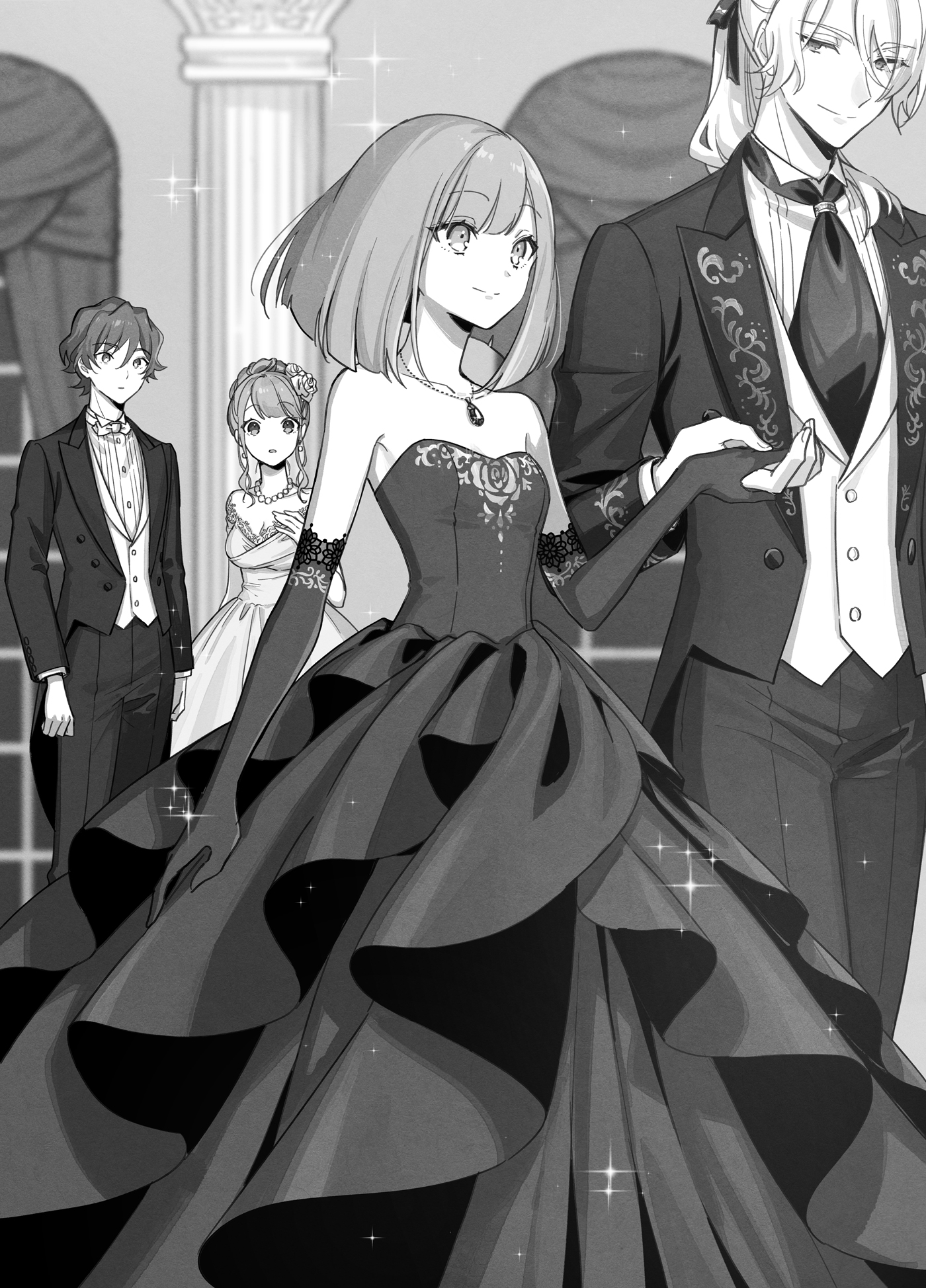
Day Off with a Friend
Day Off with a Friend
Central District was home to the most flamboyant fashion in all of the kingdom’s capital. Changing weekly, the storefront displays were both textbooks and art galleries to Lucia; every visit had her heart racing, her mind overcome with emotion. Clothes, shoes, accessories, and cosmetics of all designs and colors passed her by in the streets, and simply gazing upon the different combinations and outfits was one of her favorite pastimes. Over the past few years, foreign styles had begun to have a greater influence—furs and pelts à la neighboring nation Ehrlichia, numerous layers of fabric in the palate of the native rocks of desert nation Išrana, long sleeves and lustrous sashes from Esterland—and it very much fascinated Lucia.
This dazzling day found many shoppers gazing at summer styles in the shopwindows, some of which required a bit of confidence to wear given their lack of surface area, so to speak. They would certainly look great on Irma, but Marcella would most likely not be very happy with the suggestion. There had been a sharp increase in the number of shirt and blouse designs too—polka dots and stripes had been commonplace already, but now it was more common to see fish, mollusks, kraken, and even sirens emblazoned across the chest, making for quite the summery and unique trend. Maybe a slime-patterned top would make a great present for Dahlia.
There was so much beauty, cuteness, and playfulness in the designs here, but it was no time to stop and stare. Lucia hurried her steps, as she had somewhere to be—she finally had a day off today, and she was going to meet her friend.
“Lucia! Over here!” Waving to her was her redheaded friend, who was standing by a table at a restaurant along the street. The large beige parasol made it quite enjoyable to dine alfresco, but the shadow that it cast had hidden her friend.
“Dahlia! I missed you so much! Your outfit and hairstyle both look fantastic today!”
Dahlia had on a lily-white sweater, olive green pants, and white shoes with a bit of a heel. She wore her shoulder-length hair down; the red curls had a healthy shine and fluttered in the breeze. Both because she herself had never had much interest in fashion and because she had been accommodating her now-ex-fiancé, Dahlia unfortunately kept her appearance rather subdued. Maybe because she not only worked as a magical toolmaker but also as the chairwoman of a company that had business with the nobility, she had suddenly become so much more beautiful—Lucia was so happy to see the change.
“Do you have any recommendations, Dahlia?”
“The seafood spaghetti and chilled tomato soup are good here.”
“Okay, I’ll do exactly that with a glass of sparkling water. How about you?”
“I think I’ll have the chilled mung bean potage, but I can’t decide between the summer vegetable spaghetti or the mushroom and prosciutto pizza.”
“Why don’t you order the spaghetti and then we can split the pizza?”
“Let’s do that!” Dahlia’s response came a beat late—she took a quick glance down at her waist, but Lucia pretended not to notice. It was nothing that couldn’t be fixed by walking home instead of taking a carriage and eating a bit less tomorrow. “Has work been busy for you lately, Lucia?”
“It’s not not busy. But I’m glad to have it, and the pay is good. Besides, in my line of work, there are always ebbs and flows.” She explained that although they somewhat varied in number depending on the season, there were always sudden tailoring requests, rushed orders of formalwear, and fluctuations in order size, so it was consistently inconsistent. She worked as hard as she could when the Magical Garment Factory was busy, and when there was some slack, she scrutinized the products to identify areas for improvement. Dahlia understood it well—apparently magical toolmaking and development were the same. “Have you been keeping busy as well, Dahlia?”
“Yeah. I found someone who’s an expert at processing tools, and I’ve been doing some studying recently.”
“You’re a full-fledged toolmaker already, but you still have more learning to do? What, are you developing new ideas?”
“Postprocessing magical tools, like miniaturizing and lightening them, is rather complicated. There’s a lot of trial and error as well.” Being a toolmaker must be hard work. Just like being a clothier, there always seemed to be room to learn and grow—just as you thought you were halfway decent, a veteran or a specialist put you to shame.
“Oh, this is good!” The chilled tomato soup had the right balance of acid, salt, and a basil punch.
Dahlia seemed to be pleased with her choice as well; her eyes curved as she put her spoon to her mouth. It was at times like these that the errant thought came to Lucia’s mind: how she resembled her late father! Carlo had been a magical toolmaker and Dahlia’s master. Whenever Lucia had gone to the Green Tower to hang out, Carlo was there with a smile to receive her. He had always complimented her on her hairstyle and clothes, bringing a smile to her face as well. Though a baron, he had never once been pompous; rather, he had always been kind and amiable. Lucia couldn’t help but feel a little sorry for Dahlia now that she was alone. There was surely a lot he still had to teach her as his daughter and apprentice; he was probably cheering for her from the other side as she continued her never-ending quest to improve herself.
“Gosh, Lucia, look at the size of that pizza...”
Lucia looked up to find the two spaghettis and pizza arriving at their table. Not only was the latter a whole size larger than she had expected, it was completely smothered in toppings and overflowing with cheese, as if to say that today was customer appreciation day. “It’s, uh, it’s fine! We’ll walk home today!”
“You think you’ll be able to move after eating all of this?” Her cold green eyes froze Lucia’s lips shut.
As Lucia cut the pizza, she explained that they’d take their time window-shopping afterward. “Oh, I meant to tell you about the machines—we got a bunch of new ones, so production has been going swimmingly. I think we can up our production very soon and cut prices for next year.” Unless they could increase production and lower costs for both the toe socks and drying insoles, they would never be products for the common folk. Lucia was wearing the insoles this very moment, and the more she wore them, the more she learned to appreciate them. The toe socks had received great feedback from the men as well.
“That’s great news. I had my doubts, to be honest—I was worried that I’d thrown all this trouble onto you, Lucia.”
“Not at all! Not only has my salary gone way up, I’ve got so many master couturiers looking over me, and I get to make new clothes, so thank you from the bottom of my heart.”
After bringing a smile to Dahlia’s face with her words of appreciation, Lucia took a big chomp out of her slice of pizza, and it punished the roof of her mouth for her impatience. She braved the scorching pain, and she was rewarded with the flavors of browned cheese, tender ham, and aromatic mushrooms. Maybe it was where they had been foraged or maybe it was because of the weather, but this year’s fungi seemed to be much more flavorful than the previous year’s.
Lucia continued, “The other day, I saw this lipstick and face powder made with kraken so that they won’t come off as easily.”
“Perhaps the face powder is made with kraken membrane,” Dahlia wondered aloud. “Oh, this lipstick I’m wearing is made with red slime. They said it makes it extra glossy.”
“I’ll have to take a look for it next time,” Lucia said with a big smile, for today was a momentous occasion: in the twenty or so years that she had known Dahlia, this was the first time she had been the one to recommend makeup to Lucia. “I’ve heard that lately, a certain fabric factory got themselves this great big magical weaving machine that’s two stories tall.”
“A magical tool that weaves? No kidding! I wonder if it uses crystals or monster parts.”
“I heard that it’s air crystals. Up until now, the superwide weaving machines have always been worked by people with body strengthening magic, but with crystals, even those who don’t have magic can use the machine.”
“Oh, I’d love to see one someday,” she said, daydreaming.
Just as Dahlia wanted to see the magical tool, Lucia wanted to see the textiles made there. “If I ever get permission for a tour, I’d love to bring you along.” The machine still needed more adjustments, as the warp and weft weren’t quite even, and with its sizable working width, it made sense that it ought to be as perfect as can be.
“Hopefully that means fabric will come down in price,” Lucia said.
Textiles were more affordable than ever. Back when her grandmother was still a child, they had been three times more expensive than they were now. It was the advent of spinning, weaving, knitting, and other machinery, as well as better access to raw materials, that had driven prices down. According to Max, dyes for thread and fabric were now produced in three times the volume too. Vegetable dyes were still just as popular, but insect, mineral, and monster dyes had become more commonplace. Imports of dye had also increased, with a vermilion from Esterland being the hottest thing right now. It wasn’t too easy to work with, but mastering it sounded like fun. The dye was apparently sourced from trees too.
“Say, Dahlia, do you know of any tree-shaped monster material? I heard that there’s this beautiful orange-red dye from Esterland that’s supposedly made from trees.”
“I’m wondering if that isn’t lacquer. Do you know if anyone has developed a rash?”
“Well, the Tailors’ Guild is all about safety first, so they process it and it’s fine,” Lucia said. “You do some dyeing too, right? What kinds of dye do you use for magical tools?”
“There’s this plant from Esterland called onirosso that makes an amazingly beautiful red and a durable finish, so it’s often used on furniture. Monster fish scales are also used, and those come in many colors, like white, red, and yellow.” Dahlia was a wealth of knowledge, and she always taught Lucia a lot. “I’ve heard that enchanting with griffin talon and wind dragon scale produces really great colors, but those are a little out of my reach...”
Lucia was sure that before long and hot on the heels of the waterproof cloth and toe socks, her friend would come out with more delightful clothing-related magical tools.
After quite a while chatting and eating, they had finally finished their meal; even Lucia’s second stomach for dessert had been filled.
“Ugh, I’ve been eating too much and gaining weight lately...” moaned Dahlia.
It probably wasn’t the best thing to say right after a meal, but Lucia wholeheartedly agreed—snacking while working certainly didn’t help. She had been taking lunch with other Magical Garment Factory members more often as well, and in the afternoon, Forto sometimes brought the cakes and such he got from his clients. Any leftovers were saved for snacks during overtime. In an ongoing war with her waistline, Lucia had been doing more push-ups and sit-ups before hopping in the bath.
“Once I get over this hump, wanna hit the sauna with me, Dahlia?” Saunas were a feature of the bathhouses scattered around the capital; older apartments didn’t have bathtubs or hot water dispensers, and stopping by the bathhouse after work was a nice way to relax. Saunas had quite the queues outside in the evening, as there were always patrons seeking health benefits and to lose weight.
“That’s a great idea, but I’m wondering if I couldn’t come up with a simpler alternative at home.”
The concept of “simple” was not compatible with the ideas of dieting and physique improvement, but Lucia held her tongue—her friend had never seriously worried about her figure before, so it would have been counterproductive to criticize a good habit. Then she contemplated—was there something Dahlia could casually do at the Green Tower? “How about going up and down the steps with heavier weights? Or maybe adding a sauna at home?”
“Yeah, I’ll try adding more weights. But installing a sauna might not be easy with the round walls of the tower, and it would be quite a waste of money, as I’d be the only one using it...” Dahlia pulled her purse strings quite tight considering how much money she made. She licensed out her waterproof cloth, and that provided her with a regular income, but she saved that money as a fund for developing new magical tools—and for her retirement. As an aside, she had first uttered the words “retirement fund” when they were fifteen, and Lucia remembered she had asked for an explanation. Dahlia was truly responsible.
Lucia saved money too, but it was for her future atelier and shop; she gave no thought to her golden years. “Oh, that’s right—was that long, thin roll of waterproof cloth for someone very tall?”
“You know how there are raincoats and rain pants? Well, I was thinking of combining them like a onesie, as I had a request for something that would keep the wearer completely dry. It didn’t really work, though.”
A suit made of waterproof cloth might be useful for people working in rivers and lakes, but there was a glaring issue. “Did water get in from the sleeves and from the neck?”
“That much was expected, and it was nothing you couldn’t fix by wearing another layer and fastening it with cords. The problem was with it getting really stuffy inside, like you couldn’t imagine by wearing just a raincoat. Sweat pooled around the hips. The client said that ‘wearing it was so much more tiring than not,’ and this was someone with body strengthening magic.”
“So, it’s a breathability issue?” The waterproof cloth repelled water; there was no miracle material that was both breathable and waterproof. “But it sounds useful! It’d be great for when you only need it for a short period of time!”
“Yeah, but it’s like a sauna suit...”
“Hey, that’s brilliant! You’d definitely get a sweat going if you wore it into the bath!”
“Um, yeah, sure...” Dahlia stared off into the distance; maybe she was coming up with an idea of how to sell it. She had always had such a wonderful imagination.
The sauna was just a small wooden room where people could relax in the steam, but if sweating was the point, then that waterproof suit might just work—it’d definitely be hot enough that you could sweat off some weight by wearing it into the bath.
“I’ll make a pair—one for me, and I’ll have the other one sent to you. I’ll tailor mine to fit myself before I test it.” Dahlia was taller and had longer limbs; what fit her would be too large for Lucia, so she’d have to find some time to make this sauna suit.
“Thanks, Lucia!”
It’d be easier for Dahlia to do the testing, but Lucia had a reminder for her. “Make sure you don’t stay in there for too long, okay?”
There was this incident back in their primary school days when Lucia, Dahlia, and Irma had first gone to the sauna together. Lucia and Irma had been defeated by the heat fairly quickly, but Dahlia had remained inside for quite some time. Worried, Lucia had gone back to check up on Dahlia, who had said with a bright red face that she was trying to stay in there as long as she could. Sweating was supposed to be the fun part, but she had made it into a self-imposed punishment. Lucia and Irma had poured water over Dahlia as they got her to rehydrate.
Dahlia blushed; she must’ve realized what Lucia was hinting at. “You don’t have to worry about that anymore, Lucia! I’ll make sure to set a timer!”
Days later, the redheaded friend asked Lucia whether she knew of any good ointments for sweat rash. A mere timer could not change Dahlia’s nature, apparently.
The Noblewomen Twins
The Noblewomen Twins
“Lucia, I have a favor I earnestly wish to ask you—” In his office and with his attendant and a maid beside him, Forto said nothing to beat around the bush.
Lucia returned her cup of floral black tea to its saucer and sat up straight. Her boss had summoned her first thing after lunch to discuss a matter most serious, so she had braced herself for what was to come.
The guildmaster could not maintain his usual collected expression; he had a grave look on his face. A sudden order for toe socks that he could not refuse? Giving her position as head manager of the Magical Garment Factory to someone else? His pause gave Lucia much anxiety.
“I apologize for the suddenness of it all, but I was hoping you could design a dress each for two noblewomen, the caveat being that the two dresses must be different in shape from each other.”
“A dress each for two noblewomen?”
It was such an odd request that she couldn’t help but repeat his words, but Forto mistook it as hesitancy. “Of course, I understand that you are extremely busy, so I shall take your place in the Magical Garment Factory while you’re on this job. If you still need more people, then I shall transfer more staff to your team. Even just your rough sketches would be much appreciated.”
“Um, I would love to discuss this matter more if you could give me the details, Mr. Forto.”
Looking like the world had been lifted off his shoulders, he nodded and placed a parchment case on the table. “These are the two for whom you would be designing—a pair of young women from a viscountcy family that is close to my own.” He took out portraits that were as large as sheets of regular writing paper. The noblewomen looked to be around eighteen to twenty years old. They both had frosty blue hair, mimosa-yellow dresses, and smiling blue eyes—in fact, their hairstyles, accessories, makeup, and clothing all seemed to be identical. Perhaps these portraits had been drawn to mirror one another.
“Are they twins?”
“Precisely. Their mother—er, the viscountess always instructed their family’s couturier and the ones here at the guild—including me—to make the same dresses or very similar ones for these two. However, she has said to make them unique from here on out...”
Even if the twins had been dressed the same way all along, each must’ve wanted to wear what she wanted to wear, since they were growing up. Maybe the drawings portrayed them as older than they really were. “May I know how old they are?”
“They are eighteen years old.” Scratch that—they should’ve asked for this a long time ago. The age of majority in Ordine was sixteen, meaning they had been adults for two whole years. It was curious that they had agreed to wear the same clothes for so long only to change their minds after all this time. “The situation was originally thought up so as to prevent the twins arguing over what colors to wear, but as they grew older, they found that they like to match each other as well—so goes the pretext that makes it easier to explain...”
“Erm, so neither of them ever wanted to wear different clothes until now?”
“Not at all. The viscountess never did anything differently for either one of them if she could help it—even their hair and makeup was to be done in an equal amount of time.”
The story was getting weirder by the minute. What’s the point in being so fussy? “May I ask as to why that is? I hope I’m not prying, but it sounds like the twins aren’t allowed to wear what they like or look good in. Maybe I’m unfamiliar with noble customs, but is no one else in their family able to say otherwise? Do noble twins have to wear the same clothes?”
“It’s because—” Forto cut himself off; his attendant Lotta, who was always concealing his presence, cleared his throat as he stared with his black eyes at his master. Forto elegantly sipped his tea, then pointed his blue eyes straight at Lucia. “I shall explain to you the full details, but I ask that you keep this matter private. The viscountess was a twin as well. She was the older sister and the one in line to succeed to the viscountcy, so she was favored; their parents gave the elder sister the best dresses and the younger sister second-rate ones, among other examples. The older sister protested for equity many times, yet their parents refused to listen, saying that it was only natural she received more, as she was the one to become viscountess.”
“I see...”
“Before her debut, the younger sister fell ill and passed away, and her funeral was meager. And so, as you can imagine, the viscountess hasn’t been able to make peace with what happened.”
It all made sense to Lucia now. Outrageous had been the treatment from the viscountess’s parents; Lucia wanted to offer them a few choice phrases. It might be a case of “that’s just how nobles are,” but she was indignant at what had happened.
Forto continued, “Those who knew what happened followed the viscountess’s wishes. However, her daughters grew up. The elder sister has her wedding ceremony planned for next year, hence the commission from the viscountess for different dresses.”
“So, the viscountess decided to put an end to the whole matching thing because her daughters are going their separate ways?”
“No, the fiancé reprimanded the viscountess—his future mother-in-law. A daring lad, isn’t he?”
Actually, he was a wonderful man who deserved utmost respect.
“The people here at the guild do not know of the viscountess’s background; rather, they thought they had been making matching dresses because the twins were very close,” said Forto. “The viscountess has said that any couturier would be fine for this task so long as they are someone I recommend, and the first person who came to my mind was you, Lucia.”
“What an honor.” Oh, no pressure or anything. But she wasn’t one to back down from a challenge.
“The guild shall be providing you with the necessary materials and personnel for this project. This will be your remuneration, there will be a bonus upon successful completion of the job, and I shall bear the responsibility should things fail. Will you give it a try?”
“I am delighted to take on this project,” said Lucia, without even looking at the pay. This was a rare opportunity; why would she hesitate?
“Very well. I shall ask them for their availability, then.”
Two days later, Lucia arrived at the viscountess’s mansion situated in the North District’s nobles’ quarter. Accompanying her as her attendant was Hestia. She was a woman from the Tailors’, close with Lucia, and familiar with etiquette due to her viscountcy background—Lucia felt terribly sorry to have reduced her to attendant status, but Hestia had been the perfect choice. Reassuringly, she had accepted the role with a smile, offering her help with anything that Lucia might need.
Lucia had also started sewing the dress that had caught Hestia’s eyes at dinner the other day. Hestia had even supplied her with a very fine bolt of fabric for it. Though progress had been slow due to their busy schedules, Lucia had been having Hestia check the ongoing work, and the two of them had been having lunch together too. Having even one person to call a friend was very heartening.
As for the work at the Magical Garment Factory, Lucia had received permission from the guildmaster to delegate her tasks to Dante, who didn’t so much as question her. “Don’t worry, boss. Go do your best; we’ll be here waiting for you,” he had said as he saw her carriage off with a smile on his face. Though Dante was older than Lucia, there was something childlike in the way he was wont to tease her—not unlike the neighborhood boys when she had been a little girl.
The carriage stopped by the healthy, freshly trimmed lawn. Lucia and Hestia disembarked, then followed the white brick path. It was a historic and tasteful building assembled from stone. This was the estate of Viscountcy Volandri.
“We welcome you to the Volandri home. My name is Marialuna, eldest daughter of the Volandris.”
“Very pleased to meet you. I am her younger sister, Delphina.”
The sisters introduced themselves in the parlor. They were wearing identical makeup and mimosa-yellow dresses, though their hairstyles were different—Marialuna’s slightly wavy hair was tied up, while Delphina’s was long and straight. The elder sister also had a gleaming gold engagement bracelet with green gemstones.
“My name is Lucia Fano of the Magical Garment Factory. Thank you very much for reaching out to us,” she said as she sat on a sofa. As her attendant, Hestia remained standing diagonally behind her; hopefully she wouldn’t get too tired.
“I apologize for our mother’s absence today.”
“Oh, you needn’t apologize. I am sure she is very busy.” Lucia had heard from Forto that the viscountess had deliberately given her daughters some space so that they wouldn’t feel pressured by her presence.
“Lately, the both of us have grown tired of our enforced likeness. Our mother has always dressed us the same way so as not to show any bias to either of us, and she seems to enjoy the attention that we afford her,” said one twin.
“We aren’t too fond of the situation, yet we find it so difficult to be honest with her...” said the other.
It was just as Forto had described, and Lucia did not want to pry further. She looked at the young women sitting across from her, and even at this distance, it was obvious that they had their differences. Their portraits depicted them as perfectly identical, but the shapes of their eyes, cheeks, and jaws slightly differed. The colors of their eyes were subtly different as well. With distinctive outfits, each was sure to become unmistakable.
Lucia asked, “I understand. May I start by surveying you two about the kinds of dresses you are looking for?”
“Yes, please.”
“Very well. I will be interviewing you individually.”
“Does that mean you won’t need both of us together?” Delphina asked with trepidation; by default, she was always in the same room as her sister.
“That is correct. I would like to get into the finer details, and I wouldn’t want to waste your time—either one of you.”
“Very well. Shall we begin with me?” Like the older sister that she was, Marialuna took the initiative with a smile. Yet her fist was clenched so tightly.
Lucia and Marialuna headed to a room beside a washroom and across from a dressing room. Inside, there were a few sofas in the center of the room, a footstool to sit on while putting on one’s shoes, and a set of large mirrors affixed to one wall—a very noble setup. Hestia and Marialuna’s lady’s maid accompanied the other two.
“May I know the venue where you will be wearing the dress?” asked Lucia.
“It will be an informal dance held ten days from today, if that is enough time. Otherwise, it will be at the one next month.”
Slightly more playful dresses were accepted at these informal dances, so Lucia had heard. This development was reassuring; she did not yet have the confidence to make a dress for a noble’s formal function. “Do you have any shapes or colors that you prefer? Or perhaps a certain style or image that you would like to pursue?”
Marialuna hesitated for a split second. “Something graceful, suitable for someone who is betrothed and soon to be married, in an inoffensive color and a standard style—that would be fine.” She seemed so nervous, but if that was what she was truly thinking, then she could have picked any off-the-rack dress at a store. Even the maid looked troubled by her mistress’s answer.
“Would you like for this dress to be appropriate to wear after you are married as well?”
“Indeed. Our wedding ceremony is slated for sometime next year, so it would be nice to wear it in all sorts of styles—after all, this would be a dress of my own,” said the warmly smiling noblewoman. “A dress of my own” was music: she really did want to look like herself.
“Setting the dress aside, what colors are your favorites?”
“I beg your pardon?”
“It will help me plan your outfit, like in striking a balance with accessories, for example.”
She once again hesitated to answer. “I enjoy white, ivory, and pale pinks and blues. Oh, and bright green as well.” The inconsistency of her answers was worrying, to say the least.
“What are your plans for the future?”
“It may sound queer, but I have always wanted to be a bride...” Did she have cold feet? Her deep blue eyes turned muddy. All of a sudden, she ordered some tea, and the maid left the room. Marialuna then said, “I presume that you have heard the whole story from Lord Fortunato?”
“Yes, I have.” There was no point in lying; that would do nothing to facilitate good dialogue.
“My mother believed that we twins ought to be as equal as possible, yet any notion of equality between us has long since become a fiction. As the elder sister, I have been engaged since age ten to my betrothed, who is from our allied house.” Such was the way of nobility. Lucia had heard that allied houses, as the name implied, were families who had formed something of a defensive pact; she hadn’t expected it would come up here, though. Marialuna continued, “I cannot help thinking my sister would be more helpful to my betrothed’s family...”
“How do you mean?”
“Delphina is much cleverer than I am; she is proficient at foreign languages and mathematics. My betrothed is currently a knight of the Order of Beast Hunters, a role to which he long aspired in childhood and which he has long since assumed. Therefore, as his wife, I would be the one who would be obliged to take charge of the family. My future mother- and father-in-law treat me very well, and I foresee that I will one day inherit their family trade.” Marialuna’s long lashes pointed downward as she softly spoke.
“Forgive me for being nosy, but what sort of trade might that be?”
“Both our families inspect the city walls.” It seemed as though their families were titular viscounts, nobles by virtues of their positions rather than their domains. The royal capital was enclosed by stone walls, interminably long and impregnably great. As such, it was natural that people were hired to manage them, and she must’ve thought her sister was better suited for this very difficult job.
“Lady Marialuna, do you love your fiancé?”
“Of course I do!” she asserted. “Knowing my worries, he went to my mother and protested on my behalf, saying to her that the world knows she loves her daughters but that there is no good reason to treat two individuals as the same person. I want to be a noblewoman and wife who will beseem him.” Her eyes were pinned to the ground, and the gemstone glimmered on her engagement bracelet, which sat above her tightly clenched left hand.
“You mentioned that you like green; indeed, the jewel on your bracelet is a very beautiful shade.”
“Green like his eyes—he is an adept user of air magic.”
“Is he perhaps a mage with the Order of Beast Hunters?”
“No, a knight in the rear guard. My father-in-law is a former Beast Hunter as well, and when horned rabbits appear at the wall, he turns them into stew for supper,” she said, giggling with pride. Marialuna seemed to be very close with her fiancé’s family; there was no reason for her concern.
“Then let’s come up with a dress that will have your fiancé fall head over heels for you all over again!”
“Sorry?”
Lucia knew she was being a little absurd, but that didn’t mean she was any less serious. “Was he not the one who said that there was no need for you and your sister to be uniform? Was he not the one who gave you, Lady Marialuna, the engagement bracelet? I believe that you are simply feeling sentimental before your wedding.”
“Is...is that right?”
“I’m certain of it. Hence a dress to make him fall even more deeply in love with you—no, rather, won’t you find a dress that will make you fall in love with yourself?”
“Love myself, you say...”
“Correct. We can set aside the commission for now, so let’s come up with some dresses that you like. I’m sure that would be very refreshing for you,” Lucia said. She felt sorry for Hestia, though, who was now pressing her fingers against her temple. If Marialuna was going to pussyfoot around the matter of her new dress, then she may as well have gone to a store in the nobles’ quarter instead of coming to Lucia. If Marialuna was to choose something for herself, then she must choose something she truly loved.
“Very well. In that case, I should appreciate your help!” the noblewoman responded with her right hand in a fist. Perhaps she was quite strong willed.
“Gladly. May I please have you remove your makeup and all of your clothes save for your underwear? So that I can take your measurements and gauge your body shape.”
“Y-Yes, of course.”
It was transparent that she was quite nervous, but Lucia acted unaware. As the lady’s maid had gone to prepare tea, Hestia helped Marialuna change out of her clothes. Without the guise of a noblewoman, she boasted a terrific figure.
But Hestia was fuming. “Why would you go so far to bind your breasts?! Keeping them compressed for too long will deform them and hurt you!” To flatten her chest as much as possible, Marialuna had a cloth binder over her underwear and corset; it hurt to just look at the many constrictive layers covering so much of her body. Maybe it was stylish for noblewomen to be as slender as possible.
“Because I am, um, rather plump...”
“Absolutely not! You are more than slender enough!” Hestia shouted back before Lucia could get a word in. The maid, who had returned with the refreshments at that very moment, pointed her stern gaze at Hestia.
“Please pick the fabrics you like, not the ones you think you might or might not look good in,” said Lucia. She laid out a swatch that featured large palm-sized cuts, not little trimmings. They were premium, high-quality fabrics too; the guild assembled samples like these for their noble clients. She would’ve loved to get her hands on one of these swatches as well, but one complete collection filled a whole trunk—not exactly maneuverable.
“Oh, these are wonderful...” The noblewoman took out a white, a pastel pink, and a light blue; all three were meek.
“Which is your favorite color, Lady Marialuna?”
“This one here. It’s absolutely wonderful.” She had a shiny patch of ivory silk in her hand, something that could even be used for her wedding dress.
However, ivory and beige dresses were surprisingly challenging to work with—just a slight change in shade made a gargantuan difference in the impression it created: a light beige brightened the face, but it could highlight any blemishes; matching one’s skin color might sound sexy, but it could be vulgar in the way it made someone look too exposed.
Lucia, to the right of Marialuna and across from Hestia and the maid, began designing a dress with that ivory sample in mind. Simultaneously, she began the questions. “I believe this style would look very nice on you.”
“No,” Marialuna replied, “I’m not keen on anything that is tight to my body.”
“Something to draw attention away from your chest, then?”
“Yes, I would prefer to look slimmer and more dignified.”
“Lady Marialuna, I assure you that you are not overweight by any means.”
“She is correct, Lady Marialuna! Your figure is no less than perfect as it is!” the lady’s maid chimed in. It seemed as though she hadn’t upbraided her mistress for her stubbornness until today.
Lucia continued the questions. “Erm, do you like lace, beads, and the like?”
“Yes, I do,” said the client.
“Would you prefer the skirt tight or flared?”
“Flared, please. I, um, like it to spread when I spin...”
After that, Lucia spoke only when she needed to as she drew and erased, designing additional dresses one after another. Marialuna sat at the edge of her seat, leaning over to watch the couturier’s pencil. On a fresh sheet of paper, Lucia combined all of the elements that suited Marialuna: some parts tucked in and some looser; not too much bare skin; and beaded lace that covered the top of her shoulders and her chest. For the bust that Marialuna worried about, Lucia designed a feature like a cache-cœur where two bands overlapped in front just above her waist and tightly wrapped around her midriff—that helped to minimize her frame, although her figure was just fine—then transitioned to the flared skirt. The back was open and had some lace and beads as decoration.
In the two-page sketch, Lucia also took the liberty of accessorizing Marialuna’s image with a wedding bracelet and the set of Esterland pearl earrings and necklace she had received from her fiancé. He had bought the earrings with his first paycheck as a Beast Hunter and delivered them to her that very day; Lucia wanted to commend him for an excellent showing. Marialuna had received the necklace for her birthday that following year. The knight was the essence of romance; whyever she doubted her fiancé’s love was beyond Lucia. Not only that, but as she was sketching the accessories, she muttered, “Every man in the world needs to learn from his example,” with which Hestia and the maid strongly concurred.
At last, the design was complete. “Lady Marialuna, I think you’ll like this,” Lucia said.
Marialuna stared unwaveringly at the two pages, looking completely serious with her pursed lips. “Will this suit me?” she began to wonder aloud, but she quickly shut down her own doubts. “No. I like this.”
Lucia refrained from contradicting Marialuna’s doubts.
Marialuna continued, “At first, when you asked me what style or image I would like to pursue, I was thinking of my sister’s intelligence, my friend’s ladylike behavior, and my mother’s elegance—I was cobbling together the merits of others. But I am no one but myself.” It was as though she was trying her best to convince herself. Her hesitant and childlike demeanor had changed to a graceful noblewoman’s. Her deep blue eyes looked straight into Lucia’s, and she said, “Madam Fano, I should like to commission you to make the dress from this design.”
“Thank you very much! I’ll give it my all!” Lucia stopped herself from succumbing to her excitement and leaping out of her seat.
“And I know it must be odd to ask this of you, but please, I hope you will lend your strength to my sister Delphina as well.” As she pleaded with Lucia, Marialuna’s expression was none other than that of an elder sister.
After the guests had indulged in a small mountain of cakes and cookies during afternoon tea in the parlor, they returned to the original room with Delphina, who did not bring a maid with her.
“May I know the venue where you will be wearing the dress, Lady Delphina?” asked Lucia.
“It would be at the same informal dance my sister is attending, but I am also hoping for the dress to be suitable for the cocktail reception afterward.”
“Cocktail reception?”
Hestia leaned over and whispered, “A social event where members of the nobility stay standing as they enjoy canapés, drinks, and conversation.”
“I may be called upon to interpret for guests from abroad as well,” said Delphina, confirming her aptitude for foreign languages as mentioned by her sister.
“Good to know,” said Lucia. “Lady Delphina, do you have any shapes or colors that you prefer or perhaps hope to look a certain way?”
“I would like something that would be suitable for me as someone from a viscountcy and as an interpreter while looking distinct from my sister.”
Sorry, but what am I supposed to do with that? Lucia didn’t have the slightest idea what kind of look that would be. She caught herself examining Delphina: she was unlike her sister in that her hair was long and straight, her blue eyes were a shade lighter, her cheeks were smaller, and her jaw was ever so slightly sharper. Copying her sister’s makeup did her no good either: her blush was too strong and her eye shadow didn’t compliment her eyes—in fact, it was downright unstylish. Lucia said, “Very well. So that I can take your measurements and gauge your body shape, may I please have you remove your makeup and all of your clothes except your underwear?”
“I shall return shortly.” She disappeared into the washroom; it seemed she could change out of her clothes on her own.
“Are you sure you don’t want to dig a little deeper, chief?” asked Hestia in a soft voice, sounding rather worried.
But Delphina did not have a clear idea of what she wanted, and Lucia couldn’t imagine asking more questions would provide her anything of value. As she stared at the blank page of her sketchbook, Delphina returned.
“I hope my unattractive and homely looks will not offend you too much.” The younger twin’s eyes were smaller and narrower, and their color was refreshingly brisk. Her lips were on the thinner side but had great shape to them. Her frosty blue hair suited her features very well. Though she may have thought herself homely, her features made her beautiful in a cool and mysterious way.
“Not at all; you’re very pretty! I think you would look even better in a different style of makeup.”
Delphina looked at Lucia with a bit of surprise, almost as if she hadn’t expected to hear that. Then she removed her bathrobe, and it became apparent why Marialuna was insecure about her figure: the younger twin was slimmer, had longer limbs, a narrower waist, and a smaller bust—which could be enhanced if she would like. “Unlike Marialuna, I don’t have the curves to make a dress shine...”
“I guess people always ask for what they don’t have...” muttered Lucia, accidentally voicing her thoughts.
“It is true—I don’t have any of her attractive features...”
“No, you misunderstand! I’m saying that you’re slim and have great proportions. To pine for curves is simply thinking that the grass is greener on the other side! You see, Lady Marialuna said much the same thing about you, wishing she had your trim figure.”
“But my sister is perfect as she is—she has a womanly shape. I, on the other hand, am still so lacking even at eighteen years old...”
“I think both of you compare yourselves to each other too much. You and your sister each have many advantages to play to.”
Delphina heaved a weary sigh. “Thank you for trying to console me, though I know I lack my sister’s splendor and beauty. This is me without makeup. Even when she and I dress the same to a dance party, she is always the first one to be approached and asked for a dance.”
“Erm, noble etiquette does dictate that the older sister be asked first,” Hestia responded immediately, demonstrating her familiarity with this subject owing to her viscountcy background.
“But we’re twins! That shouldn’t—”
“My younger sisters are twins as well, and rules are rules. When others cannot tell them apart, they call the older one’s name from a distance, then ask for a dance from whomever responds. It is imperative that hierarchy be maintained, especially in the territories, as...”—Hestia paused for a moment—“problems regarding succession may arise.”
“That said, the two of you don’t resemble each other that much. Despite the similar makeup, the textures of your hair and colors of your eyes differ, and I don’t think there would be a case of mistaken identity,” Lucia said.
Delphina’s shoulders slumped. “Have I perhaps been worrying for nothing?”
Hestia responded with a bright smile. “I think so, at least.”
“Earlier, you mentioned your career. Have you been interpreting for long?”
“The castle first reached out to me last winter. When female foreign dignitaries come for conferences, they request a female interpreter.” How proficient she must be for the castle to have requested her at such a young age.
Lucia was in awe. Even the most basic Ehrlichian vocabulary had always disappeared from her mind the moment she finished an exam. “That is so impressive...”
“Thank you. I have already been selected to travel to Ehrlichia, and it should simply be a matter of time before I am sent abroad.” Her vibrant blue eyes gleamed just a little brighter.
“Just as an example, if you were to represent the Kingdom of Ordine as an interpreter, what kind of dress would you want to wear?”
“Erm, probably something stylish and sophisticated?” That answered what she should wear, not what she wanted to wear; Delphina, the woman, remained fuzzy.
“And what colors do you like, Lady Delphina?”
“My mother says that yellow and aqua suit me well.”
“What I asked was what color you like, and I ask that you answer the question this time. It may help us choose the right accessories too.”
“I don’t know if these are my colors, but I like blue and red and also black and white.”
“Those colors would be very easy to work with. In particular, sharp blues, like sapphire, would be wonderful.”
“Sapphire blue...”
Lucia flipped through the swatch, and Hestia produced a strip of fabric in the perfect color—glossy and vibrant, it worked tremendously well with the client’s features and skin tone.
“That is indeed a wonderful color...” Delphina said softly, like she was sighing.
Lucia replied, “I think you would look fantastic in it, Lady Delphina.” Her sketchbook was opened to a design that she had made some time ago—a tight-fitting red fishtail dress that featured many layers of sheer organdy. It was tight around the waist, flared out wide from the knees, and dragged on the ground just a little. It was also lined with lace, making its wearer a very elegant mermaid.
“I would love to wear a wedding dress like that one day...” Her words sounded less like admiration than lamentation.
Beside her, Hestia flipped through another sketchbook.
“They’re all so pretty,” Delphina murmured. A few pages later, there was a dark blue corset dress that revealed the arms and shoulders. The upper half was slim-fitting, the bust cut slightly downward, and it was trimmed with silver. The gown flared from the waist down, and the skirt had many layers that made it puff out like blossoming petals. All in all, it was quite a striking design. Delphina remained silent as she studied the drawing and looked at the fabric on the table.
“You would be absolutely marvelous in that combination,” Lucia said tenderly. The gown would highlight Delphina’s figure, proportions, and small waistline. With a composed demeanor, it would be less so cute and more so beautiful. And Lucia could have said all that, yet she carefully refrained—this exercise would be meaningless if Delphina didn’t choose the dress for herself.
“I think it is absolutely delightful, and I would love to wear it, but I fear it would be too dramatic for me...”
It seemed like there were many people who shared Lucia’s anxiety. “‘If it exists, simply wear what you like to wear’ was a piece of advice I received as a child.” That day, under the orange sky, the brown-haired youth had said those words to her; she recalled them every time she took into her hands clothes that she wanted to wear. Because of the young man that day, Lucia was now so determined not to use others as an excuse to give up—otherwise she would not be able to wear lace on her clothes and accessories in her hair.
“A family member of yours?”
“No, just an older boy who walked by. A complete stranger.”
“Uh...”
“Chief...” Now that Hestia had learned the facts of the incident, her eyes pierced Lucia, icy cold and painful.
Lucia continued, “It is a blessing that we have the freedom to wear what we want to wear—we might not be as fortunate if we had been born in a different country or era.” To be a clothier in this kingdom in this generation was something she was extremely, genuinely grateful for.
“Um, would I be able to have you make that dress for me even if I do not wear it at the dance party? Of course, I shall be paying you to do so.”
“By all means. If you aren’t satisfied with it, bring it back to me and I will make you a new one.”
“Chief!”
Lucia knew full well how outrageous an offer she was making. The labor and materials that went into dressmaking amounted to no small sum, though it was a price that Lucia could now afford to pay. That blue gown would undoubtedly suit Delphina, though if the dress was not to her taste, it would be better for her not to have it at all.
“No; a Volandri makes good on their debts. I ask that you please make this gown for me.” That serenity suggested it must be the voice she used as a professional and a noblewoman.
“Thank you very much. I shall use this design and this fabric—erm, would you like a pair of evening gloves as well? Perhaps in white or in color?”
“Color would be fine for an informal dance, but I’m wondering which would fit the dress.”
“Matching colors would make the outfit more cohesive. However, your arms are beautiful, so shorter gloves would be a fine idea as well.”
“Hmm. What a difficult decision...”
As Delphina gave it some serious thought, an idea came to Lucia. “Hestia, would you mind fetching me the sketchbook I forgot in the carriage? I have all my glove designs in there.”
“Not at all. I shall return shortly,” she said, then departed.
That left two in the room.
“Madam Fano, I think you very brave.”
“Me? Brave?” Lucia wasn’t sure what to make of the sudden comment.
“Indeed. If I may be frank, when I first heard that a young couturier would be coming, I expected to be lavished with flattery and urged to go for the latest trends. You are—how should I put it?—very straightforward or perhaps even unsparing.”
“I apologize. I am but a commoner, so any offense I may have caused was unintentional.”
“No, please don’t apologize. Your attitude is...very heartening. I have never selected an ensemble based on my own preferences; it was a very novel experience.” Delphina wasn’t totally different from her sister in this sense; their mother’s insistence on equal treatment had proven to be a shackle on their sartorial senses.
“My family insists that I am rash, not brave.”
“I think they are two sides of the same wonderful coin. I have always aspired to be more courageous a woman.” To be interpreting for foreign dignitaries at the castle, what did she have but courage?
But “courage”—that word reminded Lucia of a ritual from her primary school days. “Lady Delphina, when you were still in school, did you have any rituals before taking a test?”
“Not in particular, although I would twirl my pen once in hopes of good grades. Why do you ask?”
“This might be poor manners, but—” Though there were only the two of them in the room, Lucia explained her ritual—nothing befitting a noblewoman—in hushed tones.
However, Delphina’s blue eyes lit up with a mischievous glint. “I would love to try it out, so may I ask you to accompany me?”
“Oh. Of course.” She was responsible for this; there was no way she could refuse. Thus, the two exited the room. “Is there a staircase that won’t see much traffic?”
“We can go upstairs at the end of the hall; it should be quiet at this time of day.”
After making sure the coast was clear, the two young women burglariously proceeded to the back of the mansion. Lucia double-checked that they were indeed alone in the stairwell, then took off her shoes. “I shall now demonstrate.” There were twelve steps to the landing, twelve more beyond that to the next floor. Skipping every other one, she climbed up the stairs; the soft carpeting muffled her heavy steps. “You must skip every other step and mustn’t stop midway through or be seen by anyone other than your friends—follow these rules three, and courage shall come to thee!”
“Okay, let me try!” Delphina removed her shoes, then did as Lucia instructed and raced up the stairs at a surprising speed—she was a little out of breath by the time she reached the couturier. “If I mustn’t be seen by anyone other than my friends, then you must become my friend, Ms. Lucia.”
“Well, I’m sure it would be fine in this case, as I’m only teaching you.”
“Aren’t you worried that I won’t receive the blessing?” Her timidity had completely disappeared, leaving behind a grin on her face. Maybe the charm really had worked its magic—or more realistically, maybe she was now freer to be herself.
“Lady Delphina, are you perhaps prone to nervousness?”
“Yes, especially when meeting others for the first time. I am only able to behave like this among those with whom I am close.” They had only met today; surely they couldn’t be classified as close. “Would you please call me Fee? I have few friends, so I have always wanted to have someone outside of my family call me by my nickname.”
That was a bit of a sudden hurdle. “O-Okay, Lady Fee.”
“No titles either. Clothes can be such wonderful things, and I would like to learn more about them in the future. Perhaps I could talk about Ordinato customs while abroad, or even have my connections bring in fashion books from Ehrlichia. I would love to have the chance to read and chat with an expert such as yourself.” Not only was she very clever, she had the influence and finances to be very convincing. Though her smile and voice were bright and cheerful, her tightly clasped hands were evidence of her nervousness. Still, Fee was sure to be a very capable woman once she found her bravery. Lucia imagined a pair of thin, soft fabric gloves cladding Fee’s hands as she held a beautiful bouquet.
“Unfortunately, I don’t have a nickname, but please call me Lucia, Fee!”
“Thank you, Lucia. I am sure I can begin anew once I put on that dress. And I am sure there will be many men who will want to dance with me that day.” That smile of hers didn’t quite match her expression—she looked as though she might cry at any moment.
Based on what Marialuna had said, Lucia could surmise the reason. But this was none of her business, and she was lost on how to respond. What Lucia did know was that Fee was sure to meet many great people from here on out. “There are plenty of fish in the sea—be they men or women!” she said with all confidence.
Delphina cackled in a not-so-ladylike manner. She laughed and laughed, and a single tear rolled down her cheek.
Beyond the windows, the last sliver of light remained, but under the magical chandelier that burned to dispel darkness were nobles in glamorous tailcoats and gorgeous gowns. Today’s social dance was taking place at the estate of an earldom, the Volandris’ patron house—that was to say, a family of higher rank within the same faction. It was a regular event where people were able to acquaint themselves with others, discuss business, and trade information.
“You’re absolutely stunning, Maria,” said Delphina, who had always called her sister by her nickname.
Marialuna wore an ivory gown that was far from revealing—the beaded lace that covered her shoulders and chest and the two straps that wrapped around her bust helped diminish her buxom figure. It tightened slightly around her waist and its skirt flared out. The deep V-back had beaded lace as well, dazzling everyone every time she moved. White roses adorned her high bun. Finally, dangling from her ears and neck were pearls—gifts from her betrothed. Delphina thought her twin sister exceptionally beautiful.
“Thank you. You’re exquisite too, Fee.”
She beamed. “Thank you. I just adore this dress.” Delphina didn’t humbly reject the compliment or hunch her back today.
The first time she put on the dress, she had been utterly shocked by how mature and ravishing that woman in the mirror was, yet she had felt so nervous in it that she had asked for tips, and that couturier, with a delighted smile, had said, “A kitten arching its back may be cute, but your stoop isn’t!” Delphina hadn’t been able to keep herself from giggling—if anyone seemed like a kitten, it would be Lucia.
To go with her sapphire-blue gown, she wore a pair of thin evening gloves in the same color. They only went up to her forearms, meaning her upper arms and shoulders were bare—for her, it was quite the daring design. In the past, unwed women favored designs that obscured if not covered the shoulders and the chest, but as of late, many felt free to show their shoulders at dance parties. There was less sotto voce criticism too, though it hadn’t completely gone away. Delphina’s gown had slight silver trimming on the chest, and the bodice was snug. So as to flaunt her waist, she had her corset bound tightly. Her skirt—which started at the hip and reached down to her feet—was comprised of soft frills resembling petals on a blossom, and it bounced on her every step. The whole outfit was very elegant.
The other day, Delphina had visited her stylist in the Central District and had her long hair cut to shoulder length. She hadn’t consulted her family about the decision, making for quite the surprise when she returned. She had applied plenty of product to her hair to bring out its shine and worn it straight down; it felt very light as it brushed her shoulders. Instead of a bangle or earrings, she had borrowed from her mother a necklace with a big blue gemstone—the actual sapphire; the viscountess had received it as a present from the viscount many moons ago.
Today, no one had said a thing about how she looked like her twin sister—in fact, when she walked in, many had done double takes, as if they couldn’t recognize her as one of the Volandri daughters. The sisters giggled to themselves when they had a private moment in the hallway.
“I hope he’ll be here soon...” said Marialuna.
“I’m sure it’ll be all right.” Though they wore different dresses, the two of them were waiting for the same man, whose work at the Order of Beast Hunters seemed to be delaying him—to wit, Marialuna’s betrothed.
They had known one another since before Delphina could remember. As allied houses, their families saw each other often, and being children around the same age, the three had naturally become good friends. When they were young, the three of them often played together. At age ten, on the day when Marialuna was betrothed to him, Delphina had cried alone, wondering why she had to be the little sister. Since that day, Delphina would conveniently be busy and study alone every other time the two invited her to accompany them on an outing. She had made up excuses to reject her parents’ offers of arranged marriages, and when she reached the age at which she had little choice left, she had become an interpreter for other noblewomen and answered her parents by saying how much she loved her work. Her parents had only given up after the twins’ elder brother, who was a knight, had a son. Her sister and their childhood playmate, though, never treated Delphina any differently, and she loved both of them dearly to this day.
That was why Delphina had sworn to herself that she would keep her feelings for him a secret and take it to her grave. Perhaps she had gotten new clothes and cut her hair because she wanted to cleanly leave the past behind. She had learned how to summon bravery with Lucia’s trick; today, she stood straight and tall—the time had come to cleanly leave her feelings behind as well.
“Ah!” Marialuna quietly squeaked.
The green-haired young man had just come through the entranceway. As soon as he looked their way, his eyes shot wide and, with a big smile, he rushed to Marialuna; he always insisted—falsely, no doubt—that he merely had a quick gait. “Maria! You look so wonderful in that dress!”
A smile bloomed on Marialuna’s face too. “Thank you, Kirk.” Her profile as she faced Kirk was truly beautiful.
The twins had always worn identical dresses, makeup, and hairstyles. They had always been mistaken for each other, and that had been something at which to giggle when they were young, but without them realizing, it had become less than funny. Despite that, they had found it difficult to bring up the issue with their mother, and so they had borne the burden themselves and done as their mother wished. When the young man learned of their conundrum, he had gone to speak to their mother.
“I treat them equally because I love them both,” she had said.
He, who was usually so kind and perhaps too mild mannered, had sternly retorted, “Everyone is well aware that you love them equally, but what need is there to treat them as the same person?!”
It was as though Kirk’s words had exorcised the demon that dwelled within the viscountess. After she apologized to her girls, she had become much more cheerful, almost as if she were a different person. Marialuna and Kirk’s wedding had been slated for the year after the next, yet, for whatever reason, it had been expedited. “It wasn’t for my happiness but because mother dearest cannot wait for Kirk to be her son-in-law,” said Marialuna. Unfortunately, Delphina had been able to see what she was getting at.
Kirk turned to Delphina, the tails of his dress coat swaying. “You’re gorgeous as well, Fee! That dress looks really good on you,” he said in his soft voice as he pointed his green eyes at her.
Ah, that’s right. Kirk had never once mistaken her for her sister, even when their appearances had been made to match, so she finally realized. But it made sense: his gaze toward Marialuna was always passionate, but he never looked at Delphina the same way—the warm love he showed her was not eros but storge.
“Oh, dear brother-in-law of mine, I know you have eyes for none other than Maria.”
“You got me there...”
Today, or perhaps from this moment on, Delphina decided to address him as her brother-in-law; likely, she would never again be so familiar as to call him by his first name. But she understood—he was her amiable, levelheaded brother-in-law, and she had yearned for a lover of her own to look at with the same passionate gaze; that was all. Delphina was sure she would be able to forget these feelings of hers—Delphina was finally able to smile from the bottom of her heart.
“Your tailcoat is very dapper too. Make sure you stay on the dance floor with Maria for three songs.” The first was a greeting, the second was between friends, and the third was for sweethearts or the betrothed.
“Thanks. Afterward, may I have one—”
“I pray for your forgiveness, brother-in-law—my dance card is full.” He was just being kind, and she was just telling a little white lie.
But just then, a presence disturbed the dance hall, and everyone turned to the entrance. There, a man with dazzling beautiful golden hair and blue eyes was looking back at her. His shiny black tailcoat had ornate lapels and sleeves. The tall, lean, handsome man walked straight this way—like something out of a painting; the scene felt as real as one. He looked her in the eyes and smiled most naturally. “You are more charming than ever today, Lady Delphina. May I ask you for a dance?”
“With pleasure.”
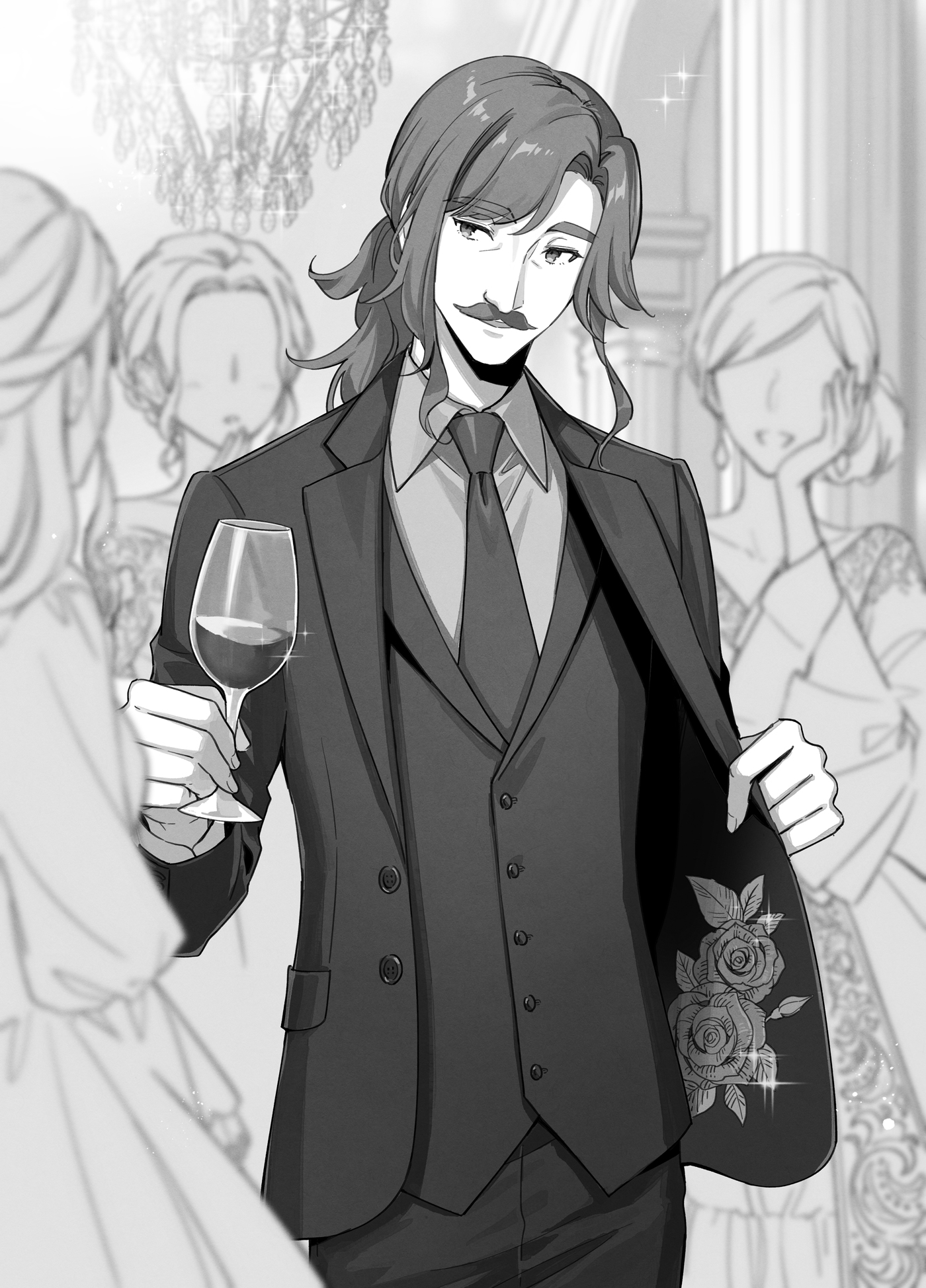
Forto tenderly took the hand she unwaveringly extended, and he mercilessly led her to the middle of the dance floor during the interlude. All the other noblewomen stared, but she pretended they were simply fawning over him.
She had one hand on his shoulder and the fingertips of the other in his palm, and she whispered, “Thank you very much for taking time out of your busy schedule for me, Lord Fortunato.”
“I would abandon my career if it meant a chance to dance with the beautiful Miss Delphina.” The way he said it so smoothly elicited a giggle from her.
“Ms. Lucia put you up to this, I’m sure?”
“Girls sure grow up quickly,” he responded with a smile, causing her to laugh aloud this time.
“You could say I skipped a few steps.”
“How so?”
Delphina and Fortunato danced to a conversation about Lucia—a dance most entertaining.
The two dances with Fortunato became a treasured memory of Delphina’s. Her brother-in-law Kirk that night and her parents the following morning asked about her relationship with Fortunato, which she explained by saying he was a work friend. There was some truth to it—she had received news that she would be sent to Ehrlichia to interpret, and when she was there, she had planned to buy a pile of sartorial literature to send back to Lucia and Fortunato. Her friends had also promised her they would explain and discuss foreign fashion with her over a cup of tea—Fortunato had been the one to tell her, but the idea had come from Lucia, apparently. “There are plenty of fish in the sea—be they men or women!” she had asserted; recalling it brought a smile to Delphina every time. Both Lucia and Fortunato were lovely beyond her imagination.
Delphina would soon be traveling to the neighboring nation. She was sure she would meet plenty of delightful people there. She would live a life of her own, give her work her all, and, if possible, develop a passionate romance. And one day, when she needed a red wedding dress, she would turn to her friends at the Tailors’ Guild.
The Nobleman and Floral Patterns
The Nobleman and Floral Patterns
The Magical Garment Factory was running at full tilt today—a din filled the air, compounded of the rhythmical zipping of the knitting machine, whispers counting stitches, and louder voices performing quality assurance. The large conference room had already been crammed full of knitting machines and their operators, so they had resorted to taking over the room next door as well. Even then, space was running out, and the crates of products that were awaiting inspection had piled up in the hall. The formal Magical Garment Factory building could not come a moment too soon.
“Chief, this order slip came in this morning with ‘100 pairs—super urgent’ scrawled on it. Would you happen to know whom the delivery is for?”
What does “super urgent” even mean? When Lucia took a look at the document one of the stitchers had brought her, she recognized the handwriting from the sketchbooks she’d been looking at. “I don’t know who that order is for, but I think that’s Mr. Forto’s writing. We should be able to ship it out by the end of the day if we take from the stock we built up yesterday.”
“I think that’s going to the support staff at the Beast Hunters’ headquarters and barracks, boss—their vice-captain left not long ago,” Dante chimed in.
“What? Then do we send it to them before the other royal knights?” Priority went to the Order of Beast Hunters; then those involved in the production, who received the few prototypes they could spare; then other chivalric orders; and finally the high-ranking nobility. That the personnel at the Beast Hunters’ building were so high on the priority list shocked Lucia.
“Yes, I think if we can make it in time for the Beast Hunters’ next delivery, then this urgent order is going to miscellaneous workers like cooks and janitors in their building. Once they get theirs, the rest goes to the miscellaneous workers in the castle.”
“Oh, I see—it’s to prevent the spread of disease of the foot.” This was part of the plan to eradicate athlete’s foot, so it would make sense that specific vicinities were being targeted.
“Well, after getting cured by the priests, wearing toe socks, and putting in drying insoles, it’d be—to put it mildly—a real pain in the ass if everyone were spreading it to each other all over again...” Dante said. That would be a frightening situation—if all of it proved to be for naught, then the guild and Dahlia would get so many complaints.
“Come to think about it, our guildmembers and the guildmaster visit the castle quite often to deliver uniforms, sheets, and the like, right...?”
“Is there a possibility they could bring athlete’s foot here?”
“I mean, they keep their shoes on, but they’ll be shaking hands with people there...”
“And they’ve got to use their hands to first put on the shoes. Does that mean shaking hands could transmit the disease?”
“Gosh, now you have me worrying!”
“Hey, everyone? No one’s feet are itching right now, are they?”
The whole room came to a standstill for several moments, then people began speaking to each other in hushed tones. Athlete’s foot wasn’t something you could identify visually, and so people got a little anxious. Even Lucia, who had drying insoles in her shoes, started feeling like there was a tingle at her toes.
“Slack off, and the stock we’ve built up will be for nothing! Less talking, more working!” Zilo commanded. The workers hurried to resume their tasks.
Not long after work started, Lucia was called to the guildmaster’s office.
“It looks like a commission for Head Manager Fano.” Forto, sitting at his desk, handed Lucia an impressive envelope crafted with light green paper trimmed with gold. Its sender was one Seward Chiesa—a name Lucia did not recognize, but he was apparently the head of Earldom Chiesa, the patron house of Viscountcy Volandri. Perhaps he was looking to discuss options for dresses for his wife or daughter.
Lucia waited in anticipation as Forto’s attendant cut open the seal for her. However, while the introductory passage was lengthy, no details about the actual commission followed it. “He wants a private meeting...for clothing advice?” There was so much to unpack here—when were what clothes needed for whom to wear where? And why the secrecy?
“We ought to decline. Earl Chiesa or not, this lack of courtesy toward a guild couturier is uncalled for,” said Forto. It was rare that he became so displeased.
“But he’s an earl—won’t it hurt the guild if we turn him down?” Though viscount of House Luini and master of the Tailors’ Guild, Forto was outranked by an earl.
“We have to be careful as well, boss,” said Dante, with a coffee in one hand. “You never know if he’ll come here with a plan to arrange a marriage between you and one of his sons or to adopt you into his family. He might bring you a pile of gifts and ask for your hand in marriage himself.”
“What?!” That made no sense to Lucia. She was but a commoner with little magic to speak of—to a nobleman, she would make a terrible prospect for either marriage or adoption.
“A young woman who is employed as the head manager of the Magical Garment Factory and is single. He might be expecting to bring you into his family with an offer of patronage and money, and your success and glory would then go to him.” The success and glory from the toe socks and drying insoles? But those were Dahlia’s inventions, not Lucia’s.
Forto added, “The sender is a fifty-five-year-old diplomat, you know?”
“Perhaps he’s seeking a wife for his son?”
“His eldest son is employed at the royal treasury department and his second and third sons are mages at the castle. The only one still single is the youngest.” Of course the guildmaster knew about all of this—he had engagement and wedding dresses to sell. Even so, his memory was frightening.
“The son of an earl and a royal mage? Not a bad deal, boss.”
“Even if we had anything in common—and we don’t—there is absolutely zero chance of that happening,” she struck back.
“Woof, you sure know how to shoot someone down.” After slipping back into a casual tone to jest, Dante took a sip of his coffee.
Lucia recalled the conversation back at the so-called factory earlier. “I was thinking since he wants to keep it a secret, maybe the earl wants to talk about the toe socks and drying insoles? A diplomat has to be prim and proper at all times, so I’m assuming he’s wearing leather dress shoes all the time too...” That was the only reason she could think of.
The men grimaced. “Hm, yes, I suppose that is possible...”
“Boss! Just ’cause someone wears dress shoes in the summer doesn’t necessarily mean they have athlete’s foot.”
“But it certainly is likelier, isn’t it? You wear toe socks too, Dante,” said Lucia.
“I wear them just because it’s hot in the summer—my feet are fine. Besides, you wear them too, don’t you, Mr. Forto?”
“No, I do not.”
“Dante, Mr. Forto uses only drying insoles. And he changes them out every three days.”
“Lucia...” Forto shot daggers at her, although she’d said nothing but the truth. To be fair, he took so many pairs not because he was selling them on the side but to conduct quality assurance on each batch. Both he and Dante wore leather shoes every day, so they really should have been making use of the Magical Garment Factory’s products anyway—anything to prevent an outbreak of that foot disease. “Let us depart from this conversation and return to the matter at hand. We ought to say Lucia has work from which she cannot step away so that we can hold the meeting here at the guild. I shall attend as well.”
“That wouldn’t be very private, though...”
“If I failed to protect my subordinates, I would be too ashamed to call myself the master of the Tailors’ Guild,” he said, as though he were a knight. Whatever he wanted, be it a surprise present for his wife or daughter or a suit to make him feel young, Earl Chiesa needed privacy, so Forto’s presence would make it difficult.
“How about we have him go through the rear entrance, set up the meeting on the third-floor drawing room, and post security in the room next to it? That could give us some peace of mind,” said Dante. It wasn’t a bad suggestion, but it seemed a little extreme.
Besides, there was something else that weighed on Lucia’s mind. “When a diplomat goes abroad, he would want to bring a supply with him, right? He wouldn’t be traveling alone either, so we should have lots of socks in our inventory.”
“Yeah, he’d be traveling with his wife, assistants, and guards, so that’s ten people at the very least. They’d be gone for a while too.”
“Sorry, Lucia, but could I ask you to prepare a hundred pairs each in advance?” With that single request, Forto had the Magical Garment Factory working after hours.
A few days later, Lucia waited in the small drawing room on the third floor. Several guild guards—and, for whatever reason, Dante too—were waiting next door. Forto had gone to the castle to attend to some business, but before he left, he had twice told her to avoid making promises if Earl Chiesa’s request was for anything unsavory, and also not to worry, as the guards would interrupt the meeting if necessary. To be honest, Lucia hadn’t been and still wasn’t worried; she’d rather Forto reward the factory personnel for having produced the extra hundred pairs of toe socks—a real accomplishment—than worry about her. Furthermore, the guildmaster had gained the personnel’s understanding immediately—he had explained the socks were for a diplomat, and it would be unfortunate if Ordine were to be known abroad as a nation with prolific cases of that foot disease.
“Pardon my intrusion,” said the man who entered the drawing room. He wore a black three-piece suit made of silk and a cool-white shirt. His necktie was the color of red wine, and his cuff links were the same. His leather shoes were blackish-brown and polished to a gleam that looked blue. Overall, his outfit was on the slimmer side and had a splash of this year’s trends. It was by no means flashy, but it was subtly stylish. “The name is Seward Chiesa. I thank you, Head Manager Fano, for carving time out of your busy day for me.”
“My name is Lucia Fano, and I am the head manager of the Magical Garment Factory. It is an honor to have been personally selected.”
Seward’s hair looked to be a faded red, and his eyes were a rich brown. Though he was said to be fifty-five, he could definitely have passed as being in his forties given his medium build and gentlemanly demeanor. “I have heard from Miss Delphina about the episode with her dress—oh, I should mention that she is my subordinate and will be joining me as one of my interpreters on the next expedition to Ehrlichia.” It made sense that she would be going abroad as part of the diplomat’s entourage.
“Is that right?”
“I should like what we are about to discuss to be kept confidential.”
“Would that be about clothes?”
“Indeed, I should like to consult you on fabrics and attire.”
“Please excuse me for one moment,” Lucia said before leaving this room and knocking on the door of the next one. She dismissed Dante and the guards, who were pressing their ears up against the wall.
“Boss! He won’t know a thing if you don’t mention it to him!”
“I’m sorry! But he wants to speak about clothes, and I want to keep his secrets safe.” She apologized to the bewildered guards and the disgruntled Dante, then returned to the drawing room.
Seward was visibly bothered; if they could hear the conversation in here, then obviously, he had heard their conversation over there. But just as Lucia was preparing to apologize, he did so first. “I pray you forgive me—when I heard ‘head manager,’ I had not expected to be meeting with a woman of such youth. I promise that there shan’t be any evil or malice in what I want to discuss, and I ask that you invite your knight or attendant to join us if doing so will provide you comfort.”
“No, this will be fine! I apologize for the rudeness as well,” she said. “Now, how may I be of service?”
“Very well, I would, erm...” His difficulty in getting his words out suggested a range of unsavory possibilities—perhaps that he wanted dresses for a mistress or a love child; Dante had said that such requests weren’t uncommon with couturier workshops around the capital, so maybe it was now her turn. As Lucia’s imagination ran wild, Seward continued. “Though a man, I should like to wear beautiful, exquisite clothing—is that queer?”
“No, not at all. In my opinion, to want to wear something beautiful is to be human. Gender should not obstruct someone’s honest preference for shapes and styles.”
The question was something of a letdown. Lucia had had consultations with people who wanted clothes in order to be well liked, to improve their image, and even to embody abstract concepts—this was a much simpler matter. This was the Kingdom of Ordine. Neither age nor gender had much effect on one’s choice of clothing, nor were there punishments of any kind for outré attire, though some prejudices unfortunately remained. In Lucia’s grandmother’s time, hardly anybody had cross-dressed or worn splashy clothing, leading to a consensus about what people “ought” to wear among the older generation. Even today, it was not rare to hear stories of people arguing with their parents or grandparents over clothing. Maybe that freedom of expression had yet to become ingrained in the minds of Seward’s generation.
Lucia continued, “What you are wearing right now is very beautiful; the color combination and the cut are both absolutely wonderful. Your bluish-brown shoes are very summery.”
“Thank you. I must say I appreciate your outfit as well—the balance of colors is delightful, and the way the different fabrics intermingle is very playful, refreshing, and fitting for the season.”
“Thank you very much for your kind words!”
Today, Lucia had on a blue casual dress with a collar and elbow-length sleeves. On the bodice, the section between the shoulders was made from a light blue fabric. The peplum was blue, but about seven centimeters below the knee, the skirt terminated in a flounce made from that same light blue fabric. It gave the appearance of two distinct layers, though they were sewn together for that refreshing summer look. Forto and Hestia had raved about the dress when they first saw it, but she hadn’t expected the gentleman before her to do so as well. She offered him the tea on the table, and both of them took a moment to breathe.
It was Seward who ultimately broke the silence. “I understand I am repeating myself, but do you think beautiful clothes—floral-patterned fabrics, for instance—belong on men?”
“Absolutely. Many men want to wear clothes with beautiful patterns or intricate details. Many women want to wear handsome styles or something that packs a punch. It’s all a matter of taste.”
If florid clothes were your thing, then wear them—though there were a decent number of those more conservative citizens of the capital who would consider it garish. They were affordable now, but floral print and other complex patterns had once been luxury goods fit only for noblewomen, and perhaps that was one reason that sophisticated menswear today—though she had seen heraldic achievements, swords and shields, ivy, feathers, and more—still didn’t feature flowers much. Maybe Seward’s line of work was more conservative and patterns were hard to wear, or maybe his family had told him that he looked weird in floral print.
“A matter of taste, you say?”
“At least, that is my opinion. Of course, there are certain elements that may or may not work with certain people, and there are those who must wear specific clothing for work. But otherwise? Why shouldn’t someone wear what they like? A departure from the usual might be a good thing.” If the occasion didn’t enforce a dress code or uniform—say, when you were relaxing in your own room—you should have the freedom to choose what you wear.
Lucia certainly didn’t want to discriminate by gender, but there were indeed styles, patterns, color combinations, and other peculiarities that may not look good on someone. Everyone’s height and build were different, and so were the colors of their hair, skin, and eyes. A garment’s shape and color may suit some but not others, and floral patterns were the same way—the size of the flowers and the warmth of the tone made a large difference. Ultimately, Lucia believed that a clothier’s work was to enhance the client’s individuality, beauty, and comfort while fitting what they were trying to accomplish and the image they were looking for.
“Yes, that is a very fine point. For instance, would it be possible to adopt these? I should not mind wearing them outside of my work.” From his leather briefcase, Seward took out two rolls of fabric. The first was in an ivory color with little flowers in pale blue and yellow—very refined. The second was black stitched with fist-sized roses. Not only did it have red for the petals, the leaves were intricately depicted in shades of green. The fine needlework was gorgeous and elaborate.
“The colors on this example are exquisite. How about a shirt for wearing in the comfort and privacy of your home?”
“Would that be possible? However, I am a little hesitant.”
“About what your family may say?”
“No, it would not be a problem if I wore it at night, and my wife is understanding. My trepidation lies in the fact that I am conscious that a man like me wearing something so heavily decorated might be seen as lavish and wasteful...” It was as though there were chains and locks binding Seward. A man ought to be like this, this wouldn’t suit me—these fetters were not unlike the ones that had bound Lucia when she was a young girl.
But to give up here would have been boring and, most of all, shameful. “Is our nation so poor that men cannot afford to decorate themselves? It is said the Kingdom of Ordine is the wealthiest nation on this continent,” she said, striking back.
“You are most correct—we certainly are not lacking. I have heard that people during my grandfather’s time had difficulties surviving winter, but Ordine now has ample food. Neither citizens in the capital nor farmers in the villages die of starvation—this abundance we enjoy should be a point of pride when we compare ourselves to other countries.”
“And isn’t being able to have patterns and beautiful clothes you love something we should be proud of? I mean, age and gender don’t have anything to do with being thankful for and enjoying that luxury. That is, erm, well, we’re fortunate to have been born here in Ordine and all that.” Lucia was desperate to find the words to get her point across, but her explanation didn’t have any modicum of eloquence.
Seward remained silent for some time before finally giving her a determined nod. “I should like to use this for my nightclothes; perhaps it might bring me pleasant dreams.”
“How about the black one for a waistcoat?”
“That is certainly an interesting proposition, but it may be difficult to wear during the day...”
“Limitations related to your work?”
“A black three-piece suit is standard,” he said. “Pardon me; I should have mentioned this at the beginning—I serve as a diplomat to Ehrlichia, meaning that I spend half the year abroad being rocked aboard a ship or carriage.” His hesitance wasn’t unfounded—someone in his position had to be a little more conservative in their dress. In neighboring Ehrlichia—and as well as Išrana—men and women wore different clothing.
Anyway, spending half a year away from home seemed tough. “Your work must be very taxing...”
“I am most grateful for my position. But my desire to have something beautiful like this at hand burns ever brighter when I part from my homeland. Perhaps it soothes the soul or calms the nerves, but just the sight of this beauty makes the heart gay.” Travel from Ordine to Ehrlichia was either by sea voyage or a long carriage ride, and though both options were now safer than they had been in the past, it wasn’t unusual for monsters to appear along the way; the physical toll was there, but the mental one was just as great—the floral pattern must’ve brought Seward comfort.
“Definitely! Having something I love with me fills me with joy as well.”
“You understand me completely!” The man’s smile was broad, but that expression gradually took on a tinge of anguish. “Though some may have more difficulty in doing so, you see...”
“You worry what others may think?”
“Yes, that is part of it, but also, erm, it brings to mind something else: ‘Something so flowery is disgraceful for a man,’ my father once said. I was still a child, and that floral pattern was simply on my favorite handkerchief...”
“For what it’s worth, I think a floral handkerchief is beautiful.”
“Much was divided between genders during my father’s generation. Well, I suppose much of my anxiety has sprung from my own head as well. Although I worked up the bravery to come here after I heard about you from Miss Delphina, I still lack a spine.” The man brought his teacup to his lips in an attempt to hide his sigh.
Lucia ached for him. Her client had mustered so much courage to bring himself before her; how could she possibly send him home having gained nothing? She needed to find a way to ensure he wouldn’t look odd or out of place, and she racked her brain as she stared at the floral fabric—that red rose on a backdrop of black might look fantastic on a gown. “How about using it as lining for yourself and to make a dress for your wife? You could have matching outfits.”
“How do you mean?”
“I’m thinking if you wore a single-breasted jacket unbuttoned, people could appreciate the lining as well. If others ask, you could say that you and your wife have matching pieces, and they would understand it as your expression of love for her.”
“Hm. An expression of love...” Seward parroted her words; maybe it was too far-fetched an idea, though matching outfits were popular among common folk.
“I’m terribly sorry—I am just a commoner, so I don’t know how a nobleman such as yourself may see it; to me, though, wearing something matching with one’s partner is very romantic.”
“I see, I see. To be able to enjoy the same fabric and pattern, though my wife and I shall be separated, is indeed quite romantic.” Thankfully, he shared her opinion, and his expression gradually softened.
And then, for whatever reason, Lucia just had to say, “Isn’t it?! When I find someone one day, I’d totally wear matching outfits with—” She clamped her mouth shut. Yes, it was true that she’d like to share something cute like that with her partner one day, but why did she have to run her mouth and talk about herself like that? It wasn’t like she had any plans to start dating either.
After trying his best to stifle a laugh, Seward cleared his throat. “A charming lady such as yourself would have no trouble finding love. Oh, yes—I am certain you have many candidates, but perhaps you could put my youngest son Stefan at the bottom of that list? He is a royal mage and he is single.”
Good thing Lucia wasn’t sipping her tea—she would’ve spat it all out on his face. His joke was a little difficult to digest; maybe noblemen were prone to teasing like this, given her experiences with Dante and now Seward. She couldn’t find a proper response, so she simply laughed it off.
“In any case, that is a wonderful idea, Head Manager Fano. I should like you to make nightclothes, add the lining to my jacket, and design a gown for my wife, please.”
“Certainly! Thank you very much!”
Thus, on the inside of his black suit jacket, red roses had been planted and were set to bloom.
As Seward was about to leave, Lucia crammed a large crate full of toe socks and drying insoles. “A gift for you—please open it after you return home. There are instructions included. I hope they will be useful to you during your trip abroad,” she said with a smile. He looked a little confused as he accepted the present. A few days later, while in Ehrlichia, Seward returned the favor by sending a delivery of top-quality horsehide—enough to trim the interior of a coach. The material was perfect for making leather shoes, but some time would pass before Lucia was troubled with the question of how to distribute it.
“To your success abroad!” Swankily dressed nobles clashed one another’s drinks together, letting their glasses ring—this tradition, which “cleansed demons,” was mandatory after a toast in the Kingdom of Ordine, be it with wine or any other drink in hand. In Ehrlichia, though, glasses were not to be clinked; rather, they were to be held up at eye level. As he took a sip of his red wine, Seward reckoned that once on the other side of the border, he would seldom hear this shrill noise.
Tonight was a cocktail reception—a chance to meet new people and to share information, in other words. The guests at his estate in the capital were all members of the same faction; they made for the perfect audience as he rehearsed wearing clothes that he enjoyed.
A couturier named Lucia had added a lining to his jacket. Though it looked no different from the outside, it wore a little heavier on the shoulders. His heart had raced the day he first put it on, but it hadn’t taken long for his doubts to catch up to him. Can I truly wear something like this?—his anxiety stuck to him. The cobalt-eyed couturier must’ve anticipated this predicament, as tucked in the pocket of his jacket was a pale blue handkerchief embroidered with little azure flowers; feeling that tender support, like her small hands pushing against his back, he could but smile. The couturier held the title of Head Manager, and young though she was, there was no question that she deserved it. Seward would honestly love for her and his youngest son to meet just once; recalling that smile she had given him when he broached the topic—that resolute refusal—was heartrending.
But now it was time to gamble on the game that the couturier Lucia had set. Red roses bloomed beautifully inside both front panels of his jacket; he dearly loved them.
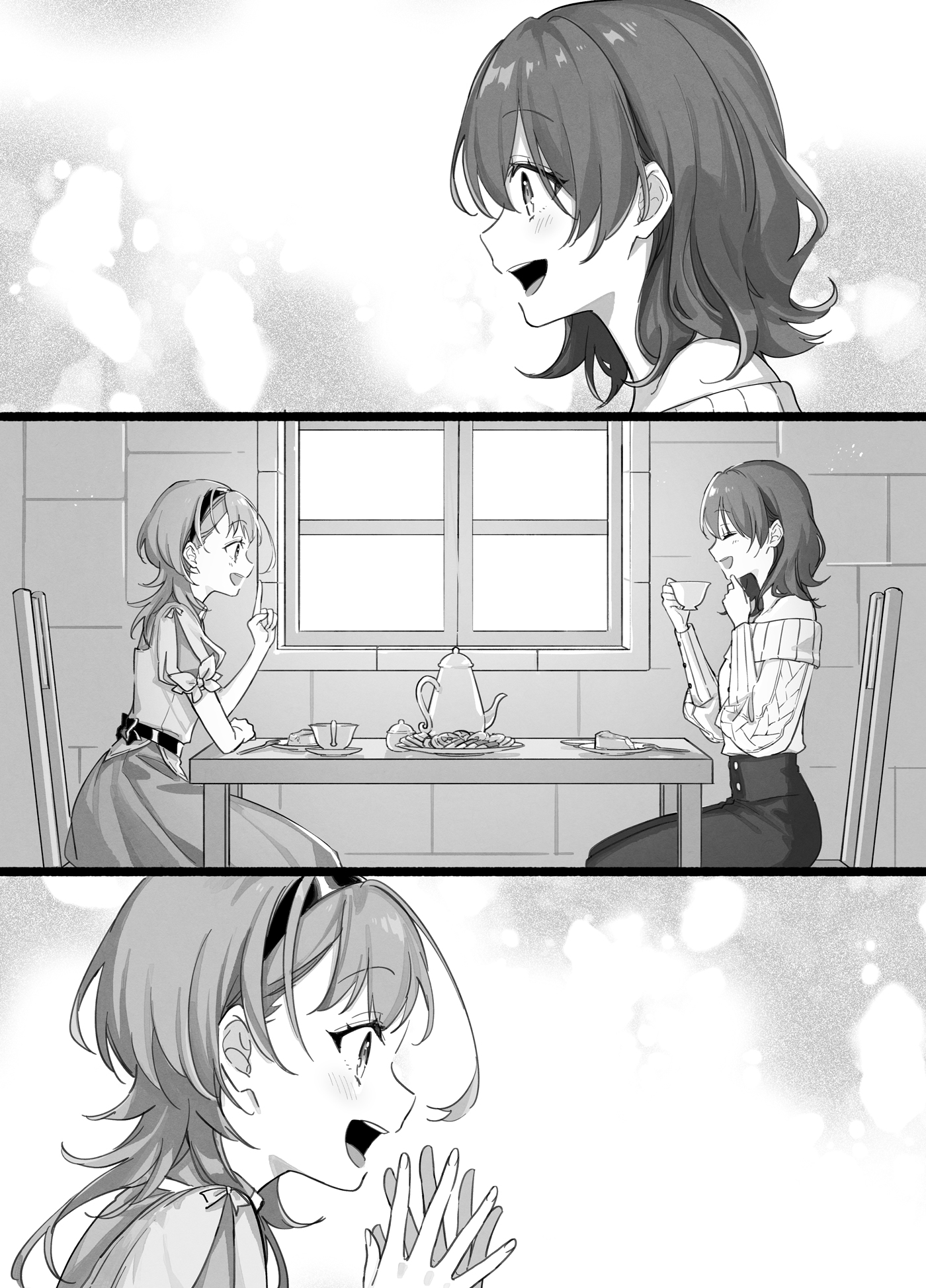
The noblewoman standing beside him must’ve had very sharp eyes. “My,” she muttered to herself before speaking in her normal voice, “your jacket is superb, but the lining is especially charming. By whom did you have it made?”
“It was by a couturier with whom I am acquainted. You see, this lining matches my wife’s gown,” Seward said, showing off the smile that he had cultivated as a nobleman and diplomat. The extent of matching items between a married noble couple was limited to bracelets, rings, and earrings, though gowns and tailcoats may share the same fabric and color or one might wear an accessory that was the same color as their partner’s outfit. It would not be a surprise for anyone to be surprised at a man like Seward wearing a jacket with the same floral pattern as his wife’s clothes.
As expected, the noblewoman opened her eyes wide in shock. Was she going to give him a compliment laced with poison? Was she going to laugh outright? As he prepared for the worst, she clasped her hands in front of her chest and beamed. “Oh, how absolutely wonderful! I ought to have my husband do the same with me.”
Another noblewoman’s voice was filled with envy. “That you cannot bear to be parted with her, that you wish her never to be far from your thoughts—I can tell just how much you must love your wife!”
“Y-Yes, I suppose that is true...” Seward could not and would not deny his love for his wife, but he hadn’t expected words so schmaltzy.
“I would love to press you for more details!”
“The embroidery is so very beautiful! May I know who made it?”
“What a lovely pattern! You mentioned that your wife has a dress with the very same?”
Before he knew it, a throng of noblewomen old and young had approached him; Seward had not been surrounded by so many women since his debut as a young man—though it must be said that in that case, they were all his relatives. He chose his words deliberately and explained the lining on his jacket and how his wife was recuperating in the territories—his younger brother ran the earldom single-handedly, and she was in the countryside with the sister-in-law at a thermae to beautify their skin, so “recuperating” could hardly be considered incorrect.
“My wife will be visiting the capital before long, and if you ladies are planning on a gathering, I hope you will please keep her in mind.”
Let it be known that everything Seward had said, from the story about recuperating in the territories to this request, had come from the creative mind of his wife. He had felt guilty about all the clothing business happening behind her back, and so he had sent her a letter by pigeon and received back a letter with the machinations spelled out in words as fine as wheat berries. She had been famous for her brilliance since her college days, but even having known her as long as he had, he was impressed anew. She had also expressed concerns about a floral gown being ostentatious for her, but the couturier Lucia had already prepared for that possibility, and the design was very contemporary, with only splotches of the embroidered fabric. The earl had shown the countess, and with her approval, work on the gown had been set into motion.
Truth be told, Seward could not wait for his wife to return to the capital. More than anything, he wanted them to be dressed in matching outfits as they sipped on drinks, reminisced about their past, and spoke of their forthcoming journey to Ehrlichia.
He glanced at the lining of his jacket, and a smile welled up from the bottom of his heart.
“Can you imagine how much love he has put into the lining?”
“I envy his wife...” Similar words and sighs were sprinkled throughout the evening.
The man kept to himself but would fondly smile whenever he looked at his jacket—though his wife was not in attendance, his love for her was ever present. Despite being an earl, Seward had but the one wife—in Ordine, where one could have a second, a third, and even lovers outside of marriage, how true to her was his heart.
The other noblewomen weren’t envious of Seward but his wife, although some noblemen understood his feelings too. “Beautiful flowers on the lining is a great way to prevent any cheating from happening.”
There were those of a different camp too. “It must have been his wife’s idea to make herself known to everyone he meets.”
“No, it has to be her admonition against him sticking his nose in other flowers.” The debate continued over flowing alcohol.
But because the design was so versatile, there were soon many more requesting the same. Men’s evening dress and suit jackets lined with beautiful flowers bloomed everywhere. The custom of casually wearing the same thing as a couple or as sweethearts was just elegant enough to become popular among the nobility. As such, the Tailors’ Guild became swamped with work, and they then dealt in many varieties of floral-patterned fabrics and even increased their production.
Later, it would become a trend for noblemen who were single to choose floral linings for themselves. To pretend as though they had partners only made them less likely to find love, but in time, it would become a source of pride. Before long, nobles of all genders would wear jackets lined with all kinds of patterns. Finally, vests and shirts would be made with these bright patterns on the outside—but that wouldn’t be for quite some time.
The Couturier and the Inexpensive Dress
The Couturier and the Inexpensive Dress
Turning the clock back a bit—after the Magical Garment Factory got their head manager and just as things started to calm down, an old friend visited the Tailors’ Guild needing a new gown. She had heard that Lucia now worked there, so she reached out to the clothier. Lucia headed down to the small drawing room, where she was to reunite with the young lady.
“Lucia! It’s been too long!”
“Good to see you again, Luna—sorry, Lunetta.”
“Oh, you can still call me Luna if you want.” Taking Lucia’s hands into her own was a petite young woman with brown hair and a big smile—Lunetta Calega, daughter of Baron Calega. Despite their noble status, their family business was horse breeding. Their horses were so cherished by the royal orders that both Lunetta’s father and grandfather had been conferred baronies.
Lucia, Dahlia, and Lunetta’s elder sister had entered primary school at the same time, and they had often studied together; Lucia especially had taken many elective courses together with the sister, and so they had been very close. The clothier had twice visited the Calegas’ home, located along the eastern highway, and she remembered being surprised by just how vast the ranch was. At that time, Lunetta had been quite little, but even so, they had all played together. As an adult, the elder sister had gone to Ehrlichia as a bride, leaving the family business to Lunetta.
It seemed that Lunetta had now been engaged to a young man who worked at the ranch. They had known each other since they were children, and as far as Lucia could tell, they were the best of friends. Later this month was Lunetta’s debut—albeit a little late, as she was now eighteen years old—and she was also preparing for her engagement announcement next month. She mentioned that she had never planned to participate in a debut, but as she had been conducting business with more nobles recently, Lunetta had also received more marriage proposals. After discussing with her patron house, they had decided that she would have the debut, then immediately announce her engagement.
“Oh, gosh. They’ve been sounding you out on marriage even though you’re engaged already? Unbelievable,” said Lucia.
“Right?! I was shocked as well. Even more shocking was the breadth of choices—I had my pick of people from ten all the way to forty-one years old...” Why give her any choices at all when she’d already chosen someone?
“That’s ridiculous!”
Lunetta burst out laughing when Lucia made an exasperated noise. “I never planned to take up the family business, but I didn’t have much of a choice after my sister went to be married and to work on a ranch in Ehrlichia.” After primary school, Lunetta’s sister had spent a year studying Ehrlichian like mad, then gone over to train as a horse breeder. She had wanted to learn more about horses there, but then she fell in love with sleipnirs instead.
“I did a triple take when I received her letter saying she was going abroad to marry a sleipnir breeder.”
“We were the same way. What worried our mom more was that my sister wrote a whole book about sleipnirs before mentioning anything about her fiancé.”
Apparently, Lunetta’s sister had found love during her apprenticeship at the ranch, and she had chosen to stay there to marry the son of the rancher. But Lucia, too, had only found out about that after learning about how great sleipnirs were. “What about your dad?”
“He went straight to Ehrlichia after getting the letter. His excuse was how worried he was for my sister, but we all knew he just wanted to see the sleipnirs.”
“And what about you, Lunetta?”
“I wasn’t worried at all. That’s just the type of tomfoolery my sister is prone to, you know? The one who was the most surprised was him—finding out he would now be inheriting the ranch with me sent him into a great panic,” she said, howling much like her sister. Lunetta then spent some time explaining her recent situation, and then they finally discussed the gown.
For her debut, she’d brought her own fabric to be sewn into a classic gown and dyed pink for her engagement announcement—a humble request. It wouldn’t be fully made to order either; they would find a preexisting pattern that suited her physique, then use that in sewing her gown. Then, the day before the event, they would give it a final fitting. The gown was on the looser side so she could wear it whether she gained or lost some weight. Change its color or modify its shape, and it would be a dress that would last a long time. It was something befitting the daughter of a baron as well.
“Forgive me for keeping you waiting,” said Forto, who had just entered the room. Lucia was shocked to find him here. She had heard the person in charge of this project would be coming, but it was hard to believe they’d have the guildmaster handle a dress that wasn’t even bespoke. Maybe Lunetta and Forto were relatives.
Lunetta replied, “It is good to see you again, Lord Luini. How is your father’s horse?”
“No finer a horse—she listens so well.”
Ah, so that’s how they know each other.
“Lucia, Lord Calega is to be thanked for the horses my brothers ride at the castle and the ones at our home as well. The horses he raises are so clever, they make me question whether they don’t understand human speech,” he explained. Lunetta’s father was nicknamed the Equestrian Baron—it was obvious where he got it from. Forto continued, “Now, Miss Calega, may I see the fabric you have brought here?”
Lunetta opened what had been wrapped in white cloth—a long wooden case containing a bolt of white silk.
“Forgive me for being so direct, but this is grade B silk, correct?” he asked as he looked at the case, which was branded with the grade of the silk. The fabric was still rolled up, so its defects weren’t easy to identify, but once it was spread out, they would become fully evident: it might be less shiny than top-grade silk or have visible damage and creases.
“That is correct. It is something my betrothed gave to me, so I am hoping we can use it.”
“I assume you understand that debutantes are judged by their gowns?”
“Yes, I have heard as much from Madam Goodwin from our patron house. Though my father has been bestowed a barony, we are originally commoners, and we raise horses for our livelihoods—I understand that we are reaching beyond our means. However...”—Lunetta turned bashful as she looked at the silk—“this is from my one and only betrothed.”
Though it may have been grade B, it was thick, definitely not cheap. It was what a young ranchhand could afford. Lunetta wore on her left wrist a less-than-gleaming silver engagement bracelet with a small green gem, but what was brilliant was the love between the couple. It was surely enough to make others envious of what they had.
“Very well. May we have the liberty of processing it to make it easier to sew and handle?” asked Forto.
“Of course. Thank you very much for doing this for me.”
He quickly filled out the paperwork in his hands. Normally, fabric only received one enchantment, but under the relevant section, he put down “luster” and “strengthening.” Enchanting something twice was supposedly more difficult, but Lucia was sure the in-house mage would do a good job. She looked forward to the results.
In a few days, the fabric had been processed, and after cutting, Lucia took part in sewing the gown under Forto’s supervision. The newly enchanted cloth had a distinct sensation to it—it warped and was much harder to pass a needle through, so there was a learning curve to the sewing. Lucia switched over to vegetable juice for lunch, then, claiming that she needed more practice, she got permission to work on the dress during her break. There were no corners to be cut with a simple gown like this, so the finished product would show the stitcher’s skills. She was nervous, but with her wishes for Lunetta’s happiness going into every stitch, the work was so much fun.
In the days following, the Magical Garment Factory had become busier, and Lucia had continued making gowns for young noblewomen and providing consultation to noblemen, as she had expected she would. What she had not expected in the slightest was that she would end up here today.
Dangling from the three-story-high ceiling were magical chandeliers, bathing the vivid mural of the first king and queen consort, knights, and mythical beasts in warm golden light. The wide-open windows put the colorful flowers in the garden on full display. The red carpeting around the dance floor muted footsteps and mellowed the orchestra. This was a prime example of a noble’s mansion.
Today’s debut was hosted by a marquisate for their beneficiary houses and business partners. The debutants and debutantes numbered six young people from various baronies. Nobles of all ranks, from dukes to barons, were in attendance. Naturally, the purpose of the event was to introduce the young people making their debuts, but it was also an opportunity for others to meet for business and for parents to introduce their marriageable children to each other.
“I’m really sorry for dragging you into this, Lucia...” said Lunetta, terribly apologetic.
But the clothier smiled, saying, “Don’t worry about a thing!”
Lucia was here today in a matte navy dress with matching evening gloves, acting as Lunetta’s attendant—originally, Lunetta was supposed to come with an older gentleman who helped manage the Calegas’ ranch, but he had thrown out his back at the last minute and was currently unable to stand. His wife had also come with him to the capital, but she had to take her now-incapacitated husband to the temple, and even if he hadn’t required her assistance after his treatment, she wasn’t familiar with aristocratic etiquette.
Apparently, a female attendant was acceptable too. The role involved keeping the bouquet that each debutante would receive in the beginning and standing by the wall to watch over Lunetta—Lucia had figured that if she only had to do that much, she should be able to handle it, and she had borrowed her outfit from the Tailors’ Guild. Ever since finding out that she would be going to the castle, she had been learning the very basics of etiquette from Hestia, and however superficial her education may have been, it would come into play today. Not to mention, this was a noble’s dance party—fancy outfits galore—there was no way Lucia would have let this chance slip past her. It wasn’t out of the goodness of her heart; if anything, she should have been the one apologizing to Lunetta.
“That gown looks amazing on you! You’re so pretty!” Lucia whispered into Lunetta’s ear.
Lunetta put her gloved hands to her blushing cheeks. “Thank you for making me something so wonderful. I can’t wait to show him when he comes to the capital.”
Come on, don’t be gushing about your fiancé before your debut begins—or, actually, it might help repel unwanted solicitation, so gush to your heart’s content.
But Lunetta truly was stunning today—in a white princess gown that revealed the shoulders. It wasn’t a trendy shape or very decorated, but every step she took made her flared skirt shimmer a brilliant white. The fabric was so shiny that no one would suspect it wasn’t top-grade silk. The way those white evening gloves gingerly embraced the bouquet of white flowers was beauty in form. Just years ago, she and Lucia had frolicked in the grass of the Calegas’ ranch; Lunetta had been a cute little girl. Standing here now, though, was a noble and a woman—how moving the sight of her was.
Then a whisper came from beside Lucia. “Yo, boss. How’s it going?” asked Dante in a black tailcoat.
“Good evening, Lord Dante.”
“No need for formalities, boss. I’m just a viscount’s good-for-nothing son before the head manager of the Magical Garment Factory,” he said flatly. On the contrary, Lucia was only some attendant today—should he really be mingling with her?
“Are you here for work or for family today?”
“Family. ‘Grow up and settle down already,’ they said. Well, it wasn’t like I had other plans, so I’ll wander around for a bit, then make myself scarce.”
She glanced at her disinterested subordinate. A standard, reliable black tailcoat, swept-back hair in a green so dark it looked black, seafoam-green eyes—attractive for sure, but his usual dress at work was much more himself.
“Excuse me, Lucia, but could you please take the bouquet?” It seemed that the first dance was beginning.
As Lucia took the white flowers, Dante spoke up. “My name is Dante Cassini, assistant manager of the Magical Garment Factory and a subordinate of Head Manager Lucia,” he said, greeting her. “Miss Calega, may I ask you for a dance afterward?”
“If you do not mind someone as inexperienced as myself, I would be most delighted to dance with you.” She gave him a sweet, innocent smile and then was escorted away to the dance floor by the viscount, the head of her patron house and her partner for her post-debut first dance—indicating to all else that he was her supporter. Lunetta had said that she and her fiancé had had their true first dance at the ranch in front of family, friends, and horses.
“Innocent, and a great shape from the back too...”
“Dante, Lunetta has a fiancé already.” Just for his information; she was certain that Lunetta wouldn’t so easily be swayed and that Dante wasn’t the type to be pushy, but Lucia didn’t want things to get awkward either.
“You know, boss, I was talking about the dress...” Welp, so much for things not getting awkward.
The first dance began and ended, and the whole time, Lunetta looked so comfortable on the dance floor. Joining in for the second song were gentlemen in tailcoats (glossy and matte; gold with silver trimmings; different fabrics for the collar and sleeves; and slim fits) and ladies in gowns (reds, blues, yellows, and all other colors of the rainbow; whites and off-whites; gradients; flowers, butterflies, and other patterns; beads and bijoux; intricate lace; and novel cuts on the back). Lucia was so glad she was here to witness this treasure trove of outfits. As one might have expected, their accessories tended to be crafted from the most precious of metals, but there were also ones cut from large pieces of glass and long necklaces and earrings; as the nobles moved about, their jewelry shimmered and sparkled, like flowers swaying in the breeze—the illusion was definitely strengthened by the colorful fresh flowers in many of the dancers’ hair. Frankly, Lucia would have loved to open up her sketchbook, spy on them with binoculars or get up close and inspect them from head to toe, or even cop a feel. Of the fabric.
When the third song came on, pairs of men and pairs of women took to the floor. This was a uniquely Ordinato tradition that other countries supposedly didn’t do; those here could dress how they wanted and dance with whomever they wanted, and so there were white gowns with white gowns and black tailcoats with black tailcoats. Nobles regularly danced in this manner in order to strengthen friendships as well. If they weren’t couples, the men would chat as they danced to see who’d run out of breath first, and women would gracefully dance as they complimented each other—sometimes truthfully, sometimes sarcastically, Lucia had heard from Dante. Just the idea made her head ache. Especially on a day like today when everyone was having their debuts, she would rather everyone just have fun.
The fourth song began, and Lunetta and Dante partnered up. Both of them were very skilled, and their smiles suggested they were enjoying their conversation too. Though Lucia couldn’t dance, it was plenty of fun to just watch. The two of them returned to the table by the wall when the song ended.
“Would you care for a beverage?” Lucia asked, much like a real attendant would.
“Sparkling water, please.” After she took the glass, Lunetta dabbed at her forehead with a handkerchief; she must’ve been quite nervous.
Dante said nothing, but Lucia handed him his drink of choice—dry red—and he nodded in thanks.
As an attendant, Lucia was to have nothing to eat or drink during the event, but she planned to hit up a favorite crespelle stand on her way home tonight.
“Congratulations on your debut, Miss Calega. Is everyone at home well?”
“Thank you very much for the kind words. They are well, still taking care of the foals.”
“Your gown tonight is splendid—it really brings out your charm.”
“That’s very flattering. Thank you.”
Lunetta had planned to make her rounds, but people were coming to her first. They celebrated with her, asked her about Baron Calega, talked about horses, and lastly, without fail, complimented her and her dress. Lucia figured it must’ve been what people did at debuts, but that was not so, Dante explained quietly. He also commented that Lunetta was very courteous and that word of her dress—a classic shape that didn’t chase the trends, made from cloth that had been a present from her fiancé—had reached many ears. She didn’t publicize herself, but Dante had realized what had happened after speaking with her patron, the viscount. There were those in attendance who had previously offered her marriage proposals or made advances on her, and the viscount wanted to keep them in check. As a result, Lunetta’s name was now on everyone’s lips.
She and her commoner fiancé were deeply in love with each other, and no nobleman of any rank could get between them. It was true that they needed to tend to a foaling mare, but that neither her father nor her fiancé were here today did little to dishearten her, and she was ever polite to everyone. That being the case, many of the other guests were whispering among themselves about how they would love to have her as a bride for themselves; this was one thing nobles and commoners had in common. Lunetta ought to skip the engagement and jump straight to getting married, thought Lucia, as she followed her mistress, who finally began going around to greet people.
Wherever Lunetta went, a small circle was sure to form around her. Yet, despite so many conversations to keep up with, she would never fail to introduce Lucia and to explain how she’d called up the couturier and leveraged their friendship to have her gown made in such a short time, after which she would always thank Lucia. Lucia hadn’t expected the captain of the Order of the Beast Hunters to be here, let alone that she would have the chance to introduce herself to him.
“Are you doing okay, Lucia?”
“I am, but more importantly, are you, Lunetta?”
“Oh, this is much easier than helping a mare give birth, you know?” She had the composure to joke and laugh as she approached the next table, but she needed much more help in the comparison-making department.
“What an endearing young lady. It is by no means flattery when I say I wanted you to marry my grandson.”
“Lord Calega must be so proud. Speaking of whom, where is your father?”
“One of our mares is foaling today, and so he could not make it,” Lunetta explained to a pair of nobles.
However, from somewhere in the distance, someone’s voice interrupted their conversation. “My, to prioritize a horse over his own daughter...” That voice belonged to a young noblewoman in a bright red dress with golden beads and an extremely mature plunging décolletage that drew gazes of all sorts. However, the woman inside was little more than a brat. “Oh, what a cute dress—it reminds me of what my grandmother wore as a debutante,” she continued in a louder voice coated in poison.
Lunetta didn’t so much as flinch; instead, she politely thanked her for the compliment, then continued making the rounds—an expert move by all counts. But that noblewoman must’ve perceived it as a slight. As Lucia was busy speaking with some Beast Hunters, she failed to notice what happened next.
“Oh, no.” Hurling toward Lunetta’s dress was a splash of crimson. Although Lunetta had given her a wide berth, that noblewoman had deliberately passed by her with a glass of red wine and tripped over nothing in particular. “Sorry. I stumbled.”
Following up on that apology devoid of the slightest hint of regret, a young nobleman a few steps behind her said, “How careless, Frandine.”
Lucia’s blood boiled. No, wait, I can’t snap at them. That would simply bring more trouble to her mistress, so she gritted her teeth.
“Perhaps you could go change clothes?” the one called Frandine said.
“I haven’t brought another with me...” replied Lunetta. She wasn’t the bride on her wedding day—why would she have a second gown? Maybe others thought Frandine was being absurd as well or maybe they were drawing a lot of attention, but people around began whispering to each other.
“My, not a single one? In that case, I shall pay for your dress. Perhaps you ought to have a more expensive one made anyway.”
The gall of this bitch! Lunetta was cute and beautiful, and her gown suited her perfectly—she had been so excited about getting to show it off to her fiancé! How dare Frandine walk all over that?! As Lucia balled her hands into fists, someone from behind gently placed a hand on her shoulder.
Dante said in a voice so quiet that only Lucia could hear, “You’re an attendant today, boss. Choose your battles wisely. Talk to Mr. Forto first before—”
There was nothing incorrect about what he said—she was a clothier, an attendant, and a mere commoner at that, but given that first label, there was something she could do. Lucia took a deep breath and stepped up beside her mistress. “Excuse me for interrupting! My name is Lucia Fano, attendant and clothier. Forgive me for questioning you, but may I hold you to your word about the compensation for making the gown?”
“Sure. I shall even pay you to make a better one, but, well, I’m not so sure if that would suit her,” Frandine said, lording over Lucia by lifting only the corners of her mouth.
So far, Lucia had lashed out because of the indignity toward her mistress, but what she was about to do was retaliate against the indignity toward herself, the couturier. She collected herself and worked her head as hard as she could.
“I’m sorry, but would it be possible to get that in writing? I, um, have only recently started working at the Tailors’ Guild, and this is one of the first gowns that I have worked on, so I don’t have a lot of money to spare between my paychecks...” Lucia pleaded mousily. To be fair, none of that was factually incorrect by any stretch—she hadn’t worked at the Tailors’ for long, she had put a few stitches into the dress, and she really didn’t have that much in savings—all she had done was fail to mention that the Magical Garment Factory had nothing to do with the dress. None of the people around Frandine had told her, so the workshop was probably not that well known.
“But of course. Your monthly expenses must be quite the burden.” The less-than-noble noblewoman smiled; she must’ve assumed she would be paying in installments.
The clothier smiled back. “I hope I’m not being disrespectful, but ought you consult your family first?”
“Wholly unnecessary. I shall personally reimburse you.”
“As expected from a lady of an outstanding family!” Outstandingly churlish, as they had failed to teach their Frandine any manners. “I apologize in advance that I may need some time before I can give you the final figure.”
“No worries. Just send it to earldom at a later date.”
“Thank you very much for your generosity!” Lucia smiled most genuinely. She had Frandine’s word—no takesies-backsies now.
The noblewoman immediately called a manservant to prepare pen and parchment, and Dante filled in the document. Then, in quite the elegant hand, she put her autograph at the bottom: Frandine Elnora. It turned out that she was the daughter of Earl Elnora, which was a relief for Lucia—there was water to be drawn from that well. Once the paperwork was complete, Lunetta went to the marquis—the host—and the viscount—her patron—and apologized for having to excuse herself.
As the trio headed back to the Tailors’ Guild in a carriage, Lucia was blessed by Lunetta and Dante’s shouting.
“Lucia! We could’ve simply dyed the gown! What are you going to do if this affects your work in the future?!”
“I told you to talk to Mr. Forto first, boss! You’re going to get your goose cooked if the Elnoras come after you!”
How her ears ached.
“—so, uh, that’s the whole story.” Back at the guildmaster’s office, Dante had explained everything to Forto.
After Lunetta had finished at the temple, the couturiers had sent her and her chaperone to an inn. Meanwhile, a stain-removal specialist was currently hard at work undoing the damage done by the splash of red wine.
Fingernails clattered on the desk—the telltale sign of an ill-humored Forto. “Lucia, what Dante has said—is it true?”
“Yes. Here is the signed document.” Now came the reckoning—hers. Lucia knew she had been rash, and if the earl wanted her fired, she wouldn’t even be able to get a word in. Still, she would accept no compromise; she wanted nothing less than for the Elnoras’ little girl to pay her due reparations.
Lucia placed the sheet of parchment on the desk, and Forto perused it. Finally, he looked up at her. And smiled. “Brilliantly done, Lucia.”
“I’m sorry?”
“Only those who do not fear the gods would throw wine at a debutante’s gown,” he said. It was as though summer had turned to winter—Lucia felt ice at her nape.
Dante said, “But Mr. Forto, we’re talking about Earl Elnora here! Your families are in the same faction, right? If any friction—”
“‘The couturier wields not a sword but a needle, not a shield but thread’—those were the words of the first master of the Tailors’ Guild.” Forto adjusted the lapels on his jacket, evoking the image of a knight donning his armor. “I shall bear all liability. And Lucia, as a couturier, bring those who are responsible to justice.”
“Will do!”
Lucia proceeded to draw up an invoice in the guildmaster’s office. She received documents that listed the cost of Lunetta’s gown, but that sum was much greater than the original’s retail price. It was mainly due to the enchantments for luster, strengthening, and wrinkle-resistance, making it quite the technical marvel; Lucia hadn’t even realized there was a third enchantment. Three families who had received horses from the Calegas had eaten up the extra cost as a present for Lunetta’s debut; the Luini family was one of the three. The other two families were the marquis who was the captain of the Order of Beast Hunters and the marquis who was the host of today’s event, the latter of whom was also the head treasurer of the castle. This matter went well beyond just the earl; Lucia regretted satisfying her curiosity. Just how amazing were the Calegas’ horses that everyone held the animals in such high esteem?
“Here is a rough draft of the invoice. Do you think this sum is about right?” she asked.
“Seems perfectly fine to me.” With a bit of a grimace, Dante nodded at the inflated number, then passed it along to Forto.
The guildmaster replied, “Double it, Lucia.”
“Pardon?” The number at the bottom of the page was plenty big—surely she must’ve heard wrong.
“Double the final sum. I shall put my name down as well.”
“Um, are you sure the number won’t be too high?” She had already padded the bill with the enchantment costs and cleaning fees. If she doubled it, then that could buy three whole noblewoman’s gowns.
“What are you talking about? The master of the Tailors’ Guild, couturier Fortunato Luini had a part in sewing that gown, you know? Plenty affordable, if you ask me.” His absolutely beautiful, well-practiced smile left no room for rebuttal. What tremendous skill and what a great character to boot, thought Lucia of her superior.
By the way, Lunetta’s gown? No trace of stain was to be found after the technician finished with it. Regardless, Lunetta couldn’t wear it again, so there were plans to alter its shape and dye it to the pink she had requested. To prevent that information from getting out, the gown wouldn’t be redyed at the guild but at their mutual friend Dahlia’s place with her guidance. It might be difficult to overwrite the existing enchantments, so Lucia would bring the specification document with her to the Green Tower. For this, she would also have to bring a snack—perhaps a delicious cake to share with Dahlia? Lucia was getting excited just thinking about it. She had a great personality too, just like that other couturier, but she had never thought about it.
A few days after the debutante ball, a certain daughter of an earl received a large aqua envelope trimmed in gold. On the front was the name of that commoner clothier from the other day—Lucia Fano. For some reason, though, the name of the Tailors’ guildmaster and head of a viscountcy was beside hers—Fortunato Luini. That green-haired girl had mentioned something about having recently started working at the Tailors’ Guild, so perhaps that was why the letter had been jointly signed by the guildmaster.
Frandine thought back upon that night: both the debut and the ball sure were tedious. It was nothing but small talk and wine, and she didn’t even like wine. Only her betrothal prospect and her friend had complimented her gown—why had she even bothered chasing the latest trends in the first place if that was going to be the outcome? Everybody had been too preoccupied fawning over that girl from a barony—two whole ranks beneath Earldom Elnora—and her uncouth dress. Her family bred horses, for goodness’ sake; there was nothing noble about that bunch. Not to mention, the father hadn’t even been present for his daughter’s debut—Frandine would have loved to have said something about him, not that she was sympathetic to that girl.
Well, it wasn’t as though Frandine’s own father had been any better. All he cared about was his work; they didn’t dine together or even chat often, aside from him checking to make sure she was making good progress on her etiquette studies, asking if there was anything she wanted, and telling her when they would dine together with her betrothal prospect. She couldn’t remember the last meaningful conversation she’d had with her father, at least not in the past few years. If Frandine’s mother were still alive, she would’ve had someone for support; that thought got her even bluer.
A few years ago, her mother’s cold had complicated and she had abruptly passed away. It had all been too sudden, and Frandine had done nothing but cry for a few months afterward. Even as she finally returned to something like normalcy, her father had begun spending more time abroad, and Frandine had felt all but abandoned, so she’d thought she would hurry up and get married to forget about all about her loneliness, but her father had yet to approve of a fiancé for her, claiming that he was still scrutinizing her current partner. Frandine’s father was busy with work and the affairs of the earldom, so there was nothing that could be done about it, but knowing that did little to soothe her agita.
With a sour face, she had the maid open the envelope with a letter opener. Frandine received three sheets of paper, the first being a conventional greeting, and the second saying that the Tailors’ Guild was to be paid by the end of the month—nothing more than what Frandine had expected. Just round up the total and send it over, she thought, then she took a look at the invoice. Then she took another look. “What in the—?! Preposterous!” She rarely ever lost her composure like this, and the maid panicked.
But then came Frandine’s turn to panic: her father arrived, although he almost never entered her room. “Viscount Luini sent me one too, Frandine. The fabric was enchanted, and Viscount Luini himself worked on it—there is nothing unbelievable about that sum.”
The guildmaster had sent her father a copy, almost as if to say that there was some question of whether she would shirk the bill. And that sum really was unbelievable. “But this much?! That would make it three times more expensive than mine!”
“You made a foolish promise. I assume you failed to confirm the cost of the dress before declaring that you would pay for it. Regardless, there is no reneging.”
“But I...” It must’ve been that girl’s attendant, the clothier with the dark blue eyes. She didn’t seem like a noble, but she must’ve been tied to some noble family.
“This Lucia Fano was personally selected by Viscount Luini to work at the Tailors’ Guild, and he has put a great deal of effort into grooming her as a couturier. Despite her young age, she holds the title of Head Manager of the Magical Garment Factory, she regularly visits the castle for business, and the Marquis Bartolone of the Order of the Beast Hunters thinks highly of her as well. Furthermore, she and Viscount Luini are on such good terms that she addresses him as Forto, notwithstanding her common birth.”
“That couturier...” She must be a candidate to become Viscount Luini’s second wife or an executive in the Tailors’—one way or another, there was no question that she had a future.
“I reckon you assumed that the daughter of a baron could only afford an inexpensive dress? Time and time again, I have told you not to make judgments based on someone’s rank. That you threw wine at another lady because of envy was truly shameful.”
“That was because I, um...” Her father’s hurt, sorrowful tone made Frandine want to curl up. She now knew that no amount of drunkenness or boredom with the event could excuse her actions.
“Spare me your excuses. I have already received reports on that night’s events. How many spying eyes do you think there were at the venue? On top of all the nobility, the witnesses included maids, servants, and bodyguards. Even your partner’s family has sent word that they need more time to deliberate; that slate called marriage has been wiped clean.”
“No!” Anything but that! But her father did not allow her a chance to protest.
“All for the better, I say. A man who could not prevent your wrongdoing is not fit to be your husband.”
“Father...?”
“Forgive me, Frandine.”
“Why are you apologizing, father? I’m the one who has done wrong!” She was confused—he had scolded her before, but he had never apologized to her for her own misdeeds.
“I felt so sorry for you when mother passed away, so I decided to let you be and do as you pleased. But I now know I have been unwise, and I will take responsibility for it. I should have been stricter with you...” His voice was awash with remorse.
“Father, I’m so sorry for my actions...” This time, it was Frandine’s turn to hang her head. Since her mother’s passing, she hadn’t been keen on any of her studies. Her father did not discipline her and her teachers were lenient; she had thought that being carefree was good. Frandine feared being chastised, but even more terrifying was the thought of being irredeemable in her father’s eyes—of him giving up on her.
“Frandine...” But he chose not to admonish her any further and instead spoke to her in a voice she hadn’t heard since she was a child. “I will raise you right from now on. I will be here for you until you understand, no matter how long that takes.”
“I-I’m afraid I’m not a quick learner...”
“You must have gotten it from me. Be it once or dozens of times—be it years—I will teach you until you get the hang of things, Frandine.”
The hand on her shoulder was achingly warm. How could she ever lift her head again? Though he had dark rings under his eyes, father had walked beside her at her debut; it had pained her to see him push himself so hard. From that day on, although Francine was able to ask him for dresses and accessories, she had found herself unable to ask for his time. She hadn’t wanted for her wishes to come true this way, but if it was another chance to spend time with him, she would do her best in her studies—she would do her best to return to being a daughter he was not ashamed of.
“I’ll give it my all, father. And I’ll draw up letters of apology to that young woman and her couturier. May I ask you to use your name as well?”
“Of course. Let us think of something we can give them as well.”
Frandine’s father stayed by her side until her tears had dried.
“I’m fine now. I apologize for making you worry, father.” Frandine looked much younger; her makeup had been washed off by the streams that flowed down her face. Never had she looked so bright before.
He did not want his daughter to suffer; he wanted her to do what she liked—all he had to do was to work hard and find her a good husband, so he had thought. How naive he had been. He had no one to blame but himself for the incident that had transpired. When he had chided her, he had been chiding himself. But having spoken to her and heard her say that she wanted to be better, the earl found himself reassured—reassured that her true nature had not warped, reassured that if he could manage to make time to provide her with guidance, she would become a proper lady. Perhaps he could ask his aunt or his married younger sister for advice; he was brimming with ideas.
“I shall go settle this, then,” he said.
“Please, and thank you, father.”
With the invoice in hand, the earl left his daughter’s room. He was unfamiliar with how much dresses cost, but this number was easily three times greater than the ones he usually bought for Frandine, and he had little doubt that it was greater than the dress’s original market price. But for this sum, he managed to rid himself of a potential suitor who was worthless in dire situations and got the chance to rehabilitate his beloved daughter—what more could he ask for?
A smile welled up from the bottom of Earl Elnora’s heart, and he said to himself, “I suppose this is an inexpensive dress after all.”
“Come in, Lucia.”
“It’s been too long, Dahlia!”
Receiving Earl Elnora’s money had put some pep in Lucia’s step on her way to her friend’s home—the Green Tower situated in the West District. She brought with her the most popular item at a patisserie near the Tailors’ Guild, a cheesecake. Lucia had decided to keep the blueberry jam filling as a secret for Dahlia to bite into. Not only did she bring a snack, Lucia was dragging along a case with casters containing a once-wine-stained gown. Lucia was making Lunetta a new gown from the same white silk, and she was going to throw in a black tailcoat for the bridegroom too; these would be kept a secret until given to Lunetta.
Surprisingly, that infuriating Frandine had sent a very courteous and well-written apology letter—in fact, it was so good, Lucia had wondered if a maid had written it in Frandine’s stead, but the words were carefully inked in genuine penitence. And maybe the earl had gotten an earful as well, because he’d addressed a letter of apology to Forto too, along with gifts for everyone—for Lunetta, a fancy tea set for twelve, made of porcelain as white as can be; for Lucia, a dozen needles and a thimble, both made of mythril. She had panicked—she had never even laid eyes on things like those before. The two ladies had shown their gifts to Forto, who had merely smiled and commented that they were quality products but refused to tell her their value.
When Dante saw the tea set, he had said that it had pedigree and that it was nice enough for nobles to use at a wedding. “My mother has a set on display that looks exactly like that one,” he had said; Lunetta had then announced she would keep it in her living room in a display cabinet kept under lock and key.
Lucia had then shown Zilo the mythril needles and thimble. Apparently, they had been crafted by a well-known artisan, but he wouldn’t tell her the price on them either. “Don’t worry about it—they’re cheaper than Mr. Forto’s,” Zilo had said with a smile. Needles weren’t decorative like a tea set, so Lucia may as well put them to good use. Afterward, she and Lunetta had returned thank-you letters to the Elnoras, finally putting the situation behind them.
“I’m hoping to dye this pink, Dahlia—like this here,” Lucia said as she showed the magical toolmaker a catalog of colors in the first-floor workshop. “What would make for a good colorfast dye? Since the fabric has already been enchanted, I’d prefer that it not be a magical material.”
Dahlia gave her a puzzled look. “There is tree bark that could produce a similar color, but I think the Tailors’ Guild could do a prettier job.”
“Well, you see, this gown’s actually Lunetta’s, and—”
Hearing the whole story about their mutual friend’s debut made Dahlia’s jaw drop. “Ugh. That must’ve been rough...”
“Just a bit. I wouldn’t have survived if not for the help of Mr. Forto and everyone else.” The whole thing had been caused by Lucia running her mouth, but somehow, everything had turned out okay—or rather, other people had helped make everything okay. In any case, her newly appointed title was still hers to keep.
“For some reason, you seem to always get dragged into trouble.”
“Oh, he-llo,Ms. Pot!” It was said in earnest, but Dahlia simply laughed it off.
“Why don’t we have a cup of tea before I get the dye out? I baked salted shortbread.”
“I thought you liked your cookies sweet.”
Dahlia’s answer came a half beat late. “I like both.”
The freshly baked shortbread had the perfect crisp yet crumbly texture, though Lucia felt the saltiness would have made it a better pairing with alcohol. As they chatted, Lucia wondered why her friend’s tastes had changed. When they went to boil more water, Lucia saw a mound of foodstuff and numerous cases of wine in one corner of the kitchen. It was obvious that the Green Tower was seeing a regular customer, and when Lucia heard how casually Dahlia now spoke of Volf—that young man from the Beast Hunters—it all made sense. Besides, she had suddenly become even prettier.
They had their third round of tea with milk, and as they sipped on their drinks, they caught each other up on what was going on around them as of late. “So, what have you been up to? Still making magical tools?”
“There’s always that, but as someone running her own company, I’ve been brushing up on etiquette as well. Or trying to, at least—there’s so much to remember...”
“It’s gotta be tough being a chairwoman...” Not only was there so much business stuff to learn, both chairwoman and head manager also had to know how to conduct themselves around the nobility; that part was especially painful. Who came up with all these confounding rules anyway?
“How about you, Lucia?”
“It’s been a little busy, but I’ve been having a blast. I get to see so many different kinds of fancy outfits at the guild. Sometimes, I even get to make them. Oh, and my savings are growing!”
“Good for you. You’ll run your own atelier one day, right?”
“That’s the plan! It’s fun working at the Tailors’ Guild, but when all is said and done, I still want to design and sew clothes and have a store to cater to each person individually. Hopefully, I’ll make fun clothes that people will love wearing. I’m sure you’re the same way about your work, right, Dahlia?”
“Yeah. There’s nothing better than seeing people enjoying the magical tools I craft.”
If there was one commonality between their occupations, it was that they made things for all sorts of characters with all sorts of tastes. Lucia wanted to bring smiles with her creations—that was what being an artisan was all about. That reminded her of something. “The other day, our workshop was talking about how craftspeople marry late. Have you heard about that, Dahlia?”
“No, never.”
“They say that for craftspeople, their creations are like their children, and so they’re prone to nearly forgetting to get married.” There was some ground to that—almost everyone in the Magical Garment Factory and even the Tailors’ Guild was single. “Maybe I see my outfits as my children, and maybe you see your tools as yours.”
“Huh. Maybe...” Dahlia slowly nodded; it seemed that she shared the same opinion.
Then, another recollection. Around the time they graduated from primary school, a boy from a barony family had teased Dahlia, saying, “You have red hair! What do you mean you can’t use fire magic?!”
Instead of getting angry, she had smiled and said, “It would be nice if I could.” Moreover, because he struggled with his arithmetic homework, she’d elected to stay after school to help him finish it; she had claimed she did so because they sat next to each other in class.
A while after, the boy had asked, “Have you ever embroidered a white handkerchief?”
She’d laughed awkwardly. “It didn’t go very well.” For a noblewoman, to give someone a white handkerchief with added needlework was to say that the recipient was her first love. Dahlia was the daughter of a baron; it was only natural that she understood the deeper meaning as well. The boy became a lot quieter after that incident.
The recipient of Dahlia’s handkerchief was none other than Carlo, as Lucia well knew, but she felt no need to clarify to the boy, who had also pulled her hair during their first year.
Even after her less-than-totally-familiar-with-love friend had gone through college and gotten herself a fiancé, Dahlia hadn’t seemed to realize that she had become more beautiful all of a sudden; her scale tipped heavily toward magical tools rather than romance, as far as Lucia could tell. But perhaps somewhat the same thing could be said of the couturier. She had little luck with that sort of thing, and she did not yearn for marriage. It would be fun to spend life alongside someone else, but there was another matter that took higher priority.
Right now, the thing Lucia loved the most in this world was clothing. There were so many she wanted to make and wear: cute, pretty, cool—wonderful clothes. Those who wore outfits that they liked and suited them strutted around the capital—or rather, the whole Kingdom of Ordine. It was proof of their freedom. And seeing that would undoubtedly be so much fun. If she could see the pieces she created among those people, she was sure to find more joy awaiting her.
Lucia had just begun to weave her way to happiness.
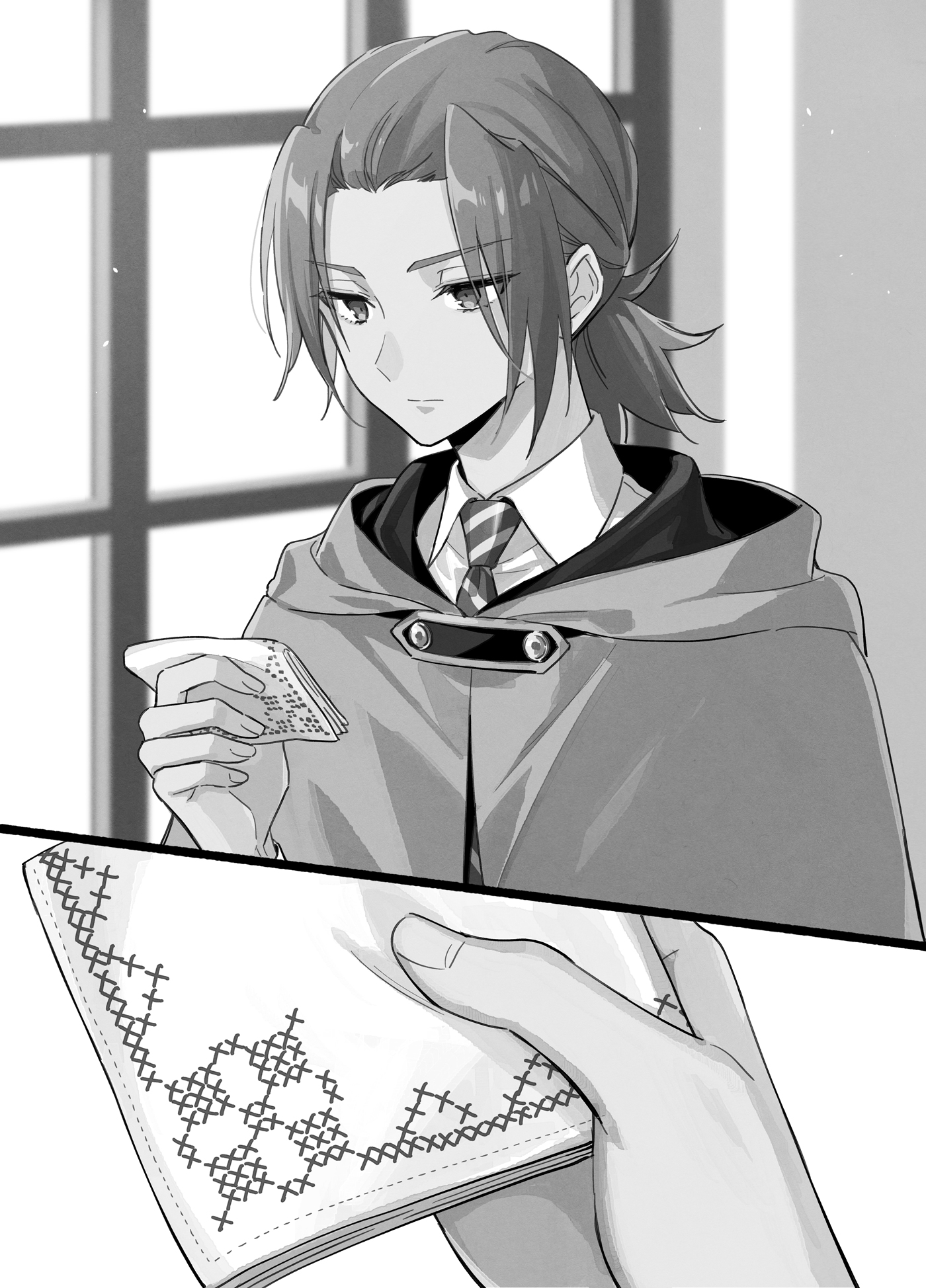
Extra Story: Mr. Sunset
Extra Story: Mr. Sunset
Life was preposterous—the youth, who would come of age the following year, knew that full well.
Many were blessed with magic in the Kingdom of Ordine, yet, despite having been born to a viscountcy family, he could express no magic externally—neither the offensive elements of fire, earth, water, and air, nor healing. He could strengthen his body, but his magic was only at grade six, about half of his father’s.
Besides, his lineage was muddy. His mother had been a slave and a dancer from the Desert Nation, and she had been presented to his father as his second wife. They had already separated, and she had returned to her homelands and found a new family, so there was little to worry about. Moreover, the youth’s appearance differed from those of others. His skin was a bright tan, while his hair and eyes were of hazy rust; he stood out like a sore thumb when he was with his kin. His relationship with his father was not bad, but his relationship with his elder brother was far from good. Thus, the youth did not enjoy protection from his mother’s side of the family, nor did he enjoy the luxuries that ordinarily pertained to the eldest son of a noble, such as ease in finding marriage prospects or entering a magic-related profession. As such, he was a black sheep among his immediate and extended family.
There were some silver linings: he had learned his mother’s native tongue at a young age and that his grades at school were rather good. He had planned to leave home to become an interpreter for a noble or wealthy business family. However, a friend from an earldom family had learned of his situation and, unable to remain indifferent, had hired him, dispelling his anxieties about the future. He had been staying in the earl’s home ever since, but at the end of the day, he was not family. The earldom family took good care of him, but, perhaps naturally, he just could not feel completely at ease with the arrangement.
Today was a day off for all college students; the season had recently turned to summer, and that called for deep cleaning. Supposedly the floors and walls were to be purified, and a layer of wax was to be applied to the former—auditoria and spaces like the cafeteria, obviously, but even the faculty office and storage rooms would get the same treatment. At the moment, the youth’s homeroom teacher was likely buried under a mountain of old books in the office. Last evening, when he had gone to drop off his daily report, only half the floor had been visible; it was a mystery whether the books were organized yet.
To take advantage of their free time, the youth’s bosom friend—the master on whom he attended—had proposed that they go for a ride, but he had woken up today with a face so swollen, he could have been mistaken for a hamster that had stuffed its right cheek full of food. He had insisted that he would be fine, but his mother had dragged him to the temple, as it was a case of a bad wisdom tooth. The youth had wanted to do as an attendant should and accompany his master, but the latter had refused, saying, “You rarely ever get days off, so you should spend it on yourself,” and handed him a bit of cash.
The youth couldn’t say he had anything better to do, and so he left the house without much of a purpose. As he stepped out of the earl’s gates, he suddenly realized that he hadn’t once returned home this month. There was no guarantee that his family would be home at this hour, but he planned to say hi to everyone and grab a few books from his room. When he arrived, he found only the servants and the maids greeting him all too politely. That was to be expected, perhaps, as he was now an attendant in the employ of the earldom.
His room was much tidier than he had left it. As he pulled the books that he’d come for off the shelf and placed them on the desk, he saw his nightstand and froze—the magical lantern had been replaced. The original had a brown reflector and handle, and its frosted glass globe was etched with a dragon—specifically, a gargouille, revered in the desert nation Išrana since olden times for their reputed ability to consume nightmares. It had been a gift from his mother back when he was young and had trouble sleeping alone. Now that lantern was nowhere to be found in the room. It was old and perhaps had ceased to function, and so they had replaced it with a new one. That was only natural.
At that moment, a knock came at the door. After the youth gave permission for the visitor to enter, in came a maid he was unacquainted with. She had sky blue hair and looked to be about the same age as him; possibly she was new here. “I bring a letter addressed to you, master. Will you also be taking supper tonight?”
“No, thank you; I’ll be heading back soon.” This was the second dinner he’d refused today. Now he had a chance to sneak off to the food stalls; maybe, since he was on his own today, he would go so far as to try eating on the go—so he thought as he stuffed the letter into his jacket’s inner pocket.
“Um, I beg for your forgiveness, Master Jonas!” Her sudden apology recaptured his attention. “While I was cleaning, I bumped into the magical lantern on your bedside table and dented the reflector. I’m terribly sorry!” The maid swung her head down low, launching one of her hair clips straight to the ground; her hair now swayed in front of her face. She was awfully apologetic for something he hadn’t even felt the need to bring up.
“It’s fine; it was old anyway.” Jonas picked up the hair clip and handed it to her. “More importantly, I hope you weren’t hurt?”
“No, not at all, and thank you for being so considerate of me. Was that lantern something you treasured, Master Jonas? I will have it repaired if—”
“No, it was quite old, and it likely had a crack in it already. Please do not worry yourself over it.” His answer might have come out a little more rushed than he had wanted. Jonas then said something about needing to head back, and the next thing he knew, he had left the estate without his books.
Jonas had nowhere in particular to go, no one in particular to see; alone, he roamed the capital. An old magical lantern that he had used in childhood had been broken, and it had been replaced. Yet because of such a trivial, trivial matter, his chest was now full of sand and grit; it all seemed so silly.
He realized he hadn’t had lunch either, so he bought two crespelle from a stall—one with sautéed vegetables and meat, the other with sautéed chopped prawns, kraken, and the like; the latter got additional sauce and mustard. He ate on the move, but it didn’t go so well, as it was a rather new experience for him. The second time the fillings fell, he gave up and found a place to sit down. Couples were monopolizing the benches nearby; he would have drawn too much attention anyway.
Jonas kept wandering and discovered an alleyway in a street lined with commoners’ homes. Dusk was just about to fall, it was empty here, and the streetlamps had yet to be lit—finally, some peace and quiet.
Scarf it down and go home—that was the plan he had in mind as he bit into the crespelle. He had the one with meat and vegetables first, then the seafood sauté second. The mustard was on the pungent side, bringing to mind a faint memory—How old was I back then?—of his mother warning him not to put too much of that same condiment on his steamed chicken. When he was done eating, Jonas fished the letter out of his jacket pocket; the sender’s name was his mother’s.
It had been years since his mother had returned to her homeland of Išrana following her divorce. She used to send him letters regularly; he had always received them without anyone in his family mentioning a single thing about them. Letters saying that she was doing well in Išrana, neatly penned in the script used over there. Letters that described how hot the deserts got, and how cold; letters that described the food, so different from Ordinato cuisine; letters that described the different species of cacti as well as the kingsnake and other creatures of the desert; letters that described how the family had acquired more horned camels—reading all of it brought him happiness. Jonas had never written anything in reply, but there had been a time when he would look forward to receiving the next letter. Just as long as mother is doing well, he had thought to himself.
By the time the stack of mail addressed to him had become large enough to tie into a bundle, his half brother had been born. He hadn’t known whether to celebrate, but he had sent back a note with a single word, “Congratulations,” along with a barrel of water crystals. The present had been thoughtfully prepared by the person he served as an attendant, whom he called his master and his friend.
Then, last year, another letter had come, saying that he now had a half sister as well. Pages upon pages had detailed how their names had been chosen—his half brother had gotten his from his grandfather and his half sister hers from her grandmother. Their relatives had celebrated with a banquet. A long prayer for good health. Jonas’s half sister looked much like him.
Before he knew it, the letter was warming the hearth. As pathetic and unseemly as it was, Jonas was jealous of the siblings he had never seen. He knew he was being unreasonable. He was no longer a child—he was an attendant to the earl’s eldest son. It had worked out as he had wanted: he had room and board covered; he didn’t need his parents’ support.
Allow me to congratulate you on the arrival of a new baby girl. It must be a hectic time there. You needn’t write me any longer; please forget the Ordinato who I am—so went the first letter he returned. This time, Jonas himself provided the barrel of water crystals.
How many seasons had passed since then? His mother’s letters had ceased arriving. Jonas had thought he’d never receive one again. But here was yet another. Surely, his mother had been hurt by what he had said, and perhaps she had sent one last reproach—he braced himself as he opened the envelope. A smattering of large print spelled: My dearest Jonas, take care of yourself. Live happily. It was not a long letter, but every character had been painstakingly, deliberately composed in the Ordinato alphabet. When his mother was still in Ordine, she’d had a hell of a time learning the language here. She had barely managed to learn to read, and writing the words she learned had been out of the question. Yet this letter was written in his script, for Jonas was an Ordinato—so he himself had asserted. He could still read the Išrana script, but she had toiled to learn his language in order to write this letter. It was not in the usual black ink but a vivid blue, just like the clear skies overhead—and yet, though there were no clouds, rain blurred the words on the page.
Jonas sat there sniffling for some time. Even with the letter tucked back inside his pocket, the text still remained, as it were, before his eyes. How utterly shameful it had been for him to tell his own mother to forget about him. Suddenly, a little girl appeared but a few steps away from him. Jonas was startled to realize that he hadn’t noticed her presence at all—a fairy? A daydream?
But her deep blue eyes stared straight into his, and her clear voice said, “Here, please take this!” She stuck out a blindingly bright white handkerchief. Embroidered.
Hold on. I don’t remember hitting on a girl this young. No, hold on. Those stitches are blue—it probably doesn’t mean what I’m thinking. No, actually, hold on. I’ve never even seen this girl before. As he panicked, he looked closer at the little girl’s face—she was in the midst of a bawl. That made two of them. “Thank you, but I wouldn’t want to soil it.”
In response to his excuse, she shone an innocent smile. “It’s okay; I have two!”
Even then, he found it extremely difficult to accept the handkerchief. But she proceeded to scour her face and blast her nose into hers—kind gestures to show him he had nothing to be afraid of. He imitated her actions, drying his tears completely. Handkerchiefs couldn’t be had for free, but she refused his offer to pay her. Jonas was surprised to learn that this young girl had done the embroidery with her own little hands, and he complimented her from the bottom of his heart. He worried for her, as she had been crying too, yet she had first worried for him, a stranger some years older than herself. How magnanimous of her. “No, uh, the crespelle I bought at the stall was a little too spicy. That’s all,” he said, his voice cracking.
Nodding, the little crespelle expert recommended salt or tomato sauce instead.
Still, it was terribly embarrassing to be caught crying by a young girl like her, and Jonas couldn’t stop himself from acting cool and asking, “If I may ask, what got an adorable little lady like you crying?”
She went very still, her cheeks radiating red heat, but when she finally managed to explain, her story infuriated Jonas.
For someone to describe such an adorable little girl as a dayflower—had there been a dearth of better metaphors? That boy had made a terrible mistake. It didn’t matter whether she was a little girl, a young maiden, a grown lady, or a mature woman, it would never do to compare someone to a dinky little flower. It was only correct to describe a woman as a grander and more gorgeous flower. Young though that boy may have been, he had much to learn. If there had been a commoner adult around, they may have told Jonas not to expect so much out of a child who wasn’t even a noble; unfortunately, Jonas had been subjected to that sort of noble education.
But his anger soon disappeared, for the next word out of the girl’s mouth was preposterous—a word that he himself had ruminated on many times over. She even graciously explained it to him, saying, “My dad said it means ‘when things don’t make sense and you won’t stand for it.’”
She must’ve been younger than he was when he had seen his mother off to Išrana, yet she had to tolerate this preposterousness. Furthermore, he understood all too well her concern about how others looked at her. As a child, Jonas used to hate his tan skin and rusty hair and eyes—he still did, but he used to too. In a sense, his insecurities were much like this girl’s; he felt small when it came to his hair, skin, magic, and descent; he hadn’t asked to be born that way. How very preposterous indeed. But just because it was unjust didn’t mean it was a reason to give up—either for him or for her.
“I know I won’t look good in it...” Tears had once again welled up in the little girl’s eyes.
“You know, I think you’re more of a nemophila.” It was not lip service; it was the first flower that had come to his mind.
“What’s that?”
Jonas described the field of nemophilas—the memory that had ambushed his mind. He must’ve been younger than the girl was now when he, accompanied by only his father and mother, had gone down the eastern highway to see an expanse of those blue blossoms. They had traveled in disguise; along the way, they had changed out of their regular attire into comfortable commoner clothes and switched to a carriage without their family’s coat of arms. At the end of a long ride had been nemophilas as far as the eye could see. The bright blue skies stretched over fields of the same color, where colorful butterflies danced as songbirds crooned. In that dreamscape, he had held his father’s hand in his right and his mother’s in his left as they strolled down the path beside the blooms. Jonas remembered his father’s coarse hand gingerly plucking one to give to his mother and her graciously accepting it with a warm smile. They had bought their boy some hard honey candy from a shop nearby, and he had so blissfully and naively cherished his sweets. It was a beautiful, joyous, untarnished memory, so perfect in his mind.
But perhaps the only one who had been happy that day was Jonas. His mother had never been comfortable in Ordine, among the nobility, or with their family. She had never shown him anything other than smiles, but she had supposedly endured countless days with no appetite and countless nights with no sleep. Only long afterward did Jonas learn that the family physician had recommended that his father take his wife on that outing. For Jonas’s mother, there had been no joy to be found in those fields of flowers. She had been forced to come to a country she did not like, live with nobility that she did not like, marry a man whom she did not like, and give birth to a boy whom she did not like—what else would that be but a living hell? Surely now—having returned to her homeland, where her friends and family were, and where she had found a man she loved—she was happy.
Jonas did not want the little girl to err the same way, and so he said in no uncertain terms, “If you say you won’t look good and just give up here, you’ll never be able to wear that dress, you know? Pay no mind to what others think and wear what you like to wear. I’m sure both lace and ribbon would be perfect on you.”
The green-haired girl’s blue eyes were sparkling, her smile beautiful; in that moment, she bloomed, that girl, the nemophila.
As the daylight abated, Jonas offered to accompany the little girl on her way home. At first, she refused, saying that her home was close by, but there was no way he was leaving a young child alone in some dark corner; what if a villain, a pervert were to show up? Under the evening glow, he matched her small strides down the alleyway, then the escort ended as quickly as it had begun.
“See you, Mr. Sunset!”
In her parting words, she addressed him in a way that made freeze for a moment. Jonas then smiled as brightly as his new nickname. He had never met his half brother or half sister, but this novel sensation must be what it was like having a younger sibling. “Mr. Sunset” was rather poetic too, he would add. In the light of the setting sun, his tan skin and rusty hair must’ve seemed to her a deep orange, although the same hue imbued all the passersby around them. Regardless of his magic and blood, this Ordinato in the capital, Jonas, felt a wave of peace wash over him.
Although she had said, “See you,” he would surely never see that young girl again. Besides, she had witnessed him sobbing; how embarrassing it would be to actually reencounter her. Pompous words nevertheless tumbled out of his mouth. “I hope to see you again as well, Lady Nemophila.”
Jonas turned and walked away. Though her gaze pierced his back, he could not turn around; it wouldn’t have been like him to do so. He squirmed as he thought about what he had done.
“This late already? I suppose it’s about time to fetch Lord Guido.” In the hallway of the Scalfarotto estate, Jonas checked his pocket watch. While musing about his encounter with the young girl, he had lost track of the time. Soon, he had to accompany Guido to the university campus for the day’s classes.
Jonas had to get Guido ready a little earlier today, lest he once again linger too long playing with his three brothers and lose time to prepare for the day. It was only a few days ago that Guido had been late for that very reason. After explaining to his youngest brother how hydrangeas changed color, Guido had given him a piggyback ride to the garden to see the flowers. The littlest brother had been delighted by the differently colored hydrangeas, but Jonas had not been delighted by their impending tardiness and the rush to replace his master’s wrinkled jacket with a fresh one.
“Have a good day at school, Dear Brother Guido! Take this with you!” The little boy had stuck out a snail, a creature Guido much abhorred. Yet what was he supposed to do but to force a smile and gallantly accept it? Such were the trials and tribulations of those in the role of “Dear Brother.”
As Jonas fastened the button on his cloak, he felt an unfamiliar object in his inner pocket—a white handkerchief with precise blue embroidery, the one from that little girl. He had carefully washed and ironed it, but as he didn’t want anyone to discover it, he had kept it hidden in his pocket.
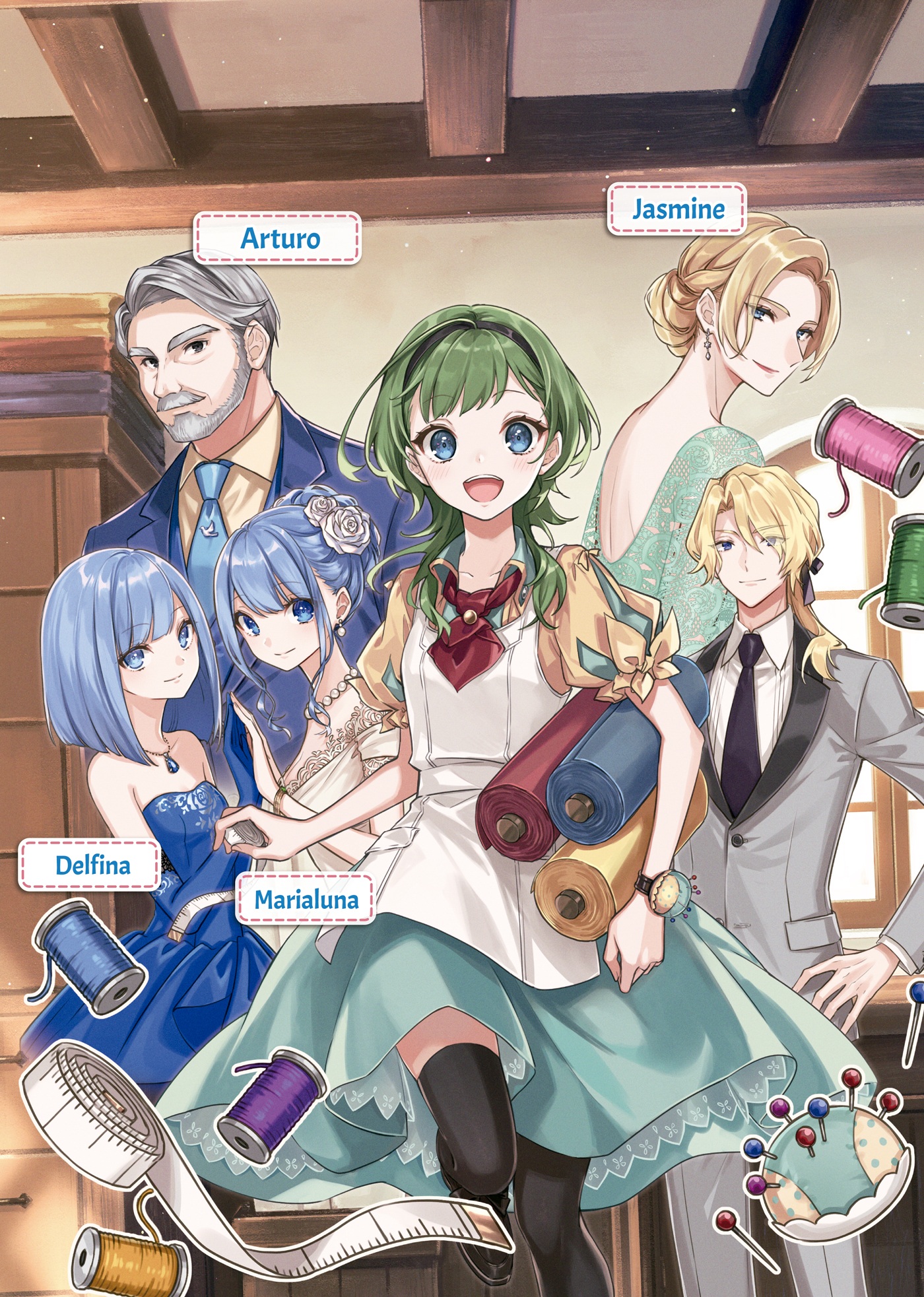
In this county, an embroidered handkerchief was a noblewoman’s declaration of her first love. Blue thread, however, was an expression of friendship and deep affection, as well as a wish for the health and fortune of someone who was dear to the sender. But that intimate gift was usually given by family, relatives, or friends, and Jonas had never received something like that. That much should have been obvious; there was no one in his life who would wish him those things. When he had been young, his mother had tried to do blue stitching, but it had instead dyed her fingertips red. In the end, he had pleaded, “Mother, just the sentiment is plenty!”
Jonas’s memory had pried his mouth into a smile, but then he suddenly realized something. “Blue...”
Up until now, his mother’s letters had always been written in black ink, yet the one he had received the other day had vivid blue letters. It was as if to symbolize blue embroidery stitches—rather, what else could it have been but his mother praying for his health and fortune?
He kept the handkerchief that the little girl had given him; it might be the first and last embroidered handkerchief he’d ever get. What with the stitching, so carefully and beautifully done, it was nothing short of valuable. Jonas decided to tuck it, along with the letter from his mother, safely away in the locked box under his bed.
Though there was one regret that pained him every time he revisited that memory. “I should have asked for her name...”
Color Illustrations