
Mystery 1 Feral Lunatic, or Prologue

In this world, there may be a night that is too dark.
Twilight had come again.
Conversely, that meant there should still have been time before nightfall, and yet…
Is it because it’s December? Is that why the sky’s so dark?
On the path that led up to the front door, under the giant evergreen sacred anise tree, Seiji sniffled noisily. He took a scant three puffs on his cigarette, careful not to draw the smoke down into his lungs, then ground it out under his sneaker. The words What a waste! rampaged around in his head, but he got rid of them along with the butt, then coughed dryly.
Sure enough, maybe because his nose was still stuffed up, the cig had tasted genuinely nasty. The smoke hadn’t stung his throat, though, so it was probably safe to consider himself recovered.
If he’d healed up this much, pushing himself a bit wouldn’t be a problem. He’d cultivated this self-made health barometer over long years of part-time work, though if a doctor found out about it, Seiji would have immediately been targeted for the mother of all lectures.
Still, who’d have figured I’d get laid up with a cold for six whole days, right into the next month?
A week earlier, he’d spent several hours running around in the rain chasing sunekosuri and had gotten soaked. Hunger and the resulting full-body fatigue seemed to have taken their toll, because the next morning he’d collapsed with a 102-degree fever.
After that, he’d had the whole nine yards: cough, runny nose, chills, and joint pain, with nausea as the cherry on top. However, he’d turned down around-the-clock nursing and spent the whole time holed up in his bedroom alone.
After all, the others had much bigger problems to deal with.
That was true of both Seiji’s owner—er, employer—Shiroshi and of Shiroshi’s attendant Beniko.
“Your father—Demon King Sanmoto Gorouzaemon has passed away. In addition, it appears that Evil God Shinno Akugorou perished at some point last night.”
Beniko’s face had been as white as death. Even now, Seiji couldn’t get the sight out of his mind.
Demon King Sanmoto Gorouzaemon was a great yokai who had once won fame through his appearance in the Ino Mononoke Roku, and young Shiroshi was his son and heir. As far as Shiroshi was concerned, his father was his only blood relation and his one and only supporter.
Just his dad dying has to hurt, and on top of that…
Since Shiroshi was only half yokai, an absolute horde of enemies had it in for him. At this point, he was completely surrounded by foes.
All washed up, nowhere left to go, fading to black—the more Seiji thought about it, the darker the gathering clouds up ahead seemed to get.
Even so, Shiroshi was alive and here with him. The mere fact that Shiroshi wasn’t dead was enough to make Seiji feel as if everything would work out somehow.
But—
He interrupted his own train of thought with a massive sneeze, and a shudder shook its way down his spine. Apparently, he was still far from 100 percent.
If I relapse now, it’ll be a total dumpster fire.
Hunching against the blustering, icy wind, Seiji retreated through the door with its sign—Please come in—and into the entrance hall. He’d just taken a right turn when he stumbled to a stop.
Beniko was standing by the bay window in her usual scarlet and black Japanese maid uniform, gazing down at the empty goldfish bowl.
They haven’t gotten around to clearing it away yet— No, that’s definitely not why it’s still there.
Beniko’s elder twin brother, a goldfish named Shion, had lived in that bowl until last month. Now he didn’t live anywhere. During the incident in Okuhida ten days ago, he’d given his life as Shiroshi’s body double.
I’m pretty sure Shiroshi said Beniko was the one who’d named him Shion.
The name came from the aster, a small purple flower also known as memory grass. While delirious with fever, Seiji had looked up its meaning in the language of flowers on his smartphone and had learned it meant “I won’t forget you.”
He’d been at a loss for words.
Beniko must have chosen that name because she’d sensed they’d have to part someday.
Even so, Seiji had the feeling the empty bowl still held lingering emotions for her.
As he hesitated, unsure what to say, Beniko beat him to the punch. “Welcome back. Are you feeling quite well now?”
“Oh yes. Thanks. I think I’m pretty much over it.”
“I’m told that indulging in tobacco weakens the immune system. Why not take this opportunity to stop?”
“…Um, Shiroshi’s in the study like always, right?” Pretending he hadn’t heard her, Seiji was just about to hurry away, when—
“Seiji.”
He looked back just in time to see Beniko bow very low, her black hair rustling like silk.
“Huh?! Wha—? Where’s this coming from?!”
“I believe it’s thanks to you that Master Shiroshi is safe. I would like you to continue to help him.”
“Yes, but, um, I think you’d probably do a better job as his assistant—”
“No, if I am ever the most suitable one for the task, I will take your place even if I have to drug you.”
“……”
“That was a joke.”
I don’t think it was!
“Well, um, okay. If worse comes to worst, I’ll make sure Shiroshi gets back safely, even if I don’t.”
“No, while that may be expected, if possible, I would like you to return with him.”
The remark caught Seiji by surprise, and the depths of his nose stung. “…Okay. I’ll do my best.” He spoke as if wringing the words out of his chest, then bowed deeply in return. After he’d watched Beniko disappear in the direction of the kitchen, he turned toward the study again.
“I’m baaack.”
A familiar sight awaited him beyond the door. At the back of the room, drapes like stage curtains framed a row of floor-length windows. To the right, a bookshelf took up the entire wall. And—
“Oh, welcome home, Seiji.”
The speaker was at a table in the center of the room, seated in a Queen Anne chair with a vaguely plantlike design. His white kimono seemed to embody the epithet King of a Thousand Flowers.
Shiroshi.
During Seiji’s life as a freeloader, this sight had become routine. Every time he’d seen Shiroshi during the past week, though, he’d felt his chest fill with relief. It was a conditioned reflex, a sort of lingering trauma.
“Perfect timing,” Shiroshi said. “I had something I wanted to discuss with you. Why don’t we have tea?”
Beniko appeared with the tea wagon, and in a twinkling, the table had been set. Just having a plate of fresh-baked apple pie set down in front of him made Seiji’s chest grow tight. He promptly dug in and was savoring the crispy crunch of the crust on the tines of his fork, when…
“I take it you’re feeling better, then?”
“Oh, yes, I’m all healed u—koff. ” Crud. Apparently, his cough was still hanging around. “E-excuse me. It’s taking a while.”
“Well, it wasn’t a simple cold, so this is to be expected.”
Hm? What was that supposed to mean? Puzzled, Seiji blinked at Shiroshi. They hadn’t had time for a proper conversation during the past ten days, so this was the first time they’d been face-to-face in quite a while.
Shiroshi didn’t look well. His skin was fair to begin with, but now it seemed bloodless, and there were dark circles under his eyes. Seiji almost asked, Are you all right? but caught himself.
There was no way Shiroshi could be “all right.”
“Well, where should I begin…?”
With a little sigh, Shiroshi brought his cup of black tea to his lips. Seiji involuntarily followed suit. The heat from the liquid seemed to seep into him.
“I’ll start with Odoro. Thanks in part to Beniko’s first aid measures, his wound soon closed. He’d lost so much blood that I’m told his heart stopped temporarily, but his condition has now stabilized. Perhaps due to the emotional shock, though, he hasn’t yet regained consciousness.”
“…Is that right?”
Seiji couldn’t blame him. The twin brother whose death he’d mourned for five whole years had reappeared out of thin air, alive and well, and turned a shotgun on him.
“…Death has taken a great man from us.”
“Wait, you just said he wasn’t dead.”
“Ah, no, I was thinking of all the additional trouble we’ll have if he regains consciousness, and I accidentally said what I wished I could say.” Covering his face with a hand, Shiroshi heaved a deep sigh.
…He seems really wiped out.
Seiji nearly asked, Want a cig? but a visual of Beniko wielding a kitchen knife loomed in his mind, and he hastily shut his mouth. Better not risk it.
“Well, setting Odoro aside, allow me to get to the crux of the matter,” Shiroshi began, but then he bit his lip, hesitating. Seiji was feeling a tiny scrap of pity for Odoro, who’d been summarily shelved, when… “It very much looks as though Odoro is not the only one who is not dead.”
“Huh? Wait, who are we talking about now?” Seiji’s voice cracked.
“My father—Sanmoto Gorouzaemon. Shinno Akugorou as well.”
No, no way. Not even possible!
“B-but Beniko said they’d ‘passed away’ a whole week ago.”
“Yes, they aren’t alive. However, we can’t state categorically that they are dead, either.”
What on earth did that mean? Seiji was completely bewildered. Sighing a little, Shiroshi returned his teacup to its saucer with a light clink.
“To cut to the chase, I’m told their bodies aren’t rotting.”
“Huh? Meaning…?”
“Apparently, their souls are still ‘alive.’ In other words, it’s believed that rather than killing them, Ibara simply extracted their souls from their physical vessels and sealed them somehow. They may still be in his possession.”
“Um, so if we retake them and put them back into their bodies—”
“Yes, it’s possible they will come back to life. However, that is troublesome in its own way,” Shiroshi said bitterly. “If Ibara holds the souls of two demon kings, he couldn’t ask for better hostages.”
A startled “Oh” escaped Seiji.
Of course, he thought. If Ibara had gone to the trouble of sealing their souls instead of simply killing them, he must have had a solid reason for it. And, in all ages and places, once a criminal had hostages, the next thing he did was—
“Ah, speak of the devil,” Shiroshi said, rising smoothly to his feet. Using both hands, he flung the windows open, revealing the gloom outside. “Now then, let us hear his demands.”
Before Seiji could ask, Who from? there was a ferocious gust of wind.
The curtains billowed out, framing a wintry twilit sky. When the gust subsided, a blue will-o’-the-wisp had appeared on the table. It crackled, floating in midair, and burned itself out, and then Takamura was sitting in one of the room’s chairs. As always, his entrance could have been a special effect.
“Well. What brings you here today?” Shiroshi asked.
“I’ve been fired from the Enma Ministry, you see, so I came to pay my respects.”
…Hold it.
Whoa, back up. What did he just say?
“Um… What do you mean?”
Seiji was about to ask whether a wave of downsizing had hit the underworld, but Shiroshi spoke first.
“When we were discussing the Mirror of Illumination the other day, Seiji, I believe I told you it was possible that there was a second traitor very close to me.”
“Yes, you did say that.”
“It’s Takamura.”
Seiji felt as if someone had dumped a bucket of ice water over his head. All the blood in his body retreated into his core, and his fingertips grew cold. Even then, he couldn’t seem to process a single piece of what he’d just heard.
“You’re kidding…right?” he finally managed. He fully expected Shiroshi to respond like Beniko: “Yes, that was a joke.” “Huh? Wait just a minute. That’s not even possible, is it? I mean, come on, it’s Takamura.”
“…Yes. It’s precisely because it is Takamura.” Shiroshi’s voice was unnaturally flat, as if he was stifling his emotions. “If you’ll recall, I mentioned that the Mirror of Illumination had been stored in a suitable place.”
“Um, yes, I remember hearing that.”
“That place is the Enma Ministry. He was the one in charge of its care.”
In short, this had been Shiroshi’s line of thinking: If fragments of the Mirror of Illumination had been sown in the human realm, it meant that instead of being in storage, it had been either stolen, lost, damaged, or switched with a substitute. As its caretaker, could a man of Takamura’s caliber possibly have failed to notice?
“Simultaneously, another thought occurred to me. If Takamura himself were involved, it would have been easy to deceive everyone else.”
When Shiroshi asked the Enma Ministry to investigate, they discovered that the Mirror of Illumination had indeed been cleverly switched with an imitation and the storage record falsified.
Not many people would have been capable of such a feat, narrowing down the list of suspects considerably.
“And so I had the Enma Ministry continue their investigation in secret. That is why I concealed my condition from Takamura during the previous incident and had a detached force under the command of Great King Enma search for Ibara.”
A recent memory surfaced in Seiji’s mind.
During the search for Shiroshi, Takamura had gone out of his way to visit. What if he hadn’t done so out of sympathy or kindness but in order to sound Seiji out about whether Shiroshi was alive or dead?
But Shiroshi said they’d known each other for longer than he could remember.
Seiji had heard that Takamura used to stop by from time to time to make small talk and play sugoroku. To Shiroshi, he might have been like a much older brother.
Suddenly, a high staccato sound rang out. Takamura had clapped his hands. “Splendid,” he said, smiling wryly. “I’d expect no less of you. That means you didn’t trust me as much as I had assumed, though.”
“Unfortunately, for a very long time, I’ve made a point of believing in no one except Beniko,” Shiroshi said indifferently.
Takamura lowered his eyes, as if he pitied him. “As always, your life sounds terribly difficult.”
“That…is not something you may say at this point.” The lack of inflection in Shiroshi’s voice made the size of the emotions he was suppressing palpable.
Oh, I see.
Shiroshi had been completely surrounded by enemies since birth. He must have seen the shadow of eventual betrayal in everyone besides Beniko. He’d lived his whole life with that fear and the resulting endless suspicion.
Out of nowhere, a voice rose in Seiji’s memory.
“That’s why, for as long as you remain my assistant, I will continue to believe you.”
It was something Shiroshi had said to him during the incident on that remote island in Kyushu. Maybe those words had carried even more weight than Seiji had thought…
“When I first encountered Ibara, I thought he resembled you more than me.” Shiroshi’s eyes were fixed on Takamura. “A rare genius, a giant among men, eccentric. Such sobriquets have always been yours to do with as you pleased, and yet there was a side to you that the public could not fail to see as mad—to the point that they called you a feral lunatic. You are the one who refused to participate in the mission to Tang China, in the full knowledge that you would be charged with violating an imperial order. A mere thousand years isn’t enough to change one’s nature, so I doubt Great King Enma could have ever hoped to manage you.”
Seiji could almost hear the words that came next: But why did you betray me?
As if to forestall that question, Takamura held out an envelope. “I came to deliver this.”
The envelope was stamped with a wax seal in Berlin blue; it almost looked like an invitation. When Shiroshi carefully broke the seal, two pieces of paper fluttered out.
“Train tickets…?” he muttered.
The rectangular slips of paper were the color of the night sky, stamped with a gold foil emblem modeled on the moon and stars. The train was scheduled to depart from Tokyo Station at six the next evening.
Its name was the Blue Magic Lantern.
“Those are in lieu of a letter of challenge. Put simply, Master Ibara formally requests a duel, with the souls of your father and Shinno Akugorou as hostages.”
“A-a duel…? As in mortal combat?” Seiji shuddered.
“No,” Takamura said in the tone of someone soothing a child. “It will be a battle of wits, just as before. Each of you will be permitted one companion only. All agreements made through the Enma Ministry will remain in effect. Until the train reaches its destination, neither party will be allowed to directly harm the other. A violation will result in immediate defeat.”
In other words, Shiroshi’s opponent had switched from Odoro to Ibara. And now Ibara was providing the venue for a new duel in the hopes of settling the battle for the throne in a single night.
“He’s gone to the trouble of chartering a train? He is fond of theatrics, isn’t he?” Shiroshi sounded a little appalled. He shook his head slowly, just once. “What happens if I win?”
“Shinno Akugorou’s faction will lose, and you will be formally acknowledged as the Demon King. Naturally, your father’s soul will be released immediately.”
“And if I lose?”
“Just the opposite: The souls of both demon kings will be destroyed, and Master Ibara will take the throne.”
“…What if I refuse the duel?”
“To phrase it as a villain would, the lives of the hostages cannot be guaranteed.”
“It sounds as if I essentially have no choice. I’m not strong enough to survive without the support of Demon King Sanmoto Gorouzaemon.” Shiroshi bit his lip, cold anger building inside him. He closed his eyes for a moment, waiting slightly longer than the space of a blink, and then: “…All right. I accept the challenge.”
But…! Seiji wanted to interject, but he didn’t even have time to speak.
Opening his eyes, Shiroshi fixed Takamura with a piercing glare. “No matter what your reasons may be, I do not think I will ever forgive you for this.”
“I’m honored.” At that, Takamura made his usual exit, vanishing like the flame of a snuffed-out candle.
For a little while, silence fell.
Left behind, Shiroshi looked both tired and wounded. At last, he exhaled deeply, then finished what little tea remained in his cup. “There’s something I’ve wanted to discuss with you for a while now, Seiji.”
“Wh-what is it?”
“Your habit of running away,” he said unexpectedly. “I’ve taken the liberty of investigating your upbringing. Frankly, you seem to have been treated rather carelessly; perhaps as a result, you see no value in yourself. I think that’s the root cause. Because neither your work nor your future matters to you, you run at the slightest provocation…even though, between this and that, you’re able to do your best as long as it’s for others.” He smiled suddenly, as soft as a white peony blooming. It seemed a little too awkward to count as genuine, though. “As long as you do that, however, you may as well be running from life itself. No occupation, no home, no money—even if you have nothing at all, your life is your own. So please, do try.”
With that, he took a folded slip of paper from the breast of his kimono.
Opening it, Seiji saw an unfamiliar address. It had a building name and a room number, so it probably belonged to an apartment.
“That is your new residence. I procured it while you were in bed with your cold. The rent has been paid for six months in advance; if possible, I would like you to move there tonight. I’ll send instructions regarding how to repay the thirty million yen later on.”
“Huh?” Seiji’s voice stuck in his throat. His vision grew hazy, as if he wasn’t getting enough oxygen. Somehow, he managed to swallow. “B-but tomorrow—the duel with Ibara—”
“I’ll have Beniko accompany me. I’m limited to one companion, and she is the most suitable.”
“Hang on! Um, wait just a second, please. A-are you…firing me?”
Shiroshi looked down. That probably meant yes. If he was being honest with himself, Seiji knew without having to ask: He’d clearly been given his notice, but…
No. He’s not firing me because he wants to.
It wasn’t just a hunch. Seiji was almost positive.
I no longer need you as an assistant. No matter how harsh it might be, if it was the truth, Shiroshi would never have averted his eyes.
And so, clenching the slip of paper in his hand, Seiji stood up.
I’m really glad I got to talk to Beniko earlier, he thought. If he was making a mistake, he was confident she’d stop him even if she had to drug him. Being able to trust someone that way made him happy—and so did being trusted.
And so…
“I refuse,” Seiji said, all in one breath, before ripping up the address.
A gust of wind blew through the room.
It snatched the tiny bits of paper away, sending them fluttering into the cloudy sky like butterflies, then whisking them out of sight.
“I’m not sure, but I get the feeling you’re worried about me, Shiroshi.” When he turned back, Shiroshi’s eyes were uncharacteristically wide with surprise. Seiji didn’t give him time to speak. “The thing is, I’m worried about you, too, so if you tell me to get out, I’m taking you with me.”
“…Huh?”
“I mean, I haven’t spent my whole life ducking out on stuff I’m supposed to do for nothing. If I commit to running, I think it’d go pretty well… No, wait, that’s not what I meant. Um…”
Not knowing what he was saying, or even what he could say, Seiji still somehow put his thoughts into words. In the end, there was only one thing he wanted to get across.
“If you don’t want me running, take me with you. No matter where we’re headed, if you’re alive, that’s enough for me.”
It took Shiroshi the space of a breath to respond.
He opened his mouth to say something, then promptly closed it again. It looked as if words had almost slipped out, and he’d just barely managed to swallow them back down. Then he inhaled deeply, as if catching his breath. “…Is that right?”
“Yes.”
“Even if what lies ahead is Hell?”
“Nah, I’m sure it’ll be fine, so I’m not worried. After all,” Seiji added, “this is you we’re talking about.”
In response, he got an expression he’d never seen before. Just for a moment, it looked as if Shiroshi had almost started to cry but toughed it out, or as if he’d nearly smiled but stopped himself.
“Heh-heh-heh. Actually, that’s what I think, too.”
“…Well, of course.”
“Yes.”
If someone else had been present, it would have sounded like an obvious bluff, whistling in the dark. With only the two of them there, though, it was just the truth.
They might not have had any grounds for thinking that way, or felt very confident about it, but at the very least, it wasn’t a lie.
“In that case, Seiji. Setting the future aside, would you come with me to a spot one step from Hell?”
Seiji nodded. Nodding was all he could do. He knew he could never take the lead and pull Shiroshi by the hand or stand beside him as an equal.
Even so, if by some chance Shiroshi stumbled, Seiji thought he could at least support him a little so that he wouldn’t fall over backward. And in that case, for now, half a step behind him was where he wanted to be.
Before long, night fell.
Mystery 2 Hyakki Yagyou
Dawn broke, and then the next night came. As usual, Seiji and Shiroshi called a taxi and headed for Tokyo Station together. The sun had only just set, but the streets that flowed past outside the windows were dark—or actually, they were white.
It was fog.
According to their smartphone weather apps, a dense fog warning had been issued from the Tohoku region all the way down to Kyushu. What should have been a familiar nightscape was pale and hazy, and only a pane of glass separated them from a different world.
The mist-blurred skyscrapers looked a bit like gravestones, and the lines of cars threading between them crawled as slowly as a procession of the dead. There weren’t many people or cars around, yet somehow they’d gotten stuck in traffic.
When Seiji glanced at the taxi’s digital clock, it was already past five. Would they get to the station in time?
Still, worrying was pretty pointless, so…
“Um, what sort of train is the Blue Magic Lantern?” he asked.
“It’s a cruise train that began operating out of Tokyo Station in January of this year.” Shiroshi’s explanation was so polished that he might as well have been waiting for the question. “It’s the successor to the Hokutosei, Cassiopeia, and the other sleeper trains popularly known as blue trains, due to their typical color. To be specific, I’m told it was manufactured for the second Tokyo Olympics due to the success of the Seven Stars in Kyushu, which JR Kyushu began operating in 2013.”
“And the budget was?”
“Roughly three billion yen.”
“…If you haggled the price down a bit, I think you could buy a country with that.”
Seiji was dumbfounded, and Shiroshi gave a little burst of laughter, covering his mouth with one hand. Not that Seiji had any right to talk, but as always, this kid could stand to be a little less laid-back.
“Still, it’s incredible that he managed to get a train like that,” said Seiji.
“Groups and corporations can charter it for use as a party venue. In addition, it’s easy to put together special schedules during the late-night hours.”
Ah. So apparently, it wasn’t all that hard as long as you let your money do the talking.
“It’s used to entertain important guests, as a sort of luxury cruise ship on land. It really is a high-class hotel on rails. Some criticize it as having outdated aristocratic pretensions, but since one of its models was the Orient Express, that may have been inevitable.”
That name sounded familiar to Seiji.
“There is a world-famous mystery titled Murder on the Orient Express, so no doubt you’ve had plenty of opportunities to run across it.”
According to Shiroshi, the Orient Express—nicknamed the Blue Lady—was created by the venerable Compagnie Internationale des Wagons-Lits in spring 1883 as the world’s first and greatest luxury sleeper train.
Known as one of the social hubs of Europe, the train carried all sorts of upper-class individuals: royalty and nobles, the extremely wealthy, and high-level government officials. And during the Golden Age of Mysteries following the First World War, Agatha Christie, a woman known as the “queen of crime,” released Murder on the Orient Express.
But just hearing the word murder made Seiji feel as though a death flag had been raised. Did that count as an occupational disease at this point?
Abruptly, Shiroshi turned to look out the window. “Ah, it seems we’ve arrived at last.”
The familiar Tokyo Station complex rose up from beyond the veil of mist.
Disembarking from their taxi at the Yaesu Gate, they started toward the station together, pushing through fog that rolled at them in waves. Seiji followed Shiroshi’s back, keeping half a step behind.
The cold seemed to stab into him. The chill was even worse than the weather report had predicted, and when the ticket gate came into view, he gave an involuntary sigh of relief.
“It appears we’ll be in time,” Shiroshi murmured. He was wearing a thick muffler—hand-knit by Beniko—pulled up far enough to cover his chin.
“Um, the information board says there’s a dedicated lounge this way— Oh, over there.”
Seiji stopped in his tracks.
He’d seen a familiar figure in that direction: a very tall man in a black swallowtail coat and white gloves. It was probably the train crew’s uniform, but he looked so at home in it that he could have been a butler.
It was Takamura.
“Welcome. We’ve been expecting you.” Smiling faintly, the man gave an exquisite bow. Then he took a pocket watch from his waistcoat, opening its cover with a light click. “The train will leave shortly, so please make your way to the platform using the direct-access elevator at the back of the lounge. The other six passengers are already on board. Dinner will be served directly after departure. As soon as you have unpacked, repair to the lounge car—”
“Huh? Wait, six…? D-don’t tell me—are we up against all of them?”
“No, I assure you, it will be no different from the usual contests. I’ll explain later,” Takamura said, interrupting Seiji. He held out an envelope. Taking it hastily, Seiji broke the seal, and…
“A key?”
It was a brass, antique-style bit key. A thin cork tag printed with the number 302 hung from a Berlin blue satin ribbon threaded through the hole in its bow.
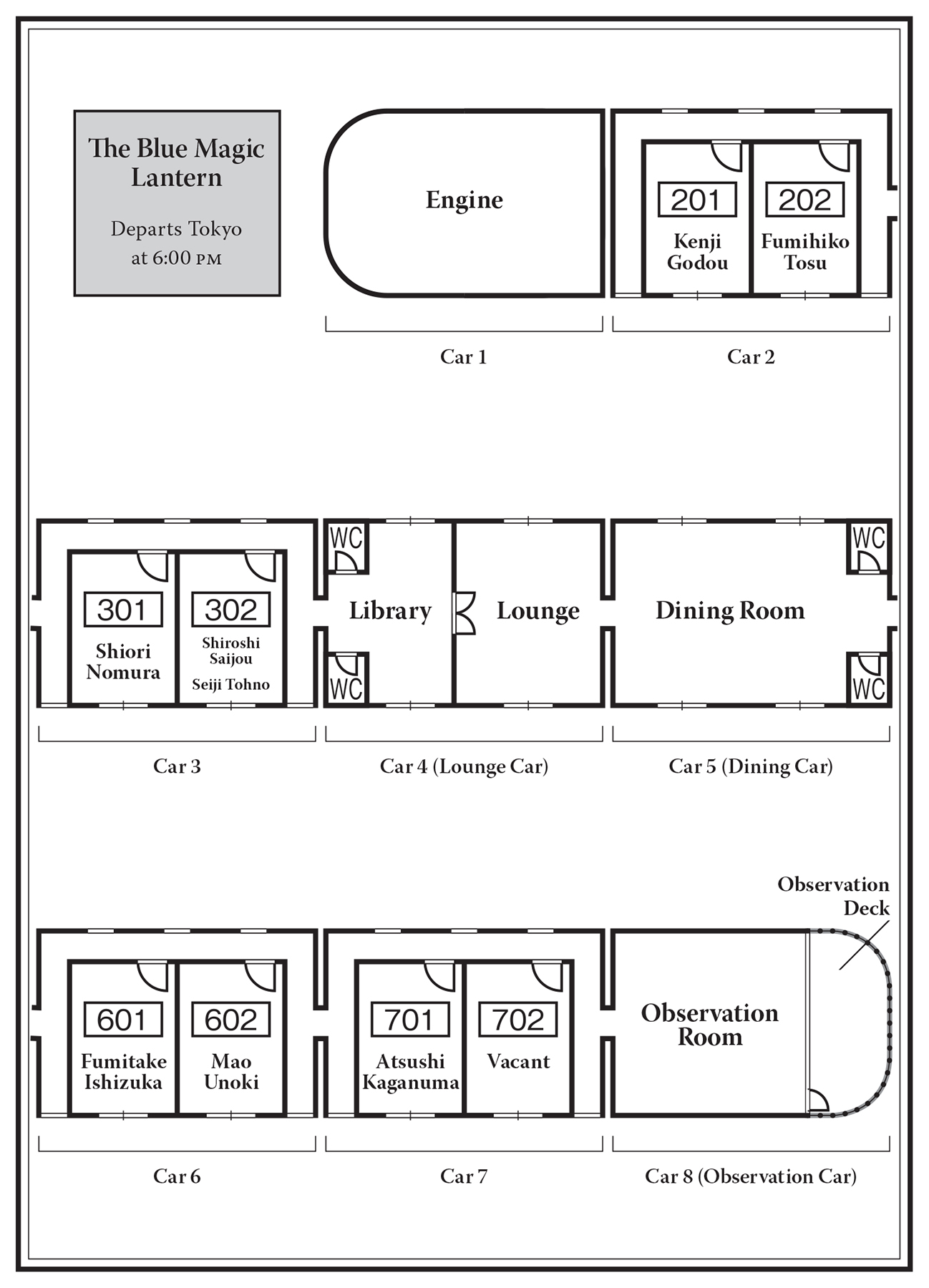
“That is the key to your compartment. The two of you will be in Room 302. A map of the train has been enclosed; make use of it as needed.”
When Seiji unfolded the paper he’d found in the envelope, it really was a diagram of the train.
There were eight cars in all. The engine was at the front, while an observation car brought up the rear. The lounge and dining cars were in the center of the train, flanked by two cars with two guest rooms each on either side.
Each compartment had a number along with the occupants’ names.
“…Where is Ibara?” Shiroshi asked dubiously. As Seiji saw it, too, he gulped.
He’s right. He’s not there.
The name Ibara Rindou was missing. Don’t tell me he’s passing himself off as somebody else again, Seiji thought, but apparently that wasn’t it.
“Master Ibara is in the observation car at the end of the train. The connecting door will remain locked until the contest is decided; it won’t be possible to enter it from the passenger cars.”
“What?” Seiji said, without meaning to. Hold it. This is a duel. But if the guy we’re dueling won’t even be there, then…
“Your opponent will be the passenger who is Master Ibara’s companion. A proxy, as it were.”
Impossibly, his guess had been right on the money.
“…I see. So he plans to be an idle spectator, as usual.” Shiroshi murmured wryly. Then he gave a resigned sigh. “Are you the proxy, then?”
“No, I am a witness. I will serve as the referee, to ensure that the contest is conducted fairly.”
“Just as you’ve always done?”
“Yes, just as I’ve always done.”
“…How strange. One might think you weren’t my enemy.”
“As far as I am concerned, that has always been the case.”
Takamura smiled; his face was unbelievably gentle. Shiroshi softly bit his lower lip. Immediately, Seiji recalled a line he’d once heard the boy say.
“No one’s harder to read than you, Takamura.”
He’d been right.
“I’ll take my leave, then,” said Takamura. “I pray that fortune favors you.” Then he vanished.

Shiroshi looked like an abandoned child, and Seiji felt his chest constrict.
“Um, Shiro—?”
But just as he was about to call to him, Shiroshi started walking, as if to cut him off. They crossed the lounge, then took the elevator at its back to the platform.
It was cold and very quiet.
The platform was usually jammed with railway fans waiting for their favorite train, but due to the fog, it was nearly empty. The night mist soundlessly stroked Seiji’s cheeks; it was so frigid, it hurt.
“Ah, that must be our train,” he said.
As if in response, a light gust of wind swept the veil of mist away.
Like a phantom, an eight-car train drawn by a diesel engine appeared. Its body had been painted the deep blue of the night sky, then polished to a mirror shine. One gold stripe ran down its side, and an emblem with a moon and stars motif held the train’s name in Latin script.
The Blue Magic Lantern.
“We were in Car Three, weren’t we?” asked Seiji.
“Oh, and it’s right in front of us.”
Shiroshi started up the car’s brass-colored steps.
“Um, Shiroshi?” Seiji’s voice cracked with nerves, but he finally managed to get the words out. “I, uh, I’m not sure how to put this… I think it would be a good idea to sit down and talk things out with Takamura.”
“…Why is that?”
“I think you’re angry and hurt because you did trust him. I mean, you only call somebody a traitor if they were on your side to begin with, you know?” To Seiji, the two of them had seemed to truly trust each other. If even part of that had been real… “Frankly, I have no idea what he’s thinking, but that means it would be better to ask him straight out now, while you still can. That’s something I couldn’t do, so…” He clenched his fists tightly, crushing the word regret in them, trying hard not to visualize the corpse in the bathroom.
Turning back, Shiroshi narrowed his eyes, as if he were looking at something dazzling. “You really are you, Seiji.” As usual, he seemed to feel the words deeply. “To be honest, I think mine is the more human reaction. He forced a crushing amount of debt onto you, then committed suicide. Continuing to call someone ‘a friend’ after a betrayal like that is lunacy.” Then he smiled, though there was a trace of loneliness in it. “However, I would like to learn from your example. It may be impossible for me, but at any rate, let’s discuss that later. We have less than ten minutes left before departure.”
“R-right, sorry.”
Hastily, Seiji followed Shiroshi up the stairs.
The moment he stepped into the train, he felt the air around him change. It wasn’t the heating system but a more abstract sense that something wasn’t right. It was almost as if they’d wandered from reality into fiction.
“Don’t tell me. That wasn’t another barrier, wasn’t it?”
“I fear that’s extremely likely.” Shiroshi held up his smartphone. Its display showed the main screen. There was no signal whatsoever.
“…Can we go home?” Seiji asked, struck by the urge to crouch down and hug his knees.
“Frankly, I would like to do so as well. If it weren’t for the hostages, that is.” Shiroshi’s gaze had grown distant.
“W-well, we do have a sort of countermeasure this time.” Seiji tapped the cuff on his right ear with a fingertip. Shiroshi had gotten the item custom-made for tonight, but to be honest, Seiji thought it looked awful on him.
“Heh-heh. Yes, although the ‘sort of’ bit is rather sad.”
Lamenting the situation’s stubborn refusal to go their way, the two of them nevertheless trudged through the automatic glass door and into the car. With only two compartments per carriage, there was no way to get lost, and they promptly arrived at Room 302. Seiji took out the key he’d been given, then noticed that there was a peephole, but no spot to insert a key. Hm…
“Oh, while it appears to be an antique key, I believe it’s electronic. There seems to be a sensor in the handle; try holding it over that.”
“You mean like this…? Hey, it opened.”
There was a click as the mechanism turned, unlocking the door.
“Um, ’scuse us.”
“It would be rather frightening if someone answered you.”
They stepped through the door, which swung inward. When Seiji turned to look, he saw the thumb-turn knob rotate halfway back all by itself. Apparently, it was an automatic lock.
So the light switch is… Oh, here.
Immediately, all the lights in the room came on.
“Whoa, it’s huge!”
There was a section of parquet flooring near the door, with an expanse of ivory carpet beyond it. To the left were two queen-size beds. On the right, there were two doors; the nearest one seemed to belong to a closet, while the one in back led to a bathroom. All the furnishings had been designed to look antique, including the pair of armchairs facing each other by the window.
It was as if they’d been abruptly transported from the train to a luxurious European hotel, and it made Seiji feel a bit dizzy. He felt that, if he wasn’t careful, he might get stuck in a dream, unable to find his way back to reality.
That said, this dream was almost certain to be a nightmare.
As they finished inspecting the room, they found name badges on the table, so Seiji decided to change clothes and put his on. Naturally, he changed into Beniko’s handmade three-piece suit.
Since Shiroshi didn’t need to change, he sat down in one of the armchairs by the window. In profile, his expression was unexpectedly grim, and Seiji felt his heart stir uneasily. Once again, it came down to a single question: What was going to happen on this train tonight?
“Um… Are you sure you shouldn’t be the one to carry this, Shiroshi?” Sitting down in the other armchair, Seiji opened his jacket to reveal a shoulder holster. It held the revolver he’d swiped from Odoro. As an aside, the gun was apparently a Smith & Wesson Model 19.
“Hmm. In terms of appearance, I think you could bluff with it more effectively.”
“Well, yeah, probably.”
“And in my case, it would make for a better threat if I produced yokai instead of a pistol.”
“…Yeah, it would.”
Their conversation trailed off, and Seiji’s gaze moved to the fixed window.
The train was still enveloped in fog.
Only night lay beyond the mist. The view made Seiji feel as if there might be no city, no people—nothing at all aside from the platform.
“Um, don’t tell me Murder on the Orient Express takes place on a foggy night,” he said.
“Heh-heh. Personally, this reminds me more of Night on the Galactic Railroad.”
“Oh, the one about Giovanni and Campanella… How did it go again?”
“It’s a children’s story written by Kenji Miyazawa. Giovanni, a boy living in poverty, goes for a journey on the galactic railroad with his friend, Campanella.”
Hm. Seiji seemed to recall reading that one in grade school…but he barely remembered anything about it. Only that it had struck him as an awfully pretty story, with the Milky Way and galaxies and crystals and things.
Had the two friends managed to get back home safely after setting off for such a faraway place?
“Well, it’s nearly time for us to depart.” Shiroshi slowly got to his feet, and Seiji followed him out of the compartment.
As they made their way down the train toward the back, they reached a space that looked like a study. According to the diagram, it was a common area called the library.
As the name suggested, it contained bookshelves with glass doors stocked with railroad-related books and photo collections. A vermilion lamp shone on a writing desk furnished with stationery, a fountain pen, and a telephone like the one in their compartment.
“My,” said Shiroshi. “Unlike the one in our room, this window appears to open.”
“Oh, you’re right.”
That’s Shiroshi for you. He’s got sharp eyes. The window might have been for ventilation: It was possible to raise or lower it by turning a crank.
Leaving the library, they found the lounge beyond it.
“Wow. This really is classy.” Seiji’s eyes widened in delight.
His initial impression was that it looked like the lounge of a high-class hotel. Four earlier arrivals had made themselves comfortable and were drinking glasses of champagne beneath a magnificent chandelier.
The first thing that caught his eye were the couches facing each other beyond the upright piano. One was occupied by a girl who looked like a high schooler and a woman in her thirties. The girl’s colorful party dress contrasted sharply with the woman’s drab business suit.
The two men on the other couch seemed like polar opposites as well. One was a swarthy twenty-something in a motorcycle jacket. The other was a stern older man who looked like a professor; for some reason, there was a whiskey shot glass near his hand.
Huh? That’s weird. Weren’t there supposed to be six other…? Oh.
There he is.
A slight young guy in an oversize hoodie and jeans was standing by the wall, wearing a pair of earbuds. Is he a college kid? Seiji was wondering, when out of nowhere—
The room was suddenly full of monsters.
“Huh?”
The first ones to leap out at him were yokai he recognized.
The first was a shoukera. It had a mouth that split its bald head all the way to its ears, and it was clinging to the back of the couch with hawklike talons. Beside it was a makuragaeshi, which looked like a miniature Deva king. The third was an azukiarai, an old man no taller than a child, who was busily stirring a wooden washtub with his hand.
And…
“Y-yeek!”
The one that had made him shriek was a bloodied baby. Half of one sofa had turned into a rock scarred by a large slash from a sword, and the infant lay on top of it. It wailed loudly, its lizard-like face twisting with…what? Hunger, resentment—or sadness?
Then abruptly, a shadow loomed up from a spot by the wall. A starving demon, drooling heavily, glared at Seiji with bloodshot eyes. It thrust out a two-fingered hand, as if it meant to strip the flesh from his face.
“Wagh, agh!”
Seiji tottered backward, but a hand connected with his back, supporting him just in time. It was Shiroshi.
“Well. How many of them looked like yokai?”
“A—” Seiji tried to say All of them, but the words stuck in his throat.
And then…
“Well, that’s embarrassing. I accidentally took a nap. I hope I’m not late.”
The clear, fresh voice sounded out of place. When Seiji turned, he found a man wearing a suit jacket without a tie. He was smiling wryly, the picture of a pleasant young man—until his face turned pitch-black.
“A-agh…” Seiji stared at the vague black shadow, stupefied. It looked a bit like a robed monk. Its lips were moving deliriously, and he made out the words I’ll give back the oil. I’ll give back the oil.
That’s when it hit him.
Every one of the other six passengers was a Hell-bound sinner.
“…I see. It appears we’ve stumbled into a demon horde’s night parade,” Shiroshi murmured, guessing the truth from Seiji’s expression.
Just then, with a heavy clunk, the wheels started to move.
The night train began to roll over the rails, carrying six monsters—sinners who had escaped judgment.
The demon horde’s night parade had begun.
After departing on schedule, the train gradually picked up speed.
The clackety-clack as its wheels hit the joiners between rails reached them through the floor as vibrations. Seiji, who was clinging to the bathroom sink on the verge of tears, spat up stomach fluid. He could’ve handled the crowd, but not when they were all monsters. Six was just way too many.
“Well, this is going to be troublesome,” Shiroshi grumbled, rubbing Seiji’s back.
They were in the common restroom at the far end of the library. According to the map, there were two each at the front of the lounge car and the back of the dining car.
Thanks to that, after claiming Seiji was a little motion sick and slipping out of the lounge, they’d easily found a spot for him to go Merlion without holding back. Frankly, though, he still felt half dead.
“Shoukera, makuragaeshi, azukiarai—I believe I’ve identified the remaining three as well,” said Shiroshi. “The rock with the bloodied infant is a yonaki-ishi; the one like a salivating, starving demon is a kowai, and the sixth and final one—the shadow that resembled a monk—is an aburabouzu.”
“You mean each of them committed a separate sin?”
“Yes, I would imagine so.”
As Seiji’s nausea finally subsided, a possibility occurred to him. “…Um, couldn’t they be a hyakki yagyou, a demon horde’s night parade?”
“Hm? What do you mean?”
“In the Shidou family incident, the four of them were a snake, a tanuki, a tiger, and a monkey, but they counted as one yokai together. Nue. Right?” Incredibly, all four members of that family had been accomplices in a murder. “So I was wondering whether all six of them might be accomplices in one crime, and actually a hyakki yagyou.”
“All of the passengers, accomplices…? That really would be Murder on the Orient Express. I think that possibility is probably negligible, though.”
Why? Seiji cocked his head.
“Seiji, when you think of a hyakki yagyou, what do you picture?”
“Um, all sorts of yokai getting together and acting tough outside in the middle of the night?”
Basically, the yokai version of a motorcycle gang.
Shiroshi very nearly cracked up but managed to turn it into a cough. “Hyakki yagyou originally referred to grotesques that wandered the main street of the capital at night a millennium ago during the Heian period, specifically when their true forms were unclear. ‘Indescribably dreadful apparitions.’ In other words, they had no definite shapes: Their true forms were concealed by impenetrable darkness.”
“Um… But if their true forms aren’t known, why do they have a name?”
“Because the ki—or ‘demon’—character in Hyakki has its origins in the word onu, meaning ‘hidden.’ The word yokai was first used in the Shoku Nihongi, and at the time, it referred to ‘a strange phenomenon whose cause is unclear.’ In modern terms, they would have been a type of malicious, invisible spirit. And you see, a hyakki yagyou is a gathering of these ‘indescribably dreadful apparitions.’”
“Oh… Okay.”
In a vague way, Seiji understood.
In that case, yokai with definite shapes like shoukera and makuragaeshi could get together all they wanted without ever being a hyakki yagyou. However…
“But I think I’ve seen a picture of a hyakki yagyou somewhere. There were all sorts of monsters based on old tools, like a mortar and a lute.”
“Ah, that will have been Tosa Mitsunobu’s Hyakki Yagyou Emaki. It was drawn several centuries later, during the Muromachi period. By then, yokai had become visible beings. Many of the grotesques drawn in that picture scroll were the spirits of old objects, so later generations came to picture objects that had acquired spirits and become tsukumogami when they heard the term hyakki yagyou.”
“Huh? Then its image is different in different eras?”
“Heh-heh. By the Edo period, it had changed yet again. The terms hyakki and hyakki yagyou came to refer to all sorts of monsters cataloged scientifically. It’s just like the first part of the word hyakka jiten, ‘encyclopedia.’ I believe you’re quite familiar with an example of that one, Seiji.”
…Hm? Nothing was coming to mind.
“Toriyama Sekien’s The Illustrated Demon Horde’s Night Parade. Otherwise known as the Gazu Hyakki Yagyou.”
“Oh!” That made sense. So it was literally a field guide to yokai. Now Seiji knew what a hyakki yagyou was, but… “Um. In the end, though, we haven’t made any progress at all on the main issue, have we?”
“Well, frankly, we don’t know anything yet. If Takamura is to be believed, Ibara has only one companion. Since it isn’t even clear why the remaining passengers are on the train with us, I think we’ll just have to wait and see how the situation develops.”
Hm. Shiroshi had a point.
That said, being in an enclosed environment like a train with six sinners—all of whom could very well be murderers—screamed “thrills and suspense,” to put it mildly.
“We’ll return to the lounge for now,” said Shiroshi, “but do be very careful, please.”
You too, Shiroshi, Seiji added silently. Then, just as they left the bathroom together…
“Dwah!”
…they ran smack into a shoukera.
No—it was the high school girl from the lounge. Her name badge read Mao Unoki. Apparently, she’d come out of the other bathroom right as they emerged.
“S-sorry!” Seiji exclaimed.
“No, it’s my fault. I startled you.” The girl returned Seiji’s nod, then gave Shiroshi a friendly smile. “That crew member, Takamura, came to the lounge car a minute ago. He said it was time for dinner, so we should all go to the dining car.”
“Oh, did he?” asked Shiroshi. “It’s very kind of you to tell us; thank you.”
“No, no. To be honest, I’m relieved you’re back. Not having anyone my age around was lonely. I’m in my last year of high school, and…um, Mr. Saijou, was it? You’re about the same, aren’t you?”
“I’m a little older, but yes.”
Sure: He was over seventy in human terms, but for a supernatural, he’d count as a millennial.
“So we are in the same age group! Wow, and traditional clothing still suits you so well. That’s incredible. Are you the heir to a school of some traditional art that’s been handed down for generations or something?”
“Heh-heh-heh. I’ll leave that to your imagination.” The girl’s eyes were shining, but as usual, Shiroshi evaded. “By the way, Miss Unoki, how did you come to be on this train?”
“Well…this is going to sound strange, but I don’t really know.” A shadow had crept into Mao’s expression, and there was a hint of fear in her eyes. “It was as if I was on board before I even knew it. I didn’t stow away or anything. I have an invitation, and when I thought about it, I remembered applying to be a trial customer for a travel company… I’m pretty sure it was for some kind of active participation mystery game. That memory’s hazy, too, though.”
An active participation mystery game. Seiji had a very bad feeling about that.
“I’m not sure how to put it,” she continued. “It feels like remembering something that happened in a dream. Even this dress: I recall renting it… But is that memory really mine?”
Ordinarily this would have been sheer nonsense, but Seiji felt himself break out in goose bumps. He knew who could have done a thing like that.
Ibara Rindou—or no, had it been Takamura?
Shiroshi whispered in his ear, “It sounds as if she’s had false memories implanted.”
She couldn’t have been kidnapped, right? Seiji shuddered.
Mao seemed to think she’d weirded them out; she hastily waved her hands in front of her chest. “I’m sorry, I know that sounds pretty random. Please just forget about it.”
“No, um, erm…”
And with that, the conversation died. The three of them passed through the deserted lounge in awkward silence, stepped through the connecting door to the dining car, and then—
“Omigosh, it’s like a movie!” Mao squealed.
In a space even more old-fashioned than the others, two tables for four had been set out in a row. Silver cutlery was arranged neatly on spotless white tablecloths, and the flames in fantastical table lamps flickered gently with the vibration of the wheels. Maybe that was why the passengers’ reflections in the window all seemed hazy. It looked like a dinner party for ghosts.
The table in the back was full, and there was already one person in a window seat at the table nearest them. It was the college guy who’d appeared as a kowai earlier; his name badge read Fumihiko Tosu. He was still wearing his earbuds, and Seiji concluded that communication wasn’t going to be an option.
“Um… Excuse me.” Asking permission anyway, Seiji was about to pull out a random chair when Mao spoke up.
“If you don’t mind, could I sit across from you, Mr. Saijou? I don’t know dining etiquette at all, so if you’re all right with it, I’d like to imitate you.”
That was the reason she gave, anyway. But she’d gone red all the way to her ears… Hmm.
“I think you may have a shot with her,” Seiji whispered to Shiroshi, grinning.
“Heh-heh-heh. I wonder. Though I’ve resolved not to play around until I’m a bit older.”
“Meaning you do intend to play around.”
“……”
“……”
“Well, why don’t we sit down? You take the window seat, Seiji, and Miss Unoki and I will sit on the aisle.”
He dodged!
Shiroshi had immediately opted to run, but just as Seiji was about to launch a follow-up attack, someone spoke to them out of nowhere.
“Are you two friends with that Takamura guy?”
It was Tosu.
“Wh-what makes you think that?” Seiji asked, flustered.
“No reason. I just wondered.” The young guy promptly turned away. It made zero sense.
What the heck…? No, never mind that; his voice is more mature than I expected.
Seiji had thought the guy was in college, but he might be Seiji’s own age—or maybe even older.
Then he heard Mao’s excited voice again; she was taking photos with her phone. “Ooh, the tables over there are amazing, too. All those flowers…! It looks like they’re going to spill onto the floor!”
When Seiji looked, he saw two small tables on the other side of the aisle. The one toward the front of the train held an arrangement of white lilies, while the other displayed a rack stocked with bottles of red wine.
“My, is that a record player?” asked Shiroshi.
“Oh, hey, yeah.” On closer inspection, there was an acrylic case in the middle of the lilies; a black record spun inside it. The needle that traced the record’s grooves was playing subdued music. Something classical.
“Hmph! Funeral flowers. Lousy taste,” someone spat.
Startled, Seiji turned. The azukiarai—or rather, the scowling man who seemed like a professor—was right behind him. His name badge read Fumitake Ishizuka.
Hm, yes, he had the “patently sarcastic geezer” persona nailed. In suspense dramas, his type tended to get impulsively bludgeoned with nearby blunt instruments.
Still, he’s right…white and black… That thought sent a chill down Seiji’s spine. The colors of mourning flowers and a coffin.
Once dinner began, it proved to be a full-course French meal.
Seiji had a few coughing fits from time to time, but he wasn’t too nervous to eat. In his role as crew member, Takamura waited on them, and every dish was exquisite. If Seiji had gnawed on the plates, he suspected they would’ve been tasty, too.
However…
“Come to think of it, is it okay to just eat the food?” he asked, suddenly realizing it might not be.
“…It is very like you to think of that only after you’ve polished off the appetizer, Seiji.” Shiroshi shot him a tepid look.
S-sorry about that.
“Since the agreement is that we are not allowed to harm each other directly, I don’t think they’ll poison us. However, we can’t be certain about the other passengers.”
Wh-what?!
Seiji’s trepidation aside, dinner continued without a hitch.
Thank goodness. It looks as if there won’t be any trouble.
Cups of after-dinner coffee were sitting on the tables, sending up pale wisps of steam, and various circles of small talk had formed. Tosu was still one with his earbuds, but Shiroshi and Mao had been having fun talking about their pets for the past few minutes.
…Not that Seiji had the foggiest idea what kind of pet Shiroshi had.
“Ah-ha-ha! Oh, I know. Even when you know something’s bad for them, it’s so hard to say no when they beg.”
“Yes, I understand that it’s poison, but I just can’t help it. I’d like to reduce the amount, at least…”
Mao probably meant dog treats, while Shiroshi was referring to a certain someone’s cigarette habit. They were discussing entirely different things, but for some reason, the two ideas meshed perfectly. How terrifying.
Mao had set her phone down on the table, and there was a photo on its screen.
It must have been taken at night: A Shiba Inu was curled up on a dog bed, giving a humongous yawn in front of a perfectly black window. There was a metal water dish near the edge of the picture, and although the reflected flash made it hard to read, Seiji could just make out the name Dumpling written on it in permanent marker.
Yes, name and nature were in agreement here: That dog was in definite need of a diet.
“Don’t you have any photos of yours, Mr. Shiroshi?”
“Hm, no. I’m afraid I don’t have a single one yet. Shall I try to get a picture now?”
Swiftly detecting danger, Seiji fled under the table. But…
“Ngh, koff, kaff……gah!”
…a bout of coughing made him whack his head solidly against the table’s underside, and the impact knocked two stick-shaped sugar packets off the top. His and Tosu’s. Hastily retrieving them, Seiji crawled out from under the table. “I-I’m sorry! I can have Takamura get you a new one.”
“Nah, that one’s fine,” Tosu said easily. Accepting the packet from Seiji, he promptly emptied it into his coffee. He was surprisingly broad-minded.
“U-um, do you want this one?”
When Seiji looked over, the makuragaeshi was offering him a sugar packet. No, it was the middle-aged woman in the business suit. Her name badge read Shiori Nomura.
“I’m not fond of sweet coffee, so please use it if you’d like.”
“Oh… I actually take my coffee black, too.”
“Huh? Oh, I-I’m sorry; that was pushy of me, wasn’t it?”
“N-no, um, I’m the one who should be, uh…”
For some reason, the conversation had turned into an apology battle.
It seemed this woman had the same sort of communication issues Seiji did. Feeling as if he’d spotted another F student at the makeup test site, he was mentally cheering her on when an angry yell from behind interrupted him.
“I told you, shut off that dreary music!”
Seiji turned around hastily. It was Ishizuka. He’d flagged down Takamura and was criticizing—or rather, filing a complaint.
He seems like the type you don’t want to mess with.
The man’s face was twisted irascibly, and one of his cheeks was twitching. His suit looked expensive at first glance, but it didn’t seem to have been properly cared for; it was stained here and there.
Come to think of it—he’d had an additional glass of whiskey in the lounge car, hadn’t he? The only one in the group. His voice was slightly hoarse from overindulging, too. There was a good possibility that he was a heavy drinker.
“I’m very sorry. I was instructed to play this album,” Takamura replied.
“Hmph. That’s the sort of by-the-book customer service you’d get at a family restaurant. And they call this a luxury hotel on wheels! Talk about false advertising.”
Just as Ishizuka was launching into a drunken rant, someone smoothly cut in.
“Now, now. Just let it be. Dinner’s almost over anyway.”
It was the pleasant young man who’d been the last to show up in the lounge car, the one who had appeared as an aburabouzu. His name badge read Kenji Godou.
“Still, since it’s an analog record, it’s funny that the music never trails off. When the final piece plays, it starts over at the beginning. The player must have a repeat function.”
“Ha! So you’re an expert, huh? Nobody cares. I’m saying the music ticks me off, that’s all.”
…What’s this?
The sight of Godou’s face gave Seiji an abrupt feeling of déjà vu. He blinked a few times.
He seems familiar… But where had he seen him before?
Seiji’s circle of associates was about as wide as that of a tadpole in a canal. He really only knew people from school and his various part-time jobs, but…
“Oh.”
That’s right; I remember. He was the manager at one of Seiji’s previous jobs. Yeah, and his name had been…
“Seiji Goshima!”
“Huh?”
“Um, didn’t you manage a casino bar called Jack in Ikebukuro, about three years ago? I worked there for—”
At that point, a sudden realization hit him. Wait, is this maybe…?
Was it the sort of memory it would have been safer to forget?
Three years ago…
Seiji had been slurping a bowl of plain udon noodles in the university cafeteria when a tough-looking upperclassman had come up to him out of nowhere.
“Hey, I hear you’re looking for part-time work,” he’d said, and had marched him to a shady casino bar.
An extremely fearful Seiji had spent half a day working in the gaming hall.
It was possible the bar had been an actual underground casino instead of a fake, just-for-fun place, because men who looked a whole lot like genuine gangsters kept showing up. The sight had made Seiji shudder; he’d claimed his stomach was acting up, dashed for the bathroom, then made his escape by going out the window and shimmying down a drainpipe.
Suspecting they’d cut off a finger or two as punishment if they caught him, he’d spent a couple of weeks shaking in his apartment. But in the end, that tough-looking upperclassman had withdrawn from school so abruptly, he’d practically vanished.
Rumor had it that he’d surfaced—or failed to surface—in Tokyo Bay…
I’m pretty sure the guy managing the bar was Mr. Goshima… Hang on, though, his name’s different.
The name tag on the man’s chest said Kenji Godou.
Wait. Is he using an assumed name? That idea made Seiji break out in a cold sweat.
But no, he probably just had the wrong guy.
In the first place, he’d only retained a faint memory of the manager because they’d had the same first name. What’s more, there was no way an agreeable young guy with such a breezy smile would have been hired as a manager at an underground casino.
“Sorry, but I think you’ve mistaken me for someone else. I don’t recognize you, and I’ve never even set foot in a casino bar.”
“Oh, y-yeah, absolutely.” Seiji was trying to cover for himself with a dry laugh when…he saw it.
His eyes…
The man had the same eyes as the manager Seiji remembered. His lips were parted slightly, revealing white teeth; he definitely looked as if he was smiling. However, his eyes were freezing cold.
They were silently threatening him: Don’t say stuff nobody needs to hear. Those were the eyes of a villain who was used to forcing the weak to surrender as easily as if he were crushing ants.
Don’t tell me he really is…
Seiji swallowed hard. The pressure of the man’s gaze was unbearable, and Seiji was fighting the impulse to flee into the bathroom, when someone else spoke up.
“Oh, I remember now.”
It was the man in the motorcycle jacket sitting across from Ishizuka, the one whose name badge said Atsushi Kaganuma. He’d been a yonaki-ishi, and his swarthy skin and muscular frame made him look dangerous in a different way from Godou. He seemed like the type who’d spend his nights mugging middle-aged men downtown for kicks.
“Jack in Ikebukuro. That’s the place that had an embezzlement stink three years back. Their manager and a student part-timer teamed up and bailed with the casino’s take. I’m pretty sure the manager’s name was Go—”
An explosive clatter made the air tremble.
Godou had bolted to his feet, kicking his chair over. In sharp contrast to his previous “pleasant young man” demeanor, he fixed Seiji and Kaganuma with a bitterly cold glare. Then he stalked out of the car.
The remaining passengers just looked at one another in silence.
Understandably, the tranquil mood of a moment ago was gone without a trace. The atmosphere had cooled to subzero temperatures.
Kaganuma ducked his head and said, “Ooh, scary.” The way he was smirking seemed completely out of place; there was no telling what he’d found funny. “Yo, underdog. Listen up.”
Hm. Apparently, Seiji was being paged.
…Though if he responded to that, he’d feel like he’d lost as a human being.
“Um, what?”
“You’d better watch yourself. Worst-case scenario, that wolf in sheep’s clothing is gonna make you disappear.”
“…Huh?”
No, no way, that couldn’t possibly…
“Rumor has it the syndicate’s still looking for that bastard. If he’s using an alias, he’s living on the run. You could tip them off, so it would be easier for him to just get rid of you—although the same goes for me,” he boasted. Then he grinned as though he’d told a good one-liner. “Besides, somebody’s already died because of that dude, ages back. The idiot college kid who helped him embezzle the money. In the end, the guy bailed on the kid without giving him his cut, and the syndicate nabbed him. I can’t remember if they found him floating in Tokyo Bay or if he’s still down there.”
“Y-you can’t mean…” Seiji felt goose bumps prickle up all over his back. The idiot college kid… Does he mean that tough-looking upperclassman?
He thought, It couldn’t be, but in his heart, he was already sure.
At the time, Seiji hadn’t understood why his upperclassman had hauled him over to the bar. But if he’d been planning to drag him into their embezzlement scheme—probably as a fall guy—it made perfect sense.
When he’d bailed on his first day, then, he’d narrowly escaped with his life. In the worst-case scenario, he could have been feeding the fish at the bottom of the bay with that upperclassman right now: a pair of extremely unlikely BF-literally-Fs.
“The aburabouzu is one of the ‘seven mysteries’ handed down at Kongourin Temple.” Shiroshi leaned in close, speaking in a whisper. “Every morning, part of the monks’ training was to take a pot filled with oil to the temple’s main building. One young monk fell prey to temptation and sold the oil to a merchant from town. He planned to use the money to disport himself, but before he could even leave the temple, he was overcome by a sudden illness and died.”
Hm. So both then and now, crime didn’t pay.
“It’s said that ever since, a black shadow sometimes appears at the temple’s main gate. Those who listen carefully can hear it say, ‘I’ll give back the oil, I’ll give back the oil, it was such a little thing, such a small thing.’”
“…That’s a pretty dismal story.”
He’d certainly gotten what he deserved. However, even if he’d wanted the money to go play around, if he kept on regretting his mistake even after divine punishment had struck him down, it was hard not to feel sorry for him.
That said, Godou’s feelings on the matter didn’t seem quite so admirable.
“In other words, Godou’s sin was embezzling?” asked Seiji.
“Yes, as the yokai aburabouzu takes the form of a young monk who stole valuable oil, I believe it indicates the crime of absconding with the underground casino’s earnings.”
And if he’d ended up on this train with them while still hiding from his pursuers…
“Um… I’ll go check on him,” Seiji said, getting up.
He hastily made for the lounge car, but Godou wasn’t there. Had he already gone back to his compartment? According to the map, he was in Room 201.
Me checking on him probably won’t do much good, but…
Even so, he felt like he had to do something. This guy had genuine yakuza ties. As someone who’d come very close to having all his organs sold off at bargain prices to cover a thirty-million-yen debt, Seiji was very conscious of how terrifying that could be.
If Godou was planning to do something to him—or, worst-case scenario, to all the passengers—to keep them from talking, Seiji had to stop him, no matter what it took.
For that reason, he wanted to at least get an idea of how the guy was doing, but…
The door’s closed, huh? Yeah, I guess it would be.
If he couldn’t peek into Room 201, he had no way to check on Godou.
Just to see, he crept up to the door and put one eye to the peephole. All he could tell was that the room lights were on.
“…I guess that’s not gonna work.”
He was about to slink away with his tail between his legs like a dejected dog, when—
“Huh?”
He stopped in his tracks. The downy hairs on the back of his neck prickled up. A moment later, he realized why.
…A scream?
He’d heard a voice—or thought he had. It had been more of a noise, really. As if someone had yelled on the other side of the door, and that yell had morphed into a series of unintelligible sounds.
Don’t tell me… An ugly premonition reared its head. The words death rattle surfaced in his mind. He hastily tried to erase them, but then…
“What the—?!”
…something seeped out through the hairline crack below the door, soaking into the corridor’s carpet.
It was a clear, colorless liquid…it looked like water. It bled out from the room, slowly expanding across the floor, and finally stopped. A few seconds later, Seiji recollected himself with a gasp.
“Mr. Godou! What’s wrong?!”
He pounded on the door with his fist, rattling the handle, but there was no response. If he was just pretending to be out, fine. But this hush was far too ominous.
“Has something happened?”
When he turned around, Shiroshi was there. It seemed he’d come to check on him.
“I—I heard something like a scream from inside—”
After he’d managed a rather incoherent explanation, Shiroshi nodded. “For now, why don’t we try calling his room phone? If we let it keep ringing, he may give us some sort of response.”
“He didn’t,” a voice said behind him, and Seiji jumped.
Tosu was standing there. He was as expressionless as ever, but he’d finally taken his earbuds out, at least.
“H-how long have you been there?!” Seiji exclaimed.
“Since you started explaining. It seemed pointless to listen to the whole story, so I left in the middle and called his phone from my compartment.”
Oh, right. Tosu was in Room 202 next door.
“Y-you’re better at talking than I thought.”
“…Is that relevant right now?” Tosu shot him a disgusted look from under half-lowered eyelids. He was absolutely right: It wasn’t.
The young guy knocked lightly on the door in front of them. “It’s soundproof. As you’d expect from a good sleeper train, the great soundproofing is one of its selling points. You’d have to yell pretty loud before he could hear you.”
“…Then you mean the scream I heard was really loud?” A chill ran down Seiji’s spine. Had it been a yell of terror, or a cry for help? Something awful had definitely happened in that room. “B-but how can we unlock the—?” Seiji was muttering fretfully, when…
“My, you’re all here?”
“Dwah!”
…Takamura arrived. He’d used his usual stealth mode, erasing his presence and the sound of his footsteps.
Seiji falteringly explained the situation again.
“I understand. We’ll use the master key,” Takamura said, taking a card key out of his coat. He swept it in front of the sensor in a smooth motion, and there was a light click as the lock released—but…
“Huh?”
…when they tried to open the door, it clanked and stopped. They could see a door guard peeking through the ten-centimeter gap.
“…So he really is inside,” Shiroshi said, his eyes narrowing. Seiji broke out in goose bumps.
However, with the door guard engaged, they had no way to get in. As Seiji was practically tying himself in knots trying to see in through the gap…
“Hey, move it,” said a voice behind him.
Who—? Before Seiji could even turn around, the speaker had smashed a heel dropkick into the door guard.
It was Kaganuma.
There was a crack as the door guard snapped, and the impact threw the door open, revealing the room behind it. Egad, a corpse! Seiji thought, squeezing his eyes shut, but…
“…No one’s there,” Shiroshi murmured.
“Huh?” Seiji raised his head, blinking.
The room was empty.
He’d just assumed something he didn’t want to see would be waiting inside, but the room was quiet, and its occupant was nowhere in sight.
The layout and furnishings were exactly the same as Seiji and Shiroshi’s compartment. Nothing seemed obviously abnormal, but…
“Um, what do you think this is?” he asked.
For some reason, there was a puddle of water on the parquet flooring near the door.
It was probably where the water in the corridor had come from. It had spread all the way to the carpeted area, its surface gleaming under the ceiling lights.
…Huh?
For just a moment, Seiji felt something tug at his memory. Was it déjà vu? But before he could put his finger on it—
“The hell is this? Harassment?”
Splashing his way violently through the puddle, Kaganuma stalked into the compartment. Apparently, the concept of “preserving the crime scene” had never occurred to him. Granted, it was extremely unclear at this point whether any sort of incident had even taken place, but…
“It doesn’t look like rainwater leaked in,” Seiji observed.
“No, it doesn’t. Yet it’s hard to imagine it could have come from the toilet or the bath.” It seemed Shiroshi was out of ideas as well. That meant their only option was to ask the room’s occupant. Except…
“He really isn’t in here, is he?”
Takamura and Tosu had disappeared at some point, so the two of them and Kaganuma searched every corner of the room. In the end, though, they found nothing.
“Where could he have disappeared to?” asked Seiji.
“From what Kaganuma said, it’s conceivable that he feared someone would inform on him and left the train mid-journey,” said Shiroshi. “Since the window is fixed, however, it’s extremely unlikely that he escaped from this compartment.”
“…Could there be a secret room or something?”
“I really doubt it. A secret room on a train would require a conspiracy involving the entire corporation.”
As they were conversing in whispers, they saw Kaganuma rifling through the pockets of a jacket he’d taken from its hanger in the closet. When all he found was the room key, he spat “Tch! Lousy haul,” and tossed the jacket onto the floor. They’d just witnessed a failed attempt at luggage theft.
However, if Godou had left the key in here, maybe he hadn’t gone out after all.
“Do you have a minute?”
They turned at the sound of the voice to find Tosu and Takamura standing in the doorway. Ms. Nomura and Mao were behind them; it seemed they’d met up somewhere along the way.
Mao took a moment to pick up the poor jacket and return it to its hanger. A brilliant example of doing one good deed a day.
Tosu got right down to business. “These two were still in the dining car, so I had them help search the train. We split up and looked for any places where someone might be able to hide, but…”
In the end, they hadn’t found Godou.
“Oh, how was the observation car?” asked Shiroshi.
“Just like the engine: It had a lock requiring a security code, and entry from the passenger cars is restricted. It sounds like it’s open as a rule, but they closed it tonight because of the fog.”
That wasn’t why, of course. It was because Ibara was in there. However, if it actually was locked, then Takamura had been telling the truth about it being impossible to enter or leave.
Mao spoke up rather uneasily. “So, um, then we started wondering if he might be in someone else’s compartment.”
Maybe the underworld vocabulary words Tokyo Bay and underground casino had gotten to her: Not being able to see Godou seemed to make her anxious. She had the look of a pedestrian who’d just been told that a crocodile had escaped from a nearby zoo.
“Um, so you’d like us to show you our compartments?” asked Seiji.
“Yes. Everyone’s, if possible, in order.”
And so they checked all the rooms, starting with Car 2 and working their way back. There weren’t many of them, and it only took two or three minutes per compartment. The last one belonged to Ishizuka, who was back in the lounge drinking. Though he gave them a sarcastic earful, he still dug his key out of his pocket and opened his door for them.
In the end, though, Godou was nowhere to be found.
“So he’s somewhere no one would expect, hm? Those are quite limited on a train. There can’t be many spaces where an adult could hide in the first place.” Unusually, Shiroshi’s brow was furrowed. He folded his arms.
They were currently in the library. As they were all looking at each other, at a loss, Tosu spoke up.
“This window looks like it opens. It’s big enough for an adult to fit through, too,” he said, pointing at the crank-operated ventilation window.
Takamura promptly shook his head. “The status of the windows and exterior doors is recorded as data, and I receive a text alert whenever the library windows are opened. They have not been opened once since we left the station.”
In other words, the train was currently a locked room, and one of its passengers had suddenly disappeared.
No, no way. That’s crazy!
It wasn’t possible for a person to vanish like that. And if something impossible was happening, then they had some sort of abnormality on their hands, at the very least.
Had Godou made a run for it? Had there been some sort of accident? Or—?
“He can’t have been killed, right?” Seiji asked.
“At this point, it’s merely a disappearance. However, if it was murder…” Shiroshi fell silent without finishing his sentence, but Seiji thought he knew how it would have ended.
Then there is a killer in our midst.
On Takamura’s recommendation, they all returned to the lounge car.
“No doubt you’re tired,” he said, serving them their choice of hot coffee or black tea, along with apple crumble and macarons.
However, while the warmth had put their stomachs straight into relaxation mode, the mood in the room was still uneasy. That was only to be expected: They could hardly respond to a fellow passenger’s disappearance with Oh, really? Okay! and move on.
Without warning, the room’s grandfather clock chimed, making Seiji jump. The clock’s hands were pointing to nine. They’d been on the train for three hours already.
Was time moving quickly or slowly? The one sure thing was that dawn was still far away.
Then Takamura, who’d slipped out of the room, abruptly returned pushing a two-level cart. When Mao saw the object occupying the top level, she gave an excited little cheer.
“Ooh, a phonograph! I’ve never seen one that actually worked before.”
It was a classic phonograph with a flaring horn. While the record player in the dining car had been the very latest model, this one looked like an antique.
As usual, Ishizuka snorted. “Hmph. Is that piano back there just for show or something?”
“There is no pianist on the train tonight,” said Takamura, “so other arrangements were made.”
He was holding a 78-rpm record. After setting it on the turntable in one smooth motion, he lowered the needle to its surface. “I’m aware you may find it an imposition, but I ask that you listen quietly for just a few moments.” His eyes traveled over the group’s faces, then he bowed.
And then…a voice spoke.
It was oddly high-pitched, as if it had been filtered through a voice changer, and it delivered a series of criminal accusations—or rather, death sentences.
“Ladies and gentlemen, silence, please. You are all sinners worthy of Hell’s punishment, and you stand accused of the following crimes:
The first of you appropriated a large sum of money out of wickedness.
The second killed a pregnant woman, robbing her child of its mother.
The third drowned his wife on a stormy night.
The fourth caused the death of someone they envied.
The fifth informed on others, causing several deaths.
The sixth stole their elder brother’s life.
The seventh left the corpse of a friend to rot.
I regret to inform you that none of you has room to justify your actions. However, if you confess your sin and vow to atone, I promise that you will be released from this train. Beginning now, the enforcer in your midst will conduct your executions over the course of the night. Please use your brief grace period wisely.”
At that, the voice broke off.
In the tense silence that followed, even the hands of the clock seemed to have fallen still.
Then there was a splash. Ms. Nomura’s teacup had slipped from her hands and was rolling on the carpet, spitting up blood. Or, no—for a moment, the red of her tea had merely given that impression.
“Huh? What…was that?” asked an abrupt, shrill voice. It was Mao.
Her words sparked a murmur that spread among the passengers. Seiji was rattled and confused, too. His temperature dropped, and his breath grew shaky. It felt as if wet hands were clenched around his heart.
In the back of his mind, the voice on the phonograph kept repeating one phrase.
“The seventh left the corpse of a friend to rot.”
That was Seiji’s sin.
It was why he’d once seen himself as the yokai called itsumade. He’d confessed to Shiroshi and begun working as an assistant for his proxy service in order to atone. After that, his reflection had reverted from yokai to human, and yet…
No. In the end, he’d just been under a convenient, self-serving illusion.
He might have escaped Hell’s punishment, but there was no way to erase that sin.
Takamura clapped his hands, calling for silence.
Instantly, the uneasy murmur died, as if it had never been, and a hush filled the room.
“Starting now, we will play a little game until the train reaches its destination. For the roughly nine hours that remain until dawn, I request that each of you choose either to confess or keep silent.”
Takamura was holding a stack of envelopes that he’d retrieved from the cart’s lower shelf. They were uniform in size, but their thickness varied; a couple were as thick as mail order catalogs. Their fronts and backs were entirely unmarked, but they were stamped with the same Berlin blue wax seal as the invitation Shiroshi had received the day before.
“What…the hell…? What is this?!”
“I-it’s not true! This—this isn’t…”
As the passengers opened their envelopes, screams and angry shouts went up.
Timidly, Seiji broke the seal of his own. Its contents turned out to be several photos of him in the act of tumbling out of a familiar-looking apartment.
He didn’t even have to check the date they’d been taken. They’d captured the very moment he’d discovered Inokoshi’s corpse in the bathroom and bolted, leaving everything just as it was.
“I see,” said Shiroshi. “They’ve used the Mirror of Retribution to look back in time and had photographs developed from what it showed them, as if it were a security camera. The individuals who received very thick envelopes seem to have been given more detailed investigation materials. Either way, it’s in extremely poor taste.”
Takamura resumed his explanation. “If you choose to confess, a recording of your confession and the contents of the envelope you are holding will be sent to individuals connected with the incident. Specifically, to the police and to the victims’ surviving family members. You will also be exempted from punishment on this train and will be released when we reach our destination.”
Meaning… Seiji shuddered, swallowing hard. They were basically being threatened: We’ll expose your sin.
If their crime was serious, they wouldn’t be able to avoid social sanctions and arrest. To criminals who’d managed to avoid punishment so far, that would be a genuine living hell.
“If you choose silence, you will be judged on this train at the hands of the executioner. However, if you are able to escape judgment until dawn, you will be released at our destination. In that event, your envelope will not be given to anyone.”
Hell’s punishment—the moment Seiji heard those words, the world seemed to pitch and roll, as if he’d been slugged right in his inner ears. He felt nauseated and dizzy, almost seasick. At that point, he finally realized he was low on oxygen.
It was as if invisible hands had placed a noose around his neck.
“I see. I finally understand what Takamura meant when he said this would be like our usual contests,” Shiroshi whispered. There was clear anger in his voice now. “Exposing the truth, prompting the sinner to confess, exempting them from punishment only if they accept their atonement—up to that point, it’s exactly what I’ve been doing all along. One could say that this very train is a kasha, a fiery cart transporting sinners to Hell while they still live. However, what they are doing here is indiscriminately tormenting sinners. They’re dangling the twin bait of returning alive and being pardoned, as if it were a spider’s thread.”
He was interrupted by an angry shout. “D-don’t screw with me! This is groundless—it’s hogwash—it’s nothing more than anonymous slander. Whatever your ‘mystery game’ is, if this is supposed to be some sort of event, you’d better lawyer up! I’m suing!”
It was Ishizuka. He’d flushed so deeply that his face was nearly black; howling like a dog, sending spit flying, he kicked his chair back and stood up.
“Dammit, I’m not taking any more of this! Our phones may not work here, but the engine room has to have a way to communicate with the rest of the world. Even if it doesn’t, there’s an emergency brake somewhere. I’ll force this thing to stop!”
However, before he was out of the lounge—
“I should have mentioned this earlier,” said Takamura, “but if even one of you leaves the train during the journey, all of your envelopes will be sent to the parties connected to your incidents. In your case, Mr. Ishizuka, it will also go to the police officer who suspected you. I believe his name was…yes, Masayuki Kubo.”
“…What?”
Instantly, the atmosphere changed.
Ishizuka stopped in his tracks. His lips had turned bluish-black, like slugs, and he was shuddering wordlessly. As the other passengers gazed at him, their expressions were similar. Full of wariness and self-preservation.
In that moment, Seiji knew: From now on, they would all watch one another to make sure no one left the train during the night.
Ishizuka’s choked voice broke the silence. “Wh-what’s with you people? Wh-wha—? Why would you do s-something like…?”
There was a pause.
Takamura closed his eyes. When he opened them again, they were as deep and still as the night.
“To ensure that you are punished for your sins—or, I believe that is what the person who invited you onto this train would say. However, it is not for me to tell you more than that,” he said quietly. He had to be talking about Ibara.
“Well, he’s one hell of a psychotic bastard,” Kaganuma spat. He scratched his head, as if he were disgusted. “Hey, didn’t that phonograph say the executioner was one of us?”
“Yes, that’s right. They are among you.”
“So if we grab the guy and stop the executions, we’ll go home safe and sound, right?”
“Yes.”
“Well, that’s easy, then. First, we slug you and tie you up, then we make you cough up who it is.”
Hm. He had a point. His argument was primitive, but that made it tremendously persuasive. However…
“Unfortunately, that won’t be possible. There is a rather unique mechanism on this train: If I harm any of you, or am harmed by you, it will trigger a fatal explosion. Please consider me a witness who cannot affect the situation.”
Seiji wanted to write the idea off as ridiculous—but he couldn’t.
The memory of a temple gate being devoured by flames rose in his mind. If the barrier around this train was the same sort that had enclosed that abandoned temple in the mountains of Okuhida, it was extremely possible that it would go up in flames.
As the other passengers stared, speechless, Tosu spoke up.
“When Godou disappeared from his compartment, was it because the executioner killed him?” Although the others were hopelessly flustered, his expression was as blank as ever.
“I’m very sorry, but I can’t answer that.” Huh? Why not? “Please consider it an accident. The one thing I can tell you is that he was not executed as part of the game.”
“Then is he alive or dead?”
“…I can’t answer that.”
What the heck? Seiji thought, and it seemed he wasn’t the only one. Irritation crept into Tosu’s voice.
“An accident? I don’t see how that would make a guy vanish from a locked room. Was his compartment rigged somehow? Or is there someone else with a master key?”
“No, I hold the only master key. In addition, nothing was done to Mr. Godou’s room, or to any of yours. You may relax and make yourselves at home there.”
Takamura’s response seemed pretty brazen to Seiji, and again, he wasn’t alone.
“Man, do I want to deck you,” Kaganuma grumbled.
…Just don’t get us blown up, please.
Tosu wasn’t done asking questions. “There were seven accusations made, and there are seven of us here now. Can we assume Godou’s crime wasn’t included?”
“No, one of the seven accusations was for Mr. Godou,” Takamura replied. “Originally, he should have been here to hear the recording as well.”
Hm. So the part about his disappearance being an unforeseen accident hadn’t been a total lie.
“In that case, our numbers are off,” Tosu said. He cocked his head, although his face stayed expressionless. “If there are seven accusations, including Godou’s, and eight passengers, that means one of us hasn’t committed a crime. Is that person the executioner?”
“No—they are a detective.”
…A detective?
“One was invited to join us on this train tonight. I believe one of you received an empty envelope; that person is the detective.”
Just then, there was a brief electronic noise.
Looking startled, Shiroshi took his smartphone out of his Shingen bag. Even though it was out of range, he’d gotten a text. The sender was Takamura.
If two or more of the sinners subject to execution are still alive when thetrain reaches its destination, as the detective, you will win. However, if only one survives, or if there are no survivors at all, you will have lost.
…Ah. In other words, this was the duel. Naturally, the detective was—
“Oh, I see. I’m the detective, then.”
“…Huh?”
Seiji thought he must have heard wrong.
After all, it wasn’t Shiroshi who’d spoken. When he followed the other passengers’ gazes, he found that everyone was looking at Tosu. He was holding a crumpled empty envelope.
…Wait.
Hold on just a second. Could this possibly mean…?
“S-so are there two detectives?” Seiji asked, dazed.
Shiroshi blinked, as if he’d been taken by surprise, too. “No, I believe Tosu is falsely assuming the role. He may have hidden the contents of his envelope somewhere. He is wearing that oversized hoodie; he could simply have slipped them into his belt.”
“Whoa, come on, is this any time to sit back and analyze?! You need to hurry and tell them you’re the real—”
Just as Seiji was trying to light a fire under Shiroshi, the other man continued.
“If I’m going to reintroduce myself, I should probably use this name instead.”
When Seiji saw what Tosu was holding, he froze, mouth agape.
It was a business card. An extremely familiar one, with affected gold letters on a black background that read Rindou Detective Agency.
“Fumihiko Tosu is my real name. I run a detective agency in the city under the byname Odoro Rindou. Some of you may have heard of me; I may not look like it, but I’m notoriously skilled.”
There was a dull thunk.
When Seiji looked toward the noise, Shiroshi was doubled over on the sofa, shoulders trembling slightly. Apparently, he’d been trying to hide the fact that he’d burst out laughing and had whacked his forehead solidly on the table.
What the heck am I supposed to do in this situation?!
“…E-excuse me. It’s just that the idea that he has impersonators throughout the land is such an exquisite—”
“So that’s the part that cracked you up?!” Understandably, Seiji’s voice had gotten loud.
Shiroshi cleared his throat, covering for himself. “Still, proving that he is an impostor will be rather troublesome. It would be simple if Takamura corroborated the real detective’s identity…but they may be in on this together.”
He glanced at Takamura. The man was wearing a cool smile, as if none of this had anything to do with him.
“For example,” Shiroshi continued, “let us say that I step forward as ‘the real detective’ now. It will be immediately clear to the other passengers that one of us is lying. The one they decide is the liar will be identified as the executioner by default.”
Whoa. Then if the other passengers believed Tosu, Shiroshi would promptly find himself with his back against the wall.
On top of that, since the other guy had produced a Rindou Detective Agency business card, he currently had an overwhelming advantage.
“So does that mean Tosu is actually the executioner?” Seiji asked.
“I think that’s the most likely possibility. However, there is another potential—”
Just then, Takamura clapped his hands, signaling for quiet. “Very well. Since that concludes my explanation, I’ll take my leave. Before I go, let me ask you: Will you confess or stay silent? Is there anyone who wishes to confess now?”
No one spoke up. A hush was the only response.
“Who the hell would…?” someone spat under his breath. Had it been Ishizuka or Kaganuma? Ms. Nomura looked down, biting her lip; she seemed to be in deep denial.
The only one whose expression held any hesitation was Mao, and she was looking at Tosu, the detective. There was hope in her eyes. She thought things might work out even if she didn’t risk confessing.
Oh, at this rate, none of them will.
“Very well. I will be waiting in Room 702. If any of you wish to confess, summon me using the phone in your compartment. Until we reach our destination, I will be available at all times.”
Takamura gave a beautifully polished bow. If no one did anything, this absurd game would begin whether they wanted it to or not.
Even though there was one way to stop it.
“Um, please wait!”
The second Seiji shouted, all eyes were on him, and he cringed. He wanted to say Actually, never mind and go hide in the bathroom.
But…
There was one thing he could do that Shiroshi couldn’t—because Seiji was one of the sinners.
“E-excuse me. I’d like to confess my sin; please listen.”
As soon as the words were out, his heart began to ache as if he’d developed an arrhythmia. His mouth went bone-dry, and he lowered his eyes, staring at his shaking hands.
Come to think of it, this was the second time he’d confessed his sin.
This isn’t the house, though, and I’m not talking to Shiroshi.
Back then, to Seiji, Shiroshi had seemed like a demon who would inflict Hell’s punishment on him. However, if you asked him which was more terrible now, humans or demons, well…
“…Lame,” Kaganuma scoffed after Seiji had managed to muddle through his confession. “That’s so pathetic, I dunno what the hell you’re even here for. But hey, good for you: You’re the first one out.” There was an unspoken You can go, now get lost behind the careless words.
Hungry for air, Seiji dragged in a breath, then exhaled. Then he raised his head, as if he’d made up his mind. “I’m sorry, but if possible, I’d like other people to confess as well—”
“Oh yeah?”
…N-not good. The guy sounded like a gangster who’d just had a drunk pick a fight with him.
“Listen, kid. You don’t really think you did anything all that bad, do you?”
“Huh?”
“If you did, there’s no way a twitchy guy like you could confess his sin. If it was the sort of nastiness that would get you arrested, you’d be running. You ran from the executioner just now; you were the first one out the gate. And yet you’re telling us to do the same thing? If you want to fake being a good guy, don’t go dragging other people along with you, coward.”
To Seiji, the words felt like a punch to the side of his face.
His heart hurt, as if it were being stabbed again and again by something he couldn’t see. It was probably because, in the end, Kaganuma had called it in one.
I want to run.
He wanted to look down, to turn away. After all, that was how he’d always gotten through everything before.
“But…,” he murmured.
Just then, a hand touched his back. He didn’t even have to look to know it was Shiroshi. Wordlessly, he patted Seiji’s back. He didn’t try to stop him, and he didn’t come to his defense. He just patted him once, like always.
And that was enough.
“M-my…” Seiji’s voice shook. He went on anyway, desperately forcing it not to crack. “My sin wasn’t leaving my friend’s body lying there after he’d killed himself. It was the fact that I pretended none of it had ever happened.”
Exactly.
The fact that Inokoshi, his only friend, had sold him out.
The fact that, one day, he’d had a massive debt shoved onto him out of the blue and had been targeted by loan sharks.
The fact that even though his friend had been cornered so badly he’d been considering suicide, Seiji had said something insensitive to him at the very, very end, and his friend had died before he could make anything right.
He’d pretended none of those things had ever happened, and he’d run.
I…did feel guilty about it, but…
Taking advantage of the fact that none of it felt real, he’d kept pushing it away into a corner of his mind. He’d justified his actions by telling himself that the other guy had landed him in a nasty situation first.
That was probably why Seiji’s sin had taken the form of an itsumade: It had been asking him itsu made, or “how long,” he was going to keep running.
Itsu made, itsu made, the voice had called over and over. He hadn’t even shouted for it to shut up and stop bothering him; he’d just plugged his ears and pretended not to hear.
Then, as he was wandering through Hell’s darkness, he’d encountered a demon-judge named Shiroshi Saijou.
“What I learned is that, in the end, it’s not possible to make a clean escape. As long as you keep running, you’re basically abandoning yourself. I was only faking that I was alive, when I was really just ‘not dead.’ But somebody was kind enough to tell me that wasn’t okay, and so…”
By now, even Seiji wasn’t sure what he was saying. Still, he kept groping for words, one by one, taking care not to lie. “…If it’s a choice between running away and living, I want to choose to live.”
When he’d gotten that far, his throat closed up. He choked and coughed, panicking a little when he couldn’t stop, and then…
“So you’re telling us to confess our crimes without running, too?”
Incredibly, Kaganuma was the one who finished his thought for him.
“Yes. But, um, that’s not really the part I wanted to emphasize… If confessing your sin means you can go home safely, I’d like you to choose to live. If you can avoid dying, please do. Please.” Seiji bowed his head very deeply.
Silence fell. When he carefully looked up, the other passengers were watching him. He almost locked eyes with a few of them—but the next instant, they all looked away.
In that moment, Seiji knew.
They were like people who’d just seen a dead dog on the street and averted their eyes as they walked past. They’d clearly decided to pretend they hadn’t seen a thing.
“All right; I’ll take my leave. Please enjoy the remainder of the night.”
With that, Takamura left the car.
The death game had begun.
In the end, he’d had to flee after all.
He was back in the common bathroom at the front of the library. As soon as Takamura had left, the passengers had begun buzzing like a poked beehive. Seiji had excused himself, ducked into the restroom, and gone Merlion again.
“Daaaah, argh!”
He struck the sink, taking out his frustration on it, and a dull pain ran through his palm. When he looked at his hand, he discovered four nail marks, discolored purple. He’d been clenching his fists so hard, he’d caused internal bleeding.
Just then, someone spoke behind him. “Well, well. You put up an excellent fight back there.”
A hand patted his head in a “good boy” sort of way, and Seiji felt an ache well up in the depths of his nose.
This is Shiroshi, after all.
He’d probably known that Seiji wanted to run. Even so, he hadn’t tried to stop him or defend him; he’d just silently encouraged him.
That probably meant he’d believed in him.
“…I’m sorry. That was basically pointless, wasn’t it?”
“No, not necessarily. At any rate, I don’t think it was.”
That hand kept on ruffling his hair, so Seiji ended up sliding down to sit on the floor. Two guys chatting in a bathroom was a pretty sad sight, but since they didn’t want the other passengers seeing them, they didn’t have much choice.
“…Still, there’s something very odd about this,” Shiroshi said. He folded his arms and tilted his head. “If the detective’s conditions for victory are as Takamura outlined, then if two or more of the sinners targeted for execution survive, we will win. You’ve already confessed your sin, so we only need one more. We could persuade someone to confess or unmask the executioner and halt their crimes. However, the rule itself seems quite unlike Ibara.”
Hm? How so?
“The detective’s advantage is too great. If the passengers are gradually killed off, the circle of potential culprits will shrink with each death. The more people die, the greater the risk to the killer. It is an inevitable demerit when one commits murder inside a closed circle, but…this is Ibara, after all. There may be something more to it.”
Shiroshi had a point. It really didn’t seem typical of that guy, except…
“But we’re up against a proxy this time, aren’t we? Not Ibara.”
“Yes, and so I may be overthinking it. Frankly, it’s still too soon to say.”
In that case, their greatest concern was the question of who that proxy was.
“Tosu seems like the strongest candidate, doesn’t he?”
“I believe he is the likeliest suspect, but…why don’t we organize the information we have?”
Shiroshi took a fountain pen and black leather notebook out of his Shingen bag and began to write in a flowing hand.
Kenji Godou—Aburabouzu
Fumihiko Tosu—Kowai
Shiori Nomura—Makuragaeshi
Fumitake Ishizuka—Azukiarai
Mao Unoki—Shoukera
Atsushi Kaganuma—Yonaki-ishi
He made a list of yokai ordered by the passengers’ room numbers. Then, on the next page…
First—appropriated a large sum of money out of wickedness—Kenji Godou?
Second—killed a pregnant woman, robbing her child of its mother
Third—drowned his wife on a stormy night
Fourth—caused the death of someone they envied
Fifth—informed on others, causing several deaths
Sixth—stole their elder brother’s life
Seventh—left the corpse of a friend to rot
“Whoa, impressive as always! You remembered all of them?!”
“Heh-heh-heh. Well, it is me.”
“Um, Godou’s crime was embezzlement, so he’s the first one, for sure… But what about the others?”
“Let’s see. The clearest is probably the yonaki-ishi,” Shiroshi said. His pen skimmed over the notebook again.
Killed a pregnant woman, robbing her child of its mother—Yonaki-ishi—Atsushi Kaganuma?
…I see. Kaganuma, huh?
“The legend of yonaki-ishi hinges on a boulder in the Sayo-no-Nakayama pass in Shizuoka Prefecture,” Shiroshi explained. “The boulder was originally a place to pray for a safe journey when crossing the pass, but at some point, it’s said to have begun crying at night.”
According to Shiroshi…
Long ago, a pregnant woman known as Koishi-hime was attacked by a bandit in the pass. Her stomach was slashed open, and the infant leaped out, surviving in exchange for his mother’s death. Seeing the baby crying on the rock at night, the head priest of a Buddhist temple took pity on him and raised him. After he had grown and become a renowned sword sharpener, the young man killed the bandit who had murdered his mother, avenging her death.
…Did that count as a happy ending?
“Still, putting aside the legend,” said Seiji. “Kaganuma hasn’t been caught by the police yet, has he?”
“I don’t believe so. The only sins the Mirror of Illumination shows as yokai are those who have escaped punishment in the mortal world. So either it hasn’t been acknowledged as an incident yet or the case has gone cold.”
If Kaganuma’s sin was “killing a pregnant woman,” then the fact that the executioner was after him now was…
“He’s just reaping what he sowed…isn’t he?” Just as Seiji murmured those words to himself…
“Hey. Comin’ in.”
“Eeeeeep!”
The intruder was Kaganuma himself. Seiji shrieked and plastered himself against the sink, like a gecko hunted by a snake.
“Listen,” said Kaganuma, “when you said this guy wasn’t doing so great, did you mean his head?”
“No, no. He’s merely being Seiji; please don’t concern yourself. Did you need something?” Shiroshi smiled; he’d quickly slipped the notebook into the breast of his kimono and out of sight.
Eyeing him dubiously, Kaganuma stuck a hand into his jacket pocket. “I’ve got a favor to ask Scrawny over there.”
I don’t want to hear it.
Seiji would have loved to tell him so, but the only correct response in this case was to nod like a bobblehead.
“Once you’re off the train, stick a stamp on this and drop it in the mail.”
Kaganuma held out an envelope. From the fact that it was embossed with the train’s emblem in foil, it was clear he’d taken it from the library. It was addressed to an apartment in Tokyo, and he’d left the space for the sender’s name and address blank.
“Um, what’s in this?” Please tell me it’s not white powder or a letter of challenge or something.
Seiji had swallowed the second sentence, but Kaganuma seemed to have read it in his expression. He gave a sly grin.
“If you’re curious, go ahead and look. There wasn’t any glue, so it’s not sealed. If you damage it, though, I’m using your head as a piñata.”
…Agh, enough, I can’t stand this barbarian.
On the verge of tears, Seiji timidly opened the envelope and found a flyer, folded into quarters. It was from a Western-style pub focused on original cuisine. The phrases Opening Celebration and Free Glass of Wine danced across the paper.
Hm. Setting aside the fact that the flyer was shockingly ragged…
“…What is this?” Seiji asked.
“A letter. To my little bro.”
…No matter how charitably Seiji read it, the paper was just an ad.
However, it was addressed to Hitoshi Kaganuma. Perhaps that really was his little brother.
“Um, then, why me?”
“You got out first, so there’s a good chance you’ll survive this. Take care of that for me, a’right?”
He’d said the words so casually that it took Seiji a minute to understand them.
“Okay, see ya,” Kaganuma said, turning to go.
Impulsively, Seiji called after him. “W-wait a second. If you know you might die, then—” Wouldn’t it be better to confess? But before he could get the words out, Kaganuma had turned back to him wearily.
“First off, that executioner piece of shit burns me up.” As he spoke, he took out a folding survival knife and snapped it open. The brutally serrated blade shone like a misplaced joke. “Who the hell is he, anyway? The husband or kid or dad or friend of the woman I killed? No way. If he was, he’d never make a screwball rule like ‘If you survive until we reach our destination, you’ll be released.’”
He was right. Aggressor and victim, murderer and avenger—neither pair described the passengers on this train.
It was Hell-bound sinners, the oni who’d made them pawns in his game, and that oni’s executioner.
“Not only that, but he’s saying that, if I confess my sin and atone for it, he’ll send me home alive? Any guy who says that is just a total stranger with a hero complex. If he knew my victim, even if I died, he’d never be able to forgive me. It ain’t the sort of thing an apology or whatever can fix. In the end, whether I repent or not doesn’t mean a damn thing.”
That’s irrational, thought Seiji, but he couldn’t say it. As far as Kaganuma was concerned, that was the unvarnished truth. Besides, he knew that in the face of sins even death couldn’t erase, repenting and apologizing were meaningless.
“But—” Seiji tried to respond anyway, but Shiroshi spoke up in the same moment.
“If you won’t allow atonement in order to forgive, and you won’t atone in order to be forgiven, how do you intend to live from now on? Whether you regret your sin and atone for it is your affair. No matter how mistaken the executioner may be, it doesn’t justify your playing the victim and giving up on life.” His voice was quiet, and his eyes reflected the other man’s shape like still water.
“Ha!” Kaganuma barked. “Yeah, probably not. That’s why I made up my mind: If that executioner comes to kill me, I’m killing him right back. You watch yourself, too, Underdog; don’t get offed by accident.”
With that, he turned and left the room.
Seiji stood there in a daze, still holding the envelope with the flyer—the “letter” to Kaganuma’s brother.
“Wai—!”
He didn’t even have time to stop him.
But maybe the person he’s sending this letter to doesn’t…
If there was a chance that person didn’t want Kaganuma to die—shouldn’t Seiji stop him?
Just then, Shiroshi patted Seiji lightly on the back, as if encouraging him, or maybe sympathizing.
“Let us return to the lounge as well,” he said. “I’m concerned about the other passengers.”
“Oh, yes, absolutely.”
Seiji hastily slipped the envelope into his jacket pocket, and the two of them went back into the library together.
But when they arrived, Seiji doubted his eyes. The glass connecting door in front of them—or no, the lounge beyond it—was solid white.
“Is that…? It can’t be fog, can it?”
It looked like a white haze. As if the night mist drifting outside the train had stolen inside somehow. But…
“Hey, what the hell?! A fire?! What, they’re gonna burn us to death?”
The roar from the lounge finally tethered Seiji’s mind to reality.
It was a fire.
It had started in the lounge, and the room was already filled with smoke. The air was so thick with it that even keeping your eyes open had to be difficult.
“Somebody get the fire extinguisher! Hurry!”
“Dammit, I can’t see a thing! What’s going on?!”
He could hear angry yells from somewhere in the smoke. Whose voices were those? Seiji was close to panicking as well. Y-you’ve gotta be kidding; this can’t… If a fire breaks out in a place like this…
But if he just stood here, it would be the same as the night when he’d stood in front of that blazing temple gate, completely at a loss—when he’d been told Shiroshi had died, and all he’d been able to do was despair.
And so…
“Um, it has to be somewhere—! Oh, there! A fire extinguisher!”
Sure enough, a compact fire extinguisher sat in the shadow of a glass-doored bookshelf. It had been bound to its stand by a chain, for some reason, and it took him time to free it.
Stay cool, stay cool… Okay, it’s off!
However, just as he’d grabbed it and was about to dash into the lounge car—
“Dwaaah!”
Shiroshi grabbed the back of his collar, and he landed heavily on his butt.
“Wh-what are you doing?!” he asked.
“Calm down, please. That may not be a fire.”
…Huh?
“Wh-what do you mean?”
“If I recall, there are sprinklers with heat sensors on the lounge ceiling. They haven’t activated, and on top of that, the smoke doesn’t appear to be turning black. That means…”
Just then, Seiji spotted something on the other side of the door.
The black silhouettes of living creatures were thrashing around, low in the thick white smoke.
Were they…snakes?
Two shadowy serpents were flailing and thumping their heads on the carpet.
In the next moment, Seiji realized that the “snakes” were the legs of someone writhing in agony on the floor, and he felt goose bumps prickle up all over his body.
“N…no…”
His stunned murmur sounded so distant, it could have been someone else’s voice. His knees began to quake, but although he stumbled several times, he managed to get through the door.
As he did so, he realized that the smoke was no longer opaque.
The air was clearing.
By the time he ran over to the “snakes,” they’d collapsed to the floor, clearly somebody’s legs.
It was Kaganuma.
He was lying on his back beside the door, in front of the fire extinguisher. His eyes were wide and glaring, his mouth open as if he were gasping. A trickle of saliva ran from the corner of his lips all the way to the back of his ear.
There was no room for doubt. That was the face of a dead man.
“……Ngh.”
Seiji’s vision lurched, as if he’d been hit with a hammer.
Why is Kaganuma…?
Just a minute ago, he’d been talking and walking around. He’d forced Seiji to take that envelope with the flyer; he’d said he’d kill whoever came to kill him. As soon as that thought struck Seiji, his desire to reject all this turned to nausea.
However, what he really wanted to reject was what he was seeing. He staggered away, and then…
“You stay back.”
Someone knelt down, as if taking Seiji’s place. It was Tosu.
He felt for Kaganuma’s pulse and checked his pupils. For the first time, something like an expression appeared on the young man’s face. His eyebrows came together slightly, and he bit his lip. Then he started CPR—but stopped after just a few seconds.
“No. He can’t be… He isn’t dead, is he?” asked Mao. The words sounded like a prayer, as if she were pleading with him.
Ms. Nomura and Ishizuka had also appeared at some point. Both were as pale as death as they stared at the first victim—and at the mysterious fake detective.
“I think he was killed with poison, via injection,” Tosu said in a flat voice, without answering Mao directly. Picking up an object lying beside the corpse, he held it out wrapped in a white handkerchief, probably to keep from getting fingerprints on it. It was a syringe the size of his little finger.
“I see. There is an injection mark on his neck,” Shiroshi said from beside him.
“Huh?!” Hastily looking at the corpse, Seiji saw a tiny red dot about a millimeter in diameter. Oh, I see. So that’s from a needle?
“The symptoms were convulsions and difficulty breathing. On closer inspection, there is some dark brown liquid left in the syringe… I believe it may be concentrated liquid nicotine.”
“Huh? Nicotine? Like the stuff in cigarettes?”
“Yes, that’s right. However, when injected intravenously, it’s far more toxic than when it is absorbed through your lungs. Just three or four drops from a needle is a lethal dose. Less than a minute after it enters the body, convulsions begin, breathing becomes impossible, and the victim perishes.”
“L-less than a minute?”
A chill ran through Seiji. In that case, even if Kaganuma had felt a pain in his neck, he might not have had time to realize what had happened to him.
When Seiji looked around, he saw the man’s folding knife lying near his body. It seemed to have fallen out of his pocket while he was thrashing around in agony. The blade hadn’t even been opened.
“…Ugh, ghk—”
Just then, there was a gurgling, spattering noise. When Seiji glanced over, startled, Mao had crouched and was losing her dinner.
Who could blame her? She could easily have been the one who’d died.
“You should go rest in your room,” said Tosu. “…Ms. Nomura, would you walk her back there?”
“Huh? Me…? Y-yes!”
When she was abruptly singled out, Ms. Nomura’s voice cracked, but she timidly ran up to Mao and helped her out of the room.
Oh, good. It looks like she’ll be okay.
But Seiji’s relief didn’t last long.
“This was probably part of the trick,” Shiroshi said from behind the upright piano.
When Seiji ran over and peeked inside, he saw a box behind the soundboard. Its metal housing made it look like some sort of device, but…
“…It’s a smoke machine,” Tosu said.
Huh? What was that?
“They’re used during disaster trainings and stage shows. They vaporize a special chemical to create ‘smoke.’ Unlike the real stuff, it’s harmless, and heat detectors won’t respond to it.”
So that was why the sprinklers hadn’t come on, huh?
They also found something that looked like a remote control lying carelessly on the floor. It had an on/off switch and was small enough to fit in someone’s palm.
Shiroshi clapped his hands once lightly. “So the situation was as follows: The perpetrator of this incident—most likely the executioner—waited for Kaganuma to return to the lounge car, then activated the smoke machine using a remote control concealed on their person. Then, under cover of the smoke, they crept up behind Kaganuma and jabbed him in the back of the neck with the syringe. After that, they no longer needed the smoke screen, so they turned off the machine and discarded the remote.”
Yes, that sounded right. And yet…
“Um, but since the room was all white with smoke, the killer couldn’t have seen anything either, right?” Seiji asked. “How did they know where Kaganuma was?”
On top of that, they’d accurately stuck his neck with a syringe. Was the killer a skilled assassin?
“The fire extinguisher,” Shiroshi said, as simply as ever.
Huh? What does he mean?
“Look at the location of the corpse. See how he collapsed just in front of the fire extinguisher? In addition, there are signs that he tried to unchain it from its base. When the killer struck, I think Kaganuma may have been trying to remove the fire extinguisher from its stand.”
“Oh.”
Seiji remembered his own struggle with the one in the library. If this one was set up the same way, Kaganuma had probably spent quite a while grappling with the chain.
“Since smoke machines are designed to produce smoke by heating a chemical in a vaporizer, the smoke they give off is hot air, and it rises. In other words, the closer one is to the floor, the easier it is to see. Once crouched on the floor, Kaganuma would have been a fairly easy target.”
“Now that you mention it…,” Tosu murmured. He’d narrowed his eyes, as if he was remembering something. “When the smoke got thick, I’m pretty sure somebody screamed ‘Fire extinguisher! ’ The voice was oddly shrill. Who do you suppose that was?”Î
“I-it can’t be—,” stuttered Seiji.
“Yes, I believe that was the killer,” Shiroshi declared. “After ensuring that one of the passengers would search for a fire extinguisher, they lay in wait for them, syringe in hand. Kaganuma happened to be the closest, and he became their victim.”
Seiji felt cold sweat trickle down his back.
“Somebody get the fire extinguisher! Hurry!”
He’d reacted to that voice as well. If he’d been looking for the fire extinguisher in the lounge instead of in the library, would he have been the one to die?
Shiroshi shook his head slightly. “It’s doubtful. Confessing your sin should have excluded you from the executioner’s list of targets. In fact, it’s possible that they activated the smoke machine while we were absent to ensure they would not accidentally kill you.”
“I—I see.” Just as Seiji was nodding…
“I dunno about that,” Tosu objected. “It’s possible you two are the killers, and this was all a setup. The remote would have worked from outside the lounge. Actually, if we’re talking location, you two were closest to Kaganuma.”
No, come on, no way. Seiji was about to deny it, when—
“…My.” Shiroshi blinked, as if he’d just noticed something. “Ishizuka isn’t here.”
“Huh? But he was right over there a minute ago—”
Just then, there was a sharp crash, followed by a scream. Both noises had come from beyond the connecting door. The dining car.
Don’t tell me… The three of them exchanged looks, then scrambled through the door.
“M-Mr. Ishizuka?”
There he was, looking just like a murderer caught in the act.
The man stood tall and menacing in the center of an enormous puddle of blood. He was holding a wine bottle by the neck like a club and bringing it down violently.
A smell hung in the air, chokingly thick. What was—?
“It’s red wine.”
“Oh, you’re right.”
As Shiroshi said, the puddle of “blood” on the ground was a red wine stain. Fragments of broken glass glinted in the light of the chandelier.
A little ways away, the wine rack had been dragged off its small table and dashed to the floor.
That earlier scream seemed to have been Ms. Nomura’s. Her trembling lips parted. “M-Miss Unoki said she wanted to lie down for a while, so I helped her to her room; I was on my way back to the lounge car when I saw Mr. Ishizuka trying to steal a bottle from the wine rack.”
Ah. An alcoholic like Ishizuka must have felt this situation called for a drink. That said, he couldn’t simply order wine or whiskey from Takamura, so out of desperation, he’d gone for the wine rack in the dining car.
…But why had he destroyed it?
“I—I don’t know,” said Ms. Nomura. “I really don’t know. All of a sudden, he grabbed a bottle from the wine rack and started hitting the record player with it.”
“…The record player?”
When they looked closer, the bottle was coming down on the player’s acrylic case. Inside the case, the record kept spinning indifferently.
“I-it’s really sturdy,” said Seiji.
“…Is that relevant right now?” asked Tosu.
“Actually, yes, it is. If it can take a beating like that without moving in the slightest, it must have been secured to the table in such a way that the record can’t be stopped, no matter what. And—” Shiroshi narrowed his eyes in a feline way. “I believe that record is the cause of Ishizuka’s state.”
“Wh-what do you mean?”
“He berated Takamura in an attempt to make him stop the record player during dinner as well. The same song was playing then.”
“Huh?”
When Seiji strained his ears, he heard a whisper-soft piano melody. He’d never had much to do with classical music, but there was a curious nostalgia about this piece that seemed to stir distant memories, even in him.
“Is that Schubert’s ‘Wiegenlied’?” Ms. Nomura suggested. “I remember learning it in music class. ‘Sleep, sleep, on thy mother’s breast…’”
She began awkwardly singing the opening stanza but abruptly broke off. Ishizuka had wheeled around to face them.
There wasn’t a trace of sanity in his expression. The yellowed whites of his eyes were bloodshot, and there was foam at the corners of his snarling lips.
O-oh crud!
A chill ran through Seiji. On reflex, he stepped forward to shield Ms. Nomura, but…
“Mr. Ishizuka.”
He heard a voice—and then Ishizuka was lying on the floor. Tosu had slipped behind him and twisted his dominant hand up, pinning him.
“Y-you’re pretty tough, huh?”
“…Not important; would you take his weapon? Soon would be good.”
Wh-whoops. Tosu was glaring at him. Kneeling quickly, Seiji managed to pry the bottle out of Ishizuka’s hand as the man thrashed around.
“Dammit, damn you, you useless lunks!” Ishizuka’s lips were twisted in pain, and his howl sounded like a curse. “What are you doing?! If you’re going to shut someone up, make it her. It’s all her fault! Argh, dammit, shut up! Can’t you hear that, you fools?! Hurry and shut that woman up! You good-for-nothings! If you’re going to mock me, die! Die, and do it right!”
Ms. Nomura gave a little shriek. She probably thought “that woman” meant her. After all, she was the only woman present.
Does it really, though?
Seiji had seen Ishizuka’s eyes, and now he wasn’t sure. The man wasn’t looking at Ms. Nomura. His gaze was focused on empty space, on someone who wasn’t there.
“Is ‘that woman’…your wife?” Tosu asked casually.
An ear-piercing scream went up. Thrashing far harder than anyone had thought he could, Ishizuka finally broke free of Tosu’s grip, then snatched up a shard of glass from the carpet.
Look out! Seiji thought—but no.
The man took off, sprinting to the door at the back of the car, and disappeared.
A little while later…
“It looks as if he intends to barricade himself inside his compartment,” Shiroshi said. He and Tosu had given up their pursuit of Ishizuka and returned to the lounge car.
Frankly, Seiji felt a little weak with relief, but… “Um… Are you sure we don’t need to bring him back? In a situation like this, holing up in his room seems like a pretty clear death flag.”
“Well, not necessarily. Besides, dragging him back would put us in danger. Actually—” Tosu broke off, coughing painfully. “Sorry; I may be coming down with a cold. Anyway, I think we should take a cue from him and go back to our rooms. They’ve all got toilets and showers, so it won’t be inconvenient.”
“N-no, we couldn’t do that. Wouldn’t that be playing into the killer’s hands?”
After all, the killer was one of the passengers. If they started going around separately, they wouldn’t be able to keep an eye on one another, leaving the killer free to do whatever they wanted. Or so Seiji thought, but…
“The thing is, when I first went into the lounge car, that smoke machine was already there. If the executioner boarded before the rest of us and set it up—then there may be other tricks all over the train.”
Something Takamura had said surfaced in Seiji’s mind.
“Nothing was done to any of your rooms. You may relax and make yourselves at home there.”
Had he meant that things had been done to the areas outside their rooms?
“Each of you should lock up tight,” said Tosu. “Even if you hear a scream or a shout, don’t leave your compartment. If anything happens, call me immediately on your room telephone; I’ll do the same.” Then he looked at Ms. Nomura, who was stealing uneasy glances toward the door at the back of the car. “I’m concerned about what Ishizuka may do as well, though, so I’ll patrol the corridor every thirty minutes.”
“…Huh? What, by yourself?”
“Yeah. But even if you hear me scream outside your door, I don’t want you opening it up, no matter what.”
No, come on, that’s ridiculous!
“I-if we’re going to patrol, then I should be the one who does it! I confessed, so I should be harder to kill!”
“I really doubt you’re strong enough to take on even a drunk in a fight.”
“Me and Shiroshi together, then!”
“…Fine. You two and me. For now, let’s trade off every hour.”
Once they’d covered Kaganuma’s body with a tablecloth, they walked Ms. Nomura back to Room 301, then dispersed. Tosu said he’d call Mao, who was resting in Room 601, and fill her in later.
Will this be okay?
The sight of Kaganuma’s dead body rose in the back of Seiji’s mind, and he tried not to see it. When he touched the envelope in his jacket pocket, it was as cold as a corpse.
Just as they were closing their compartment door, Seiji heard the faint sound of the grandfather clock chiming the hour.
Midnight. Six hours remained until dawn.
Imagining an ominous countdown, Seiji shuddered. Behind him, the door shut with a decisive click.
Six people left.
“…Huh? Come to think of it…”
It was around half past midnight when Seiji spoke up. Perhaps Tosu, the false detective, was on the other side of the door, patrolling the train right now.
After they left the dining car, they’d searched Room 302 for bugs, on Shiroshi’s suggestion, but hadn’t found much of anything. When they stopped to rest, a thought struck Seiji.
“Um, I just now realized that even though Kaganuma was killed, nobody’s shape has changed. I still get glimpses of their yokai forms, and they’re all the same as earlier.”
Exactly: Nothing had changed. That was why it hadn’t registered before. But now that Seiji was thinking about it, “no change” seemed pretty unnatural. Someone had died. Was it possible for the Mirror of Illumination to simply ignore that crime? Or could it be that—?
“Could Godou, who’s still missing, be the killer…?” he asked fearfully.
“Hmm.” Shiroshi put a hand to his chin, his brow furrowed in thought. “It isn’t impossible. After all, it’s not even clear whether he’s alive or dead. However, there is another possibility.” He put up an index finger. “Note that the Mirror of Illumination always reflects one sin only. If a criminal has committed two or more crimes, the gravest is the one reflected as a yokai. In other words, when a sinner commits a more serious sin, their yokai form is overwritten. For example, in her journal, Mayuka said that she first saw Kazutora as a dorotabou, but he became an ushioni after Kuniomi’s murder. Conversely, if the culprit’s past sin was more serious than killing Kaganuma, the murder would not affect their appearance.”
“No, but… Then you mean the culprit is somebody completely heinous?”
The moment the words were out, Seiji’s upper arms broke out in goose bumps. A crime more serious than murder—he couldn’t think of too many of those. Who’d have thought the executioner would be someone so dangerous?
However, there was another bigger question on his mind.
“Who exactly is the executioner?” In the end, it all came down to that. “Tosu’s the most suspicious one right now, isn’t he?”
“Actually…” Unusually, Shiroshi hesitated. He tilted his head indecisively. “I really don’t think it’s him.”
“…Huh?” No, come on, that can’t be right. “Why is he passing himself off as the detective, then?”
“There’s no way to know without asking him. I have an idea, but we’re woefully short on clues.”
Setting aside the issue of how to deal with Tosu, however, the most serious question was…
“Then wh-who else could it be?”
“Well, let’s examine that now.” Shiroshi took out his notebook.
Thinking it might give them some sort of lead, Seiji got that out of his luggage: his own personal copy of The Illustrated Demon Horde’s Night Parade.
Shiroshi began to chuckle ominously, so Seiji got up again before he could reach out and pat his head.
“I’ll get some drinks out of our bags.”
Bwa-ha-ha-ha, evasion successful! Or so he thought, but in the end, he just got patted when he came back. Jesus.
“The azukiarai is essentially a mysterious sound,” Shiroshi began. “In simple terms, it’s a yokai that makes a noise that resembles someone washing azuki beans by rivers, wells, and other sources of water. In some regions, it also sings. Its legend is found throughout the country, from Tohoku in the north to Kyushu in the south, and its name and true form differ by region.”
Hm. Talk about vague.
“The common element is the fact that only the sound is heard, and its shape is never seen. Anyone who searches for it is unable to find it and will fall into the water during the attempt. For that reason, it’s also considered a shared auditory hallucination.”
“Why azuki beans? If you heard that sort of scraping noise by water, it seems like the first thing you’d think of would be rice.”
“Heh-heh-heh. Quite so. However, long ago, azuki beans were a special food eaten only during festivals and on important occasions. Their red color was considered to have magical significance. There are even old tales of using stewed azuki beans to vanquish monsters.”
“…Huh. I see.” This wasn’t really clicking for Seiji, but it sounded plausible. More importantly… “Um, then what sin would show up as an azukiarai?”
“That’s a good question. Let’s formulate our deduction from its true shape. Since its distribution is nationwide, explanations are quite varied. In the Ehon Hyaku Monogatari, it is said to have been a young monk who was ostracized and killed by some older apprentice monks. However, other sources say it was someone who fell into the river and died, or the ghost of someone who was killed. In most cases, the ghost is said to be that of a woman.”
“Oh.”
Ah. That part had clicked.
Shiroshi seemed to have read Seiji’s expression; his fountain pen skated across the notebook.
Drowned his wife on a stormy night—Azukiarai—Fumitake Ishizuka?
Nice; I called it.
“Then ‘that woman’ Ishizuka mentioned is his drowned wife?”
“It’s quite likely. And, to Ishizuka, I believe Schubert’s ‘Wiegenlied’ is a trigger that evokes a memory of her death.”
“…Um, so it’s like PTSD?”
That would mean the person who’d invited Ishizuka onto the train knew that and intentionally used the record player. If the wine rack on the other table had been bait to lure the man closer, and the never-ending Schubert piece had been a trap meant to drive him out of his mind and isolate him from the other passengers, then…
“…I think that goes way beyond tripping a death flag.”
“Yes, but at this point, having him lock himself in his compartment is our best—”
Just then, the phone rang.
The second he heard it, Seiji flinched.
Slowly rising to his feet, Shiroshi checked the room phone’s number display. “Ah, it’s Tosu.”
“Huh? But isn’t he on patrol right now?” Then Seiji remembered what he’d said: “If anything happens, call me immediately on your room telephone; I’ll do the same.” Then…had something happened during his patrol?
“Hello? This is Room 302.” Picking up the receiver, Shiroshi promptly switched the phone to speaker mode.
“Hello. Tosu here.” His voice was as impassive as always. “I’ve got two things to fill you in on. First off, I found bugs in the dining and lounge cars.”
Ugly news, right off the bat.
“They were the type that look like USB adapters. After I split up with you two, I went straight back to the lounge car to check, and sure enough. I suspect there are more, but I haven’t been able to find them.”
“I see. Excellent work… However, do you mean to say you’ve been searching on your own all this time?”
“Yes. Why?”
“Under the circumstances, that seems rather reckless.”
“…You’re not going to tell me you’re worried about me.”
“Yes, actually, I am. You don’t strike me as someone with a long life ahead of them.”
“Yeah, I doubt it. I already know the age I’ll die at.”
Okay, I’m pretty sure that was a joke, but…
“Now for the second thing. While I was searching the dining car, I found an intact bottle in addition to the one Ishizuka was using as a weapon. I think it’s probably the one he initially tried to steal. Anyway, it was open.”
“My.” Shiroshi blinked. “I don’t believe I saw a bottle opener there.”
“It looks like he did it with his bare hands. The cork had been shoved down into the bottle.”
The tenacity of drunks was a terrifying thing. What about that is a problem, though? As Seiji was puzzling over it, he heard a violent cough from the receiver.
“Sorry. I guess I really did catch a cold… Like I was saying, I licked a little of the contents of that bottle, and it made my tongue go numb. It may be poisoned.”
Seiji’s heart thudded. Like a swarm of insects crawling out of their nest, a black haze spread through his mind.
“According to Ms. Nomura, though, he started bashing the wine rack beforehe’d taken a drink from the bottle, so I don’t think there’s any need to worry there. But I do have a really bad feeling about this.” Tosu seemed to be having trouble breathing; he was wheezing painfully.
Naturally, Ishizuka hadn’t responded when he called his phone or knocked on his door, so Tosu was about to call Takamura and have him use the master key. He said he wanted the other passengers to be present as well.
“…I wonder if he’s still alive.”
He murmured the words to himself, and Seiji couldn’t give an answer. The man probably didn’t want one anyway.
Oh, it’s a corpse, Seiji thought.
The body couldn’t possibly have been any deader. After all, there was a hole in the back of its skull.
The location was Room 601, right in the center of that expanse of ivory carpet. Ishizuka’s corpse lay face down, one hand reaching out toward something no one else could see.
In the back of his head, a hole gleamed slickly with blood and brain fluid; the hair around it was plastered wetly to the scalp. Yes, a hole—a gunshot wound that looked almost like a crater.
“Why would they do…something so horrible…?” Mao sank weakly to the floor, murmuring deliriously.
Ms. Nomura hurried over to her; her face was nearly the color of clay. As Seiji watched the women take shelter in the bathroom, he reviewed what had happened before they reached the room.
After that phone call, Seiji and Shiroshi headed down the train to Car 6, meeting up with Tosu and Ms. Nomura on the way.
Takamura, whom Tosu had called ahead of time, and Mao, who was still pale, were waiting in the corridor for them. The weirdest thing was…
“Wh-whoa, are those…bloodstains?”
…there was a trail of large drops of blood on the floor. Not only that, but they stopped right in front of Room 601. Egad, another murder?! Seiji shuddered, but…
“No, Ishizuka was gripping a shard from a wine bottle when he left the lounge car,” explained Shiroshi. “I believe he simply cut his hand.”
“I—I see… Oh yes, you’re right. There’s a piece of glass in front of the door.”
It had probably been in his way when he was trying to get the lock open, so he’d tossed it aside. Geez, way to scare people, Seiji thought, but he still had a desperately bad feeling about all this.
And now he was looking at exactly what that premonition had been warning him about.
“Shot with a gun,” Tosu muttered, looking down at the hole in the corpse’s head.
A gun, Seiji echoed mentally. And then it hit him.
…Isn’t this seriously bad news?
He was still carrying the revolver he’d snitched from Odoro. If the others found out about it, they’d assume he was the killer for sure. He’d be finished.
As he stood there frozen, gushing cold sweat, his gaze wandering unnaturally, Tosu shot him a look.
“You don’t look so great.”
“N-n-n-n-noooo, I’m f-fine! Totally!”
“…You could’ve fooled me.”
Giving Seiji a cold sidelong glare, Tosu knelt beside the corpse. He pulled on thin gloves he seemed to have brought with him, then pointed at the neck. “Ishizuka wasn’t killed with a gun, though. He died from injected poison. See? If you look closely, there’s a needle mark on his neck.”
“Huh?” When Seiji inspected the body, he saw the same sort of mark he’d seen on Kaganuma. “B-but then why shoot him in the head?”
“I really couldn’t tell you. That said, it’s a pretty sure bet he was shot postmortem.” Tosu carefully parted the hair on the back of the man’s skull, revealing his scalp. “If you do this, you can see a blackish circle around the wound. That’s what you get when you push a gun muzzle directly against the skin and fire or shoot from a few centimeters away. Normally it’s red or orange, but if the victim is already dead when they’re shot, it turns grayish-brown like this.”
I see. Yeah, you’re right… Hold it, how do you even know that? Seiji retorted silently.
Watching him out of the corner of his eye, Tosu coughed painfully. “On top of that, it doesn’t seem as if any burns or blisters formed when he was shot. That means Ishizuka was poisoned with a syringe first, then had his head blown off.”
“Wh-why would anybody…?” Wasn’t shooting him in the head, when they’d already killed him with poison, literally twice the work?
“Well, I sure don’t know. What I understand least, though, is how the killer got in here.”
“Huh?” Seiji said foolishly. However, a few moments later, it hit him.
When Ishizuka was killed, he’d been holed up in here with the door locked. If the executioner wanted to kill him, whether they used poison or a gun was secondary; they would have had to get into the room first.
But…how?
That was the problem. There wasn’t anything wrong with the door, so they probably hadn’t forced their way in. That said, it wouldn’t have been possible to persuade Ishizuka to open up for them. That violent, prickly hedgehog of a man would just have cracked their skull with a wine bottle.
Seiji swallowed hard. “Do you mean this happened in a locked room?”
Exactly. This was another locked room.
First Godou had vanished from Room 201 with the door guard still in place. Now Ishizuka had been poisoned and shot in the head in Room 601, which had been impossible to enter.
In a single night, two passengers had fallen prey to mysterious incidents in locked rooms.
And then…
Shiroshi’s hand came up smoothly, pointing at the corpse’s suit-clad upper body. More accurately, at the right-hand jacket pocket, which was covered with a flap. “I believe Ishizuka kept his room key in that pocket. Is it still there?”
“Huh? How did you know—?” The words were almost out of Seiji’s mouth when the answer occurred to him. Oh, right. When Godoudisappeared, and we were checking everyone’s compartments. Shiroshi must have remembered where Ishizuka stowed his key. He really did have sharp eyes.
Tosu stuck his hand into the man’s pocket, as Shiroshi had instructed. On closer inspection, the flap had blood on it. Had Ishizuka gotten it dirty trying to get his key out with his wounded right hand?
“You mean this?” Tosu said, holding up the key to Room 601.
Naturally, its design was almost the same as the key to Room 302. There was a Berlin blue ribbon tied to the hole in its bow, with a cork tag that showed the room number hanging from it.
Hm. Nothing in particular seemed abnormal, but—
“That’s very strange,” said Shiroshi.
…And here we go again.
As far as Seiji could tell, the key hadn’t changed a bit from when he’d seen it earlier.
“Yes, and that is what’s strange. From the fact that there’s no blood on the door lever, we can assume that Ishizuka used his undamaged left hand to push it down. That means he must have held this key to the sensor with his right hand… And yet, though he held it in his bloody hand, the key is perfectly clean.”
“I—I see.”
Shiroshi was right. If Ishizuka had held the key in his right hand, it was weird that the ribbon and cork tag weren’t sticky with blood. The inside of his right pocket and the flap that covered it both had bloodstains on them.
In that case, what was another possible scenario?
“Um, did the killer wipe the bloodstains off afterward?” he asked.
“If it were only the key, they could have. However, the ribbon and tag are made of satin and cork. I think it would be quite difficult to clean blood from those.”
Then what exactly was going on? Seiji was perplexed.
Tosu watched him out of the corner of his eye. Then he blinked, as if something had just occurred to him. “…I see. Is that what it is?” His eyes scanned the room.
“Yes, that’s it.” Shiroshi smiled and nodded, looking smug.
As usual, Seiji seemed to be the only one who didn’t get it. Not only that, but just as he was about to request an explanation, Tosu left the room.
Taking charge, Shiroshi clapped his hands. “Well, now. There is one other unnatural aspect to Room 601. Can you tell what it is?”
…What do you think?
“Heh-heh. Put simply, although Ishizuka left a trail of bloodstains in the hall, there are none to be seen in the room. Since the corpse is in its center, that’s very unnatural indeed. There’s no indication that he wiped the blood away with his clothes or anything else, either.”
Actually, yeah, now that you mention it… Seiji nodded.
If Ishizuka had walked across the carpet, it was strange that the trail of bloodstains he’d left out in the hall hadn’t continued right through the door and into the room. And yet the carpet was perfectly clean.
“Maybe…he washed his hands in the sink first?” suggested Seiji.
“The sink is in the bathroom, which is accessible only through that door in the back. Even if he took the shortest route, there should be bloodstains on the carpet.”
“Th-then maybe he…wiped off the blood with his handkerchief or something as soon as he got in the door, and the killer took it away with them?”
“That isn’t likely. Ishizuka’s handkerchief is here.” Kneeling beside the corpse, Shiroshi pulled a handkerchief out of the breast pocket of his suit. He whisked it open and held it up, as if he were about to perform a magic trick. “Ishizuka seems to have been using his pocket square as an ordinary handkerchief. There, you see the wine stains?”
“Oh, you’re right.”
“Since alcohol makes one’s hands tremble more readily, I would imagine he frequently spilled food and drink. It’s a breach of etiquette to use a pocket square this way, so the killer probably didn’t notice it. And there are no visible bloodstains on it.”
Huh. Then what on earth happened here?
Just as Seiji was puzzling over the matter, Tosu came back. Takamura was standing beside the door like a doorman; giving him a sidelong look, Tosu slipped past into the room.
Then he staggered, struck by a violent coughing fit.
“A-are you okay?”
Seiji ran over, but as he tried to catch his shoulder to steady him, the other man planted a hand on his side, shoving him away.
“It’s better than getting killed,” he spat.
Yikes, what a jerk. Seiji gave him a resentful look; ignoring it, Tosu walked right up to Shiroshi.
“It was the key to Room 201. That’s the only one that’s missing,” he said, as if that was important somehow.
“I see. Then there’s no longer any room for doubt.” Shiroshi nodded as if he understood perfectly.
“I’m not sure about that,” Tosu told him, glancing at Seiji out of the corner of his eye. “Sorry, but I’d like you to come to the library. All of you; Ms. Nomura and Miss Unoki, too.”
And so the four of them relocated to the library. They were now watching Tosu with bated breath. It was a lot like the “solution” scene in a mystery; everyone with a connection to the incident had gathered and was waiting anxiously for the detective to speak.
That said, Tosu’s blank face leeched a lot of the drama out of the scene.
“I should probably say who the killer is at this point,” he said. “First, though, there’s something I’d like you to take a look at.”
Just as Seiji was wondering, What would that be? a shock ran through his left ankle.
The world lurched, going off-kilter. Just as he realized the guy had swept his leg out from under him, he felt a hand close on his right arm.
Then there was a metallic click.
When Seiji looked, a deep black ring was locked around his wrist. Handcuffs.
“Wh-what is this?!”
“Handcuffs.”
“Oh, absolutely! That’s exactly what they look like! …No, I’m asking why you’ve got them!” Seiji howled, thoroughly flustered.
As expressionless as ever, Tosu locked the other handcuff around the stainless-steel handrail under the window. Now Seiji’s range of motion was limited to the length of the chain.
“I should be asking you that,” Tosu said. He flipped Seiji’s jacket open and pulled out what had been hidden beneath it: the revolver.
“H-h-how…?”
Before he could ask him how he’d known—
“Frankly, you’ve been acting way too suspicious. You kept unconsciously touching this through your jacket. More than anything, the second you learned a gun had been used in the crime, you started acting all sketchy and didn’t know where to look. So a minute ago, I faked like I’d lost my balance and touched it myself to make sure.”
“Huh? Then that was—”
Seiji would have loved to yell Dammit, you tricked me! but it would have made him sound just like every villain ever.
“To begin with, you were the only one who could have been behind Godou’s disappearance,” Tosu began. “When he vanished, no one but you claimed to have heard a scream from Room 201. If you were lying, we can hypothesize that Godou didn’t disappear from his room. He never got through the door in the first place. While he was on his way back, you caught up and killed him.”
According to Tosu, while Godou was on his way from the dining car to Car 2, somewhere in Car 3 or Car 4, Seiji had overtaken him and killed him with that syringe of nicotine. Then he’d dragged his corpse into the common bathroom in Car 4.
Next, taking the corpse’s jacket, he’d left the bathroom and used the room key to unlock Room 201. To make it look as though Godou had come back, he’d returned the key to the jacket’s pocket, then hung it up in the closet.
When he went back out into the corridor and shut the door, it had locked automatically. Then he’d waited for the other passengers to come running and had started shouting about how he’d heard a scream from inside.
Hm, yeah, that checks out… But no, come on, this isn’t funny!
“B-but the door guard was on—”
“You could have rigged that from outside with a string or something. The laces of those leather shoes you’re wearing, for example.”
“But you and the others checked the bathrooms! There was no corpse—!”
“Right, no corpse. I think Takamura cleared it away while we were investigating Room 201. He probably took it to the engine room. By the time we checked the bathroom, the body was already gone.”
“Th-then what was that puddle in front of the door?”
“I dunno… But is that really relevant?”
Daaaaaaaaaah, he’s got a comeback for everything! Seiji had hit his limit; he was raking his hand through his hair, when—
“At the very least, it’s true that you two and Takamura are acquaintances, isn’t it?”
“Huh?”
How did he know? The question must have shown in Seiji’s expression.
“While we were still at the station, I took a look around the rest of the train before going to the lounge car, and I heard the two of you talking near the door to Car Three. I couldn’t catch most of what you said, but I picked out the words Takamura and traitor. Then when I got to the lounge, the crew member who greeted us was named Takamura; that startled me. So later on, I asked you a leading question.”
Seiji felt the blood drain from his face. At the same time, Tosu’s voice came back to him.
“Are you two friends with that Takamura guy?”
Who’d have thought that random question had so much intent behind it?
“I’ve got a good idea about why Godou had to disappear, too. Since ‘Godou’ was an assumed name, you didn’t realize until the day of the trip that he knew you, the executioner. As a result, you had to get rid of him before starting the game.”
“N-no, that’s…” Seiji wanted to deny it, but his voice gave out on him. His mouth was so dry that it hurt to swallow.
What Tosu was saying made sense. If you pieced the information together like that, Seiji was the only possible candidate for executioner.
“But—” Just as he tried to argue…
“I don’t think you were the mastermind, though.”
“Huh?”
What now? Just as Seiji braced himself, Tosu’s hand closed around Shiroshi’s wrist, just like a handcuff.
“Wh-whoa, wait! What are you doing?!” Seiji could tell he was getting louder.
Shiroshi put a finger to his lips, trying to calm him down; then he tapped his earlobe. Be quiet for now? Was that what he meant?
But…
As Seiji gritted his teeth, Tosu went on.
“The ‘executioner’ was two people: Saijou gave the orders, and you carried them out. The phonograph never specified that it was only one person.” He tugged on Shiroshi’s arm, pulling him closer. “Saijou, why don’t you come to Room 202 and tell me your story?”
“Yes, that’s fine.”
“Miss Unoki and Ms. Nomura, I’ll walk you back to your rooms, so I’d like you to let me check them and your luggage. Since I found listening devices earlier, we can’t be too careful.”
Then, coughing again, he set off. Apparently, he’d been telling the truth about his cold. No, forget that. Are they just going to leave me in the library?!
“Huh?! Hey! What about me?! If you’re going to question people, take me with!”
“There’s really no point in hearing from you.”
“M-maybe not, but…! And I mean, a fake detective doesn’t have the—!”
“Man, shut up,” he heard Tosu grumble.
A second later, he’d darted back to Seiji and clamped an elbow around his neck—and even before Seiji realized it was a choke hold, he’d blacked out.
After that, he didn’t know what happened.
He was dreaming. Actually, it might have been a memory.
“…Uhn. Huh? Shiroshi?”
“Oh, you’re awake? You were sleeping quite soundly.”
When he opened his eyes, Shiroshi was sitting across from him in his usual Queen Anne chair, reading a book that lay open on the table.
They were in the study, as always; an autumn breeze was blowing through the window Seiji had opened for ventilation. He’d been planning to smoke, but it seemed he’d drifted off instead. He blinked a few times, then sat up.
“Huh? Where did my cigarettes—? Gah!”
For some reason, the pack had been on top of his head, and it slipped off and hit the table with a light thump. He’d been pranked. Now, who could have done that? When he looked at Shiroshi, the kid was innocently turning a page in his book, but his shoulders were quivering. He seemed to be trying not to laugh.
Registering Seiji’s cold look, Shiroshi cleared his throat and closed his book. “Perhaps you’ve had an encounter with a makuragaeshi.”
That was a total bald-faced lie… But what was a makuragaeshi?
“It’s a yokai who appears while people sleep and moves their pillows. Have you ever gone to bed with your pillow under your head, only to find it down by your feet when you awakened? That was the work of a makuragaeshi.”
“Huh. I figured it was just me being a restless sleeper.”
“Heh-heh. And you were right. However, ‘makura-gaeshi,’ the act of turning a pillow, has an unexpected significance.”
…Hm. If nothing else, Seiji understood that the kid was trying to weasel out of trouble by changing the subject.
“The term originally referred to turning the pillow of the dead to face north, as has been done at funerals since antiquity. By treating the pillow as a magical implement and turning it, you switch the natural order of things from life to death.”
“Come on, a magical implement? That seems kind of overdramatic.” I mean, it’s just a pillow…
“Long ago, people considered the pillow to be a device that linked dreams and reality. In other words, by turning it, you cut off the path by which the soul could return to its body. It was equivalent to taking a life, a malicious act.”
“Th-that’s surprisingly dark.” The idea sent a shiver down Seiji’s spine.
“Heh-heh-heh. In some versions of the legend, the makuragaeshi’s true form is the ghost of a traveler who was killed at an inn,” Shiroshi said, sounding a little entertained. Yes, those were the eyes of a pet owner watching his dog get spooked by lightning.
“So we might run into a sinner who looks like that someday?”
“It’s entirely possible. However, it would be better if there were no sinners at all.”
Shiroshi had murmured the remark casually, but Seiji felt as if he’d caught a glimpse of what he really thought.
The light streaming in through the window had long ago lost the brightness of summer. It was a perfectly ordinary September afternoon, the sort you might forget right away if you blinked.
“Um, how did this ‘sending people to Hell’ business get started in the first place?” The words were out before Seiji even thought about what he was saying. “I mean, I think you said it was originally the Enma Ministry’s job.”
“Yes, that’s right. I’m merely a proxy; as a rule, the duty would belong to others, such as the kasha.”
“But if these people are going to Hell when they die anyway, why do they need to be sent there while they’re still alive? It just sounds like extra work.”
“Hmm.” Shiroshi crossed his arms, thinking. Then he exhaled, unfolding them again. “I believe it’s because that is what humans wanted.”
“Huh? But…I mean, humans are the ones getting punished, so why would they…?”
“Because they are human. In the first place, it is humans who want to punish others beyond the range of penalties humans can inflict. What creates Hell in the next world is resentment—the feeling that even death isn’t enough.”
I see. He has a point.
If you’d lost someone precious, the knowledge that the person who took them from you was going to Hell might be a comfort. Even more so if you knew Hell could come for them while they were still alive.
“At the same time, it’s also resentment directed at gods, demons, and other beings who transcend human understanding. If they aren’t able to stop people from doing evil, at the very least, humans want them to mete out punishment. That is how the kasha came to be. If it is humans who do evil, it is also humans who wish for punishment. In a manner of speaking, one could say that the duty to punish humans is a punishment imposed on gods and demons.”
Oh, I see, Seiji thought.
It wasn’t that demons wanted to punish humans. They were expected to punish them.
In that case, was sending sinners to Hell just a punishment even for Shiroshi, who was only a proxy?
“No, because I am also human, and I wish for punishment as others do. Since I am both human and demon, I feel I should view the issue from both perspectives.”
Hm? Seiji blinked; he hadn’t been expecting that. He seemed to remember hearing Shiroshi say that he was “human yet not, yokai yet not.”
“Yes, that is what I used to say.” Registering Seiji’s gaze, Shiroshi cleared his throat. “At present, I make it a point to consider myself both, as you put it then. I am both supernatural and human.”
“…Really?”
“Heh-heh-heh. Yes, really.” Shiroshi smiled like a white peony blooming. That face hadn’t changed a bit since they’d first met. It might never change.
But…
Even so, would his heart keep changing? If they changed each other during their lives in this world, little by little, it might be…
…like flowers blooming in the darkness of Hell.
Then Seiji woke up.
When he came to his senses and got his eyes to focus, he found himself looking at the light of a vermilion lamp. He was in the library.
“…Ngh…ow.”
As soon as he stirred, his muscles screamed.
He was sitting below the window with his legs kicked out in front of him. Naturally, his right wrist was still handcuffed. His arm had been kept unnaturally raised the whole time, and he couldn’t feel anything past his elbow.
How long have I been out?
When he checked his smartphone, it was already three in the morning. Was Shiroshi all right?
He strained his ears but couldn’t hear a thing. A hush filled the train—or was this dead silence? What if they weren’t just being quiet? What if they couldn’t talk?
“Shiroshi, are you okay?!”
Just as he was about to start yelling his head off…
“If you’re awake, please look out the window.”
…he heard Shiroshi’s voice.
…The window?
Following instructions, he turned. In that moment, light lanced through the car.
An enormous mass of wind rushed by with a roar, making the train vibrate.
Two eyes that seemed to belong to a giant monster raced past on the other side of the window, glowing brightly.
They were the headlights of a train running alongside theirs on the opposite track.
And then…
…he saw it.
“Smoking is prohibited on the train.”
An abrupt voice behind him nearly made Seiji jump out of his skin.
In the process, he dropped his lit cigarette.
When he hastily picked it up, Takamura held out a portable ashtray in what seemed like the same way Beniko conveniently produced dried squid.
“I received an alert that the library window had been opened.” He was looking at the window Seiji had just cranked down. Takamura had been on standby in Car 7, and Seiji hadn’t expected him to get here anywhere near this quickly.
“S-sorry. We’re in deep trouble and still sinking, and I needed a smoke break pretty bad.”
“You have my sympathy.”
I don’t want to hear that from you. Seiji managed to keep his retort to himself, although it was pretty close. “Um, Takamura, why are you—?”
But before he could finish the question, Takamura bowed. “If you’ll excuse me,” he said, and left the car. He was making for the front of the train, and Seiji’s heart skipped a beat, but fortunately, his footsteps didn’t stop. Was he going to the engine room?
His relief was short-lived. An unexpected figure entered the library from the door leading to Car 3.
“…Ms. Nomura?”
Both her expression and the way she walked were almost ghostlike. She looked as if she was brooding obsessively over something…or perhaps she’d already gone far past that point.
I’ve seen this before…
Then it hit him: She was wearing the same expression Inokoshi had the last time he came to Seiji’s apartment.
As the woman passed him, he called to her. “Um, where are you going?”
She stopped but kept looking at the floor; she wouldn’t meet his eyes. “…I thought I’d go to Car Seven.”
“Oh, are you looking for Takamura? He just went through here, so I don’t think you’ll find him back there.” It can’t be. Is she planning to confess her sin?
Ms. Nomura bit her lip, as if she were thinking hard—and then she sighed. “I guess you’ll do, then.”
“Huh?”
The toes of her shoes turned his way.
Instantly, a horrified shudder swept through Seiji. He’d seen a familiar object in her hand—Kaganuma’s folding knife.
It was normal.
The way she’d felt exhausted all the time for the past few years, as if she’d just pulled an all-nighter. The way her heart pounded violently and tears spilled over when she closed her eyes late at night, and how she couldn’t get them to stop, even though she was desperately sleepy. The way she felt as if the tracks were drawing her down to them when she stood on the platform at the train station.
The fact that she’d applied to over a hundred companies, but the only one that had given her an unofficial offer had been the one with no one manning its booth at the job fair. The fact that ten other people had been hired at the same time she was, but before she knew it, only two of them were left. The way she kept catching herself gazing at Hello Work’s help wanted site and free job placement magazines.
All of that was normal.
When she went online, she saw scores of stories about companies that were worse. Even if hers didn’t have paid leave or overtime pay and didn’t give raises, she always found plenty of reasons to tough it out a little longer.
And so she’d done her best, like any normal person.
She’d been earnest and well-behaved, and she’d avoided making enemies.
She didn’t help anyone or compliment them, but she wasn’t malicious to anyone, either; she didn’t hurt or trample on them.
She’d lived her life as a good person, a normal person.
But her social media feed was brimming with the “normal” lives of friends she’d fallen out of touch with. Girls-only get-togethers at hotels, house parties, couples’ anniversaries, “I got married,” “We’ve had a baby”… She’d always silently clicked Like when she saw that sort of “normal,” but lately, her finger wouldn’t move.
It was right around then when…
“You know, I don’t think Ms. is quite normal.”
She overheard a woman talking about her with their supervisor.
The woman had come to the office as a temp worker. “I’m satisfied with just a little work,” she always said. She passed out souvenirs from the overseas trips she took every year, and she complained that her parents—who lived a thirty-minute drive away—spoiled her child too much. On her days off, she and her husband went shopping together. Once a week, she took a flower-arranging class for fun.
That was her “normal.”
“People like her live in a different world, don’t they? I can tell she isn’t a bad person, but frankly, I’m not comfortable around her. She scares me a little… I mean, clearly, she can’t help but be jealous of me. I know it’s not nice to say this, but I really don’t know what she’s living for. She doesn’t have a boyfriend, she isn’t succeeding, she has no time off or qualifications, no guarantees for the future—she really has nothing. That can’t be normal.”
And so…
At their New Year’s Eve party, when the woman said, “I feel sick. I think I’m going to throw up,” and went to lie down and fell asleep, she’d quietly slipped the folded-up coat out from under her head and put it down by her feet instead.
And when the woman had thrown up in her sleep, choked on it, and suffocated before anyone noticed…
…the fact that she’d thought, It serves her right was probably normal.
It was Ms. Nomura.
That was definitely who Seiji was looking at: a quiet, well-behaved, middle-aged woman in a drab business suit. Someone who was as bad at talking to people as he was.
And yet she was holding that knife. The vicious serrations on its blade gleamed red in the light of the lamp.
Step by step, she was coming closer.
Aaaaaaaaaargh, dammit! This crud is happening way too often!
Seiji had been attacked by a lot of violent individuals recently, and all he could do was curse his luck: Why is it always me?! As he was rattling the handcuffs, trying to break the chain somehow…
Huh?
…something struck him as odd.
It was the way Ms. Nomura was holding the knife. She had the blade pointed up, almost as if she were planning to stab herself in the throat.
Meaning…
The moment his mind found the word suicide, his body just moved.
“Huh?” Ms. Nomura yelped.
Seiji had stretched his leg as far as it would go and kicked at the knife, and it had flown right out of her hand.
He might not look it, but he was pretty confident in the length of his legs. His slump canceled out that length and then some, but still.
“Wh-why would you just—? Why?!” His voice cracked.
Raising her head, Ms. Nomura met his eyes for the first time. There was a savage desperation in her face. “B-because I don’t want to be a murderer! That means dying first is my only option!” The words didn’t make any sense, but her voice was almost a shriek. “S-so I thought I’d at least die in front of the people who set this up. I’d bleed all over the place to harass them. I was going to go find that man, Takamura.”
In other words, she’d run into Seiji first and thought, Fine, he’ll do. I’ll just die in front of this guy. Was that it?
But…
“Um, the thing is, I’m not the executioner—”
“I know that.”
“Huh?”
The corners of Ms. Nomura’s lips seemed to spasm. “As if someone like you could kill anybody! You’re the sort of person who tells other people to confess their sins as well! Murder and the police feel like somebody else’s problem to you; that’s why you can talk like that!”
Her shrill, hysterical voice was trembling painfully. It was almost like a death rattle.
“Was I really that bad, though?! Is it all my fault? In the end, there were no good people anywhere; why am I the only one who has to be a murderer?! Was I wrong to envy her?! But I wasn’t the one who talked people down or hurt them! I’m not like her; I never even said bad things about anybody! Why me?!”
That’s— But Seiji’s throat closed up on him.
He couldn’t find the right words. It felt as if no matter what he said, he might as well have said nothing at all.
Still, I have to do something.
That had to be why Ms. Nomura had chosen him instead of Takamura: Since Seiji had failed to prevent a suicide once, she knew he’d try to stop her. She was attempting suicide so that someone would stop her—just like Inokoshi had.
“But I think that person probably didn’t want to die, either. Just like you right now, Ms. Nomura.”
The moment the words were out, a shock ran through his cheek. The stinging pain set in a second after he realized she’d slapped him.
“…You don’t know a thing,” Ms. Nomura spat.
Her voice was a mixture of irritation and contempt. Just like Inokoshi’s had been when he’d told Seiji, “Man, you haven’t changed a bit.”
“In the end, you didn’t understand anything about your friend who killed himself, either. He’d destroyed his health, quit his job, gambled himself into debt. He couldn’t face anybody. If he went to see an old childhood friend like you despite all that, it’s clearly because he wanted you to encourage him to go back home.”
It felt like she’d hit him again.
She was right. Inokoshi had parents and grandparents. “Going back home is a pain; they’re always all over me,” he’d grumbled, but he’d looked a little shy and embarrassed.
He’d had a place to go back to.
Oh, I see. That’s why he came to me at the end.
If Seiji had offered to go home with him, would Inokoshi have lived? Or if he’d at least urged him to go back to his hometown…
But he hadn’t been able to do it. Was that why Inokoshi had pushed all that debt onto him?
And had it taken him a whole year to figure out something that simple?
Still, I guess Inokoshi didn’t understand me, either.
To Seiji, that port town in Kanagawa hadn’t been “home.” He’d been neglected, cursed at, chased off as a nuisance—and he’d come to Tokyo to get away.
In the end, we were just different.
Still—even then, they’d been friends.
Since they were different, they hadn’t understood each other, but the fact that they were different was also why they’d been together.
I wish I’d asked. I wish I’d been able to tell him.
All he could do now was say he hadn’t wanted him to die.
Even so…
“In that case, please don’t die, Ms. Nomura.” His voice had gone damp; the tears were threatening to come. Gritting his teeth, he went on. “If it hadn’t been me—if it had been you, I bet Inokoshi would have survived. In that case, never mind me; I want you to live. People who can understand other people’s feelings shouldn’t ignore their own. Please,” he said, his voice trembling. Then he bowed his head.
Silence fell.
A long, long silence.
At some point, Ms. Nomura had sunk down to sit on the floor in front of him. She was gazing at him vaguely, hugging her knees like a child. She wasn’t mocking him or blaming him or getting angry. She just seemed tired.
“…To tell you the truth, I knew when I heard your confession,” she murmured. Her expression hovered somewhere between tears and a smile. “I was running away, only pretending to live, too. In my case, I pretended I was trying hard and ran away from running. Even though, no matter how hard I tried, I was just giving up on myself…”
The words fell quietly, one by one, like tears.
But then…
“So I won’t die. I’ll kill instead.”
“Huh?”
Seiji thought he’d heard wrong. The statement had been a complete non sequitur.
Before he could ask any questions, Ms. Nomura got to her feet. “I’m going back to my room,” she told him.
“Wha—? Wait…!” Seiji called after her, but she only walked faster, disappearing through the door to Car 3.
“K-kill”? She can’t have meant…
Had she been talking about the executioner or Takamura? That would mean they’d all go up in flames. No, more importantly— If it’s Shiroshi or Mao or somebody else…
The second that thought occurred to him, Seiji broke out in goose bumps.
I have to stop her.
However, Shiroshi—his only hope—was still under arrest in Room 202. That didn’t make it okay to expose Mao to danger, though. He had to get these cuffs off somehow.
“Ngh, ow!”
He twisted his wrist, straining, and a burning pain shot through it. It felt like he’d scraped himself up royally. This was no time for complaining, though. As he was putting more and more force behind the motion, trying not to cry…
“Ah, thank goodness. You’re all right.”
“Huh?!”
Incredibly, it was Shiroshi.
Tosu had come in right behind him. He shot Seiji a glance out of the corner of his eye, then hurried through the other door, heading for Car 3. Was he going after Ms. Nomura?
“Wh-what are you doing here? No, never mind that…” The two of them had entered from Car 4, but they should have been in Room 202, on the other side of the train. “Did you switch cars while I was out?”
“No, we were in Room 601 all along. I’ll explain later. For now…” Shiroshi brought out a bundle of keys that Seiji didn’t recognize. Apparently, he’d gotten the keys to the handcuffs from Tosu. The cuffs were the double-locking type, with two keyholes.
Wh-what the heck is going on? Or, no, that’s not what’s important right now.
Ms. Nomura came first.
With a clank, the cuffs were off. As Seiji had figured, he’d scraped himself up badly enough that he was bleeding, but he ignored the pain and followed Shiroshi through the door.
In the corridor of Car 3, they ran into Takamura on his way back from the front of the train. With Tosu standing by, he promptly used his master key to unlock the door to Room 301, Ms. Nomura’s compartment.
Seiji had a really bad feeling in the pit of his stomach. The premonition, along with the tension, seemed to crush his lungs.
With a click, the door opened.
“…It’s the same,” Shiroshi murmured, and Seiji felt his heart turn over.
Again.
Once again, there was a puddle of water in front of the door. It was just like the one they’d seen in Godou’s room. And, again, there was no one inside.
“No…,” Seiji said, groaning. His voice was hoarse and shaky.
The fear seemed to have leeched away his body heat; his teeth were chattering uncontrollably. What he was seeing terrified him.
The bottom line was that Ms. Nomura had disappeared from Room 301.
For the second time, someone had vanished.
For as far back as he could remember, he’d been the one in charge of feeding it.
He thought that was probably the only reason he was allowed to live in that house. After all, on the rare occasions when his stepdad came home and silently left money on the table, it was always just enough for the food.
The wallpaper in the house was yellowed. The fluorescent bulbs almost never got changed, so it was gloomy inside even during the day. The air conditioner was on its last legs, and its moan sounded like the howl of some strange beast. Every time he heard it, he glanced up to the second floor.
There was a monster upstairs.
On his way home from grade school, he’d stop by the convenience store for stuffed rolls and rice balls, then hang the bag on the second-floor doorknob. That was his job.
At some point, though, he stopped being able to do it.
The money had run out. By then, his stepdad almost never came home at all. Every now and then, as if on a whim, he left bags from the supermarket hanging on the front doorknob. They were the only sign that he was even alive.
And so he stole the food his stepdad sent, taking it for himself.
By then, even getting up in the morning felt like too much work, so he’d stopped going to school. He spent most of the day in the house, hugging his knees and spacing out. It wasn’t long before his greasy hair began to cling to his neck and the T-shirt he hadn’t washed for ages turned a dingy, stewed color.
When he was like that, he felt as if he’d become the monster upstairs.
Those were the only times he felt as if he belonged in that house. As if he was someone his family fed, someone they kept alive.
However, one night, the monster came down.
He hadn’t taken a bath for quite a while, and his face was speckled with black grime. His hair, which was long enough to brush the shoulders of his oversized hoodie, was stiff with dust and grease.
At that point, the boy remembered his job.
He’s going to kill me, he thought.
He’s going to eat me.
And so when the monster asked him, “Are you hungry?” he nodded.
“I see.” The monster nodded back. Then he returned to the second floor.
That was all.
That was when his big brother hung himself.
Four people left.
Or rather, if Seiji was counting sinners and excluding Shiroshi the detective, it was just three.
If two or more of the sinners subject to execution are still alive when the train reaches its destination, as the detective, you will win. However, if only one survives, or if there are no survivors at all, you will have lost.
Seiji thought back over the conditions for victory Takamura had given them.
Besides him, only two of the passengers who’d been accused by the phonograph were left. Since one of those was the executioner, there was essentially only one person they had to protect.
If that person died, Shiroshi’s defeat would be assured.
They were down to their last chance.
No, more than that, more than anything—
What part of this is a game?!
When this many people had vanished or been killed in the span of a single night, how could it possibly be called a duel?
Sure, they were probably despicable sinners, Seiji included. On top of that, they’d been given the option of confessing their sins and atoning.
Even so, this was the work of an oni, an inhuman fiend.
As Seiji thought about that, a question occurred to him.
Ibara’s and Shiroshi’s lives are on the line in this game, but what does tonight mean for the executioner, Ibara’s proxy?
Just then…
“It’s time I gave you an explanation as well, Seiji.”
The sound of Shiroshi’s voice brought Seiji back to the present with a jolt.
They were in Room 202, Tosu’s compartment.
After discovering that Ms. Nomura had vanished, they’d searched Room 301 thoroughly but hadn’t found a single clue. In the meantime, Tosu’s condition had visibly deteriorated, so they’d made an emergency retreat to his compartment. That said, it wasn’t as if they had any medicine. They’d suggested that he at least lie down on the bed, but he’d flatly refused.
Seiji thought he might feel a little better if he drank some water, but since it could be poisoned, he said he wouldn’t. There was simply nothing to be done.
“We raced to Room 301 earlier because I’d let Mr. Tosu listen to your conversation with Ms. Nomura,” Shiroshi began.
“Huh? So you told him about this?” Flustered, Seiji took a miniature radio transceiver from the inside pocket of his jacket.
This was their trump card, the “barrier countermeasure” that Shiroshi had procured.
Since the barrier prevented any communication with the outside world, their smartphones were useless. However, radio transceivers with reduced output power didn’t go through a relay station, so they could be used inside the barrier.
In addition, Seiji was wearing an earpiece made to look like a cuff so that Shiroshi could give him instructions without anyone catching on.
“If you’re awake, please look out the window.”
That was how he’d heard Shiroshi when he’d regained consciousness in the library. However, if Shiroshi had told Tosu about that, it meant…
“Um… You’re sure it’s okay to trust him?”
After all, he was a genuine fake detective. On top of that, he’d framed Seiji for murder and knocked him out. Shouldn’t they pay him back for that, with change?
“It appears he is an active police detective, you see. One who is affiliated with Division One of the Tokyo Metropolitan Police, at that.”
“…Huh?”
Hold it. Wait just a second. What was up with that shocking revelation?
“Y-you’re kidding me, right?”
“No, it’s true. Granted, he isn’t carrying his police badge at the moment, but…” Shiroshi took a business card from the breast of his kimono. It was the Rindou Detective Agency card that Tosu had flashed around. “First, there’s the fact that Odoro’s business card isn’t a forgery. Since Odoro offers his services exclusively by introduction, very few people would be able to obtain a genuine card. That would include his clients and individuals with a connection to his investigations, as well as members of the police force, with whom he cooperates regularly.”
I see. Seiji nodded.
Of those two, it seemed unlikely that Tosu was connected to an incident. Odoro didn’t have an atom of mercy for sinners. He’d never turn a blind eye if a candidate for damnation showed up as someone related to a case. Maybe a card he’d given to a member of the Metropolitan Police Department—a regular client—had found its way into Tosu’s hands.
“The most decisive piece of evidence was the fact that the handcuffs he used to restrain you were stamped with the rising sun crest. In other words, they weren’t a replica; those were real. To be honest, I was already quite suspicious when he started using martial arts.”
Seiji’s curiosity finally got the better of him; he turned to Tosu, who was slumped in an armchair. “Um, excuse me. How old are you, Mr. Tosu?”
“Thirty-one.”
…When you took being baby-faced that far, it was fraud.
“But if you’re not the executioner, why did you claim to be the detective?”
“I figured the detective would have the easiest time controlling the passengers, so the executioner would probably say they were the detective instead. In fact, you were the most suspicious ones here, and it turned out to be you.” Tosu hunched over, coughing and hacking. He really was in bad shape.
If nothing else, though, one thing absolutely had to be said.
“We’re not the executioner.”
“I do think you’re the only one who could have killed Godou. Even if you weren’t the one who killed Ishizuka.”
“Huh?” Seiji blinked at him, bewildered. “Y-you don’t think I’m the one who killed…?”
Tosu nodded briefly. “Right; it wasn’t you. From the look of the corpse, Ishizuka was shot with a smaller caliber gun. Something weak enough that it couldn’t blow his head off unless he was shot at point-blank range. Besides, it would be pretty unnatural for a criminal who was called to a crime scene to saunter in with the gun he’d just used. That means someone else used a gun specifically to turn suspicion on you.”
“Th-then that somebody else is—?”
Before Seiji finished his question, the answer hit him with a jolt. He didn’t even have to think about it now. There had been only two potential executioners left. If it wasn’t Tosu, it had to be…
“…It’s Miss Unoki?” he asked; his voice was trembling.
Shiroshi nodded. “Yes. As a matter of fact, both Mr. Tosu and I realized she was the culprit when we saw the scene of Ishizuka’s murder.”
“……Huh?” Seiji looked dumbfounded.
Raising an index finger, Shiroshi began to explain, as though soothing a pet dog who wasn’t too bright. “First, there was the lack of bloodstains in Room 601, the scene of the crime.”
As he listened, Seiji thought back. Ishizuka had cut his hand on that piece of glass and had left a regular trail of bloodstains all the way down the corridor from the dining car to his compartment. However, they hadn’t seen any blood at all on the wood flooring just inside the door of Room 601 or on the expanse of carpet farther back. In addition, Ishizuka’s corpse had been lying in the center of the room, and since there was no sign that the bleeding had been stanched with a handkerchief or anything else…
“There should have been a trail of bloodstains like the one in the corridor across the floor of the compartment as well, and yet there wasn’t. The first possibility was that the killer had cleaned the floor after his death. However,” Shiroshi went on, “if the bloodstains could be wiped away that neatly, it meant that Ishizuka hadn’t walked over the carpet. In other words, he died just after entering the room—on the wood flooring.”
“Huh?”
It was true—it would have been hard to miss any dirt at all on that ivory carpet.
If Ishizuka had walked around on it with blood dripping from his palm, it would have been impossible to make it look as if he hadn’t. The killer would only have been able to clean up the blood on the wood flooring. And yet…
“Th-then why was Ishizuka’s corpse where it was?”
“The killer moved it after death. She waited for his wound to stop bleeding, then dragged his body into the center of the room.”
But why?
“In order to obscure the time at which the crime took place. If the bloodstains and the corpse had remained in their original states, it would have been clear at a glance that he had been attacked immediately after returning to Room 601 from the dining car. There is only one passenger who would have been inconvenienced by that situation.”
“Huh? Wh-who…? Oh!” A second later, Seiji got it.
When the deranged Ishizuka had bolted out of the dining car, Ms. Nomura had just come back from escorting Mao to her room. In other words, everyone except Mao had been in the dining car. That made her the only possible culprit. And yet…
“B-but how did she get into his room?”
That was the fundamental problem.
At the time, Room 601 had been locked. Getting inside to kill Ishizuka should have been impossible.
“Oh, I know. Did she wait for him in the corridor, then jump him from behind as he unlocked the door…or something?”
“There are no obstacles in the corridor of Car Six that could serve as hiding places. Besides, Miss Unoki is a high school girl of average build. Mounting a brute-force attack on a large man would have been too great a risk, even if she caught him by surprise.”
True. Besides, if the attack had developed into even a brief struggle, Tosu and Shiroshi might have seen it as they ran after Ishizuka.
“Then, um, how on earth did she—?”
“When Ishizuka returned to Room 601, Miss Unoki was already waiting inside. Thanks to the bug she planted in the dining car, she knew exactly when Ishizuka would return. She attacked him with the syringe just as he stepped through the door.”
“…Huh?” No, no way, that’s ridiculous! “W-wait just a minute! Ishizuka had the room key, didn’t he? How could Miss Unoki get inside to ambush him?!”
“The hint was that the key in the pocket of Ishizuka’s suit was perfectly clean.”
That was true. Even though he’d held it in his bloodied hand, the room key had been spotless.
“The second hint was that the key to Room 201 had gone missing. Do you remember how we found it in the pocket of that jacket when we searched the compartment?”
“Yes. The jacket was hanging in the closet, but Kaganuma tossed it on the floor, and then— Ah!”
Right. Mao had picked it up and returned it to the closet.
“That is when Miss Unoki acquired the key to Room 201. Next, when we were inspecting everyone’s compartments, she saw that Ishizuka kept his key in his suit pocket. Then she activated the smoke machine in the lounge and, in the confusion, took the key for Room 601 from Ishizuka’s pocket and replaced it with the key to Room 201. One could say that Kaganuma’s murder was an afterthought.”
“A-an afterthought…” For a moment, Seiji’s mind went completely blank, but he managed to shake the dizziness away. “B-but wouldn’t that have been pretty obvious? I mean, the room numbers are on those cork tags.”
“She tore it off. Everything else is the same, down to the color of the ribbons,” Shiroshi said, as casually as ever. “That’s why she couldn’t put the key to Room 201 back. To make matters worse, Ishizuka’s wounded hand had gotten it quite bloody… I would imagine she dropped it down a drain.”
Then something occurred to Seiji. “But then…when Ishizuka got back to Room 601, the key he had was the key to 201, right? So he couldn’t have opened the door—”
“That was an astute observation, Seiji. Especially for you,” Shiroshi said, ruffling his hair.
…Right. That was such a routine move by now that it didn’t even warrant a comeback.
“Frankly, it was quite simple: As Ishizuka tried to unlock the door, Miss Unoki released the lock from the inside.”
Oh, I see, Seiji thought. The compartment doors had peepholes. She’d only had to peek through it and twist the thumb-turn knob when Ishizuka raised the key to the sensor.
“…So it really was Miss Unoki,” he murmured, groaning.
Shiroshi nodded quietly. “Mr. Tosu assumed that she and the two of us were all ‘the executioner,’ acting in concert. That is why he restrained us, then performed a thorough search of Miss Unoki’s compartment and belongings on the pretext of ensuring her safety. However, he found nothing.”
In other words, she’d already disposed of everything, gun included?
“B-by the way, where is she now?” Seiji asked.
“In Room 602. When we ran to Ms. Nomura’s compartment, Mr. Tosu jammed a chair under the door handle, so I believe she’s unable to leave.”
…Ah. So they’d isolated her already.
But before that, though Tosu had been keeping an eye on Shiroshi, and Seiji had been chained up in the library, Mao had been free to come and go as she pleased. In other words, she really had killed Ms. Nomura. Or so Seiji thought, but…
“About that.” Unusually, Shiroshi hesitated. “After we escorted Ms. Nomura and Miss Unoki to their rooms, the two of us made it seem as if we’d returned to Room 202 for my interrogation, but we actually stayed in 601 and kept an eye on the corridor. If Miss Unoki went anywhere else, she would have to pass by Room 601.”
I see. Seiji nodded. So that was why they’d come through the library’s rear door earlier.
“That said…” Shiroshi looked perplexed. “We never saw her. In other words, when Ms. Nomura vanished from Room 301, Miss Unoki was still in Car Six.”
But that can’t— Seiji wanted to deny it, but the words wouldn’t come. After all, the ones keeping watch had been Shiroshi and Tosu. No alibi could be more solid than that.
“In addition, when Godou disappeared from Room 201, Miss Unoki was still at our table in the dining car. She has an alibi for both disappearances.” Shiroshi frowned, folding his arms. “As ever, it comes down to the question of how Godou and Ms. Nomura vanished. If it was the work of the executioner, how did she get rid of them?”
Yes, that was the crux of the matter.
As long as they didn’t know, it was even possible that Tosu would wink out of existence right before their eyes. In order to keep that from happening…
“Um, Mr. Tosu?” said Seiji. “I don’t suppose you’d call Takamura now and confess your sin…?”
“…No. There’s no guarantee they’ll release us anyway.”
I mean, he’s not wrong, but… “E-even so, it would be better to improve your chances of getting home alive as much as you—”
“Nah. Frankly, if it’s just me, I don’t care about getting out alive in the first place. I was planning to die soon anyway.”
“Huh?”
Was it reckless desperation? No, it didn’t look like that. There was an unmistakable note of truth in Tosu’s impassive voice.
Something else he’d said surfaced in Seiji’s mind. “Yeah, I doubt it. I already know the age I’ll die at.”
If that hadn’t been a nasty joke, then…
“Wh-why?”
“…My brother died when he was thirty-one.”
His voice was hollow. It sounded as if simply breathing was painful for him. Maybe because of his fever, his consciousness seemed to be fading in and out.
Seiji was seriously considering whether they should force him to drink some water or maybe tie him down to a bed, when…
“In that case, you are the sixth sinner,” Shiroshi said, leaning forward to look into his face. Tosu pulled his chin back, giving the barest hint of a nod.
Um, what was the sixth one again? As Seiji was fishing through his vague memories, Shiroshi took out his notebook and ran his fountain pen over it, adding to the list of sins and passenger names.
First—appropriated a large sum of money out of wickedness—Aburabouzu—Kenji Godou
Second—killed a pregnant woman, robbing her child of its mother—Yonaki-ishi—Atsushi Kaganuma
Third—drowned his wife on a stormy night—Azukiarai—Fumitake Ishizuka
Fourth—caused the death of someone they envied
Fifth— informed on others, causing several deaths
Sixth—stole their elder brother’s life—Kowai—Fumihiko Tosu
Seventh—left the corpse of a friend to rot—Itsumade—Seiji Tohno
There were just two sins left.
Ms. Nomura’s had probably been “causing the death of someone she envied.”
“Was I wrong to envy her?!”
The woman’s scream rose in his ears. Her voice had been angry and resentful, brimming over with negative feelings about the world. Even then, she’d longed for help more than anybody else. Seiji bit his lip.
Ignoring him, Shiroshi raised the notebook again and wrote quickly.
First—appropriated a large sum of money out of wickedness—Aburabouzu—Kenji Godou
Second—killed a pregnant woman, robbing her child of its mother—Yonaki-ishi—Atsushi Kaganuma
Third—drowned his wife on a stormy night—Azukiarai—Fumitake Ishizuka
Fourth—caused the death of someone they envied—Makuragaeshi—Shiori Nomura
Fifth—informed on others, causing several deaths
Sixth—stole their elder brother’s life—Kowai—Fumihiko Tosu
Seventh—left the corpse of a friend to rot—Itsumade—Seiji Tohno
That meant Miss Unoki had to be…
Fifth—informed on others, causing several deaths—Shoukera—Mao Unoki
Finally, they’d identified all the passengers’ sins. There was still one yokai Seiji wasn’t familiar with, though. “Um, what’s a kowai?”
“A yokai depicted in the Ehon Hyaku Monogatari, an Edo-period collection of strange tales,” Shiroshi replied. “It’s the shape assumed after death by someone who stole others’ food in life. It attacks shops, rummages through garbage, and even then, it constantly suffers from severe hunger.”
“Th-that sounds pretty awful.”
More than anything—it would hurt.
Seiji couldn’t begin to imagine what kind of crime the man had committed, but if this kowai yokai kept suffering even after death…did that mean Tosu was also in the throes of some sort of pain?
“Nah. Frankly, if it’s just me, I don’t care about getting out alive in the first place. I was planning to die soon anyway.”
Maybe those words came from that pain.
Although…I guess it isn’t just the kowai, is it?
The aburabouzu kept saying “I’ll give back the oil, I’ll give back the oil,” regretting his misdeeds even as a ghost. In addition, if Seiji remembered right, the yonaki-ishi had been created by the deep-seated grudge of a mother who’d been cut down by a bandit.
Then the azukiarai is the ghost of someone who fell in a river and drowned, and I’m pretty sure the makuragaeshi was originally a traveler who’d been robbed and killed… Wait.
He felt something tug at a corner of his mind. It was as if he was on the verge of some tremendous realization.
Come to think of it…
He’d felt a tug like this once before. A sense of déjà vu that had pricked his memory.
Oh, that’s right. It was in Godou’s room, when…
When he’d seen that puddle of water in front of the door. It felt as if he’d seen the same thing before somewhere.
Right…a person…vanished… And the water…
And then everything clicked.
It can’t be. His thoughts had zeroed in on a single possibility. The temperature in the room seemed to plummet; he was cold all the way to his fingertips, and he started to tremble.
But that’s ridiculous. He tried to deny it, but he couldn’t. Scattered fragments of information seemed to fall into place one after another, like puzzle pieces. It was all coming together.
Those pieces formed a single answer.
“…Um, Shiroshi?” he said, or tried to; his voice wouldn’t cooperate. He swallowed so hard, he could hear it, then he forced his thick, frozen tongue to move. “E-excuse me… I know who made Godou disappear.”
“Oh? Who was it?”
“Probably me.”
“……Pardon?” Shiroshi was wearing an expression Seiji had never seen before. He looked completely stupefied. He cleared his throat, trying to minimize the reaction. “Could you explain it to me from the beginning, calmly?” he asked, encouraging him to go on.
Seiji explained for dear life, and when he’d somehow managed to fumble his way through, Shiroshi seemed to agree with his conclusion.
“…Oh, I see.” Slowly, his hand came up to cover his mouth. “Then this train… It really is Night on the Galactic Railroad, isn’t it?” His murmur sounded almost delirious.
A moment later, there was a heavy thunk.
When they looked over, Tosu had slipped out of his chair and slammed into the floor, without even trying to catch himself. He may as well have been a corpse.
“A-are you okay?” Seiji ran to him and caught his shoulder, then did a shocked double take. Even through the thick fabric of his hoodie, Tosu was frighteningly hot. Seiji could feel the heat of his damp, sweaty skin under his palm… Was this really just a cold?
A chill crawled up Seiji’s spine, along with a premonition.
“It appears it isn’t a mere cold,” Shiroshi murmured, as if he’d read Seiji’s mind. Rising deliberately to his feet, he started toward the restroom. He’d left Tosu behind, though.
“Um, err, just a—” As Seiji started to call after him, he heard a noise.
It was the phone. Its ring shook the frozen air like an ill omen.
Who is that?
Timidly, Seiji went over and peeked at the number display. Then he sucked in his breath.
Room 602—Mao.
“Good evening.”
When he switched the phone to speaker mode and picked up the receiver, he heard a cheerful voice.
It was definitely Mao’s, but the impression it gave was completely different. Not that it was cruel or merciless. It was a whisper that held hints of a faint smile—yes, exactly like Ibara’s.
“How is Mr. Tosu doing? It’s been quite a while since he drank the poison, so it should be about time.”
“Poison,” Seiji echoed, as if he wasn’t sure what to do with the word.
“It’s ricin. I switched his sugar packet for a poisoned one when we had our coffee after dinner.”
Seiji felt his breath catch.
Fear stroked his spine. He’d remembered the scene just before dinner.
“If you don’t mind, could I sit across from you, Mr. Saijou?”
The seat across from Shiroshi had been the one next to Tosu. If she’d switched seats with Seiji then because she’d been planning to kill Tosu…
“You gave me a scare when you knocked his sugar off the table, Mr. Tohno. Since he’s showing symptoms, though, he must have gotten the right one after all.”
“S-symptoms?”
“Violent coughing, fever, joint pain… They all seem like cold symptoms, so I doubt he’s caught on, either. Under the surface, though, his liver, kidneys, and pancreas are gradually failing.”
Seiji’s mind went white, as though he’d been punched in the temple. An invisible hand was on his throat, slowly tightening around his windpipe.
So…even now, when it looked as though all he had was a cold, Tosu was dying?
H-how do we neutralize…?
As if she’d read his mind, Mao giggled. “Unfortunately, Mr. Tosu is already dead. You see, there’s no antidote for ricin. There is a vaccine, but it has to be given ahead of time. That means dying is his only option now.”
No… But Seiji couldn’t get even that word out.
If what Mao was saying was true, Tosu had been slowly dying since he drank his coffee after dinner. At this point, he was right at death’s door.
Shiroshi took the receiver from his hand; he’d come back before Seiji noticed.
“That’s very odd,” he began. His voice was almost flat. There was hardly any inflection in it, let alone anger or outrage. “While ricin is extraordinarily lethal, it works quite slowly. Even when injected, it takes anywhere from thirty-six to seventy-two hours for death to occur. In other words, the possibility that Tosu will die before the train reaches its destination is extremely low.”
“Yes, that’s right. You do know an awful lot, don’t you?”
“I believe the detective’s conditions for victory were for two or more of the sinners subject to execution to be alive when we reach our destination. If that is true, then since Tosu is still alive, we will win.”
There was suppressed laughter in Mao’s voice. “The thing is, one of your assumptions is wrong,” she told him. “Five of the seven sinners on this train were dead to begin with. There are only two ‘survivors’ who can fulfill the conditions: me—the executioner—and Mr. Tohno. If one of us dies, the detective will lose.”
Seiji felt a throb of terror.
The premonition that had been gnawing at him was now a certainty. His earlier suspicion had been correct. Kenji Godou, Fumihiko Tosu, Shiori Nomura, Fumitake Ishizuka, Atsushi Kaganuma: Those five passengers were…
“Exactly. All the others were resurrected for this journey.”
The smile in the young executioner’s voice was just like a certain white-haired oni’s.
It may have even been a sneer.
The train raced on through the night.
Clackety-clack, clackety-clack. The vibration of the wheels was like a heartbeat. It didn’t even register as noise at this point, and it never stopped.
It was five in the morning. One hour left until dawn.
The train window abruptly brightened, and then white light swept through the car, illuminating the figure sitting across from Seiji.
Mao.
They’d passed through a station somewhere. Before Seiji had time to make out the name on the sign, darkness engulfed the window again. The fog had cleared, but the world was still shrouded in night.
“Thank you for letting me out of my compartment. It would have been more convenient for me to stay inside, but it wouldn’t have been as satisfying. Not when we have time before dawn.”
Her voice was nearly a whisper.
They were in the dining car, which still had wine stains on its carpet. Mao was facing Seiji and Shiroshi across a pure white table. They might have been travelers who’d awakened too early and were waiting for the breakfast service to begin.
The girl chuckled. “Just so you’re aware, you aren’t allowed to tie me up. That was the arrangement tonight, after all: The Sanmoto and Shinno factions must not harm each other’s members. The moment you try to restrain me by force, you’ll have violated the rules.”
“I’d expect no less from Ibara’s proxy,” Shiroshi said caustically. “It takes unmitigated gall to talk like that when the duel itself is practically fraud.”
Mao’s smile deepened. With a light clunk, she set her smartphone on the table. It was in a rather large, wallet-type case. “By the way, Mr. Saijou, when did the two of you figure it out?”
“It was Seiji who noticed it first, not I. The hint was the yokai he saw. Aburabouzu, kowai, makuragaeshi, azukiarai, yonaki-ishi—all of them were humans who became yokai after death. The common thread was that each had already died once before.”
Exactly.
The aburabouzu, the oil-stealing apprentice monk, died of an illness and became a ghost.
The kowai stole another’s food and became a monster after death.
The makuragaeshi was the restless spirit of a traveler who’d been robbed and murdered.
The azukiarai was said to be the ghost of a drowning victim.
The yonaki-ishi was possessed by the grudge of someone who’d been cut down in cold blood.
Each sin had taken the shape of a yokai who’d already lost their life due to illness, accident, or murder. If that was a reflection of the sinners’ own circumstances, it meant each of them had already died.
The trigger for that realization had been…
“We saw something identical four months ago, on a remote island in Nagasaki,” said Shiroshi. “My elder brother Hibana, who had been resurrected by the Art of Soul’s Recall, turned to water and vanished.”
The secret Art of Soul’s Recall restored the dead from bones—or so Seiji had been told, anyway. It was a technique mentioned as early as the Heian period, in which skeletonized corpses were gathered and restored to the shape they’d had in life.
However, the technique came with a taboo: one couldn’t tell the dead person their real name. If that falsehood comes to light, both the creator and his creation will dissolve and vanish.
When Hibana had appeared to his little brother, Shiroshi, his memories had been altered, and he’d been convinced that his name was Aka.
If the same thing had happened on this train tonight…
“It’s very likely that the memories of those five passengers were altered, and that the names they gave were not their real ones. While they were using false names, there was no danger that the taboo would be violated. However, as chance would have it, Seiji had met Godou before, and as a result…”
Shiroshi didn’t finish the sentence. That didn’t change the reality, though: Godou had turned to water and disappeared because Seiji had said his true name.
“Seiji Goshima!”
Godou had left the dining car right after that.
The physical changes had probably started after he was back in Room 201. When he abruptly began turning transparent, starting from his fingertips, Godou had run to the door, shouting for help.
However…
“Mr. Godou! What’s wrong?!”
By the time Seiji had heard the scream and started pounding on the door, the other man had already dissolved and vanished. In other words, the puddle by the door had been Godou himself, or all that was left of him.
Seiji’s stomach turned over, and he fought down a surge of nausea.
It was guilt—though fear was quickly overtaking it. After all, he’d turned a person into water without even knowing he’d done it. Wasn’t that the same as having killed him?
Shiroshi patted him firmly on the back. His hand was warm; it felt as if he were trying to share that heat with Seiji. Then he turned to face Mao again.
“In a way, this train was Night on the Galactic Railroad, wasn’t it?” he murmured; he might almost have been talking to himself. “In that story, with the exception of the protagonist Giovanni, nearly all the train’s passengers are dead. The siblings and their tutor who died when their ship sank, for example—and Campanella, who drowned in a river while trying to save a friend.”
Oh, I see. Seiji nodded.
So those two hadn’t been able to continue their journey together after all.
Still, though they couldn’t stay side by side forever, they had definitely been together once. Passengers on the same train, even if it was no more than a fleeting dream.
Abruptly, Shiroshi’s eyes narrowed until his gaze was as sharp as a blade. “While Godou’s disappearance was unanticipated, it was convenient for you. As a result, Tosu began to suspect Seiji. Then you thought up a string of incidents that would make use of the smoke machine and record player, devices you’d installed on the train in advance.”
The moment Seiji heard that, a shudder ran down his spine. So she improvised all that?
Was that even possible? No, of course it was. After all, she was a proxy for that inhuman fiend, Ibara Rindou.
Seiji spoke up, his lips pale and trembling. “Then, um, Ms. Nomura—”
“Yes, I erased her,” said Mao. “After she left you and returned to Room 301, I called her telephone. Though I only said her true name, like you did with Godou.”
No…, Seiji thought, but he couldn’t say even that much.
Then, unexpectedly…
“Still, there’s one thing I really don’t understand,” Shiroshi said, putting a hand to his chin. “In order for the detective to win, two or more of the sinners must be alive when we reach our destination. I also understand that no one aside from you and Seiji would ever have counted as a ‘survivor,’ although I maintain that such an argument is mere sophistry, and basically fraudulent. However,” he went on, “that means it genuinely didn’t matter whether the remaining five passengers lived or died. Why did you kill them?”
Mao’s response sounded almost like a monologue. “Because I couldn’t forgive them. I couldn’t stand the fact that they got away from their sins just by dying. That’s why I asked Ibara to let me be the executioner.”
Her voice was so impassive it seemed flat, but Seiji could sense anger seething in its depths.
Shiroshi rebutted that as well. “They had all died once already, most likely taken by illness and accident. Couldn’t you say that they had already reaped what they had sown—that they had been punished?”
“Yes, that’s true. Evil begets evil, it serves them right… And it does look as if they all ended up unhappy.” In a light, pleasant voice, Mao began to explain.
According to her, Godou, who had escaped with a fortune, had fallen sick and died just as he was preparing to flee overseas.
Tosu, who had provoked his stepbrother’s suicide by pushing him to the brink of starvation, had killed himself, intentionally choosing the anniversary of his brother’s death.
Ishizuka’s wife had been trying to obtain a divorce by consent when he pushed her into a river on the night of a typhoon and drowned her; he’d become an alcoholic and had finally fallen into the river himself when he was blind drunk.
“Maybe it was Schubert’s ‘Wiegenlied’ that called him there. A detective named Masayuki Kubo told me that Ishizuka’s wife had been pregnant, and she’d hummed that piece frequently. Ishizuka suspected her of cheating on him, but actually, the baby was what made her decide to leave him. She brought up divorce because she wanted to protect her child from her husband’s verbal abuse.”
The barrage of information was making Seiji’s head reel.
“I was planning to die soon anyway.”
So Tosu had been serious about that? And Ishizuka, too. If he’d begun drinking heavily to forget the fact that he’d killed his wife and child and had ended up meeting the same end—wasn’t that basically suicide?
“The death of the coworker Nomura envied was treated as an unfortunate accident. I hear the police were never even called. Nomura couldn’t bring herself to keep working at that company, though; she quit almost immediately and went back to the country. I guess it was too hard for her to face her family, because she was living out of net cafés when she was killed by a robber.”
Seiji felt as if he’d taken a punch to the head.
“He’d destroyed his health, quit his job, gambled himself into debt. He couldn’t face anybody. If he went to see an old childhood friend like you despite all that, it’s clearly because he wanted you to encourage him to go back home.”
Had Ms. Nomura been describing her own feelings as well? She killed someone, lost her job, was too ashamed to see her family—and even then, she’d wanted to go home.
She’d hoped someone would nudge her in that direction, and yet…
“When Kaganuma turned twenty, he got into a fight and ended up doing jail time for manslaughter. As it happened, back when he was in middle school, he’d knocked over a pregnant woman while snatching her purse, and she’d wound up in a vegetative state. Though the case never went to trial due to insufficient evidence, one of the woman’s relatives avenged her by killing Kaganuma right after he got out of jail.”
Just as Seiji was about to say No way, he remembered something: The tale of the yonaki-ishi was also a story of revenge, in which the baby grew up and killed his mother’s murderer.
“If he knew my victim, even if I died, he’d never be able to forgive me. It ain’t the sort of thing an apology or whatever can fix.”
Then, just as Kaganuma had said, even though he’d died, he hadn’t been forgiven.
How tragic.
All of their stories were far too tragic. Maybe endings like theirs were only to be expected for sinners, but still…
“Even then, you felt it wasn’t enough. And so you became the executioner and punished them further. Were their sins that grievous?”
Mao’s smile didn’t so much as flicker at Shiroshi’s question.
“Who measures the weight of a sin? It’s true that murder, arson, and robbery are grave trespasses, but if the victims of ‘minor’ sins wished for the deaths of those who harmed them, would you tell them to simply grin and bear it? Even if some sins are more serious than others, the sadness and resentment of one victim isn’t less serious than that of another. It isn’t the sort of thing anyone can measure.”
Her eyes slid smoothly to the side, coming to rest on Seiji.
“As Kaganuma said, I bet you decided to confess specifically because your sin wasn’t serious,” she continued. “However, the family who claimed Mr. Inokoshi’s body wanted him to come home sooner. I’m told they cried and said, ‘How can he have been all by himself, all this time, even after he died…?’”
Seiji felt his breath catch in his throat. He really should have realized it earlier. After all, if Inokoshi had a place he wanted to go home to, it meant he had family waiting for him to come back.
As far as they were concerned, what Seiji did must have been an exceedingly grave sin.
“Oh…”
His voice deserted him.
Averting her eyes, Mao turned back to Shiroshi. “For good people, true happiness would be a world with no bad people left in it. Ibara has been kind enough to help me with that. I wanted to send as many monsters as possible to Hell, and he heard my wish and punished sinners.”
Shiroshi thought for a little while. Then he sighed. “Ah, I see. I finally understand why your sin is a shoukera.” He looked straight back at Mao. “A shoukera is a yokai depicted in The Illustrated Demon Horde’s Night Parade; it’s considered to be the same as the Daoist Sanshi, which are also known as the ‘three worms.’ On the night of Koushin, if one falls asleep instead of spending the night in prayer, the three worms crawl out of their host’s body and report the host’s sins to the lord of Heaven. The lord then metes out a commensurate punishment.”
When Seiji heard that, a thought tugged at him.
Informing a judge of crimes. If that judge were an oni who actually existed in this world, someone like Shiroshi or Ibara, that would be almost like…
“By informing Ibara of the sinners your eye revealed to you, you’ve sent them to Hell, haven’t you? Like Seiji, you possess an eye with a shard of the Mirror of Illumination.”
Seiji was so startled, he stopped breathing.
Mao gave a small nod. “Yes, that’s right. Like Mr. Tohno, I’m an assistant for a proxy service for Hell.”
She’d always believed she was on the side of justice.
Like her father.
She was sure being a police officer wasn’t just a job to him. It was the way he lived.
Her father was utterly devoted to his work, and he always came home after his only daughter had gone to bed. They rarely interacted as family; he’d never gone on a trip with her, let alone visited her class on parents’ day or watched her athletic meets.
However, whenever Mao’s father saw her do something bad, he was kind enough to scold her harshly, no matter how small her misdeed. In her father’s mind, “good” and “bad” were clearly defined, and he never let the excuse that she was just a child blur the lines.
She’d wanted to be her father.
Mao had possessed a shard of the Mirror of Illumination in her eye almost since birth. She believed that the moment people did bad things, they became something inhuman and that the police existed to vanquish them.
However…
“You have a strong sense of justice, Mao, just like your father.”
“That’s a policeman’s daughter for you, all right. You’re so serious.”
The adults around her meant their remarks as high praise, but they always soured her mother’s mood. She’d get through the situation by pasting on a diplomatic smile, but when they got home and she and Mao were alone, she’d tell her, “There’s no way you take after that man.”
When Mao wanted to learn aikido, her mother was ferociously opposed. When her husband gave her an earful over it, she retreated into sulky silence and eventually started leaving home for long periods.
“Be anything you want, but don’t be a police officer,” her mother always said. Then she’d list all the hardships she endured as a police officer’s wife, and when Mao didn’t get it, she’d rage at her for her ingratitude.
Mao didn’t want to become her mother.
During the winter of Mao’s third year of middle school, her mother burned to death in a gasoline fire.
The root cause had been an affair. When Mao’s mother left home, she’d been going to see the man she was cheating with, and they’d been using a minivan with dark tinted windows as a love hotel.
“Burning car on the side of the road. It looks like someone’s inside.”
By the time the fire engine received the report and raced to the scene, ferocious flames were erupting from the car’s interior.
The occupants had kept the engine running for heat; they’d gotten carbon monoxide poisoning from the exhaust, and then someone had splashed gasoline around inside the car.
The man had been unconscious when he burned to death, but her mother’s corpse showed signs of having tried to escape. One of her hands was stretched toward the open car door. Had she been attempting to crawl to safety?
Mao’s father was arrested ten days later.
Mao knew it was a mistake. Her eye still saw her father as human. However, he pleaded guilty to his wife’s murder and died without ever revealing the truth. He’d killed himself.
The media covered the incident heavily, and even after Mao moved in with her paternal grandfather, they were at the front door day after day after day. The world seemed to loathe the fact that Mao’s grandfather had also been a police officer.
There were anonymous threatening letters and prank calls from withheld numbers. The words murdering public servant were scrawled on their mailbox and front door, and her grandfather was spit on by a local man he’d just happened to run into while taking out the trash.
His Shiba Inu, Dumpling, whom he’d kept in the yard, was kicked by a rubbernecker who’d come onto their property without permission. After that, the mere sight of passersby frightened the animal so much that he’d yelp and bark.
Dumpling started living with Mao in a room on the second floor with all the shutters closed tight. He’d been an old dog already, and he died before half a year had passed, still unable to go on the walks he’d loved so much.
The stress had taken its toll on her grandfather, too, making his chronic illness worse. No longer able to stand by and watch, other relatives showed up and drove Mao away. They cursed her to her face, calling her a cancer; her grandfather apologized in tears. “I’m sorry. It’s all because my boy made himself a murderer.”
“No,” Mao had muttered to herself. “It’s because this world isn’t just.”
However, she no longer had any chance of being hired as a police officer, and that left her with no way to capture the monsters running rampant. She could either avert her eyes and run away—or she could kill them.
Mao was taken in by relatives on her mother’s side and changed her last name. With their support, she began attending an online high school, but almost nothing interested her. The next thing she knew, she’d started wandering around busy districts like Shibuya and Shinjuku all day long, looking for monsters. When she found one, she’d find out where they lived or worked by tailing them or lying in wait. Then she’d get their personal information. In the blink of an eye, the list she’d collected had close to a hundred entries.
The world itself seemed like a demon horde’s night parade.
That said, just having a list didn’t mean there was anything she could do about it. She imagined herself punching, stabbing, and killing every person on it, one by one. Each time she came close to impulsively acting out those fantasies, she remembered her grandfather apologizing to her—and then she gritted her teeth and bore it.
When it came down to it, was killing a bad person really that wrong?
Her father might have scolded her and said it was. Her grandfather might have told her he was sorry. But this hopelessly unjust world had trampled their rightness under its feet.
And in that case, everyone should just go to Hell.
Somebody, please punish these people.
Mao published her list of monsters on a blog, filling the post with all her resentment, anger, and hate. However, all she got in return were malice, criticism, and mockery, and she ended up having to delete or shut down her blog time and time again.
Somebody, please—anybody.
Anybody would do. They didn’t even need to be human.
And at last…
“I’ll grant your wish. In exchange, I want you to lend me your eye’s power.”
A white-haired oni appeared and punished those hundred sinners in her place. All except for the five who’d lost their lives before he got to them.
As long as Mao was his assistant, she could be on the side of justice.
Mao didn’t want to be a police officer anymore.
She wanted to be Ibara Rindou.
“I’d suspected as much for quite some time,” said Saijou. He faced Mao across the pure white table, that white peony still blooming on his shoulder. “Even during the Nagasaki incident, the crime was planned based on the knowledge of how the parties involved would look to someone who possessed a shard of the Mirror of Illumination. That made it seem as if Ibara might have one on his side as well.” He narrowed his eyes, remembering. “I thought it might have been Mayuka, but if Ibara is to be believed, he wasn’t acquainted with her at the time.”
“You know someone like her could never have been his assistant.” Mao’s voice grew sharper.
Mayuka Asaka had also possessed a shard of the Mirror of Illumination. Mao had never met her, but she’d heard that the woman had abused her eye’s power by using it to blackmail people. On top of that, on the night Ibara had visited, she’d killed herself.
She was just another sinner who’d escaped punishment by dying.
“She may have extorted large sums of money from sinners,” said Shiroshi lightly, “but you have forced them to participate in a game where their lives are at stake. What difference is there between you, really?”
Mao’s temper flared, and she almost shouted at him. It took her the space of a breath to calm down. As she did, it all began to seem ridiculous. Technically, she didn’t even need to have this conversation.
All she had to do was end it.
“…It doesn’t look as though we have anything more to discuss.”
She picked up her smartphone, which she’d set on the table nearby. Removing its cover, she exposed the contents.
Swinging the sliding grip down revealed a trigger, transforming the device into a small pistol. It was a smartphone gun, a weapon that had been released in America a few years back. It even had a dummy camera lens, so it wouldn’t have been possible to see it for what it was at a glance. Covering it with a wallet-type case made it even more difficult.
“I see. So that’s the gun you used to shoot Ishizuka. No wonder even Tosu failed to notice it.” Saijou looked impressed.
Wordlessly, Mao set the muzzle against her temple.
Ibara had given her this gun, and she didn’t really understand what it could do or how it was put together. But she knew that pulling the trigger would make it fire a bullet, and that was enough.
“…So you really are planning to kill yourself before dawn.” Saijou sighed. Even that remark was irrelevant now.
“It’s just as you said yourself a little while ago: If two or more of the sinners targeted for execution are alive when we reach our destination, the detective wins. Since only Mr. Tohno and I count, if I kill myself, you lose right away.”
That had been Ibara’s plan.
If one party explained the rules in advance, and the other party accepted them, the duel would be valid no matter how unfair it might be.
Once exchanged, a promise was binding. Just as the protagonist of the Haseo-zoushi had bet his life on the sugoroku match with the oni of the Suzaku gate.
“In other words, you intend to throw your life away merely to ensure Ibara’s victory in tonight’s contest. Is that what you’re saying?”
“Yes. That was our agreement all along. I wanted him to punish one hundred sinners for me. I paid him with myself.”
Aside from the five who’d died through misadventure, manslaughter, or suicide before Hell could punish them, Ibara had granted that wish.
Mao was also the one who’d asked to execute those five at the end. She’d wanted to end this demon horde’s parade with her own hands.
“…I see. Yes, that’s quite clear,” Saijou murmured. Softly, he closed his eyes. In his white robe, it almost made him look like an actual corpse.
Huh?
Just then, a glint of light caught Mao’s eye. Something silver gleamed through the black hair hung over Saijou’s ear. Don’t tell me… Is that—?
“It’s quite clear what a foolish thing you’ve done.”
“Huh?” She hadn’t meant to speak, but the word slipped out.
She couldn’t tell what he meant. Maybe this was just sour grapes. But a premonition she couldn’t ignore sent a shiver down her spine. It was as if she was facing something more terrible than any monster.
At that point, she finally remembered: The boy in the burial robe across the table from her was also one of Hell’s demons.
Slowly, his eyes opened.
Then those eyes—even darker than the dead of night—came to rest on Mao.
“Now then, let’s send you to Hell.”
With the bone-white face of an oni, he flashed her a mocking smile.
“There were several inconsistencies in the story you just told, Miss Unoki.”
The words sent a chill through her.
The boy in the white robe was still wearing an inscrutable smile.
Mao should have no need for things like fear or dread now. She could end this just by pulling the trigger—and yet.
“For good people, true happiness would be a world with no bad people left in it. That was your credo. However, it’s a lie. One you’ve told yourself.”
“What?”
Saijou went on impassively. “By rights, those words are something only one who believes in the justice and rightness of the world should say. You believe in no such thing. As far as you’re concerned, the world is what branded your grandfather and pet dog as ‘a killer’s family’ and persistently mocked, blamed, harmed, and spoke ill of them.”
That remark hit her squarely.
He was right: The man who’d spit in her grandfather’s face and the one who’d kicked their guard dog Dumpling hadn’t been monsters. They’d been ordinary people. Even if she couldn’t call each individual person a sinner, a mass of countless small malicious acts could kill people—that was what the world was like.
“In this case, those people used ‘justice’ simply as a mask to hide ill will. Deep down, they were angry. Dissatisfaction, irritation, impatience, loneliness—pent-up negative feelings want nothing more than to find an enemy. In you, the relatives of a criminal, they found a target. That’s all it was. To you, the world is nothing more than that. You couldn’t believe that humanity was inherently good, and yet you punished sinners in order to bring the general public true happiness. It’s far too inconsistent. That means you had another reason for punishing sinners.”
The lack of malice in his smile made it ominous. Those dark eyes were as black, deep, and endless as the night.
“Now, what concerns me is the fact that although your father confessed to the murder of his wife, he appeared human to the very end. If the power of the Mirror of Illumination is infallible, that means your father was falsely accused.”
Why bother to say that? Mao thought. He hardly needed to; it was completely obvious.
“In that case, why did he kill himself? Do you know?”
“Huh?” He’d caught her by surprise. She drew a breath, then let it out, trying to come up with something that sounded logical. “Well—my father was on the force, and the police were probably very harsh when they interrogated him.”
“Then why did you not search for the perpetrators of that inhumane interrogation?”
“What?”
“In the first place, if the accusation against your father was false, then the true culprit behind the killings of your mother and her lover was still out there somewhere. An inhuman fiend who framed your father for a crime he had not committed and went on with their life, free of care. Didn’t you want to track them down?”
Mao felt as if the air had begun to warp and twist.
Saliva that had an ominous tang to it spread over her tongue. It tasted and smelled as if she’d licked something rusty—no, it was blood. She’d bitten her lip without realizing.
Hurry. I have to pull the trigger fast.
But her finger seemed paralyzed. It wouldn’t move. She felt like a frog in a stare down with a snake.
“It’s strange, isn’t it? You have a stronger sense of justice than anyone, and you are quite capable of acting. Searching for the killer would come naturally to you, and yet you’ve continued to leave them at large. Now, why would that be?”
Mao could feel her teeth begin to chatter. Unease and fear were constricting her throat.
Even then, Saijou smiled at her. “The hint was the photo you showed me at dinner. I would imagine you showed me a picture of your pet to divert my attention from Tosu’s poisoned sugar packet, but it proved to be your undoing.”
What is he talking about? Mao thought.
She’d shown Saijou a photo of Dumpling yawning in his bed by the window. She’d taken the photo after her parents died, when she was living on the second floor of her grandfather’s house. However, there hadn’t been a single thing in the image that might have given her away.
“It was the reflected light from the flash. It may have been turned up too high; it reflected off the metal water dish, creating a lens flare. The window glass should have reflected the most light, but it was pure black, completely unaffected. In other words, the glass was covered on the inside with black cloth, paper, or some other material that would reflect no light whatsoever.”
“B-but that was to keep the rubberneckers and reporters who got into our yard from peeking in—”
“No, it wasn’t. You said so yourself a moment ago: After Dumpling grew frightened of passersby, he lived with you in a room on the second floor, with all the shutters closed tight. The shutters were already hiding the second-floor windows. In that case, what purpose was there in covering them on the inside?”
Saijou’s index finger came up.
“If the shutters are fully closed, darkening the glass, the inner surfaces reflect light as a mirror would. See, just like that?”
He was pointing at the dining car window.
Beyond the glass was solid darkness, devoid of light and color. Their three figures were reflected in its surface, as pale as ghosts: the detective, his assistant, and Mao in the form of the yokai shoukera.
“That’s right. You covered the windows in order to hide your yokai form from yourself. Seiji was struggling with the same thing when I first met him: Seeing yourself as a monster is unbearable. In avoiding your reflection, you were attempting to avert your eyes from your sin. But…” Shiroshi cocked his head slightly. “What yokai did you resemble at the time?”
Mao’s heart gave a heavy thump.
She couldn’t even scream; she just sat there trembling. She could tell the monster reflected in the window was trembling, too. As if it were a member of a shadowy demon horde and the light of dawn was about to reveal its true shape.
“I’m told your current form is a shoukera. It’s conceivable that you assumed that form when you helped Ibara send nearly a hundred sinners to Hell. However, you met him after you were driven out of your grandfather’s house. In other words, you were not a shoukera when you took that photo. You wore another yokai’s form.”
Her vision seemed to warp. As it did, the shape of the reflected monster in the train window twisted like taffy—and then she saw it blaze up with the fires of Hell.
Yes, I know.
She knew this yokai: a kasha. It was an oni from a tale in the Uji Shuui Monotagari who loaded living sinners into a blazing, fiery cart and sent them to Hell.
It was also Mao’s former shape.
“When one commits a graver sin, the yokai form that the Mirror of Illumination reflects is overwritten with another. In short, when you gave your list of a hundred sinners to Ibara, you took the form of a shoukera. I believe you assumed your first yokai form when your mother and her lover were burned to death and your father took the blame on himself and died.”
She didn’t want to hear this.
She wanted to pull the trigger right this second, but her finger refused to move. After all, if she did that, she’d be running away by dying—just like the five sinners who’d been resurrected from bones for the sake of this one night.
“I’ve spoken with someone I know on the police force. According to them, your father’s arrest wasn’t entirely groundless. A security camera captured the license plate of a suspicious vehicle near the scene of the fire, and it matched the plate of your father’s car. At the time, he was on paid leave. In other words, your father was present during the incident. He killed himself with full knowledge of the true culprit’s identity. By now, it must be quite clear who that is.”
Unexpectedly, something white flitted across the edge of her vision.
Snow?
White snow was drifting through the dark night beyond the train window.
Oh, yes, it’s snow.
Mao had gazed at the fluttering snow through a window then, too. She was pretty sure it was while she was trying to light a match with shaking fingers, after she’d poured gasoline over the back seat.
Yes, back then, Mao had been in the car. Her mother lay limply on the seat; conscious or not, Mao didn’t know. She was sitting beside her, trembling with cold and fear.
She’d plotted a murder-suicide.
She’d packed the muffler with snow from the road’s shoulder, using the carbon monoxide from the exhaust to render the pair unconscious. Then she’d broken a window, opened the door, and splashed around gasoline from a fuel can. Once she climbed in and lit a match, that would be that.
A family suicide. Not that I even want to call it that.
She’d meant to burn herself and her parents alive. Mao, her mother—and her biological father.
“That man isn’t even really your father.”
Mao’s mother had spat the words at her a few days before the incident. Mao had realized she was having an affair and had confronted her with evidence—photos she’d taken herself.
If her parents got divorced, naturally, she’d planned to go with her father. She’d wanted to support him in his work as a police officer, and someday she’d wanted to follow in his footsteps, but…
“Your real father is the man in those photos. I don’t need you telling me to divorce; after you graduate from middle school, I fully plan to. I’ve waited all this time for the day when I could ditch that workaholic and the three of us could live together as a real family.”
“There’s no way you take after that man.” Finally, Mao understood the words her mother had repeated like a curse. They might as well have been despair itself.
She’d always believed she was on the side of justice.
Like her father.
In fact, though, Mao’s whole existence was unjust.
Ever since birth, she’d been an accomplice in her mother’s sin, someone who had wronged her father. And, since she’d been born as a child of adultery, she had absolutely no way to right that wrong.
In that case, she’d at least wanted to die as her father’s daughter.
And yet…
Just as she finally managed to strike a match, she felt an impact run through her. Mao was flung out of the car through the rear door, which had been opened before she noticed. The next thing she knew, she was sprawled on the gray pavement, and flames were erupting from the open door.
And then she saw it…
Her mother’s hand…which had shoved Mao away.
That hand had opened the door of the car and sent her to safety.
A moment later, fire had engulfed the vehicle, sending up a geyser of sparks. It was strangely quiet; there were no sounds, no screams, nothing at all. In the midst of the drifting, fluttering snow, Mao had launched herself off the road and run—rejecting reality and fleeing.
And now, in the present…
“I heard something else about your father, too.”
Saijou’s voice pulled Mao back to reality. She could hear the endless clackety-clack of the train wheels. The heartbeat of the night train, which was racing intently toward dawn.
“During his interrogation, he stated that he had packed the muffler with snow from the shoulder of the road and knocked the pair out with the exhaust gas before perpetrating the crime. The contents of his testimony all matched the state of the crime scene. In other words, your father saw the culprit burn his wife and her lover alive and did nothing to stop it. His suicide may have been an attempt to atone for that.”
Oh, I see.
If her father had taken paid leave, he might also have found out about her mother’s affair and planned to catch her in the act. Even if they weren’t related by blood, Mao and her father really did resemble each other.
And if he had learned that she wasn’t his real daughter…
Dad hated me, too, not just Mom.
That was why he’d stood by and watched his wife and the man she was having an affair with be burned alive by their own child. Even though that child was planning to burn herself along with them.
As far as her father was concerned, that had been unjust beyond all hope of redemption.
Being a police officer wasn’t just a job to him. It was the way he lived. Now he’d turned a blind eye to murder. Even if it had only been temporary insanity, the fact that he’d prioritized his revenge on his wife and her lover must have seemed like an unforgivable crime. As a result, he’d punished himself by taking responsibility for the killings and committing suicide.
Then Mao was the only one left.
“Once you were alone, you couldn’t forgive yourself, just like your father couldn’t forgive himself. However, you couldn’t bear the reality—and so you forgot it all.”
That was why Mao had covered the windows of her room on the inside after they’d become mirrors: so that she wouldn’t see herself as a kasha and be reminded.
“All that was left inside you was anger with nowhere to go. Anger at the adults, who’d escaped punishment through death, and at yourself, for living on comfortably even though you were a sinner. Above all else, anger seeks an enemy. It engendered a hatred in you of those who had committed crimes and still lived without a care, and of those who had escaped their sins through death.”
She tried to deny it, but her voice wouldn’t come.
That was the one thing she absolutely must not admit. If that was the reason she’d hated criminals… If she’d sent a hundred sinners to Hell, alive, just for that…
“Yes, frankly speaking, you were just venting your anger on them. While you punished others, you could prove that you were in the right. You were good when you attacked evil—‘and so I’m not bad.’ You punished sinners simply to justify yourself.”
Oh, that’s right. She’d finally remembered it. Another memory she’d kept sealed away.
Ibara had said he wanted to borrow the power of Mao’s Mirror of Illumination eye in exchange for punishing one hundred sinners. Then he’d said that after the hundredth sinner had been punished, it would be her turn.
“Are you…telling me to die?” she’d asked.
Ibara had cocked his head slightly. “You’ve been the hundred and first sinner all along, haven’t you?”
Come to think of it, Ibara had never called her his assistant. Not even once. In those amber eyes of his, she’d probably always been just another ugly, foolish sinner.
I can’t take this, she thought.
Her trembling finger tried to pull the trigger, but just then—
“Don’t run.”
A voice that was far too quiet reached her ears.
When she looked up, startled, she saw a ferocious yaksha dressed in white. His dreadfully pale face radiated an ominous anger.
“Escaping one’s sin by dying is unforgivable. That was what you believed. In that case, you have no right to die and flee your own sin. You have a duty to live and atone for it.”
The words seemed even more terrible than a death sentence.
But…
Oh, I see. I don’t even have the right to go to Hell anymore.
Mao had personally inflicted a second death on sinners who had died once already. Even though she was the most sinful one on this train.
Even so…
“…I’m sorry.”
The words slipped out as a dazed murmur—and she pulled the trigger.
A gunshot.
But her skull didn’t erupt in a burst of blood and brain fluid. With a jolt that felt as if it might tear her fingers off, the gun she’d pressed to her temple flew out of her hand.
And then…
“Glad this was loaded,” said a voice.
She turned. A slight figure was standing just inside the door, holding the revolver he’d confiscated from the detective’s assistant in the library a little while ago.
It was Tosu.
“…Huh?” Mao finally managed.
I can’t blame her, Seiji thought. She’d put a gun to her head and tried to pull the trigger, and the gun had been blown into next week instead. Not only that, but the guy who’d done it should have been three-quarters dead from poison.
“Wh-why is Mr. Tosu…? At this point, he shouldn’t even be able to move.” Mao’s eyes were on the newcomer.
As he retrieved the smartphone gun from where it had fallen by the wall, Tosu gave several thick, wet coughs. Still, considering how dead he’d looked just a little while ago, his recovery was nearly miraculous. It was clear that his fever had come down.
“It’s true that ricin is a terribly vicious poison. Once you’ve ingested it, there’s no hope: It slowly eats away at your organs, and you die unable to even put up a fight. However, Tosu was never exposed to ricin in the first place.”
“Huh?” Mao said again.
“As you’d feared, when his and Seiji’s sugar packets fell to the floor, they were switched. Seiji accidentally returned the wrong one. The poisoned packet was by his cup until we finished our meal.”
Seiji had never been so glad he took his coffee black… Although if he’d tried to use it, Shiroshi might have stopped him.
Mao’s voice was nearly a shriek. “B-but then why does he have symptoms of ricin poisoning?! Severe cough, fever… Just listen to that painful cough.”
“It’s influenza.”
“…What?”
“Severe cough, a sudden rise in temperature, joint pains, dehydration: The symptoms of ricin poisoning are easily confused with influenza in the first place. In fact, Seiji had a case of influenza that had him bedridden just a week ago; I would imagine Mr. Tosu caught it from him.”
Hm. That’s the first I’ve heard of it.
Seiji had just assumed that hunger and fatigue had made his cold worse, but apparently it had taken so long to heal because it had actually been the flu. Come to think of it, he seemed to remember the medicine they’d given him after meals being prescription stuff instead of the usual over-the-counter medications… Why didn’t they tell me? He would have loved to complain, but it would have been pretty awkward if Shiroshi had responded with Why didn’t you notice?
Tosu gave him a rather clammy look. “You were coughing across the table at me all through dinner. Without a mask.”
“I, um… I’m extremely sorry about that.” But Seiji silently added, You choked me, though.
“And so when you mentioned ricin, Miss Unoki, I promptly suspected a misunderstanding. That said, dehydration genuinely had worsened his fever, so I dragged him into the shower and poured water over his head. That appears to have improved the situation somewhat.”
“…You could have killed me doing that,” said Tosu.
W-well, that aside…
“Even if that had not been the case, I think you would ultimately have failed to kill him. Ricin isn’t a very effective toxin when administered orally. It is derived from castor beans, which contain ricinine, a toxic alkaloid that causes fever, difficulty breathing, and so on…the same symptoms as a cold. I think that is what caused the confusion. But your poisoned sugar packet couldn’t have killed anyone.”
“No…,” Mao said. She groaned, then fell silent. She seemed stupefied; it looked as if she’d given up on life itself. The smile that resembled Ibara’s was gone without a trace. Had that been her mask as the executioner? Right now, she was dismayed, drooping, and weak.
Come to think of it, she was still just eighteen.
So she’s been running all this time, too.
They were the same. She and Seiji seemed like polar opposites, but they were actually very similar. It was a bit like the way mirror images were horizontally reversed, but still perfect copies of each other.
Seiji had spent his life running. Mao hadn’t allowed herself even to run; forgetting had been all she could do.
These eyes must be a curse.
Mao had received the power of the Mirror of Illumination just after birth. With their yokai forms, sinners must always have seemed like “something inhuman” to her.
For as far back as she could remember, bad people hadn’t been “people” at all. That was why she hadn’t been able to forgive herself once she’d sinned, and why she hadn’t directed any human feeling toward those fiendish, inhuman monsters.
If she hadn’t had that eye, maybe she wouldn’t have killed anybody at all.
“Um, Miss Unoki…”
Seiji tried to say something to her, but the words just weren’t there. He could feel the end of his unfinished sentence disappearing into bottomless darkness. And then…
“Miss Unoki,” Tosu said. He bent down to meet her at eye level, the way he would have done for a crying child. It was clumsy and awkward, but he was clearly trying to be as gentle as he could. “I heard everything you said. Saijou gave me his transceiver… Actually, I’m the person he knows on the police force.”
The cuff-shaped earpiece still gleamed on Shiroshi’s ear. He’d worn it to link himself to Tosu, who’d been waiting on standby in the library after literally cooling his head in the shower.
“What you’ve been doing here is murder. You almost killed me, too. Even so, I don’t want you to die. I’m a cop, and it’s my job to make it so that nobody has to die or commit crimes…not to catch bad people and get rid of them.”
His throat rattled painfully. Still, he looked as if he were trying to soothe a child; his expression was somewhere between a smile and tears.
“I doubt your dad only thought of the good people, either. He also worked for the bad ones, the ones you say are monsters. So I don’t want to kill anymore. Not other people, and not yourself.”
However—that pushed Mao past her limit.
The scream that ripped its way out of her throat was more of a howl than anything human. With an inarticulate shriek, she shook her head like a child throwing a tantrum, then bolted for the door to the lounge car.
“Miss Unoki!”
Seiji chased after her, shouting. He dashed into the lounge car—and stopped in his tracks.
“…Huh?”
He didn’t know what had happened. He couldn’t process what he was seeing.
There was a corpse right in front of him.
The body had fallen face up, sprawled out unnaturally, like a marionette whose strings had been cut. Its wide, staring eyes were vacant; they’d never blink again.
It was Mao.
“Wh…why?”
He and the others stood there, frozen.
And then…
“I see.”
Someone spoke.
Instantly, the darkness beyond the windows grew darker.
No, that was just an illusion. It was as if the night, suddenly more ferocious, was threatening to break through the glass and engulf the lights in the car.
Someone whose voice created that impression was there, right behind them.
“The demon horde’s night parade meets its end fleeing in panic from the dawn. In that case, this may have been a fitting end for her.”
Fingers snapped.
Right above the fire extinguisher where Kaganuma had collapsed earlier, in what had looked like a blank stretch of wall, a square box appeared. So did the words emergency brake.
“On her request, I tampered with the emergency brake before the train departed. I cast a glamour over it so that no one else could use it to escape. While I was at it, I put a poisoned needle on it so that it would prick her hand if she tried to run.”
With a slight rustle of fabric, the speaker appeared.
He walked like a ghost, and the ominous chill of the night seemed to cling to his long Inverness cape.
Ibara Rindou.
“There are people who can only live by dying, running, or killing, you see—congenital villains. The impulse to throw stones at evil isn’t ‘good’ in the first place. It’s more evil than evil itself. Just as she, who vanquished a hundred demons, was a demon horde unto herself.”
Ibara, who had shown himself at last, narrowed his eyes, as if he were watching a dull play. His whisper was cloaked in deep, suffocating darkness.
No—he’d been here all along.
A hidden oni.
Like the hyakki yagyou that had once been an object of dread, he could never be seen, but he was there.
“All of which is to say that, in the end, good can’t understand evil. Since you were unable to discern her true nature, you lose…”
Then Ibara smiled.
It was as if a bud of fear and death had blossomed into a great flower.
“…and I win.”
Despair gave a mocking smile.
The door closed behind Shiroshi.
That was all it took to separate him from Seiji, who’d been half a step behind him. He’d probably been sent back to Room 302 by Takamura.
Shiroshi had been invited in, and at the same time, he’d been trapped.
The door behind him required an eight-digit code for both entry and exit. That was probably the reason he’d been summoned to the observation car: In order to face the victor of the game, as the defeated, in a locked room that would never be opened.
“Welcome.”
Ibara’s voice was almost a whisper. He was seated at a table for two.
The space had nothing of the starkness the words “observation car” suggested. It was furnished with antiques, and it reminded Shiroshi of a box upholstered in deep red velvet. The entire front wall was an observation window made from a single enormous pane of glass. Did the door in the corner mean it would be possible to go out onto the exterior observation deck?
That said, jumping from a moving train would be suicide.
“May I sit?” he asked.
“Go ahead. It’s your seat.”
Across from him, Ibara’s white hair seemed to hint at death, like always. His features were too even, almost doll-like. In combination with his delicate build, they made him seem terribly fragile. His pale skin was more the white of grave wax than of fallen snow, and his veins showed through it.
“To begin with, permit me to ask a question: Tosu was taken away a few minutes ago. What will become of him?”
Ibara’s eyes narrowed. He probably hadn’t expected Shiroshi to ask about another passenger first thing. “He’ll be released when the train reaches its destination. Those were the rules of the game, after all. I have a set of identification documents and cash for him, so he’ll be able to continue living as ‘Fumihiko Tosu’ if he likes.”
However, it wouldn’t be possible to take back his real name… Was that what he meant?
Tosu had already committed suicide. His death had been reported and his certificate of residence erased. He’d have no choice but to start over as someone else. Of course, since he’d turn to water and vanish the moment someone called his old name, discarding his former life would have been his only option anyway.
“All right. Then why have you invited me here?”
“Well, let’s see. To kill time until we arrive at our final destination—and since we had the chance, I thought I’d let you and your father bid each other farewell. Yours is the one on the left.”
With a dull clunk, he set two mirrors on the table. They didn’t look like mirrors at first glance. They were lumps of bronze, each with a silvery reflective surface: the ruins of the broken Mirror of Illumination.
“I see. You used a magic mirror to seal the demon kings? …It really was you who stole the Mirror of Illumination, then.”
“Well, well.” Ibara blinked. “It sounds as if that isn’t a new realization for you.”
“No doubt Takamura was the one who falsified the Enma Ministry’s storage records. No matter how I thought about it, though, he had no motive for the actual theft.”
Exactly: Since his position would have allowed him to borrow the mirror indefinitely, the idea of stealing it was ridiculous.
“The Mirror of Illumination reveals sinners who’ve escaped punishment in the mortal world. Who would find that useful? The obvious answer was ‘a proxy service for Hell.’ Not only that, but I’m told Great King Enma proposed this contest to the two demon kings eighteen years ago. That also happens to be when the mirror was stolen and its fragments sown in the human realm.”
“I’m the one who stole it; my father ordered the theft. He wanted a human with a Mirror of Illumination eye to help with the proxy service for Hell. Since the mirror isn’t compatible with supernatural eyes, of course.”
That was why the Mirror of Illumination’s fragments had been sown in the human world.
However, no matter how many fragments they scattered, no human with the power ever appeared. Their efforts had been in vain, because…
“It’s likely that only very young children are able to acquire the power of the Mirror of Illumination. Seiji Tohno, Mayuka Asaka, Mao Unoki—those three acquired their mirror fragments at the ages of five, six, and less than a year, respectively. They were all below the age of reason.”
Until the age of seven, children are among the gods—was that why? It was probably a power that only came to dwell in the innocent. As a result, Evil God Shinno Akugorou’s scheme had ended in failure.
Ibara had found Mao and her Mirror of Illumination eye just three years ago. At that point, the contest to send sinners to Hell had been underway for two years already.
“Yes. That’s why my father hit on the idea of ordering the thirteen of us to kill each other, taking advantage of the confusion to fake my death, and having me work covertly behind the scenes—in order to do away with you.”
“And so he installed your twin as his heir, as a false display for the public. I understand that much. However, there is one thing that doesn’t make sense to me.” Shiroshi tilted his head to one side. “Why didn’t you kill Odoro?”
“What do you mean?”
“A week ago, you shot him with a shotgun. You even used a slug, ammunition typically meant for hunting big game. However, shotguns are really designed to fire buckshot. Had you used buckshot, it would have struck many points across his entire body; adequately extracting the pellets would have been impossible, and he would have died… Why, then, did you opt to use a slug?”
Ibara blinked, quietly gazing at Shiroshi through his bangs. “Because buckshot doesn’t have the force that a slug does. Even if it is highly lethal, it wouldn’t have been enough to forestall a counterattack.”
“In that case, you went too far when you avoided his dominant arm. Saying you meant to prevent him from retaliating isn’t convincing unless you take the arm he would use to strike back out of commission. And yet at such close range that you couldn’t possibly have missed, you intentionally fired at his left shoulder. Were you afraid you’d cause lasting damage?”
Exhaling, Ibara cocked his head slightly, eyes narrowing as if he were biting back irritation. “…What are you getting at?”
“It’s something I’d wondered about for a while: What sort of person were you to your twin? Odoro can’t read others’ intentions, but his instincts are exceptionally sharp. After all, when I disappeared in Okuhida, he immediately suspected a charade.
“Even during the Shidou family incident, despite the nue ripping his throat out, he made the right call regarding the criminal. He might stumble partway through the equation, but somehow, he finds the right answer. At a glance, he seems easy to lead around by the nose, but no one would be harder to fool once he becomes suspicious.
“However, Odoro never doubted your suicide. In other words, to him, that was the sort of person you were. The type who, at the end of a fight to the death between thirteen brothers, would end his own life to yield the position of heir to his younger brother. Was he actually wrong?”
Ibara gave an abrupt smile, something between a smirk and a jeer. “That’s nauseating. You can’t mean to tell me I look like that to you, too.”
Shiroshi didn’t nod.
He wordlessly closed his eyes, then opened them again. After the space of a breath, he shook his head. “No, you don’t. And so I’ll say from the bottom of my heart—that this serves you right.”
He gave a mocking smile.
It was like a stark white peony, blooming out of season on a freezing night.
Sensing an ominous presence behind him, Ibara began to turn, and in that very moment—there was a splash.
It was followed immediately by the stink of burning flesh and hair and a scream.
The voice wasn’t Ibara’s. The assailant who’d crept up behind him and dashed a small bottle of sulfuric acid in his face had shrieked, her mouth open so wide, it threatened to split at the corners.
She was shuddering with the horror of what she’d just done.
It was Shiori Nomura—the passenger Mao had said she’d dissolved.
From his chair, Ibara slammed a kick into Ms. Nomura’s side. She went over sideways, landing with a brief groan; she might have hit her shoulder or her head. Immediately standing up, Ibara planted a foot on her back, pinning her down. He was breathing shallowly through ferocious pain: The acid had splashed across the upper half of his face.
“…And why exactly are you alive?”
He had a hand over the left side of his face. His exposed right eye was clouded white; his rippled, blackish-red, ulcerated flesh was bubbling here and there.
That eye had been blinded.
“It looks as if it will be faster to break your spine,” he said, grinding the sole of his shoe into her back.
Ms. Nomura gave a whistling shriek. “Sh-she called me! Miss Unoki called my room telephone! She said she was the executioner, but she’d send me home alive if I followed her instructions and killed you! She promised!”
What she said was incoherent in places, but after Shiroshi had pieced it together…
When Miss Unoki had first told Ms. Nomura to kill Ibara, she’d refused and had planned to harass her by killing herself. However, Seiji had stopped her, so she’d decided to go through with the plan after all.
“A-and then, on Miss Unoki’s orders…”
She’d splashed water around near her door to mimic the circumstances under which Godou had vanished, then left Room 301 and hid in the common bathroom in Car 4. While there, she’d picked up the bottle of sulfuric acid that Miss Unoki had hidden earlier.
Oh, I see. Shiroshi nodded.
Thinking back, he and Seiji had run into Miss Unoki outside the restrooms in Car 4. She might have been hiding the acid then.
After that…
Concerned for Ms. Nomura’s safety, Shiroshi, Seiji, and Tosu had gone to Room 301. At that point, she’d relocated to the lounge car. Then she’d searched Kaganuma’s corpse for the key to Room 701—now vacant, since its occupant had died—and hidden there.
After a little while…
Ibara had emerged from the observation car and crossed in front of Room 701. Having watched him leave through the peephole, Ms. Nomura input the numerical code Miss Unoki had taught her and slipped into the car he’d just left.
Then she’d hidden in the shadows, gripping the bottle of sulfuric acid, waiting for an opportunity to strike.
Even though Miss Unoki is already dead…
But Ms. Nomura had had no way to know that. As a result, she’d dashed the contents of the bottle into his face, just as she’d been told.
In order to survive.
Seiji’s words—Please don’t die—had given her the push she needed.
“Did she happen to tell you why she wanted to kill me?” Ibara asked.
Ms. Nomura groaned like a frog under his foot. “Sh-she said if you asked, I should tell you…‘I wanted to be you, but you wouldn’t be me. If I die tonight and won’t get to judge bad people anymore, I’d rather you died with me.’”
Ibara laughed out loud.
His throat and shoulders shook with amusement. He might have been in the audience at the end of a comedy.
“…I’d expect no less of her. A consummate villain, even in death.”
Then he snapped his fingers.
Immediately, Ms. Nomura’s head fell limply to the floor. She was breathing slowly, like a child who’d cried herself into exhaustion. He’d put her to sleep.
“You aren’t going to kill her?” Shiroshi asked; he sounded rather surprised.
Ibara lifted his foot from Ms. Nomura’s back. There was no hostility or malice in his eyes as he looked down at her, just complete disinterest. “She’s in the same position as Tosu. There’s no reason to kill her.”
“By the way.” With an intentionally loud click, Shiroshi cocked the hammer of the revolver in his hands. “You’d foreseen this development, hadn’t you?”
He was holding the Smith & Wesson Model 19.
Tosu had returned it to Seiji, who’d given it to Shiroshi for self-defense. Originally, it had been Odoro’s.
As a matter of fact…
As soon as Ibara had kicked Ms. Nomura to the floor, Shiroshi had drawn the gun from where he’d hidden it in the breast of his kimono. He’d been prepared to fire the moment her life was in danger. However, Ibara hadn’t noticed: When Shiroshi leveled the gun, he’d acted in perfect silence.
In other words—Ibara had lost sight in both eyes.
“…I suppose it was never going to be possible to hide this completely,” he murmured, almost to himself. He lifted the hand he’d used to cover the left side of his face.
He might as well have been removing something that had been glued down. An unsettling substance dripped from his face: a mixture of congealing blood and pus—and skin.
Once revealed, his left eye was as clouded as his right. Drawing a shallow breath, Shiroshi trained the gun on that eye. “It always seemed odd to me. The rule tonight was that neither of us was allowed to harm the other until we reached our destination. However, the penalty for doing so was ‘losing the game.’ In other words, that rule would be meaningless to the loser as soon as the contest was decided.”
At that point, the victor could do one of two things: either keep the loser isolated somewhere until they reached the station or hide somewhere himself.
“And yet, out of all the options, you chose to lock yourself in a room with me—in the full knowledge that I was carrying a weapon.” As he finished the sentence, his finger tightened on the trigger. He exhaled heavily. “You’re practically asking me to kill you. Is that what you want?”
Ibara’s only response was a smile.
The moment Shiroshi looked into his eyes, a numbing shudder ran down his spine.
Aside from white misted darkness, those eyes held nothing.
All that was there was a deep, dark void.
“…That should have been obvious from the start.” Ibara tilted his head. He was in such pain that simply breathing threatened to make him pass out, but he kept smiling. “There’s only one person I want to kill, and one thing I want to steal. I want to drop Evil God Shinno Akugorou into Hell and steal the throne he spent his life pursuing. That is my wish, and the wish of the eleven brothers who died pretending to fight me.”
His whisper carried the scent of death.
The smell of blood and pus—of a living corpse.
“Blood for blood, a life for a life: That was what the twelve of us decided. Only two of us would live. Only I had a chance of killing our father. We needed one more, someone who could take the throne after I’d killed that man. One who knew nothing of this, who would destroy me—a traitor who’d killed our father—and assume the throne as the legitimate heir. That was Odoro. That’s all it was.”
Shiroshi closed his eyes.
His eyelashes trembled. His lips parted, trying to form words of some sort, then closed. After the space of a breath, he opened his eyes again.
“And so now you are trying to make me kill you? At the end of tonight’s duel, you—a traitor guilty of patricide—will meet your end at my hands after defeating me, and Odoro will take the throne in your place. That is what you intended.”
Ibara didn’t answer. There was probably no need to.
Moment by moment, dawn was approaching. Shiroshi had only two options left.
Kill Ibara—or be killed.
“However…,” Shiroshi murmured.
With a light clunk, he set the gun down on the table. Then, slowly, he turned to face Ibara again.
“I believe I do have a third option. Even now.”
He was smiling.
He looked like a demon worthy of the name King of a Thousand Horrors and like the boy he was.
He wore the expression of a master boasting about his pet dog, and of a child proud of his one and only friend.
“I apologize if he offends you. He’s merely being Seiji.”
Right after that…
“Shiroshi!”
The door behind him opened. The door to the observation car, the one with the eight-digit code that only Ibara should have been able to open.
A figure dashed through it and stopped in front of him, shielding him.
Seiji.
And then, faster than a blink, even before his face could twist in shock, Ibara pulled a pistol from inside his cape and pointed it in the direction of the voice, his finger tightening on the trigger.
In the next moment…
“…I see. Finally, I understand.”
…a voice spoke—from right beside him.
Ibara froze from the toes of his shoes to his fingertip on the trigger.
Taking advantage of that momentary vulnerability, a hand reached in and grabbed the gun, slotting an index finger into the space in front of the hammer so that it couldn’t fire.
“Why…?”
The murmur sounded delirious. Ibara’s clouded eyes were so wide, it seemed as if the corners might tear.
“…Why is Odoro here?”
That’s right—the speaker was right next to him.
He’d silenced his footsteps and hidden his presence, but he’d been close enough to reach out and touch him.
It was Odoro Rindou.
The first thing Odoro did was bring the head of his walking stick down on Ibara’s skull.
There was a dull thunk.
Concussed, Ibara crumpled, his knees buckling. Odoro promptly caught him; then, on seeing his clouded eyes, he ground his teeth. Lowering Ibara to the carpet, he carelessly removed his hat, raked his fingers back through his hair, and sighed.
“Just in time—or so I’d like to say, but you took longer than I’d anticipated,” Shiroshi told him.
“Cracking the door code delayed me. I’d assumed it would be the full birth date of one of his favorite composers or novelists. To think he’d use the date of Agatha Christie’s death…”
Ordinarily, Seiji would have been clutching his head and thinking, What the heck just happened? But this time, for once, he’d been in on all of it.
It had begun with a text Shiroshi had sent Odoro.
Although Odoro had appeared to be unconscious and in critical condition for the past week, he’d actually been playing possum and watching for a chance to escape.
Having guessed that might be the case, Shiroshi had sent a photo of the invitation he’d received from Ibara to Odoro’s e-mail. He’d also attached the schedule of a train that would overtake theirs en route.
I didn’t think he’d actually board a moving train, though. Appalled, Seiji thought back.
“If you’re awake, please look out the window.”
Right after hearing Shiroshi’s voice in the library, he’d seen Odoro climb up the side of a freight train, then leap across to the roof of the Blue Magic Lantern in a stunt that would have given a professional the screaming abdabs.
And then, getting instructions from Shiroshi through the transceiver, Seiji had hastily rolled down the window and stuck a lit cigarette outside, signaling to Odoro on the roof. When Odoro had slipped in through the library window, Seiji had handed him the key to Room 302 and told him to go hide there. Then—
“I received an alert that the library window had been opened.”
Takamura had appeared immediately after that. They’d cut it incredibly close.
In the end, it was a gamble.
The very act of inviting Odoro onto the train had been a risk.
He was practically a wounded animal. Who would he turn on? Would he take revenge on Ibara, the traitor? Would he rescue his father, who’d been taken hostage? Would he side against Shiroshi? They hadn’t even known what his goal would be.
However…
“In the end, I decided to bet on Odoro’s sharp instincts. I felt certain he would sense that there was something more to Ibara’s actions.”
And so, after being turned away from the observation car, Seiji had taken the transceiver that linked him to Shiroshi, given it to Odoro in Room 302, and had him eavesdrop on Shiroshi’s conversation with Ibara.
He’d trusted that Shiroshi would manage to make Ibara reveal his true intentions.
And now, striding over to the table, Odoro picked up one of the two Mirror of Illumination pieces and tossed it carefully to Shiroshi. “Reparations,” he explained.
“It really doesn’t seem like enough.”
“I’m about to pay you the rest.” He carelessly raised the end of his stick—and then there was a gunshot and the smell of powder smoke.
However, there was no spray of blood.
All that was left on the table was the shattered wreck of a Mirror of Illumination piece: the last remains of the soul of Evil God Shinno Akugorou, killed by his own children.
“…So that is your answer?” Shiroshi asked.
Odoro didn’t respond.
Deliberately picking up Ibara, he strode across the carpet and kicked open the door to the deck.
When they emerged onto the observation deck, an icy wind buffeted them.
The semicircular deck was bordered by a railing, and the view seemed limitless. As Seiji looked up, his white breath fluttered hazily toward the sky. Through it, he could see a wintry forest.
The mountains seemed to have been painted with shadow-colored pigment. The entire ridgeline was dusted with snow, and its whiteness was starting to take on a faint blue tinge.
Dawn was breaking. They’d reach their destination soon.
Just then…
Huh? The wheels sound different…
When he listened closely, he could tell that the train was slowing.
The surface of a wide river spread out below them. A railroad bridge ran straight across it, through the morning mist; the first cars had just reached it.
Striding up to the railing, still carrying Ibara, Odoro leaped onto the handrail. Executing a skillful half-turn on the heel of his shoe, he pivoted to face Shiroshi and Seiji. “Evil God Shinno Akugorou’s faction admits their defeat in this contest. The victory goes to Demon King Sanmoto Gorouzaemon’s faction. This concludes the battle for the throne.”
He proclaimed his own loss, loudly and clearly.
Then, in an unexpectedly careless motion, he flung Ibara toward the river’s surface. Removing his hat and pressing it to his chest, he bowed.
“…I’d really prefer not to tell you to take care,” Shiroshi told him.
“Frankly, I’d rather not hear it.” With that, Odoro kicked off the railing and plunged into the river.
Seiji didn’t hear much of a splash.
By the time he blinked, startled, the train was across the bridge, and the view was dominated by the frail light peculiar to winter dawns.
It was as if everything he’d seen that night had been a fleeting dream.
Clackety-clack, clackety-clack.
The sound of the wheels went on, carrying them toward that final station.
“Um…does this maybe mean we won?”
“The match doesn’t officially end until the train reaches its destination. The other party has forfeited, so I do think victory is ours—although it feels quite strongly as if they won and fled from a rematch, and that’s unpleasant.” Shiroshi’s face was uncharacteristically sour.
It was possible that those two would drown in the river…but no, they probably wouldn’t. After all, for better or for worse, it was Odoro.
Oh, I see. Then the new Demon King is…
Frankly, the thought didn’t seem real. Nothing did.
Except for the fact that they were alive. At this point, Seiji felt as if that was enough for him: the mere fact that they were standing here, side by side.
Then, unexpectedly…
“We’ll be arriving soon. Please return to your compartment,” Takamura said mildly, stepping through the door to the observation deck. He took the pocket watch from his waistcoat, glanced at it, closed its cover with a click, then turned to go.
“Takamura,” Shiroshi called. “Were you aware of the circumstances when you decided to help Ibara?”
Takamura turned back to face him. It wasn’t possible to tell what he was thinking from his expression.
“When Master Ibara stole the Mirror of Illumination, he intentionally left traces so that I would eventually make contact with him. After divulging everything, he challenged me to a game of sugoroku—and wagered his life.”
“…He must have been truly desperate. Even I’ve never won against you.”
“Yes, not once. And I do not think you have ever genuinely wanted to.” Takamura smiled, as if he were thinking fondly of some distant memory. “As the one he’d defeated, I was compelled to risk my life to help him as well. Besides, it has never been in my nature to ignore tyranny. Even from a bystander’s perspective, the atrocities the two demon kings inflicted on their sons were unpardonable.”
“…Yes, that’s true. You always were that sort of person.” Shiroshi nodded, lowering his eyes.
“In addition…” With a smile that probably hadn’t changed in a thousand years, he narrowed his eyes, as if he were rather dazzled. “…I thought you would survive. Just as you have for as long as I’ve watched over you. However, if it weren’t for something like this, you would never have thought to leave that birdcage, would you?”
Shiroshi grimaced. He nearly said something—but gritted his teeth and shook his head instead. When he did speak, he looked as if he’d forced himself to choke back some immense emotion.
“Even so, I don’t think I will ever be able to forgive you.”
“I’m honored.”
Bowing deferentially, Takamura vanished like smoke rising into the sky.
Then only Shiroshi was left.
For a moment, he looked as if he might be crying—but then he gave a small sigh, shook his head, and simply gazed up. When Seiji tipped his head back, the paling sky, the clouds, the wind…everything seemed to have a blue cast to it. The sky was endlessly clear and lonely—just sheer blue.
Right now, the world was nothing but sky.
However, before long, a town appeared from beyond the reverie. Their dream of a night spent traveling the galactic railroad was coming to an end.
Drawing a deep breath, Shiroshi turned to him. “Shall we go home, Seiji?”
Seiji nodded, and they set off together, taking their first step toward the place where they belonged.
And so the Blue Magic Lantern reached its final destination.
Mystery 3 Human, or Epilogue
MYSTERY 3HUMAN,OREPILOGUE
It was his second Hell.
The second one he’d drawn from a convenience store fortune box, anyway.
With a lazy voice saying, “Come on iiiiiin” on autopilot for background music, Seiji chose a pack of résumé forms from the stationery corner and headed for the register, where he found himself confronted with an ominously familiar box.
“Heeere you gooo, draw a fortune, pleeeease.”
He had a bad feeling about it, but he drew a slip. Sure enough, there was a familiar four-letter word on it.
Hell.
Between the nostalgia and the awful luck, Seiji was alternating between smiling faintly and fighting back tears, when—
“Huh? Whoa, that’s—! That fortune! No way—somebody actually pulled it?!”
“…Huh?”
He hadn’t asked for the full story, but he got it: The manager had said to make a box of fortunes back when the flu was going around and they were already shorthanded, and this particular clerk had, in his words, flipped his friggin’ lid and impulsively slipped two fortunes that said Hell in with the rest.
In other words, it had just been a harmless prank. On closer examination, there was nothing supernatural or karmic involved—although it was pretty creepy that the same person had drawn both those fortunes.
“All righty, shake it off and try again. Here you goooo.”
Immediately, Seiji shook his head. “Nah, it’s fine. Um…I don’t think Hell’s all that bad.”
He meant it.
“The heck? That’s hilarious,” the clerk said, laughing. “Okay, well, call this an apology, then.” He held two cans of coffee across the counter. Then he started right in with “Next in liiine, pleaaase,” so Seiji gratefully accepted the cans. He walked through the automatic doors with his plastic bag of résumé forms, ushered out by a voice saying, “Thaaanks for your businesss.”
Sitting down on a metal parking barrier, he took a slip from one of the coffee cans. Thankfully, it was black.
I’m glad it’s hot, too.
The wind was too strong, and it was still a little chilly. It was well past the season where he’d had to hunch his shoulders against biting wind, though, and this one had a vague aura of light to it.
If he listened closely, he could hear the leaves of the trees along the street rustling. The green of those leaves, the blue of the sky—everything he saw seemed a shade brighter.
Spring had come.
After that night on the Blue Magic Lantern…
He and Tosu had quietly exchanged contact info, and later on, Tosu had texted a report about what he’d been up to. He’d located Ms. Nomura a little while after that; she was in treatment for depression, but the two of them had started going out to eat together now and then.
I’m glad, Seiji thought.
That was the only good thing to come out of that nightmarish night.
No, actually, there was one more.
When they’d met up again the other day, Tosu had changed from his hoodie and jeans into a jacket that looked age appropriate. Even then, his appearance was basically fraudulent.
“That was how my brother dressed; I was imitating him,” Tosu confessed.
His mother had remarried, and the “brother” had been his new stepdad’s kid.
He was the man’s only son. He’d been his pride and joy once, but his face had been scarred up in a car accident, and he’d stayed holed up in his room on the second floor ever since. Tosu’s mother had gotten fed up with the perpetual gloom and run off; then, worn out by life, their stepfather had abandoned the brothers.
And then…
“Are you hungry?”
That was the last time Tosu’s brother had spoken to him, and then he’d killed himself. Just before he put the noose around his neck, he’d called the police and said, “I’m afraid my little brother’s going to starve to death.”
“After that, for some reason, I couldn’t relax unless I was imitating him. I went through all his school compositions and photo albums and social media, researching him. Even I didn’t know why. From what the phonograph said, I guess I basically stole his life.”
As always, Tosu’s voice was impassive, but it made Seiji feel as if he were suppressing pain and sadness. He racked his insufficient brain, desperately looking for something to say.
“Um…I think maybe you just didn’t want him to die.”
“What do you mean?”
“I—I think your brother was your only family, as far as you were concerned. Since he’d asked if you were hungry. Maybe you wanted to keep him alive somehow by becoming him.”
Tosu still wasn’t sure what his real reason had been.
But…
“…I hope that was it,” he said. He might have been smiling or crying—and, naturally, he seemed just like a living human being.
As an aside…
On closer inspection, the “letter” Kaganuma had left with Seiji had a brief note written in the corner: Stop by for a meal. Without knowing what it meant, Seiji had put a stamp on the envelope and dropped it in a mailbox, as he’d been told.
According to Tosu, Kaganuma’s little brother—the recipient of that letter—worked at the pub on the flyer.
Apparently, Kaganuma’s family had disowned him while he was in prison. The flyer meant that one of them had been trying to repair their relationship.
In the end, Kaganuma had never visited the pub, but he’d carried that flyer around with him until it was falling apart.
Meanwhile, Takamura and the Rindou brothers’ whereabouts were unknown.
That said, Ms. Toribeno had updated her scary stories blog the other day. The urban legend about “The Detective Who Summons Death” had apparently undergone a change, revealing that the “detective” was actually a pair of twin brothers. Also, for some reason, their base of operations had changed from Japan to England. Well, that was probably what had happened.
And so winter had come to an end.
It had also been four months since Seiji moved away from Shiroshi. Even Seiji couldn’t tell whether that was a long time or not much time at all.
After that night, Shiroshi had assumed the throne, but he hadn’t released the soul of Demon King Sanmoto Gorouzaemon.
“Because of a certain someone, I’ve been locked up in various mansions since birth, so I believe I’ll repay him in kind for a while,” he’d said. Apparently, he was planning to hit him with about a century’s worth of abandonment play.
“…Are you going to be okay?”
Earlier, he’d heard Shiroshi say he wasn’t strong enough to survive without his father’s support. Conversely, if he put himself under his protection again, he could keep living peacefully in that house by the sacred anise tree. He, Beniko, and Seiji: all three of them together, just like before.
“Well, I am technically the demon king, so there’s no one blatantly opposing me at the moment. No doubt it’s only a matter of time, however—so I’d better do something about it soon.”
With that, Shiroshi had handed Seiji a slip of paper. It was the address he’d ripped up the other day. This time, though, Shiroshi had promised he’d be back.
“I plan to thoroughly reconsider how I’m going to live, so that I can continue to be myself. In any case, I have every intention of returning home safely. It is me, after all.”
Exactly. That was Shiroshi down to the ground, and it was Seiji’s job to believe in him. As a result, he’d left the house without saying anything resembling good-bye.
They were bound to meet again someday. He believed in that even more firmly than he believed in himself.
Meanwhile, on Seiji’s end of things…
Shiroshi paid the rent on that apartment for six months, but I’d better find a steady job soon.
On that note, he’d been frequenting Hello Work while putting his old experience to good use and making ends meet with short- term part-time jobs. Were his prospects bright? Quite the opposite, really.
No home, no work, no money—he still lacked all three, and his life was bound to stay riddled with disgrace.
He no longer felt trapped, however. His days of standing frozen in pitch blackness, unable to go anywhere, were over.
After all, he’d had someone who stayed half a step ahead of him and led him by the hand.
It was as if he’d followed a butterfly through the darkness of Hell. One as white as a bug light, as a lamp on the way home, as the light of dawn.
Since that was so, he thought it would all work out somehow. The simple fact that they were both alive somewhere in this world was enough to make him think so.
And now, the world had definitely taken on the colors of spring.
Squinting against the wind, Seiji started wanting a cigarette, and he rummaged through his jacket pockets. Then, for no particular reason, he stopped. There was no one around to badger him to quit anymore.
Somehow, he felt desperately homesick. But…
“I should get going.”
He smacked his cheeks lightly, psyching himself up, and got to his feet. Just as he was about to set off…
“Huh?”
When he looked up—he was right there.
For just a moment, he felt his heart stop. His mouth was hanging open, but his voice wouldn’t come. The emotions welling up inside him had blocked his throat.
Still, even before his shock-blanked mind understood who it was, he called his name.
“Shiroshi.”
And…
“It’s been a long time, Seiji.”
…there he was, his voice, his gestures, that smile, all unchanged.
Shiroshi.
Chatting in front of the convenience store would have been awkward, so they relocated to a bench in a nearby park.
Since he had an extra, Seiji offered Shiroshi the other can of coffee. “Heh-heh-heh. You’re treating me, Seiji?” Shiroshi took a cheerful swallow, then—still smiling—pushed the can away, toward the end of the bench. Too bitter, apparently.
After that, his eyes fell on the résumé forms sticking out of the convenience store bag.
“Oh, you’ve already decided what sort of work to apply for?”
“Um, no, not yet. Frankly, I’m bad at deciding that stuff, so I thought I’d start something first and then worry about it.”
“Heh-heh. That’s quite like you. It’s a good idea.”
“…You think?”
“I do.”
They smiled for a bit, and then Shiroshi gave a troubled sigh. “To tell the truth, I am also unemployed. I’ve stepped down as Demon King.”
“…Huh?”
“Or rather, I risked my life to force the role onto someone else.”
According to Shiroshi, Japan had originally had a figure worthy of being called the true Demon King.
Come to think of it, Demon King Sanmoto Gorouzaemon had come to Japan to watch the Genpei War; before that, Japan had been under the command of a great yokai who outranked Evil God Shinno Akugorou. That individual had abruptly made himself scarce, and that was why the two had begun to fight over the throne.
“Yes, that personage is the supreme commander of yokai, Nurarihyon. He’s as slippery and evasive as his name suggests: a great yokai whose true identity is unknown. Beniko and I spent the past four months frantically searching for him.”
Incredibly, they’d found him disguised as an old retiree, living a leisurely, freewheeling pensioner’s life.
“Therefore, I humbly had him reclaim the throne. In specific terms, I took a page from Ibara’s book and challenged him to a game of sugoroku. I did stake my life on the match, but I managed to win somehow.”
And so…
At present, the supreme yokai commander Nurarihyon reigned as Demon King. Although the supernaturals had been thrown into chaos by the loss of both demon kings, peace had been restored, at least on the surface.
“The remaining issue was my future path, and so I pitched myself to the Enma Ministry.”
“…Huh?”
“After losing Takamura, the Enma Ministry was also in great turmoil. Frankly, they’re positively desperate for more help. In due time, I hope to take Takamura’s position. However, as I am still too young, I will be accepting outsourced duties in this world on a work-from-home basis until I reach maturity. In a word, it will be Hell’s branch office.”
Smiling, Shiroshi told him that he was considering having a well dug to the underworld later.
I’m glad I already finished my coffee, Seiji thought.
If he’d had some in his mouth, a shock like that might have made him go Merlion.
Still, this was the answer Shiroshi had found.
He’d asked himself how he was going to live, then stressed, agonized, searched all over, and finally come up with this. In that case, it had to be the best outcome.
“So until you’re an adult, you’re going to be living at that house just like you’ve been doing?”
“Yes, that’s right. For about a hundred years.”
And then, unexpectedly, Shiroshi looked at Seiji.
In the dappled light under the trees, his face was as pale as the sacred anise flowers, and as luminous as if it were collecting the soft spring sunlight.
“And so, Seiji. Would you give me your next hundred years?”
He smiled, looking him straight in the eye. “In specific terms, I would like you to help me with my work as a live-in assistant. If possible, it would be kind of you to eventually repay the thirty-million-yen loan I took over for you through labor. If you find other work, I won’t mind if you only help me on the days when you’re free.”
“Um.” Seiji blinked.
Words surfaced and vanished in his mind with dizzying speed. He found himself pressing his hands to his eyes. It felt as if he had to, or the sheer brightness of this would make him tear up.
“…If you mean a hundred years starting now, I think I’ll probably come up short.”
“Well… Put in a little effort, please. Quit smoking, for example,” Shiroshi told him, grinning.
Seiji laughed and got to his feet. In the reverse of another day, he held out a hand to Shiroshi as proof that he agreed.
“All right. Let’s go.”
And they set off—side by side.
In this world, there may be a human who lives with an oni.
MAJORWORKSREFERENCED
- All About the Seven Stars in Kyushu. Takarajimasha, 2014.
- Aramata, Hiroshi. Hiroshi Aramata’s Dictionary of Things That Got Turned into Yokai. (Shuwa System), 2019.
- Emsley, John. Molecules of Murder: Criminal Molecules and Classic Cases. Translated by Akira Yamazaki. Kagakudojin, 2010.
- Inui, Katsumi. The Big Dictionary of Japanese Fantasy and Legend. Kadokawa Shoten, 1986.
- Ishigami, Katashi. Stone Legends. Sekkasha, 1963.
- Kagawa, Masanobu. The Edo Yokai Revolution. Kadokawa Gakugei Shuppan, 2013.
- Komatsu, Kazuhiko. The Mystery of the Hyakki yagyou Emaki. Shueisha, 2008.
- Miyata, Noboru. Yokai Folklore: Japan’s Invisible Spaces. Iwanami Shoten, 1985.
- Murakami, Kenji. The Yokai Dictionary. Mainichi Shimbunsha, 2000.
- Old Tales of Oumi. Edited by the Shiga Prefecture Seniors Club Association and the Shiga Prefecture Social Welfare Council. Rakuki Shuppansha, 1968.
- Rider’s Report! Travel on the Latest Luxury Trains. Neko Publishing, 2014.
- Sakurai, Kan. A Journey on the Orient Express. Sekai Bunkasha, 2005.
- Sasama, Yoshihiko. The Japanese Cryptid Dictionary, Illustrated. Kashiwa Art Publishing, 1994.
- Shimura, Kunihiro. So That’s How That Came to Be! Illustrated Guide: A Yokai Map of Japan. Seishun Publishing Co., 2013.
- Tada, Katsumi. Deciphering the Demon Horde: What Are Yokai, Really? Kodansha, 1999.
- Tada, Katsumi. Residents of the World of Fantasy IV: Japan Edition. Shinkigensha, 1990.
- Tanaka, Takako. The City Where You Can See a Demon Horde’s Night Parade. Chikuma Shobo, 2002.
- The Big Dictionary of Japanese Monsters and Yokai. Compiled by Kazuhiko Komatsu. Tokyodou Shuppan, 2013.
- The Complete Book of Japanese Yokai Studies. Edited by Kazuhiko Komatsu. Shogakkan, 2003.
- The Traditions and Creation of Yokai Culture: From Picture Scrolls and Zoushi Books to Manga and Light Novels. Edited by Kazuhiko Komatsu. Serica Shobo, 2010.
- This Is the Orient Express. Fuji TV Publishing, 1988.
- Watanabe, Shujun. Folktales of Oumi: The Oil Monk of Kongourin Temple. Folklore Culture Issue 18, 1965.
- Yamanouchi, Azumi. On the Origins of the Azukiarai: Why Does It Wash Azuki Beans? The Journal of the Historical Association of Komazawa University, Issue 73, 2009.
- Yamazaki, Mikio. About Poison. Chuoukoron-sha, 1985.
Afterword
AFTERWORD
My name is Yoru Michio. Thank you very much for picking up Hell Is Dark with No Flowers. I wrote this series to be a retro suspense detective story packed with lots of yokai, murders, and laughter; however, I think my fundamental motive for writing it was that people frightened me.
People are scary. They’re absolutely terrifying. The more I found out about them, the more I wanted to stay in bed shivering with the covers over my head. However, on the other hand, people were also what I was dying to know more about. As a result, I decided to learn instead of staying scared. I studied crime, social pathology, psychology, folklore… And in the course of my studies, I fell head over heels for yokai.
Cases, detectives, humans, and yokai. When I wrote Hell Is Dark with No Flowers, I packed it with things I really wanted to write about. It feels like a genuine miracle that I’ve been able to take something I wrote because I wanted to and send it out to people who will read it because they want to. During the three years I worked on this series, I gained so much happiness that no matter when my life may end, I’ll be able to state categorically that it was a happy one. Thank you so much.
Sharp-eyed readers will have picked up on this, but when I submitted my proposal for Hell Is Dark with No Flowers, I’d planned it as a four-book series that would cycle through spring, summer, autumn, winter, and back to spring. Even though there are all sorts of things I’d do differently now, having brought the story safely to a stopping point is a relief.
In addition, as far as I’m concerned, each one of Maiko Aoji’s cover illustrations was my motive for releasing this series into the world as printed books. I really can’t thank her enough.
Not only that, but there’s going to be a manga version. Characters, backgrounds, motion, dialogue—every single panel is just the way I imagined it. But more than that, it’s been fashioned into something entertaining as a manga. I really think I’m the luckiest person in the world. If you have the opportunity, I hope you’ll give the manga a look as well.
While the story may have reached a stopping point, I’m happy to report that I’ve been asked to continue the series. If fate allows, I’ll be very glad if you spend a little while longer with Seiji, Shiroshi, Odoro, and Ibara.
Your experience in Hell depends on the oni you’re with.
In that case, your experience in this world also depends on the people you meet, and so…
I pray that, just as when someone lonely has someone else to nestle close to them, happiness takes its place beside everyone who reads this.
PS
I made a website for myself when Volume 3 was released, but it’s very inconspicuous and easy to miss. Please do check it out if you’d like.
https://